
Evidence for the occurrence of infiltration excess overland

- Slides: 15
Evidence for the occurrence of infiltration excess overland flow in an eroded peatland catchment: implications for connectivity Claire S. Goulsbra and Martin G. Evans Upland Environments Research Unit, School of Environment and Development, University of Manchester, UK UPLAND ENVIRONMENTS RESEARCH UNIT
Introduction Overland flow and Connectivity • • • OLF generation is a crucial processes in catchment hydrology Different flow pathways and flow processes influence the magnitude and timing of the delivery of water, sediment and solutes. Need to understand the spatial and temporal distribution of different flow processes so models can be adequately developed. OLF in peatlands • • OLF is the most important runoff pathway in peatlands OLF in peatlands is produced almost exclusively by saturation excess overland flow as opposed to infiltration excess overland flow. • high stream flows always occur at times of high water table • fluctuations in water table are swift with recoveries occurring more rapidly than recessions.
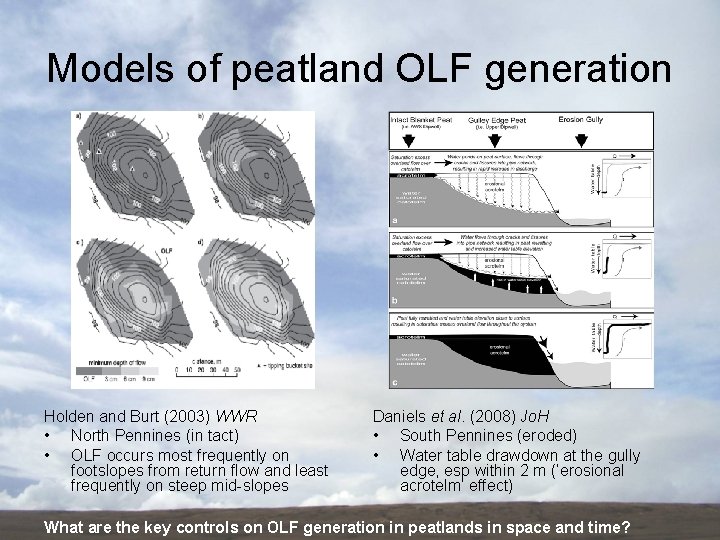
Models of peatland OLF generation Holden and Burt (2003) WWR • North Pennines (in tact) • OLF occurs most frequently on footslopes from return flow and least frequently on steep mid-slopes Daniels et al. (2008) Jo. H • South Pennines (eroded) • Water table drawdown at the gully edge, esp within 2 m (‘erosional acrotelm’ effect) What are the key controls on OLF generation in peatlands in space and time?
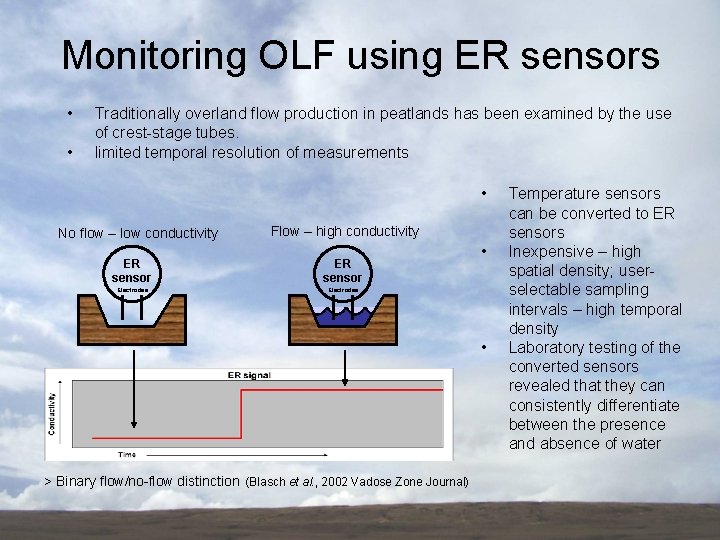
Monitoring OLF using ER sensors • • Traditionally overland flow production in peatlands has been examined by the use of crest-stage tubes. limited temporal resolution of measurements • No flow – low conductivity Flow – high conductivity ER sensor Electrodes • • > Binary flow/no-flow distinction (Blasch et al. , 2002 Vadose Zone Journal) Temperature sensors can be converted to ER sensors Inexpensive – high spatial density; userselectable sampling intervals – high temporal density Laboratory testing of the converted sensors revealed that they can consistently differentiate between the presence and absence of water
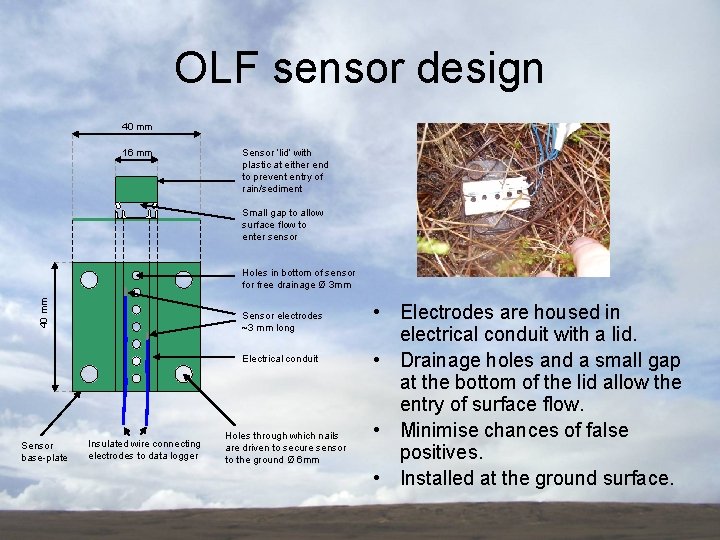
OLF sensor design 40 mm 16 mm Sensor ‘lid’ with plastic at either end to prevent entry of rain/sediment Small gap to allow surface flow to enter sensor 40 mm Holes in bottom of sensor free drainage Ø 3 mm Sensor electrodes ~3 mm long Electrical conduit Sensor base-plate Insulated wire connecting electrodes to data logger Holes through which nails are driven to secure sensor to the ground Ø 6 mm • Electrodes are housed in electrical conduit with a lid. • Drainage holes and a small gap at the bottom of the lid allow the entry of surface flow. • Minimise chances of false positives. • Installed at the ground surface.
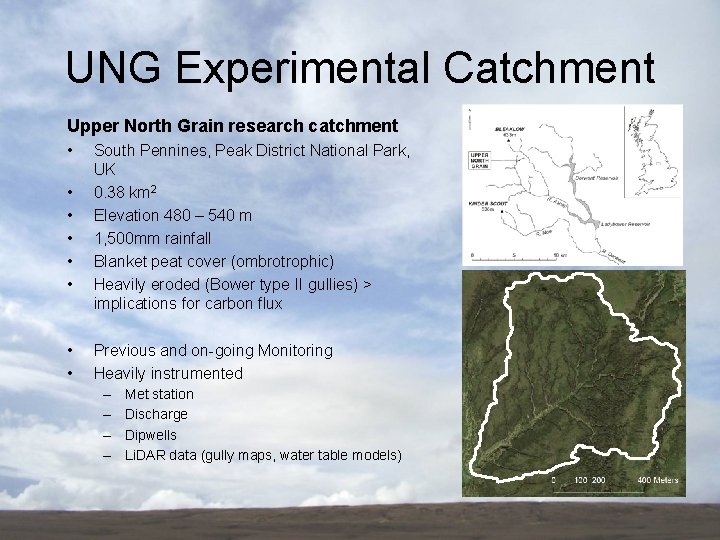
UNG Experimental Catchment Upper North Grain research catchment • • South Pennines, Peak District National Park, UK 0. 38 km 2 Elevation 480 – 540 m 1, 500 mm rainfall Blanket peat cover (ombrotrophic) Heavily eroded (Bower type II gullies) > implications for carbon flux Previous and on-going Monitoring Heavily instrumented – – Met station Discharge Dipwells Li. DAR data (gully maps, water table models)
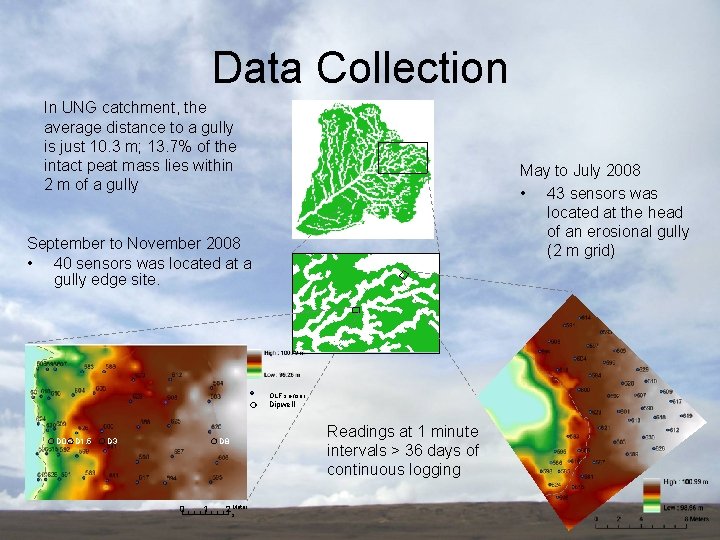
Data Collection In UNG catchment, the average distance to a gully is just 10. 3 m; 13. 7% of the intact peat mass lies within 2 m of a gully May to July 2008 • 43 sensors was located at the head of an erosional gully (2 m grid) September to November 2008 • 40 sensors was located at a gully edge site. OLF sensor Dipwell D 0. 5 D 1. 5 D 3 D 8 0 1 2 Meter s Readings at 1 minute intervals > 36 days of continuous logging
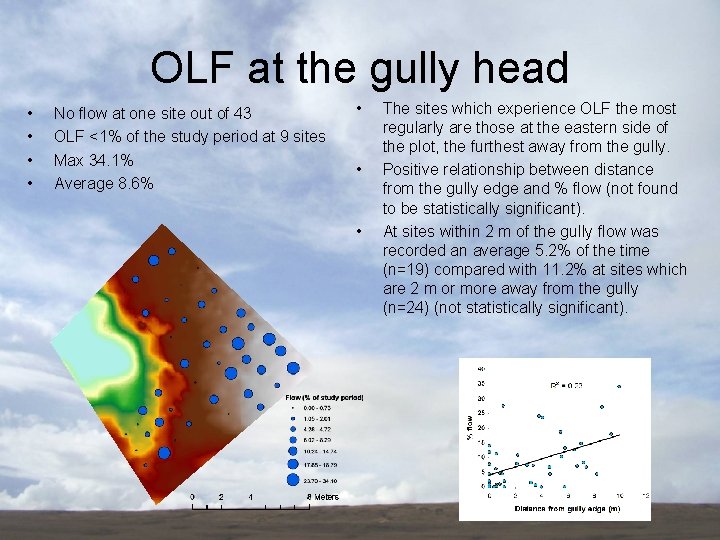
OLF at the gully head • • No flow at one site out of 43 OLF <1% of the study period at 9 sites Max 34. 1% Average 8. 6% • • • The sites which experience OLF the most regularly are those at the eastern side of the plot, the furthest away from the gully. Positive relationship between distance from the gully edge and % flow (not found to be statistically significant). At sites within 2 m of the gully flow was recorded an average 5. 2% of the time (n=19) compared with 11. 2% at sites which are 2 m or more away from the gully (n=24) (not statistically significant).
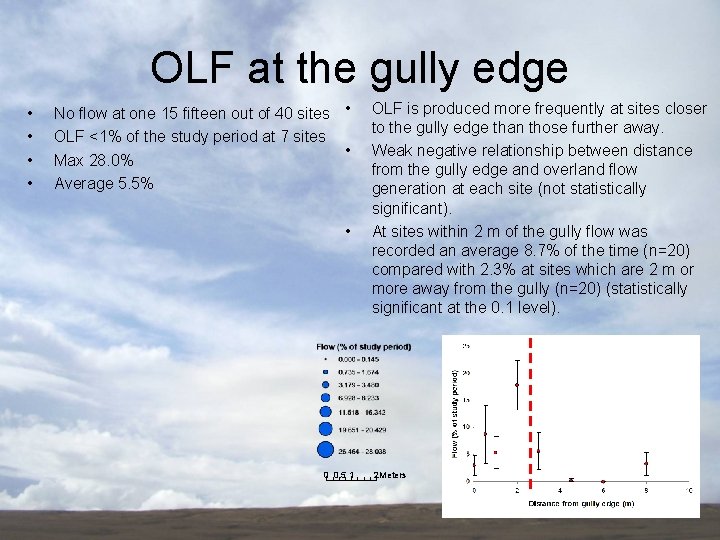
OLF at the gully edge • • No flow at one 15 fifteen out of 40 sites • OLF <1% of the study period at 7 sites • Max 28. 0% Average 5. 5% • 0 0. 5 1 OLF is produced more frequently at sites closer to the gully edge than those further away. Weak negative relationship between distance from the gully edge and overland flow generation at each site (not statistically significant). At sites within 2 m of the gully flow was recorded an average 8. 7% of the time (n=20) compared with 2. 3% at sites which are 2 m or more away from the gully (n=20) (statistically significant at the 0. 1 level). 2 Meters
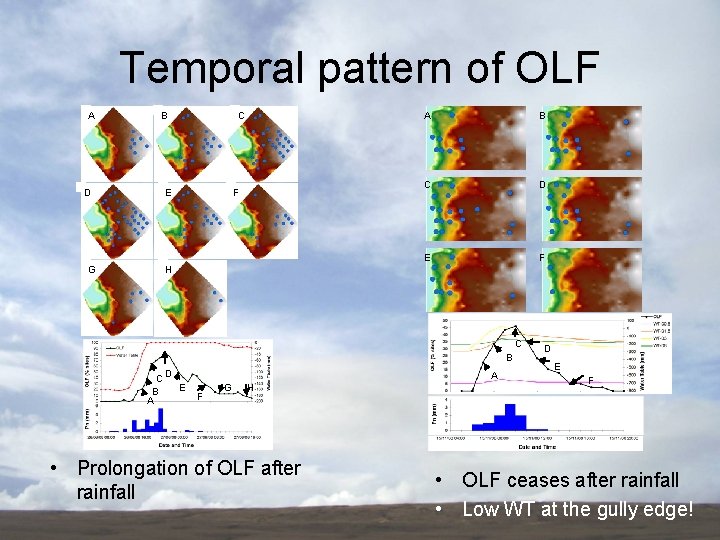
Temporal pattern of OLF A D G B C E F A B C D E F H C B CD E B A A F G H • Prolongation of OLF after rainfall D E F • OLF ceases after rainfall • Low WT at the gully edge!
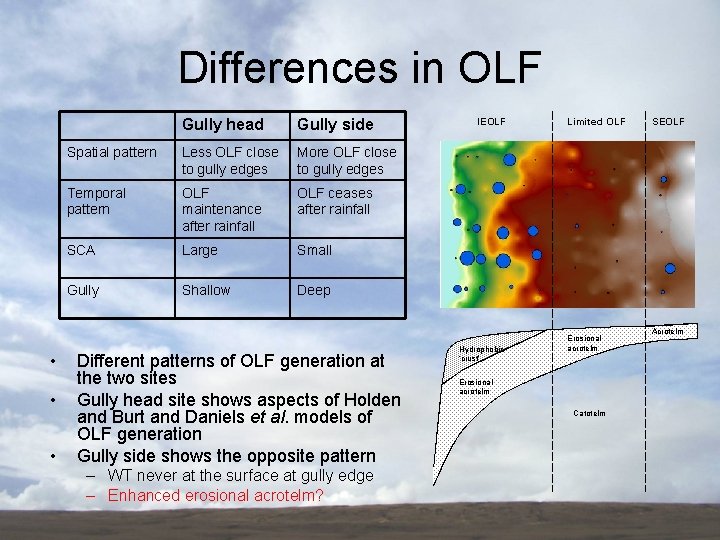
Differences in OLF • • • Gully head Gully side Spatial pattern Less OLF close to gully edges More OLF close to gully edges Temporal pattern OLF maintenance after rainfall OLF ceases after rainfall SCA Large Small Gully Shallow Deep Different patterns of OLF generation at the two sites Gully head site shows aspects of Holden and Burt and Daniels et al. models of OLF generation Gully side shows the opposite pattern – WT never at the surface at gully edge – Enhanced erosional acrotelm? IEOLF Hydrophobic ‘crust’ Limited OLF Erosional acrotelm Catotelm SEOLF Acrotelm
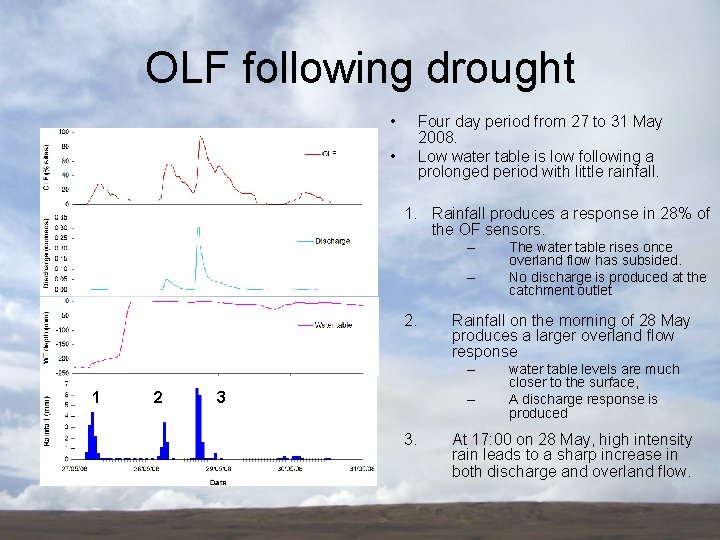
OLF following drought • Four day period from 27 to 31 May 2008. Low water table is low following a prolonged period with little rainfall. • 1. Rainfall produces a response in 28% of the OF sensors. – – 2. Rainfall on the morning of 28 May produces a larger overland flow response – 1 2 3 – 3. The water table rises once overland flow has subsided. No discharge is produced at the catchment outlet water table levels are much closer to the surface, A discharge response is produced At 17: 00 on 28 May, high intensity rain leads to a sharp increase in both discharge and overland flow.
Implications • Importance of water table variation in time and space • Climate change > summer conditions in the UK may become warmer and ‘stormier’ • More frequent water table drawdowns may lead to an increase in hydrophobic conditions in time and space. • Shift in the dominant OLF process from saturation excess to infiltration excess as expanses of the peat surface become hydrophobic. • This has implications for floodwater delivery – IEOLF can be produced rapidly following rainfall – IEOLF will result in a lower proportion of incident rainfall will enter the peat mass, resulting in higher runoff totals
Summary • • ER sensors are a viable alternative to crest stage tubes for monitoring OLF generation. OLF is widespread at both the gully head and the gully side • • Water table variation in time and space is key in controlling connectivity. Both saturation and infiltration excess overland flow are observed in this study. – IEOLF occurs at the dry gully edge site - enhanced erosional acrotelm effect – IEOLF is also observed at the ‘wetter’ gully head site following drought. • IEOLF may become more widespread under future climate change scenarios This has implications for the timing and magnitude of floodwater delivery • • The apparent importance of infiltration excess overland flow has hitherto not been widely acknowledged and as such this represents a major advancement in our current knowledge of the dominance of various runoff mechanisms in peatlands.
Thank you UPLAND ENVIRONMENTS RESEARCH UNIT