
Evidence for the Higgsboson Yukawa coupling to tau
Evidence for the Higgsboson Yukawa coupling to tau leptons with ATLAS detector Tomonobu Tomura (Kamioka Observatory, ICRR) 2015/2/18 Colloquium 1
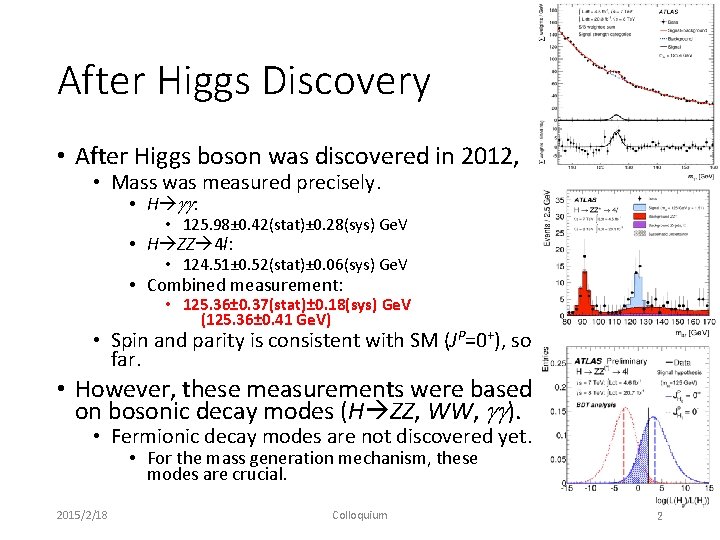
After Higgs Discovery • After Higgs boson was discovered in 2012, • Mass was measured precisely. • H gg: • 125. 98± 0. 42(stat)± 0. 28(sys) Ge. V • H ZZ 4 l: • 124. 51± 0. 52(stat)± 0. 06(sys) Ge. V • Combined measurement: • 125. 36± 0. 37(stat)± 0. 18(sys) Ge. V (125. 36± 0. 41 Ge. V) • Spin and parity is consistent with SM (JP=0+), so far. • However, these measurements were based on bosonic decay modes (H ZZ, WW, gg). • Fermionic decay modes are not discovered yet. • For the mass generation mechanism, these modes are crucial. 2015/2/18 Colloquium 2
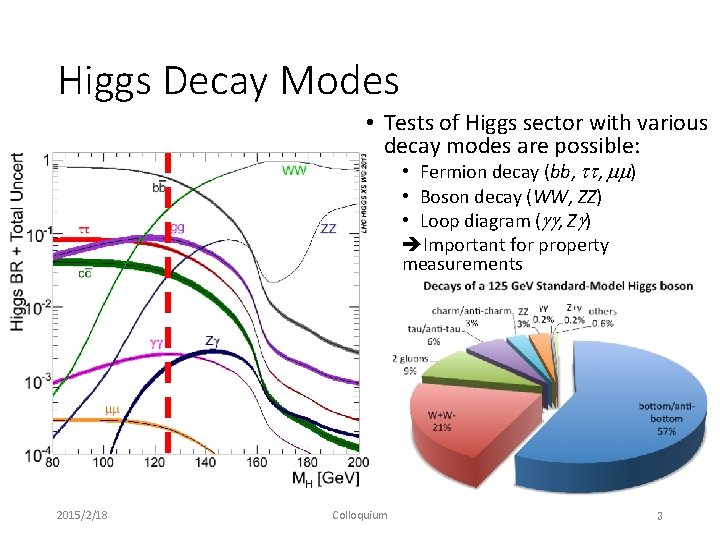
Higgs Decay Modes • Tests of Higgs sector with various decay modes are possible: • Fermion decay (bb, tt, mm) • Boson decay (WW, ZZ) • Loop diagram (gg, Zg) Important for property measurements 2015/2/18 Colloquium 3
Higgs Production 2015/2/18 Colloquium 4
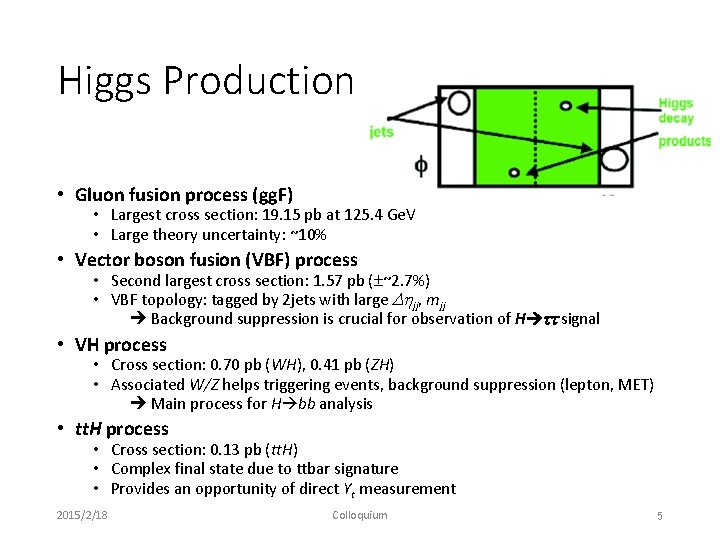
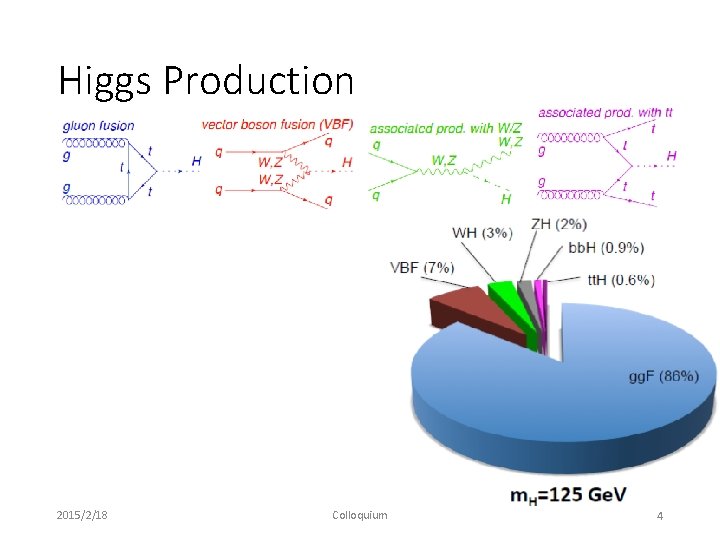
Higgs Production • Gluon fusion process (gg. F) • Largest cross section: 19. 15 pb at 125. 4 Ge. V • Large theory uncertainty: ~10% • Vector boson fusion (VBF) process • Second largest cross section: 1. 57 pb ( ~2. 7%) • VBF topology: tagged by 2 jets with large Dhjj, mjj Background suppression is crucial for observation of H tt signal • VH process • Cross section: 0. 70 pb (WH), 0. 41 pb (ZH) • Associated W/Z helps triggering events, background suppression (lepton, MET) Main process for H bb analysis • tt. H process • Cross section: 0. 13 pb (tt. H) • Complex final state due to ttbar signature • Provides an opportunity of direct Yt measurement 2015/2/18 Colloquium 5
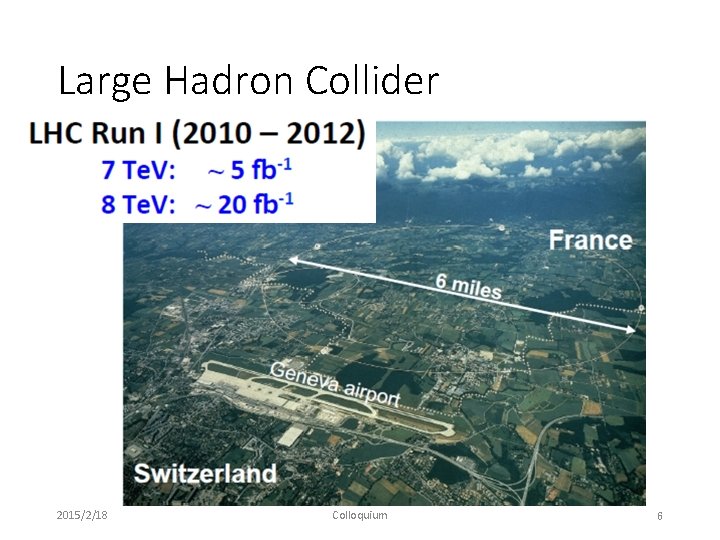
Large Hadron Collider 2015/2/18 Colloquium 6
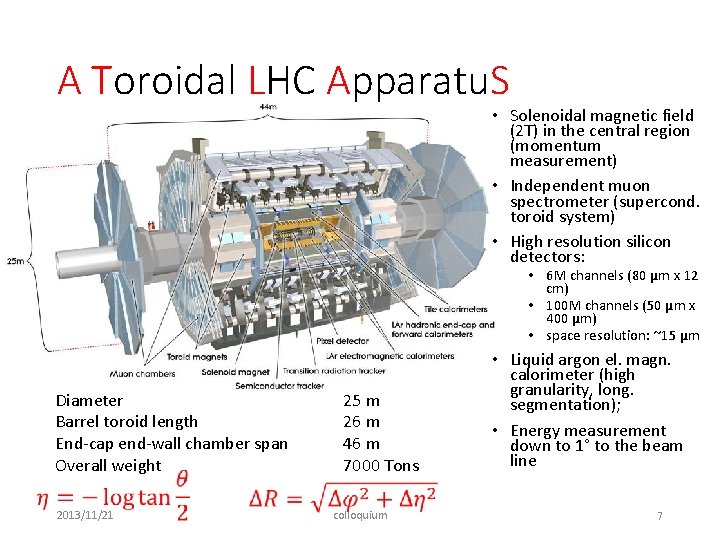
A Toroidal LHC Apparatu. S • Solenoidal magnetic field (2 T) in the central region (momentum measurement) • Independent muon spectrometer (supercond. toroid system) • High resolution silicon detectors: • 6 M channels (80 μm x 12 cm) • 100 M channels (50 μm x 400 μm) • space resolution: ~15 μm Diameter Barrel toroid length End-cap end-wall chamber span Overall weight 2013/11/21 25 m 26 m 46 m 7000 Tons colloquium • Liquid argon el. magn. calorimeter (high granularity, long. segmentation); • Energy measurement down to 1° to the beam line 7
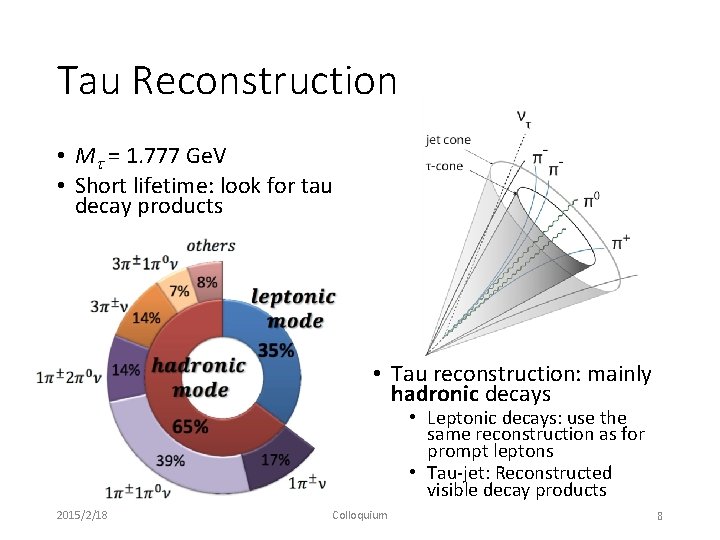
Tau Reconstruction • Mt = 1. 777 Ge. V • Short lifetime: look for tau decay products • Tau reconstruction: mainly hadronic decays • Leptonic decays: use the same reconstruction as for prompt leptons • Tau-jet: Reconstructed visible decay products 2015/2/18 Colloquium 8
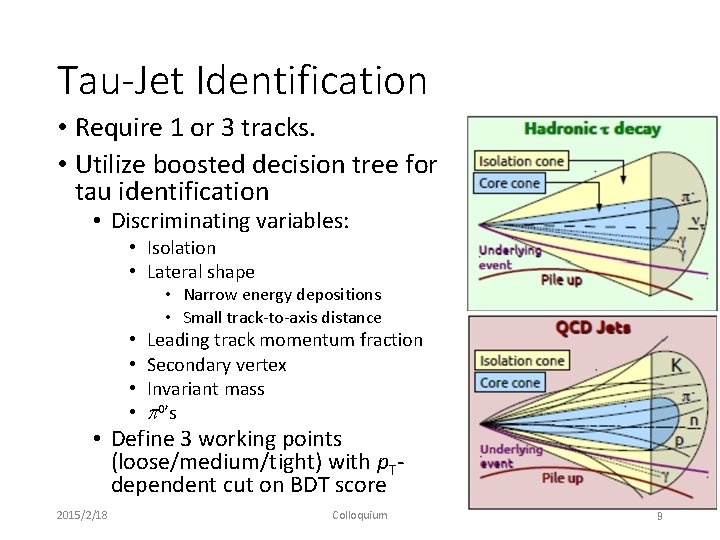
Tau-Jet Identification • Require 1 or 3 tracks. • Utilize boosted decision tree for tau identification • Discriminating variables: • Isolation • Lateral shape • Narrow energy depositions • Small track-to-axis distance • • Leading track momentum fraction Secondary vertex Invariant mass p 0’s • Define 3 working points (loose/medium/tight) with p. Tdependent cut on BDT score 2015/2/18 Colloquium 9
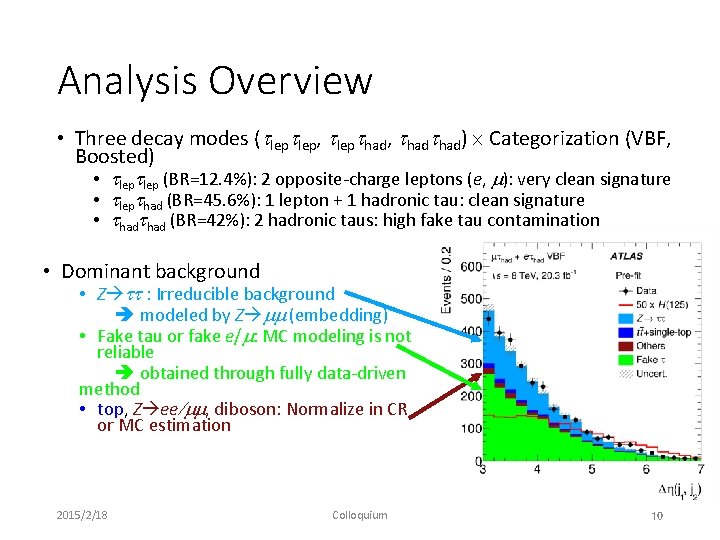
Analysis Overview • Three decay modes (tlep, tlepthad, thad) Categorization (VBF, Boosted) • tlep (BR=12. 4%): 2 opposite-charge leptons (e, m): very clean signature • tlepthad (BR=45. 6%): 1 lepton + 1 hadronic tau: clean signature • thad (BR=42%): 2 hadronic taus: high fake tau contamination • Dominant background • Z tt : Irreducible background modeled by Z mm (embedding) • Fake tau or fake e/m: MC modeling is not reliable obtained through fully data-driven method • top, Z ee/mm, diboson: Normalize in CR or MC estimation 2015/2/18 Colloquium 10
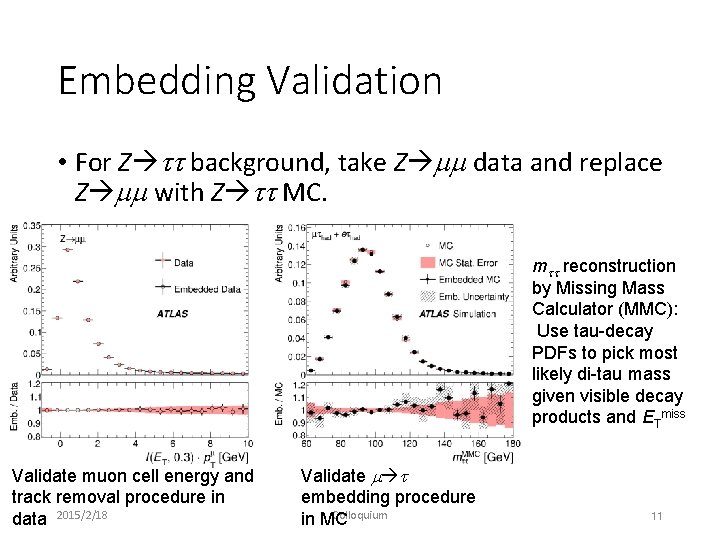
Embedding Validation • For Z tt background, take Z mm data and replace Z mm with Z tt MC. mtt reconstruction by Missing Mass Calculator (MMC): Use tau-decay PDFs to pick most likely di-tau mass given visible decay products and ETmiss Validate muon cell energy and track removal procedure in data 2015/2/18 Validate m t embedding procedure Colloquium in MC 11
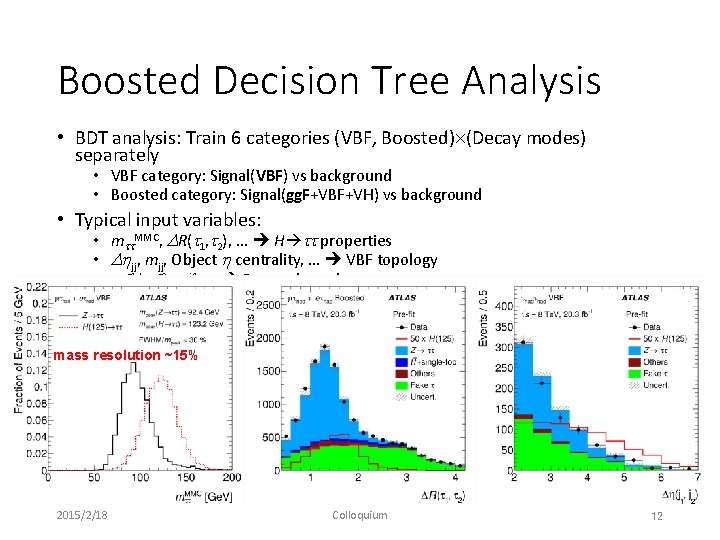
Boosted Decision Tree Analysis • BDT analysis: Train 6 categories (VBF, Boosted) (Decay modes) separately • VBF category: Signal(VBF) vs background • Boosted category: Signal(gg. F+VBF+VH) vs background • Typical input variables: • mtt. MMC, DR(t 1, t 2), . . . H tt properties • Dhjj, mjj, Object h centrality, … VBF topology • p. Tt 1/p. Tt 2, p. Tj 1, … Boosted topology mass resolution ~15% 2015/2/18 Colloquium 12
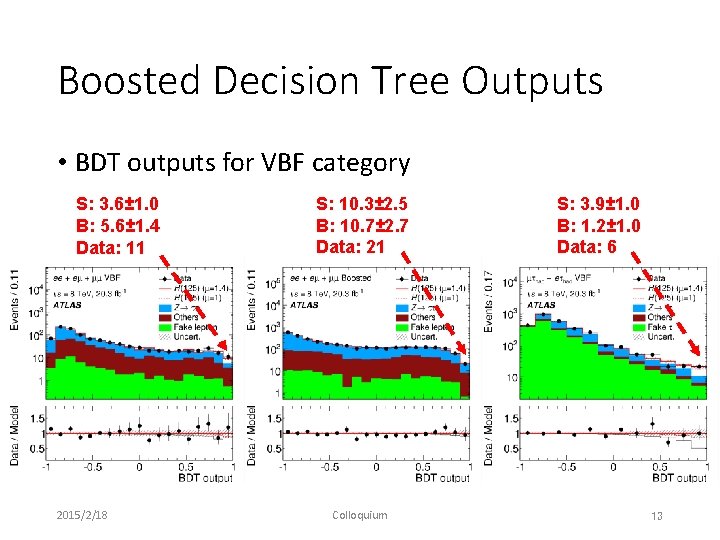
Boosted Decision Tree Outputs • BDT outputs for VBF category S: 3. 6± 1. 0 B: 5. 6± 1. 4 Data: 11 2015/2/18 S: 10. 3± 2. 5 B: 10. 7± 2. 7 Data: 21 Colloquium S: 3. 9± 1. 0 B: 1. 2± 1. 0 Data: 6 13
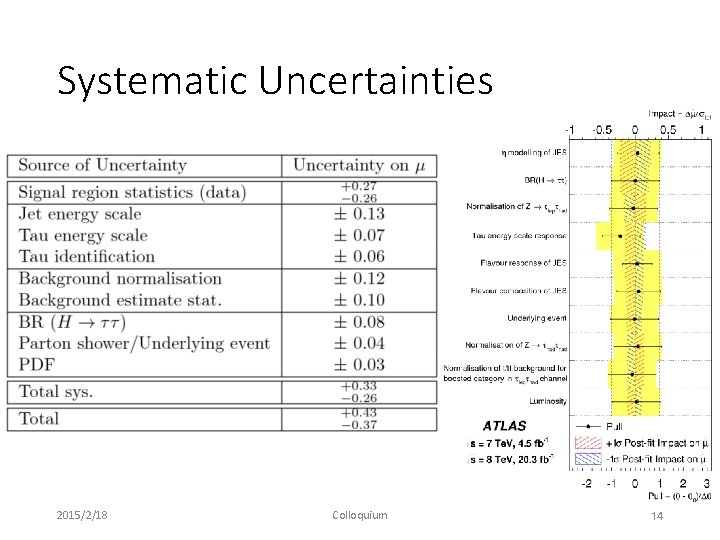
Systematic Uncertainties 2015/2/18 Colloquium 14
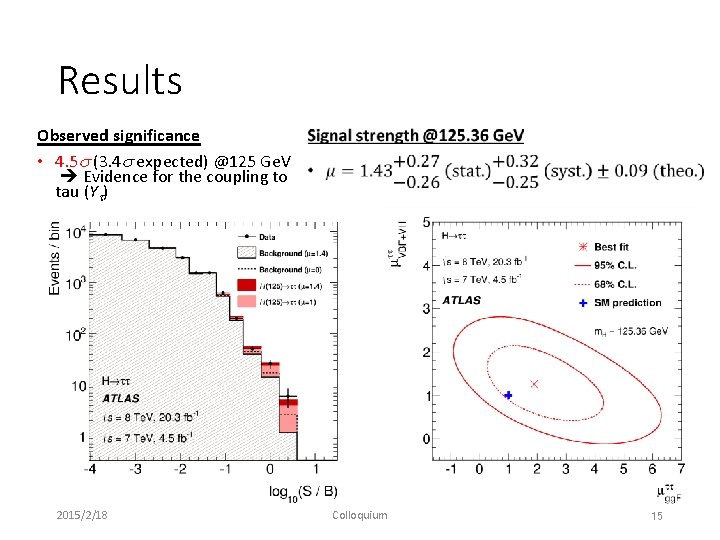
Results Observed significance • 4. 5 s (3. 4 s expected) @125 Ge. V Evidence for the coupling to tau (Yt) 2015/2/18 • Colloquium 15
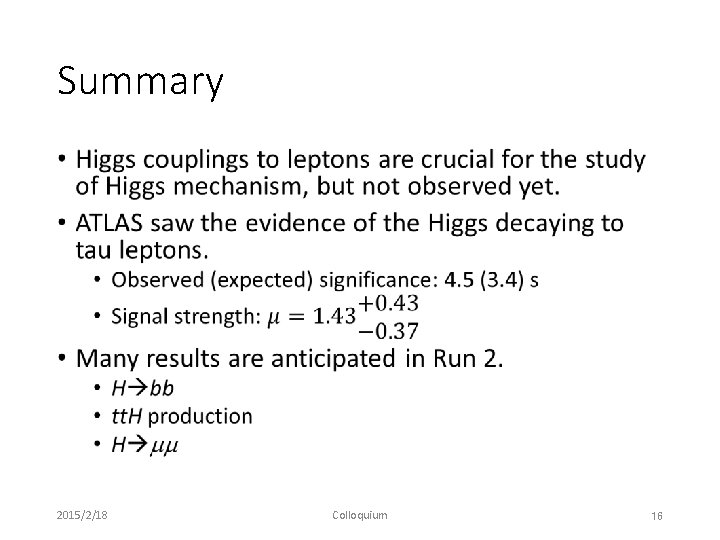
Summary • 2015/2/18 Colloquium 16

BACKUP 2015/2/18 Colloquium 17
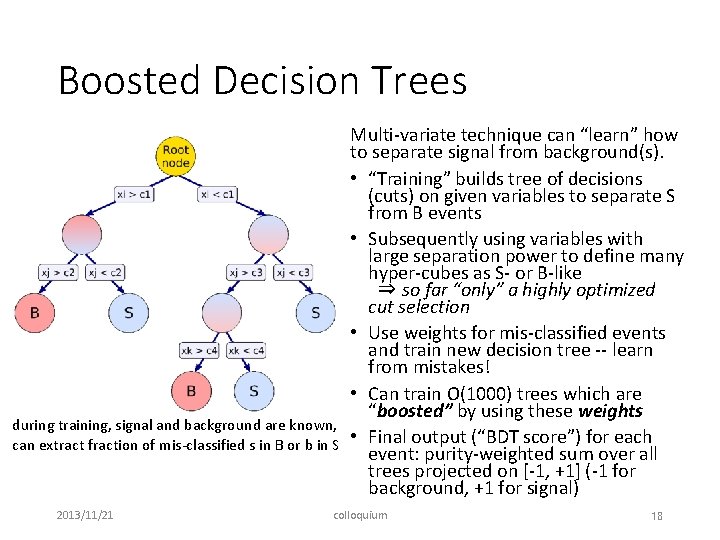
Boosted Decision Trees during training, signal and background are known, can extract fraction of mis-classified s in B or b in S 2013/11/21 Multi-variate technique can “learn” how to separate signal from background(s). • “Training” builds tree of decisions (cuts) on given variables to separate S from B events • Subsequently using variables with large separation power to define many hyper-cubes as S- or B-like ⇒ so far “only” a highly optimized cut selection • Use weights for mis-classified events and train new decision tree -- learn from mistakes! • Can train O(1000) trees which are “boosted” by using these weights • Final output (“BDT score”) for each event: purity-weighted sum over all trees projected on [-1, +1] (-1 for background, +1 for signal) colloquium 18
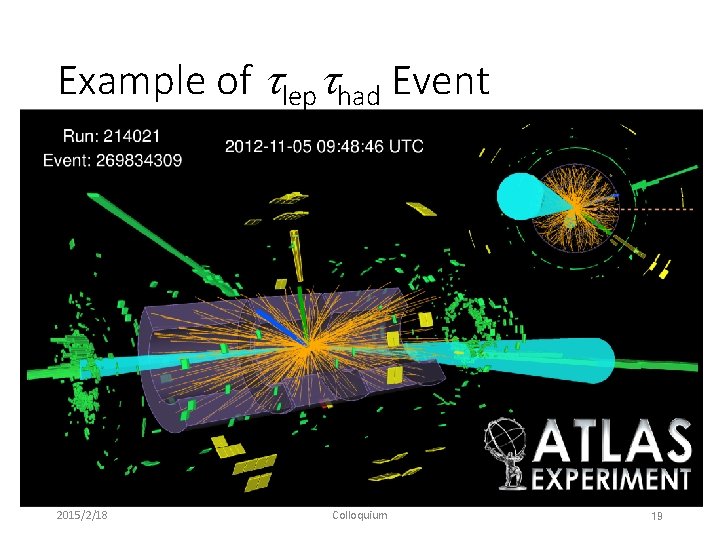
Example of tlepthad Event 2015/2/18 Colloquium 19
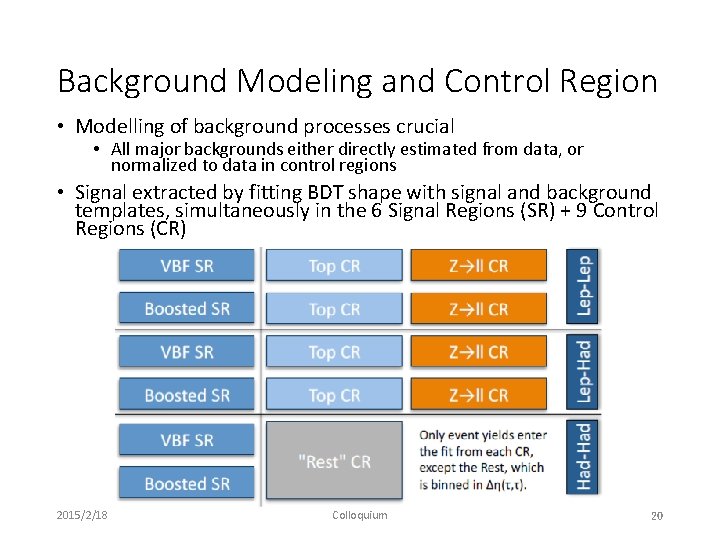
Background Modeling and Control Region • Modelling of background processes crucial • All major backgrounds either directly estimated from data, or normalized to data in control regions • Signal extracted by fitting BDT shape with signal and background templates, simultaneously in the 6 Signal Regions (SR) + 9 Control Regions (CR) 2015/2/18 Colloquium 20
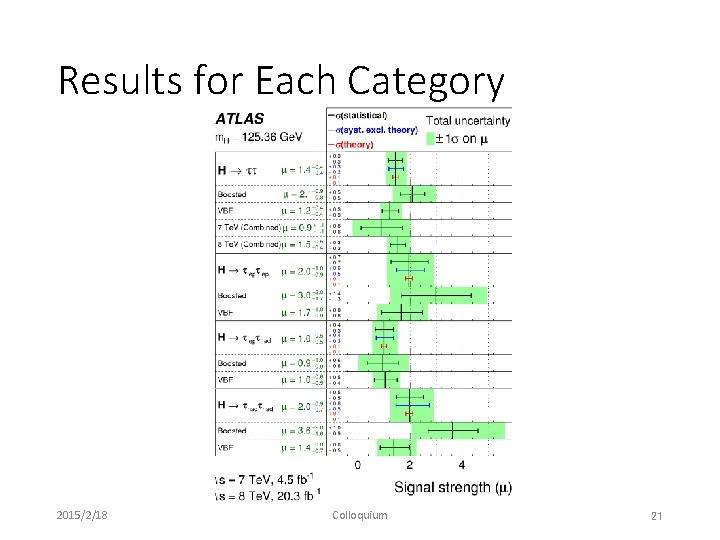
Results for Each Category 2015/2/18 Colloquium 21

Drell-Yan Background Suppression 2015/2/18 Colloquium 22
- Slides: 22