
Evidence for Program Learning Outcomes A rhetorical approach



- Slides: 24
Evidence for Program Learning Outcomes A rhetorical approach to assessing student learning
Learning Outcomes for Today Participants will be able to � Identify evidence appropriate to at least one of their learning goals � List at least two ways evidence could be obtained for a learning goal And will have � begun to plan their assessment activities
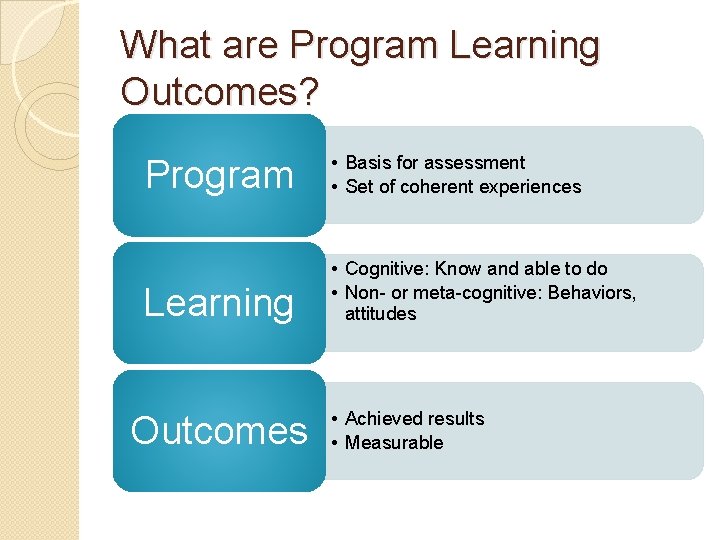
What are Program Learning Outcomes? Program • Basis for assessment • Set of coherent experiences Learning • Cognitive: Know and able to do • Non- or meta-cognitive: Behaviors, attitudes Outcomes • Achieved results • Measurable
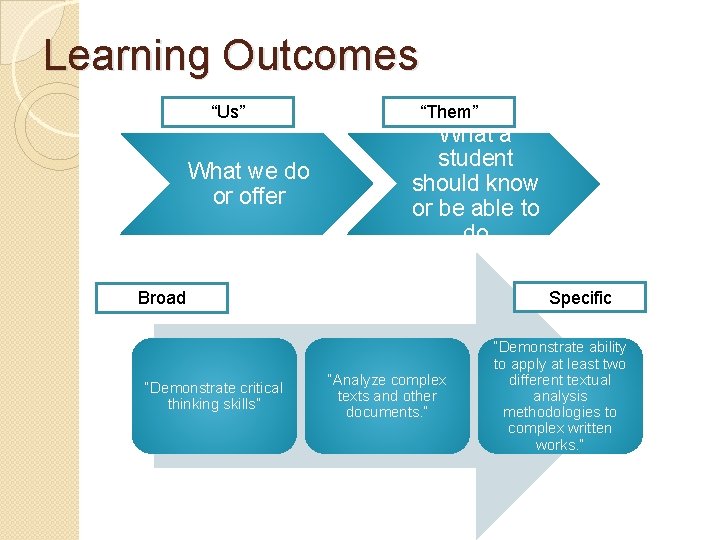
Learning Outcomes “Us” What we do or offer “Them” What a student should know or be able to do Specific Broad “Demonstrate critical thinking skills” “Analyze complex texts and other documents. ” “Demonstrate ability to apply at least two different textual analysis methodologies to complex written works. ”
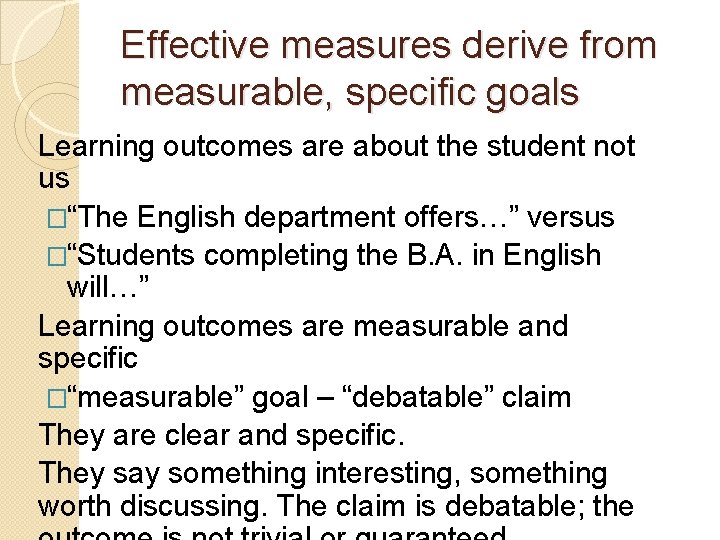
Effective measures derive from measurable, specific goals Learning outcomes are about the student not us �“The English department offers…” versus �“Students completing the B. A. in English will…” Learning outcomes are measurable and specific �“measurable” goal – “debatable” claim They are clear and specific. They say something interesting, something worth discussing. The claim is debatable; the
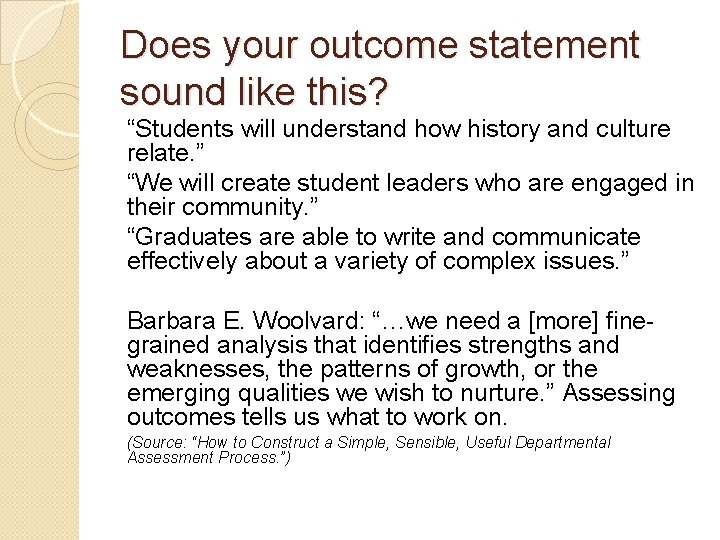
Does your outcome statement sound like this? “Students will understand how history and culture relate. ” “We will create student leaders who are engaged in their community. ” “Graduates are able to write and communicate effectively about a variety of complex issues. ” Barbara E. Woolvard: “…we need a [more] finegrained analysis that identifies strengths and weaknesses, the patterns of growth, or the emerging qualities we wish to nurture. ” Assessing outcomes tells us what to work on. (Source: “How to Construct a Simple, Sensible, Useful Departmental Assessment Process. ”)
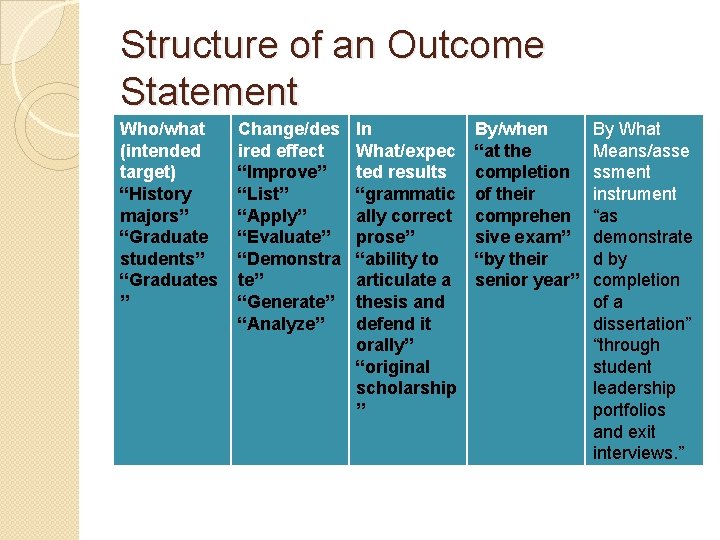
Structure of an Outcome Statement Who/what (intended target) “History majors” “Graduate students” “Graduates ” Change/des ired effect “Improve” “List” “Apply” “Evaluate” “Demonstra te” “Generate” “Analyze” In What/expec ted results “grammatic ally correct prose” “ability to articulate a thesis and defend it orally” “original scholarship ” By/when “at the completion of their comprehen sive exam” “by their senior year” By What Means/asse ssment instrument “as demonstrate d by completion of a dissertation” “through student leadership portfolios and exit interviews. ”
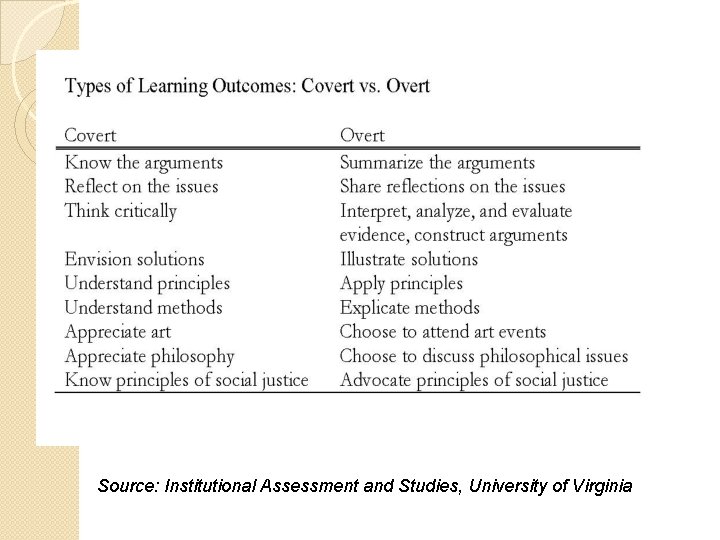
Source: Institutional Assessment and Studies, University of Virginia
EXERCISE: Generating specific, measurable outcomes statements “Students will understand how history and culture relate. ” “We will create student leaders who are engaged in their community. ” “Graduates are able to write and communicate effectively about a variety of complex issues. ”
Types of Evidence for Program Learning Outcomes � Direct ◦ ◦ ◦ (factual, direct observation) Papers, theses, dissertations Portfolios Exam grades and other course-level assessment Participation Artistic performances � Indirect ◦ ◦ ◦ (reported or derived information) Surveys and focus groups Placement and other post-graduation outcomes Course evaluations Completion rates Licensure and related external exams
Types of Evidence for Program Learning Outcomes Summative assessments – dissertations & theses, capstone projects, licensure exams Discrete assessments – embedded within program; accumulate along path towards degree Quantitative assessments – surveys, multiple choice exams, license exams Qualitative assessments – focus groups, portfolios, performances
Connecting the two…linking outcomes with evidence Multiple, mixed measures �Direct and indirect �Quantitative and qualitative �Summative and discrete Multiple opportunities to assess �When is learning best assessed? �Milestones and capstones
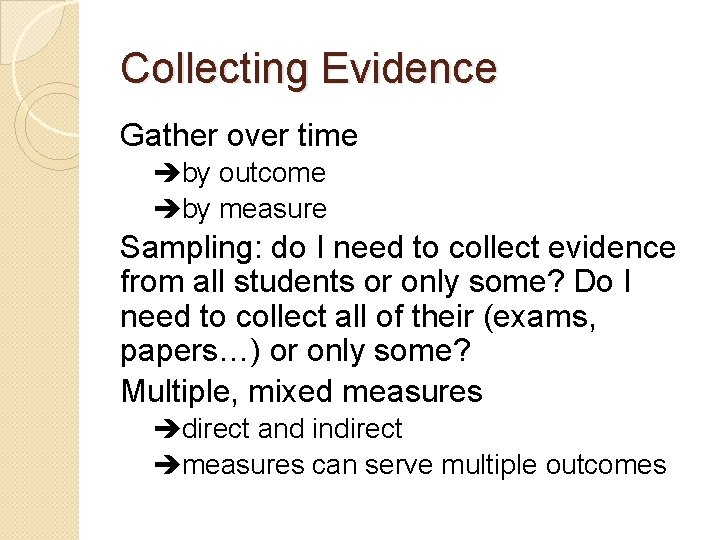
Collecting Evidence Gather over time by outcome by measure Sampling: do I need to collect evidence from all students or only some? Do I need to collect all of their (exams, papers…) or only some? Multiple, mixed measures direct and indirect measures can serve multiple outcomes
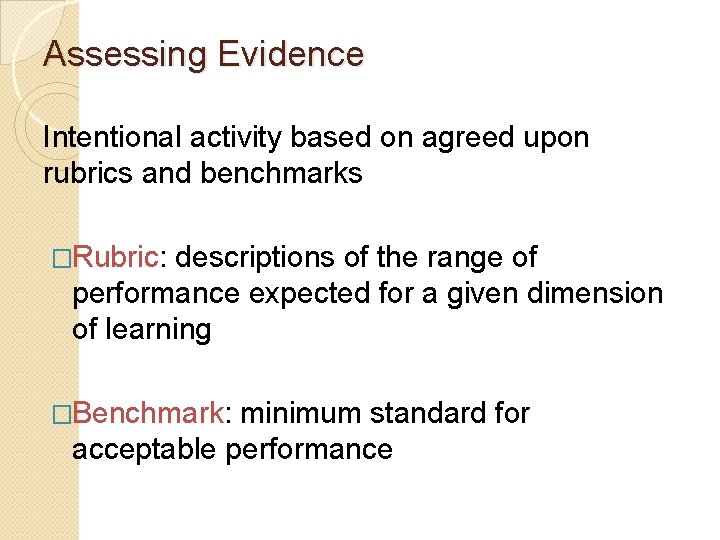
Assessing Evidence Intentional activity based on agreed upon rubrics and benchmarks �Rubric: descriptions of the range of performance expected for a given dimension of learning �Benchmark: minimum standard for acceptable performance
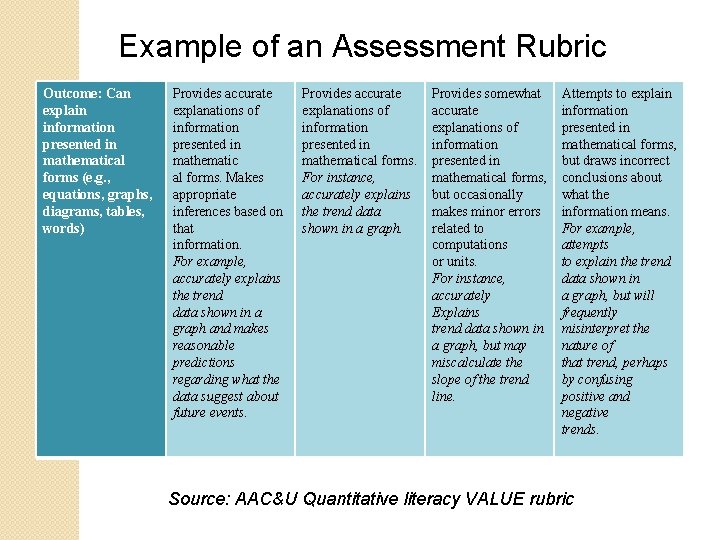
Example of an Assessment Rubric Outcome: Can explain information presented in mathematical forms (e. g. , equations, graphs, diagrams, tables, words) Provides accurate explanations of information presented in mathematic al forms. Makes appropriate inferences based on that information. For example, accurately explains the trend data shown in a graph and makes reasonable predictions regarding what the data suggest about future events. Provides accurate explanations of information presented in mathematical forms. For instance, accurately explains the trend data shown in a graph. Provides somewhat accurate explanations of information presented in mathematical forms, but occasionally makes minor errors related to computations or units. For instance, accurately Explains trend data shown in a graph, but may miscalculate the slope of the trend line. Attempts to explain information presented in mathematical forms, but draws incorrect conclusions about what the information means. For example, attempts to explain the trend data shown in a graph, but will frequently misinterpret the nature of that trend, perhaps by confusing positive and negative trends. Source: AAC&U Quantitative literacy VALUE rubric
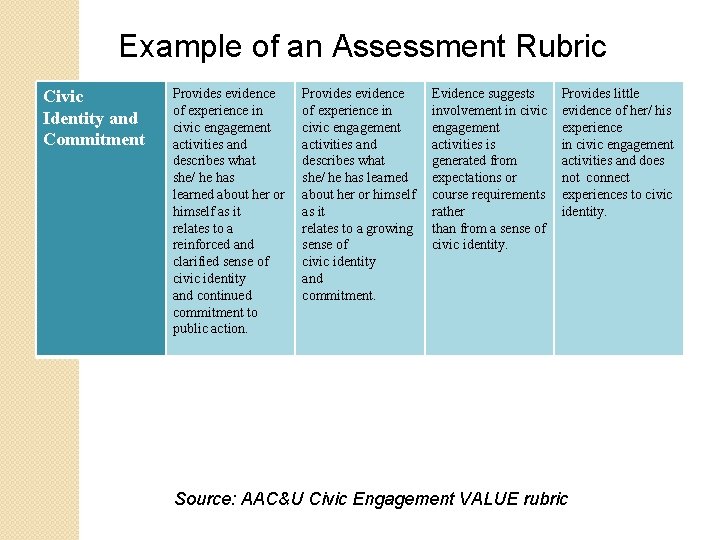
Example of an Assessment Rubric Civic Identity and Commitment Provides evidence of experience in civic engagement activities and describes what she/ he has learned about her or himself as it relates to a reinforced and clarified sense of civic identity and continued commitment to public action. Provides evidence of experience in civic engagement activities and describes what she/ he has learned about her or himself as it relates to a growing sense of civic identity and commitment. Evidence suggests involvement in civic engagement activities is generated from expectations or course requirements rather than from a sense of civic identity. Provides little evidence of her/ his experience in civic engagement activities and does not connect experiences to civic identity. Source: AAC&U Civic Engagement VALUE rubric
Examples of Benchmarks “Graduates pass the state licensing exam with a minimum score of 90%. ” “The majority of theses assessed against [this] rubric will receive a score of 4 or 5 (out of 5). ” “Assessments of civic engagement will exceed those of peer institutions as measured by NSSE. ”
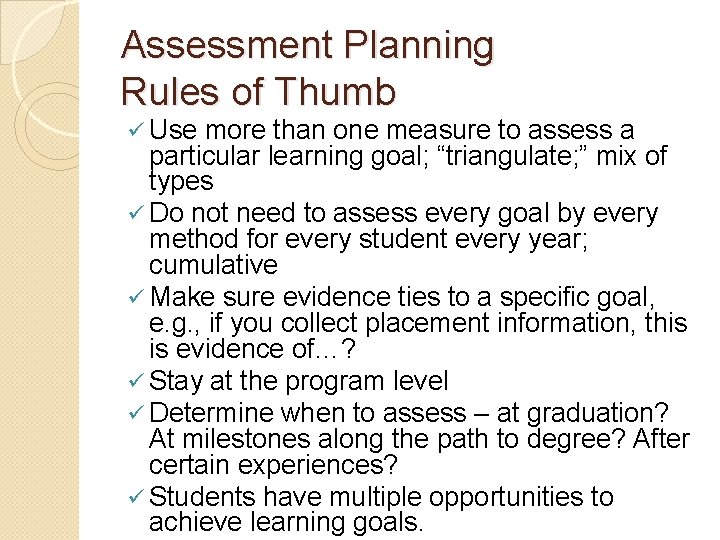
Assessment Planning Rules of Thumb ü Use more than one measure to assess a particular learning goal; “triangulate; ” mix of types ü Do not need to assess every goal by every method for every student every year; cumulative ü Make sure evidence ties to a specific goal, e. g. , if you collect placement information, this is evidence of…? ü Stay at the program level ü Determine when to assess – at graduation? At milestones along the path to degree? After certain experiences? ü Students have multiple opportunities to achieve learning goals.
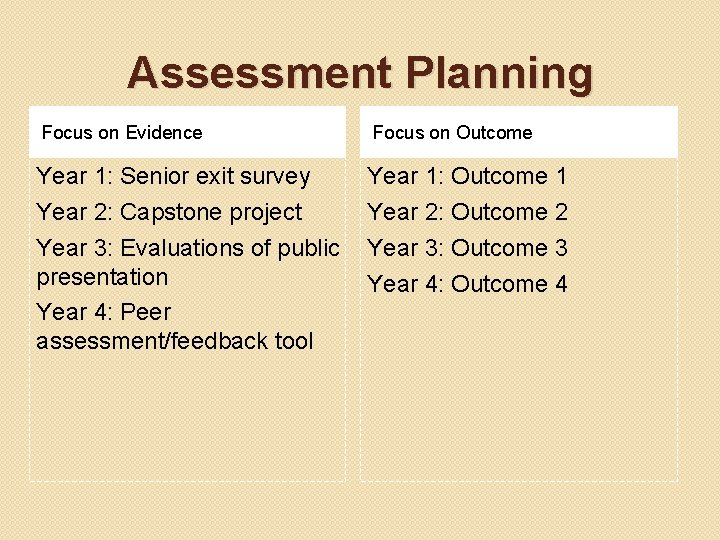
Assessment Planning Focus on Evidence Focus on Outcome Year 1: Senior exit survey Year 2: Capstone project Year 3: Evaluations of public presentation Year 4: Peer assessment/feedback tool Year 1: Outcome 1 Year 2: Outcome 2 Year 3: Outcome 3 Year 4: Outcome 4
Outcome Knowledge acquisition & retention Knowledge creation Organization and communication of knowledge Application and evaluation of knowledge Behaviors and attitudes towards/about learning outcomes Type(s) of evidence that would best demonstrate achievement � Exercise: Aligning evidence with outcomes
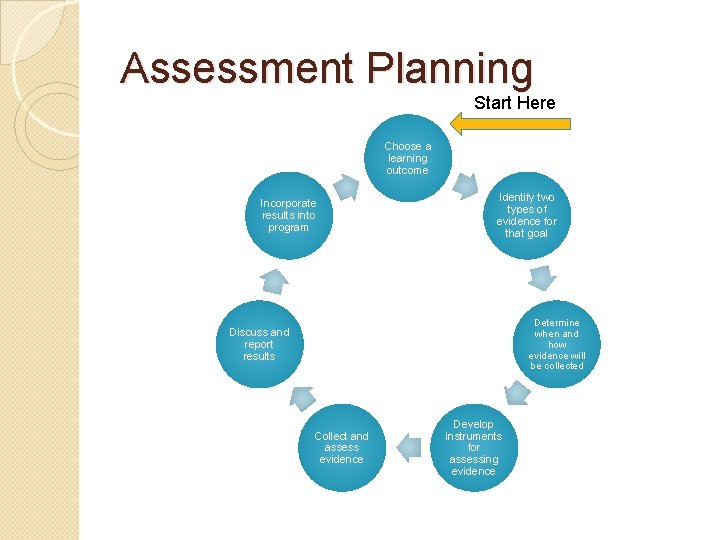
Assessment Planning Start Here Choose a learning outcome Incorporate results into program Identify two types of evidence for that goal Determine when and how evidence will be collected Discuss and report results Collect and assess evidence Develop instruments for assessing evidence
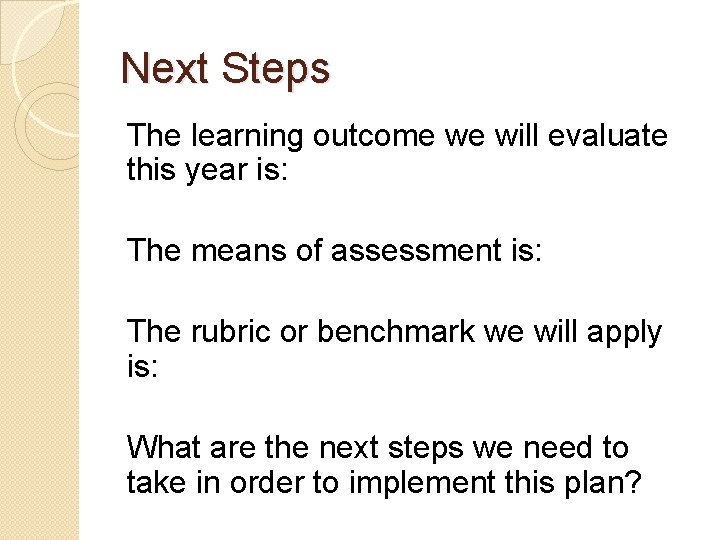
Next Steps The learning outcome we will evaluate this year is: The means of assessment is: The rubric or benchmark we will apply is: What are the next steps we need to take in order to implement this plan?
Samples Exit survey: file: ///Users/lpohl/Dropbox/BU%20 Docu ments/interviews-surveys. htm Survey planning document: file: ///Users/lpohl/Dropbox/BU%20 Docu ments/Survey%20 Planning%20 Docume nt_DRAFT_March%202012. htm
Using Rubrics in Assessment Developing a rubric � Clearly define the outcome and the evidence. � Brainstorm a list of what you expect to see in the student work that demonstrates the particular learning outcome(s) you are assessing. � Keep the list manageable (3 -8 items) and focus on the most important abilities, knowledge, or attitudes expected. � Edit the list so that each component is specific and concrete (for instance, what do you mean by coherence? ), use action verbs when possible, and descriptive, meaningful adjectives (e. g. , not "adequate" or "appropriate" but "correctly" or "carefully"). � Establish clear and detailed standards for performance for each component. Avoid relying on comparative language when distinguishing among performance levels. For instance, do not define the highest level as "thorough" and the medium level as "less thorough". Find descriptors that are unique to each level. � Develop a scoring scale. � Test the rubric with more than one rater by scoring a small sample of student work. Are your expectations too high or too low? Are some items difficult to rate and in need of revision? Using a Rubric � Evaluators should meet together for a training/norming session. � A sample of student work should be examined and scored � More than one faculty member should score the student work. Check to see if raters are applying the standards consistently. � If two faculty members disagree significantly (. e. g. more than 1 point on a 4 point scale) a third person should score the work. � Iffrom: frequent disagreements arise about a particular Adapted http: //web. virginia. edu/iaas/assess/tools/rubrics. shtm item, the item may need to be refined or removed.