
Evidence for criteria 1 Teaching and Learning 1
- Slides: 19
Evidence for criteria 1 Teaching and Learning
1. 1 Understanding amongst pupils of the purpose • The history subject lead carries out termly pupil voices from all year groups termly with a different focus each term. • Below are some extracts from pupil voice from the nursery to Year 6. • These are then used to influence the structure of history taught in each group.
1. 1 Pupil Voice • ‘I have enjoyed going on a school trip and learning about the Fire of Nantwich. ’ • ‘It is important because you can understand more things that happened and what happens. ’ • ‘Its important because if we didn’t we wouldn’t know anything that used to happen and we wouldn’t know anything about where we live. ’
1. 1 Pupil Voice • ‘It is really important because we find out about what happened in different parts of the world too. ’ • ‘So you don’t forget people and things its important. ’ • ‘Because you can understand more things that happened and what happens. ’
1. 2 How teaching impacts upon achievement • Monitoring by the subject lead includes lesson observations, pupil conferencing, regular book scrutiny, regular planning scrutiny and learning environment walk rounds. • The history subject lead produces an annual action plan which is then discussed with the Deputy during an annual subject meeting.
1. 2 How teaching impacts upon achievement • Observations are used to monitor the children’s progress within lessons. This is combined with subject audits and book scrutinies to help track subject coverage throughout the school and skills that are taught. • Our curriculum tracking allows for the children to make expected or better progress and this is supported by the schools most recent ofsted inspection.
1. 2 How teaching impacts upon achievement • Observations are used to monitor the children’s progress within lessons. This is combined with subject audits and book scrutinies to help track subject coverage throughout the school and skills that are taught. • Our curriculum tracking allows for the children to make expected or better progress and this is supported by the schools most recent ofsted inspection.
1. 2 How teaching impacts upon achievement • The most recent ofsted inspection was July 2018. • ‘You work in a highly effective manner with your deputy head teacher to develop leadership at all levels and to provide the very best possible education for the pupils in your care. Together, you have devised a curriculum which inspires and excites pupils. ’ • ‘You also display information outside each classroom highlighting the strengths of different subjects in the curriculum and the areas where leaders are planning for improvements. ’ • ‘You ensure that all pupils enjoy a rich, exciting and engaging curriculum. You focus the teaching of all subjects on knowledge and understanding of the world, enquiry, emotional intelligence and enterprise. This curriculum design enables pupils to make strong connections with local and national issues. You expertly weave key skills such as resilience and respect through your curriculum. ’
1. 2 How teaching impacts upon achievement • ‘ Pupils are enthusiastic about the broad range of opportunities provided for them in their curriculum. Evidence provided during the inspection shows that the high standard of performance in reading, writing and mathematics is consistent across the curriculum in subjects such as science, geography and history. ’
1. 3 Teaching, learning, achievement and progression. • The children progress through the year groups with different skills targeted and developed throughout the key stages. • For example, in Early Years the children look at changes within their own lives and ask and answer questions to develop the language. • Year one children focus on the differences between the ways of life at different times and then consider the changes within living memory of their family or adults around them. • From there the Year two children will look into more detail at why things happen and what happened as direct results of events. They begin to look more at the past beyond their families living memory.
1. 3 Assessment in the Early Years • Assessment in Early Years is presented on Tapestry, an application that Teachers, Teaching assistants and parents can access at home and at school to record things that the children have achieved with relation to the early learning goals. The primary goals related to history are knowledge and understanding of the world: Peoples and communities and The World.
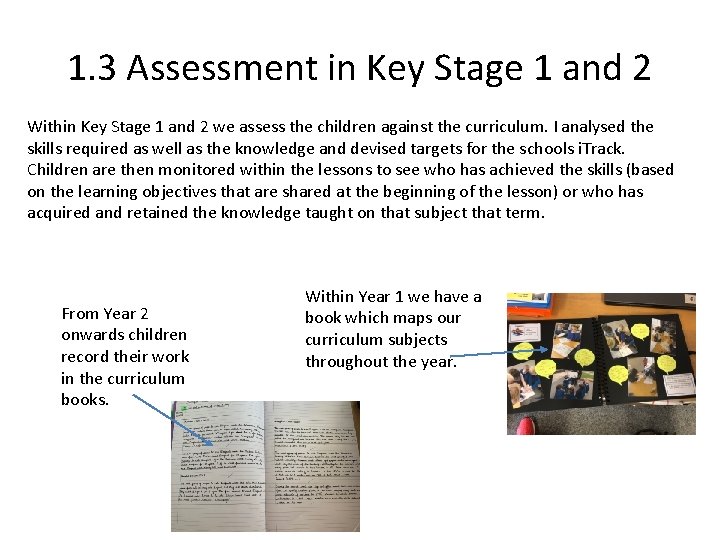
1. 3 Assessment in Key Stage 1 and 2 Within Key Stage 1 and 2 we assess the children against the curriculum. I analysed the skills required as well as the knowledge and devised targets for the schools i. Track. Children are then monitored within the lessons to see who has achieved the skills (based on the learning objectives that are shared at the beginning of the lesson) or who has acquired and retained the knowledge taught on that subject that term. From Year 2 onwards children record their work in the curriculum books. Within Year 1 we have a book which maps our curriculum subjects throughout the year.
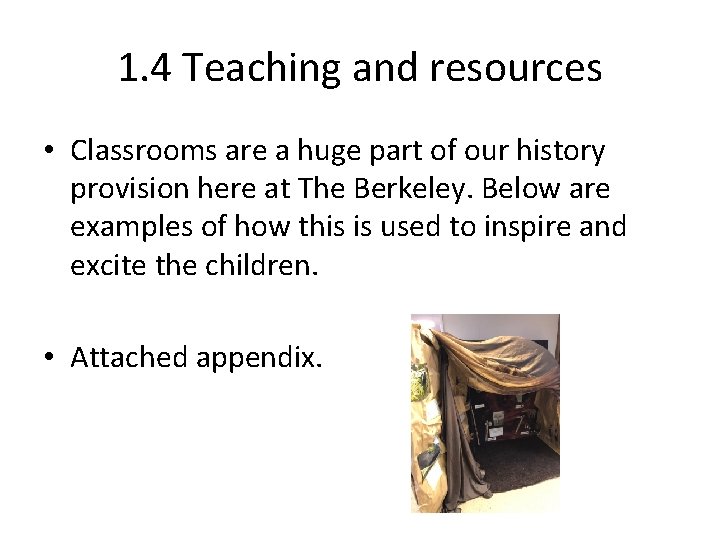
1. 4 Teaching and resources • Classrooms are a huge part of our history provision here at The Berkeley. Below are examples of how this is used to inspire and excite the children. • Attached appendix.
1. 4 Examples of planning • We have since added the schemes of work from the History Association which forms the basis of our planning as seen in the appendix.
1. 4 Use of local historic environment • EYFS – Trip to the Railway museum Crewe to learn about the development of trains in our town. • Year 2 – Nantwich museum trip. Comparing the Great fire of London and the Fire of Nantwich. • Year 3 – trips to Chester to visit the Roman experience and learn about the impact of Roman Britain still felt today.
1. 4 Community • As part of our remembrance service we invited Bernard Morgan to talk to the school about his experiences in World War 2 and the children were entranced by his stories regarding D-day and receiving the coded document to say the war was over. This was a fantastic opportunity for the children and as evidenced by the history parent voice, well received by all.
1. 4 Community • I also took the opportunity to respond to the invitation by the local Mayor to take the head boy, head girl and deputies to lay a wreath during the remembrance service in Crewe town centre. The children were taken by the sombre occasion and also chosen to speak to members of the French delegation from Macon. • See attached appendix.
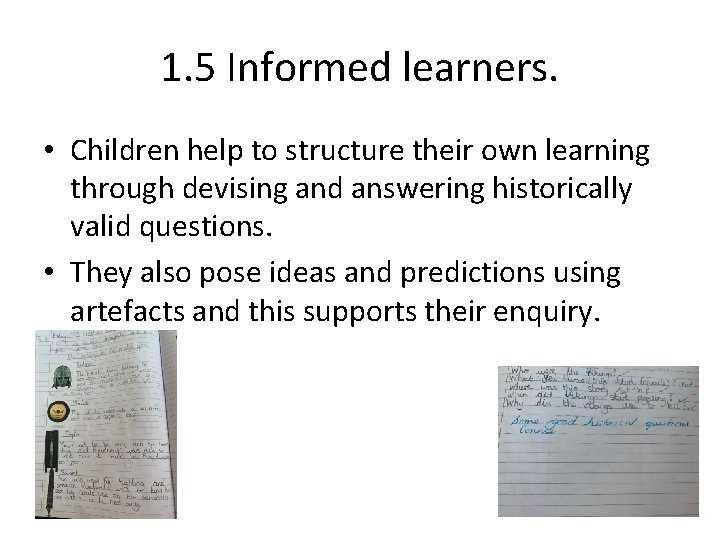
1. 5 Informed learners. • Children help to structure their own learning through devising and answering historically valid questions. • They also pose ideas and predictions using artefacts and this supports their enquiry.
1. 6 Marking and feedback • The marking scheme for the school is applied consistently across the history taught at The Berkeley. It includes the keys that demonstrate the independence or guided nature of the lessons. It also highlights whethere was verbal feedback during the lesson. • Next steps are also used to consolidate or stretch children's knowledge, or to challenge any historical mistakes. • See attached appendix.