
Evidence for an Explosive Origin of Central Pit
- Slides: 17
Evidence for an Explosive Origin of Central Pit Craters on Mars Nathan R. Williams, James F. Bell III, Philip R. Christensen, Jack D. Farmer Arizona State University Dec. 11, 2013
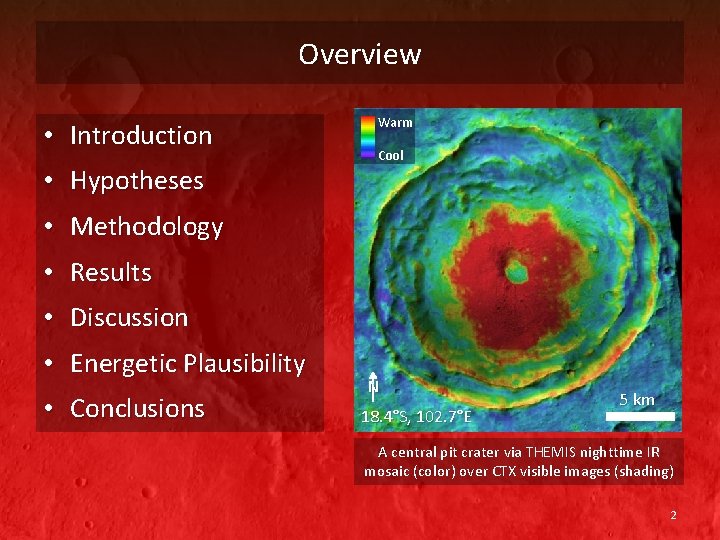
Overview • Introduction • Hypotheses Warm Cool • Methodology • Results • Discussion • Energetic Plausibility • Conclusions N 18. 4°S, 102. 7°E 5 km A central pit crater via THEMIS nighttime IR mosaic (color) over CTX visible images (shading) 2
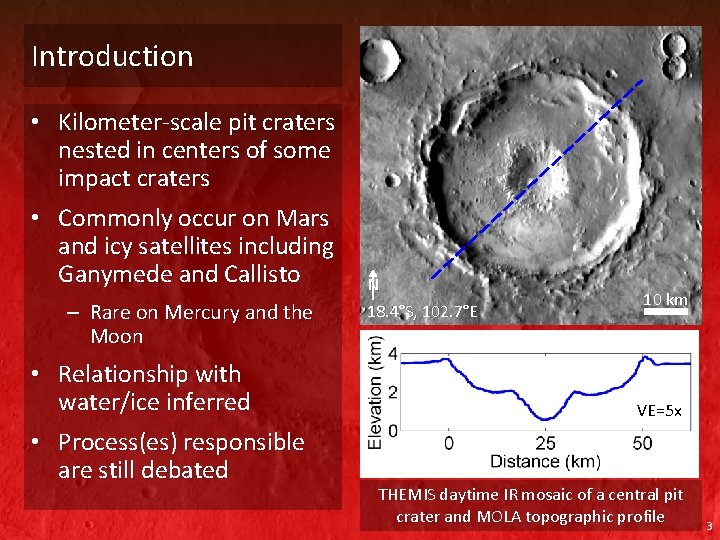
Introduction • Kilometer-scale pit craters nested in centers of some impact craters • Commonly occur on Mars and icy satellites including Ganymede and Callisto – Rare on Mercury and the Moon • Relationship with water/ice inferred • Process(es) responsible are still debated N 18. 4°S, 102. 7°E 10 km VE=5 x THEMIS daytime IR mosaic of a central pit crater and MOLA topographic profile 3
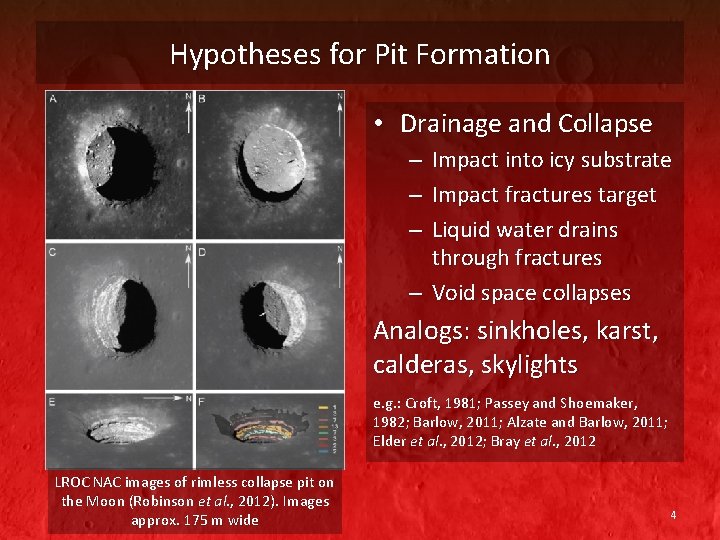
Hypotheses for Pit Formation • Drainage and Collapse Impact into icy substrate Impact fractures target Liquid water drains through fractures – Void space collapses – – – Analogs: sinkholes, karst, calderas, skylights e. g. : Croft, 1981; Passey and Shoemaker, 1982; Barlow, 2011; Alzate and Barlow, 2011; Elder et al. , 2012; Bray et al. , 2012 LROC NAC images of rimless collapse pit on the Moon (Robinson et al. , 2012). Images approx. 175 m wide 4
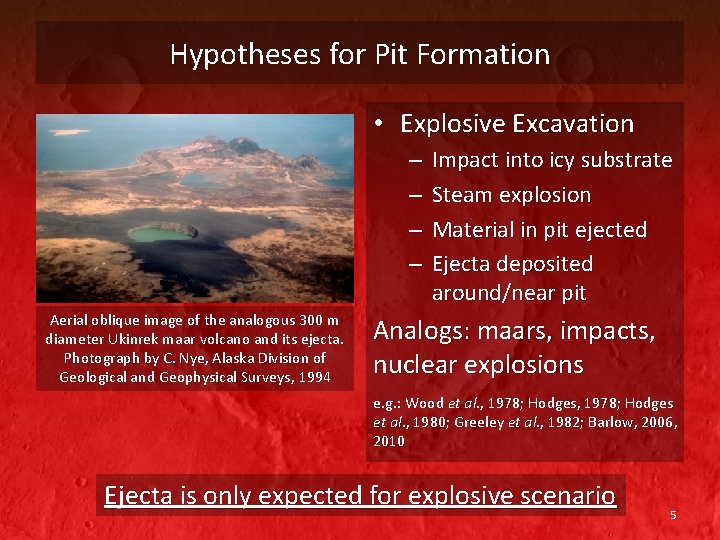
Hypotheses for Pit Formation • Explosive Excavation – – Aerial oblique image of the analogous 300 m diameter Ukinrek maar volcano and its ejecta. Photograph by C. Nye, Alaska Division of Geological and Geophysical Surveys, 1994 Impact into icy substrate Steam explosion Material in pit ejected Ejecta deposited around/near pit Analogs: maars, impacts, nuclear explosions e. g. : Wood et al. , 1978; Hodges et al. , 1980; Greeley et al. , 1982; Barlow, 2006, 2010 Ejecta is only expected for explosive scenario 5
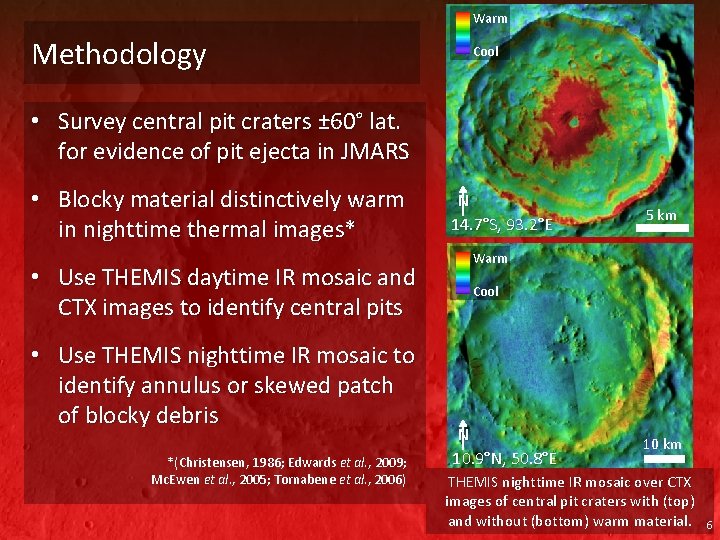
Warm Methodology Cool • Survey central pit craters ± 60° lat. for evidence of pit ejecta in JMARS • Blocky material distinctively warm in nighttime thermal images* • Use THEMIS daytime IR mosaic and CTX images to identify central pits • Use THEMIS nighttime IR mosaic to identify annulus or skewed patch of blocky debris *(Christensen, 1986; Edwards et al. , 2009; Mc. Ewen et al. , 2005; Tornabene et al. , 2006) N 14. 7°S, 93. 2°E 5 km Warm Cool N 10. 9°N, 50. 8°E 10 km THEMIS nighttime IR mosaic over CTX images of central pit craters with (top) and without (bottom) warm material. 6
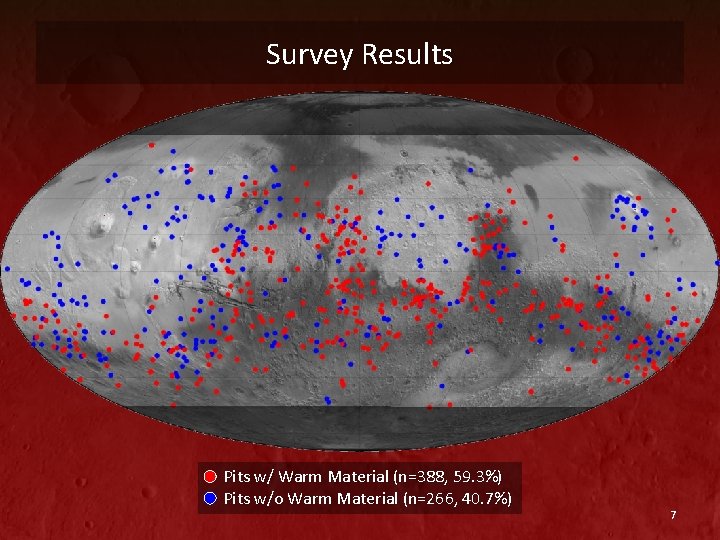
Survey Results Pits w/ Warm Material (n=388, 59. 3%) Pits w/o Warm Material (n=266, 40. 7%) 7
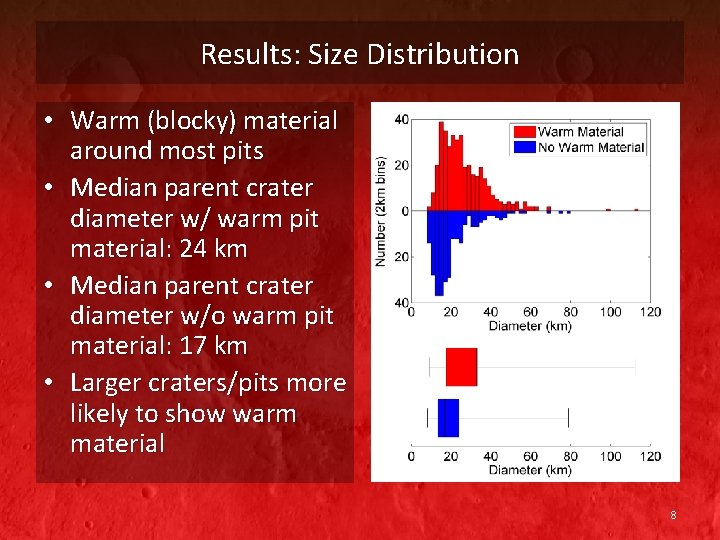
Results: Size Distribution • Warm (blocky) material around most pits • Median parent crater diameter w/ warm pit material: 24 km • Median parent crater diameter w/o warm pit material: 17 km • Larger craters/pits more likely to show warm material 8
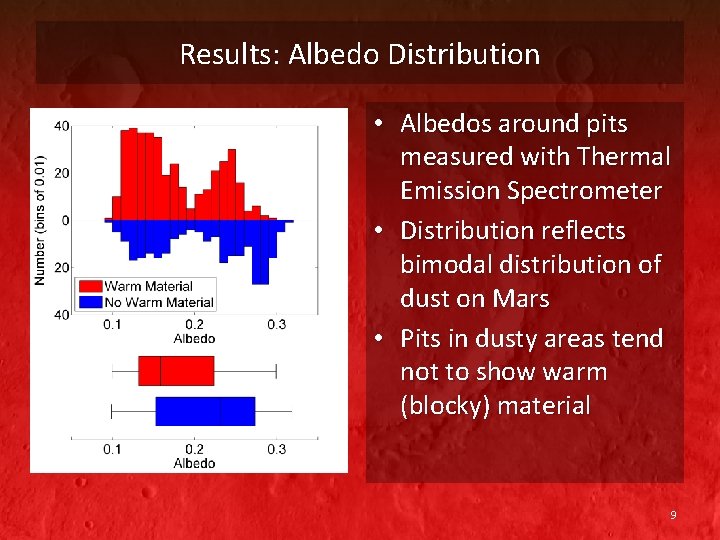
Results: Albedo Distribution • Albedos around pits measured with Thermal Emission Spectrometer • Distribution reflects bimodal distribution of dust on Mars • Pits in dusty areas tend not to show warm (blocky) material 9
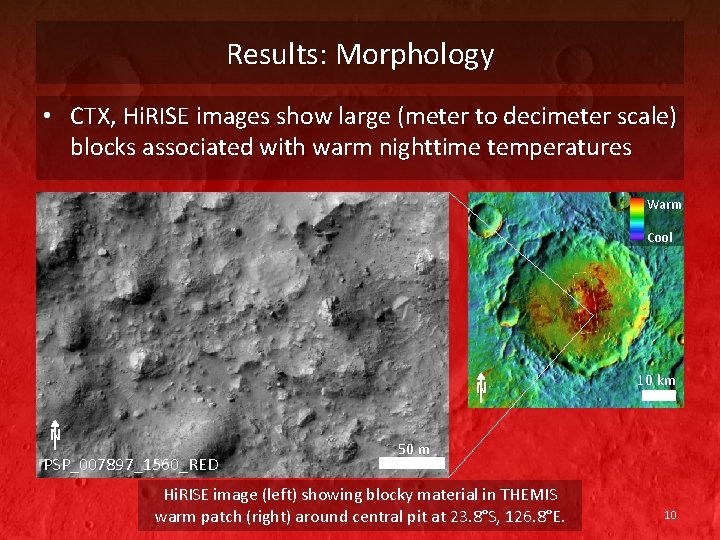
Results: Morphology • CTX, Hi. RISE images show large (meter to decimeter scale) blocks associated with warm nighttime temperatures Warm Cool N N PSP_007897_1560_RED 10 km 50 m Hi. RISE image (left) showing blocky material in THEMIS warm patch (right) around central pit at 23. 8°S, 126. 8°E. 10
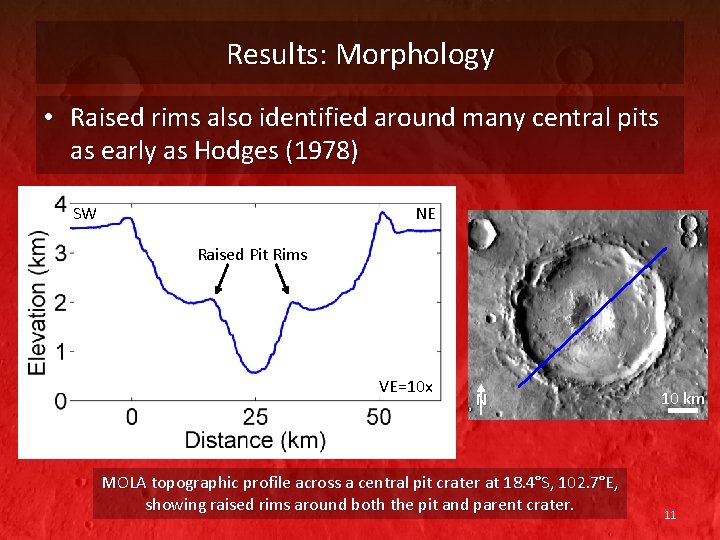
Results: Morphology • Raised rims also identified around many central pits as early as Hodges (1978) SW NE Raised Pit Rims VE=10 x N MOLA topographic profile across a central pit crater at 18. 4°S, 102. 7°E, showing raised rims around both the pit and parent crater. 10 km 11
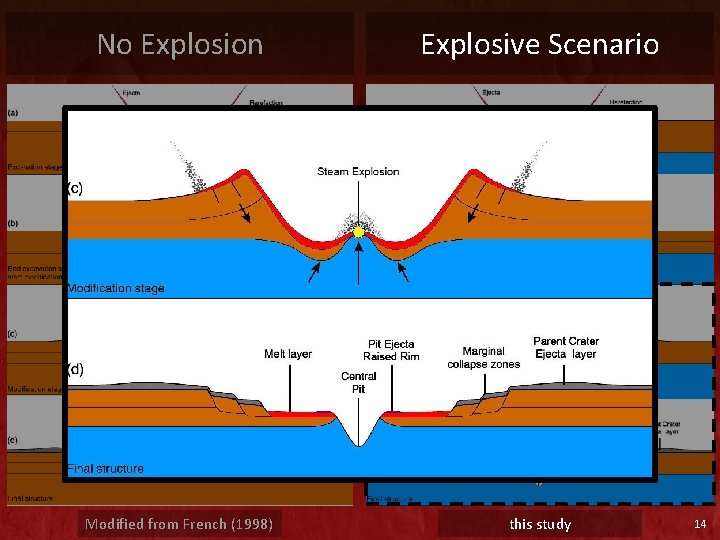
Discussion • Smaller pits’ ejecta finer-grained, and more easily eroded or buried • Dust deposits several centimeters thick mask diurnal thermal variation • Raised rims around many pits likely ejecta • Expected for explosive excavation, not collapse • Preservation of pits indicates formation during or after impact modification phase • Perhaps late-stage phreatomagmatic interaction? • Similar-sized maar craters are observed on Earth (Beget et al. , 1996) 12
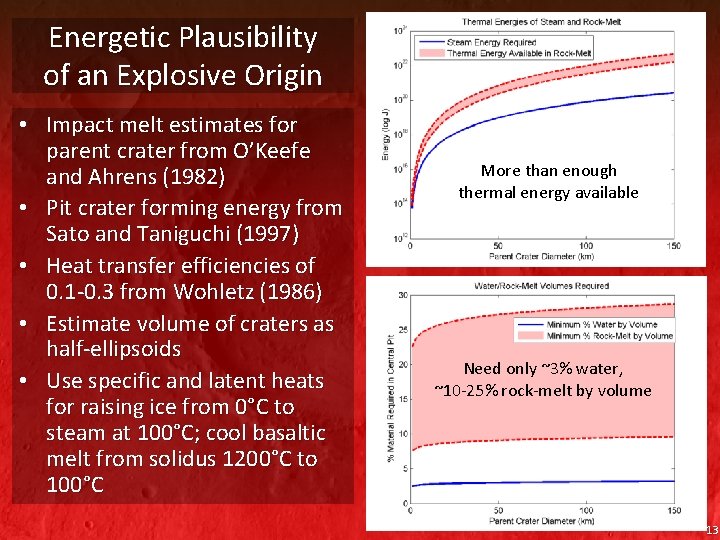
Energetic Plausibility of an Explosive Origin • Impact melt estimates for parent crater from O’Keefe and Ahrens (1982) • Pit crater forming energy from Sato and Taniguchi (1997) • Heat transfer efficiencies of 0. 1 -0. 3 from Wohletz (1986) • Estimate volume of craters as half-ellipsoids • Use specific and latent heats for raising ice from 0°C to steam at 100°C; cool basaltic melt from solidus 1200°C to 100°C More than enough thermal energy available Need only ~3% water, ~10 -25% rock-melt by volume 13
No Explosion Explosive Scenario Modified from French (1998) this study 14
Conclusions • Blocky debris and raised rims observed surrounding many central pits suggest an explosive origin • Blocky ejecta and raised rims are not expected for collapse structures • More than enough thermal energy already available via impact rock-melt to drive large steam explosions • Explosive excavation requires only ~3% water • Future work and modeling needed to address explosive feasibility on other planets and icy satellites • Explosive origin of central pit craters supported on Mars 15
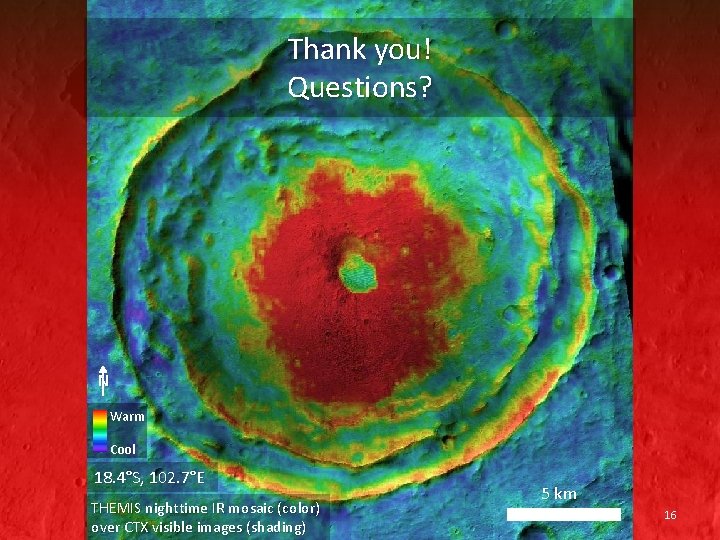
Thank you! Questions? N Warm Cool 18. 4°S, 102. 7°E THEMIS nighttime IR mosaic (color) over CTX visible images (shading) 5 km 16
References • • • • • • • Alzate, N. and N. G. Barlow (2011), Icarus 211, 1274 -1283. Baker, V. R. (1982), The Channels of Mars, 198 pp. , University of Texas Press, Austin, Texas. Baker, V. R. and D. J. Milton (1974), Icarus 23, 27 -41. Baloga, S. M. , et al. (2005), JGR 110, E 10001, doi: 10. 1029/2004 JE 002338. Barlow, N. G. (2006), Meteoritics & Planetary Science 41, 1425 -1436. Barlow, N. G. (2010), GSA Special Paper 465, 15 -27. Barlow, N. G. , et al. (2000), JGR 105, E 11, 26733 -26738. Barlow, N. G. (2011), Proc. 42 nd LPSC, Abs #1149. Begét, J. E. , et al. (1996), Arctic 49, 1, 62 -69. Bell, J. F. , III, et al. (2013), Mars 8, 1 -14, doi: 10. 1555/mars. 2013. 0001. Bray, V. J. , et al. (2012), Icarus 217, 115 -129. Burr, D. M. , et al. (2002), GRL 29, 1, 1013, doi: 10. 1029/2001 GL 013345. Carr, M. H. , et al. (1977), JGR 82, 28, 4055 -4065. Carr, M. H. (1979), JGR 84, B 6, 2995 -3007. Christensen, P. R. (1986), , Icarus 68, 217 -238. Christensen, P. R. , et al. (2001), JGR 106, E 10, 23, 823– 23, 871. Christensen, P. R. , et al. (2009), AGU FM, Abs. #IN 22 A-06 Christensen, P. R. , et al. (2004), Space Science Reviews, 110, 85 -130. Clifford, S. M. and D. Hillel (1983), JGR 88, B 3, 2456 -2474. Croft, S. K. (1981), Proc. 12 th LPSC, 196 -198. Cushing, G. E. , et al. (2007), GRL 34, L 17201, doi: 10. 1029/2007 GL 030709. Edwards, C. S. , et al. (2009), JGR 114, E 11001, doi: 10. 1029/2009 JE 003363. Edwards, C. S. , et al. (2011), JGR 116, E 10008, doi: 10. 1029/2010 JE 003755. Elder, C. M. , et al. (2012), Icarus 221, 831 -843. Fergason, R. L. , et al. (2006), JGR. , 111, E 12004, doi: 10. 1029/2006 JE 002735. French, B. M. (1998), Traces of Catastrophe, LPI Contribution No. 954, Lunar and Planetary Institute, Houston. 120 pp. • • • • • • • Gault, D. E. and R. Greeley (1978), Icarus 34, 486 -495. Greeley, R. , et al. (1982), in D. Morrison (Ed. ), Satellites of Jupiter, pp. 340 -378. Grieve, R. A. F. , et al. (2010), Meteoritics and Planetary Science 45, 5, 759 -782. Head, J. W. , et al. (2003), , Nature 426, 797 -802. Hodges, C. A. (1978), Proc. 9 th LPSC, 521 -522. Hodges, C. A. , et al. (1980), Proc. 11 th LPSC, 450 -452. Malin, M. C. , et al. (2007), JGR 112, E 05 S 04, doi: 10. 1029/2006 JE 002808. Mc. Ewen, A. S. , et al. (2005), Icarus 176, 351 -381. Mc. Ewen, A. S. , et al. (2007), JGR 112, E 05 S 02, doi: 10. 1029/2005 JE 002605. Mc. Kenzie, D. , and F. Nimmo (1999), Nature 397, 231 -233. Mellon, M. T. , et al. (1997), JGR 102, E 8, 19357 -19369. Melosh, H. J. (1989), Impact Cratering: A Geologic Process, Oxford Monographs on Geology and Geophysics #11, Oxford University Press, New York. O’Keefe, J. D. and T. J. Ahrens (1985), Icarus 62, 328 -338. Okubo, C. H. and S. J. Martel (1998), Journal of Volcanology and Geothermal Research 86, 1 -18. Passey, Q. R. and E. M. Shoemaker (1982), In: Morrison, D. (Ed. ), Satellites of Jupiter. Univ. of Arizona Press, Tucson, pp. 340– 378. Robinson, M. S. , et al. (2012), Planetary and Space Science 69, 18 -27. Salvati, R. and I. D. Sasowsky (2002), Journal of Hydrology 264, 1 -11. Sato, H. and H. Taniguchi (1997), GRL 24, 3, 205 -208. Smith, E. I. (1976), Icarus 28, 543 -550. Smith, B. A. , et al. (1979), Science 206, 927 -950. Smith, D. E. , et al. (2001), JGR 106, E 10, 23689 -23722. Tornabene, L. L. , et al. (2006), JGR 111, E 10006, doi: 10. 1029/2005 JE 002600. Xiao, Z. and G. Komatsu (2013), Plan. and Space Sci. , DOI: 10. 1016/j. pss. 2013. 015. Wohletz, K. H. and M. F. Sheridan (1983), Icarus 56, 15 -37. Wohletz, K. H. (1986), Bull. Volcanol. 48, 245 -264. Wood, C. A. , et al. (1978), Proc. 9 th LPSC, 3691 -3709. 17