
EVIDENCE Definition of Hearsay in Criminal Cases SCTLA
![Whose burden is it to show that the statement is an assertion? “‘[I]t is](https://slidetodoc.com/presentation_image_h2/a24fc88059dde1fe4c59c2fdfcf5a7bb/image-16.jpg "Whose burden is it to show that the statement is an assertion? “‘[I]t is")
![Answer #3 Not hearsay. “[T]he testimony. . . referred to questions posed or directions](https://slidetodoc.com/presentation_image_h2/a24fc88059dde1fe4c59c2fdfcf5a7bb/image-23.jpg "Answer #3 Not hearsay. “[T]he testimony. . . referred to questions posed or directions")
![Answer #6 Yes. “[W]e hold that [defendant] has met his burden of demonstrating that](https://slidetodoc.com/presentation_image_h2/a24fc88059dde1fe4c59c2fdfcf5a7bb/image-34.jpg "Answer #6 Yes. “[W]e hold that [defendant] has met his burden of demonstrating that")
![Answer #13 Yes. “[T]he only evidence presented by the government to justify its establishment](https://slidetodoc.com/presentation_image_h2/a24fc88059dde1fe4c59c2fdfcf5a7bb/image-62.jpg "Answer #13 Yes. “[T]he only evidence presented by the government to justify its establishment")
- Slides: 96
EVIDENCE Definition of Hearsay in Criminal Cases SCTLA Presentation October 17, 2016 Gerald I. Fisher Copyright © 9/21/2016
Hearsay - Defined FRE 801. Definitions. ***** (c) Hearsay. “Hearsay” means a prior statement — one the declarant does not make while testifying at the current trial or hearing — that a party offers in evidence to prove the truth of the matter asserted by the declarant. Accord, Jenkins v. United States, 80 A. 3 d 978, 989 (D. C. 2013). Carter v. United States, 614 A. 2 d 542, 545 n. 9 (D. C. 1992).
Definitions �“witness” – one who testifies in court �“testimony” – what a witness says in court �“declarant” – person who makes an out-of-court statement A person can be both a declarant and a witness if s/he testifies about statements they made out-ofcourt. �“statement” – out-of-court; can be written, oral, silence or conduct
Preliminary Principles: 1. The rules of evidence, including the rules relating to hearsay, apply in both jury and non-jury trials. 2. The rules relating to hearsay apply when the witness is also the declarant � i. e. , a witness may not testify to his/her own hearsay statements unless they fall within exceptions to the bar against hearsay
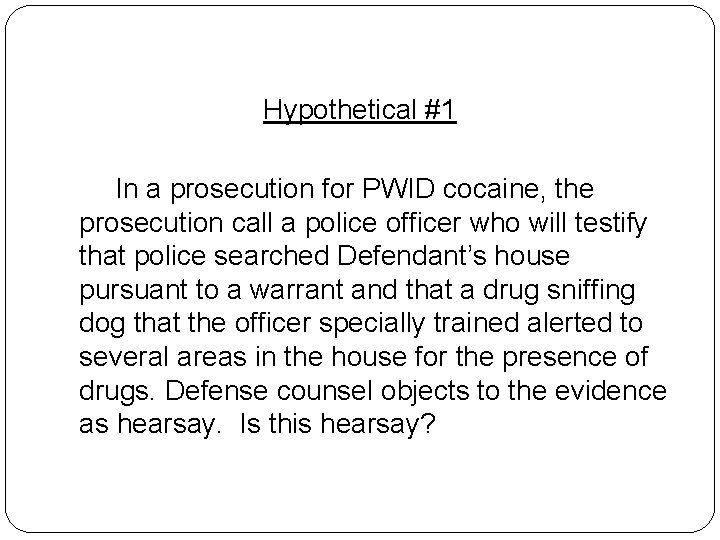
Hypothetical #1 In a prosecution for PWID cocaine, the prosecution call a police officer who will testify that police searched Defendant’s house pursuant to a warrant and that a drug sniffing dog that the officer specially trained alerted to several areas in the house for the presence of drugs. Defense counsel objects to the evidence as hearsay. Is this hearsay?
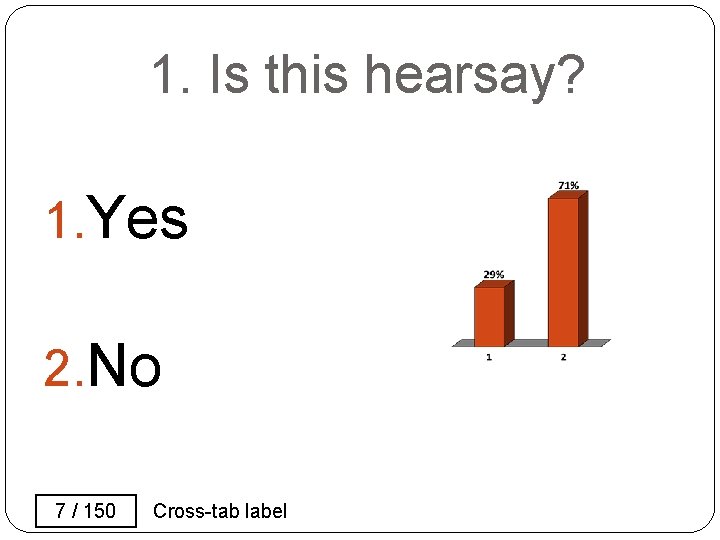
1. Is this hearsay? 1. Yes 2. No 7 / 150 Cross-tab label
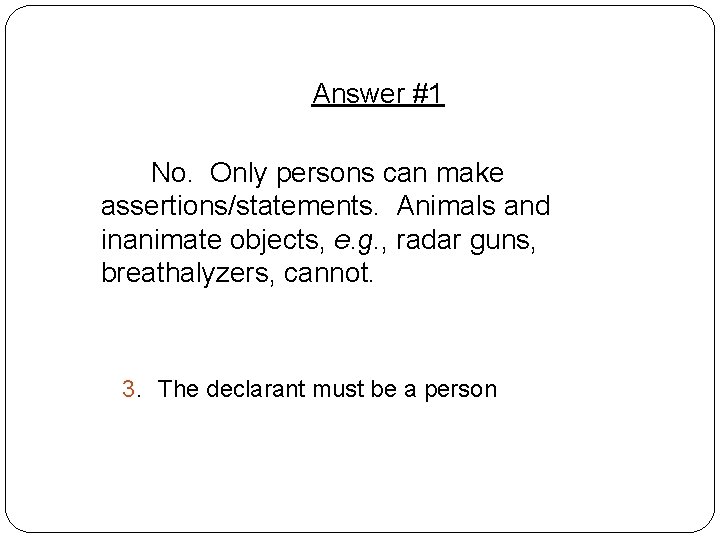
Answer #1 No. Only persons can make assertions/statements. Animals and inanimate objects, e. g. , radar guns, breathalyzers, cannot. 3. The declarant must be a person
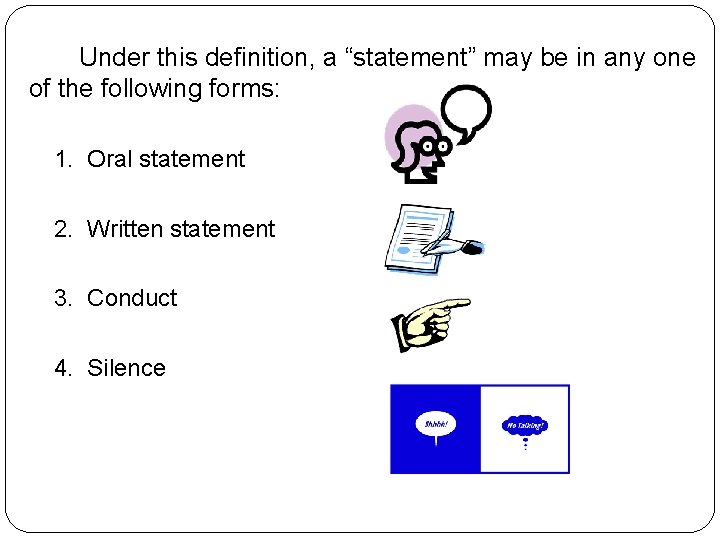
Under this definition, a “statement” may be in any one of the following forms: 1. Oral statement 2. Written statement 3. Conduct 4. Silence
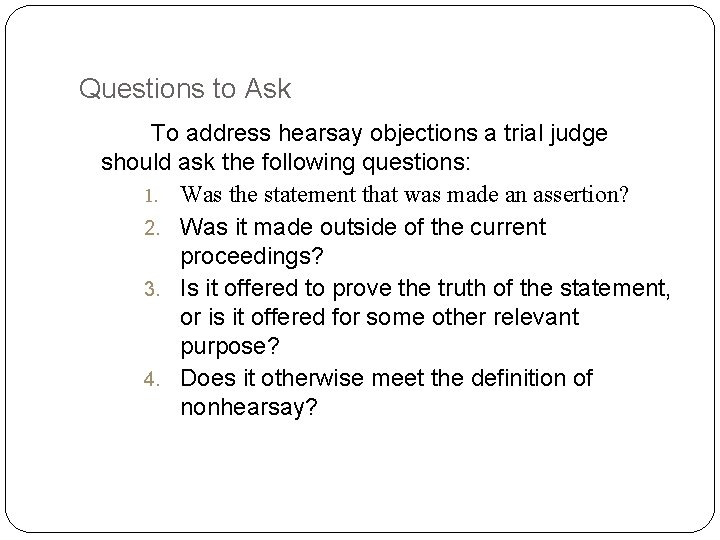
Questions to Ask To address hearsay objections a trial judge should ask the following questions: 1. Was the statement that was made an assertion? 2. Was it made outside of the current proceedings? 3. Is it offered to prove the truth of the statement, or is it offered for some other relevant purpose? 4. Does it otherwise meet the definition of nonhearsay?
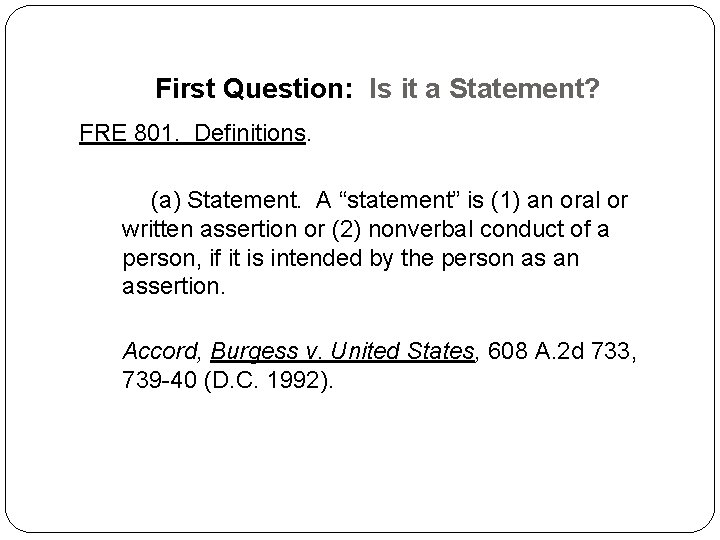
First Question: Is it a Statement? FRE 801. Definitions. (a) Statement. A “statement” is (1) an oral or written assertion or (2) nonverbal conduct of a person, if it is intended by the person as an assertion. Accord, Burgess v. United States, 608 A. 2 d 733, 739 -40 (D. C. 1992).
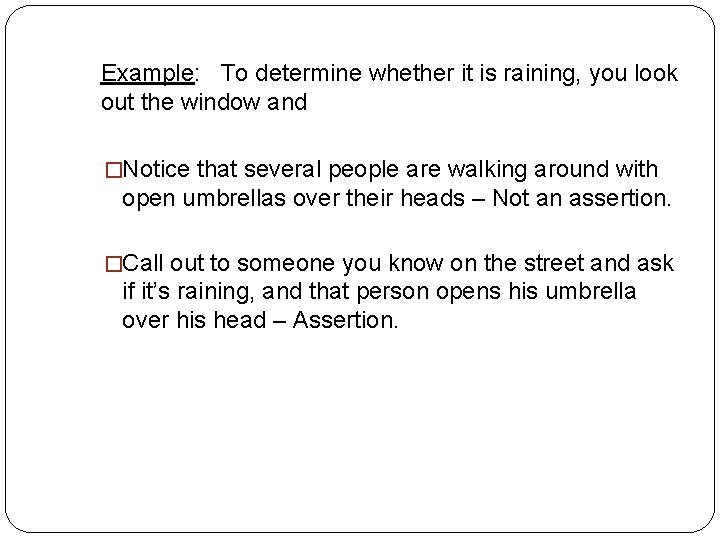
Example: To determine whether it is raining, you look out the window and �Notice that several people are walking around with open umbrellas over their heads – Not an assertion. �Call out to someone you know on the street and ask if it’s raining, and that person opens his umbrella over his head – Assertion.
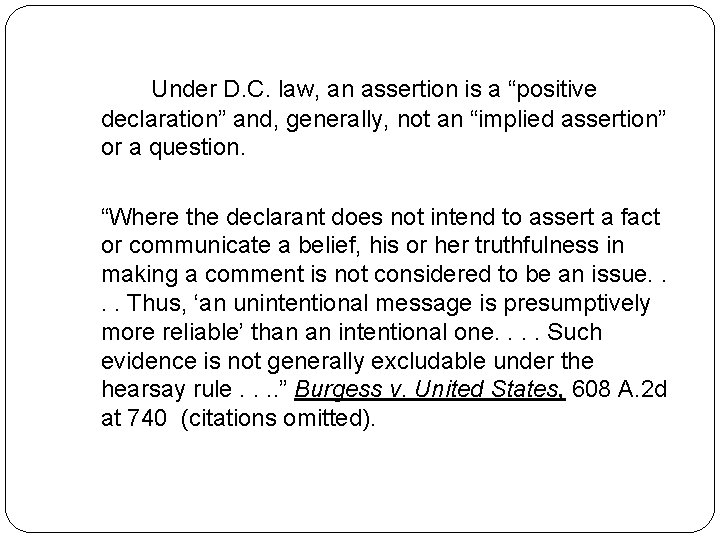
Under D. C. law, an assertion is a “positive declaration” and, generally, not an “implied assertion” or a question. “Where the declarant does not intend to assert a fact or communicate a belief, his or her truthfulness in making a comment is not considered to be an issue. . Thus, ‘an unintentional message is presumptively more reliable’ than an intentional one. . Such evidence is not generally excludable under the hearsay rule. . ” Burgess v. United States, 608 A. 2 d at 740 (citations omitted).
Implied Assertion ≠ Express Assertion “‘In determining what is an assertion, the crucial distinction. . . is between intentional and unintentional messages, regardless of whether they are express or implied. ’ ‘[N]othing is an assertion unless [it is] intended to be one. ’ An unintentional message is ‘not generally excludable under the hearsay rule, ’ because the declarant's truthfulness ‘is not considered to be an issue’ if the declarant does not intend to be asserting a fact. ” Martin v. United States, 991 A. 2 d 791, 797 (D. C. 2010) (citations omitted).
Example: In a will contest where the testator’s competence is at issue, letters written by friends to the testator during the time when he made his last will disinheriting his children, where the letters clearly assume that the testator is competent. �If the letters do not contain statements asserting that the testator is competent – Not an Assertion �But if those same friend wrote to the presiding judge and stated in their letters that the testator was competent – Assertion Wright v. Tatham, 112 Eng. Rep. 148 (Eng. 1837).
With respect to each “statement”, the critical issue is analyzed from the point of view of the declarant: Whether the written or oral words, conduct, or silence were intended by the “speaker, ” “actor, ” or “writer” to be an assertion, i. e. , intended to be communicated as a fact with the expectation that the fact will be accepted as true.
Whose burden is it to show that the statement is an assertion? “‘[I]t is the party challenging admission of the declaration that bears the burden of demonstrating the declarant’s requisite intent. ’” Martin v. United States, 991 A. 2 d at 798 n. 36 (quoting United States v. Summers, 414 F. 3 d 1287, 1300 (10 th Cir. 2005)); see also Fed. R. Evid. 801 advisory committee’s note (“The rule is so worded as to place the burden upon the party claiming that the intention existed; ambiguous and doubtful cases will be resolved against him and in favor of admissibility. ”).
What information can trial judge consider when determining whether a statement is hearsay? Fed. R. Evid. 104 (a) allows judges to consider hearsay and other inadmissible evidence that is not privileged in ruling on questions of admissibility. Although the Court of Appeals has not “adopted” Rule 104 (a) in a formal sense, it has stated that the principle the rule states is one which it will generally follow (outside the coconspirator hearsay context). Butler v. United States, 481 A. 2 d 431, 439 (D. C. 1984). See, e. g. , Roberson v. United States, 961 A. 2 d 1092, 1096 & 1096 n. 11 (D. C. 2008).
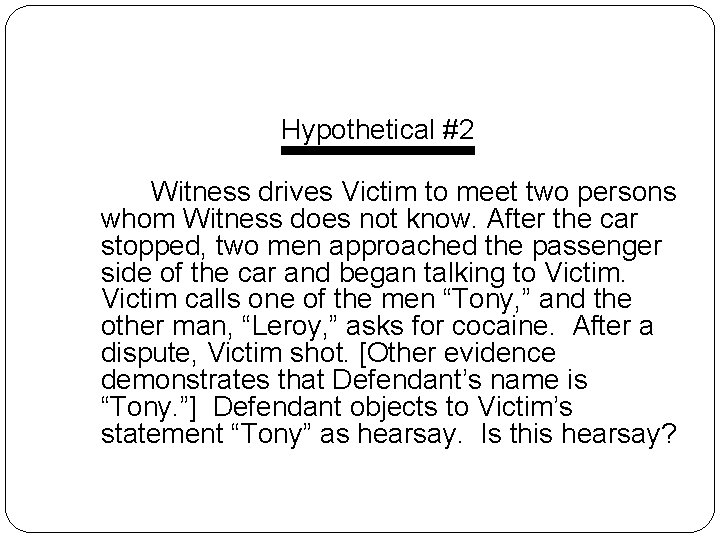
Hypothetical #2 Witness drives Victim to meet two persons whom Witness does not know. After the car stopped, two men approached the passenger side of the car and began talking to Victim calls one of the men “Tony, ” and the other man, “Leroy, ” asks for cocaine. After a dispute, Victim shot. [Other evidence demonstrates that Defendant’s name is “Tony. ”] Defendant objects to Victim’s statement “Tony” as hearsay. Is this hearsay?
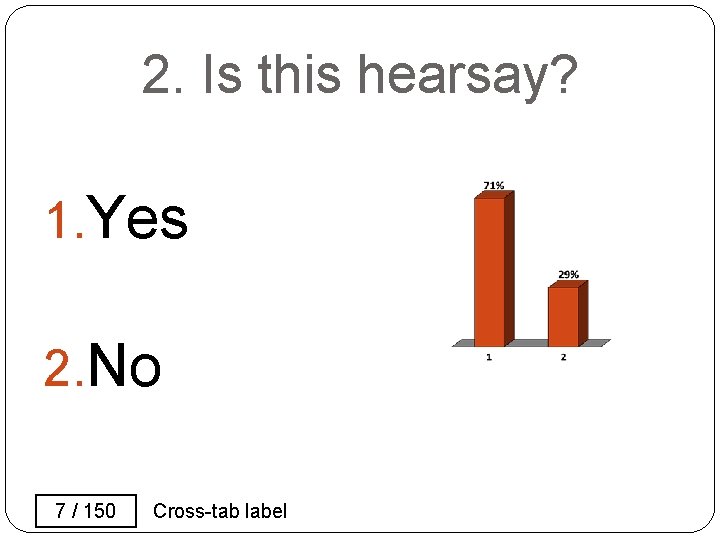
2. Is this hearsay? 1. Yes 2. No 7 / 150 Cross-tab label
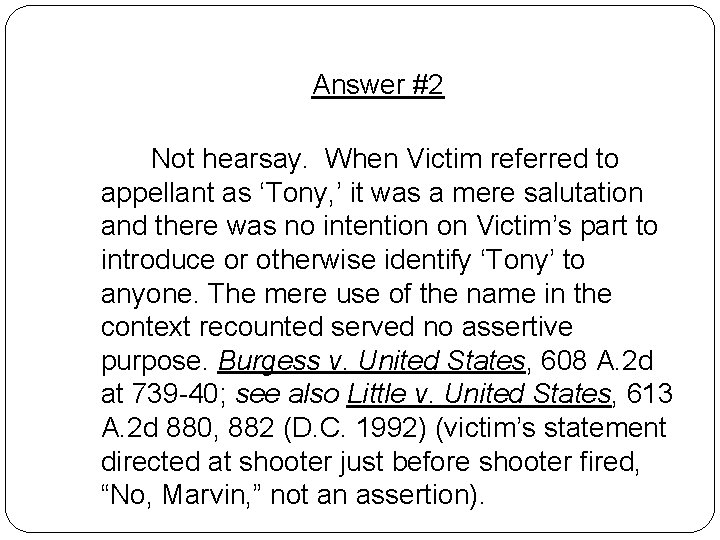
Answer #2 Not hearsay. When Victim referred to appellant as ‘Tony, ’ it was a mere salutation and there was no intention on Victim’s part to introduce or otherwise identify ‘Tony’ to anyone. The mere use of the name in the context recounted served no assertive purpose. Burgess v. United States, 608 A. 2 d at 739 -40; see also Little v. United States, 613 A. 2 d 880, 882 (D. C. 1992) (victim’s statement directed at shooter just before shooter fired, “No, Marvin, ” not an assertion).
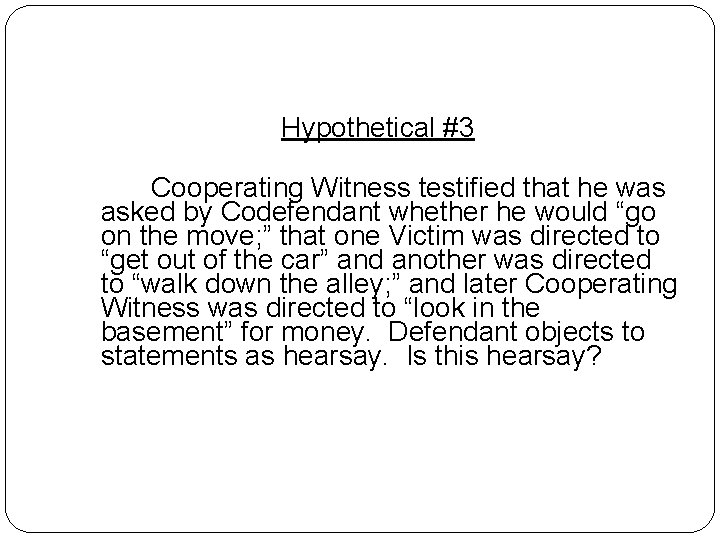
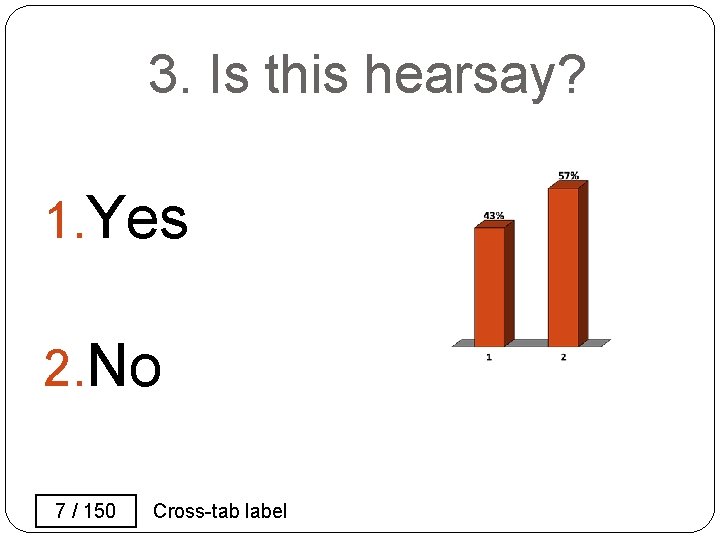
Hypothetical #3 Cooperating Witness testified that he was asked by Codefendant whether he would “go on the move; ” that one Victim was directed to “get out of the car” and another was directed to “walk down the alley; ” and later Cooperating Witness was directed to “look in the basement” for money. Defendant objects to statements as hearsay. Is this hearsay?
3. Is this hearsay? 1. Yes 2. No 7 / 150 Cross-tab label
Answer #3 Not hearsay. “[T]he testimony. . . referred to questions posed or directions given. . . it was ‘a directive offered to prove that instruction was given [not an assertion of fact]. ’” Walker v. United States, 982 A. 2 d 723, 737 (D. C. 2009).
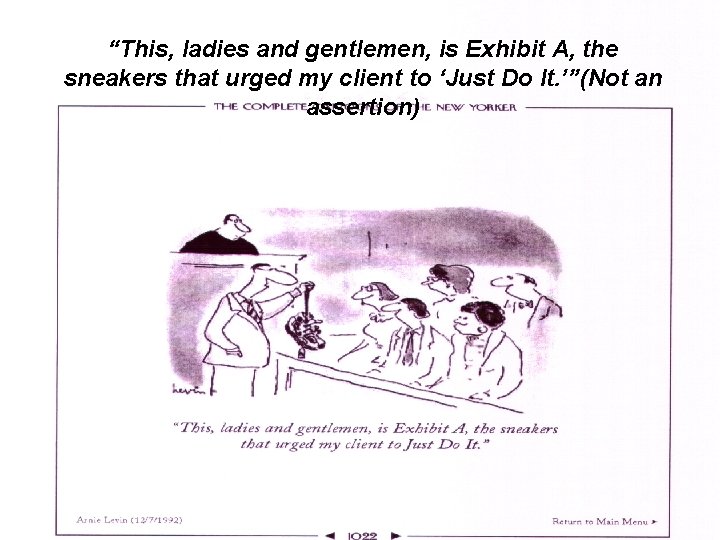
“This, ladies and gentlemen, is Exhibit A, the sneakers that urged my client to ‘Just Do It. ’”(Not an assertion)
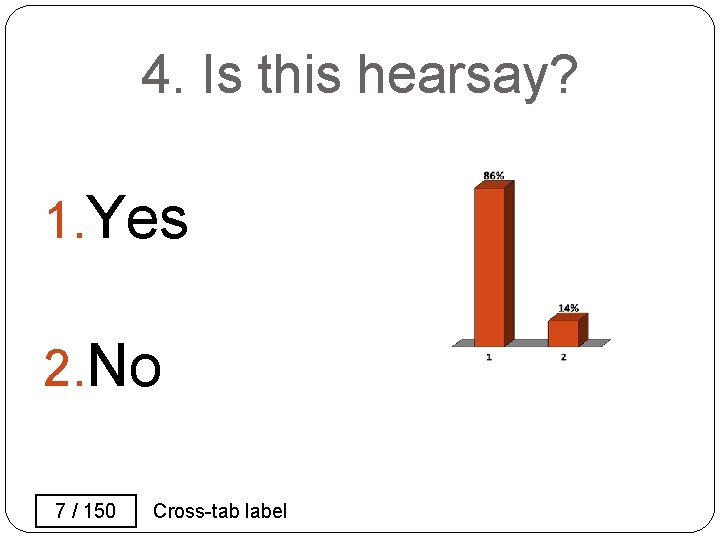
Hypothetical #4 Defendant is charged with possession with intent to distribute drugs from an apartment. The prosecution seeks to introduce as evidence “pay/owe” sheets (documenting drug transactions) to prove the character and use of the apartment where the sheets were found. Defense objects. Is this hearsay?
4. Is this hearsay? 1. Yes 2. No 7 / 150 Cross-tab label
Answer #4 Not hearsay. The pay/owe sheets are not being offered to show the truth of the documents, i. e. , that money was paid or owed for purchase of drugs, but merely the presence of the pay/owe sheets, which makes it more likely that the apartment was used for drug dealing, which is relevant to show that persons associated with the apartment were engaged in drug dealing. United States v. Jamarillo-Suarez, 950 F. 2 d 1378 (9 th Cir.
Can a question ever be an assertion? Questions usually are intended to acquire information, not to impart it. Thus questions usually are not characterized as intentional assertions and hence are not hearsay. But that is not invariably so. Some questions can be intended as assertions and not as genuine requests for information.
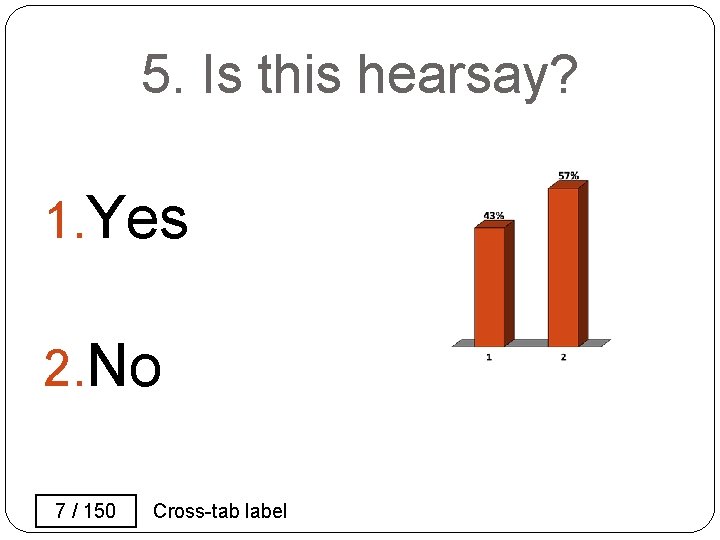
Hypothetical #5 Defendant is charged with various firearms and narcotics charges after a police search of the apartment in which he was arrested. While officers were searching the apartment, a telephone rang and police answered it. The unidentified caller first asked to speak with “Keith” [Defendant’s name] and then asked whether Keith “still had any stuff? ” When asked as to the meaning of this question, the caller responded by indicating a quantity of crack cocaine. Defendant objects, arguing that the hearsay statement asserted that he was involved in drug distribution. Is this hearsay?
5. Is this hearsay? 1. Yes 2. No 7 / 150 Cross-tab label
Answer #5 No, according to the D. C. Circuit, which holds that Defendant had failed to provide any evidence to suggest that the unidentified caller actually intended to assert that he [defendant] was involved in narcotics distribution. United States v. Long, 284 U. S. App. D. C. 405, 905 F. 2 d 1572 (D. C. Cir. 1990). �Query why the question “Does [Keith] still have any stuff is not an assertion?
Hypothetical #6 Defendant is prosecuted for bank robbery. At trial the prosecution seeks to introduce the statement of Codefendant made during his apprehension by police. As he was being walked to the squad car, Codefendant stated, “How did you guys find us so fast? ” Assume this evidence is relevant and there is no Confrontation Clause objection. Defendant objects to the statement as hearsay. Is this hearsay?
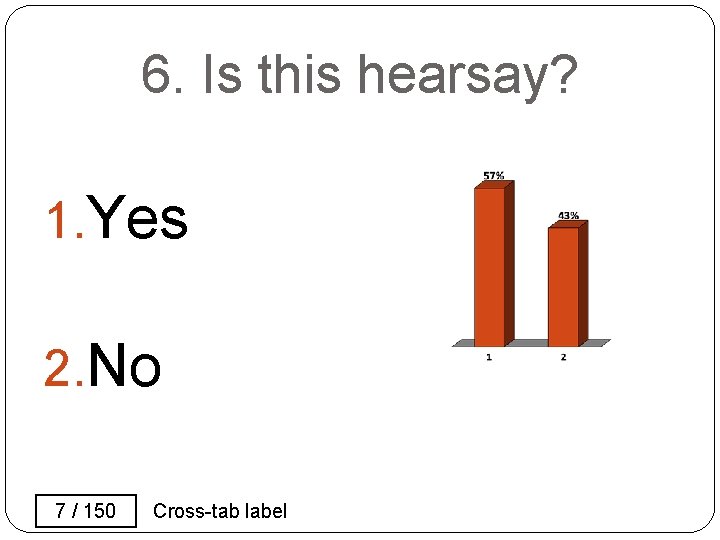
6. Is this hearsay? 1. Yes 2. No 7 / 150 Cross-tab label
Answer #6 Yes. “[W]e hold that [defendant] has met his burden of demonstrating that by positing the question, . . . declarant intended to make an assertion. . [Declarant’s] question clearly contained an inculpatory assertion. It begs credulity to assume that in positing the question [declarant] was exclusively interested in modern methods of law enforcement, including surveillance, communication, and coordination. Rather, fairly construed, the statement intimated both guilt and wonderment at the ability of the police to apprehend the perpetrators of the crime so quickly. This in turn is distinguished from the questions. . . that were designed to elicit information and a response, rather than assert the defendant's involvement in criminal activity. ” United States v. Summers, 414 F. 3 d 1287, 1297 -
Hypothetical #7 Defendant is charged with offenses including assaulting a police officer. Evidence showed that officer approached Defendant’s car to conduct a traffic stop, a struggle ensued, including shots fired by the officer. After a car chase Defendant was arrested by other officers. In defense, Defendant testified he thought officer was a carjacker, not a policeman. Defendant sought to present testimony that when he was arrested, he asked the arresting officer, “Why’d that man shoot at us? ” as evidence that he was not aware the person was a police office. Prosecution objects to the
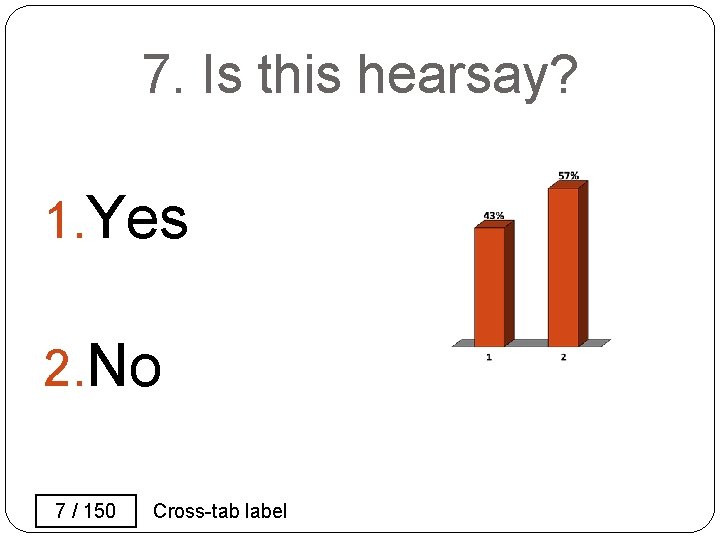
7. Is this hearsay? 1. Yes 2. No 7 / 150 Cross-tab label
Answer #7 The Court of Appeals observes that it depends on the intent of the declarant. “Different inferences are possible: appellant sincerely may have been wondering why [the officer] shot at him. . . , or he may have been intending to convey his innocence to the arresting officer. The judge did not make a factual finding on the issue of appellant’s intent. In a new trial, the burden of showing that he meant to assert a fact (his innocence) rather than to obtain information will be on the government. ” Martin v. United States, 991 A. 2 d 791, 798 (D. C. 2010).
Silence as an Assertion Silence cannot be considered an assertion (hearsay) unless one concludes that by remaining silent the declarant intended to assert something. Silence is usually ambiguous. FRE Advisory Committee has indicated that ambiguous cases are resolved in favor of concluding that there was not an assertion (thus no hearsay): “The rule is so worded as to place the burden upon the party claiming that the intention existed; ambiguous and doubtful cases will be resolved against him in favor of [classifying the conduct as non-assertive and therefore non-hearsay]. ”
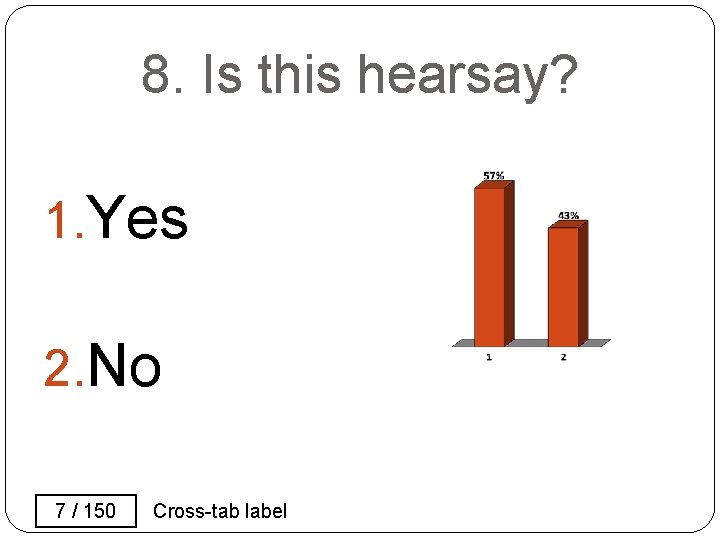
Hypothetical #8 Plaintiff sues because the railway car in which he rode was too cold. Defendant Railroad wants to call the porter to show that other passengers did not complain, thereby indicating that the car was not too cold. Plaintiff objects as hearsay. Is this hearsay?
8. Is this hearsay? 1. Yes 2. No 7 / 150 Cross-tab label
Answer #8 No. The lack of complaint(s) by the other passengers is relevant, non-assertive silence. Silver v. N. Y. Central R. R. , 105 N. E. 2 d 923 (Mass. 1952)
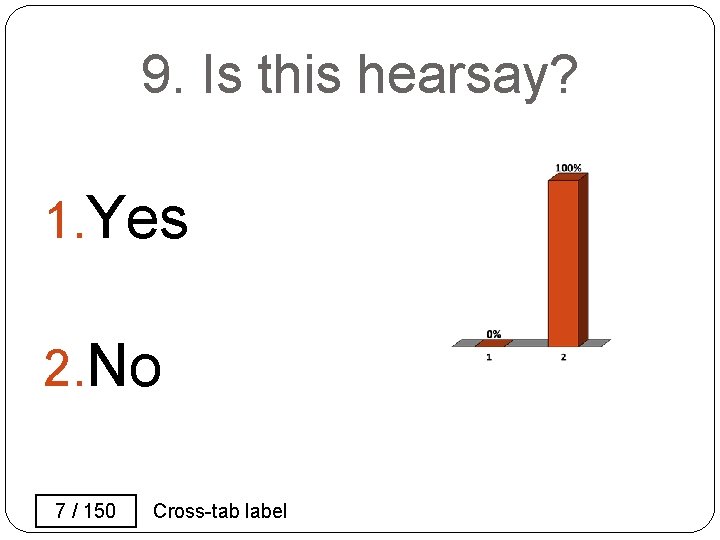
Hypothetical #9 What if, instead, the porter asked if anyone else thought that the car was cold, “please raise your hand, ” and everyone remained silent? Is this hearsay?
9. Is this hearsay? 1. Yes 2. No 7 / 150 Cross-tab label
Answer #9 Yes. This would be assertive silence and hearsay conduct; by their silence the passengers are indicating agreement.
Definition of “Assertion” -- Recap � Hearsay is a “statement” (oral, written, conduct, silence) if it is intended by the declarant as an assertion. � An assertion is a “positive declaration” and, generally, not an “implied assertion. ” � With respect to each “statement”, the critical issue is analyzed from the point of view of the declarant, i. e. , did the declarant communicate a fact with the expectation that the fact will be accepted as true by a third person.
� An unintentional message (implied assertion) is not generally excludable under the hearsay rule. � Implied Assertions v. Questions as Assertions: Generally, an implied assertion is a assertion of fact, i. e. , a direct assertion, from which other inferences can be drawn (e. g. , the letters to the testator in Wright v. Tatham assuming he was competent). The issue concerning questions is whether the declarant is actually asking a question, i. e. , seeking information, or intending to assert a fact in the form of a question – the court must determine the declarant’s actual intent in asking a question.
�In either circumstance, it is the party challenging admission of the declaration that bears the burden of demonstrating the declarant’s requisite intent and ambiguous and doubtful cases will be resolved in favor of the statement not being an assertion and therefore not hearsay.
Second Question: Is the Statement Made Out-of-Court ? FRE 801(c) Hearsay. “Hearsay” is a statement [oral, written, conduct or silence], other than one made by the declarant while testifying at the trial or hearing. . . [emphasis added]. �Whenever a witness testifies to words that were spoken by anyone (including himself/herself) other than during the trial/hearing currently being held, those words are an “out-of-court” statement for the purposes of 801(c). �This means that usually if a witness attempts to testify about a statement he or she made outside the courtroom, the court must conduct a hearsay analysis.
Third Question: Is the Statement Offered for the Truth of the Matter Asserted? “Hearsay” is a statement. . . offered in evidence to prove the truth of the matter asserted. [emphasis added]. For each statement you have to ask: �Is the party trying to prove the truth of the out-of- court statement or conduct or, instead, trying to prove that the statement or conduct occurred and that the occurrence is relevant to an issue in the case? �If the statement is not offered to prove the truth of the matter asserted in the statement, then it is not hearsay.
Situations Where Statement Not Offered for its Truth � Mental state of the party – (a) were actions willful (b) malicious (c) with intent to defraud (d) with intent to murder, etc. � To show effect on hearer such as duress, self- defense. � To show knowledge or proof of notice. � To show state of mind of the declarant.
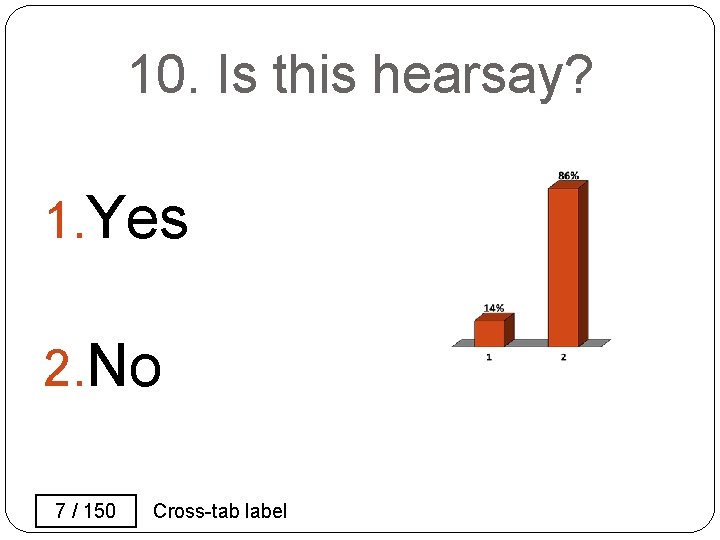
Hypothetical #10 In a DV contempt proceeding, Complainant testifies that when answering telephone calls from Defendant (in violation of CPO) she told Defendant he was violating the CPO. Defense counsel objects to statements by Complainant as hearsay? Is this hearsay?
10. Is this hearsay? 1. Yes 2. No 7 / 150 Cross-tab label
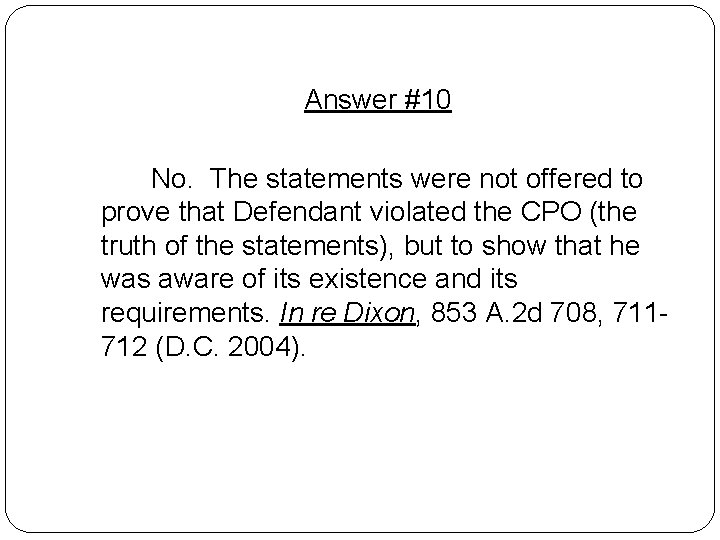
Answer #10 No. The statements were not offered to prove that Defendant violated the CPO (the truth of the statements), but to show that he was aware of its existence and its requirements. In re Dixon, 853 A. 2 d 708, 711712 (D. C. 2004).
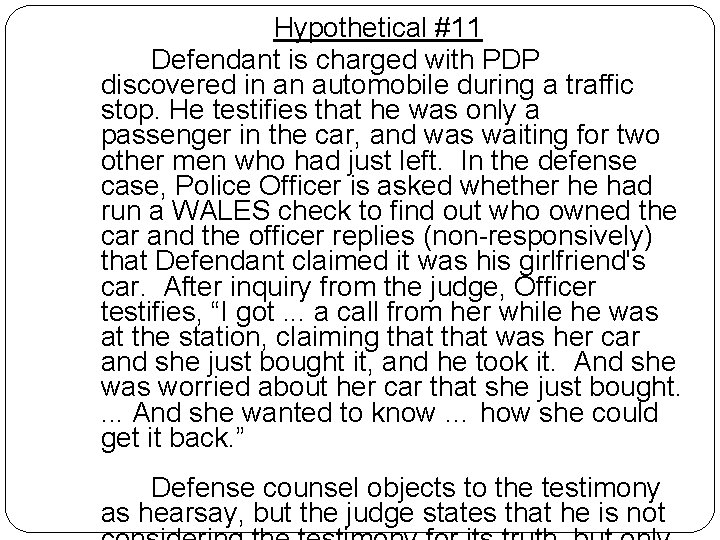
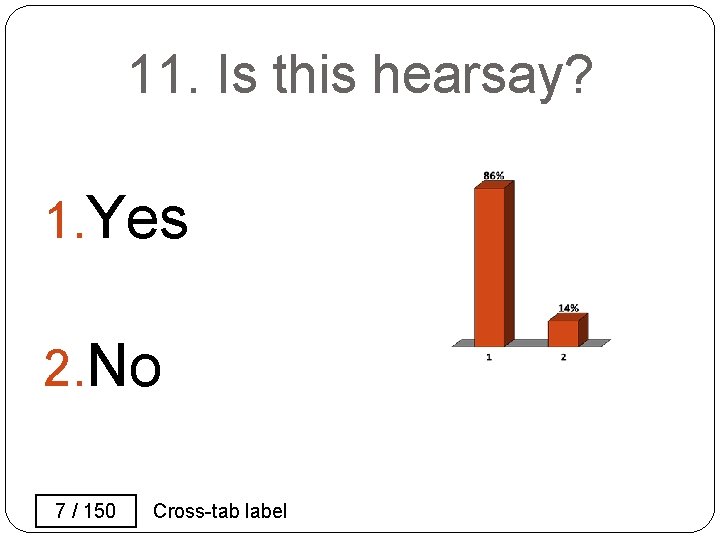
Hypothetical #11 Defendant is charged with PDP discovered in an automobile during a traffic stop. He testifies that he was only a passenger in the car, and was waiting for two other men who had just left. In the defense case, Police Officer is asked whether he had run a WALES check to find out who owned the car and the officer replies (non-responsively) that Defendant claimed it was his girlfriend's car. After inquiry from the judge, Officer testifies, “I got. . . a call from her while he was at the station, claiming that was her car and she just bought it, and he took it. And she was worried about her car that she just bought. . And she wanted to know … how she could get it back. ” Defense counsel objects to the testimony as hearsay, but the judge states that he is not
11. Is this hearsay? 1. Yes 2. No 7 / 150 Cross-tab label
Answer #11 Yes. “There can be no doubt that Officer Johnson's testimony about the phone call he received from appellant's ‘wife or girlfriend’ was patent hearsay. . ” “The only value the statement had as impeachment evidence was in the truth of the matter asserted, i. e. , that the declarant was the owner of the car, contrary to appellant's testimony that it belonged to ‘Bill. ’ If what the woman said was not true, then her statement had no probative value because it could not have impeached appellant's testimony. Thus the impeachment value of the statement depended on its truth, and that fact made it hearsay. Since it did not fall within any of the recognized exceptions to the hearsay rule, it was inadmissible. ” Carter v. United States,
Hypothetical #12 Defendant is charged with possession of a firearm discovered during a traffic stop. At trial, he testifies that the gun was registered in Maryland that he was at a Maryland firing range the day before and forgot the gun was in the car. In the Government’s rebuttal case, the prosecutor asks arresting officer Franchek during redirect examination, “Did defendant ever tell you that he had a permit for the gun? ” to which the officer responds “No. ” Defense wishes to call the second arresting officer, David, to testify that at the time of the stop Defendant stated to Officer Franchek that he had a Maryland permit, had been to a firing range the day before, and forgot the gun was in the car. Prosecutor
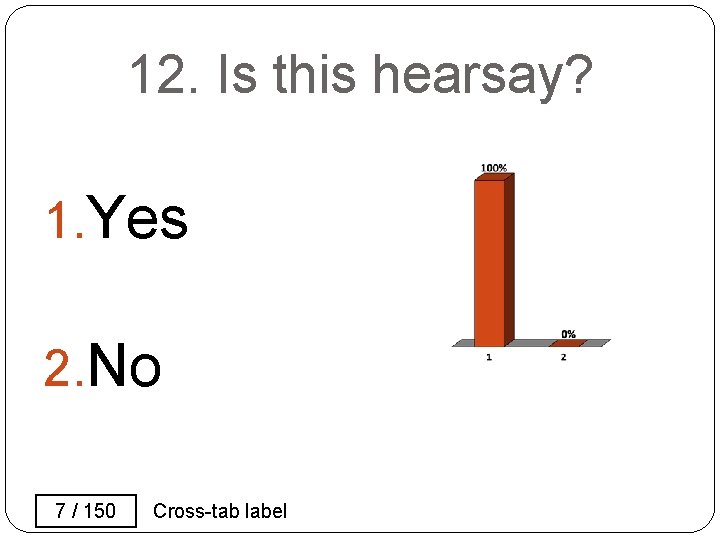
12. Is this hearsay? 1. Yes 2. No 7 / 150 Cross-tab label
Answer #12 No. Because Officer Franchek’s testimony left the impression that Defendant had not said anything about a permit, under the rule of completeness the statement was admissible, not for its truth, but for the fact that the statement was made. See, e. g. , Puma v. Sullivan, 746 A. 2 d 871, 876 (D. C. 2000). “Officer David's testimony, in other words, would not have been admitted to prove that appellant had gone to a shooting range and afterwards left his gun in the car innocently, but instead to prove only that he had given that account to the officer when arrested. ” Cox
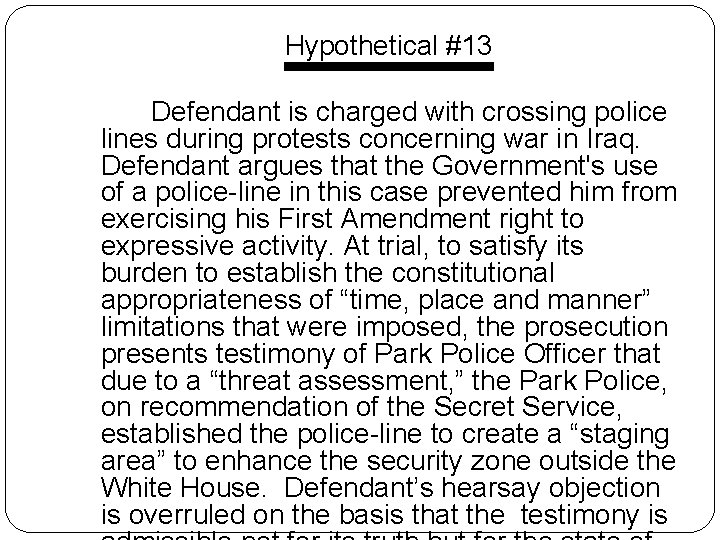
Hypothetical #13 Defendant is charged with crossing police lines during protests concerning war in Iraq. Defendant argues that the Government's use of a police-line in this case prevented him from exercising his First Amendment right to expressive activity. At trial, to satisfy its burden to establish the constitutional appropriateness of “time, place and manner” limitations that were imposed, the prosecution presents testimony of Park Police Officer that due to a “threat assessment, ” the Park Police, on recommendation of the Secret Service, established the police-line to create a “staging area” to enhance the security zone outside the White House. Defendant’s hearsay objection is overruled on the basis that the testimony is
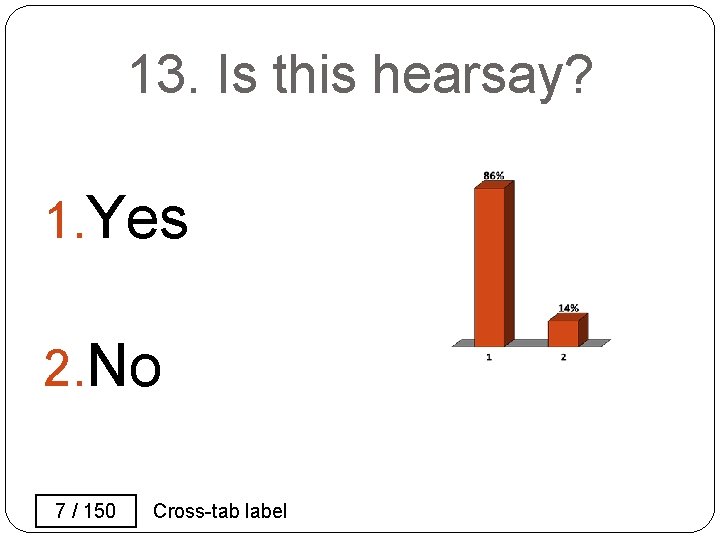
13. Is this hearsay? 1. Yes 2. No 7 / 150 Cross-tab label
Answer #13 Yes. “[T]he only evidence presented by the government to justify its establishment of the police-line was the hearsay and speculative testimony of [police officers] that the police-line was established to provide for a ‘staging area’ and the free flow of traffic. Because no competent, admissible testimony was presented sufficient to show that the restriction on expressive activity was narrowly tailored to serve a significant governmental interest, ” the conviction was reversed. Bloch v. District of Columbia, 863 A. 2 d 845, 846 -851 (D. C. 2004).
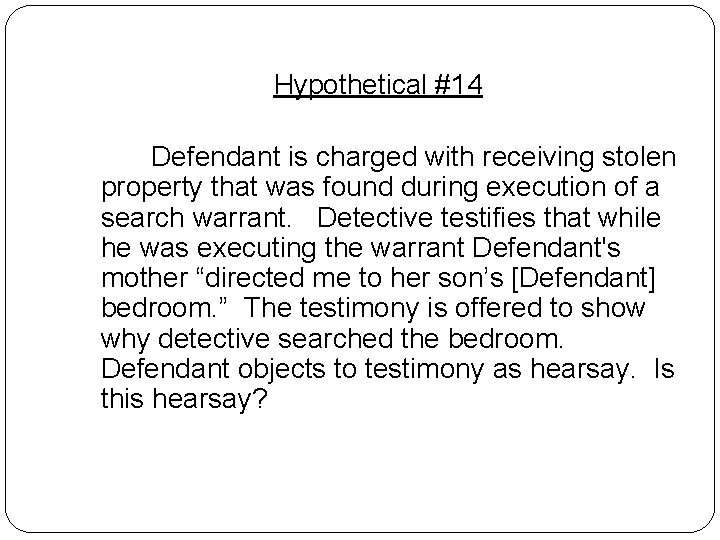
Hypothetical #14 Defendant is charged with receiving stolen property that was found during execution of a search warrant. Detective testifies that while he was executing the warrant Defendant's mother “directed me to her son’s [Defendant] bedroom. ” The testimony is offered to show why detective searched the bedroom. Defendant objects to testimony as hearsay. Is this hearsay?
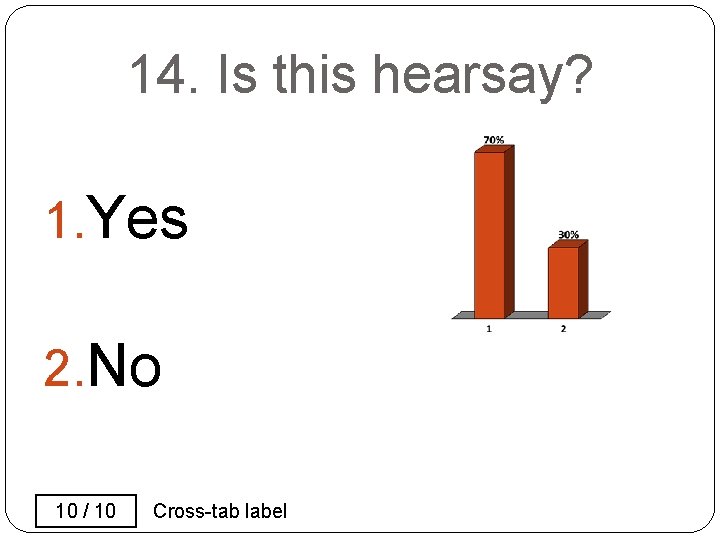
14. Is this hearsay? 1. Yes 2. No 10 / 10 Cross-tab label
Answer #14 Yes. “The only evidence presented which linked appellant with the stolen property was the hearsay statement introduced through the. . . detective. . [T]he detective’s testimony is a classic example of an out-of-court statement introduced to prove the truth of the facts it asserts. The statement was crucial to the government’s proof in connecting appellant to the bedroom where the property was found. ” In re H. , 399 A. 2 d 556, 557 -559 (D. C. 1979).
Hypothetical #15 Defendant is charged with murder of Victim with whom he had a long-term tumultuous relationship. Defendant’s defense is that Victim had the gun and gave him a “look” which caused him to grab her and the gun went off accidentally. On the issue of Victim’s state of mind, the prosecution offers testimony of three witnesses, who testify that Victim stated to them that Defendant “had beaten her and inflicted injuries, ” had “wanted to kill her, ” “had threatened her life and that she was very concerned about this because it was part of a pattern of abuse that had gone on for some
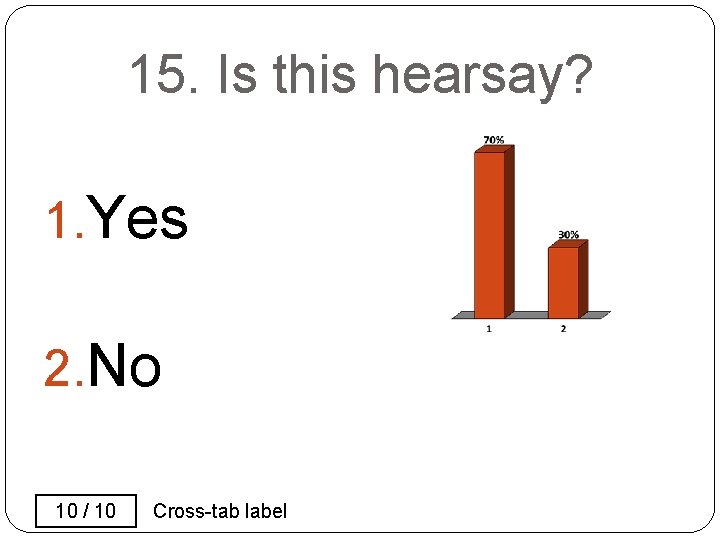
15. Is this hearsay? 1. Yes 2. No 10 / 10 Cross-tab label
Answer #15 No. “Where the defendant in a murder case has raised a defense of accident, suicide, or self-defense, the victim's [state of] mind is of particular concern to the jury. . A statement by the decedent that she was afraid of the defendant, or that the defendant has threatened her, may therefore be admissible if the decedent's state of mind is at issue. . [however, when ] this type of statement. . . also includes the allegation of an act which has not been proven by competent evidence … [t]he danger is that the jury, even with a proper limiting instruction, may be unable to use the statement as evidence of the declarant's state of mind without also erroneously concluding that the incident related in the statement has been proven to have occurred. ” Clark v.
Other Non-assertions: Legally Operative Acts, or Statements of Legal Significance (“Verbal Conduct”) Advisory Committee Note: “The effect [of the definition] is to exclude from hearsay the entire category of “verbal acts” and “verbal parts of acts” in which the statement itself affects the legal rights of parties or is a circumstance bearing on conduct affecting their rights. ”
�A party is offering statement or conduct to prove that the words were spoken or that the conduct occurred, and that legal rights and responsibilities attached as a result of the words or conduct. �Issue is what the statement or conduct does or constitutes legally, not whether it was true.
Examples: Puma v. Sullivan, 746 A. 2 d 871, 871 -876 (D. C. 2000)(Plaintiff’s testimony that deceased husband orally requested to modify promissory note, and extend the time for payment of promissory note on his behalf and his wife’s, not hearsay but verbal act with legal consequences). Doe v. Medlantic Health Care Group, Inc. , 814 A. 2 d 939, 942 -950 (D. C. 2003)(testimony that one employee told another that Plaintiff had AIDS admissible as a verbal act with regard to the invasion of privacy claim and not for its truth).
Evidence That is Not Hearsay Under D. C. law D. C. Code § 14 -102 (codifying Federal Rule 801) a statement is still not hearsay if it is an out‑of-court statement intended as an assertion by the declarant, offered to prove the truth of the matter asserted within the statement, and �The declarant testifies and is subject to cross‑examination, if it is:
Evidence That is Not Hearsay 1. A prior inconsistent statement given under oath at a prior trial, hearing or deposition. D. C. Code § 14 -102. Bell v. United States, 790 A. 2 d 523, 528 -9 (D. C. 2002) (not required that witness be given an opportunity to explain; only required that witness gave previous statement under oath and there is an opportunity to cross-examine).
If a prior inconsistent statement is unsworn, it may only be used for impeachment. See Carter v. United States, 614 A. 2 d 542, 545 (D. C. 1992) United States v. Livingston, 661 F. 2 d 239, 242 -3 (D. C. Cir. 1981). However, if the witness adopts an unsworn statement while testifying under oath at a prior proceeding, when a witness is impeached with a prior inconsistent statement it is admissible as substantive evidence. Koonce v. United States, 993 A. 2 d 544, 552 -553 (D. C. 2010). Examiner must establish that there is a material inconsistency. Sampson v. United States, 407 A. 2 d 574, 578 (D. C. 1979).
Counsel is entitled to have inconsistent portions of prior written statements admitted into evidence. Reed v. United States, 403 A. 2 d 725, 728 -9 (D. C. 1979).
Evidence That is Not Hearsay 2. A pre‑motive consistent statement, D. C. Code § 14 -102(b)(2). If witness is attacked (implicitly or explicitly) as having recently fabricated testimony or having an improper motive or influence, regardless if the statement was under oath, and the consistent statement was made at a time when the witness did not have a motive to fabricate, then the statement is not hearsay. Daye v. United States, 733 A. 2 d 321, 325 (D. C. 1999).
Recently, in Worthy v. United States, 100 A. 3 d 1095 (D. C. 2014), the DCCA may have expanded the scope of admissibility of prior consistent statements. The Court declared that “[t]he overriding principle is that consistent statements are admissible to rehabilitate a witness when the facts and circumstances of the statement have particular relevance in refuting theory of impeachment that has been advanced” and cited with approval a recent amendment to FRE 801 – adding subsection (d)(1)(B)(ii) – that allows admissibility of a prior consistent statement as substantive evidence when the statement is offered “to rehabilitate the declarant's credibility as a witness when attacked on another ground, ” id. at 1097 -98, but stopped short of adopting the amendment’s acceptance of prior consistent statements as substantive evidence. The change will be reflected in the Comment to Instruction 2. 27 appearing in the next update of the Criminal Jury Instructions for the District of Columbia.
Refusal/Reluctance to testify: In a recent case, Mc. Roy v. United States, 2015 D. C. App. LEXIS 5 (D. C. Jan. 15, 2015), the Court of Appeals has noted (without deciding) the issue of whether a refusal to testify about a certain subject is inconsistent with a previous statement discussing that topic. As the Court noted, there is case law on both sides of the issue. Some courts have analogized a refusal to testify on a subject to loss of memory of the witness. Diggs v. United States, 28 A. 3 d 585, 594 (D. C. 2011); United States v. Truman, 688 F. 3 d 129, 142 (2 d Cir. 2012); United States v. Iglesias, 535 F. 3 d 150, 159 (3 d Cir. 2008); People v. Homick, 55 Cal. 4 th 816, 150 Cal. Rptr. 3 d 1, 289 P. 3 d 791, 828 (Cal. 2012).
Other courts have reasoned that a witness’s refusal to testify is unlike a claim of memory loss because there is no current testimony to compare with the prior statement. See Tyler v. State, 342 Md. 766, 679 A. 2 d 1127, 1132 (Md. 1996); Barksdale v. State, 265 Ga. 9, 453 S. E. 2 d 2, 4 (Ga. 1995); State v. Williams, 182 N. J. Super. 427, 442 A. 2 d 620, 623 (N. J. Super. Ct. App. Div. 1982). Despite its recognition of the split among courts, the Court of Appeals stated did not resolve “the more abstract question of inconsistency” because it concluded that the government did not lay a sufficient foundation to demonstrate the witness was refusing to testify on an issue.
Before avoiding the issue the Court noted, “The common-law tradition is one of live testimony in court subject to adversarial testing. . Thus, a strong preference for live testimony undergirds the rules of evidence. . [M]any of those [hearsay] concerns are ameliorated because the declarant testifies at trial, prior consistent statements of a witness are inadmissible for their truth unless they meet the requirements of D. C. Code § 14 -102 (b)(1) because of ‘an unwillingness to countenance the general use of prior prepared statements as substantive evidence. . ’ Fed. R. Evid. 801 (d)(1) advisory committee's note (1972). Unless an out-of-court statement falls within one of the recognized exceptions to the rule against hearsay, it may not be used to supply the testimony of a witness. ” (Citations omitted).
Evidence That is Not Hearsay 3. A prior identification, regardless of when identification made and whether it was under oath. D. C. Code § 14 -102(b)(3); FRE 801(d)(1)(C). May apply to prior descriptions. Scott v. United States, 619 A. 2 d 917, 921 (D. C. 1992). Applies even when the declarant is uncertain of or recants his prior identification in court. Sparks v. United States, 755 A. 2 d 394, 399 -400 (D. C. 2000)(“Sparks asserts that ‘evidence of a prior identification is not properly admissible when the declarant is uncertain of, or recants, the prior
Declarant need not remember making the identification in order to be available for crossexamination. United States v. Owens, 484 U. S. 554, 561 -2 (1988). The prior identification is admissible “through the testimony of either the identifier or a third party who was present when the identification was made. ” (Larry) Brown v. United States, 840 A. 2 d 82, 88 (D. C. 2004)(citing Morris v. United States, 398 A. 2 d 333, 336 (D. C. 1978).
Descriptions of an event itself stated during the identification are admissible only to the extent necessary to provide context to the identifications. See Lewis v. United States, 996 A. 2 d 824, 829 -30 (D. C. 2010) (citing Porter v. United States, 826 A. 2 d 398, 410 (D. C. 2003)).
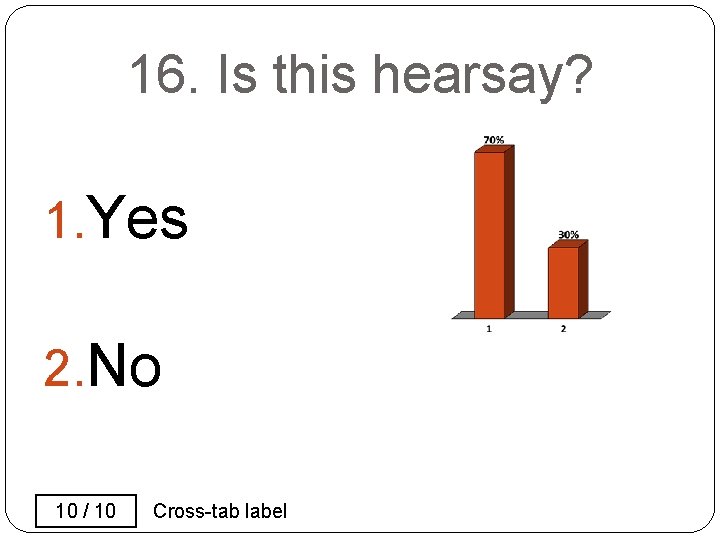
Hypothetical #16 A few weeks after a murder, Witness calls Homicide Detective and states that Defendants told him that they were involved. Prior to trial, Witness suffers significant medical issues which cause loss of memory about what was told to him, although he is able to testify. The prosecution seeks to call Homicide Detective to testify as to what the witness told him concerning Defendants’ confession to him as a statement of identification. Defendants object, arguing that Witness did not observe the murder. Is this hearsay?
16. Is this hearsay? 1. Yes 2. No 10 / 10 Cross-tab label
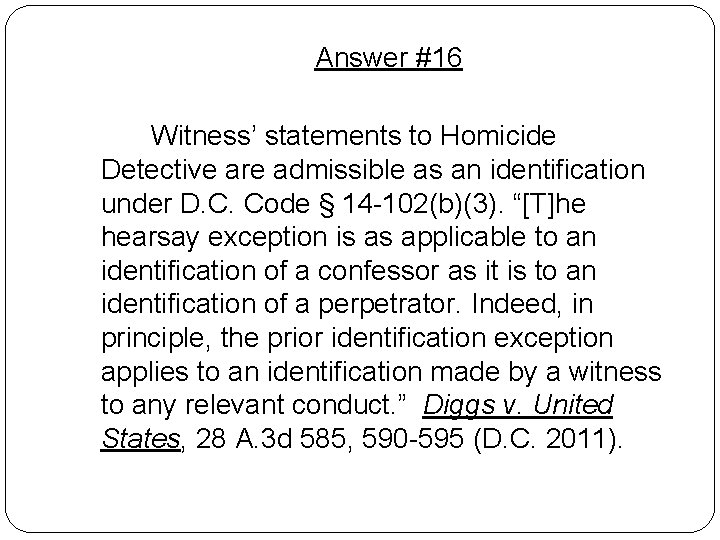
Answer #16 Witness’ statements to Homicide Detective are admissible as an identification under D. C. Code § 14 -102(b)(3). “[T]he hearsay exception is as applicable to an identification of a confessor as it is to an identification of a perpetrator. Indeed, in principle, the prior identification exception applies to an identification made by a witness to any relevant conduct. ” Diggs v. United States, 28 A. 3 d 585, 590 -595 (D. C. 2011).
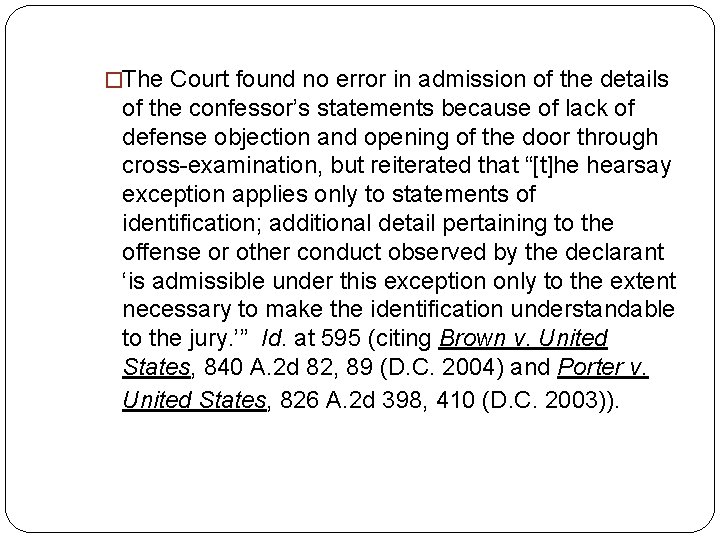
�The Court found no error in admission of the details of the confessor’s statements because of lack of defense objection and opening of the door through cross-examination, but reiterated that “[t]he hearsay exception applies only to statements of identification; additional detail pertaining to the offense or other conduct observed by the declarant ‘is admissible under this exception only to the extent necessary to make the identification understandable to the jury. ’” Id. at 595 (citing Brown v. United States, 840 A. 2 d 82, 89 (D. C. 2004) and Porter v. United States, 826 A. 2 d 398, 410 (D. C. 2003)).
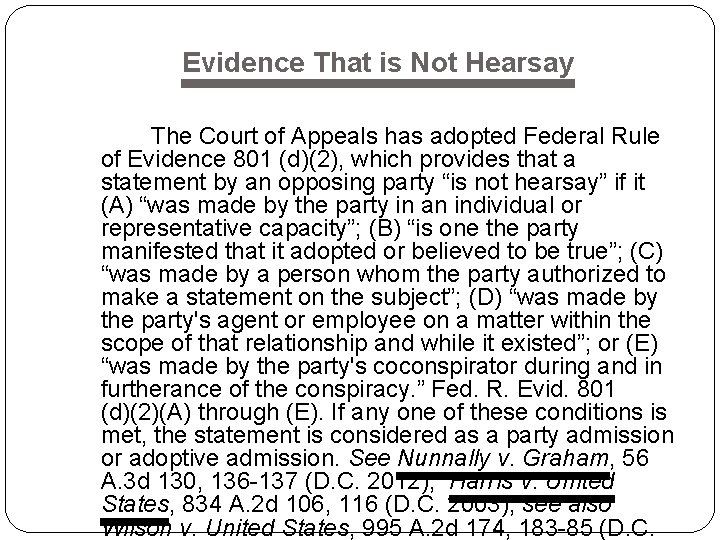
Evidence That is Not Hearsay The Court of Appeals has adopted Federal Rule of Evidence 801 (d)(2), which provides that a statement by an opposing party “is not hearsay” if it (A) “was made by the party in an individual or representative capacity”; (B) “is one the party manifested that it adopted or believed to be true”; (C) “was made by a person whom the party authorized to make a statement on the subject”; (D) “was made by the party's agent or employee on a matter within the scope of that relationship and while it existed”; or (E) “was made by the party's coconspirator during and in furtherance of the conspiracy. ” Fed. R. Evid. 801 (d)(2)(A) through (E). If any one of these conditions is met, the statement is considered as a party admission or adoptive admission. See Nunnally v. Graham, 56 A. 3 d 130, 136 -137 (D. C. 2012); Harris v. United States, 834 A. 2 d 106, 116 (D. C. 2003); see also Wilson v. United States, 995 A. 2 d 174, 183 -85 (D. C.
Although the Court of Appeals has adopted the substance of Rule 801 (d)(2), “our cases continue to treat party-admissions as an exception to the rule against hearsay. ” Wilson v. United States, 995 A. 2 d 174, 183 (D. C. 2010). In the context of Confrontation Clause analysis, however, the Court of Appeals has stated, “we believe it is appropriate to utilize the federal framework of analysis -- i. e. , the rule that a statement adopted as a party-admission is not hearsay (rather than the rule of our case law that party-admissions are admissible under an exception to the hearsay rule). ” Wilson v. United States, 995 A. 2 d 174, 183 (D. C. 2010).
Consequently, under D. C. law, a statement is still admissible even if it is an out‑of-court statement intended as an assertion by the declarant, and offered to prove the truth of the matter asserted within the statement, if �Regardless of whether the declarant testifies, it is:
Evidence That is Not Hearsay 1. A statement made or adopted by the opposing party (expressly or by silence), FRE 801(d)(2)(A), (B). This does not require an explicit statement of adoption; all that is necessary is some manifestation of a party’s intent to adopt another's statements, or evidence of the party's belief in the truth of the statements. �“‘[S]tatements are admissible as adoptive admissions so long as there is sufficient evidence from which a jury could reasonably conclude that the defendant unambiguously adopted’ another's statement. . One ‘factor [used to] support[] a finding of adoption is the extent that the adoptive party accepted and acted upon the evidence. ’”
�“Whether a party has adopted the statement of another is a preliminary question of fact for the trial judge, which is determined by considering the ‘context … and the surrounding circumstances’ of the claimed adoption. … The party seeking to introduce evidence as an adopted admission has the burden to produce ‘specific proof of such adoption. ’” Harris v. United States, 834 A. 2 d 106, 116 -117 (D. C. 2003) (internal citations omitted). �Party admissions do not require additional foundations beyond the fact that they are made by a party or his/her agent to be admissible as substantive evidence; they need not have been made on personal knowledge and may be in opinion form. �They are to receive “generous treatment, ” because of a party’s ability to rebut the out-of-court statement by
�Guarantee of trustworthiness is not an aspect of the admissibility of a statement of a party opponent, and the presence of the party at trial is irrelevant. Id. ; see also Freeland v. United States, 631 A. 2 d 1186, 1194 (D. C. 1993).
2. A statement by the party’s agent so long as the agent (i) was authorized by the party to make a statement concerning the subject or (ii) made a statement concerning a matter within the agent’s scope of agency and during the agency relationship, FRE 801(d)(2)(C) & (D). Speights v. 800 Water St. , Inc. , 4 A. 3 d 471, 473 -477 (D. C. 2010). In some circumstances, statements made by Assistant United States Attorney are admissible against the government in a criminal case. Harris v. United States, 834 A. 2 d 106, 116 (D. C. 2003) (statements made in affidavit in support of a search warrant); Freeland v. United States, 631 A. 2 d 1186, 1193 -94 (D. C. 1993) (statements made by AUSA in E. D. Va about trustworthiness of Defendant’s grand jury testimony and fear of retaliation admissible against government as statement of a party opponent in Defendant’s Superior Court murder trial to prove
In Harris, the Court of Appeals rejected the Government’s argument that statements in a warrant should not qualify as admissions because the purpose being served is “investigatory” not “prosecutorial. ” “But the distinction between ‘investigatory’ and ‘prosecutorial’ stages is an artificial one that is illsuited to answering the real question of whether the government adopted the statements in question. . An application for a warrant is not a mere investigative report or offhand remark. Its contents are not an undigested stew of investigative leads. The warrant affidavit is a sworn statement, reviewed and approved by the government's attorney, that the information known to the affiant and set forth in the application is reliable enough to engender a prudent belief that the subject of the warrant has committed a crime, and reliable enough as well to justify a search or seizure under the Fourth Amendment. We see little reason to exempt sworn, constitutionally required representations to the court from the party admission rule merely because they are made pre-indictment. ”
3. Statements by a co‑conspirator made during and in furtherance of a conspiracy FRE 801(d)(2)(E); Butler v. United States, 481 A. 2 d 431, 438 -9 (D. C. 1984). Such statements may be admitted as non-hearsay evidence only if the court finds it more likely than not that (1) a conspiracy existed, (2) the defendant had a connection with the conspiracy, and (3) the coconspirator made the statements during the course of and in furtherance of the conspiracy. Butler, 481 A. 2 d at 439. The court may only consider “independent nonhearsay evidence, ” i. e. , evidence other than the coconspirator’s statement. Jenkins v. United States, 80 A. 3 d 978, 990 -91 (D. C. 2013) (not following Bourjaily v. United States, 483 U. S. 171 (1987). However, this limitation is necessary only if the