
Evidence Collection Crime Scene Documentation Methods of Documentation
- Slides: 11
Evidence Collection: Crime Scene Documentation
Methods of Documentation �The purpose is to record and preserve the location and relationship of discovered evidence & the condition of the crime scene. � 4 methods Reports and note-taking (sometimes audio) Photographs Vidography Crime Scene Sketching
Crime Scene Sketching �Is a permanent record of the size and distance relationship of the crime scene and the physical evidence within it. �Usually drawn from an overhead perspective � 2 types are produced Rough sketch Final sketch
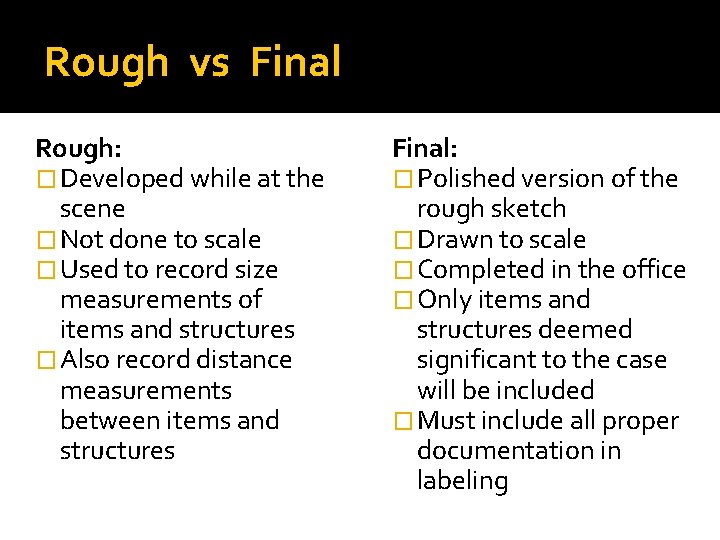
Rough vs Final Rough: � Developed while at the scene � Not done to scale � Used to record size measurements of items and structures � Also record distance measurements between items and structures Final: � Polished version of the rough sketch � Drawn to scale � Completed in the office � Only items and structures deemed significant to the case will be included � Must include all proper documentation in labeling
Labeling of Final Sketch �Title – ex: ABC Bank Robbery �Legend – “key” depicting what each symbol in the sketch means �Case information – date, time, place, case # �Name – name of person who drew the sketch �Indication of direction (N-S-E-W) �Scale – ex: 1 inch = 1 foot
5 Basic Sketch Techniques �Triagulation Mapping �Polar Coordinate Mapping �Baseline Mapping �Rectangular Coordinate Mapping �Advanced Mapping Techniques
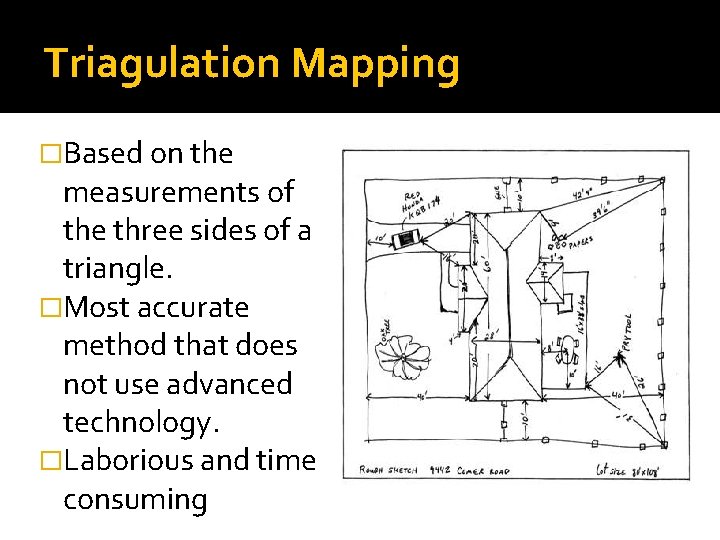
Triagulation Mapping �Based on the measurements of the three sides of a triangle. �Most accurate method that does not use advanced technology. �Laborious and time consuming
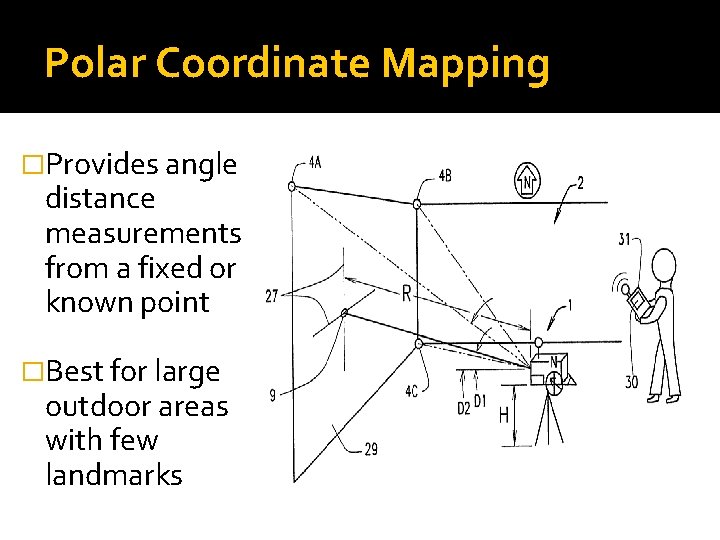
Polar Coordinate Mapping �Provides angle distance measurements from a fixed or known point �Best for large outdoor areas with few landmarks
Baseline Mapping �Most basic �Least accurate �All measurements are made in reference to one straight line within the crime scene �Error comes from measurements not being taken at exactly 90º angle from the reference line
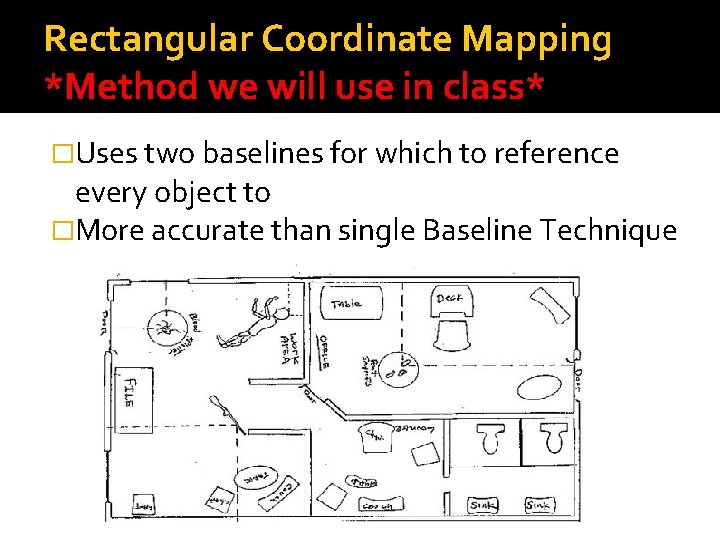
Rectangular Coordinate Mapping *Method we will use in class* �Uses two baselines for which to reference every object to �More accurate than single Baseline Technique
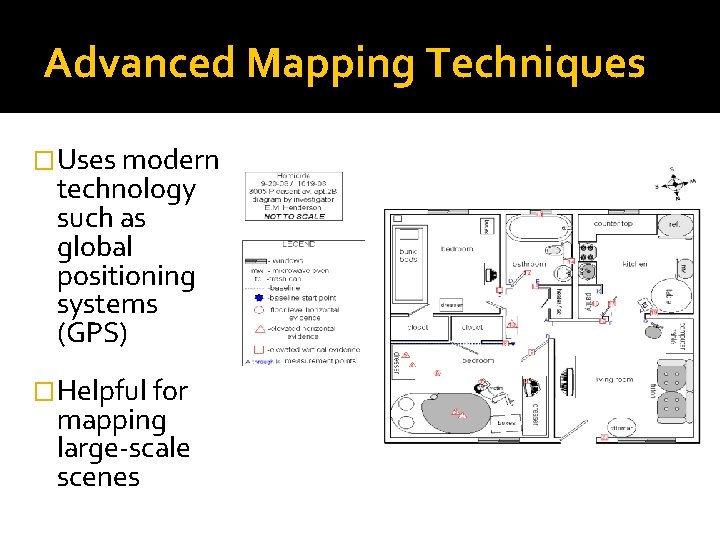
Advanced Mapping Techniques �Uses modern technology such as global positioning systems (GPS) �Helpful for mapping large-scale scenes