
Evidence Based Practice Training Prompting Objectives Become aware
Evidence Based Practice Training Prompting
Objectives • Become aware of 27 EBPs identified for learners with ASD • Describe key steps to using prompting – How to prepare for implementation – How to implement – How to assess progress • Identify key pitfalls and ways to avoid them • Identify ways to learn more about how to implement prompting
What are EBPs? Focused interventions that: • Produce specific behavioral and developmental outcomes for a learner • Have been demonstrated as effective in applied research literature • Can be successfully implemented in educational settings (Odom, Colett-Klingenberg, Rogers, & Hatton, 2010)
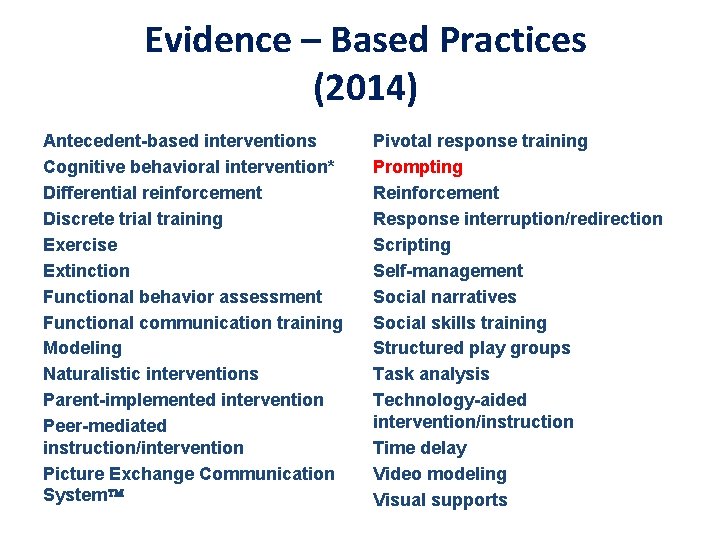
Evidence – Based Practices (2014) Antecedent-based interventions Cognitive behavioral intervention* Differential reinforcement Discrete trial training Exercise Extinction Functional behavior assessment Functional communication training Modeling Naturalistic interventions Parent-implemented intervention Peer-mediated instruction/intervention Picture Exchange Communication System Pivotal response training Prompting Reinforcement Response interruption/redirection Scripting Self-management Social narratives Social skills training Structured play groups Task analysis Technology-aided intervention/instruction Time delay Video modeling Visual supports
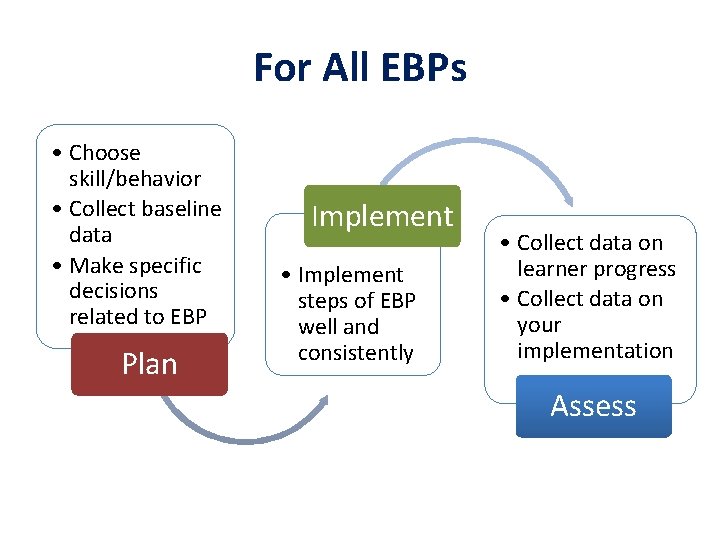
For All EBPs • Choose skill/behavior • Collect baseline data • Make specific decisions related to EBP Plan Implement • Implement steps of EBP well and consistently • Collect data on learner progress • Collect data on your implementation Assess
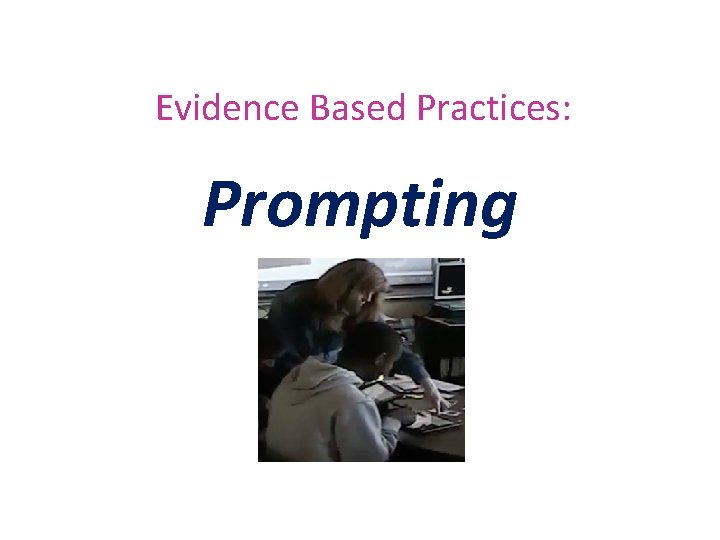
Evidence Based Practices: Prompting
Who uses Prompting?
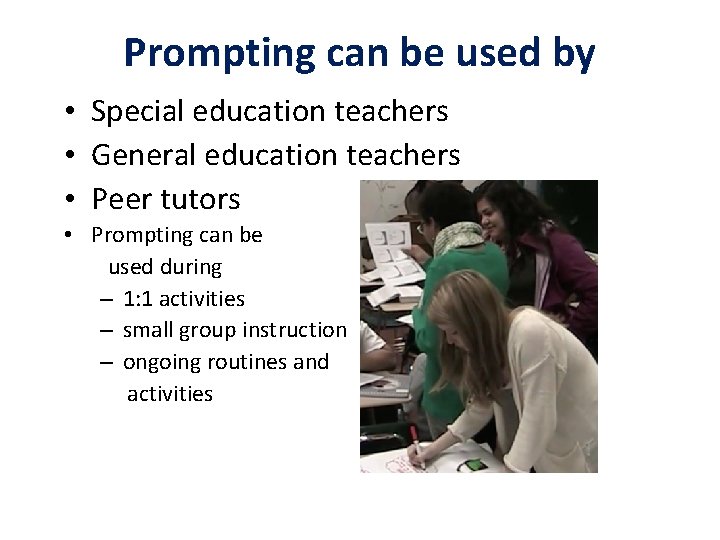
Prompting can be used by • Special education teachers • General education teachers • Peer tutors • Prompting can be used during – 1: 1 activities – small group instruction – ongoing routines and activities
Common Pitfalls Verbal verbal Physical physical No wait time Inappropriate prompts Not catching errors Response to learner not immediate • Prompts not faded effectively • • •
What is prompting? • An evidence-based teaching method that: – Prompting procedures include any help given to learners that assist them in using a specific skill. Capitalizes on observational learning. – Often used in conjunction with other evidencebased practices including time delay and reinforcement. – Generally given by an adult or peer before or as a learner attempts to use a skill.

Definition of Prompting & Prompts • Prompting Procedures – ØAny help given to learners to assist them in using a specific skill • Prompts – ØSpecific forms of assists given before or as the learner attempts to use a skill
Why use Prompting? • An efficient and effective way to provide instruction to learners with ASD that maximizes their success and increases their generalized use of target skills § errorless learning • Procedures designed to reduce incorrect responding as learners acquire new skills
Target Skills Addressed Prompting can be used to teach a variety of skills, including: • seeking information, pointing to objects, • remaining in “on-task” behavior, various academic skills, communication, • social skills, and motor tasks
Types of Prompts • • • Physical – hand-over-hand Gestural – gesture signal Model – show what to do Visual – pictorial/written cue Verbal – spoken words/signs • Controlling prompt – one that results in learner doing behavior correctly
Verbal Prompts Description: Teacher/practitioner verbally gives a hint, a clue, or a direction. Example: When teaching Jill to read the word “agitated, ” the teacher gave a hint (e. g. , “It starts with A”) or some other clue (e. g. , “It means unhappy. ”).
Gestural Prompts Description: Teacher/practitioner makes some kind of gesture to prompt the learner to use the target skill. Example: When teaching Jeff how to solve algebraic equations, the teacher pointed to the box of manipulatives for Jeff. For another learner, she gestured toward the book drop in the library when teaching the learner library procedures.
Full Model Prompts Description: Teacher/practitioner models the target skill for the learner with ASD. Full model prompts can be verbal if the skill being taught is verbal, or they can be motor responses, if the skill being taught involves moving a body part.
Full Model Prompts Examples: When teaching Bill to fill out a voting ballot, the teacher wrote her name on her ballot and said, “Write your name here, Bill. ” When teaching a Samantha how to multiply, the teacher said, “Count with me, Samantha. 5 -10 -15. ”
Partial Model Prompt Description: Teacher/practitioner models only part of the target skill for the learner with ASD – either verbal or motor. Example: When teaching Joshua how to request assistance during class, the teacher reached her hand in the direction of Joshua’s AAC device.
Full Physical Prompts Description: Teacher/practitioner leads a learner through the task by providing full physical assistance (e. g. , hand-over-hand) to ensure correct use of the target skill. Example: When teaching Shelly how to use the computer, the teacher took Shelly’s hand guided her through the process.
Partial Physical Prompt Description: Teacher/practitioner provides minimal physical assistance to help the learner use the target skill correctly. Taps, nudges, and light pushes are used. Example: When teaching Henry how to determine main idea during reading, the teacher nudged Henry’s elbow so that she selected a response.
Visual Prompts Description: Pictures of events that provide learners with information about how to use the target skill or behavior. Example: Task analysis checklist, transition picture card. The teacher used a transition picture card to warn Holly of upcoming transitions.
Prompting Procedures • Least-to-most (aka system of least prompts) – Sequence from the least amount of help to the most amount of help • Simultaneous – Cue and controlling prompt delivered simultaneously • Graduated Guidance – Gradually removing prompt during teaching
3 Components of Prompting Procedures • All of these prompting procedures contain three main components: § the antecedent (i. e. , target stimulus and cue/task direction) that tells the learner to use the target skill, § the target skill (i. e. , learner response), and § the consequence (i. e. , feedback/reinforcement provided by teachers/practitioners).
Least-to-Most • Learner may be using target skill, but not consistently • Learner may be in regression • For: – Discrete skills – single response of short duration – Chained skills – series of behaviors put together to form complex skill – Response classes - groups of responses with same function • Imitating peers • Having conversations with peers • Initiating social interactions
Least-to-Most: Steps for Preparing for the Intervention Step 1. Identifying the Target Skill/Behavior Step 2. Identifying the Target Stimulus Step 3. Selecting Cues or Task Directions Step 4. Selecting Reinforcers Step 5. Identifying Activities and Times for Teaching
Least-to-Most: Steps for Preparing for the Intervention Step 6. Selecting the Number of Levels in the Hierarchy Step 7. Selecting the Types of Prompts to Be Used Step 8. Sequencing Prompts from Least-to. Most Assistance Step 9. Determining the Length of the Response Interval
Least-to-Most: Steps for Implementing the Intervention Step 1. Establishing Learner Attention, Delivering the Stimulus, and Providing the Cue Step 2. Waiting for the Learner to Respond Step 3. Responding to Learners’ Attempts Step 4. Monitoring Learner Outcomes
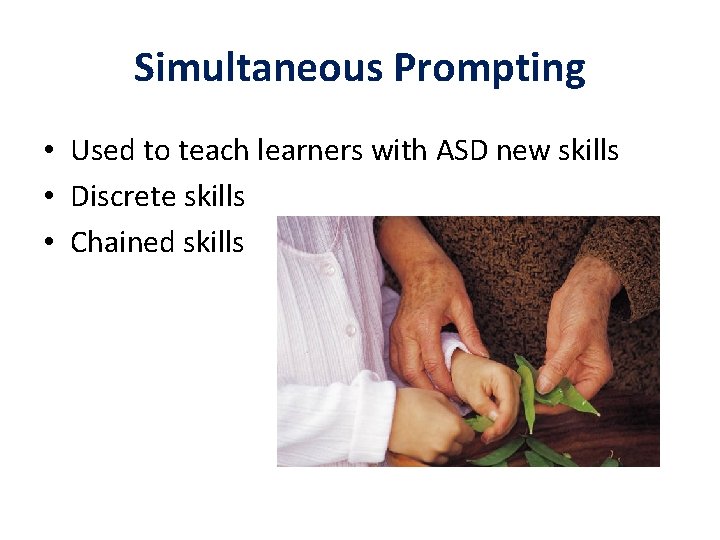
Simultaneous Prompting • Used to teach learners with ASD new skills • Discrete skills • Chained skills
Simultaneous Prompting: Steps for Preparing for the Intervention Step 1. Identifying the Target Skill/Behavior Step 2. Selecting the Target Stimulus and Cue Step 3. Selecting a Controlling Prompt Step 4. Selecting Reinforcers Step 5. Determining the Response Interval Step 6. Identifying Activities and Times for Teaching
Simultaneous Prompting: Steps for Implementing the Intervention Step 1. Establishing Learner Attention, Delivering the Stimulus, and Providing the Cue Step 2. Implementing the Prompt Step 3. Monitoring Learner Progress
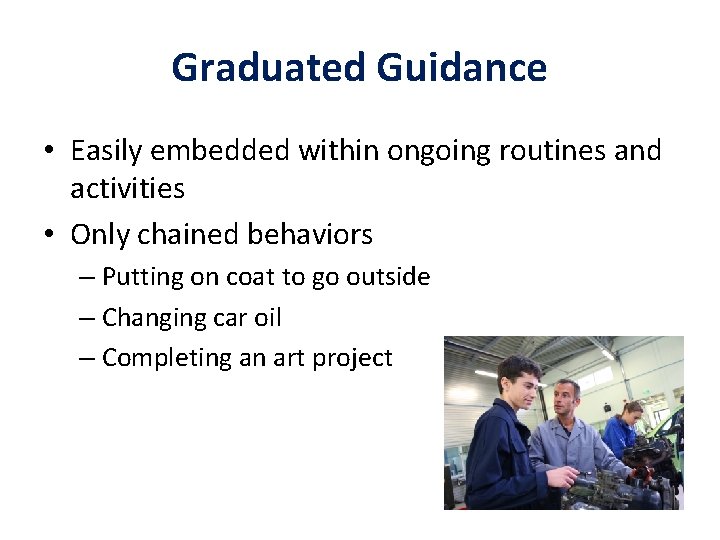
Graduated Guidance • Easily embedded within ongoing routines and activities • Only chained behaviors – Putting on coat to go outside – Changing car oil – Completing an art project
Graduated Guidance: Steps for Preparing for the Intervention 1. Selecting and Describing the Target 2. 3. 4. 5. 6. 7. 8. Skill/Behavior Identifying the Target Stimulus Selecting the Cue or Task Direction Selecting Reinforcers Identifying the Controlling Prompt Determining the Length of the Response Interval Specifying Prompt Fading Procedures Identifying Activities and Times for Teaching
Graduated Guidance: Steps for Implementing the Intervention Step 1. Implementing Graduated Guidance Step 2. Monitoring Learner Progress
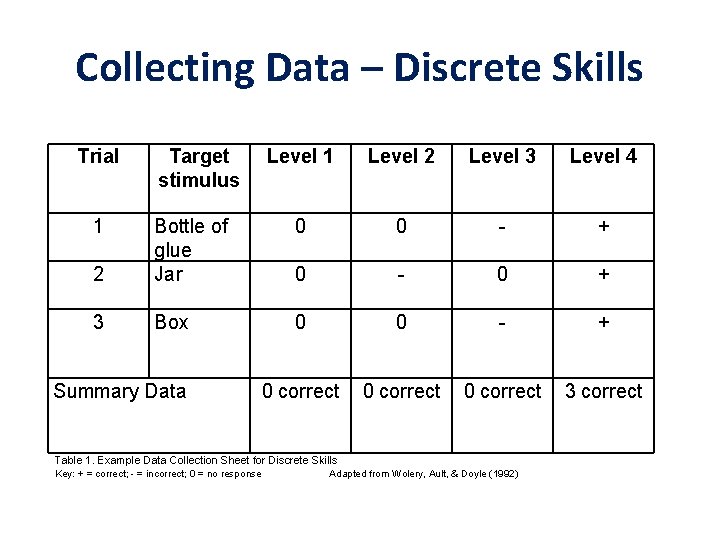
Collecting Data – Discrete Skills Trial Level 1 Level 2 Level 3 Level 4 0 0 - + 2 Bottle of glue Jar 0 - 0 + 3 Box 0 0 - + 0 correct 3 correct 1 Target stimulus Summary Data Table 1. Example Data Collection Sheet for Discrete Skills Key: + = correct; - = incorrect; 0 = no response Adapted from Wolery, Ault, & Doyle (1992)
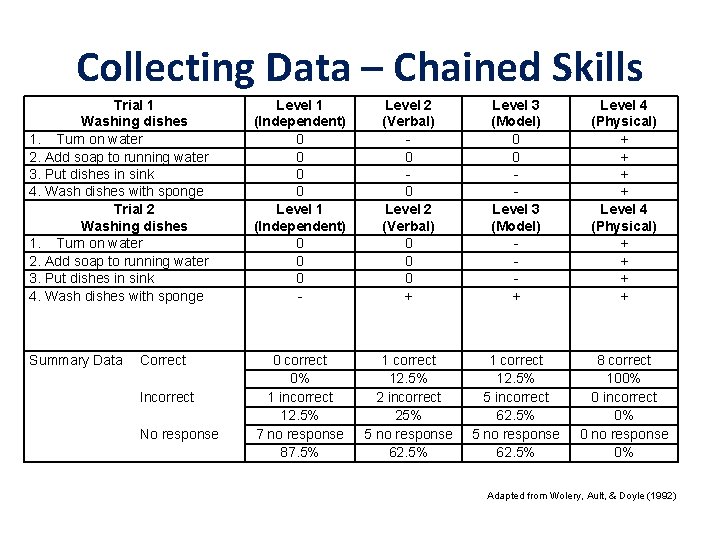
Collecting Data – Chained Skills Trial 1 Washing dishes 1. Turn on water 2. Add soap to running water 3. Put dishes in sink 4. Wash dishes with sponge Trial 2 Washing dishes 1. Turn on water 2. Add soap to running water 3. Put dishes in sink 4. Wash dishes with sponge Level 1 (Independent) 0 0 0 - Level 2 (Verbal) 0 0 0 + Level 3 (Model) 0 0 Level 3 (Model) + Level 4 (Physical) + + + + Summary Data 0 correct 0% 1 incorrect 12. 5% 7 no response 87. 5% 1 correct 12. 5% 2 incorrect 25% 5 no response 62. 5% 1 correct 12. 5% 5 incorrect 62. 5% 5 no response 62. 5% 8 correct 100% 0 incorrect 0% 0 no response 0% Correct Incorrect No response Adapted from Wolery, Ault, & Doyle (1992)
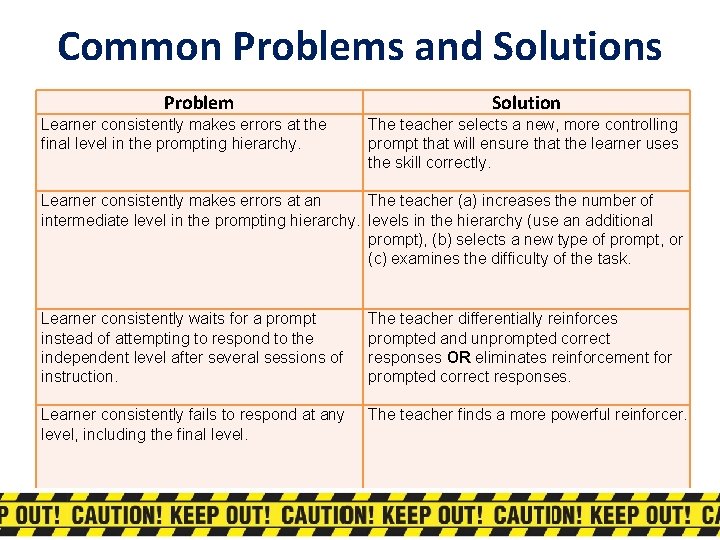
Common Problems and Solutions Problem Learner consistently makes errors at the final level in the prompting hierarchy. Solution The teacher selects a new, more controlling prompt that will ensure that the learner uses the skill correctly. Learner consistently makes errors at an The teacher (a) increases the number of intermediate level in the prompting hierarchy. levels in the hierarchy (use an additional prompt), (b) selects a new type of prompt, or (c) examines the difficulty of the task. Learner consistently waits for a prompt instead of attempting to respond to the independent level after several sessions of instruction. The teacher differentially reinforces prompted and unprompted correct responses OR eliminates reinforcement for prompted correct responses. Learner consistently fails to respond at any level, including the final level. The teacher finds a more powerful reinforcer.
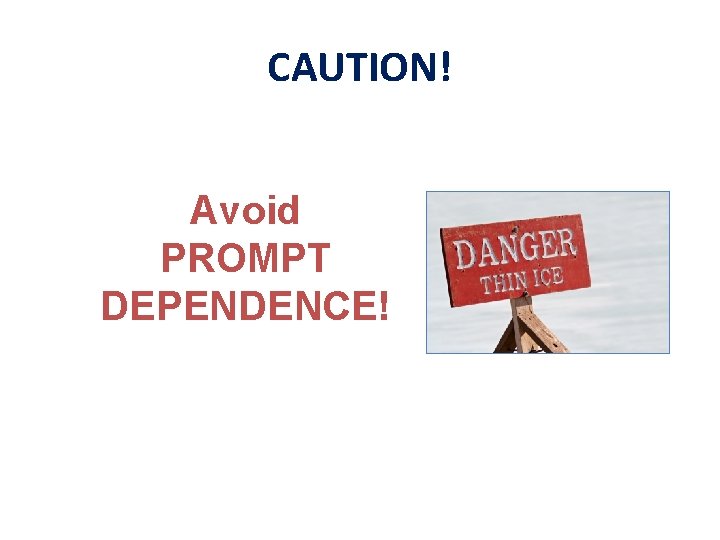
CAUTION! Avoid PROMPT DEPENDENCE!
The Key to Effective Prompting • Prompts should focus learner’s attention on the discriminative stimulus, not distract from it • Prompts should be as weak as possible • Unplanned prompts should be avoided • Prompts should be faded as quickly as possible – prompt dependency occurs as result of using prompts when not needed

To Learn More… Find additional information on Prompting and other Evidence Based Practices within the following resources.
Evidence-based Practice Resources • EBP literature review http: //autismpdc. fpg. unc. edu/sites/autismpdc. fpg. unc. edu/files/2014 -EBP-Report. pdf • EBP Case Studies for High School • EBP Briefs (http: //autismpdc. fpg. unc. edu) – Overview – Evidence Base – Steps for Implementing – Implementation Checklist – Sample Data Collection Forms (optional) • Autism Internet Modules (http: //www. autisminternetmodules. org)
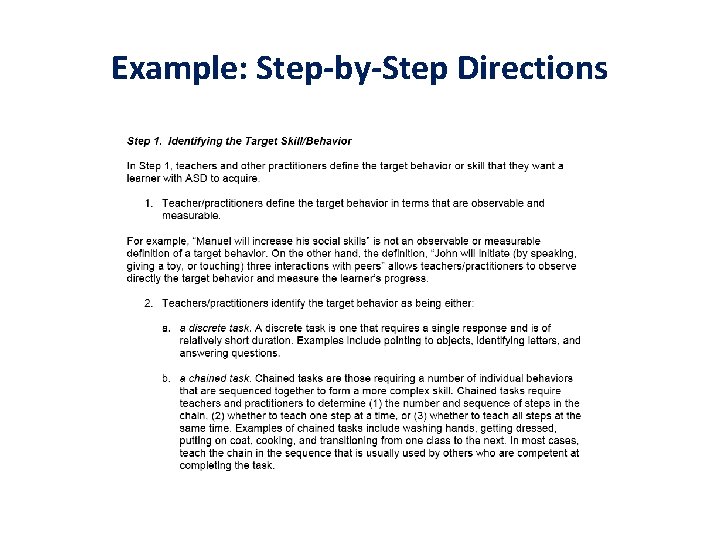
Example: Step-by-Step Directions

EBP Literature Review

EBP Case Studies for High School http: //csesa. fpg. unc. edu/resources/evidence-based-practices-case-studies
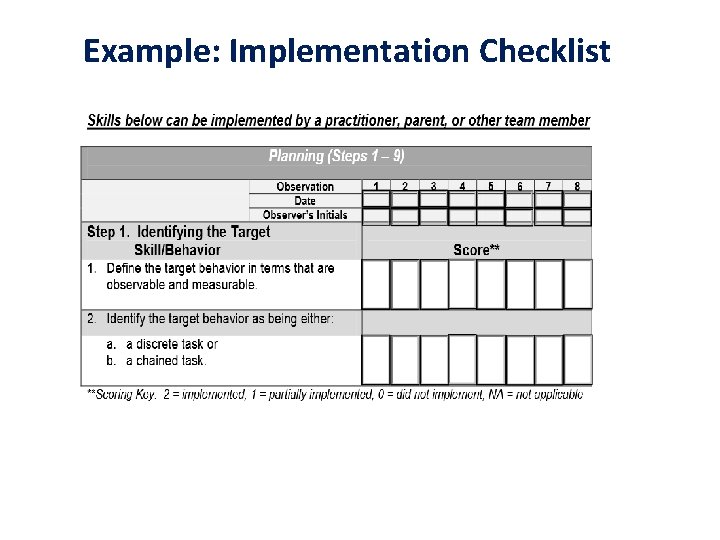
Example: Implementation Checklist
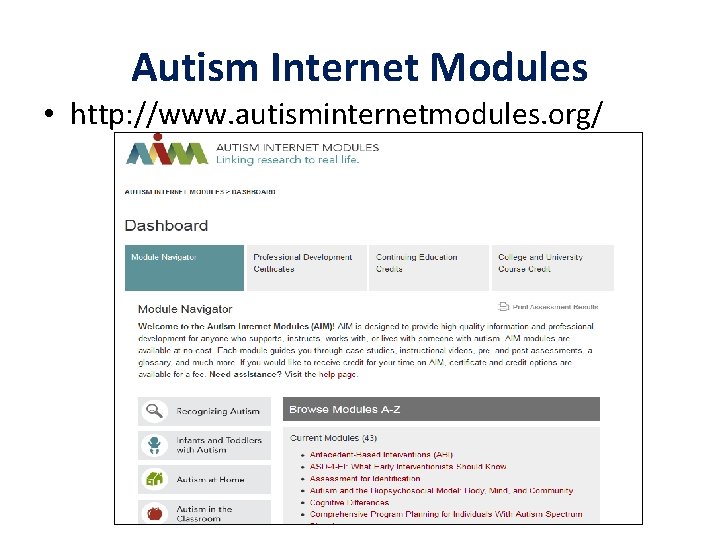
Autism Internet Modules • http: //www. autisminternetmodules. org/
Action Plan What will I do tomorrow: 1. 2. 3.

Questions
- Slides: 48