
Evidence Based Practice Selective Mutism University of Utah

+ Evidence Based Practice: Selective Mutism University of Utah Presented by: Mary Beth Pummel 05. 2009 Training School Psychologists to be Experts in Evidence Based Practices for Tertiary Students with Serious Emotional Disturbance/Behavior Disorders US Office of Education 84. 325 K H 325 K 080308
+ Selective Mutism: Diagnostic Features n Failure to speak in specific social situations despite speaking in other settings (DSM-IV-TR). n Children with selective mutism (SM) often rely on other forms of communication to function (gestures, shaking head, pointing, grunting, etc. ) (Sharp, Sherman, & Gross, 2007). n Frequently shy, behaviorally avoidant, fearful, and often oppositional (Kehle, Madaus, Baratta, & Bray, 1998).
+ DSM-IV-TR Diagnostic Criteria n 313. 23 Selective Mutism n Consistent failure to speak in specific social situations despite speaking in other situations n The disturbance interferes with educational or occupational achievement or with social communication n The duration of the disturbance is at least 1 month n The failure to speak is not due to a lack of knowledge of, or comfort with, the spoken language required in the social situation n The disturbance is not better accounted for by a Communication Disorder and does not occur extensively during the course of a Pervasive Developmental Disorder, Schizophrenia, or other Psychotic Disorder.
+ Selective Mutism: History and Current Conceptualizations n First described in 1877 as ‘aphasia voluntaria’ by Kussmaul when documenting a condition in which an individual did not speak in certain situations, despite the ability to speak (Sharp et al. , 2007; Viana, Beidel, & Rabian, 2008). n Labeled as “elective mutism” in DSM-III and DSM-III-TR n n To reflect the voluntary condition of SM n Conceptualized as a form of oppositional behavior Change to “selective mutism” in DSM-IV (1994) n To reflect refusal to speak in specific situations n Currently conceptualized as either a form of oppositional behavior or social anxiety
+ Selective Mutism: Prevalence, Etiology and Course n Less than 1% of school-age children meet diagnostic criteria (Sharp et al. , 2007). n No clear etiology: likely a combination of environmental and genetic factors (Viana et al. , 2008) n n Family history of social phobia or other anxiety disorders n Maladaptive reinforcement patterns Age of onset 2 to 5 years (Cunningham, Mc. Holm, Boyle, Patel, 2004). n Often a significant lag between onset and diagnosis/intervention n Duration 37 to 151 months (m=6. 9 years)
+ Selective Mutism: Prevalence, Etiology and Course n n SM often occurs comorbidly with other anxiety disorders and other psychological symptoms (Sharp et al. , 2007; Viana et al. , 2008). n Overlapping characteristics with social phobia n Internalizing symptoms Comorbidity with externalizing disorders (Viana et al. , 2008) n n Occurs in 6 -10% of children diagnosed with SM The effect of treatment is stronger if treatment occurs shortly after the onset of SM (Stone, Kratochwill, Sladezcek, & Serlin, 2002)
+ Selective Mutism: Assessment n Direct Observation n Parent/Teacher/Child Interview n Selective Mutism Questionnaire (SMQ) (Bergman, Keller, Piacentini & Bergman, 2008). n Functional Behavior Assessment n Behavior Rating Scales n Behavior Assessment System for Children – Second Ed. n Child Behavior Checklist n Anxiety Disorders Interview Schedule n Revised Children’s Manifest Anxiety Scale
+ Selective Mutism: Assessment n DSM-IV-TR Diagnostic Criteria n Referral to Pediatrician and Speech-Language Pathologist
+ Selective Mutism: Treatment and Intervention n n Behavior Therapy Models n Applied Behavior Analysis (ABA) n Combined approaches: principles of operant conditioning and sociallearning theory n Shaping, stimulus fading, contingency management, positive/social reinforcement (Stone et al. , 2002). Self-Modeling n Positive change in behavior that results from repeated observation of oneself producing the desired behavior (Kehle, Owen, & Cressy, 1990).
+ Selective Mutism: Treatment and Intervention n Social Skills Training: eye contact, greetings (Fisak, Oliveros, Ehrenreich, 2006). n Parent Training: anxiety management, increase opportunities for practice, positive reinforcement (Fisak et al. , 2006) n Social Problem Solving Intervention (O’Reilly, Mc. Nally, Sigafoos, Lancioni, Green, Edrisinha et al. , 2008) n n The student is taught a generic set of social rules that can be easily adapted to different social settings Pharmacological Treatment n Selective Serotonin Reuptake Inhibitors (SSRIs) n Monoamine Oxidase Inhibitor (MAOI) (Carlson, Mitchell, & Segool, 2008)
+ Selective Mutism: Fads and Non-EBP Interventions n No controlled trials of treatment methods for Selective Mutism have been conducted (Viana et al. , 2008; Stone et al. , 2002) n Research literature consists mostly of single-case experimental designs
+ Selective Mutism: Intervention n Beare, P. , Torgerson, C. , & Creviston, C. (2008). Increasing verbal behavior of a student who is selectively mute. Journal of Emotional and Behavioral Disorders, 16(4), 248 -255. n Participant: 12 year-old boy, 6 th grade student n Referred for Sp Ed when 5 years old: 30 -day trial in self-contained classroom for children with EBD n Received various levels of treatments and placed in a variety of settings throughout course of education n At time of study, in Reg Ed classroom with aide and 30 minutes of resource support per day
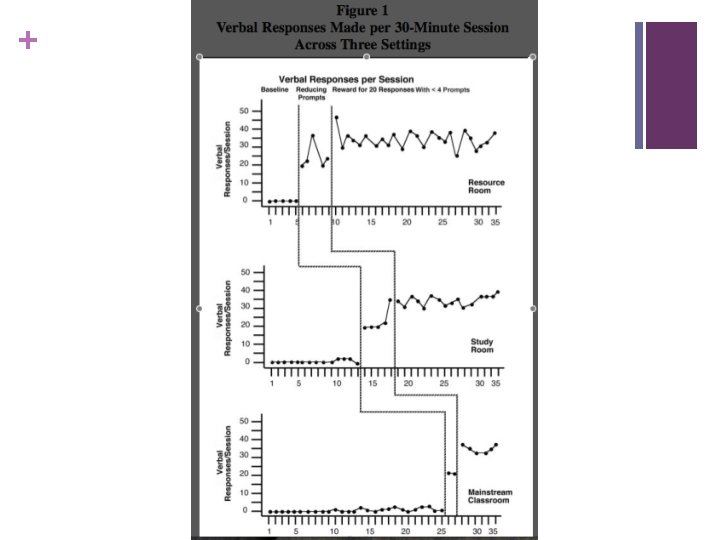
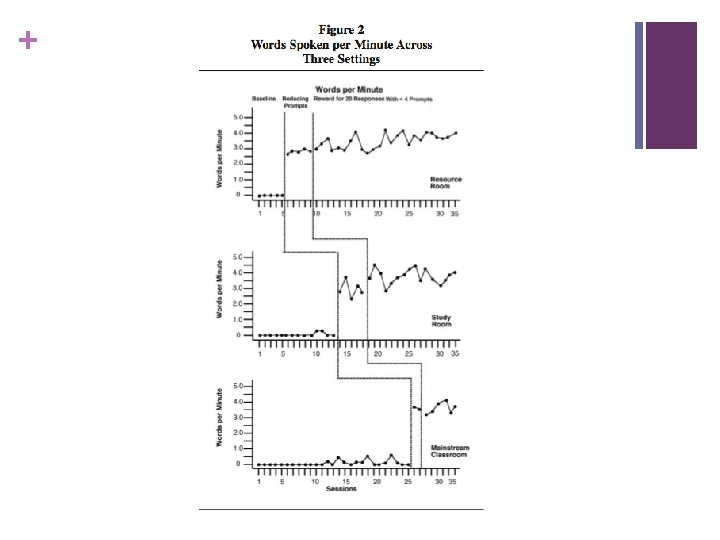
+ Selective Mutism: Intervention n Assessment n WISC-III Performance Scaled Score of 90 n WJ-II Revised Tests of Achievement: Scores within the average range on Math and Written Language A-B-B’ Multiple-Baseline Design across settings n A: Baseline n B: number of prompts delivered was reduced daily n B’: goal condition, 3 or fewer prompts to receive reinforcer Dependent Measures: Verbal Responses n Number of responses n Rate of words spoken per minute
+ Selective Mutism: n Intervention n n Stimulus Fading: n Changing settings: Resource room, Study room, Mainstream classroom n Fading prompts within each setting: number of prompts and intensity (loudness of voice) A: Baseline n Asked specific questions, no prompts n Data were collected using event recording 30 -minute time periods
+ Selective Mutism n B: Reducing Prompts n Selected a reinforcer he would like to earn for that session n Told he could have the reinforcer if he responded to the questions in a voice loud enough to be heard by the teacher (20 times with only 12 prompts) n n Prompts were reduced by 2 during B B’: Goal Condition n Selected a reinforcer to earn n Told he could have the reinforcer for 20 verbal responses with 3 or fewer prompts
+ Selective Mutism: Conclusions n Characterized by a failure to speak in specific social situations despite speaking in other settings n Relatively rare condition with onset as early as 2 years of age n Usually substantial gap between onset and diagnosis/treatment n Behavioral interventions are most typically used and show support for efficacy n Few assessment materials specific to the condition n Research n No large randomized controlled trials n Limits generalizability of results
+ References n Bergman, R. L. , Keller, M. L. , Piacentini, J. , & Bergman, A. J. (2008). The development and psychometric properties of the selective mutism questionnaire. Journal of Clinical Child & Adolescent Psychology, 37(2), 456 -464. n Carlson, J. S. , Mitchell, A. D. , & Segool, N. (2008). The current state of empirical support for pharmacological treatment of selective mutism. School Psychology Quarterly, 23(3), 354 -372. n Cunningham, C. E. , Mc. Holm, A. , Boyle, M. H. , & Patel, S. (2004). Behavioral and emotional adjustment, family functioning, academic performance, and social relationships in children with selective mutism. Journal of Child Psychology and Psychiatry, 45, 1363 -1372. n Fisak, B. J. Jr. , Oliveros, A. , Ehrenreich, J. T. (2006). Assessment and behavioral treatment of selective mutism. Clinical Case Studies, 5(5), 382 -402. n Kehle, T. J. , Madaus, M. R. , Baratta, V. S. , & Bray, M. A. (1998). Augmented self- modeling as a treatment for children with selective mutism. Journal of School Psychology, 36(3), 247 -260.
+ References n Kehle, T. J. , Owen, S. V. , & Cressy, E. T. (1990). The use of self-modeling as an intervention in school psychology: A case study of an elective mute. School Psychology Review, 19, 115 -121. n Sharp, G. M. , Sherman, C. , & Gross, A. M. (2007). Selective mutism and anxiety: A review of the current conceptualization of the disorder. Journal of Anxiety Disorders, 21, 568 -579. n Stone, B. P. , Kratochwill, T. R. , Sladezcek, I. , & Serlin, R. C. (2002). Treatment of selective mutism: A best-evidence synthesis. School Psychology Quarterly, 17(2), 168 -190. n O’Reilly, M. , Mc. Nally, D. , Sigafoos, J. , Lancioni, G. E. , Green, V. , Edrisinha, C. , et al. (2008). Examination of a social problem-solving intervention to treat selective mutism. Behavior Modification, 32(2), 182 -195. n Viana, A. G. , Beidel, D. C. , & Rabian, B. (2008). Selective mutism: A review and integration of the last 15 years. Clinical Psychology Review, 29, 57 -67.
- Slides: 20