
EVIDENCE BASED PRACTICE Performing an effective literature search
EVIDENCE BASED PRACTICE • Performing an effective literature search to obtain the best available evidence

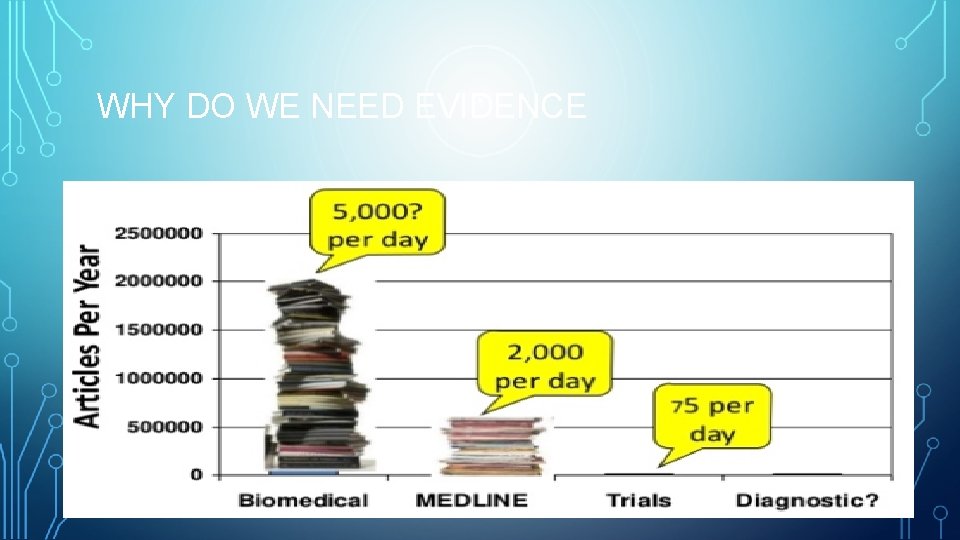
WHY DO WE NEED EVIDENCE
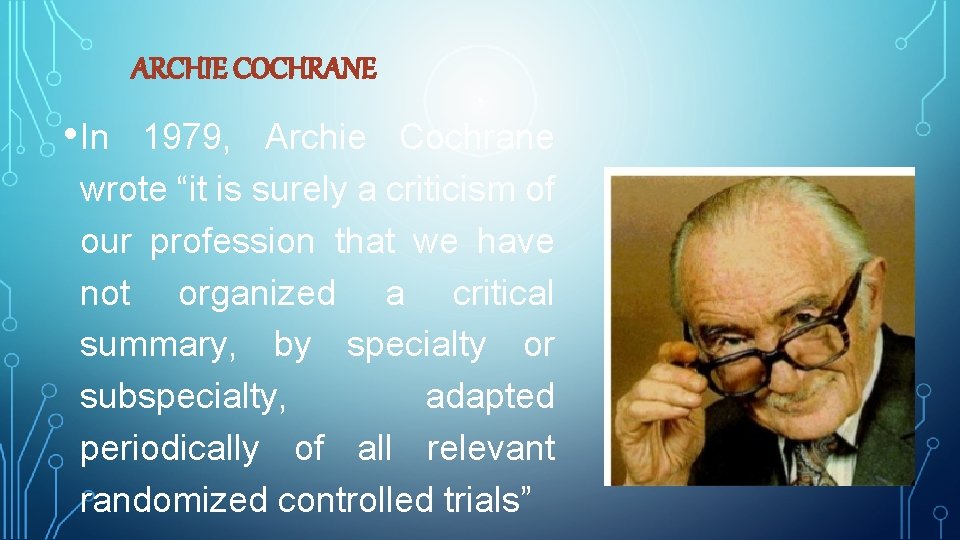
ARCHIE COCHRANE • In 1979, Archie Cochrane wrote “it is surely a criticism of our profession that we have not organized a critical summary, by specialty or subspecialty, adapted periodically of all relevant randomized controlled trials”
STEPS IN EBM ASK: formulate an answerable question ACCESS: search for evidence AAPRAISE: critically evaluate studies in terms of VALIDITY: importance & applicability APPLY: applying evidence to patient care ASSESS: evaluation of performance
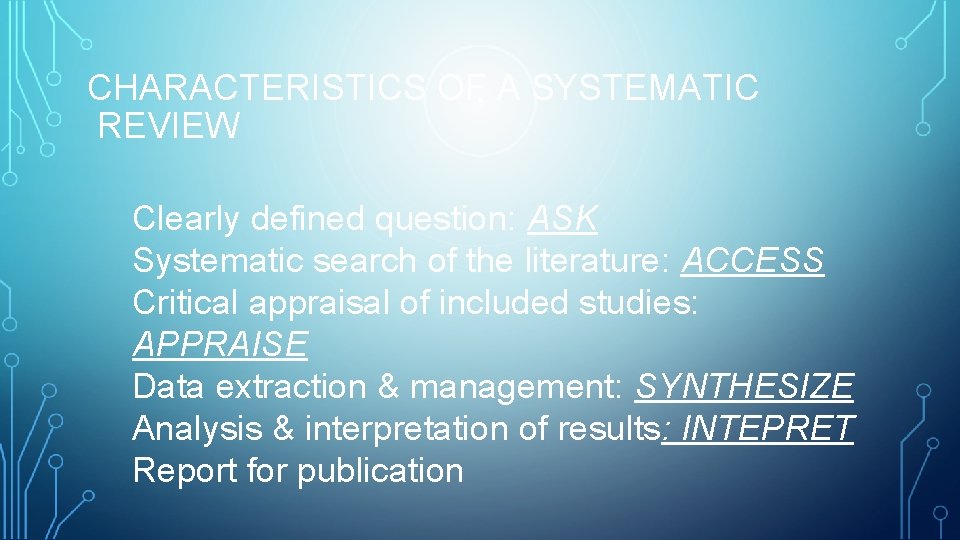
CHARACTERISTICS OF A SYSTEMATIC REVIEW Clearly defined question: ASK Systematic search of the literature: ACCESS Critical appraisal of included studies: APPRAISE Data extraction & management: SYNTHESIZE Analysis & interpretation of results: INTEPRET Report for publication
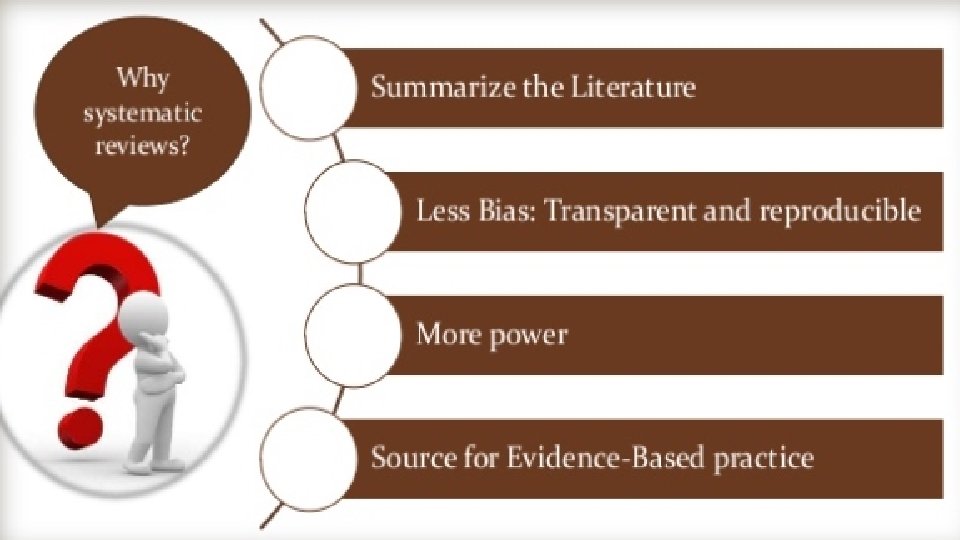
SYSTEMATIC REVIEW • Systematic review uses explicit methodology to identify, select & evaluate relevant primary studies in an attempt to answer a specific question
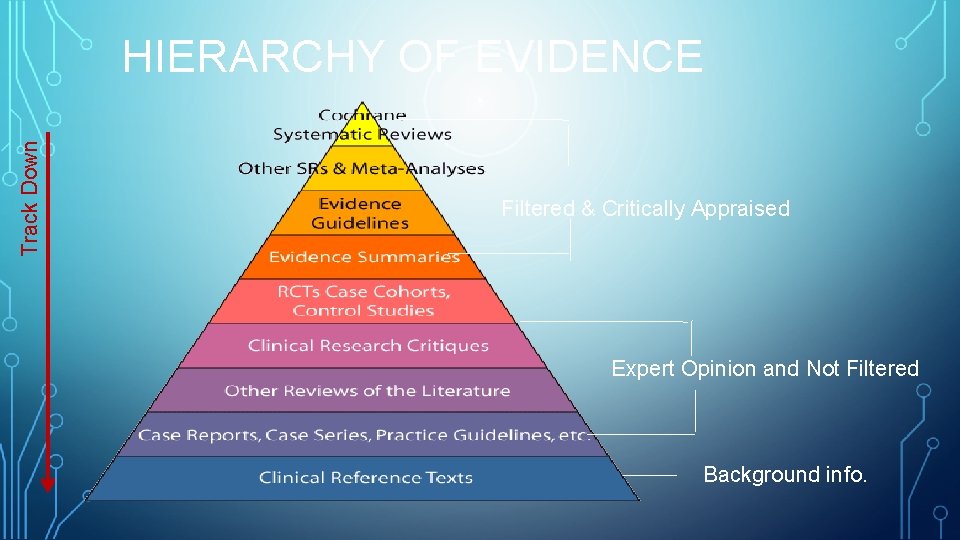
Track Down HIERARCHY OF EVIDENCE Filtered & Critically Appraised Expert Opinion and Not Filtered Background info.
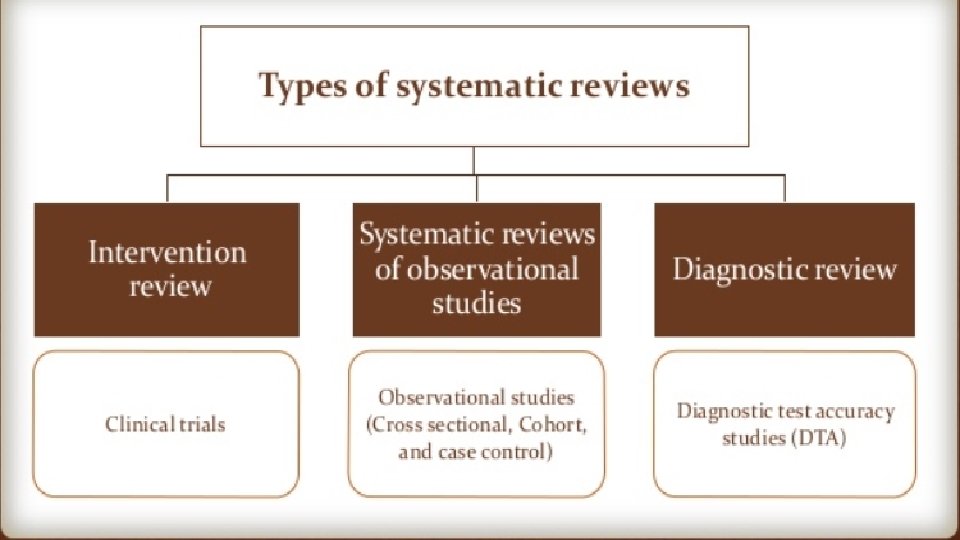
Grant, M. J. A typology of reviews: an analysis of 14 review types and associated methodologies. Health Information and Libraries Journal, 2009, 26, pp. 91– 108. Critical review- Mapping review- Narrative review- Meta-analysis- Overview- Qualitative systematic review- Scoping review- Systematic review- Systematized review- Umbrella review
LITERATURE REVIEW: NARRATIVE REVIEW VS. SYSTEMATIC REVIEW • Descriptive overview of selected literature without undertaking a systematic literature search • Use explicit & replicable methods in order to retrieve all available literature pertaining to a specific topic to answer a defined question. • Needs a priori strategies to search the literature with predefined criteria for included and excluded studies that should be reported in full detail in a review
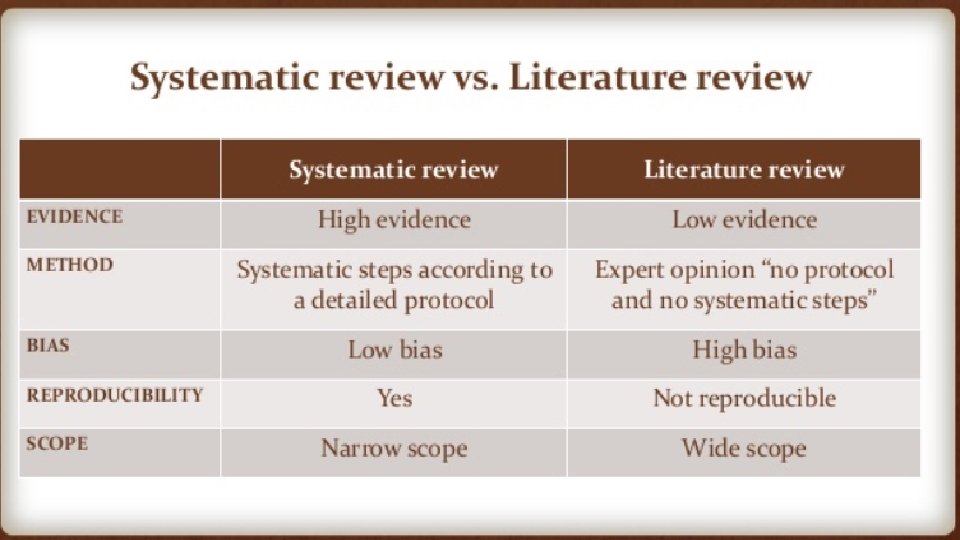
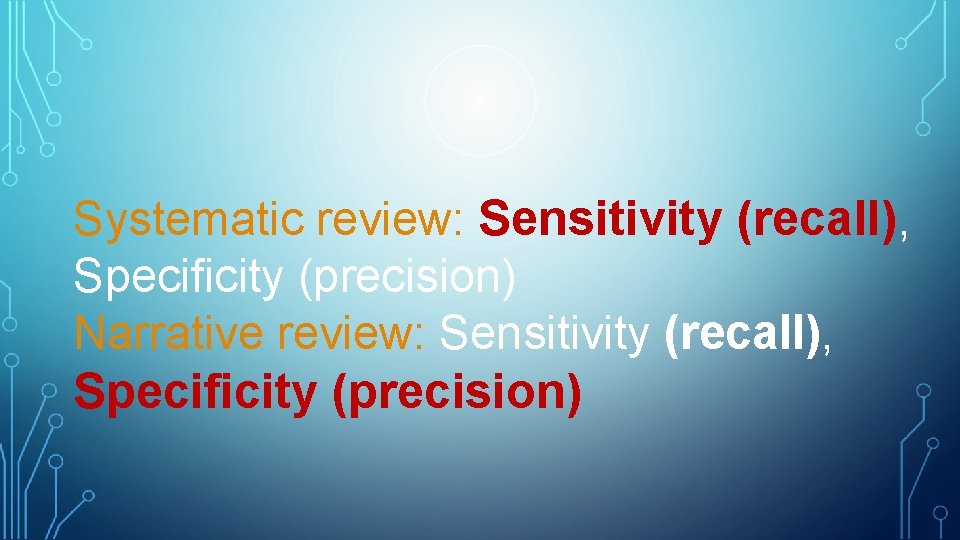
Systematic review: Sensitivity (recall), Specificity (precision) Narrative review: Sensitivity (recall), Specificity (precision)
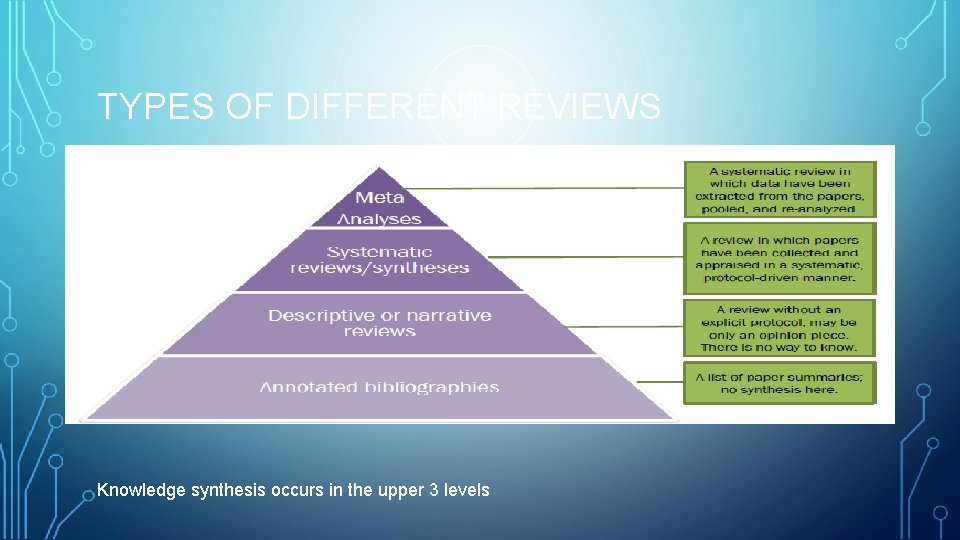
TYPES OF DIFFERENT REVIEWS Knowledge synthesis occurs in the upper 3 levels
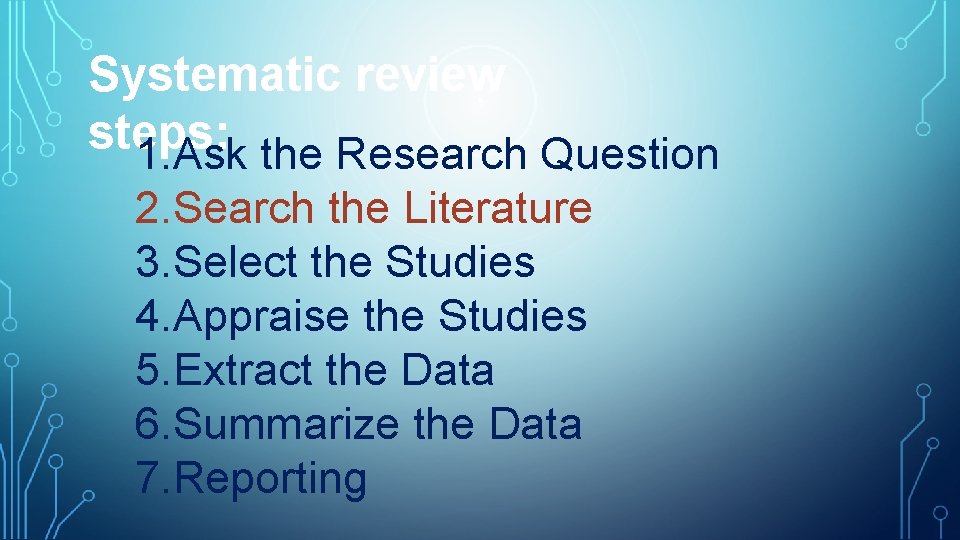
Systematic review steps: 1. Ask the Research Question 2. Search the Literature 3. Select the Studies 4. Appraise the Studies 5. Extract the Data 6. Summarize the Data 7. Reporting
WHY SYSTEMATIC SEARCH • Performing an effective literature search to obtain the best available evidence is the basis of any evidence based discipline.
SALVADOR-OLIVÁN, J. A. EAL. 2019. ERRORS IN SEARCH STRATEGIES USED IN SYSTEMATIC REVIEWS AND THEIR EFFECTS ON INFORMATION RETRIEVAL. JMLA, 107(2): 210 -221. • Objectives: Errors in search strategies negatively affect the quality and validity of systematic reviews. The primary objective of this study was to evaluate searches performed in MEDLINE/Pub. Med to identify errors and determine their effects on information retrieval. • Results: The study included 137 systematic reviews in which the number of search strategies containing some type of error was very high (92. 7%). Errors that affected recall were the most frequent (78. 1%), and the most common search errors involved missing terms in both natural language and controlled language and those related to Medical Subject Headings (Me. SH) search terms
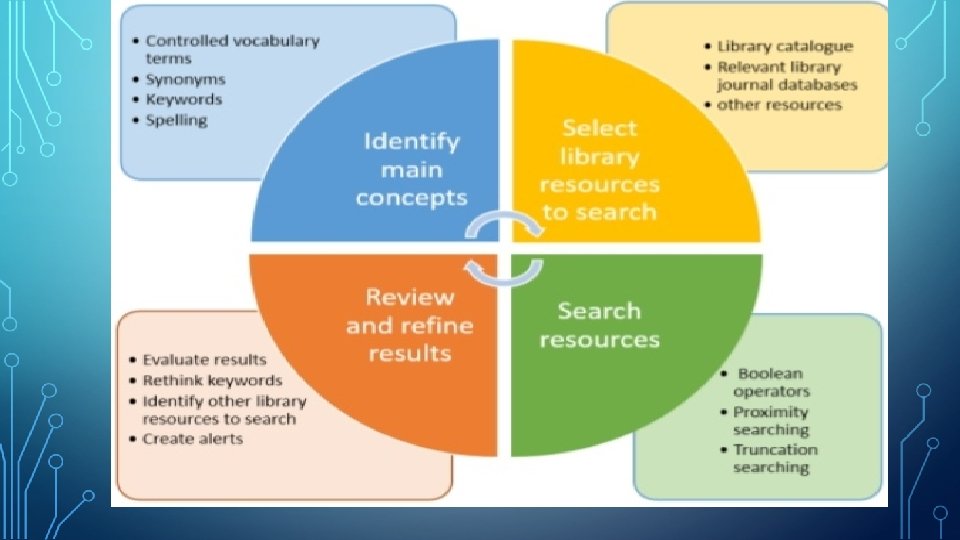
SEARCH THE LITERATURE • �Identifying major concepts • �Keywords, synonyms, controlled vocabulary • �Combination of concepts • �Boolean operators, string, truncation, proximity, etc. • �Identifying where to search • �Export citations to a reference management software & Documenting your search �Repeat the search till
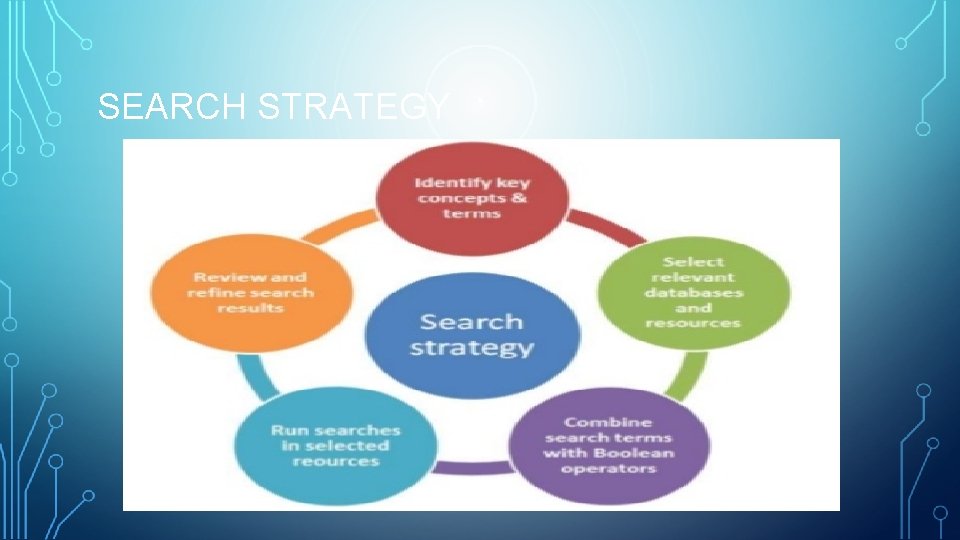
SEARCH STRATEGY
DEFINE THE QUESTIONS • Is anonymity for social media users necessary to protect freedom of expression • In patients with eating disorders, how effective is cognitive behavioral therapy in improving self esteem? • Investigate the use of Magnesium Sulfate as a possible mechanism for improving neurological
IDENTIFYING KEY CONCEPTS • Is anonymity for social media users necessary to protect freedom of expression • In patients with eating disorders, how effective is cognitive behavioral therapy in improving self esteem? • Investigate the use of Magnesium Sulfate as a possible mechanism for improving neurological outcomes after acute traumatic brain injury in young adults
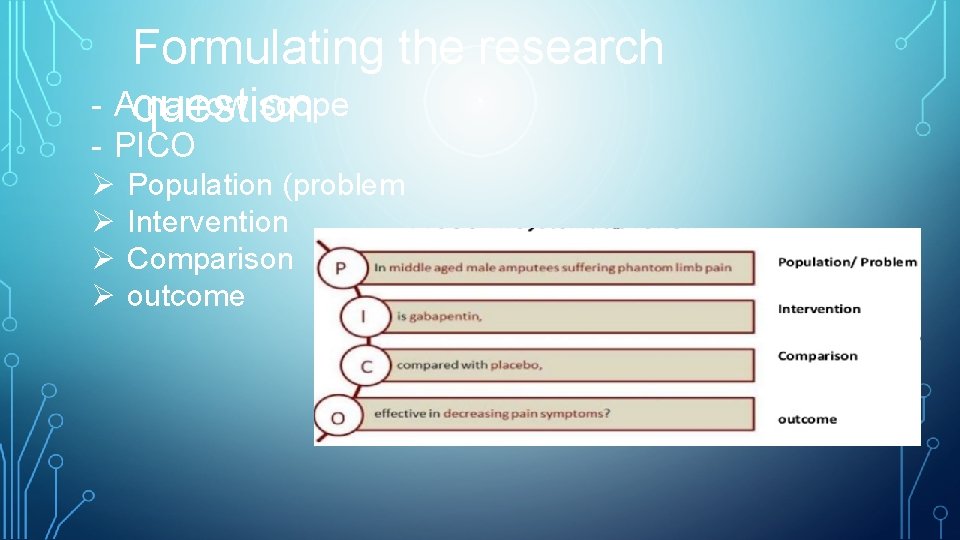
Formulating the research - Aquestion narrow scope - PICO Ø Ø Population (problem Intervention Comparison outcome
DEFINING THE QUESTION • PICO (population (problem), Intervention, Comparator, Outcome • ECLIPSE (Expectation, Client group, Location, Impact, Professionals, Service) (Wildridge 2002) • SPICE (Setting, Perspective, Intervention, Comparison, Evaluation) • Be. HEMo. Th (Behaviour of interest; Health context; Exclusions; Models or Theories) for use when

PICO
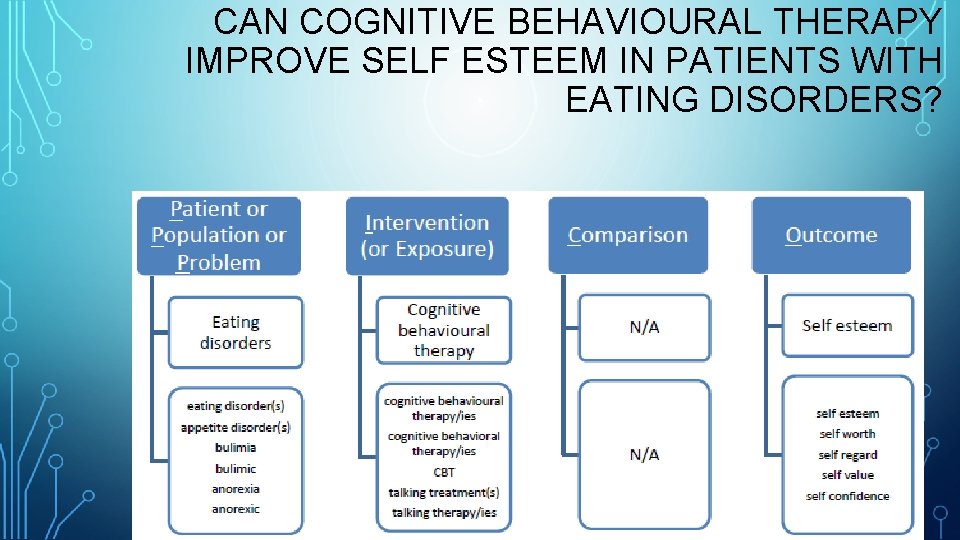
CAN COGNITIVE BEHAVIOURAL THERAPY IMPROVE SELF ESTEEM IN PATIENTS WITH EATING DISORDERS?
IDENTIFYING SYNONYMS, OTHER FORMS üBrain storming üChecking other papers üThesaurus MESH
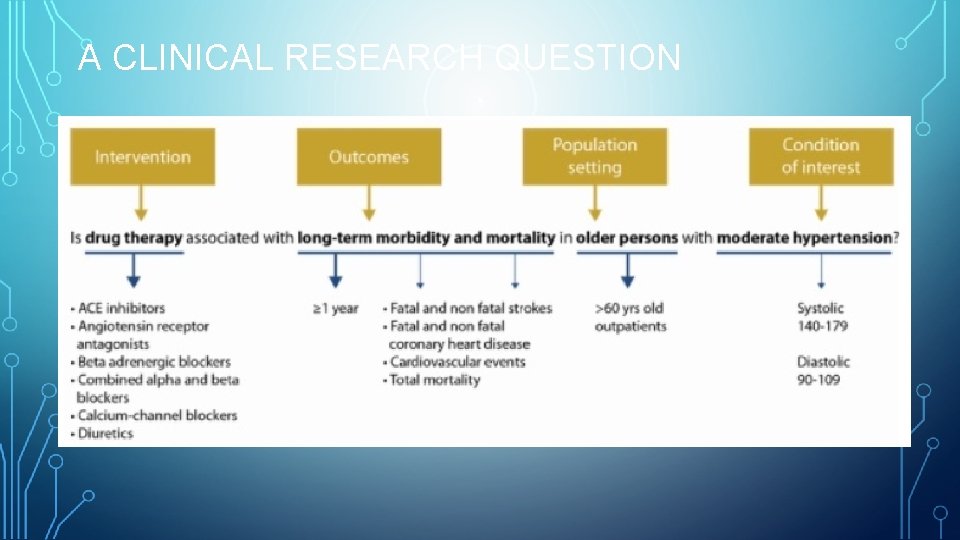
A CLINICAL RESEARCH QUESTION
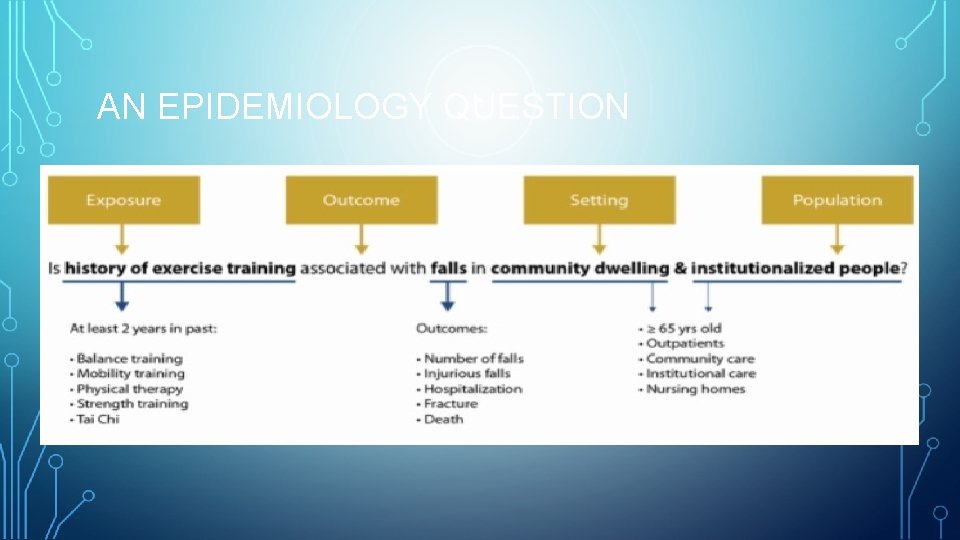
AN EPIDEMIOLOGY QUESTION
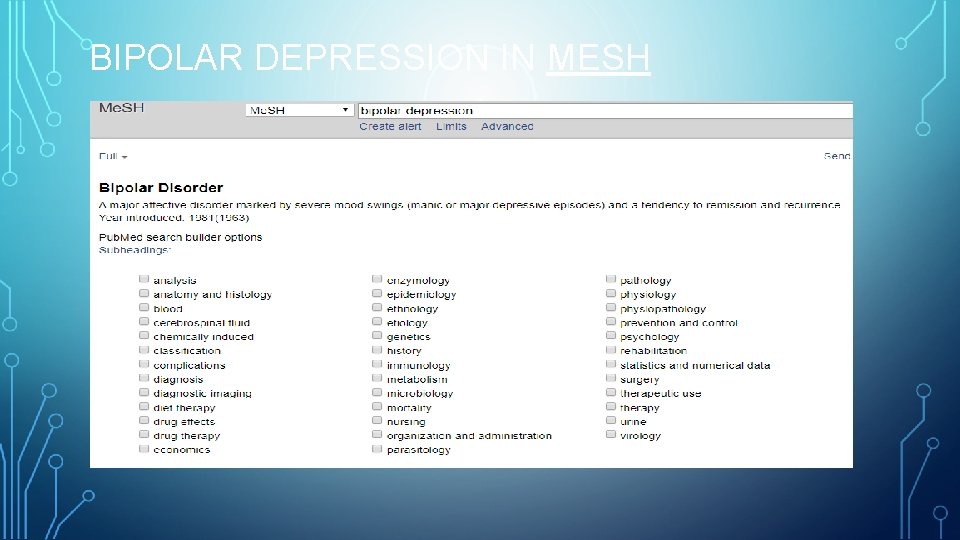
BIPOLAR DEPRESSION IN MESH
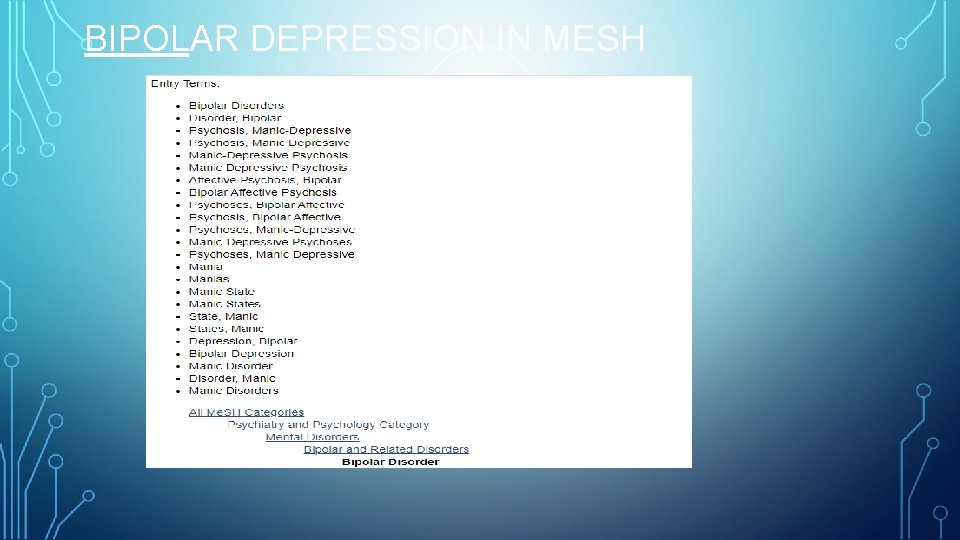
BIPOLAR DEPRESSION IN MESH
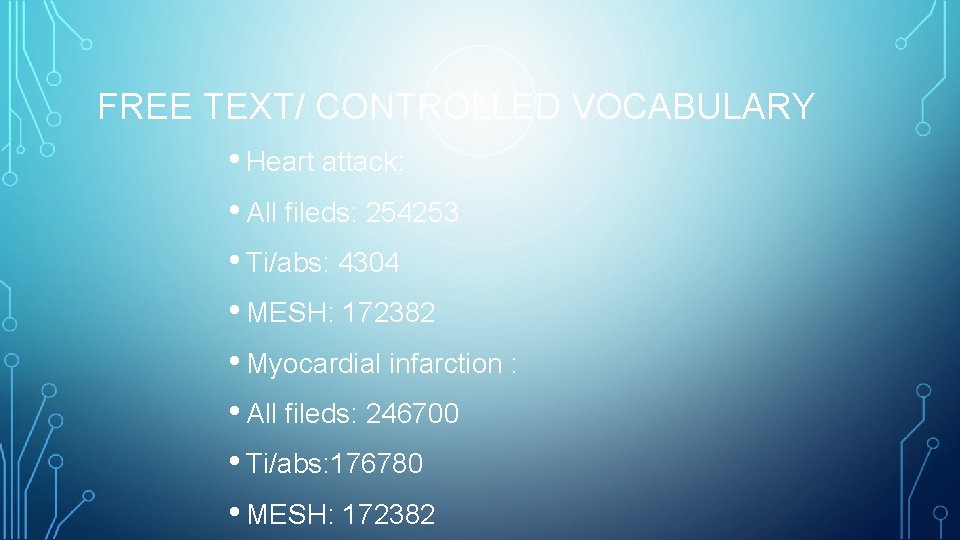
FREE TEXT/ CONTROLLED VOCABULARY • Heart attack: • All fileds: 254253 • Ti/abs: 4304 • MESH: 172382 • Myocardial infarction : • All fileds: 246700 • Ti/abs: 176780 • MESH: 172382
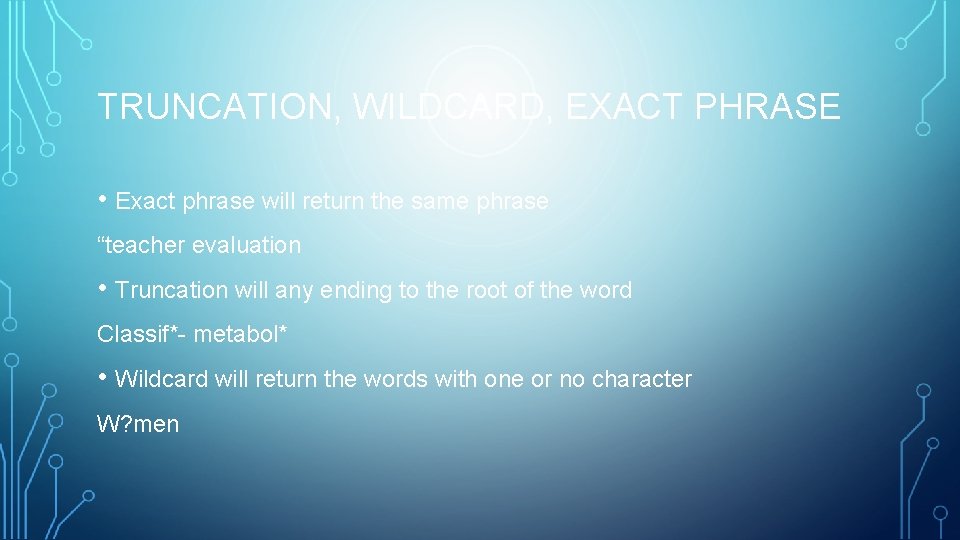
TRUNCATION, WILDCARD, EXACT PHRASE • Exact phrase will return the same phrase “teacher evaluation • Truncation will any ending to the root of the word Classif*- metabol* • Wildcard will return the words with one or no character W? men
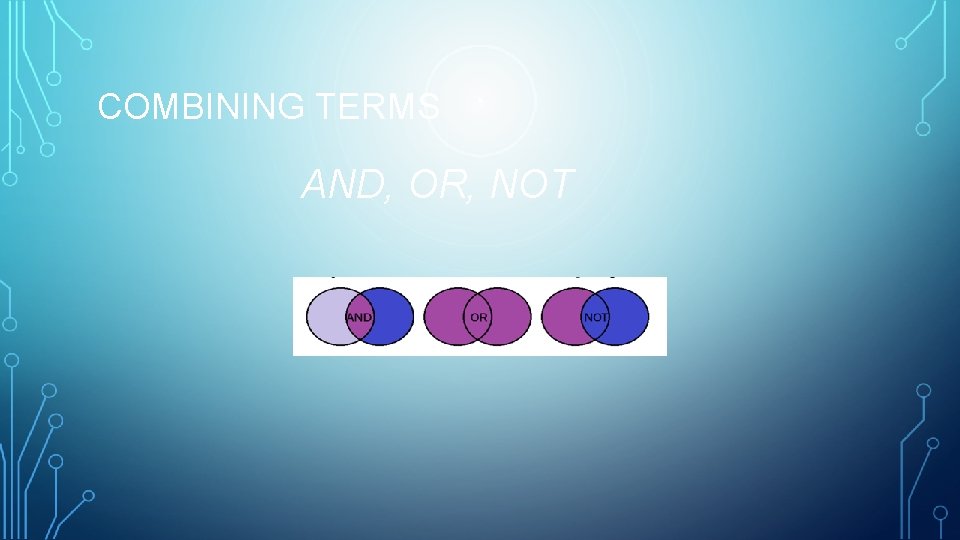
COMBINING TERMS AND, OR, NOT

USE FILTERS Limit to • study type • age • year of publication •

SEARCH IN SOURCES • Published - Electronic databases - handsearching • Grey literature
PUBLISHED VS UNPUBLISHED • Published & unpublished literature - Comparing the risk and benefits of selective serotonin reuptake inhibitors in the treatment of depression in children: - Favorable risk-benefit profiles for SSRIs (published data) - Risk outweighed treatment benefits, the relative weight of drug efficacy to side effects can be skewed if there has been a failure to search for or include unpublished

SOME RESOURCES • Medline • Embase • Cochrane • Web of Science
COCHRANE HANDBOOK Search these databases for RCT • MEDLINE • Cochrane Central • Embase (if available)
MEDLINE • >22 million references • >5600 journals • Medline in Process, non-indexed citations database • Pubmed a free version of Medline: medical & biomedical literature indexed in Medline , additional access to life science journals &
EMBASE • >30 million references • >8500 journals (2900 are not indexed in Med. Line) • Strong coverage of drug & pharmaceutical references
THE COCHRANE CENTRAL REGISTER OF CONTROLLED TRIALS (CENTRAL) • The most comprehensive source of randomized & quasi-randomized controlled trials • Some are included in MEDLINE & Embase but 150000 reports indexed from other sources, such as conference proceedings, and trial registers
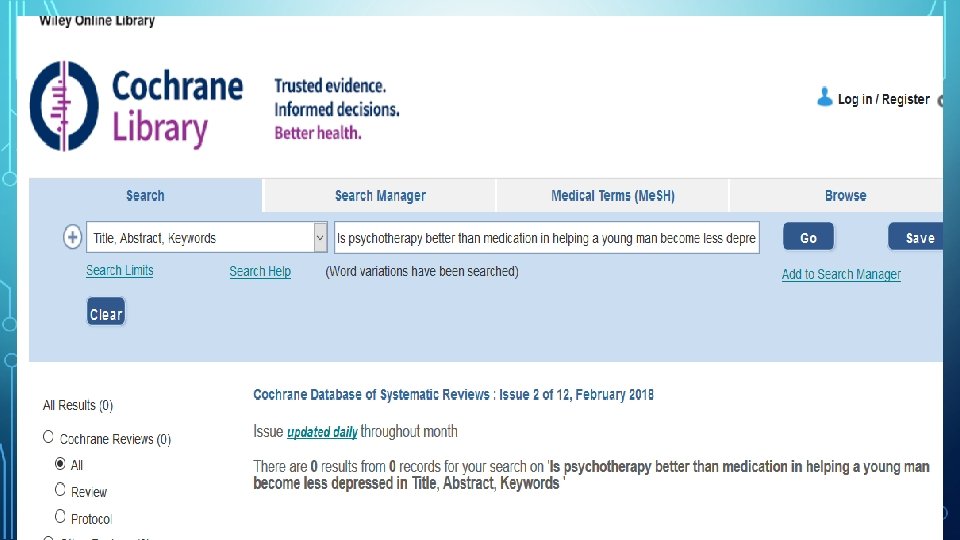

REPEAT THE SEARCH • Alerts • Save/ run search strategy
SIX MAIN CITATION INDEXES OF THE WEB OF SCIENCE™ CORE COLLECTION (WITH 72, 254, 259 BIBLIOGRAPHIC RECORDS) üScience Citation Index Expanded (SCIE): 9, 046 journals , 1900 - üSocial Sciences Citation Index (SSCI): 3, 330 journals, 1900 - üArts & Humanities Citation Index (AHCI): 1, 815 journals, 1975 - üEmerging Sources Citation Index (ESCI): 7280 journals,
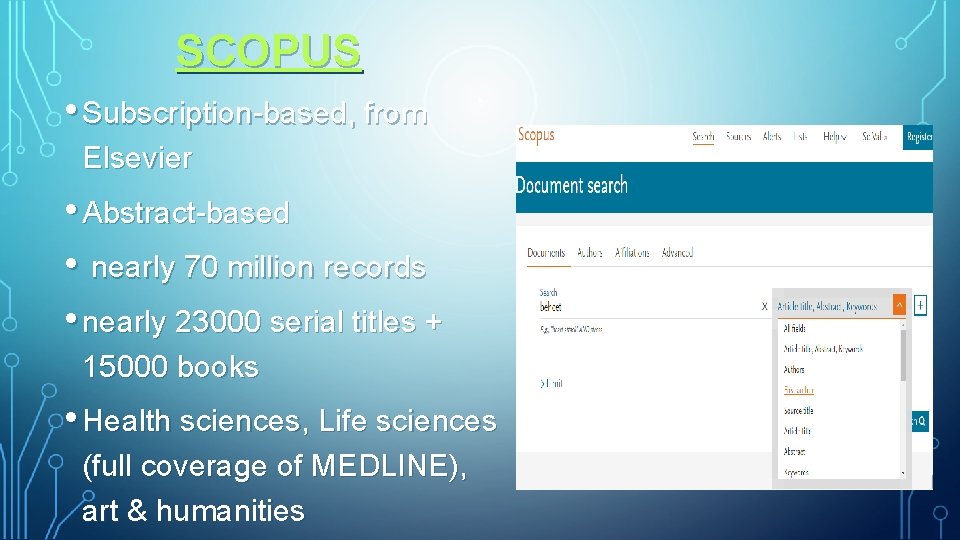
SCOPUS • Subscription-based, from Elsevier • Abstract-based • nearly 70 million records • nearly 23000 serial titles + 15000 books • Health sciences, Life sciences (full coverage of MEDLINE), art & humanities
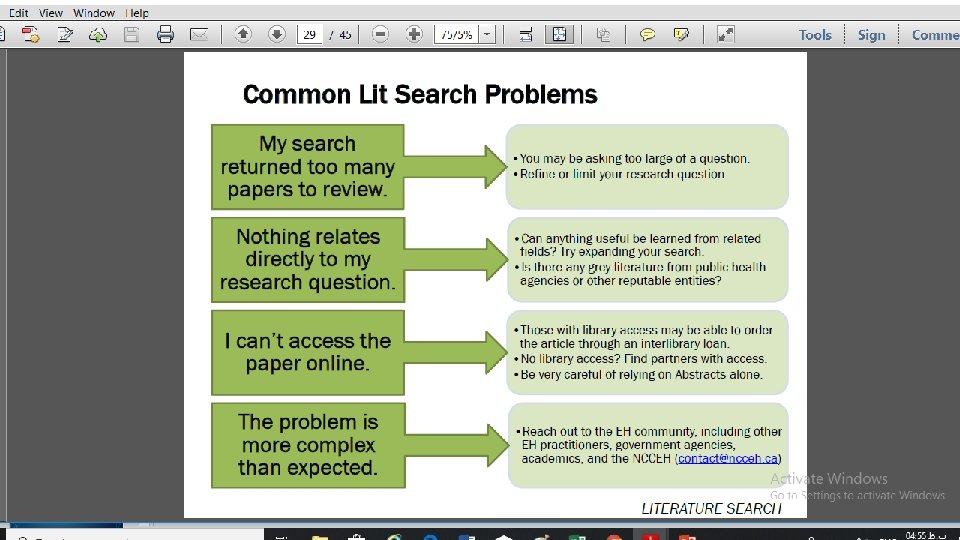
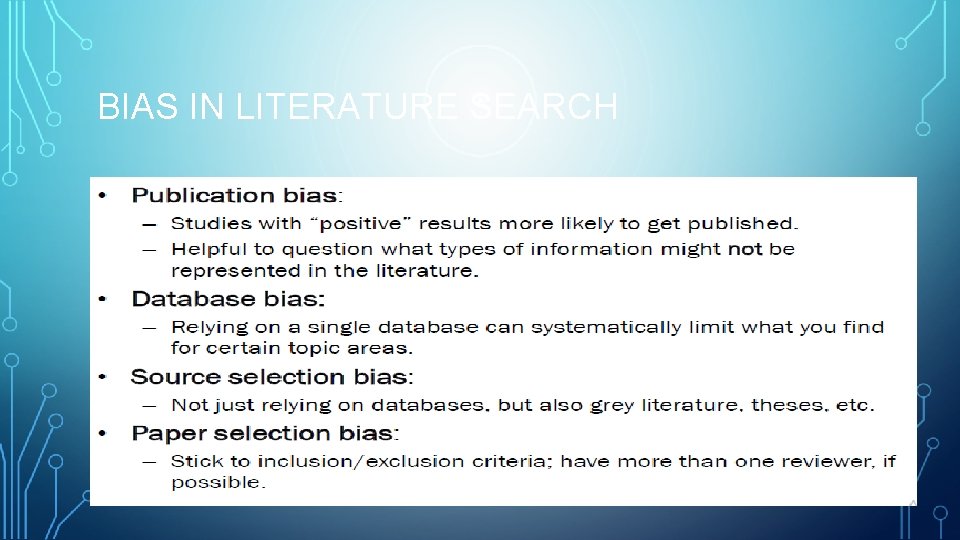
BIAS IN LITERATURE SEARCH

DOCUMENT YOUR SEARCH • Zotero • Mendeley • End. Note
FIND DUPLICATES • Use reference management softwares to find duplicated
STEPS OF A SYSTEMATIC REVIEW • �Build a review team • �Develop a protocol or plan • �Formulate review question • �Define inclusion and exclusion criteria • �Locate studies • �Select studies Assess study quality �Extract data �Analysis/summary and synthesis of relevant studies �Present results �Interpret results/determining the applicability of results
PSYCHINFO • Over 4, 450, 000 records • The biggest database in psychology • From 1967 onwards

OTHER RESOURCES • ERIC • TRIP • PROSPERO International • Google Scholar
- Slides: 54