
Evidence Based Practice Clinical Proposal Urinary Catheter Care
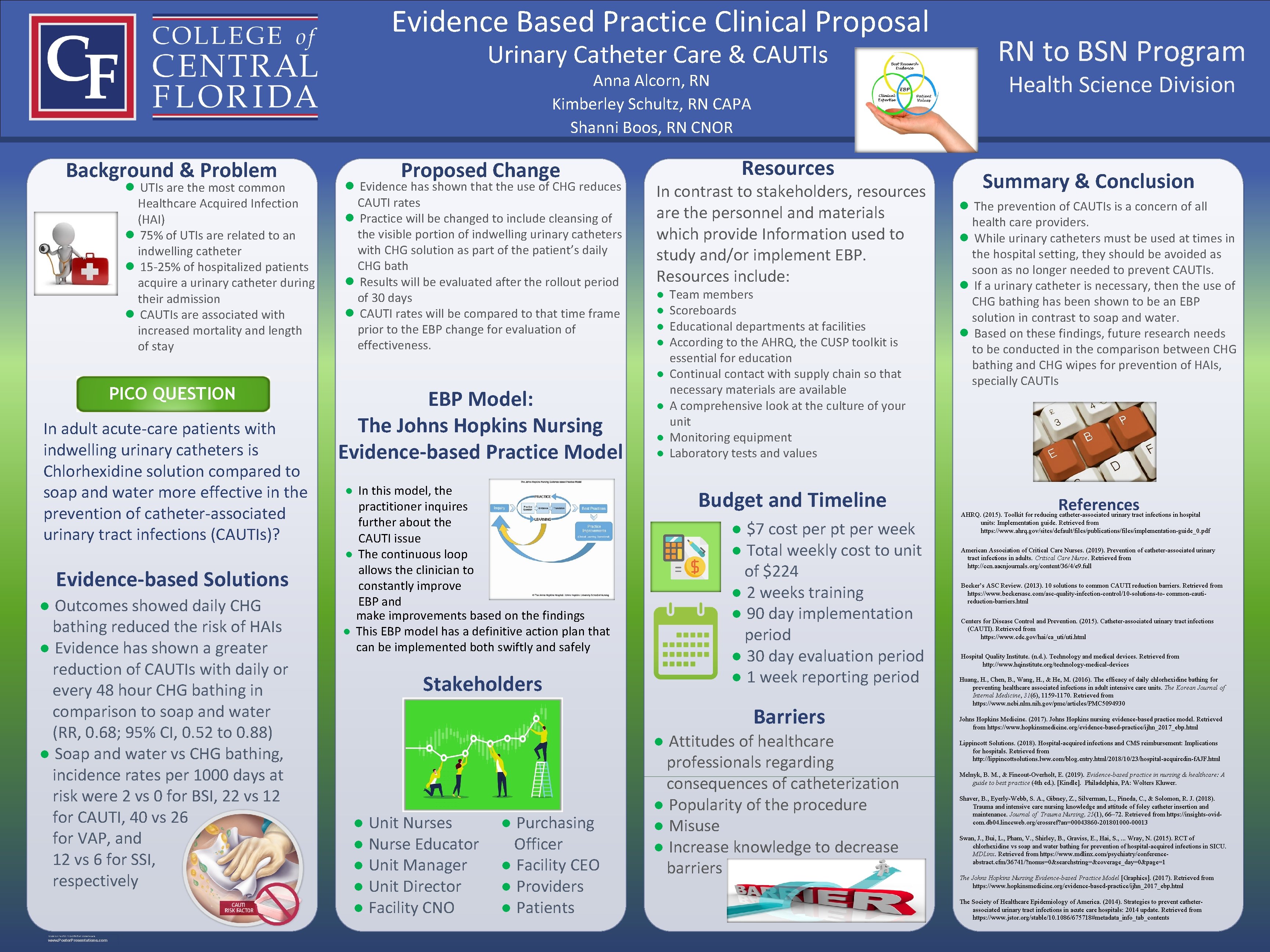
Evidence Based Practice Clinical Proposal Urinary Catheter Care & CAUTIs Anna Alcorn, RN Kimberley Schultz, RN CAPA Shanni Boos, RN CNOR Background & Problem ● UTIs are the most common Healthcare Acquired Infection (HAI) ● 75% of UTIs are related to an indwelling catheter ● 15 -25% of hospitalized patients acquire a urinary catheter during their admission ● CAUTIs are associated with increased mortality and length of stay Proposed Change ● Evidence has shown that the use of CHG reduces CAUTI rates ● Practice will be changed to include cleansing of the visible portion of indwelling urinary catheters with CHG solution as part of the patient’s daily CHG bath ● Results will be evaluated after the rollout period of 30 days ● CAUTI rates will be compared to that time frame prior to the EBP change for evaluation of effectiveness. Resources In contrast to stakeholders, resources are the personnel and materials which provide Information used to study and/or implement EBP. Resources include: ● ● ● PICO QUESTION In adult acute-care patients with indwelling urinary catheters is Chlorhexidine solution compared to soap and water more effective in the prevention of catheter-associated urinary tract infections (CAUTIs)? Evidence-based Solutions ● Outcomes showed daily CHG bathing reduced the risk of HAIs ● Evidence has shown a greater reduction of CAUTIs with daily or every 48 hour CHG bathing in comparison to soap and water (RR, 0. 68; 95% CI, 0. 52 to 0. 88) ● Soap and water vs CHG bathing, incidence rates per 1000 days at risk were 2 vs 0 for BSI, 22 vs 12 for CAUTI, 40 vs 26 for VAP, and 12 vs 6 for SSI, respectively RESEARCH POSTER PRESENTATION DESIGN © 2012 www. Poster. Presentations. com EBP Model: The Johns Hopkins Nursing Evidence-based Practice Model ● In this model, the practitioner inquires further about the CAUTI issue ● The continuous loop allows the clinician to constantly improve EBP and make improvements based on the findings ● This EBP model has a definitive action plan that can be implemented both swiftly and safely Stakeholders ● ● ● Team members Scoreboards Educational departments at facilities According to the AHRQ, the CUSP toolkit is essential for education Continual contact with supply chain so that necessary materials are available A comprehensive look at the culture of your unit Monitoring equipment Laboratory tests and values Budget and Timeline ● $7 cost per pt per week ● Total weekly cost to unit of $224 ● 2 weeks training ● 90 day implementation period ● 30 day evaluation period ● 1 week reporting period Barriers ● Unit Nurses ● Nurse Educator ● Unit Manager ● Unit Director ● Facility CNO ● Purchasing Officer ● Facility CEO ● Providers ● Patients ● Attitudes of healthcare professionals regarding consequences of catheterization ● Popularity of the procedure ● Misuse ● Increase knowledge to decrease barriers RN to BSN Program Health Science Division Summary & Conclusion ● The prevention of CAUTIs is a concern of all health care providers. ● While urinary catheters must be used at times in the hospital setting, they should be avoided as soon as no longer needed to prevent CAUTIs. ● If a urinary catheter is necessary, then the use of CHG bathing has been shown to be an EBP solution in contrast to soap and water. ● Based on these findings, future research needs to be conducted in the comparison between CHG bathing and CHG wipes for prevention of HAIs, specially CAUTIs References AHRQ. (2015). Toolkit for reducing catheter-associated urinary tract infections in hospital units: Implementation guide. Retrieved from https: //www. ahrq. gov/sites/default/files/publications/files/implementation-guide_0. pdf American Association of Critical Care Nurses. (2019). Prevention of catheter-associated urinary tract infections in adults. Critical Care Nurse. Retrieved from http: //ccn. aacnjournals. org/content/36/4/e 9. full Becker’s ASC Review. (2013). 10 solutions to common CAUTI reduction barriers. Retrieved from https: //www. beckersasc. com/asc-quality-infection-control/10 -solutions-to- common-cautireduction-barriers. html Centers for Disease Control and Prevention. (2015). Catheter-associated urinary tract infections (CAUTI). Retrieved from https: //www. cdc. gov/hai/ca_uti/uti. html Hospital Quality Institute. (n. d. ). Technology and medical devices. Retrieved from http: //www. hqinstitute. org/technology-medical-devices Huang, H. , Chen, B. , Wang, H. , & He, M. (2016). The efficacy of daily chlorhexidine bathing for preventing healthcare associated infections in adult intensive care units. The Korean Journal of Internal Medicine, 31(6), 1159 -1170. Retrieved from https: //www. ncbi. nlm. nih. gov/pmc/articles/PMC 5094930 Johns Hopkins Medicine. (2017). Johns Hopkins nursing evidence-based practice model. Retrieved from https: //www. hopkinsmedicine. org/evidence-based-practice/ijhn_2017_ebp. html Lippincott Solutions. (2018). Hospital-acquired infections and CMS reimbursement: Implications for hospitals. Retrieved from http: //lippincottsolutions. lww. com/blog. entry. html/2018/10/23/hospital-acquiredin-f. AJF. html Melnyk, B. M. , & Fineout-Overholt, E. (2019). Evidence-based practice in nursing & healthcare: A guide to best practice (4 th ed. ). [Kindle]. Philadelphia, PA: Wolters Kluwer. Shaver, B. , Eyerly-Webb, S. A. , Gibney, Z. , Silverman, L. , Pineda, C. , & Solomon, R. J. (2018). Trauma and intensive care nursing knowledge and attitude of foley catheter insertion and maintenance. Journal of Trauma Nursing, 25(1), 66– 72. Retrieved from https: //insights-ovidcom. db 04. linccweb. org/crossref? an=00043860 -201801000 -00013 Swan, J. , Bui, L. , Pham, V. , Shirley, B. , Graviss, E. , Hai, S. , . . . Wray, N. (2015). RCT of chlorhexidine vs soap and water bathing for prevention of hospital-acquired infections in SICU. MDLinx. Retrieved from https: //www. mdlinx. com/psychiatry/conferenceabstract. cfm/36741/? nonus=0&searchstring=&coverage_day=0&page=1 The Johns Hopkins Nursing Evidence-based Practice Model [Graphics]. (2017). Retrieved from https: //www. hopkinsmedicine. org/evidence-based-practice/ijhn_2017_ebp. html The Society of Healthcare Epidemiology of America. (2014). Strategies to prevent catheterassociated urinary tract infections in acute care hospitals: 2014 update. Retrieved from https: //www. jstor. org/stable/10. 1086/675718#metadata_info_tab_contents
- Slides: 1