
Evidence Based Practice Catheter Associated Urinary Tract Infections
Evidence Based Practice Catheter Associated Urinary Tract Infections (CAUTIs) Ferris State University November 2010

Team Members �Sarah Dobbrastine �Melinda �Diane Webster Williams

Introduction Indwelling Urethral Catheters Commonly used in post -operative Patients Sterile Procedure UTI (Urinary tract infections)
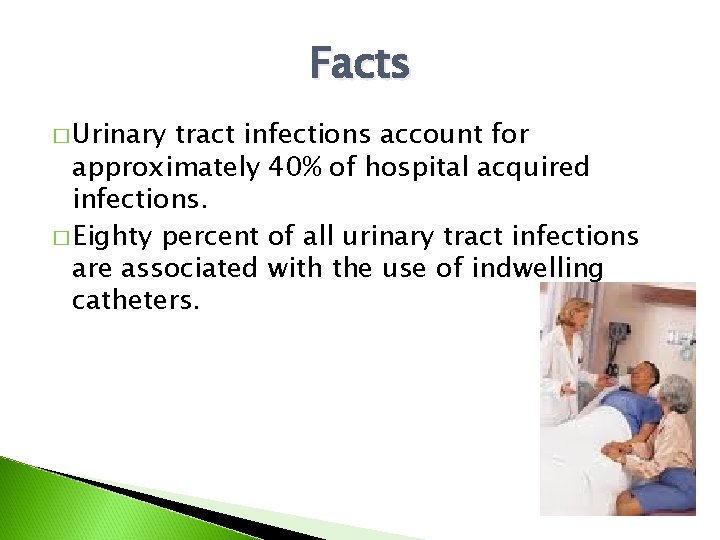
Facts � Urinary tract infections account for approximately 40% of hospital acquired infections. � Eighty percent of all urinary tract infections are associated with the use of indwelling catheters.

Facts (Cont. ) � Catheters provide a direct pathway for bacteria to enter the bladder � CAUTIs unavoidable in prolonged catheter use because bacteria colonizes over time

Problem Statement � Does the removal of Foley catheter within 2448 hours in postoperative patients reduce the risk of hospital acquired urinary tract infections as compared with patients whose Foley catheters remain in place longer than this defined period postoperatively?

PICO � � Patient population includes postoperative patients on surgical units who return form surgery with Foley catheters in place. Intervention observed will be removal of Foley catheters in post-operative patients within 24 -48 hours post-operatively to determine if a reduction of hospital acquired urinary tract infections has been achieved. Comparison will be made to those patients whose Foley catheters remain in place longer than the 24 -48 hour duration. The status examined will be the occurrence of a hospital acquired urinary tract infection. Removal of Foley catheters within our defined population will have an observable reduction in the number of hospital acquired urinary tract infections.
The Question in PICO Format � P: Foley catheter patients � I: Early removal of Foley � C: Long term Foley use � O: Urinary tract infection
Evidence has Shown… � Many Catheter associated urinary tract infections (CAUTIs) are preventable � Approximately 50% of indwelling catheters have no justifiable indication � CAUTIs increase hospital stays by approx. 13 days, increase patient morbidity, and increase health care costs
Research Ten scholarly articles were initially chosen and narrowed down to four articles based on specific criterion. The selected articles were chosen from recommended and professional databases
Article #1 Catheter-associated Urinary Tract Infection and Medicare Rule Changes � Background: UTI’s are one of the hospital-acquired complications chosen by The Centers for Medicare and Medicaid Services (CMS) for which hospitals no longer receive additional payment. � Methods: Examination of the preventable catheter-associated infection, assessment of the possible consequences of the changes and guidance for hospital-based administrators and clinicians. � Conclusion: The Centers for Medicare and Medicaid Services (CMS) rule change related o catheter-associated urinary tract infections may do more good than harm since efforts in preventing CAUTI have increased.
Article #2 Nursing Interventions of Reduce the Risk of Catheter-Associated Urinary Tract Infection � Background: Review of multiple interventions for CAUTI prevention including education, monitoring of catheter use and CAUTI incidence, insertion technique, urethral meatal care, securement, use of closed bag drainage system, bladder irrigation, frequency of catheter change, and antiseptic solutions in the drainage bag. � Methods: Nursing actions for preventions of CAUTI were identified based on search of electronic databases and Web-based search engines. � Limitations: Only limited research was found for specific questions examined within the report. � Conclusion: Essential elements of a CAUTI prevention program include staff education, ongoing monitoring of CAUTI incidence and ensuring prompt removal.
Article #3 Preventing Hospital-Acquired Urinary Tract Infection in the United States: A National Study � Background: A national study conducted to examine the current practices used by hospitals to prevent hospital-acquired UTI’s. � Methods: Mailed written surveys to infection controlled coordinators at a national random sample of non-federal US hospitals with Intensive care unit and >50 bed hospitals (n=60) and to all VA hospitals (n=119). The survey asked about prevention practices for hospital acquired UTI’s. � Limitations: Reliance on self reporting. Lack of insight as to why the hospitals chose to use specific practices which may have been better explained through a qualitative evaluation. � Conclusion: No strategy was found to be widely used to prevent hospital acquired UTI’s.
Article #4 Systematic Review: Antimicrobial Urinary Catheters To Prevent Catheter. Associated Urinary Tract Infection in Hospitalized Patients � Background: The purpose of this research was to assess the current use of antimicrobial urinary catheters for preventing UTI’s. � Methods: Randomized and quasi-randomized trials of nitrofurazonecoated or silver alloy-coated antimicrobial urinary catheter use for less than 30 days. Twelve qualifying trials which included 13, 392 participants. � Limitations: The study was limited by the number, size, and quality of the studies. � Conclusion: Antimicrobial urinary catheters can prevent bacteriuria in hospitalized patients during short-term catheterization.
Appropriate Reasons for Catheter Insertion � Conditions � Nerve � Post that obstruct urethra related bladder dysfunction surgery � Urine output monitoring in critically ill patient � Urinary retention
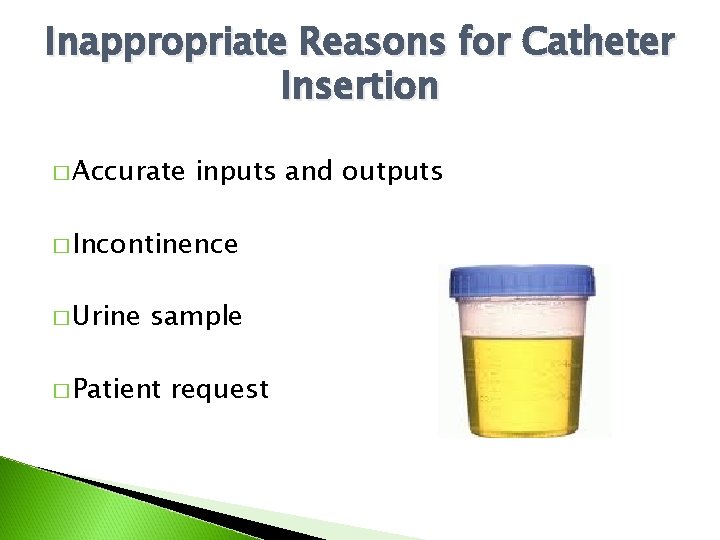
Inappropriate Reasons for Catheter Insertion � Accurate inputs and outputs � Incontinence � Urine sample � Patient request
Results � Centers for Medicare & Medicaid Services (CMS) intervention � No additional reimbursement � Attention focus on use of indwelling catheters � Enactment CAUTIs of policies for prevention of
Evidence Based Practice � Prompt removal of indwelling urinary catheters (24 -48 hours) have been shown to contribute to decrease in CAUTIs
Other Methods that Contribute to Decrease in CAUTIs � Antimicrobial urinary catheters � Staff education � Daily cleaning of urinary meatus � Maintenance of closed urinary draining system � Regular monitoring of CAUTIs � Facility wide program to insure indicated only catheter insertion
Team Consensus � Multiple nursing interventions are needed to reduce the risks of CAUTIs � Elderly are high risk population for inappropriate Foley insertion

Practices not Recommended � Antimicrobial � Rigorous, � Bladder agents in drainage bag frequent, meatal cleaning irrigation

Outcome “By failing to prepare, you are preparing to fail”
Utilization of Evidence � Constant catheter Reminders � Prompt removal when indicated � Daily cleansing of urethral meatus with soap and water � Staff education regarding indwelling catheter management � Maintenance of closed urinary drainage system
Summary The team consensus is that there is sufficient evidence for incorporation of multiple evidence based CAUTI preventative efforts in daily care of patients in the acute care setting.
- Slides: 24