
Evidence and Sourcing Historical Thinking Concepts TODAYS PURPOSE
- Slides: 18
Evidence and Sourcing Historical Thinking Concepts
TODAY’S PURPOSE Understand that… 1) History is not about memorizing dates and names; it is about coming to conclusions based on evidence and interpretation. 2) Evidence can have different levels of reliability and bias. “Sourcing” is a way for historians to evaluate the reliability or bias of any piece of evidence. 3) Sourcing is a process that takes place before, during and after reading a document.
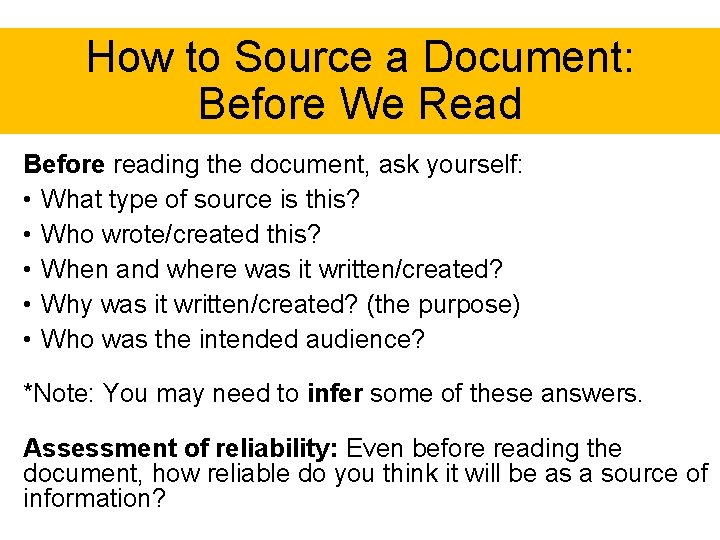
What is Sourcing? • When historians study a document (primary or secondary source), they need to determine how reliable it is as a source of information. • They do this by making inferences about the sources and thinking about the biases of the people who made them. • This process is called sourcing. • Sourcing occurs before, during and after reading a document.
Activity: Future Historian BIG Question: Did Donald Trump lie about having the largest inaugural crowd ever? • Imagine you are a group of historians in the future. • You are writing a history of Donald Trump’s presidency, beginning with his inauguration on January 20, 2017. • You are trying to gauge his popularity at the start of his presidency by determining the size of the crowd at his inauguration. • However, there is a problem. As a historian, you must come to a conclusion on this issue, BUT there is conflicting evidence! • In your groups, use the “sourcing” process to analyze our primary sources for reliability and bias, and then come to a conclusion on the big question.
How to Source a Document: Before We Read Before reading the document, ask yourself: • What type of source is this? • Who wrote/created this? • When and where was it written/created? • Why was it written/created? (the purpose) • Who was the intended audience? *Note: You may need to infer some of these answers. Assessment of reliability: Even before reading the document, how reliable do you think it will be as a source of information?
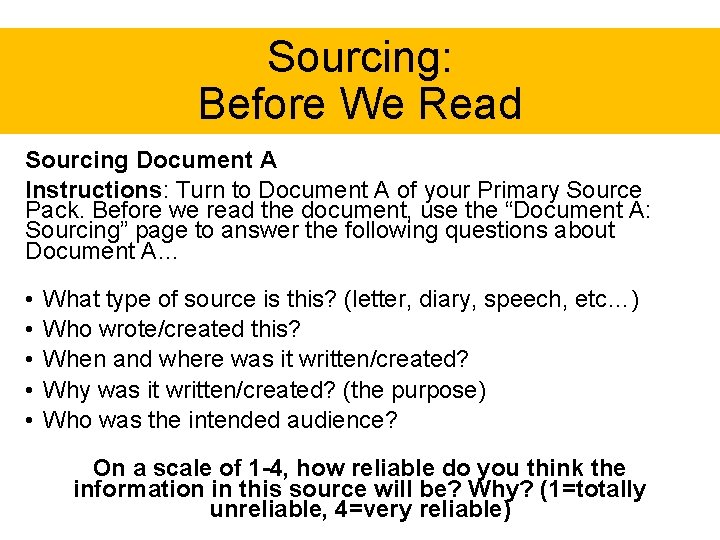
Sourcing: Before We Read Sourcing Document A Instructions: Turn to Document A of your Primary Source Pack. Before we read the document, use the “Document A: Sourcing” page to answer the following questions about Document A… • • • What type of source is this? (letter, diary, speech, etc…) Who wrote/created this? When and where was it written/created? Why was it written/created? (the purpose) Who was the intended audience? On a scale of 1 -4, how reliable do you think the information in this source will be? Why? (1=totally unreliable, 4=very reliable)
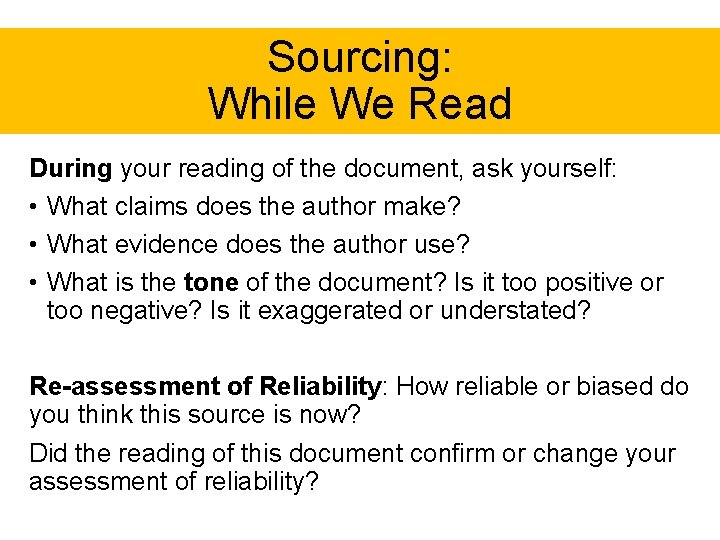
Sourcing: While We Read During your reading of the document, ask yourself: • What claims does the author make? • What evidence does the author use? • What is the tone of the document? Is it too positive or too negative? Is it exaggerated or understated? Re-assessment of Reliability: How reliable or biased do you think this source is now? Did the reading of this document confirm or change your assessment of reliability?
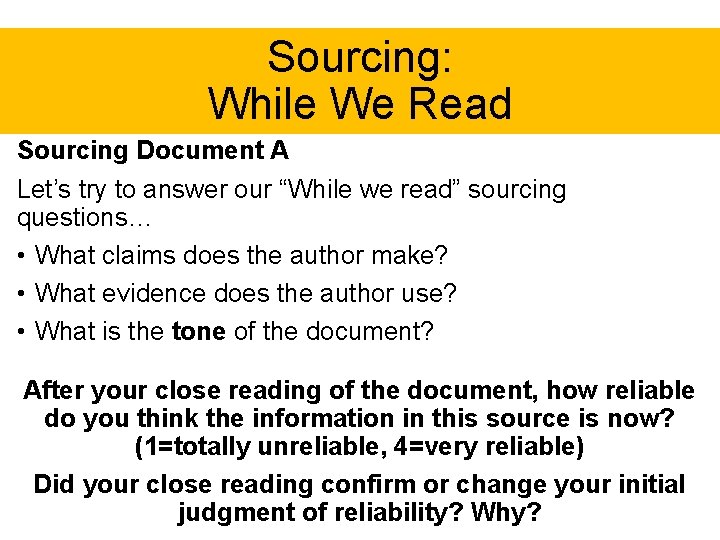
Sourcing: While We Read Sourcing Document A Let’s try to answer our “While we read” sourcing questions… • What claims does the author make? • What evidence does the author use? • What is the tone of the document? After your close reading of the document, how reliable do you think the information in this source is now? (1=totally unreliable, 4=very reliable) Did your close reading confirm or change your initial judgment of reliability? Why?
Sourcing: After We Read After reading the document, ask yourself: • How does the context of the time add to our understanding of this document? • Do other sources corroborate what is said in this document? Re-assessment of Reliability: How reliable or biased do you think this source is now? Did corroboration and contextualization of this document confirm or change your assessment of reliability?
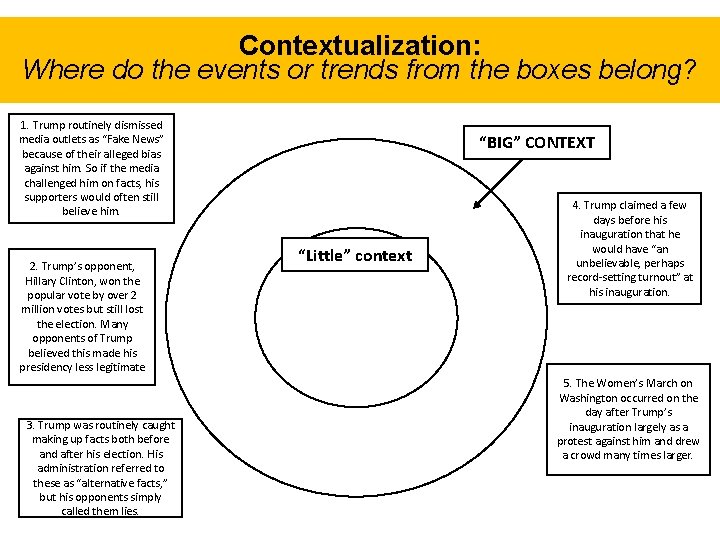
Sourcing: After We Read Sourcing Document A: Contextualization Turn to your “Document A: Contextualization” handout “Context” includes any relevant details from the time of the event that can help us understand the event and the reliability of the sources we are studying When analyzing context, we can distinguish between the “big context” and the “little context” • “Little context” = important details from around the same time as the event we are studying (days, weeks, etc. ) • “Big context” = important details from the general time period of the event we are studying (years, decades, etc. )
Contextualization: Where do the events or trends from the boxes belong? 1. Trump routinely dismissed media outlets as “Fake News” because of their alleged bias against him. So if the media challenged him on facts, his supporters would often still believe him. 2. Trump’s opponent, Hillary Clinton, won the popular vote by over 2 million votes but still lost the election. Many opponents of Trump believed this made his presidency less legitimate 3. Trump was routinely caught making up facts both before and after his election. His administration referred to these as “alternative facts, ” but his opponents simply called them lies. “BIG” CONTEXT “Little” context 4. Trump claimed a few days before his inauguration that he would have “an unbelievable, perhaps record-setting turnout” at his inauguration. 5. The Women’s March on Washington occurred on the day after Trump’s inauguration largely as a protest against him and drew a crowd many times larger.
After We Read: Corroboration • • Corroborating Document A Do other sources corroborate what is said in this document? In your groups, you will use the sourcing method (Before, During AND After reading) to analyze one of the other primary sources in your handout. When groups are finished analyzing their assigned source, each group will present their findings to the class. Your findings must include your assessment of reliability of the source, and whether or not it corroborates the information from Document A.
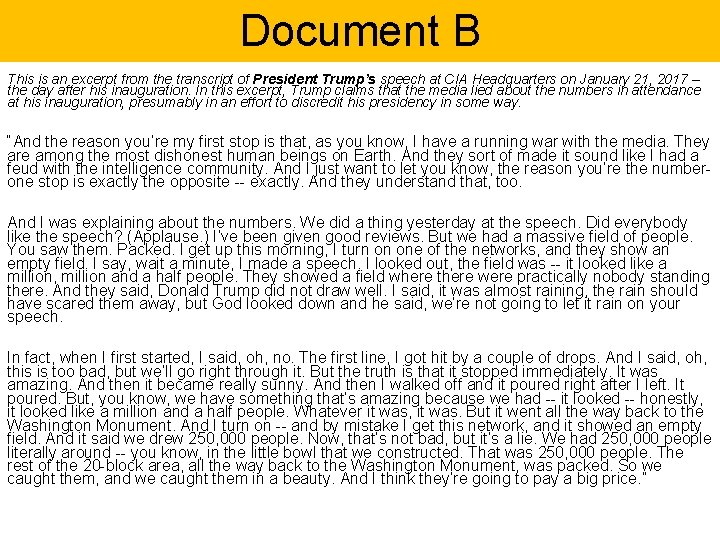
Document B This is an excerpt from the transcript of President Trump’s speech at CIA Headquarters on January 21, 2017 – the day after his inauguration. In this excerpt, Trump claims that the media lied about the numbers in attendance at his inauguration, presumably in an effort to discredit his presidency in some way. “And the reason you’re my first stop is that, as you know, I have a running war with the media. They are among the most dishonest human beings on Earth. And they sort of made it sound like I had a feud with the intelligence community. And I just want to let you know, the reason you’re the numberone stop is exactly the opposite -- exactly. And they understand that, too. And I was explaining about the numbers. We did a thing yesterday at the speech. Did everybody like the speech? (Applause. ) I’ve been given good reviews. But we had a massive field of people. You saw them. Packed. I get up this morning, I turn on one of the networks, and they show an empty field. I say, wait a minute, I made a speech. I looked out, the field was -- it looked like a million, million and a half people. They showed a field where there were practically nobody standing there. And they said, Donald Trump did not draw well. I said, it was almost raining, the rain should have scared them away, but God looked down and he said, we’re not going to let it rain on your speech. In fact, when I first started, I said, oh, no. The first line, I got hit by a couple of drops. And I said, oh, this is too bad, but we’ll go right through it. But the truth is that it stopped immediately. It was amazing. And then it became really sunny. And then I walked off and it poured right after I left. It poured. But, you know, we have something that’s amazing because we had -- it looked -- honestly, it looked like a million and a half people. Whatever it was, it was. But it went all the way back to the Washington Monument. And I turn on -- and by mistake I get this network, and it showed an empty field. And it said we drew 250, 000 people. Now, that’s not bad, but it’s a lie. We had 250, 000 people literally around -- you know, in the little bowl that we constructed. That was 250, 000 people. The rest of the 20 -block area, all the way back to the Washington Monument, was packed. So we caught them, and we caught them in a beauty. And I think they’re going to pay a big price. ”
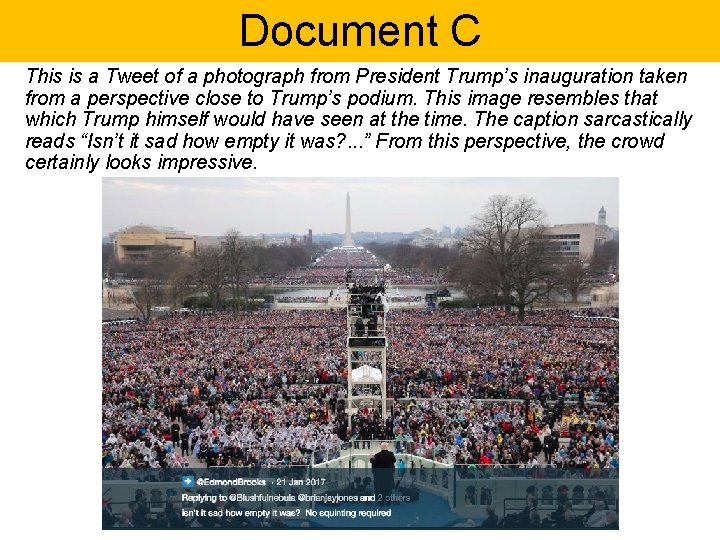
Document C This is a Tweet of a photograph from President Trump’s inauguration taken from a perspective close to Trump’s podium. This image resembles that which Trump himself would have seen at the time. The caption sarcastically reads “Isn’t it sad how empty it was? . . . ” From this perspective, the crowd certainly looks impressive.
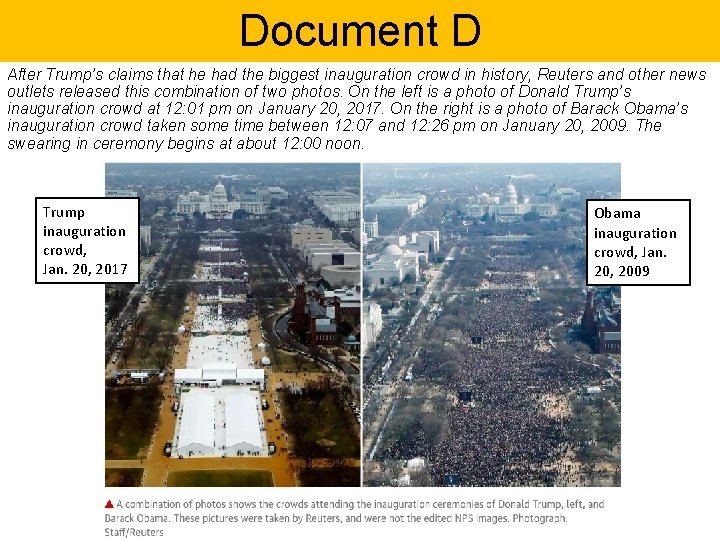
Document D After Trump’s claims that he had the biggest inauguration crowd in history, Reuters and other news outlets released this combination of two photos. On the left is a photo of Donald Trump’s inauguration crowd at 12: 01 pm on January 20, 2017. On the right is a photo of Barack Obama’s inauguration crowd taken some time between 12: 07 and 12: 26 pm on January 20, 2009. The swearing in ceremony begins at about 12: 00 noon. Trump inauguration crowd, Jan. 20, 2017 Obama inauguration crowd, Jan. 20, 2009
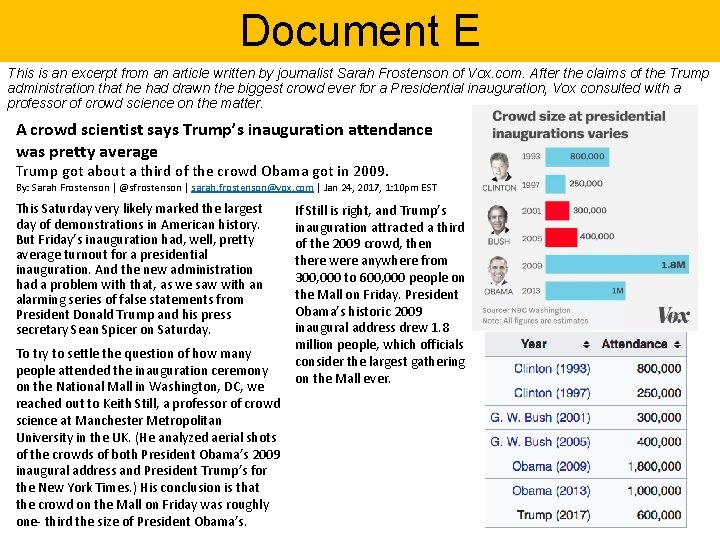
Document E This is an excerpt from an article written by journalist Sarah Frostenson of Vox. com. After the claims of the Trump administration that he had drawn the biggest crowd ever for a Presidential inauguration, Vox consulted with a professor of crowd science on the matter. A crowd scientist says Trump’s inauguration attendance was pretty average Trump got about a third of the crowd Obama got in 2009. By: Sarah Frostenson | @sfrostenson | sarah. frostenson@vox. com | Jan 24, 2017, 1: 10 pm EST This Saturday very likely marked the largest day of demonstrations in American history. But Friday’s inauguration had, well, pretty average turnout for a presidential inauguration. And the new administration had a problem with that, as we saw with an alarming series of false statements from President Donald Trump and his press secretary Sean Spicer on Saturday. To try to settle the question of how many people attended the inauguration ceremony on the National Mall in Washington, DC, we reached out to Keith Still, a professor of crowd science at Manchester Metropolitan University in the UK. (He analyzed aerial shots of the crowds of both President Obama’s 2009 inaugural address and President Trump’s for the New York Times. ) His conclusion is that the crowd on the Mall on Friday was roughly one- third the size of President Obama’s. If Still is right, and Trump’s inauguration attracted a third of the 2009 crowd, then there were anywhere from 300, 000 to 600, 000 people on the Mall on Friday. President Obama’s historic 2009 inaugural address drew 1. 8 million people, which officials consider the largest gathering on the Mall ever.
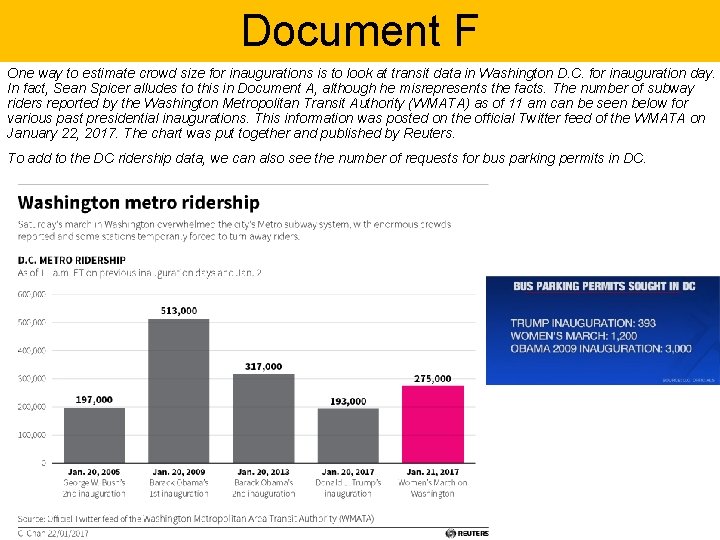
Document F One way to estimate crowd size for inaugurations is to look at transit data in Washington D. C. for inauguration day. In fact, Sean Spicer alludes to this in Document A, although he misrepresents the facts. The number of subway riders reported by the Washington Metropolitan Transit Authority (WMATA) as of 11 am can be seen below for various past presidential inaugurations. This information was posted on the official Twitter feed of the WMATA on January 22, 2017. The chart was put together and published by Reuters. To add to the DC ridership data, we can also see the number of requests for bus parking permits in DC.
Answering the Big Question Now that we have analyzed multiple sources and forms of evidence, we can finally answer our BIG QUESTION: Did Donald Trump lie about having the largest inaugural crowd ever? Instructions: Please provide a written response to this question using multiple sources and evidence from our documents. Be sure to discuss issues of reliability and bias, context and corroboration in your answer. NOTE: There are no right or wrong answers – only stronger or weaker answer based on the evidence and reliability of sources used in your answer.