
Evidence and Phylogenetic trees EVIDENCE USED IN CLASSIFICATION
- Slides: 9
Evidence and Phylogenetic trees
EVIDENCE USED IN CLASSIFICATION Taxonomists, the scientists who study classification, attempt to arrange organisms into groups based on evolutionary relationships The evolutionary history of a species is called it’s phylogeny Phylogenetic relationships are determined by the following evidence: 1. Comparative morphology 2. Embryology 3. Chromosomes/DNA 4. Biochemistry
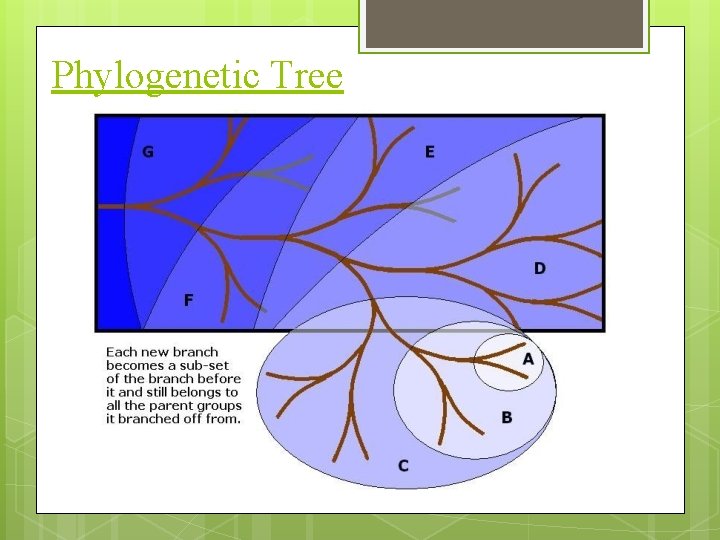
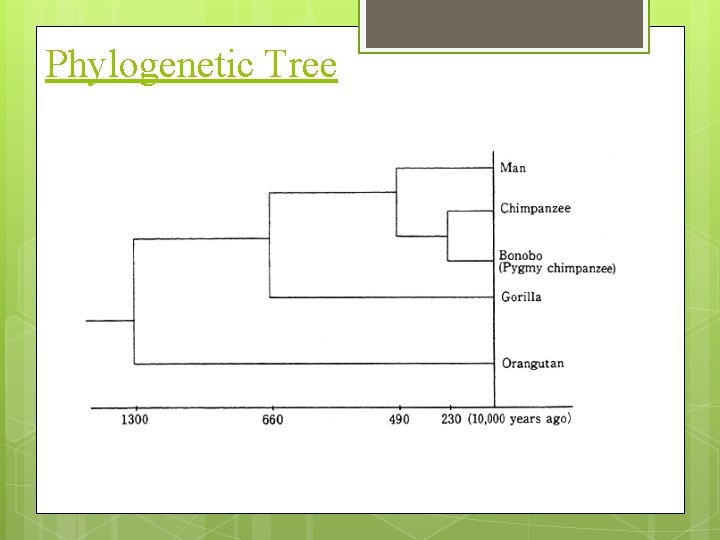
Phylogenetic Trees n n n A tree showing the evolutionary relationships among various biological species that are believed to have a common ancestor Each branch with descendants represents the most recent common ancestor of the descendants The line lengths can correspond to time estimates
Phylogenetic Tree
Phylogenetic Tree
1. COMPARATIVE MORPHOLOGY n Comparison of the structure of organisms n May not be enough by itself to accurately identify classify an organism n n E. g. analogous structures look similar but share no common ancestry (organisms are not related) ex. Wings Similar structures = similar instructions = similar DNA = common ancestor
2. EMBRYOLOGY Similarity and differences of embryonic structures and tissues and developmental patterns can determine how closely related organisms are Similar embryology = similar instructions = similar DNA = common ancestor
3. CHROMOSOMES/GENETICS Comparison of the chromosomes/genes of different organisms Can compare chromosome numbers/shapes Can compare actual DNA sequences Similar genetics = similar instructions = similar DNA= common ancestor
4. BIOCHEMISTRY Comparison of organisms' biochemistry: Comparing simple and complex molecules like proteins and amino acid sequences Similar biochemistry = similar instructions = similar DNA = common ancestor