
Evgw eivmi to Alfa Beginning Greek for Bible
Evgw, eivmi to; A[lfa Beginning Greek for Bible Study Class #8 Using the Tools kai; to; w=
Paper Tools Concordance – a book that lists every occurrence of a particular word in the Bible Dictionary – a book that gives the meaning and usually additional information about particular topics in the Bible Commentary – a book that explains the meaning of a particular book in the Bible Lexicon – a dictionary for either Greek or Hebrew words
Electronic Tools Bible Software – these are programs which contain a variety of Bible versions, dictionaries, commentaries, concordances, and sometimes parsing information Online Tools – these are websites which contain many of the above tools, but are accessed on the Internet rather than through a software program running on your computer
Tonight Focus on electronic tools, both software and online Focus on using concordances and Bible dictionaries Then… n n August 8 th – focus on doing word studies August 22 nd – focus on using commentaries
Concordance A book that lists every occurrence of a particular word in the Bible It is helpful for doing topical studies, looking for cross-references, and finding particular verses Limitations: n n n You must use a concordance for the particular version of the Bible you are using Topical study – just looking up a particular word or words may leave out key texts Context – a concordance limits the context
Paper Concordances NASB – The Strongest NASB Exhaustive Concordance (Zondervan) - $25 ($40) ESV – The Crossway Comprehensive Concordance of the Holy Bible, English Standard Version (Crossway) - $30 ($40) NIV – The Strongest NIV Exhaustive Concordance (Zondervan) - $25 ($40) KJV – The Strongest Strong’s Exhaustive Concordance of the Bible (Zondervan) $18 ($35)
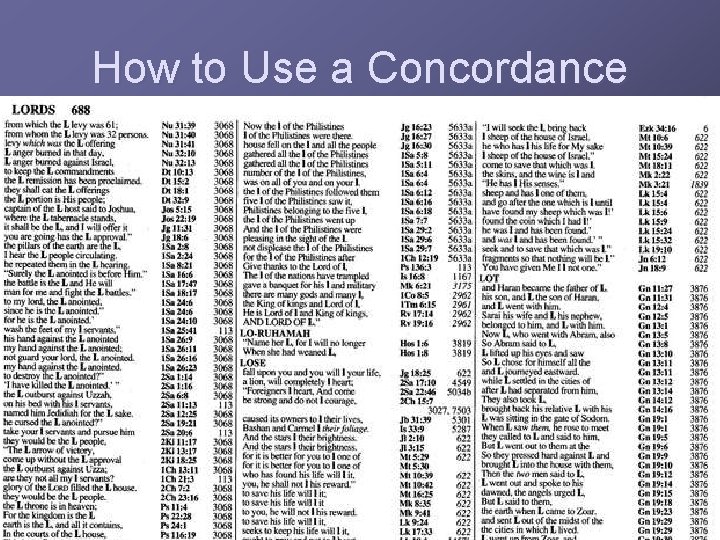
How to Use a Concordance
How to Use an Online Concordance www. blueletterbible. org www. searchgodsword. org
Paper Bible Dictionaries Nave’s Topical Bible Treasury of Scripture Knowledge Nelson’s Bible Dictionary Unger’s Bible Dictionary International Standard Bible Encyclopedia

Online Dictionaries www. searchgodsword. org
Software Most Bible software packages have an “entry level” product that is usually not much use Hint: most of the good resources you will pay for. The mediocre resources are often “public domain” Many of the programs have a free demo that you can download and try before you buy it
Software Look for: n n n The Bible versions you want and will use The dictionaries & commentaries that you want and will use An interlinear Bible An interface that is comfortable to you If you want to dig deeper into the original languages, look for Greek/Hebrew resources

Software Mac n n n Accordance ($179 -500) Logos (in process, coming soon) Others PC n n n PC Study Bible ($200 -450) Logos ($230 -475) Bibleworks ($350) Quickverse ($100 -600) E-sword (free*) Others

If you’re still confused… Ask the teacher before you buy something!
Homework Practice doing some concordance searches Use the online resources If you’re interested, investigate Bible software and print versions of the resources mentioned

Advanced Class #8 Verbs, & More Verbs!
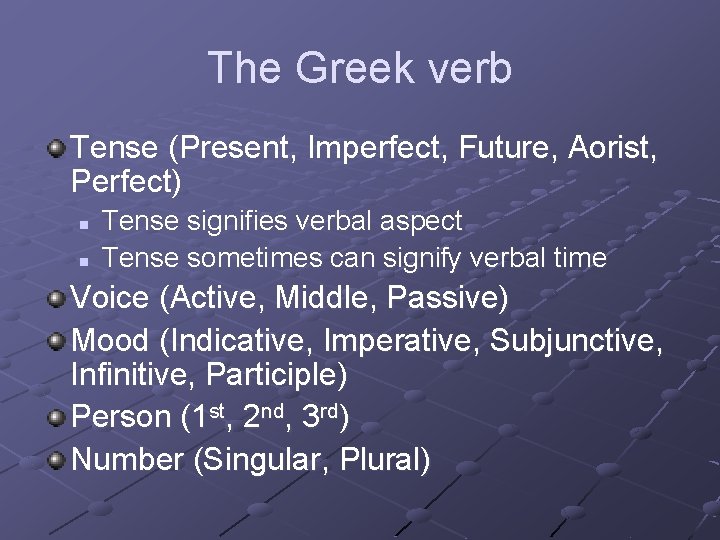
The Greek verb Tense (Present, Imperfect, Future, Aorist, Perfect) n n Tense signifies verbal aspect Tense sometimes can signify verbal time Voice (Active, Middle, Passive) Mood (Indicative, Imperative, Subjunctive, Infinitive, Participle) Person (1 st, 2 nd, 3 rd) Number (Singular, Plural)
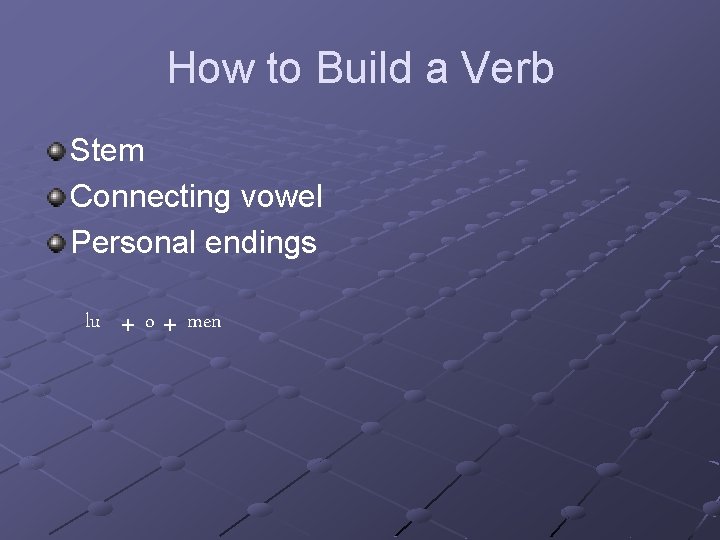
How to Build a Verb Stem Connecting vowel Personal endings lu + o + men
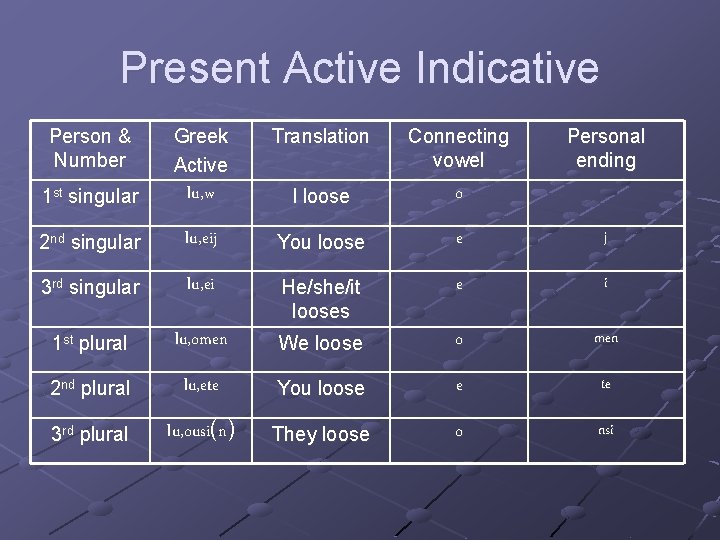
Present Active Indicative Person & Number Greek Active Translation Connecting vowel Personal ending 1 st singular lu, w I loose o 2 nd singular lu, eij You loose e j 3 rd singular lu, ei He/she/it looses e i 1 st plural lu, omen We loose o men 2 nd plural lu, ete You loose e te 3 rd plural lu, ousi(n) They loose o nsi
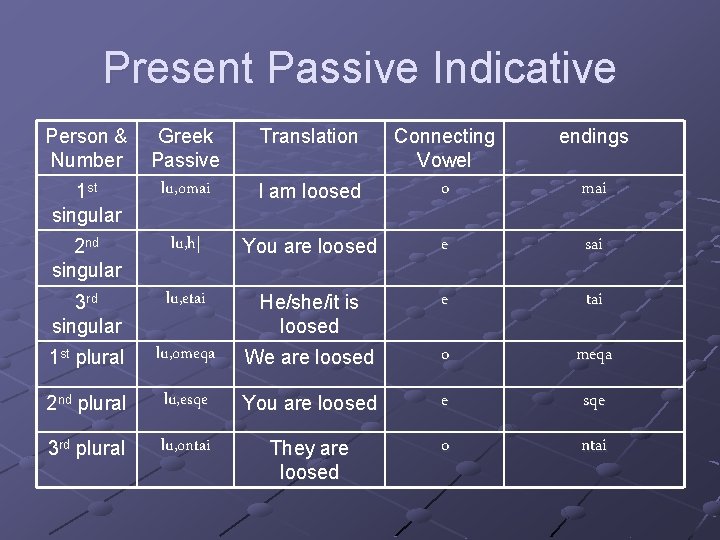
Present Passive Indicative Person & Number Greek Passive Translation Connecting Vowel endings 1 st singular lu, omai I am loosed o mai 2 nd singular lu, h| You are loosed e sai 3 rd singular lu, etai He/she/it is loosed e tai 1 st plural lu, omeqa We are loosed o meqa 2 nd plural lu, esqe You are loosed e sqe 3 rd plural lu, ontai They are loosed o ntai
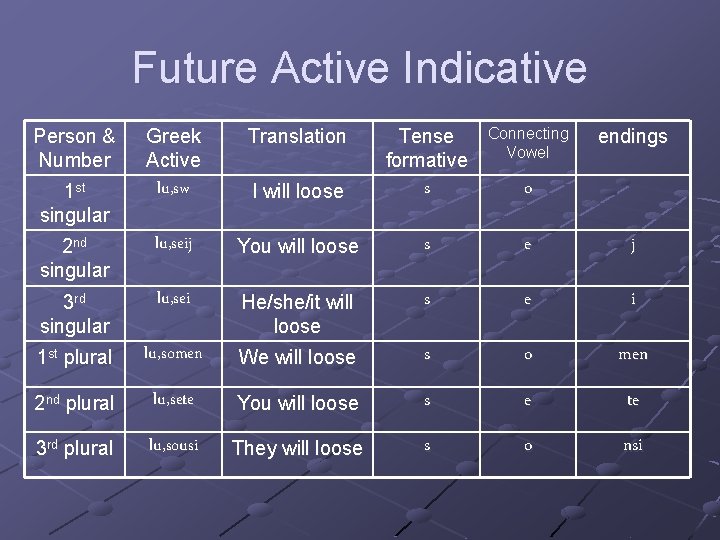
Future Active Indicative Person & Number Greek Active Translation Tense formative Connecting Vowel 1 st singular lu, sw I will loose s o 2 nd singular lu, seij You will loose s e j 3 rd singular lu, sei He/she/it will loose s e i 1 st plural lu, somen We will loose s o men 2 nd plural lu, sete You will loose s e te 3 rd plural lu, sousi They will loose s o nsi endings
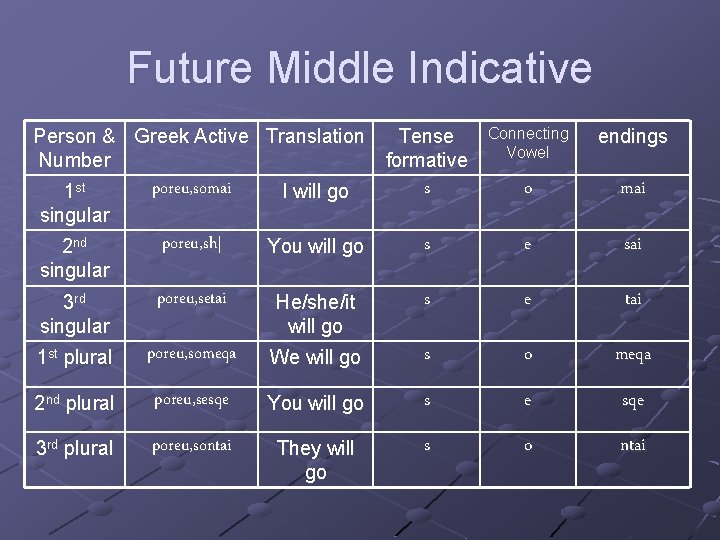
Future Middle Indicative Person & Greek Active Translation Tense Number formative Connecting Vowel endings 1 st singular poreu, somai I will go s o mai 2 nd singular poreu, sh| You will go s e sai 3 rd singular poreu, setai He/she/it will go s e tai 1 st plural poreu, someqa We will go s o meqa 2 nd plural poreu, sesqe You will go s e sqe 3 rd plural poreu, sontai They will go s o ntai
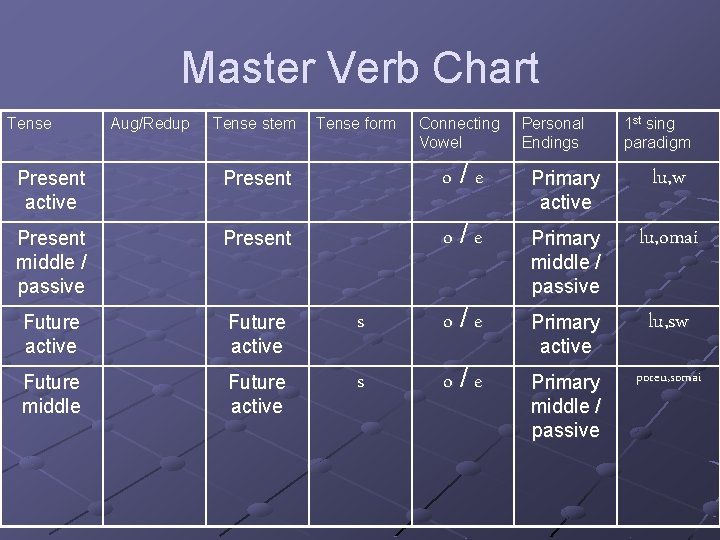
Master Verb Chart Tense Aug/Redup Tense stem Tense form Connecting Vowel Personal Endings 1 st sing paradigm Present active Present o/e Primary active lu, w Present middle / passive Present o/e Primary middle / passive lu, omai Future active s o/e Primary active lu, sw Future middle Future active s o/e Primary middle / passive poreu, somai
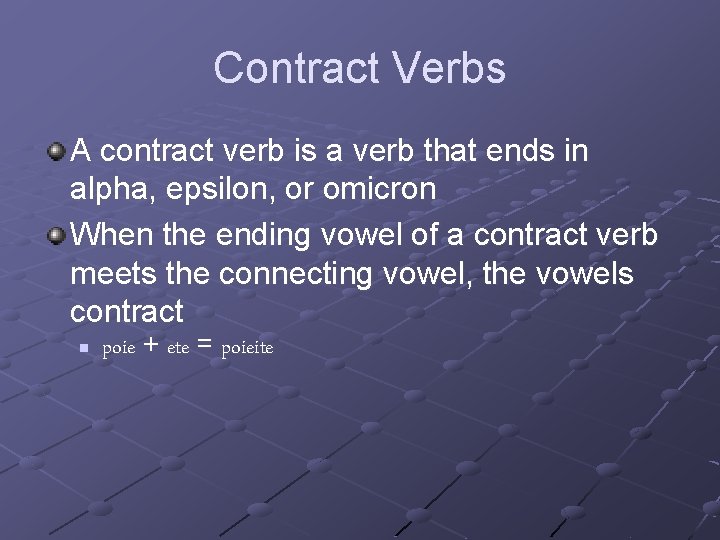
Contract Verbs A contract verb is a verb that ends in alpha, epsilon, or omicron When the ending vowel of a contract verb meets the connecting vowel, the vowels contract n poie + ete = poieite
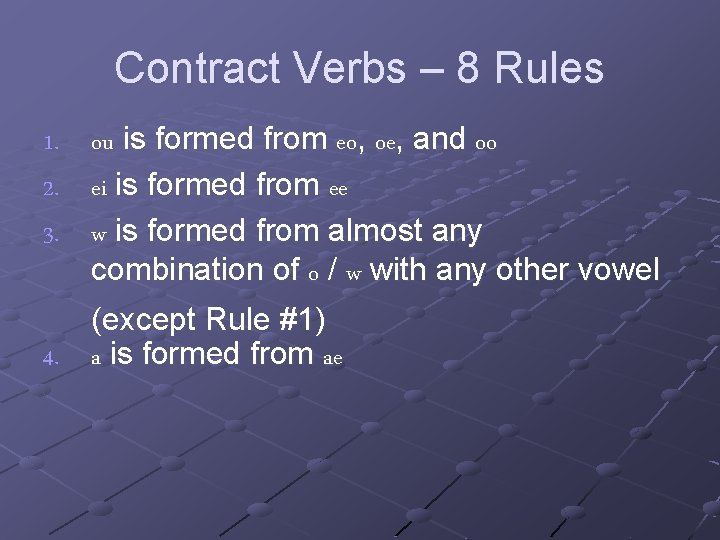
Contract Verbs – 8 Rules 1. 2. 3. ou is formed from eo, oe, and oo ei is formed from ee w is formed from almost any combination of o / w with any other vowel (except Rule #1) 4. a is formed from ae
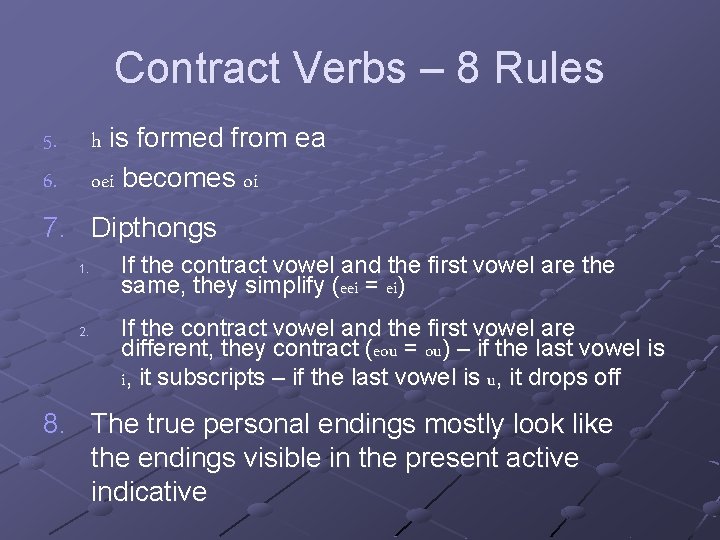
Contract Verbs – 8 Rules h is formed from ea oei becomes oi 5. 6. 7. Dipthongs 1. 2. If the contract vowel and the first vowel are the same, they simplify (eei = ei) If the contract vowel and the first vowel are different, they contract (eou = ou) – if the last vowel is i, it subscripts – if the last vowel is u, it drops off 8. The true personal endings mostly look like the endings visible in the present active indicative
Root versus Stem
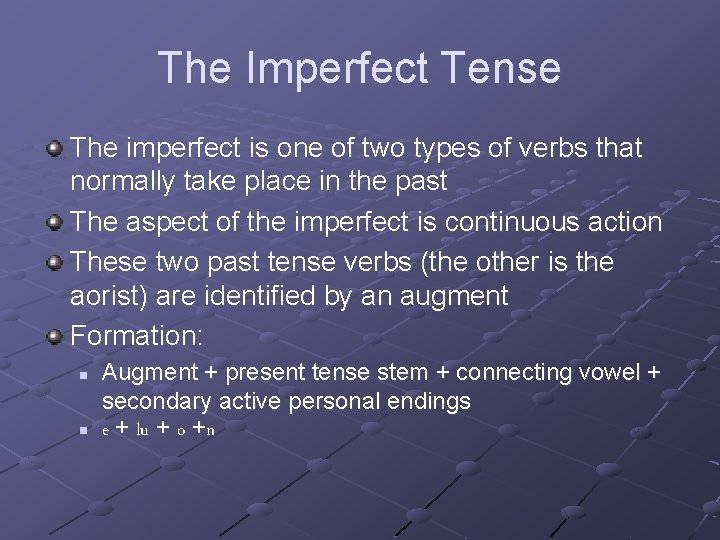
The Imperfect Tense The imperfect is one of two types of verbs that normally take place in the past The aspect of the imperfect is continuous action These two past tense verbs (the other is the aorist) are identified by an augment Formation: n n Augment + present tense stem + connecting vowel + secondary active personal endings e + lu + o +n
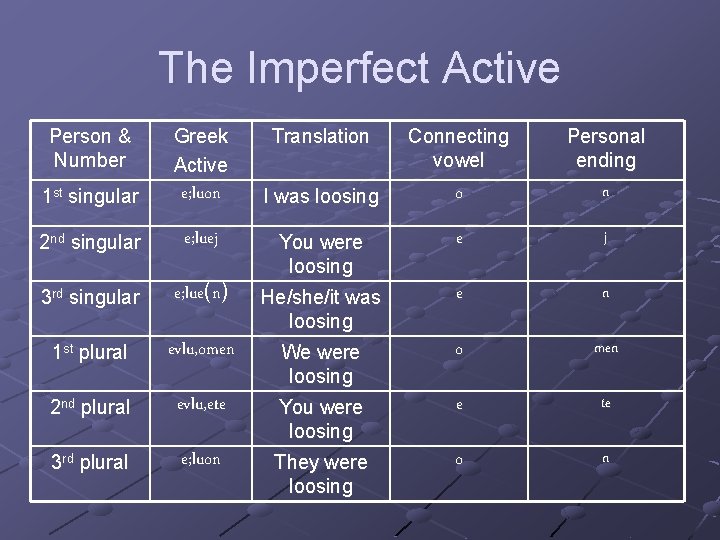
The Imperfect Active Person & Number Greek Active Translation Connecting vowel 1 st singular e; luon I was loosing o Personal ending n 2 nd singular e; luej You were loosing e j 3 rd singular e; lue(n) He/she/it was loosing e n 1 st plural evlu, omen We were loosing o men 2 nd plural evlu, ete You were loosing e te 3 rd plural e; luon They were loosing o n
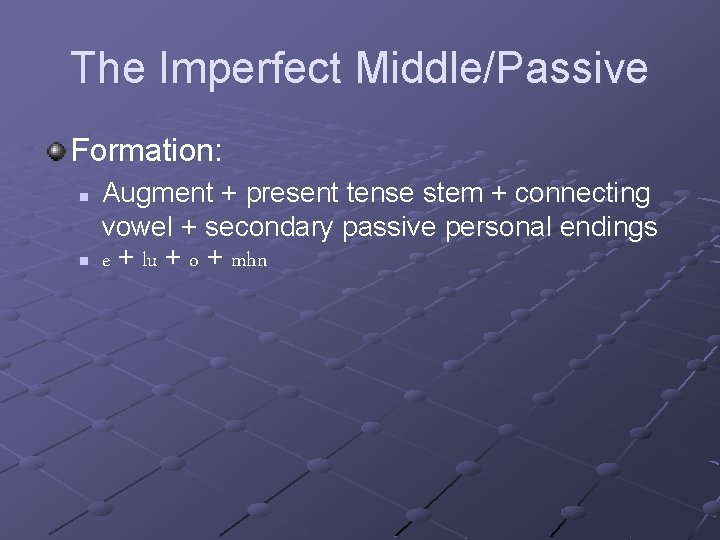
The Imperfect Middle/Passive Formation: n n Augment + present tense stem + connecting vowel + secondary passive personal endings e + lu + o + mhn
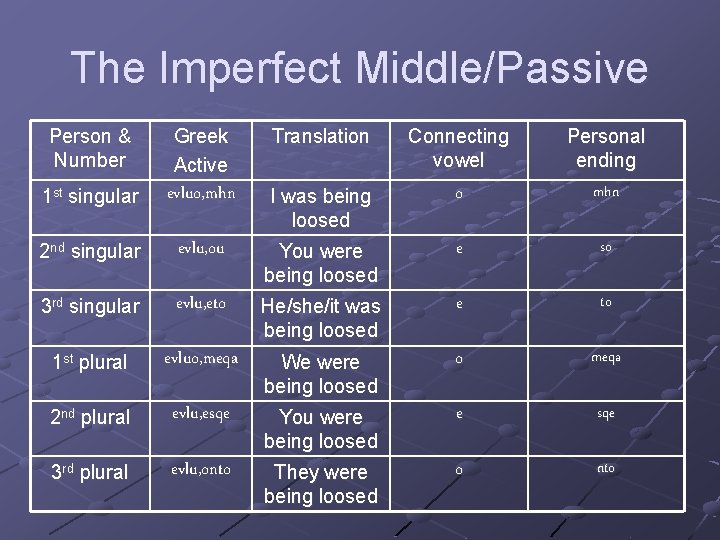
The Imperfect Middle/Passive Person & Number Greek Active Translation Connecting vowel 1 st singular evluo, mhn I was being loosed o Personal ending mhn 2 nd singular evlu, ou You were being loosed e so 3 rd singular evlu, eto He/she/it was being loosed e to 1 st plural evluo, meqa We were being loosed o meqa 2 nd plural evlu, esqe You were being loosed e sqe 3 rd plural evlu, onto They were being loosed o nto
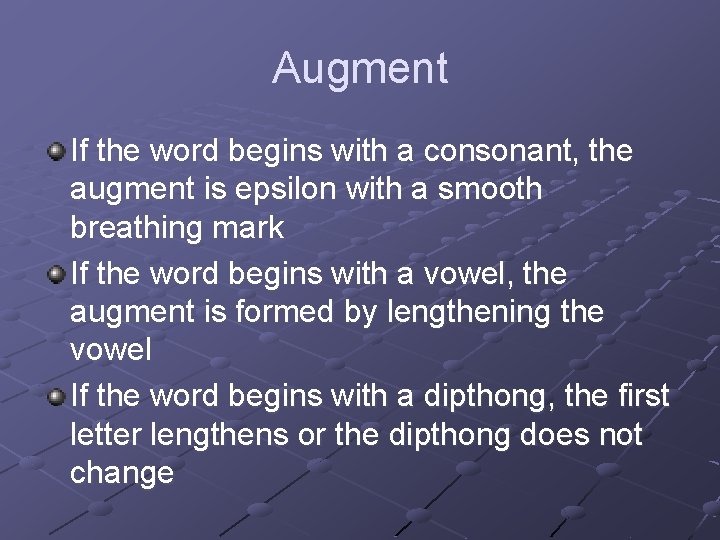
Augment If the word begins with a consonant, the augment is epsilon with a smooth breathing mark If the word begins with a vowel, the augment is formed by lengthening the vowel If the word begins with a dipthong, the first letter lengthens or the dipthong does not change
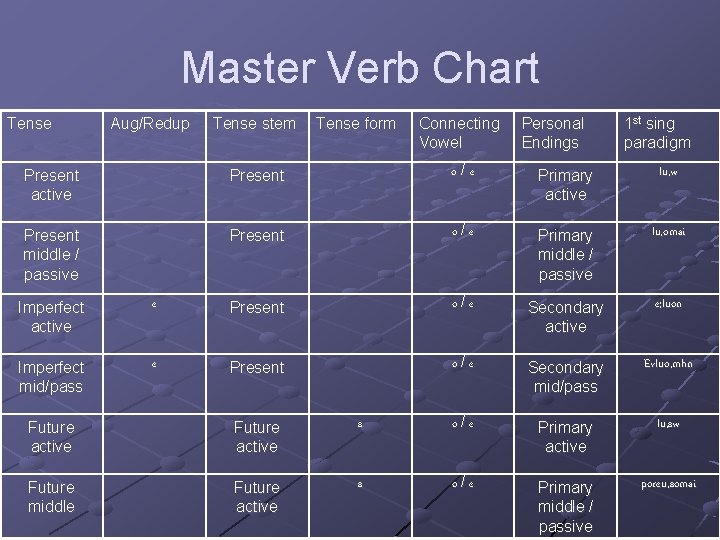
Master Verb Chart Tense Aug/Redup Tense stem Tense form Connecting Vowel Personal Endings 1 st sing paradigm Present active Present o/e Primary active lu, w Present middle / passive Present o/e Primary middle / passive lu, omai Imperfect active e Present o/e Secondary active e; luon Imperfect mid/pass e Present o/e Secondary mid/pass Evluo, mhn Future active s o/e Primary active lu, sw Future middle Future active s o/e Primary middle / passive poreu, somai
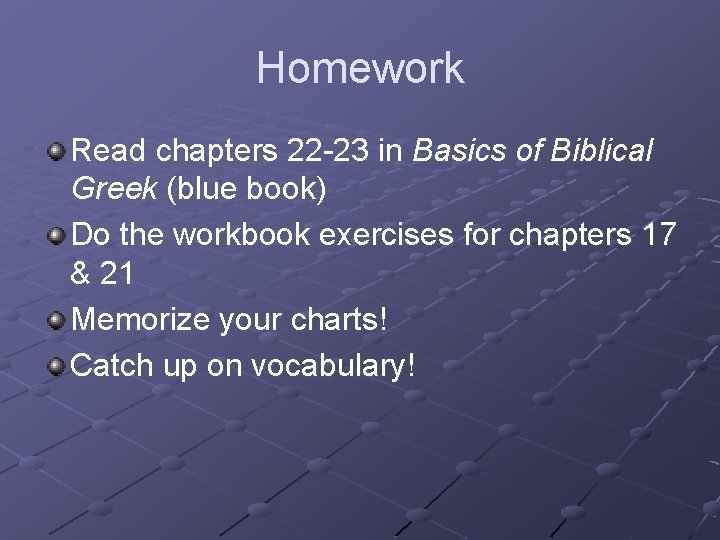
Homework Read chapters 22 -23 in Basics of Biblical Greek (blue book) Do the workbook exercises for chapters 17 & 21 Memorize your charts! Catch up on vocabulary!
- Slides: 34