
Everything You Wanted to Know about the JPML
Everything You Wanted to Know about the JPML “Current Issues in MDLs and Class Actions” March 26, 2019 1
What is the JPML? v Created in 1968 by 28 U. S. C. § 1407, after the judiciary’s experience with the more than 1800 related electrical equipment civil antitrust cases in the 1960 s. v Seven circuit and district judges designated from time to time by the Chief Justice, no two of whom shall be from the same circuit. 28 U. S. C. § 1407(d) v By custom, the Chief Justice has established a seven-year term limit. v The concurrence of four members is required for any action by the Panel. 28 U. S. C. § 1407(d) v Panel Rules: 277 F. R. D. 480 v Panel website: jpml. uscourts. gov 2
Current Panel Members Hon. Sarah S. Vance, Chair United States District Court Eastern District of Louisiana Hon. Lewis A. Kaplan United States District Court Southern District of New York Hon. Ellen Segal Huvelle United States District Court District of Columbia Hon. R. David Proctor United States District Court Northern District of Alabama Hon. Catherine D. Perry United States District Court Eastern District of Missouri Hon. Karen K. Caldwell United States District Court Eastern District of Kentucky Hon. Nathaniel M. Gorton United States District Court District of Massachusetts 3
Panel Staff Located in Thurgood Marshall FJB, Washington, DC v Panel Executive, Clerk’s Office, and Staff Attorneys support the Panel. v Panel Executive functions as Chief Executive Officer and Chief Legal Officer; manages the legal, operational, and administrative staff of the Panel. v Clerk’s Office processes motions, other filings, and orders; maintains dockets; and develops statistics. v Staff Attorneys review cases for inclusion in, or remand from, existing MDLs; summarize and analyze briefing on motions to create new MDLs, as well as contested matters in existing MDLs (e. g. , motions to vacate CTO or CRO). 4

Panel’s Primary Statutory Duties v Determine whether civil actions involving one or more common questions of fact pending in different districts should be transferred to a single district for coordinated or consolidated pretrial proceedings. v “ … for the convenience of parties and witnesses and [to] promote the just and efficient conduct of such actions …” v Select the judge(s) to conduct pretrial proceedings. v At or before the conclusion of pretrial proceedings, remand MDL actions to original (transferor) court. 5

Creating an MDL v Motion of a party (99%) or by the Panel sua sponte. v Panel Considers v Motion to centralize, responses, reply v Hearing, usually with oral argument, 6 Panel hearings each year held in courts around the country v Panel Decision – published order usually issued within 10 days or less of the hearing. v Consent of Transferee Court (district’s Chief Judge) is required by statute before transfer. 6

Transfers to Existing MDLs v Tag-along actions = actions involving common questions of fact with (1) actions on an initial transfer motion or (2) actions in an existing MDL. v Party or counsel in cases on initial transfer motion or in existing MDL must notify Panel of potential tag-along actions. Panel Rules 6. 2(d) & 7. 1(a) v If Panel Staff find action is appropriate for inclusion, Panel Clerk issues a conditional transfer order (CTO) If CTO is unopposed, action is transferred after 7 days If CTO is opposed, briefing and consideration by Panel at hearing, usually without oral argument. v If Panel Staff find action is not appropriate for inclusion, CTO will not issue, but the involved party may move for transfer. 7

Other Additions to Existing MDLs v “Direct filed” actions = potential tag-along actions filed in the transferee district v Direct filed actions do not require official Panel action. v Party should request assignment of these actions to the Transferee Judge in accordance with applicable local rules. v Panel informally advises Transferee Judges to ensure that direct filed cases are within Panel-defined parameters of MDL. v CY 2018: The Panel transferred 4, 100 tag-along actions. 38, 794 cases were added to MDLs through direct filings. Ten MDLs account for almost 84% of directly filed cases. 8
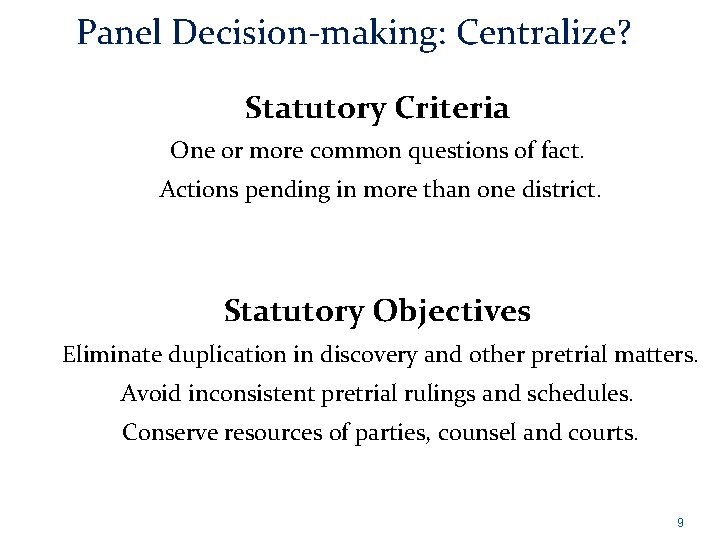
Panel Decision-making: Centralize? Statutory Criteria One or more common questions of fact. Actions pending in more than one district. Statutory Objectives Eliminate duplication in discovery and other pretrial matters. Avoid inconsistent pretrial rulings and schedules. Conserve resources of parties, counsel and courts. 9
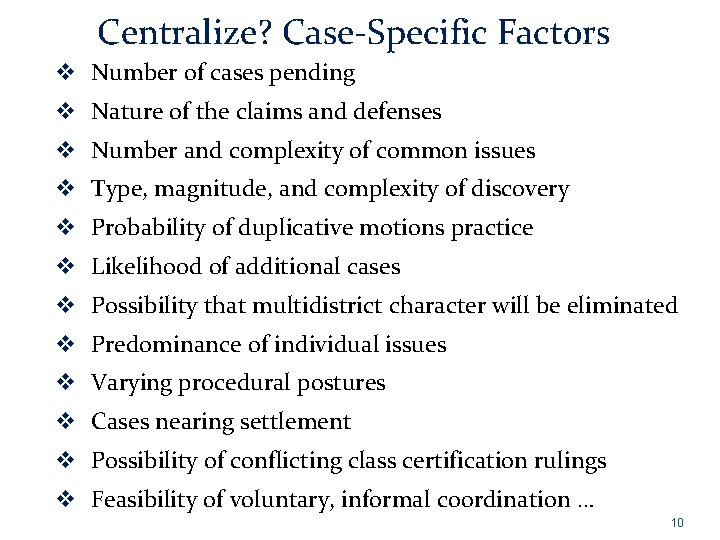
Centralize? Case-Specific Factors v Number of cases pending v Nature of the claims and defenses v Number and complexity of common issues v Type, magnitude, and complexity of discovery v Probability of duplicative motions practice v Likelihood of additional cases v Possibility that multidistrict character will be eliminated v Predominance of individual issues v Varying procedural postures v Cases nearing settlement v Possibility of conflicting class certification rulings v Feasibility of voluntary, informal coordination … 10
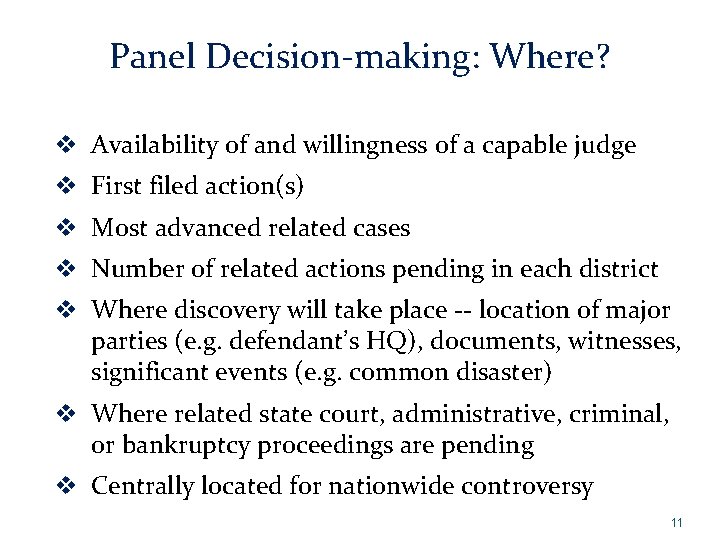
Panel Decision-making: Where? v Availability of and willingness of a capable judge v First filed action(s) v Most advanced related cases v Number of related actions pending in each district v Where discovery will take place -- location of major parties (e. g. defendant’s HQ), documents, witnesses, significant events (e. g. common disaster) v Where related state court, administrative, criminal, or bankruptcy proceedings are pending v Centrally located for nationwide controversy 11
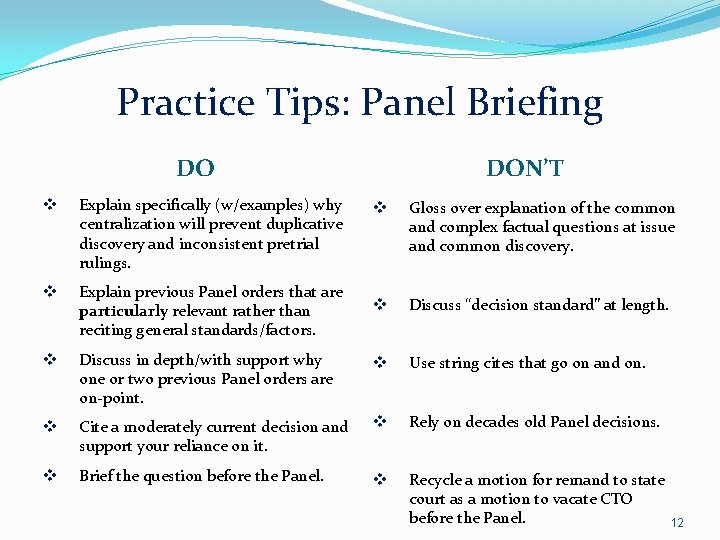
Practice Tips: Panel Briefing DO v Explain specifically (w/examples) why centralization will prevent duplicative discovery and inconsistent pretrial rulings. v Explain previous Panel orders that are particularly relevant rather than reciting general standards/factors. v DON’T v Gloss over explanation of the common and complex factual questions at issue and common discovery. v Discuss “decision standard” at length. Discuss in depth/with support why one or two previous Panel orders are on-point. v Use string cites that go on and on. v Cite a moderately current decision and support your reliance on it. v Rely on decades old Panel decisions. v Brief the question before the Panel. v Recycle a motion for remand to state court as a motion to vacate CTO before the Panel. 12
Practice Tips: Panel Briefing DO v Recognize the Panel does not need a NYC Travel Guide. v Focus caseload arguments on noteworthy capacity issues (e. g. , a district is down significantly on judges or is a widely recognized congested district) DON’T v Discuss obviously accessible districts' infrastructure (airports, plentiful hotels, etc. ). v Recite general caseload statistics (e. g. comparisons of district caseloads) 13
And whatever you do, DON’T… v Fail to promptly notify the Panel of developments in the litigation (e. g. , new potential tag along action(s), involvement of new districts, development that moots the motion or fully disposes of any action on a motion, change in position on centralization or district, etc. ). v File last-minute briefs (with unnecessary or redundant information) on the eve of the hearing. 14
Practice Tips: Oral Argument v NOT Persuasive: v Number of hotels and restaurants in suggested district v Number of transportation options to obviously accessible district v Favorability (or not) of relevant Circuit’s law or particular judge’s decisions v Invitation to evaluate the merits of cases at issue v Being unprepared to discuss alternatives to centralization pursued (since the Panel considers centralization the last resort after parties have considered the feasibility of other options, such as transfers under 28 U. S. C. § 1404(a), and voluntary coordination of discovery and pretrial proceedings). 15
Resolving an MDL v Settlement, Dispositive Motions v Transferee Court resolves > 90% of MDL cases. v But not all by settlement. See, In re: Lipitor (Atorvastatin Calcium) Mktg. , Sales Practices & Prods. Liab. Litig. (No. II), 892 F. 3 d 624 (4 th Cir. 2018) (MDL No. 2502) (affirming TJ’s exclusion of plaintiffs’ causation experts and discretion to grant omnibus summary judgment to defendant rather than suggest Section 1407 remand) v 1407 Panel Remand to Transferor Court v Usually by suggestion of Transferee Judge v Self-transfer for trial prohibited by Lexecon 16
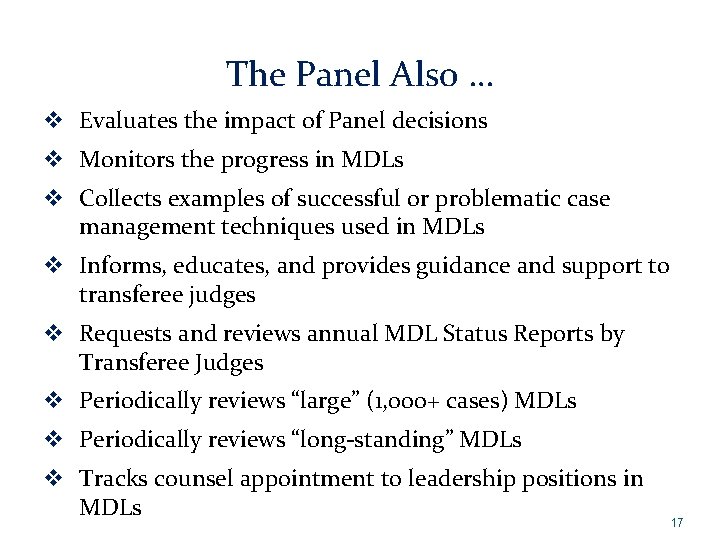
The Panel Also … v Evaluates the impact of Panel decisions v Monitors the progress in MDLs v Collects examples of successful or problematic case management techniques used in MDLs v Informs, educates, and provides guidance and support to transferee judges v Requests and reviews annual MDL Status Reports by Transferee Judges v Periodically reviews “large” (1, 000+ cases) MDLs v Periodically reviews “long-standing” MDLs v Tracks counsel appointment to leadership positions in MDLs 17
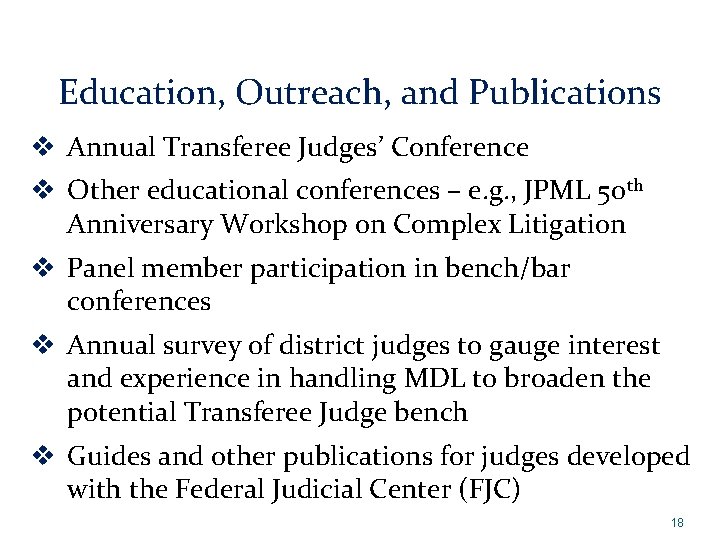
Education, Outreach, and Publications v Annual Transferee Judges’ Conference v Other educational conferences – e. g. , JPML 50 th Anniversary Workshop on Complex Litigation v Panel member participation in bench/bar conferences v Annual survey of district judges to gauge interest and experience in handling MDL to broaden the potential Transferee Judge bench v Guides and other publications for judges developed with the Federal Judicial Center (FJC) 18
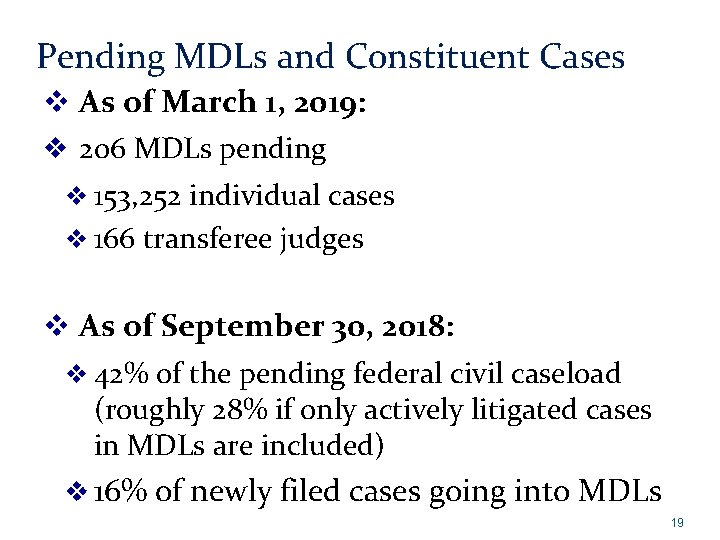
Pending MDLs and Constituent Cases v As of March 1, 2019: v 206 MDLs pending v 153, 252 individual cases v 166 transferee judges v As of September 30, 2018: v 42% of the pending federal civil caseload (roughly 28% if only actively litigated cases in MDLs are included) v 16% of newly filed cases going into MDLs 19
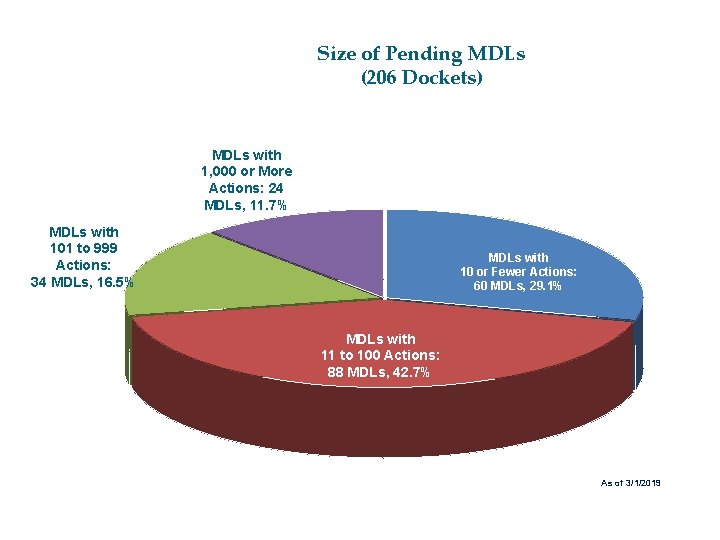
Size of Pending MDLs (206 Dockets) MDLs with 1, 000 or More Actions: 24 MDLs, 11. 7% MDLs with 101 to 999 Actions: 34 MDLs, 16. 5% MDLs with 10 or Fewer Actions: 60 MDLs, 29. 1% MDLs with 11 to 100 Actions: 88 MDLs, 42. 7% As of 3/1/2019
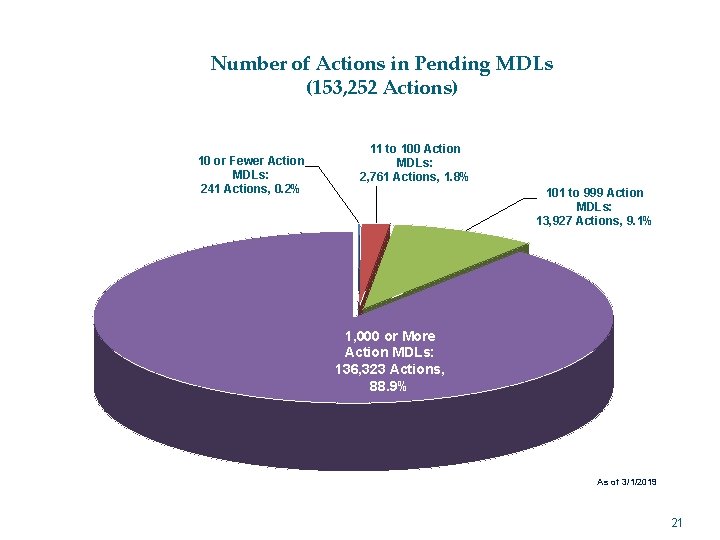
Number of Actions in Pending MDLs (153, 252 Actions) 10 or Fewer Action MDLs: 241 Actions, 0. 2% 11 to 100 Action MDLs: 2, 761 Actions, 1. 8% 101 to 999 Action MDLs: 13, 927 Actions, 9. 1% 1, 000 or More Action MDLs: 136, 323 Actions, 88. 9% As of 3/1/2019 21
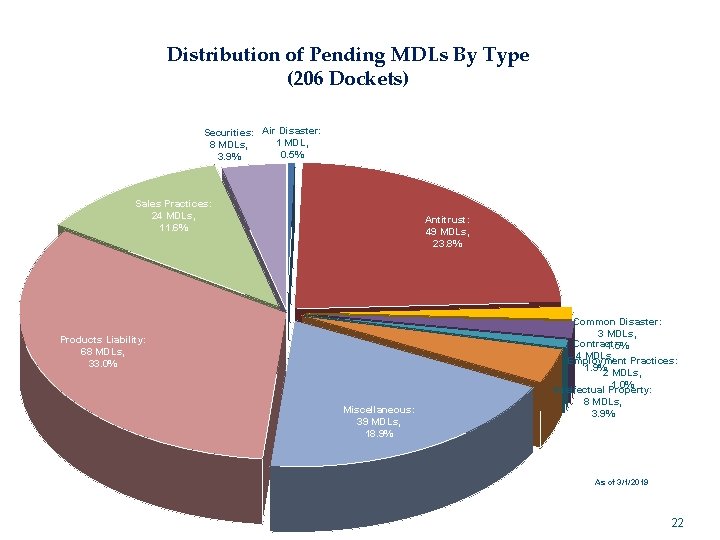
Distribution of Pending MDLs By Type (206 Dockets) Securities: Air Disaster: 1 MDL, 8 MDLs, 0. 5% 3. 9% Sales Practices: 24 MDLs, 11. 6% Antitrust: 49 MDLs, 23. 8% Common Disaster: 3 MDLs, Contract: 1. 5% 4 MDLs, Employment Practices: 1. 9%2 MDLs, 1. 0% Intellectual Property: Products Liability: 68 MDLs, 33. 0% Miscellaneous: 39 MDLs, 18. 9% 8 MDLs, 3. 9% As of 3/1/2019 22
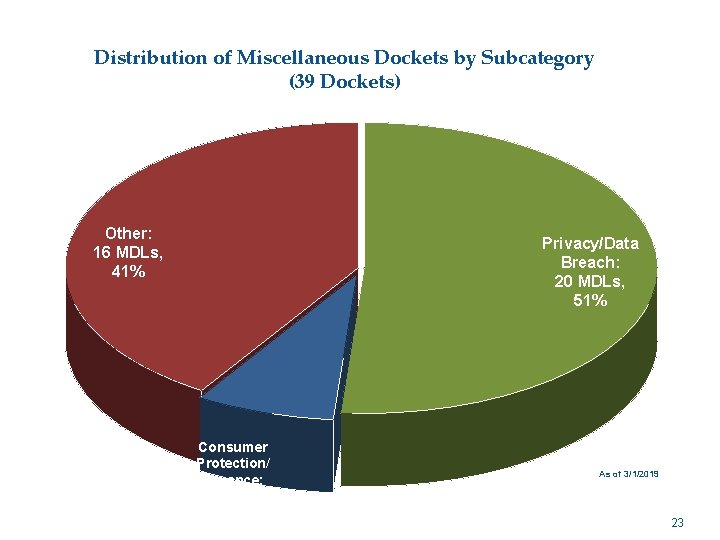
Distribution of Miscellaneous Dockets by Subcategory (39 Dockets) Other: 16 MDLs, 41% Privacy/Data Breach: 20 MDLs, 51% Consumer Protection/ Finance: 3 MDLs, 8% As of 3/1/2019 23
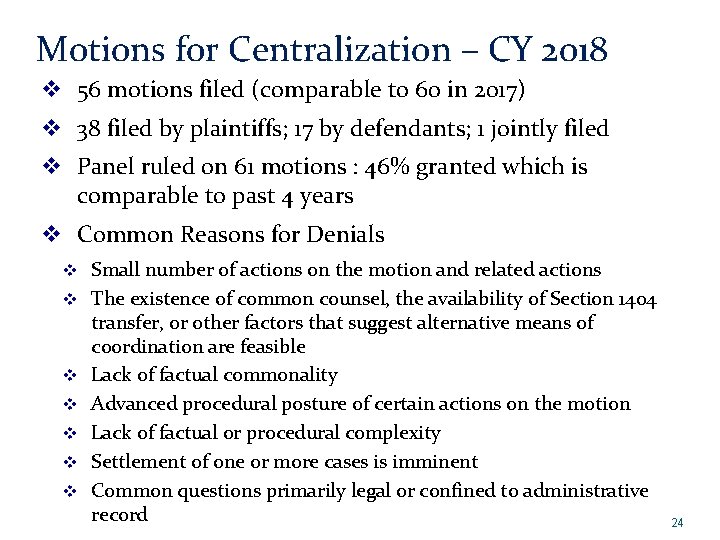
Motions for Centralization – CY 2018 v 56 motions filed (comparable to 60 in 2017) v 38 filed by plaintiffs; 17 by defendants; 1 jointly filed v Panel ruled on 61 motions : 46% granted which is comparable to past 4 years v Common Reasons for Denials v Small number of actions on the motion and related actions v The existence of common counsel, the availability of Section 1404 v v v transfer, or other factors that suggest alternative means of coordination are feasible Lack of factual commonality Advanced procedural posture of certain actions on the motion Lack of factual or procedural complexity Settlement of one or more cases is imminent Common questions primarily legal or confined to administrative record 24
QUESTIONS? 25
- Slides: 25