
Everything You Need to Know about SSDI Applications

Everything You Need to Know about SSDI Applications
Definition of Disability • Inability to engage in substantial gainful activity (SGA) by reason of any medically determinable physical or mental impairment which can be expected to result in death or has lasted or can be expected to last for a continuous period of not less than 12 months OR • Blindness, which means central visual acuity of 20/200 or less in the better eye with the use of a correcting lens
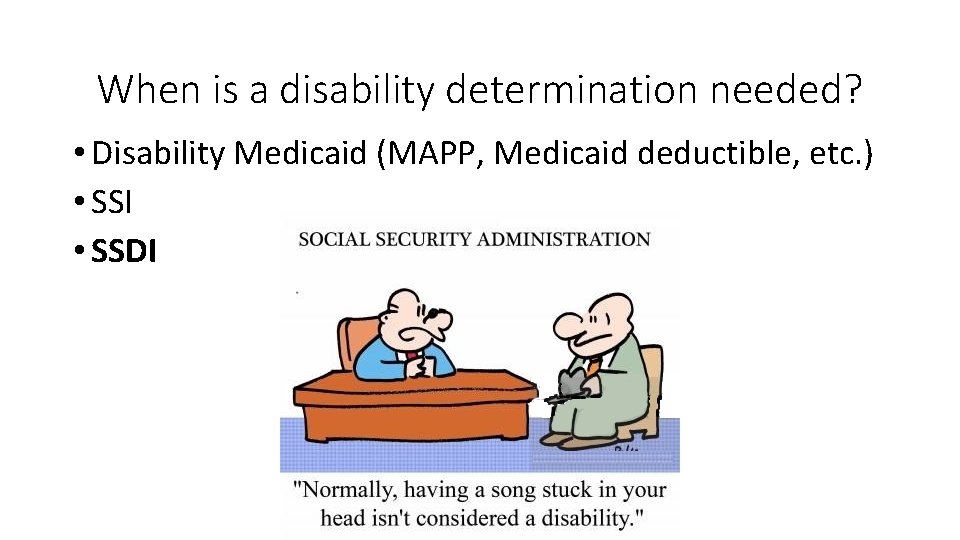
When is a disability determination needed? • Disability Medicaid (MAPP, Medicaid deductible, etc. ) • SSI • SSDI
SSDI Eligibility Requirements: • Must be under Full Retirement Age when they became disabled. • Must have recent work under Social Security – within the past 10 years before a person becomes disabled they must have 5 years of work. • Must not be performing Substantial Gainful Activity. • A physical or mental condition or combination of the two that has lasted or is expected to last for at least a year or result in death.
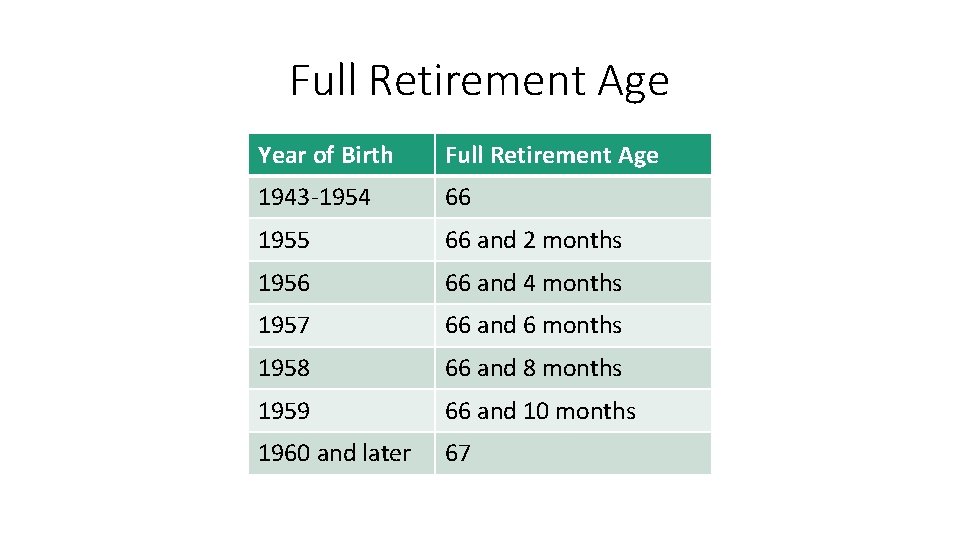
Full Retirement Age Year of Birth Full Retirement Age 1943 -1954 66 1955 66 and 2 months 1956 66 and 4 months 1957 66 and 6 months 1958 66 and 8 months 1959 66 and 10 months 1960 and later 67
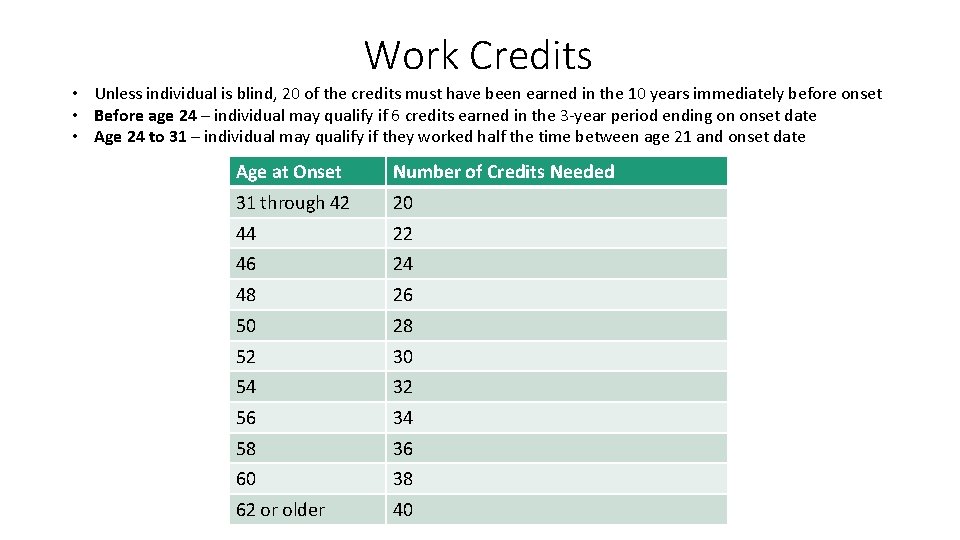
Work Credits • Unless individual is blind, 20 of the credits must have been earned in the 10 years immediately before onset • Before age 24 – individual may qualify if 6 credits earned in the 3 -year period ending on onset date • Age 24 to 31 – individual may qualify if they worked half the time between age 21 and onset date Age at Onset Number of Credits Needed 31 through 42 20 44 22 46 24 48 26 50 28 52 30 54 32 56 34 58 36 60 38 62 or older 40
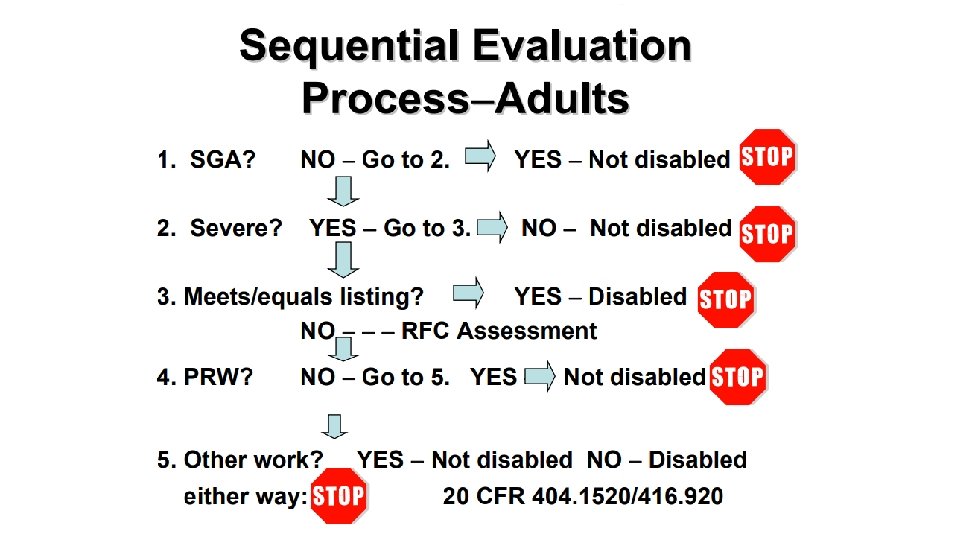
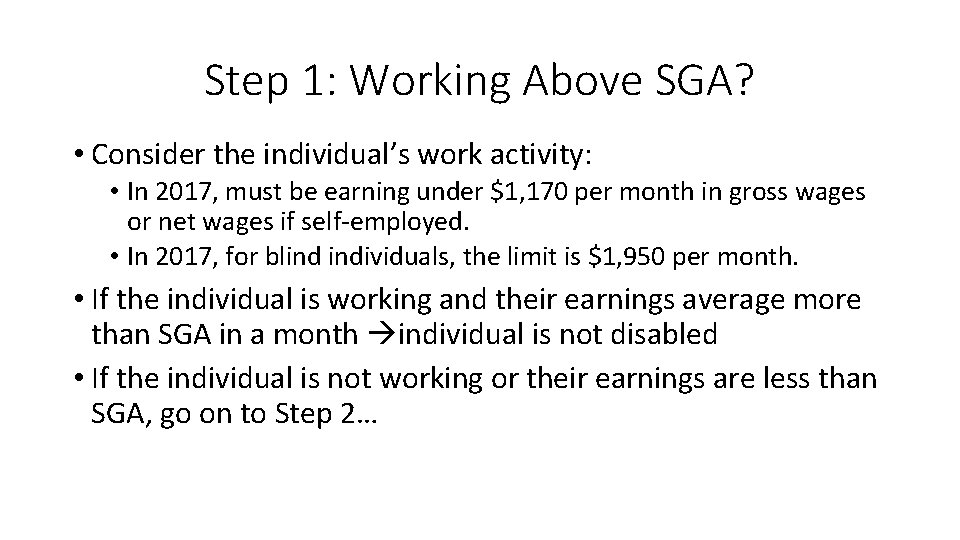
Step 1: Working Above SGA? • Consider the individual’s work activity: • In 2017, must be earning under $1, 170 per month in gross wages or net wages if self-employed. • In 2017, for blind individuals, the limit is $1, 950 per month. • If the individual is working and their earnings average more than SGA in a month individual is not disabled • If the individual is not working or their earnings are less than SGA, go on to Step 2…
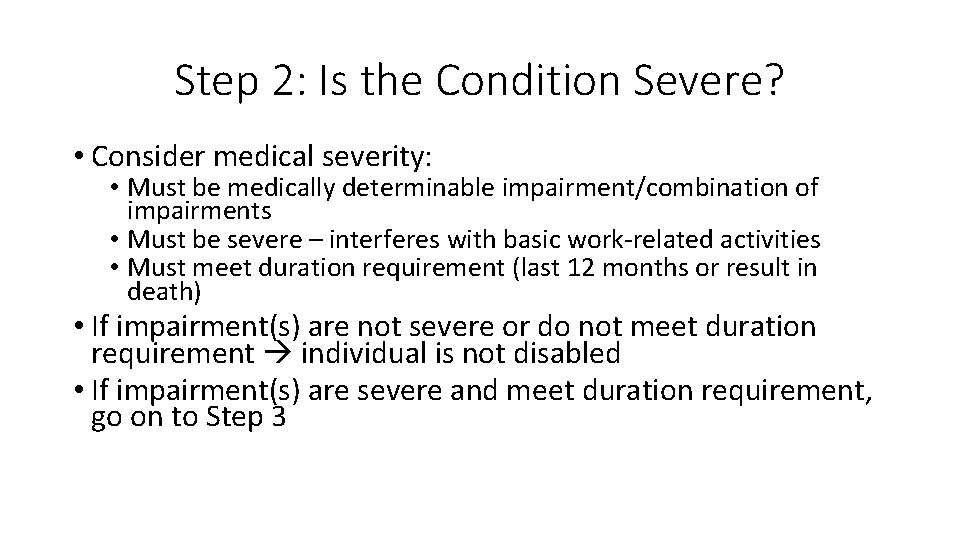
Step 2: Is the Condition Severe? • Consider medical severity: • Must be medically determinable impairment/combination of impairments • Must be severe – interferes with basic work-related activities • Must meet duration requirement (last 12 months or result in death) • If impairment(s) are not severe or do not meet duration requirement individual is not disabled • If impairment(s) are severe and meet duration requirement, go on to Step 3
Step 3: Medical Condition Meets Listing? • SSA maintains a listing of medical criteria that are so severe that an individual is considered disabled if their impairments match: https: //www. ssa. gov/disability/professionals/bluebook/Adult. Listings. htm • NOTE: If a client has a terminal illness, may file for Compassionate Allowances (CAL) to expedite the application process. The CAL conditions are here: http: //www. ssa. gov/compassionateallowances/conditions. htm • Impairment that meets or equals one of the listings and meets the duration requirement individual found to be disabled • Impairment does not meet or equal one of the listings or the duration requirement is not met assess residual functional capacity
Residual Functional Capacity (RFC) • Assessment of an individual’s capacity for full-time work despite limitations and restrictions resulting from medical condition(s) • 8 hours/day, 5 days/week • Only considers impact of medically determinable impairments, not age, sex, physical conditioning, etc. • Purpose is to determine an individual’s ability to work at Steps 4 and 5
Step 4: Past Relevant Work? • PRW must have been: • SGA, • Performed in the 15 year relevant period, and • Performed long enough to learn it (average performance) • Does the individual have the physical and mental capacity to perform any past relevant work (PRW)? • If yes individual is not disabled • If no PRW can be done, or the individual has no relevant work go to Step 5
Step 5: Adjustment to Any Other Work? • Consider whether an individual’s RFC, age, education, and work experience will enable them to make an adjustment to other work that exists in the national economy • If yes individual is not disabled • If no individual is found to be disabled • Burden of proof is on SSA for this step!
EBS Role • EBS help with the initial application: • Schedule at least a 2 -hour appointment with the client • Ask the client to bring a list of the names, addresses, and phone numbers of their treatment providers—doctors, hospitals, and clinics • Ask the client to bring a list of medications they’re taking • Ask the client what types of work they’ve had over the past 15 years before they stopped working • We do not handle SSDI appeals!
Things to Think About • Have clients fill out an application worksheet before the appointment – lets you assess likely eligibility beforehand • Clients may be reluctant to discuss medical conditions • Individuals can file for early retirement and SSDI at the same time • Online application can be completed without client present • We do not handle SSDI appeals! Tell clients this upfront. • Other tips?
Example 1 Ted, 62, makes an appointment with you for help with an SSDI application. His intake form says that he’s recently been diagnosed with glioblastoma. He says that he’s unable to work because he’s experiencing blurred vision and he’s had a few seizures. In addition, his radiation and chemotherapy treatments have left him very fatigued. He tells you that he has worked as a lawyer since his mid-20 s. What do you tell Ted?
Example 2 Jim, 63, makes an appointment with you for help with an SSDI application. According to his intake form, he has only worked a little in the past year because of back and knee pain. He’s been a plumber since his 20 s, and he now owns his own plumbing business. He says that his only trips to the doctor in the past few years have been for his annual flu shot. What do you tell Joe?
Example 3 Susan, 60, makes an appointment with you for help with an SSDI application. Her intake form says that she has been diagnosed with Stage IV stomach cancer, and her prognosis is poor. However, she tells you that, aside from a few part time jobs in college, she has not worked outside the home—she was a stay-at-home mom for around 30 years and now volunteers at the library. What do you tell Susan?
Denials • We do not handle SSDI appeals! • Appeals are fee-generating cases, refer to private attorneys: Lawyer Referral and Information Service (800) 362 -9082 http: //www. wisbar. org/forpublic/ineedalawyer/pages/lris. aspx
Approvals! • Benefits begin the 6 th month from the date SSA determines disability began i. e. disability onset date January 8, 2016, payment begins July 1, 2016. • Benefits are monthly payments and are paid the month following the month for which they are due i. e. SSA pays December benefits in January • Benefit amount is based on lifetime average earnings for work covered by Social Security – can get earning statement online and enter benefits calculator to determine amount. • When person reaches Full Retirement Age, SSDI benefits convert to retirement benefits • Client must report any improvement in their condition or if they return to work
SSDI and Medicare • Automatic enrollment in Medicare Parts A and B after person receives disability benefits for 2 years i. e. if onset of disability is January of 2017 Medicare will automatically enroll client in Parts A and B June of 2019 • May need to assist client with health insurance coverage options in the meantime
What if the client improves? • Trial work period – allows beneficiary to test ability to work • Disability only ends if services have been performed in at least 9 months in a rolling 60 month period; any month in which earnings exceed $840 is considered a month of services • Extended period of eligibility — after trial work period, individual has 36 months during which they can work and still receive benefits for any month(s) that earnings are below SGA • Expedited reinstatement – Individual has 5 years to ask SSA to restart benefits if they’re unable to keep working because of their condition • Continuation of Medicare - Medicare Part A coverage will continue for at least 93 months after the nine-month trial work period • Impairment-related work expenses may be deducted from income for SGA purposes

Questions?
- Slides: 23