
Everything You Need to Know About Developing a

Everything You Need to Know About Developing a Grading Plan for Your Course (Well, Almost) James O. Hammons & Janice R. Barnsley Presented by Sterling Mc. Leod
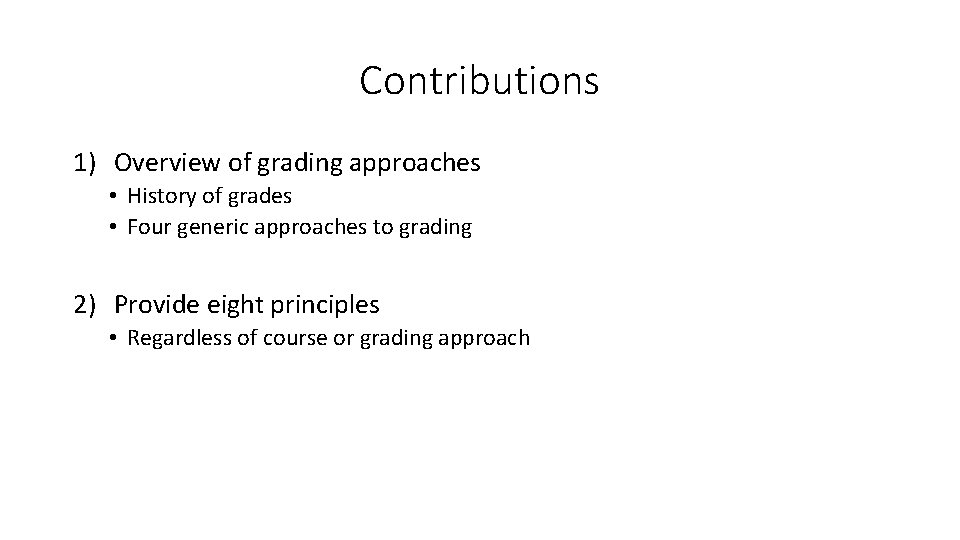
Contributions 1) Overview of grading approaches • History of grades • Four generic approaches to grading 2) Provide eight principles • Regardless of course or grading approach
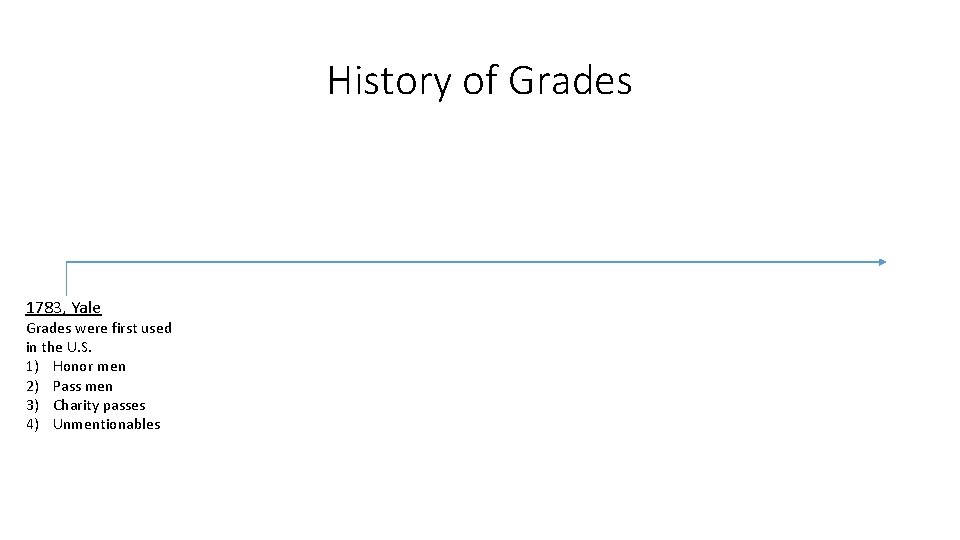
History of Grades 1783, Yale Grades were first used in the U. S. 1) Honor men 2) Pass men 3) Charity passes 4) Unmentionables
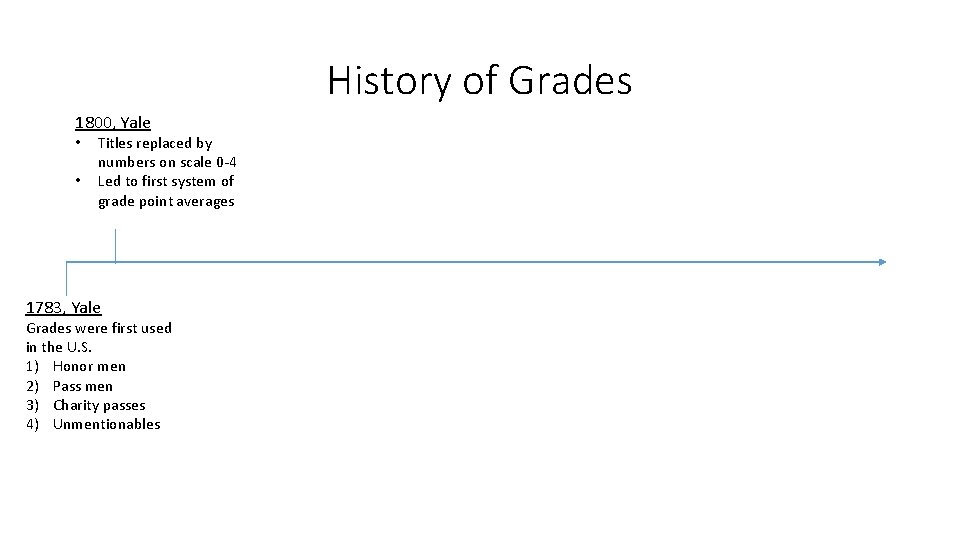
History of Grades 1800, Yale • • Titles replaced by numbers on scale 0 -4 Led to first system of grade point averages 1783, Yale Grades were first used in the U. S. 1) Honor men 2) Pass men 3) Charity passes 4) Unmentionables

History of Grades 1800, Yale • • Titles replaced by numbers on scale 0 -4 Led to first system of grade point averages 1783, Yale Grades were first used in the U. S. 1) Honor men 2) Pass men 3) Charity passes 4) Unmentionables 1850, University of Michigan • • Pass-fail system created Eventually requiring a minimum grade of 50 to pass
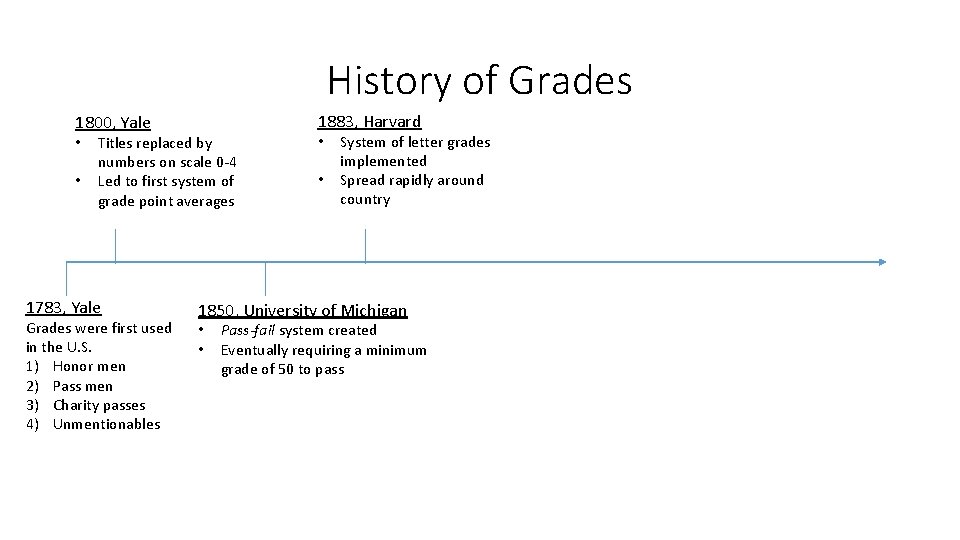
History of Grades 1800, Yale 1883, Harvard • • • Titles replaced by numbers on scale 0 -4 Led to first system of grade point averages 1783, Yale Grades were first used in the U. S. 1) Honor men 2) Pass men 3) Charity passes 4) Unmentionables • System of letter grades implemented Spread rapidly around country 1850, University of Michigan • • Pass-fail system created Eventually requiring a minimum grade of 50 to pass
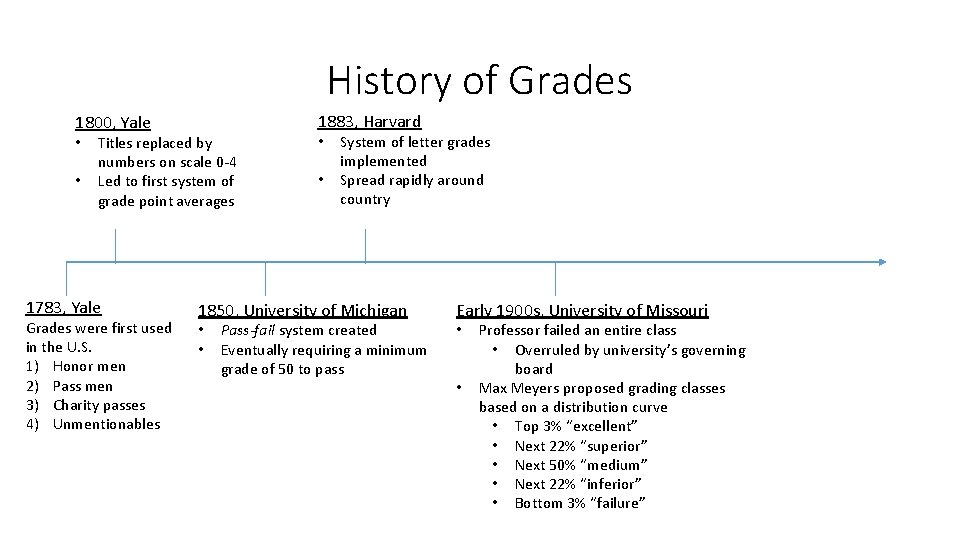
History of Grades 1800, Yale 1883, Harvard • • • Titles replaced by numbers on scale 0 -4 Led to first system of grade point averages 1783, Yale Grades were first used in the U. S. 1) Honor men 2) Pass men 3) Charity passes 4) Unmentionables • System of letter grades implemented Spread rapidly around country 1850, University of Michigan • • Pass-fail system created Eventually requiring a minimum grade of 50 to pass Early 1900 s, University of Missouri • • Professor failed an entire class • Overruled by university’s governing board Max Meyers proposed grading classes based on a distribution curve • Top 3% “excellent” • Next 22% “superior” • Next 50% “medium” • Next 22% “inferior” • Bottom 3% “failure”
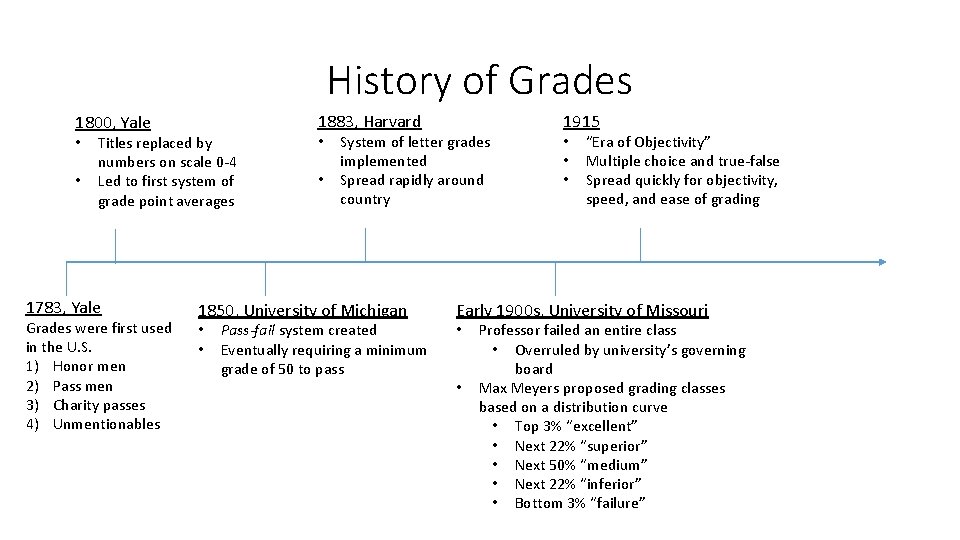
History of Grades 1800, Yale 1883, Harvard • • • Titles replaced by numbers on scale 0 -4 Led to first system of grade point averages 1783, Yale Grades were first used in the U. S. 1) Honor men 2) Pass men 3) Charity passes 4) Unmentionables • System of letter grades implemented Spread rapidly around country 1850, University of Michigan • • Pass-fail system created Eventually requiring a minimum grade of 50 to pass 1915 • • • “Era of Objectivity” Multiple choice and true-false Spread quickly for objectivity, speed, and ease of grading Early 1900 s, University of Missouri • • Professor failed an entire class • Overruled by university’s governing board Max Meyers proposed grading classes based on a distribution curve • Top 3% “excellent” • Next 22% “superior” • Next 50% “medium” • Next 22% “inferior” • Bottom 3% “failure”
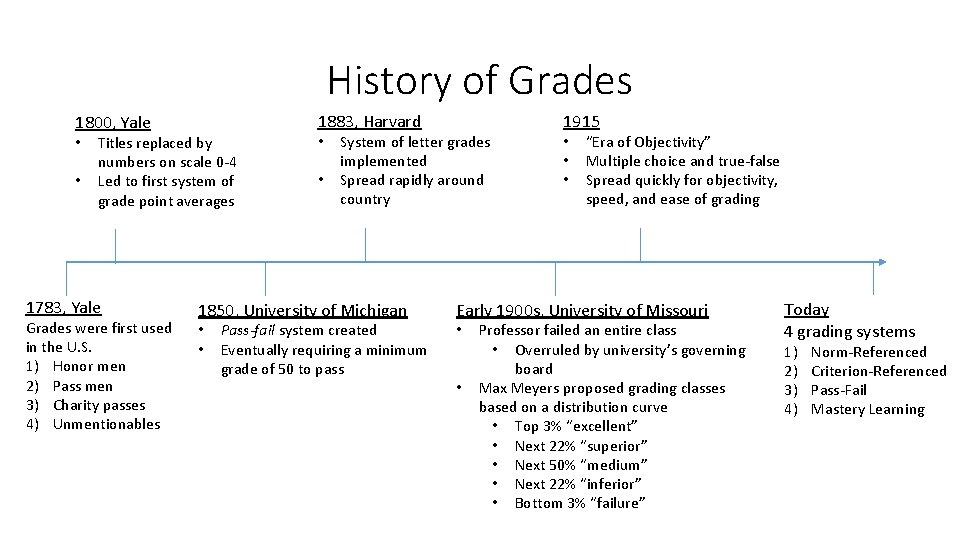
History of Grades 1800, Yale 1883, Harvard • • • Titles replaced by numbers on scale 0 -4 Led to first system of grade point averages 1783, Yale Grades were first used in the U. S. 1) Honor men 2) Pass men 3) Charity passes 4) Unmentionables • System of letter grades implemented Spread rapidly around country 1850, University of Michigan • • Pass-fail system created Eventually requiring a minimum grade of 50 to pass 1915 • • • “Era of Objectivity” Multiple choice and true-false Spread quickly for objectivity, speed, and ease of grading Early 1900 s, University of Missouri • • Professor failed an entire class • Overruled by university’s governing board Max Meyers proposed grading classes based on a distribution curve • Top 3% “excellent” • Next 22% “superior” • Next 50% “medium” • Next 22% “inferior” • Bottom 3% “failure” Today 4 grading systems 1) 2) 3) 4) Norm-Referenced Criterion-Referenced Pass-Fail Mastery Learning
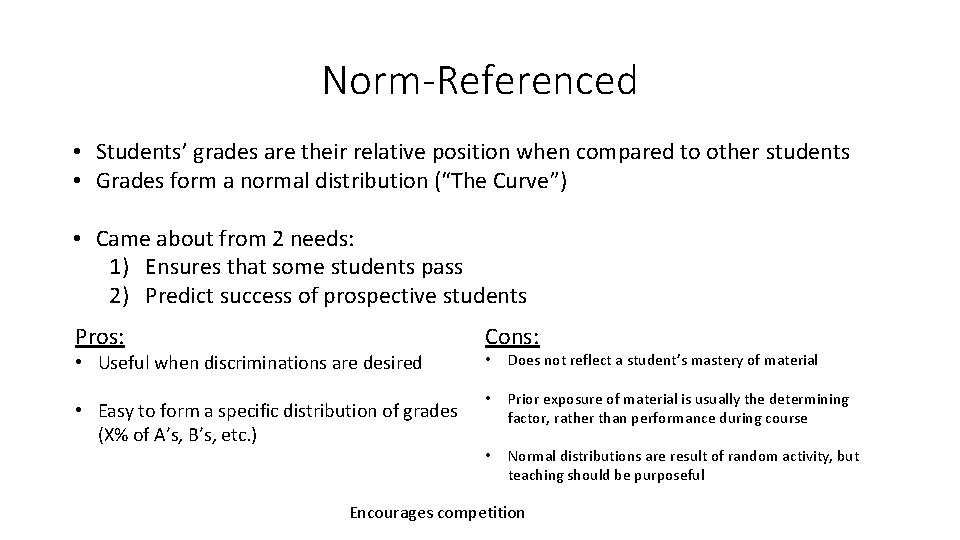
Norm-Referenced • Students’ grades are their relative position when compared to other students • Grades form a normal distribution (“The Curve”) • Came about from 2 needs: 1) Ensures that some students pass 2) Predict success of prospective students Pros: • Useful when discriminations are desired • Easy to form a specific distribution of grades (X% of A’s, B’s, etc. ) Cons: • Does not reflect a student’s mastery of material • Prior exposure of material is usually the determining factor, rather than performance during course • Normal distributions are result of random activity, but teaching should be purposeful Encourages competition
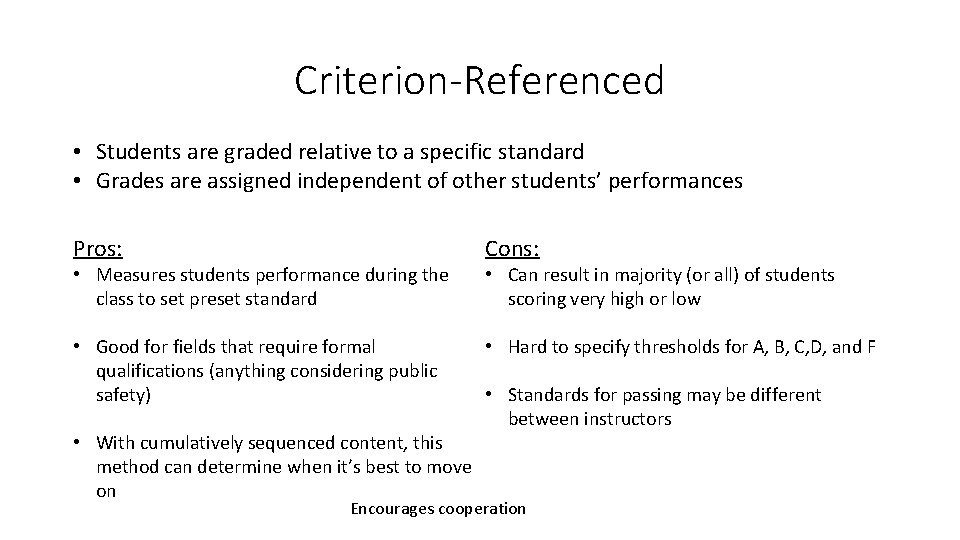
Criterion-Referenced • Students are graded relative to a specific standard • Grades are assigned independent of other students’ performances Pros: Cons: • Good for fields that require formal qualifications (anything considering public safety) • Hard to specify thresholds for A, B, C, D, and F • Measures students performance during the class to set preset standard • With cumulatively sequenced content, this method can determine when it’s best to move on • Can result in majority (or all) of students scoring very high or low • Standards for passing may be different between instructors Encourages cooperation
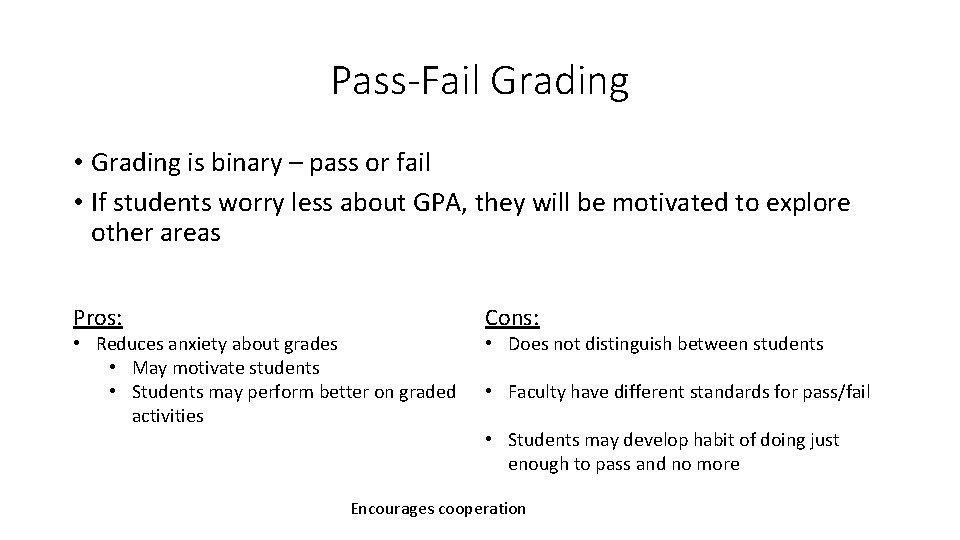
Pass-Fail Grading • Grading is binary – pass or fail • If students worry less about GPA, they will be motivated to explore other areas Pros: • Reduces anxiety about grades • May motivate students • Students may perform better on graded activities Cons: • Does not distinguish between students • Faculty have different standards for pass/fail • Students may develop habit of doing just enough to pass and no more Encourages cooperation
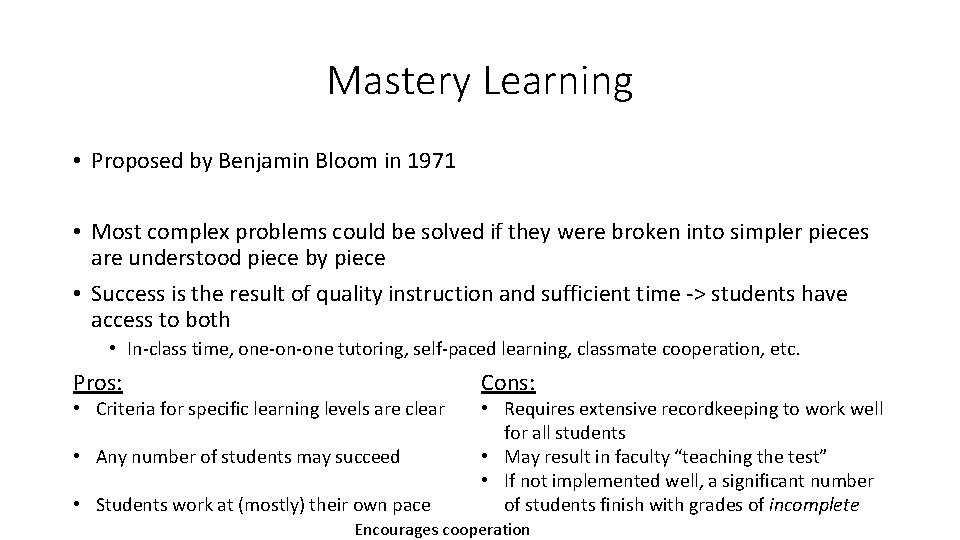
Mastery Learning • Proposed by Benjamin Bloom in 1971 • Most complex problems could be solved if they were broken into simpler pieces are understood piece by piece • Success is the result of quality instruction and sufficient time -> students have access to both • In-class time, one-on-one tutoring, self-paced learning, classmate cooperation, etc. Pros: • Criteria for specific learning levels are clear • Any number of students may succeed • Students work at (mostly) their own pace Cons: • Requires extensive recordkeeping to work well for all students • May result in faculty “teaching the test” • If not implemented well, a significant number of students finish with grades of incomplete Encourages cooperation
Contributions 1) Overview of grading approaches • History of grades • Four generic approaches to grading 2) Provide eight principles • Regardless of course or grading approach
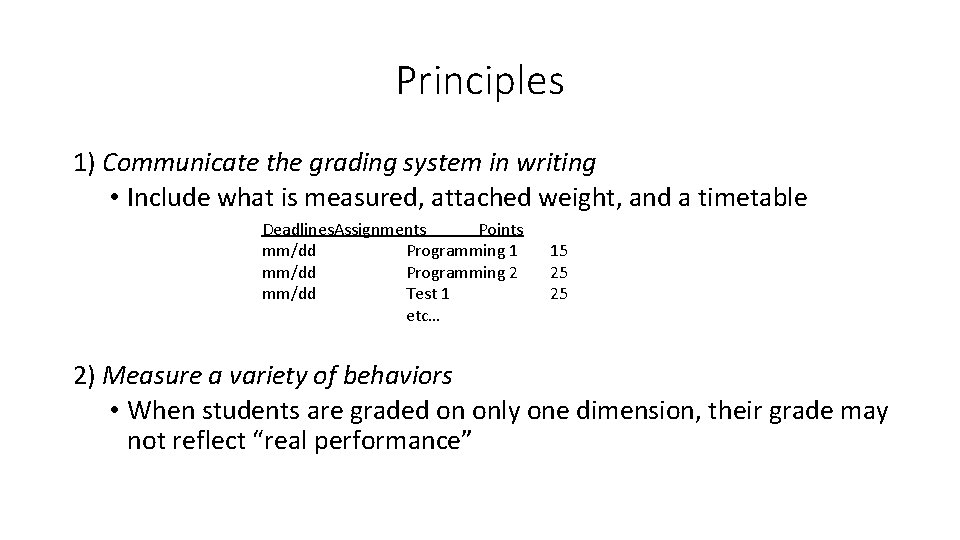
Principles 1) Communicate the grading system in writing • Include what is measured, attached weight, and a timetable Deadlines. Assignments Points mm/dd Programming 1 mm/dd Programming 2 mm/dd Test 1 etc… 15 25 25 2) Measure a variety of behaviors • When students are graded on only one dimension, their grade may not reflect “real performance”
Principles 3) Provide prompt feedback • Majority of teachers from a variety of areas agree: prompt = before students perform another similarly graded activity 4) Evaluate on different levels • Bloom’s taxonomy • The attention given to assessing a certain level of learning should reflect how much time is devoted to teaching at that level 5) Weight types of performance by importance • After deciding how to evaluate, decide which activities are more important • Different disciplines place emphasis on different activities
Principles 6) Be creative in evaluating student performance • Easy to develop a routine • Grading should be custom tailored to each course • Review grading plan periodically 7) Match evaluation measurements to course activities and objectives • Define learning objectives clearly so that students can adequately prepare for tests
Principles 8) Decide on retest possibilities • In criterion-referenced or mastery learning grading, students may be doomed if they perform poorly on a heavily weighted activity • Most faculty give another chance to perform the activity • • How to treat students that performed adequately the first time? How many chances given to pass? What grade should be assigned to those retesting? Will students use less effort on the first attempt?

Questions
What is better in a group of students – cooperation or competition?

How is today’s technology changing the viability of Mastery Learning?
- Slides: 21