
Everything you might have known about laboratory testing
Everything you might have known about laboratory testing but forgot Lesley Brannan, MPH Invasive/Respiratory Rachel Wiseman, MPH Vaccine Preventable Venessa Cantu, MPH Foodborne ELC Epidemiology Workshop 2014 1
How to Submit Specimens to the Lab �Do you have a DSHS lab account? ◦ Find your office’s lab submitter number OR get a submitter number �Is your HD’s contact information current? �Do you have current versions of all of the submitter forms? ◦ G-2 A, G-2 B, G-2 V, G-27 A, G-? ? ? �http: //www. dshs. state. tx. us/lab/mrs_forms. shtm#Mi crobiological (Note: these are SAMPLE forms only and cannot be used for submission) �Email Labinfo@dshs. state. tx. us or contact Lab Reporting at 512 -776 -7578 2
Ordering Supplies � Foodborne and pertussis supplies ◦ Order using G-6 A form: http: //www. dshs. state. tx. us/lab/mrs_forms. shtm#Micr obiological ◦ Questions? Contact Lab Container Preparation Group at (512) 776 -7661 � MMR and influenza-type supplies must be ordered through EAID ◦ MMR �Contact Rachel Wiseman ◦ Influenza/respiratory outbreaks (non-VPD) �Contact flutexas@dshs. state. tx. us � Have a sufficient number of supplies on hand in case of outbreaks!!! 3
Filling out the Forms �Each specimen needs a form �Form should be completely filled out �Information on form should match information on specimen (e. g. name, DOB) �Form(s) should be included in shipment with specimen(s) 4
CDC Submissions �CDC prefers specimens to be sent from state labs. �If testing at CDC is indicated, coordinate submitting specimens through DSHS Central Office/Laboratory, unless given different instructions. 5

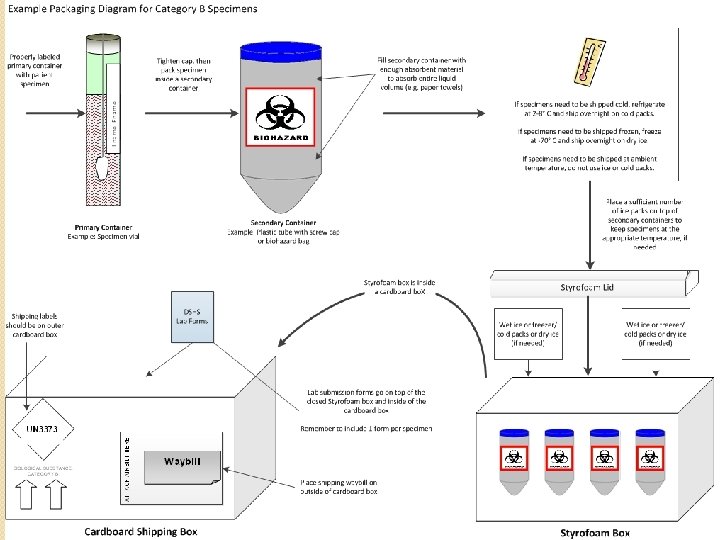
Packaging/Shipping � Packaging ◦ Triple-contained ◦ Use appropriate labeling for boxes �Most specimens are “Biological substance category B” �For Category A agents, check with lab directly ◦ Use enough ice packs/dry ice to maintain temperature (if applicable) ◦ Include submission forms in shipment � Shipping ◦ ◦ Send overnight mail Use Fed. Ex or courier of choice Don’t ship on Friday or the day before a state holiday Use physical address (1100 W 49 th, lab services) for Fed. Ex, couriers 6
7
Common Reasons for Rejection �Specimen not received within appropriate timeframe after collection �No form or form incorrect �Information on specimen doesn’t match information on form �No information on specimen container �Submitted at wrong temperature �Expired media/supplies �Submitted on wrong media �Specimen tube leaking or broken When in doubt, contact Central Office or the lab! 8
Accessing Results—Lab. Ware �Get access to Lab. Ware: https: //results- web. dshs. state. tx. us: 8443/index. jsp �Click on EPI registration (very bottom right) �Fill out PHLIMS confidentiality form AND �Fill out the EPI account registration �Most DSHS results are in Lab. Ware �CDC results will need to be reported separately (usually via fax) �Many results will show up in NBS 9
Invasive/Respiratory Infectious Diseases VIRAL RESPIRATORY OUTBREAKS (NON-VPD) 10
When to Collect Specimens �Collect outbreak specimens on: ◦ Outbreaks/clusters in facilities (nursing homes, schools, jails, etc. ) ◦ Unknown etiology or etiology suspected but not confirmed �Flu outbreaks without subtyping results or only rapid test results �Pathogens under consideration ◦ Bacterial – should be tested by private or hospital labs (or sometimes CDC) ◦ Viral – common viral respiratory pathogen testing available at DSHS Austin 11
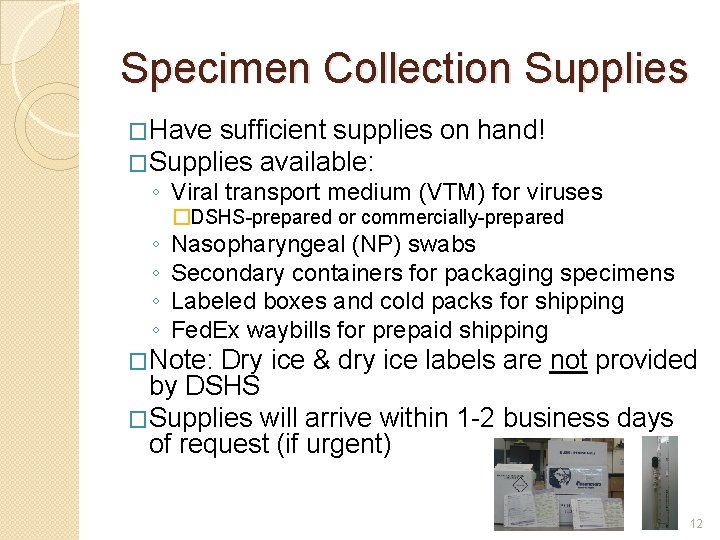
Specimen Collection Supplies �Have sufficient supplies on hand! �Supplies available: ◦ Viral transport medium (VTM) for viruses ◦ ◦ �DSHS-prepared or commercially-prepared Nasopharyngeal (NP) swabs Secondary containers for packaging specimens Labeled boxes and cold packs for shipping Fed. Ex waybills for prepaid shipping �Note: Dry ice & dry ice labels are not provided by DSHS �Supplies will arrive within 1 -2 business days of request (if urgent) 12
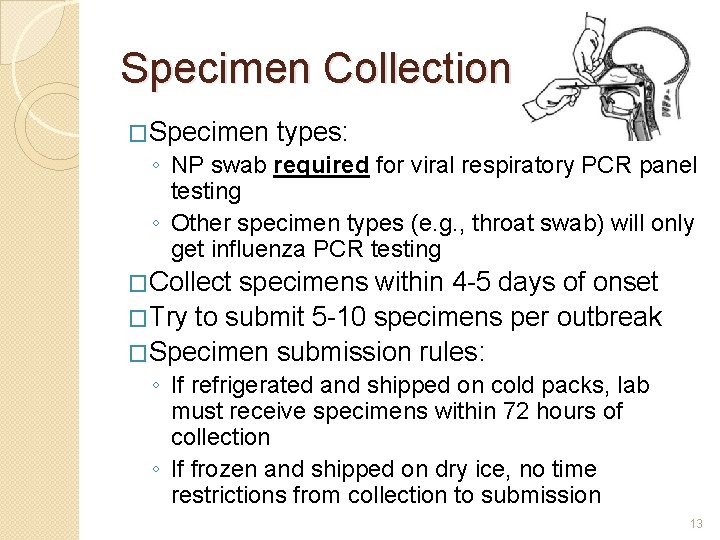
Specimen Collection �Specimen types: ◦ NP swab required for viral respiratory PCR panel testing ◦ Other specimen types (e. g. , throat swab) will only get influenza PCR testing �Collect specimens within 4 -5 days of onset �Try to submit 5 -10 specimens per outbreak �Specimen submission rules: ◦ If refrigerated and shipped on cold packs, lab must receive specimens within 72 hours of collection ◦ If frozen and shipped on dry ice, no time restrictions from collection to submission 13
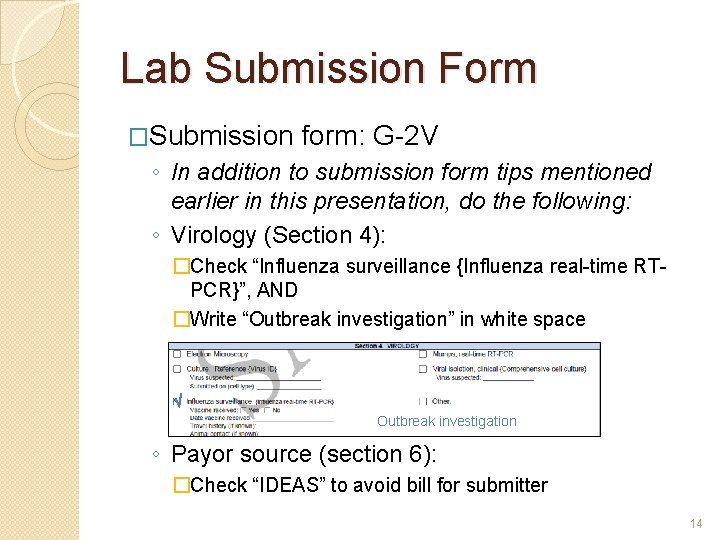
Lab Submission Form �Submission form: G-2 V ◦ In addition to submission form tips mentioned earlier in this presentation, do the following: ◦ Virology (Section 4): �Check “Influenza surveillance {Influenza real-time RTPCR}”, AND �Write “Outbreak investigation” in white space Outbreak investigation ◦ Payor source (section 6): �Check “IDEAS” to avoid bill for submitter 14
Testing � Who does it? ◦ Flu PCR test: DSHS Austin, Laboratory Response Network (LRN) labs, private labs ◦ Respiratory viral panel PCR test: DSHS Austin, private labs � Flu PCR test (public health labs) ◦ Flu A H 1, H 3, 2009 H 1; Flu B ◦ Turnaround time: 2 -5 days ◦ Individual specimen results reported to submitter � Respiratory viral panel PCR test (DSHS Austin) ◦ Rhinovirus, respiratory syncytial virus, human metapneumovirus, influenza, parainfluenza 1 -3, adenovirus ◦ Turnaround time: 1 -4 weeks* ◦ Results reported in aggregate to DSHS Austin EAIDB (public health use only) ◦ Note: Prior epidemiology approval/notification required for testing 15
Other Testing Suspect enterovirus - DSHS can culture � Mycoplasma – CDC tests � Bacterial testing, including Strep – usually performed at private labs or hospitals � Legionella � ◦ Urine antigen test for patient specimens at private labs (most common) ◦ DSHS tests patient clinical specimens and pure cultures ◦ DSHS tests environmental isolates only if patient isolate(s) available for comparison ◦ Legionella water testing available from ELITE certified labs Pathology specimens – tested by CDC Pathology Lab upon request � Unknown etiology/severe � ◦ If death, CDC Pathology Lab can test ◦ If outbreak, options may be available after consultation with CDC URDO (Unexplained Respiratory Disease Outbreaks) Group 16
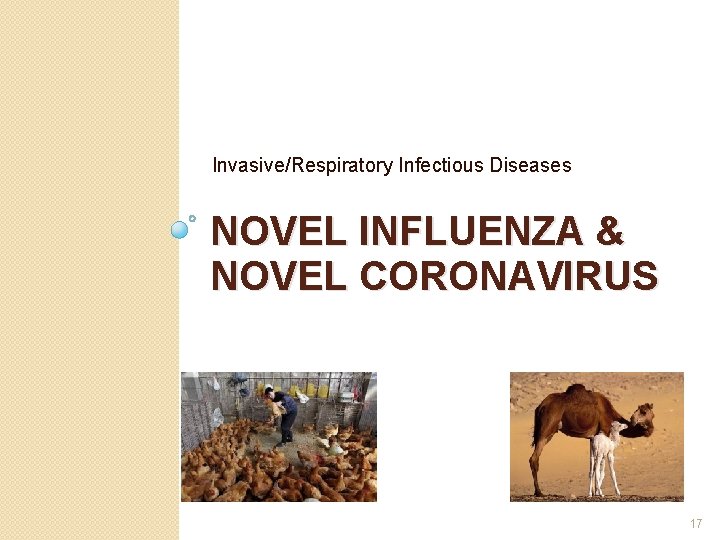
Invasive/Respiratory Infectious Diseases NOVEL INFLUENZA & NOVEL CORONAVIRUS 17
When to Collect Specimens � Collect specimens from patients who meet criteria for a “Patient Under Investigation” (novel coronavirus) or a “Case Under Investigation” (novel flu) � Usually involves: �Specific symptoms or diagnoses �Specific exposure (one or more of the following may be required): �Travel, within 10 -14 days of onset, to a specified area where the novel pathogen has been detected, OR �Epi-linked to a confirmed case, OR �Unprotected laboratory exposure (novel flu), OR �Recent contact with swine or other animal populations (H 3 N 2 v), OR �Part of a severe illness cluster of unknown etiology (novel coronavirus) ◦ See CDC’s website for most up-to-date case criteria: �Novel influenza �H 5 N 1: http: //www. cdc. gov/flu/avianflu/h 5 n 1/case-definitions. htm (Revised Jan 2014) �H 7 N 9: http: //www. cdc. gov/flu/avianflu/h 7 n 9/case-definitions. htm (Rev Jan 2014) �H 3 N 2 v: http: //www. cdc. gov/flu/swineflu/case-definitions. htm �Novel coronavirus: http: //www. cdc. gov/coronavirus/mers/casedef. html 18
Specimen Collection Supplies � For novel viruses, specimen collection should begin ASAP! ◦ Hospitals/providers should be encouraged to use their own collection supplies, if available ◦ Regions/locals should keep supplies on hand in case of need � If requested, supplies will arrive within 1 -2 business days of request from DSHS Austin � Supplies available – same as for influenza surveillance and viral (non-VPD) respiratory outbreaks ◦ Media, NP swabs, secondary containers, labeled boxes and cold packs, prepaid Fed. Ex waybills 19
Specimen Collection � Specimen types: ◦ Novel flu �Upper respiratory specimens preferred �Lower respiratory specimens may be requested ◦ Novel coronavirus �Lower respiratory specimens most important for virus detection/recovery �Also requested: NP and OP swabs, sera (acute and convalescent), stool � Collect specimens as close to onset as possible � See CDC guidance for full recommendations: ◦ Novel flu: http: //www. cdc. gov/flu/avianflu/h 7 n 9/specimencollection. htm (H 5 N 1, H 7 N 9) ◦ Novel coronavirus: http: //www. cdc. gov/coronavirus/mers/guidelines-clinicalspecimens. html 20
Lab Submission Form � Submission Form: G-2 V In addition to submission form tips mentioned earlier in this presentation, do the following: � Novel Influenza � ◦ Virology (Section 4): � Check “Influenza surveillance {Influenza real-time RT-PCR}”, AND � Write “Suspect novel flu” in white space, AND � Note travel history and animal contact, if any � Novel Coronavirus ◦ Virology (Section 4): � Check “Other: ” and write in “MERS Coronavirus” on the adjacent line � General information for novel virus testing ◦ Payor source (Section 6): Check “IDEAS” to avoid bill for submitter ◦ Note: Prior epidemiology approval/notification required for testing 21
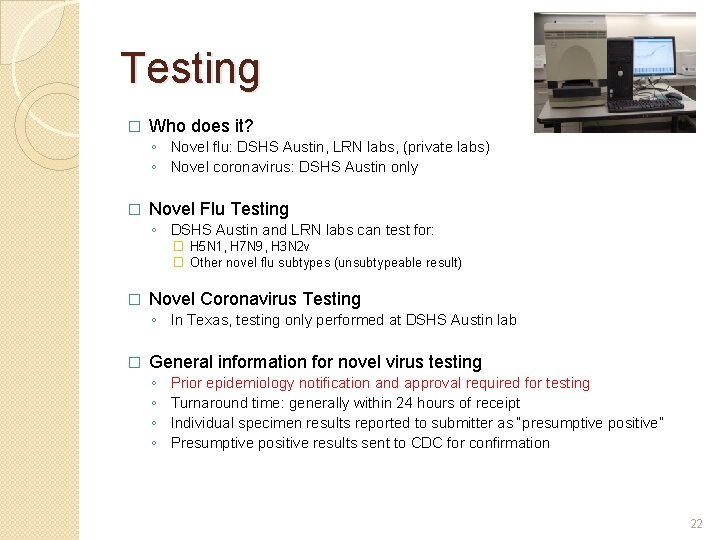
Testing � Who does it? ◦ Novel flu: DSHS Austin, LRN labs, (private labs) ◦ Novel coronavirus: DSHS Austin only � Novel Flu Testing ◦ DSHS Austin and LRN labs can test for: � H 5 N 1, H 7 N 9, H 3 N 2 v � Other novel flu subtypes (unsubtypeable result) � Novel Coronavirus Testing ◦ In Texas, testing only performed at DSHS Austin lab � General information for novel virus testing ◦ ◦ Prior epidemiology notification and approval required for testing Turnaround time: generally within 24 hours of receipt Individual specimen results reported to submitter as “presumptive positive” Presumptive positive results sent to CDC for confirmation 22
Invasive/Respiratory Infectious Diseases MENINGOCOCCAL DISEASE, INVASIVE 23
Specimen Submission Highlights �Submission of Neisseria meningitidis isolates from normally sterile sites or purpuric lesions required by law ◦ Texas Administrative Code (Title 25, Part 1, Chapter 97, Subchapter A, Rule § 97. 5) �DSHS lab serogroups all N. isolates meningitidis ◦ Currently licensed US vaccines only cover serogroups A, C, Y, & W-135 ◦ Outbreaks of serogroup B recently on college campuses �DSHS lab performs PFGE analysis on all N. meningitidis isolates to identify disease clusters 24
IRID Team Contacts Lesley Brannan – Team Leader, Epidemiologist • Outbreaks, coronavirus, influenza, all diseases (Vacant position) – Influenza Surveillance Coordinator, Epidemiologist • Influenza, RSV Michael Fischer – CJD Surveillance Coordinator, Epidemiologist • Creutzfeldt-Jakob disease, amebic meningitis, coronavirus Irina Cody – Public Health and Prevention Specialist • Meningococcal disease, legionellosis Amy Littman – Public Health and Prevention Specialist • Streptococcal diseases (GAS, GBS, Strep pneumo) Robert Russin – ILINet Coordinator, Public Health and Prevention Specialist • Influenza 25
Vaccine Preventable Diseases MEASLES, MUMPS, RUBELLA TESTING 26
Measles, Mumps, Rubella Overview Measles, mumps, rubella require lab testing to meet case definition • Testing for these is very similar • Preferred testing is PCR • �Done off-site at MN DOH for measles, rubella �Mumps done at DSHS �Measles PCR is not available at commercial labs �Preferred site is throat for measles, rubella; cheek swab for mumps • Serology (Ig. M and Ig. G) is also useful �Done at DSHS �Can be tested at Minnesota or CDC, if indicated �Widely available commercially 27
MMR: Supplies You Need G-2 A for serology • G-2 V for virology (includes PCR) • Viral transport media (e. g. Remel) • Pharyngeal (throat) swabs • • Synthetic with plastic/aluminum handle Serum separator tubes or gold top tubes • Centrifuge • Cold packs or dry ice • Shipping materials • 28
MMR: Getting Supplies �You can purchase them ◦ Any viral transport media will do ◦ You should be able to use PHEP funds �You can request them from DSHS ◦ You can pre-order them in small quantities ◦ If needed urgently, we can get them to you overnight (excluding weekends) ◦ If requesting from DSHS, contact Rachel Wiseman first 29
MMR: Collection Time Frames �Viral swabs should be collected within 10 days of symptom onset. ◦ The sooner, the better �Serology for Ig. M should be collected as soon as possible after symptom onset. ◦ Small risk of false negative Ig. M if drawn before day 5 after onset, but don’t wait. ◦ Ig. M can be collected up to 30 days after onset. ◦ Paired Ig. G samples should be collected shortly after onset and 2 weeks after onset. 30
MMR: Shipping Time Frames �PCR specimens should arrive within 48 hours of collection ◦ If longer than 48 hours, must be frozen (70) �Serology specimens should arrive within 48 hours of collection. ◦ If longer than 48 hours, must be frozen (20) �If over 48 hours and not frozen, testing at CDC is a possibility ◦ Do not ship frozen in serum separator 31
MMR: Important Serology Information �Mumps Ig. M can be falsely negative or positive. ◦ Do not use a negative Ig. M as a rule out in vaccinated individuals. �Rubella Ig. M is frequently falsely positive. ◦ It is highly cross-reactive to measles, rheumatoid factor, Epstein-Barr, & pregnancy. �Measles Ig. M can be falsely positive. 32
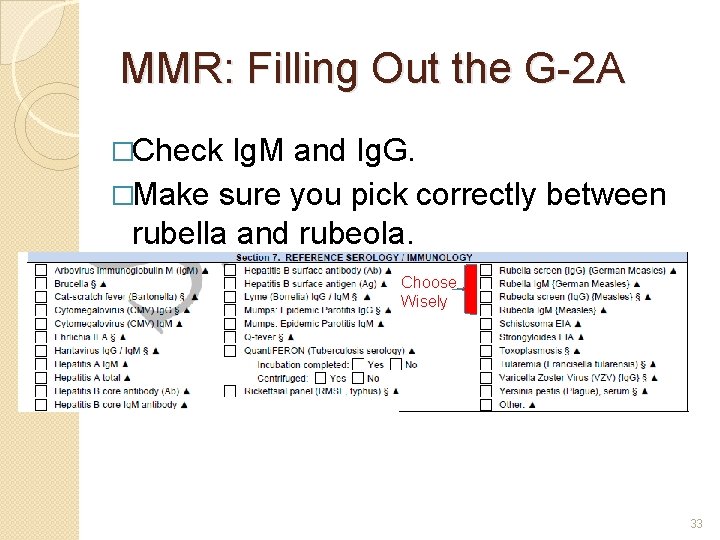
MMR: Filling Out the G-2 A �Check Ig. M and Ig. G. �Make sure you pick correctly between rubella and rubeola. Choose Wisely 33
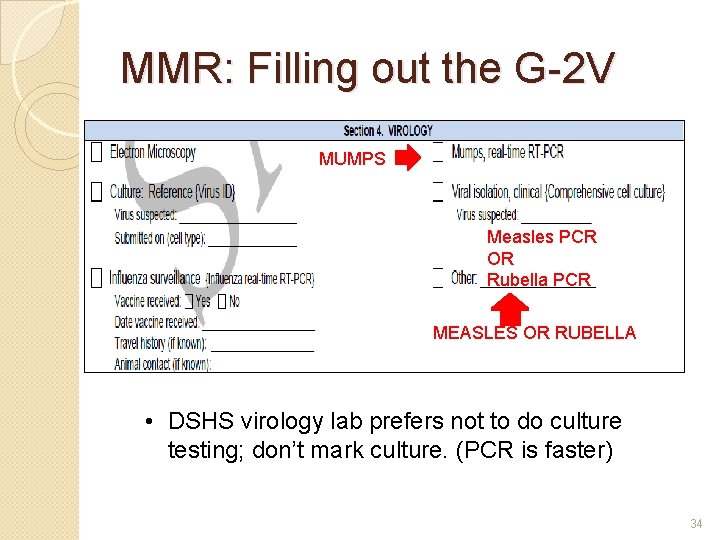
MMR: Filling out the G-2 V MUMPS Measles PCR OR Rubella PCR MEASLES OR RUBELLA • DSHS virology lab prefers not to do culture testing; don’t mark culture. (PCR is faster) 34
MMR: If Requesting a Lab to Forward a Specimen �Ensure they have a G-2 A or G-2 V. �Fill out the G-2 A or G-2 V for them. �Make sure they understand the temperature the specimen needs to be at. ◦ Most of the time the answer is FROZEN. �Get the tracking number for their shipment. �Tell Central Office a specimen is coming. 35
MMR: Paying for Testing �Immunity testing is NOT covered by DSHS. �All other MMR testing will be paid for by DSHS. �Mark the Immunizations box in the payor section of the G-2 form(s). ◦ Do not check other boxes in this section. ◦ DSHS will not correct any billing problems if the form was not completed correctly. 36
Vaccine Preventable Diseases VARICELLA 37
When to Test for Varicella �Outbreaks �Distinguish between wild-type and vaccine strain disease �Breakthrough disease ◦ May not look like varicella ◦ Often misdiagnosed ◦ Unfortunately, this can be hard to test 38
Varicella Testing �Varicella serology is no longer performed at DSHS. ◦ Ig. M not recommended for diagnosis. �Varicella PCR testing is available. ◦ DSHS sends specimens to MN DOH or CDC. ◦ Providers can send directly to CDC. �Biopsies or CSF can be sent for PCR to CDC. ◦ Severe cases/deaths ◦ Should be shipped frozen 39
Supplies for Varicella PCR �Synthetic swabs �Transport tubes, NO media �Needles �Glass slides �G-2 V form �Shipping materials �Instructions: http: //www. cdc. gov/chickenpox/labtesting/collecting-specimens. html 40
Collecting Vesicular Specimens �Unroof the vesicle (use a sterile needle or slide). ◦ Put scab in sealed container for testing. �Rub synthetic swab in lesion— vigorously! ◦ Get vesicular fluid. ◦ Get skin cells from base of lesion. ◦ Don’t make the patient bleed. �Place swab in EMPTY transport tubes. �Use a different swab for each lesion or scab. ◦ One swab or scab per tube. 41
Collecting Maculopapular Specimens �Rake edge of slide over lesion. ◦ Make sure skin cells scrape off and onto slide. �Rub synthetic swab on scraped lesion. �Use same swab to collect skin cells from slide. �Use a different swab for each lesion. �Place swab in EMPTY transport tubes. ◦ One swab per tube. 42
VZV Submission Forms �Use the G-2 V. �Check “lesion” and write in the site (e. g. left arm) in Section 3, Specimen Source. �In Section 4, check “other” and write in VZV PCR. �Mark Immunizations as payor source in Section 6. �(If testing for smallpox, use the G-27 A) 43
VZV Collection and Shipping �Best to collect within 5 days of rash onset. �Collect from at least 2 lesions. �Vesicles and scabs are preferred. ◦ A good “rub” is better than no test. �Ship at room temperature. �Can use regular mail. �Can ship whenever after collection (but don’t wait too long). 44
Vaccine Preventable Diseases PERTUSSIS 45
Pertussis Testing �DSHS lab can do culture. ◦ It requires special media for collection/transport that the submitter has to obtain. ◦ It cannot be done on what is submitted for pertussis PCR. �Pertussis PCR is widely available. ◦ Testing at DSHS lab should be paid for by the submitter. ◦ DSHS only pays for outbreak specimens in certain circumstances. You must get permission first. 46
Pertussis Testing Supplies �G-2 B form �NP swab ◦ Synthetic with plastic/aluminum handle �Transport tube, NO media �Cold packs �Shipping materials http: //www. cdc. gov/pertussis/clinical/do wnloads/diagnosis-pcrbestpractices. pdf 47
Vaccine Preventable Diseases OTHER VPDS 48
H. influenzae �Labs can forward cultures/isolates to DSHS for ID and/or serotyping ◦ Please request for all cases under five �Raw specimens can also be sent for culture, ID and serotyping �Sterile site specimens only �Use G 2 B �Results will be in NBS, regardless of type 49
Hepatitis A, B �Serology available at DSHS �Serology widely available commercially �Apart from special studies, commercial labs should be used ◦ We will contact you to request specimens �DSHS lab can be used for perinatal hepatitis B testing ◦ Check Immunizations in payor box on G 2 A 50
Tetanus �No testing recommended 51
Polio �CDC does testing for polio �Specimen types include ◦ ◦ ◦ CSF 2 -5 m. L Stool 2 -4 g on VTM NP swab in VTM Tissue in VTM Blood (antibody testing) �Coordinate testing through DSHS lab �Use G 2 V to submit viral specimens 52
Diphtheria Isolation and/or ID �Use cotton or polyester swab �Suspects: swab below the membrane ◦ Portion of membrane can be tested but does not yield C. diphtheriae well �Contacts: throat or NP swab �Ship on Amie’s or Stuarts or transfer to Loeffler’s slant �Use the G 2 B �Ship at 2 -25 degrees within 48 hours 53
Always Notify VPD Team About Incoming Specimens �Some reagents have to be set out ahead of time �Rare tests=lab staffing/resource issues �We can advocate with the lab on your behalf �We can fix your form �They are going to call me about any specimens they receive with issues. �Does not apply to pertussis, HIB or perinatal hepatitis testing 54
VPD Team Contacts Rachel Wiseman– Team Leader, Epidemiologist • Eric Garza– Program Specialist • Brandy Tidwell– Public Health and Prevention Specialist • Kayla Boykins– Public Health and Prevention Specialist • 55
Foodborne GI OUTBREAKUNKNOWN PATHOGEN 56
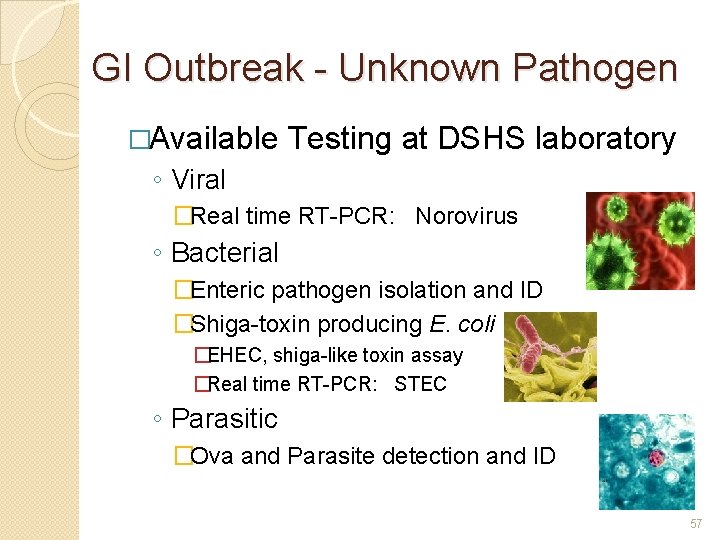
GI Outbreak - Unknown Pathogen �Available Testing at DSHS laboratory ◦ Viral �Real time RT-PCR: Norovirus ◦ Bacterial �Enteric pathogen isolation and ID �Shiga-toxin producing E. coli �EHEC, shiga-like toxin assay �Real time RT-PCR: STEC ◦ Parasitic �Ova and Parasite detection and ID 57
Specimen Types: GI Outbreak - Unknown Pathogen �Raw stool ◦ Norovirus PCR testing ◦ STEC PCR testing ◦ Also acceptable for bacterial testing if received in lab <= 24 hrs from time of collection ◦ If raw stool >= 24 hrs �Transport media required for bacterial testing �E. g. Cary-blair ◦ Use O & P collection vials for parasitic testing � 10% formalin & Z-PVA 58
Specimen Collection: Supply List �Stool Collection Kits ◦ ◦ ◦ Collection cup or container (urine cups) Plastic specimen bag (Biohazard) Cary-Blair transport media Gloves Mask Absorbent pads (you work on these to facilitate clean-up) �G-2 B forms 59
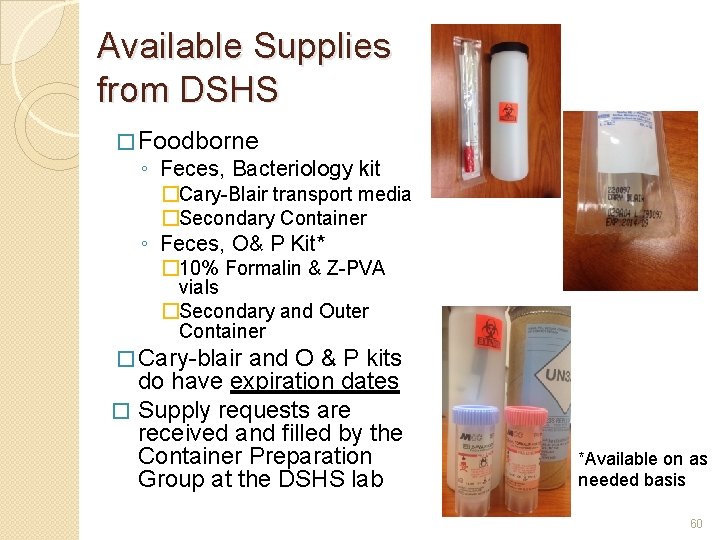
Available Supplies from DSHS � Foodborne ◦ Feces, Bacteriology kit �Cary-Blair transport media �Secondary Container ◦ Feces, O& P Kit* � 10% Formalin & Z-PVA vials �Secondary and Outer Container � Cary-blair and O & P kits do have expiration dates � Supply requests are received and filled by the Container Preparation Group at the DSHS lab *Available on as needed basis 60
Specimen collection: The Process �Collect raw stool from patient ◦ Collection cup ◦ Plastic specimen bag (biohazard) �Aliquoting specimen into Cary-Blair: ◦ Stick a swab into the stool and transfer a small amount to the Cary- Blair ◦ Wear gloves and a mask and work in an area that can be sanitized when you are done ◦ Keep in mind that this stuff is potentially infectious 61
Shipping Considerations �Norovirus testing (only raw stool accepted) • Transport temperature: 2 -8ºC (ice pack) • Transport time: as soon as possible 62
![Shipping Considerations Enteric pathogen isolation Specimen type Isolate Raw stool [not preferred specimen] Stool](http://slidetodoc.com/presentation_image_h/b257b72b78193aae47abe52b1181e896/image-63.jpg "Shipping Considerations Enteric pathogen isolation Specimen type Isolate Raw stool [not preferred specimen] Stool")
Shipping Considerations Enteric pathogen isolation Specimen type Isolate Raw stool [not preferred specimen] Stool in transport solution/medium [preferred specimen] Transport time to lab from time of collection As soon as possible to ensure viability ≤ 24 hours Transport temperature ≤ 24 hours Room Temp or 2 -8ºC (ice pack) >24 hours but ≤ 3 days 2 -8ºC (ice pack) >3 days Freeze immediately at ≤-70ºC. Ship on dry ice. Ambient or 2 -8ºC (ice pack) 63
Shipping Considerations �Parasitic testing ◦ Raw stool should be transferred within a few hours to 10% Formalin & Z-PVA vials ◦ Can be shipped at Room Temp or 2 -8ºC (ice pack) ◦ Do Not Freeze 64
Lab Submission Form �Submitter form: G-2 B In addition to submission form tips mentioned earlier in this presentation, do the following: ◦ Select appropriate test(s): �Molecular Studies (Section 6): �Check “PCR” and “Norovirus” �Bacteriology (Section 4) �Check “Culture, stool” under Clinical Specimen �Parasitology (Section 7) �Check “Fecal ova and parasite examination” AND �Check “Outbreak association” and write in name of outbreak, (bottom of Section 2) ◦ Payor source (Section 6): �Check “IDEAS” to avoid bill for submitter 65
Foodborne ADDITIONAL TESTING 66
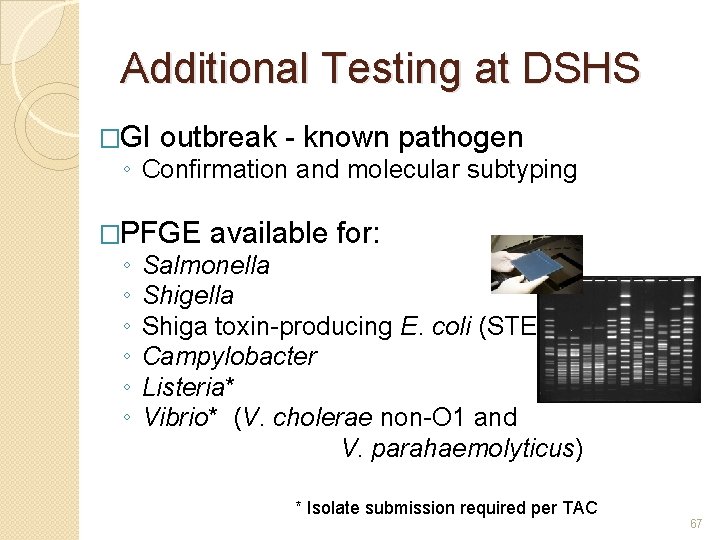
Additional Testing at DSHS �GI outbreak - known pathogen ◦ Confirmation and molecular subtyping �PFGE available for: ◦ Salmonella ◦ Shiga toxin-producing E. coli (STEC)* ◦ Campylobacter ◦ Listeria* ◦ Vibrio* (V. cholerae non-O 1 and V. parahaemolyticus) * Isolate submission required per TAC 67
Required Isolates �Diseases requiring submission of cultures*: ◦ Botulism-adult and infant (Clostridium botulinum) ◦ E. coli 0157: H 7, isolates or specimens from cases where Shiga-toxin activity is demonstrated ◦ Listeria monocytogenes ◦ Vibrio species Salmonella isolates not required but strongly encouraged!!! � *Texas Administrative Code (Title 25, Part 1, Chapter 97, Subchapter A, Rule 68 § 97. 5)
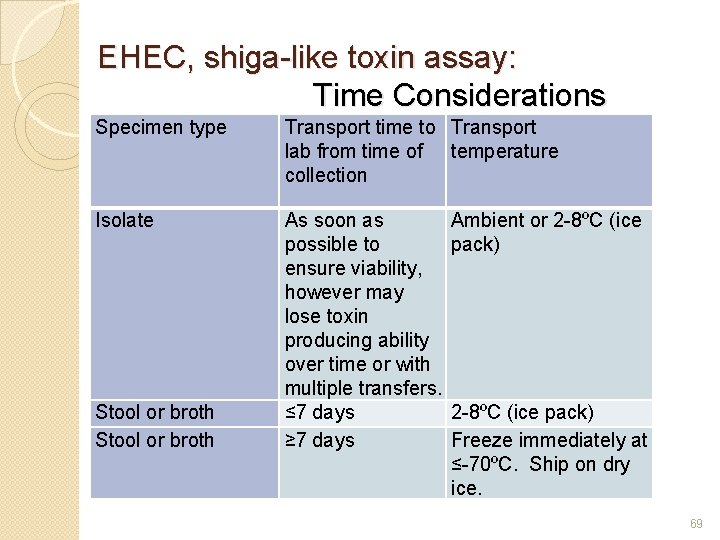
EHEC, shiga-like toxin assay: Time Considerations Specimen type Transport time to Transport lab from time of temperature collection Isolate As soon as possible to ensure viability, however may lose toxin producing ability over time or with multiple transfers. ≤ 7 days ≥ 7 days Stool or broth Ambient or 2 -8ºC (ice pack) Freeze immediately at ≤-70ºC. Ship on dry ice. 69
Botulism • DSHS Austin laboratory is only laboratory in the state that can confirm botulism cases Key point: • Please have physician consult with an EAIDB foodborne epidemiologist prior to sample collection and/or submission. • After hours, please call (888) 963 -7111 70
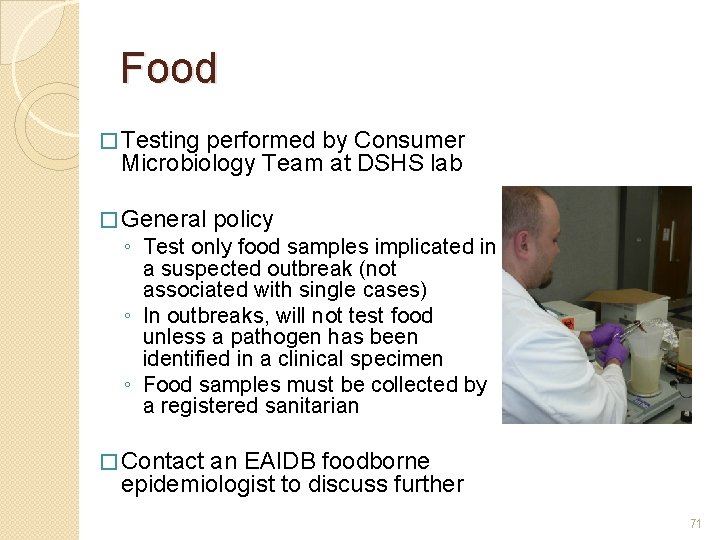
Food � Testing performed by Consumer Microbiology Team at DSHS lab � General policy ◦ Test only food samples implicated in a suspected outbreak (not associated with single cases) ◦ In outbreaks, will not test food unless a pathogen has been identified in a clinical specimen ◦ Food samples must be collected by a registered sanitarian � Contact an EAIDB foodborne epidemiologist to discuss further 71
Food: Available Tests* � � � � � Aerobic Plate Count Bacillus cereus Enumeration Campylobacter spp. Cronobacter sakazakii Clostridium perfringens Enumeration Coliform Count Escherichia coli O 157: H 7 Escherichia coli count non-O 157 STEC in Meat Products (O 26; O 45; O 103; O 111; O 121; and O 145) Listeria monocytogenes Salmonella spp. Shigella spp. Staphylococcus aureus enterotoxin Staphylococcus aureus Enumeration Vibrio cholerae, Vibrio parahaemolyticus, Vibrio vulnificus Yeast & Mold Count Yersinia enterocolitica *food is tested only upon prior approval 72
Food: Specimen Collection & Handling � Food items should be refrigerated and maintained at 0 o to 4 o Celsius, until arrival at the laboratory. � Whenever possible, submit samples to the laboratory in the original, unopened containers. � If the original container is too large, transfer representative portions to sterile containers using aseptic technique. � Dry or canned foods that are not perishable should be collected and shipped at ambient temperature. Frozen foods should be shipped frozen. � Do not freeze refrigerated foods. � Collect at least 100 grams of each sample unit. (100 grams = 3. 53 ounces or 0. 22 pounds) http: //www. dshs. state. tx. us/lab/mic-cm_collect. shtm 73
Environmental Swabs � Testing performed by Consumer Microbiology Team at DSHS lab � General policy ◦ Test environmental swabs only from facilities implicated in a suspected outbreak (not associated with single cases) ◦ In outbreaks, will not test environmental swabs unless a pathogen has been identified in a clinical specimen ◦ Environmental swabs must be collected by a registered sanitarian � Contact an EAIDB foodborne epidemiologist to discuss further 74
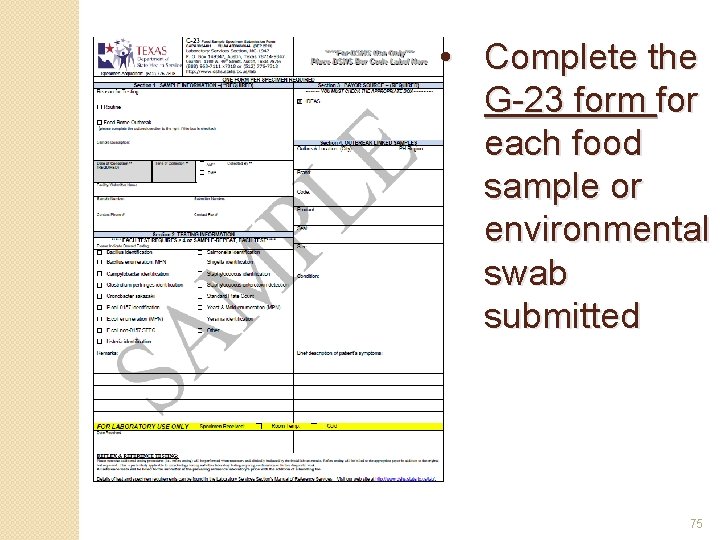
• Complete the G-23 form for each food sample or environmental swab submitted 75
Foodborne Team Contacts • • • Venessa Cantu– Team Leader, Epidemiologist Inger Vilcins– Epidemiologist (vacant)– Epidemiologist Greg Leos– Public Health and Prevention Specialist Wendy Albers-Public Health and Prevention Specialist 76

QUESTIONS? 77
- Slides: 77