
Everything You Didnt Want to Know About NEPA
Everything You Didn’t Want to Know About NEPA and Were Afraid to Ask NEPA Essentials ~ Triggers, Timelines, Pitfalls ~ for Local Agencies & Consultants Susan Vickers ODOT Local Government Section Local Agency Program Environmental Liaison April 6, 2010 Training—OSU
What Does ‘NEPA’ Stand For? 3/2/2021 2
National Environmental Policy Act • NEPA is a ‘procedural’ law requiring a prescribed process, including public involvement and scientific analysis, in order to reach an environmentally informed decision. • NEPA process timelines VARY and relate directly to project SCOPE and RISK. • NEPA requires full disclosure for ‘major actions’ taken by Federal agencies, including alternatives to the actions, impacts, and possible mitigation. 3/2/2021 3
Prior to NEPA…. • Inconsistent federal actions presented conflicts, inconsistent planning (case: Everglades). • NPS/DOI acquire land for Park • Army Corps plans to build dikes and canals • DOT plans to build airport • Environmental activism from oil spills in 1969 resulted in First Earth Day (1970). • NEPA signed by Nixon—January 1, 1970. 3/2/2021 4

NEPA Law in Summary • 1970 statute requiring Federal agencies to consider and disclose impacts on the environment. • A ‘procedural’ law (i. e. , step-by-step process). • Comprehensive framework to comply with all laws. • NEPA provides a forum for stakeholder (public and agency) involvement. • NEPA is also a ‘good decision-making’ tool. 3/2/2021 5

ODOT NEPA Guidance ODOT NEPA Procedures & Guidance link to e-Guide: http: //www. oregon. gov/ODOT/HWY/GEOENVIRONMENTAL/e_guide. shtml 3/2/2021 6
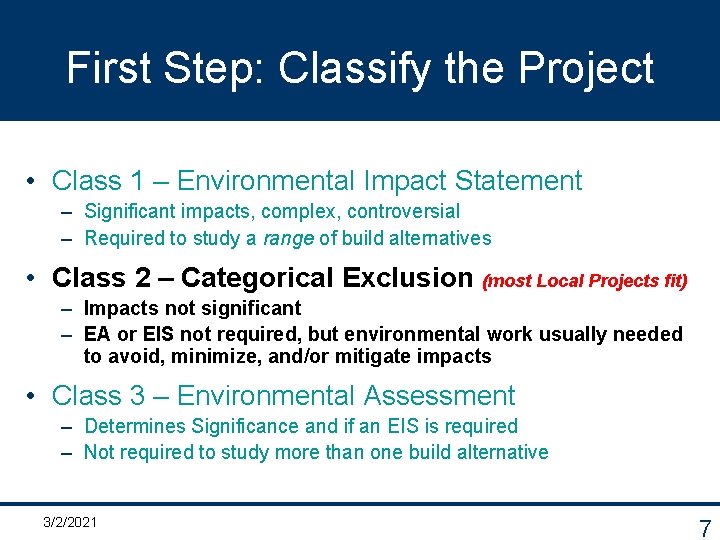
First Step: Classify the Project • Class 1 – Environmental Impact Statement – Significant impacts, complex, controversial – Required to study a range of build alternatives • Class 2 – Categorical Exclusion (most Local Projects fit) – Impacts not significant – EA or EIS not required, but environmental work usually needed to avoid, minimize, and/or mitigate impacts • Class 3 – Environmental Assessment – Determines Significance and if an EIS is required – Not required to study more than one build alternative 3/2/2021 7
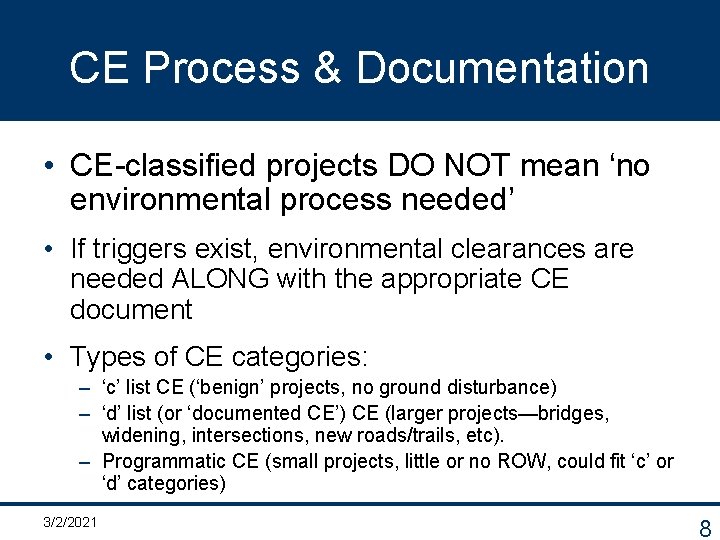
CE Process & Documentation • CE-classified projects DO NOT mean ‘no environmental process needed’ • If triggers exist, environmental clearances are needed ALONG with the appropriate CE document • Types of CE categories: – ‘c’ list CE (‘benign’ projects, no ground disturbance) – ‘d’ list (or ‘documented CE’) CE (larger projects—bridges, widening, intersections, new roads/trails, etc). – Programmatic CE (small projects, little or no ROW, could fit ‘c’ or ‘d’ categories) 3/2/2021 8
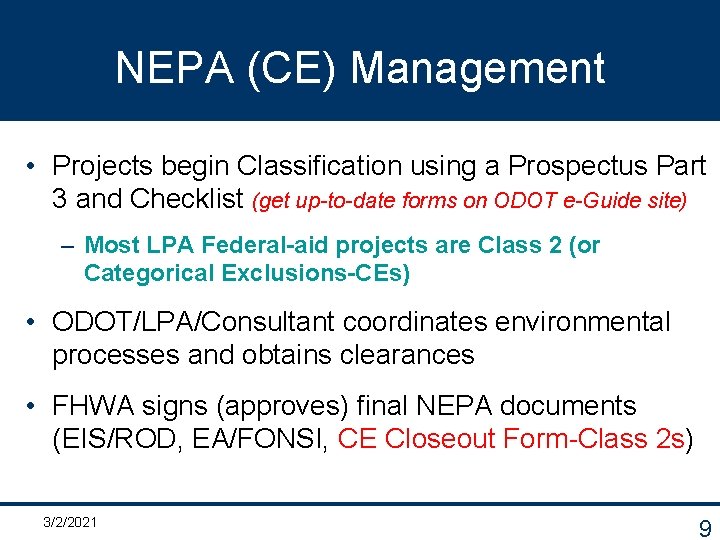
NEPA (CE) Management • Projects begin Classification using a Prospectus Part 3 and Checklist (get up-to-date forms on ODOT e-Guide site) – Most LPA Federal-aid projects are Class 2 (or Categorical Exclusions-CEs) • ODOT/LPA/Consultant coordinates environmental processes and obtains clearances • FHWA signs (approves) final NEPA documents (EIS/ROD, EA/FONSI, CE Closeout Form-Class 2 s) 3/2/2021 9
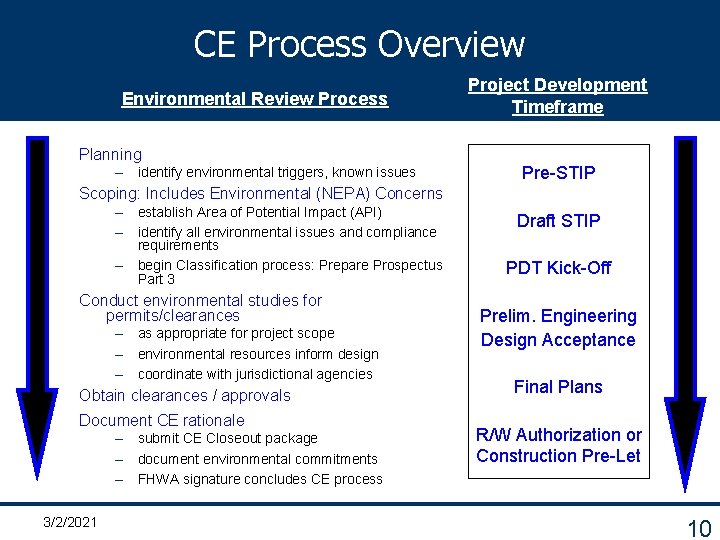
CE Process Overview Environmental Review Process Planning – identify environmental triggers, known issues Project Development Timeframe Pre-STIP Scoping: Includes Environmental (NEPA) Concerns – establish Area of Potential Impact (API) – identify all environmental issues and compliance requirements – begin Classification process: Prepare Prospectus Part 3 Conduct environmental studies for permits/clearances – as appropriate for project scope – environmental resources inform design – coordinate with jurisdictional agencies Obtain clearances / approvals Document CE rationale – submit CE Closeout package – document environmental commitments – FHWA signature concludes CE process 3/2/2021 Draft STIP PDT Kick-Off Prelim. Engineering Design Acceptance Final Plans R/W Authorization or Construction Pre-Let 10
The NEPA Process ‘Umbrella’ § Potential Federal-aid Projects involve: § Section 7 of the Endangered Species Act § Section 404 of the Clean Water Act § Section 4(f) of the USDOT Act § Section 6(f)(3) of the Land & Water Conservation Fund Act § Section 106 of the National Historic Preservation Act § Executive Order 12898 (Environmental Justice) § Oregon Statewide Planning Goals § Oregon Removal Fill Law § Fish Passage Requirements § Uniform Relocation Assistance and Real Property Acquisition 3/2/2021 11
Common Resources for Study and Potential Clearances Needed • • • Biological Resources Wetlands & Waters Stormwater Archaeology Historic Resources Land Use Socioeconomics Parks and Recreation Air Quality 3/2/2021 • • • Hazardous Materials Floodplains Hydraulics Geology and Soils Noise Energy Right of Way Traffic Climate Change 12
Resource (Regulatory) Agencies FEDERAL • • • U. S. Fish and Wildlife Service (ESA) National Marine Fisheries Service (ESA) U. S. Army Corps of Engineers (Sec. 404 CWA) National Park Service (Section 6(f)) FHWA (Section 4(f)) STATE • • • Department of Fish and Wildlife (404 and Fish Passage) Department of State Lands (Removal Fill Law) Department of Environmental Quality (NPDES) State Historic Preservation Office (Sec. 106) Department of Land Conservation and Development (Statewide planning goals—Goal exceptions) 3/2/2021 13
NEPA Covers Many ‘Substantive’ Laws • Title VI of the Civil Rights Act • Uniform Relocation Assistance and Real Property Acquisition Policies Act • Americans with Disabilities Act • E. O. 12898 (Environmental Justice) • Section 4(f) of 1966 U. S. DOT Act (49 USC 303) • Clean Air Act and amendments • Endangered Species Act Section 7 • Migratory Bird Treaty Act • Clean Water Act Section 401(b) • E. O. 11988 (Floodplain Management) • Resource Conservation and Recovery Act • Comprehensive Environmental Response, Compensation and Liability Act • Clean Water Act Section 404 3/2/2021 • Farmland Protection Policy Act • National Historic Preservation Act Section 106 • Land Water Conservation Fund Act Section 6(f)(3) • Wild and Scenic Rivers Act • Clean Air Act and amendments • Highway Noise Standards • Public Involvement Requirements • NEPA case law In Oregon: • Land Use Actions / Goal Exceptions • Fish Passage Statute • Removal/Fill Law • AND MORE, including state and local requirements… 14
Coordination is Key • • • Stakeholder Coordination Public Involvement & Coordination Regulatory Agency Coordination Tribal Coordination FHWA Coordination ODOT Coordination—early, often, any time you have a question!! 3/2/2021 15
What Can ‘Trigger’ NEPA? • Through initial project scoping, and even in the Planning process, be aware of the following indicators that may require environmental clearance processes and approvals: – Any Federal Nexus (funding or permit needed); once a project is federalized, triggers for Study and/or potential Clearances needed include: • • 3/2/2021 Streams, ditches, culverts, wetlands, vegetation Any ‘ground disturbing’ activity (dirt/soil/fill/veg) Any in- or over-water work Any right-of-way needed 16
NEPA Clearance Timelines • Depends on intensity of impacts and/or season of work needed: – Biology issues (2 months to 1 year) – Tribal Coordination (30 days +) – Historic: (<30 days to 30 days +) – 4(f) (<30 days to 6 months) – 6(f) Parks/Refuges (1 year +) • NOTE: programmatic agreements take less time, if project conforms to restrictions 3/2/2021 17
NEPA Pitfalls • NOT allowing for enough time in your schedule • NOT being clear and complete in your project description (to inform specialists) • NOT identifying the correct stakeholders • NOT coordinating with ODOT or regulatory agencies soon enough • Changing the project scope AFTER getting environmental clearances 3/2/2021 18

Making NEPA Efficient • Include environmental scoping in Local Planning • Engage ODOT environmental staff early • Conduct effective scoping (the right players) • Identify environmental constraints early • Engage regulatory agencies early • Address issues and concerns as they arise • Manage scope creep and project changes • Foster effective communication—engage often!! 3/2/2021 19
NEPA ‘Words of Wisdom’ • Be as clear and descriptive as possible with Project Descriptions, maps, locations (include T&R info) • Conduct processes concurrently as allowable • Integrate NEPA with other environmental laws • Avoid impacts wherever possible!! • Design to Programmatic Standards—Engineering, Environmental, and ROW need to work together • Finally, be as transparent as possible! 3/2/2021 20
Final Points to Keep in Mind ü NEPA Approval is required for all Federal projects ü Early & Effective scoping and coordination is key ü Allow sufficient time in your schedule ü Use ODOT references, links, contacts OFTEN— whenever you have questions! ü Don’t be afraid of NEPA ‘process’ but also don’t ignore it (knowledge is your friend!) ü Permits/clearances are required prior to NEPA Approval, NEPA Approval is required prior to PS&E (so, any project changes = more time!) 3/2/2021 21
Questions? Susan Vickers 503 -986 -3519 susan. vickers@odot. state. or. us e-Guide link: http: //www. oregon. gov/ODOT/HWY/GEOENVIRONMENTAL/e_guide. shtml Local Government Environmental Links: http: //www. oregon. gov/ODOT/HWY/LGS/manuals. shtml#Environmental_Links (MORE REFERENCES ON FOLLOWING SLIDE)

ODOT Environmental Guidance Links ± ODOT Geo-Environmental Section web page ð http: //www. oregon. gov/ODOT/HWY/GEOENVIRONMENTAL/index. shtml This is ODOT’s main website for environmental guidance and procedures. ± ODOT Geo-Environmental ‘e-Guide’ (under construction) ð http: //www. oregon. gov/ODOT/HWY/GEOENVIRONMENTAL/e_guide. shtml This comprehensive site is oriented to NEPA and environmental compliance matters. This site links to the main site above, and includes many other links. ± ODOT Geo-Environmental REC e-Guide (under construction) ð http: //www. oregon. gov/ODOT/HWY/GEOENVIRONMENTAL/e_guide_rec_guide. shtml This site contains guidance, forms, and protocols for NEPA Categorical Exclusions, including: w Links to project delivery guidance w Prospectus Part 3 information w CE documentation guidance and templates 3/2/2021 23
- Slides: 23