
Everything You Always Wanted To Know about Game
Everything You Always Wanted To Know about Game Theory* *but were afraid to ask Dan Garcia, UC Berkeley David Ginat, Tel-Aviv University Peter Henderson, Butler University SIGCSE 2003 EYAWTKAGT*bwata

What is “Game Theory”? Combinatorial / Computational / Economic Combinatorial ◊ Sprague and Grundy’s 1939 Mathematics and Games ◊ Board (table) games ◊ Nim, Domineering ◊ Complete info, alternating moves ◊ Goal: Last move Computational ◊ R. Bell and M. Cornelius’ 1988 Board Games around the World ◊ Board (table) games ◊ Tic-Tac-Toe, Chess ◊ Complete info, alternating moves ◊ Goal: Varies SIGCSE 2003 Economic ◊ von Neumann and Morgenstern’s 1944 Theory of Games and Economic Behavior ◊ Matrix games ◊ Prisoner’s dilemma ◊ Incomplete info, simultaneous moves ◊ Goal: Maximize payoff EYAWTKAGT*bwata 2
Know Your Audience… • How many have used games pedagogically? • What is your own comfort level with GT? (hands down = none, one hand = ok; two hands = you could be teaching this session) ◊ Combinatorial (Berlekamp-ish) ◊ Computational (AI, Brute-force solving) ◊ Economic (Prisoner’s dilemma, matrix games) SIGCSE 2003 EYAWTKAGT*bwata 3
EYAWTKAGT*bwata Here’s our schedule: (“GT” = “Game Theory”) • • • Dan: Overview, Combinatorial GT basics David: Combinatorial GT examples Dan: Computational GT Peter: Economic GT & Two-person games Dan: Summary & Where to go from here (All of GT in 75 min? Right!) SIGCSE 2003 EYAWTKAGT*bwata 4
Why are games useful pedagogical tools? • Vast resource of problems ◊ ◊ Easy to state Colorful, rich Use in lecture or for projects They can USE their projects when they’re done ◊ Project Reuse -- just change the games every year! ◊ Algorithms, User Interfaces, Artificial Intelligence, Software Engineering SIGCSE 2003 “Every game ever invented by mankind, is a way of making things hard for the fun of it!” – John Ciardi EYAWTKAGT*bwata 5

What is a combinatorial game? • Two players (Left & Right) alternating turns • No chance, such as dice or shuffled cards • Both players have perfect information ◊ No hidden information, as in Stratego & Magic • The game is finite – it must eventually end • There are no draws or ties • Normal Play: Last to move wins! SIGCSE 2003 EYAWTKAGT*bwata 6
Combinatorial Game Theory The Big Picture • Whose turn is not part of the game • SUMS of games ◊ You play games G 1 + G 2 + G 3 + … ◊ You decide which game is most important ◊ You want the last move (in normal play) ◊ Analogy: Eating with a friend, want the last bite SIGCSE 2003 EYAWTKAGT*bwata 7
Classification of Games • Impartial • Partisan ◊ Same moves available to each player ◊ The two players have different options ◊ Example: Nim ◊ Example: Domineering SIGCSE 2003 EYAWTKAGT*bwata 8
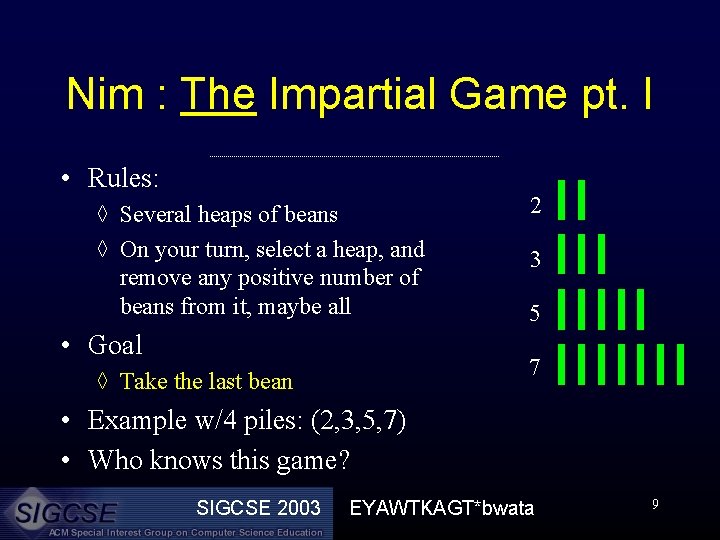
Nim : The Impartial Game pt. I • Rules: ◊ Several heaps of beans ◊ On your turn, select a heap, and remove any positive number of beans from it, maybe all • Goal 2 3 5 7 ◊ Take the last bean • Example w/4 piles: (2, 3, 5, 7) • Who knows this game? SIGCSE 2003 EYAWTKAGT*bwata 9
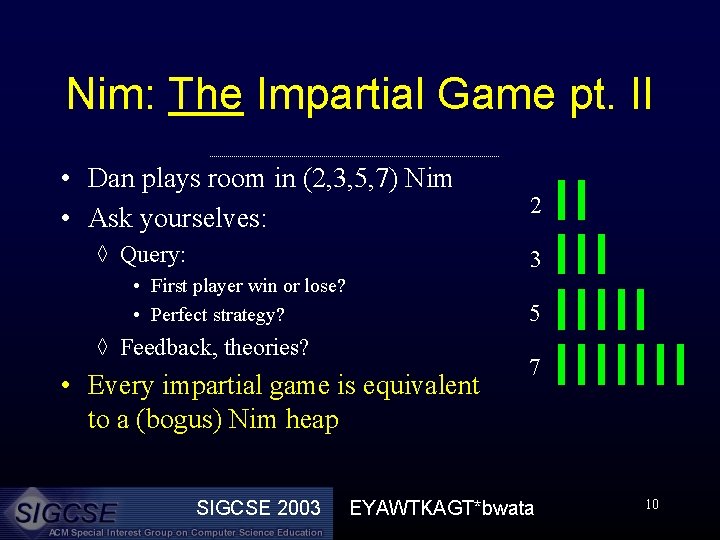
Nim: The Impartial Game pt. II • Dan plays room in (2, 3, 5, 7) Nim • Ask yourselves: ◊ Query: 2 3 • First player win or lose? • Perfect strategy? 5 ◊ Feedback, theories? • Every impartial game is equivalent to a (bogus) Nim heap SIGCSE 2003 7 EYAWTKAGT*bwata 10
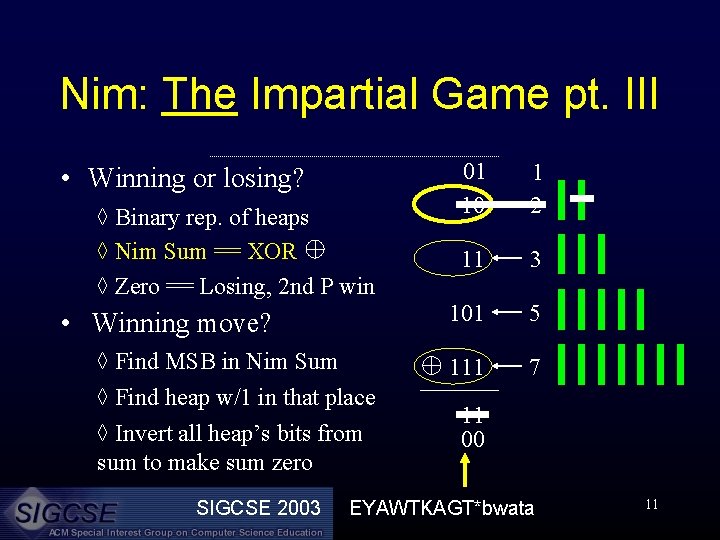
Nim: The Impartial Game pt. III • Winning or losing? ◊ Binary rep. of heaps ◊ Nim Sum == XOR ◊ Zero == Losing, 2 nd P win • Winning move? ◊ Find MSB in Nim Sum ◊ Find heap w/1 in that place ◊ Invert all heap’s bits from sum to make sum zero SIGCSE 2003 01 10 1 2 11 3 101 5 111 7 11 00 EYAWTKAGT*bwata 11
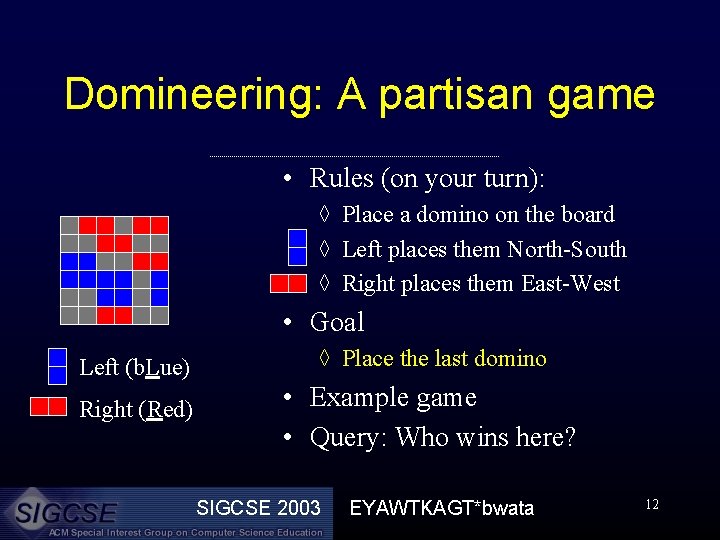
Domineering: A partisan game • Rules (on your turn): ◊ Place a domino on the board ◊ Left places them North-South ◊ Right places them East-West • Goal Left (b. Lue) ◊ Place the last domino Right (Red) • Example game • Query: Who wins here? SIGCSE 2003 EYAWTKAGT*bwata 12
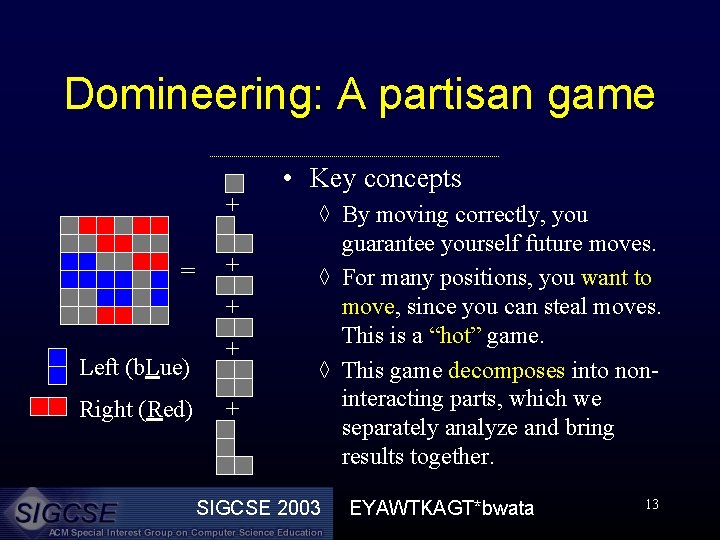
Domineering: A partisan game + = + + Left (b. Lue) Right (Red) + + • Key concepts ◊ By moving correctly, you guarantee yourself future moves. ◊ For many positions, you want to move, since you can steal moves. This is a “hot” game. ◊ This game decomposes into noninteracting parts, which we separately analyze and bring results together. SIGCSE 2003 EYAWTKAGT*bwata 13
What do we want to know about a particular game? • What is the value of the game? ◊ Who is ahead and by how much? ◊ How big is the next move? ◊ Does it matter who goes first? • What is a winning / drawing strategy? ◊ To know a game’s value and winning strategy is to have solved the game ◊ Can we easily summarize strategy? SIGCSE 2003 EYAWTKAGT*bwata 14
Combinatorial Game Theory The Basics I - Game definition • A game, G, between two players, Left and Right, is defined as a pair of sets of games: ◊ G = {GL | GR } ◊ GL is the typical Left option (i. e. , a position Left can move to), similarly for Right. ◊ GL need not have a unique value ◊ Thus if G = {a, b, c, … | d, e, f, …}, GL means a or b or c or … and GR means d or e or f or. . . SIGCSE 2003 EYAWTKAGT*bwata 15
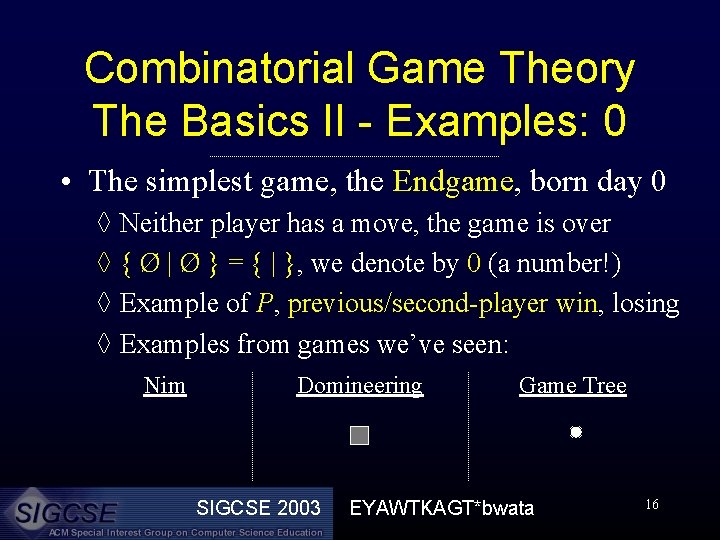
Combinatorial Game Theory The Basics II - Examples: 0 • The simplest game, the Endgame, born day 0 ◊ Neither player has a move, the game is over ◊ { Ø | Ø } = { | }, we denote by 0 (a number!) ◊ Example of P, previous/second-player win, losing ◊ Examples from games we’ve seen: Nim Domineering SIGCSE 2003 Game Tree EYAWTKAGT*bwata 16
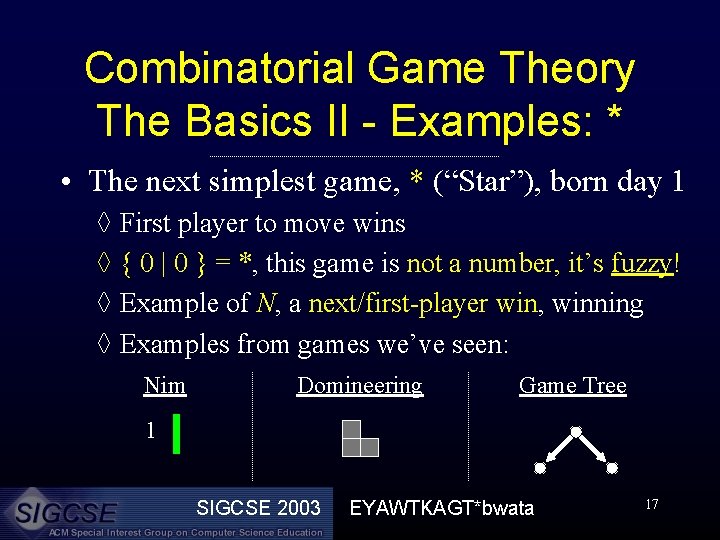
Combinatorial Game Theory The Basics II - Examples: * • The next simplest game, * (“Star”), born day 1 ◊ First player to move wins ◊ { 0 | 0 } = *, this game is not a number, it’s fuzzy! ◊ Example of N, a next/first-player win, winning ◊ Examples from games we’ve seen: Nim Domineering Game Tree 1 SIGCSE 2003 EYAWTKAGT*bwata 17
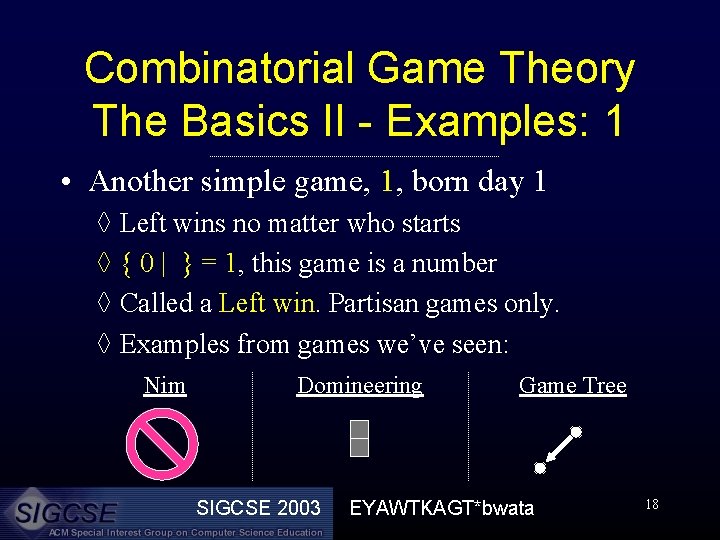
Combinatorial Game Theory The Basics II - Examples: 1 • Another simple game, 1, born day 1 ◊ Left wins no matter who starts ◊ { 0 | } = 1, this game is a number ◊ Called a Left win. Partisan games only. ◊ Examples from games we’ve seen: Nim Domineering SIGCSE 2003 Game Tree EYAWTKAGT*bwata 18
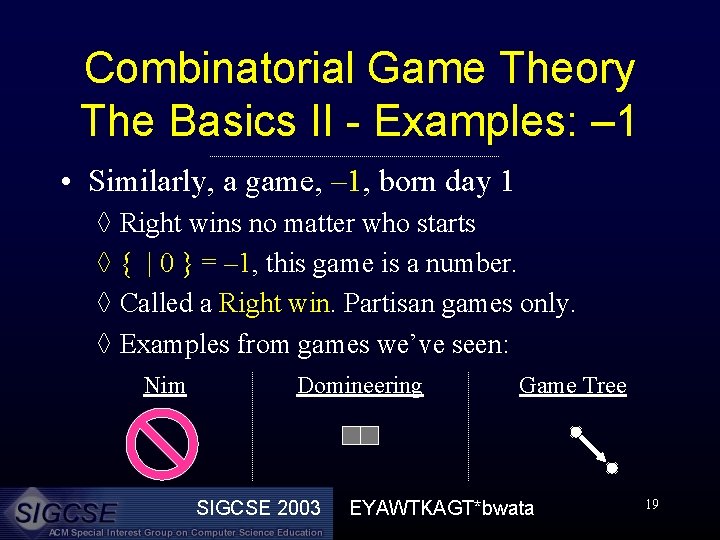
Combinatorial Game Theory The Basics II - Examples: – 1 • Similarly, a game, – 1, born day 1 ◊ Right wins no matter who starts ◊ { | 0 } = – 1, this game is a number. ◊ Called a Right win. Partisan games only. ◊ Examples from games we’ve seen: Nim Domineering SIGCSE 2003 Game Tree EYAWTKAGT*bwata 19
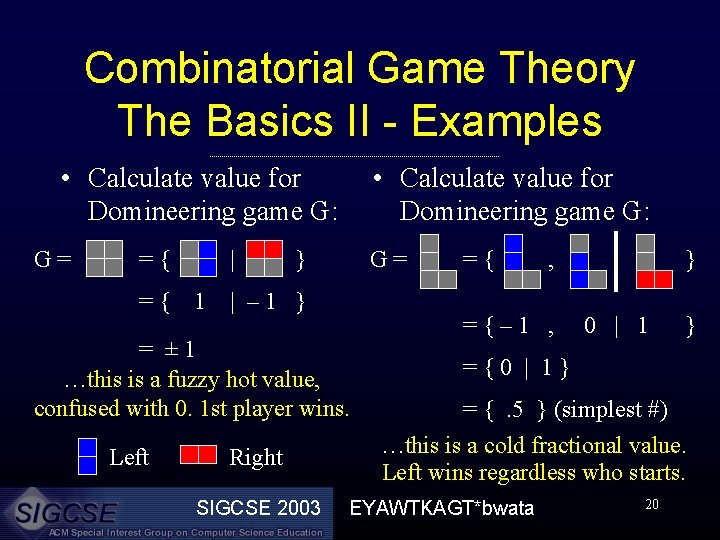
Combinatorial Game Theory The Basics II - Examples • Calculate value for Domineering game G: G= ={ ={ | 1 • Calculate value for Domineering game G: } G= | – 1 } = ± 1 …this is a fuzzy hot value, confused with 0. 1 st player wins. Left Right SIGCSE 2003 ={ , ={– 1 , | } 0 | 1 } ={0 | 1} = {. 5 } (simplest #) …this is a cold fractional value. Left wins regardless who starts. EYAWTKAGT*bwata 20
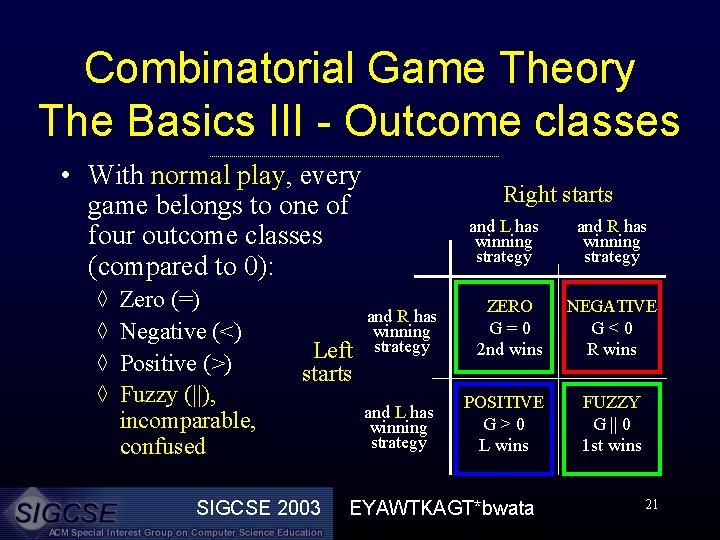
Combinatorial Game Theory The Basics III - Outcome classes • With normal play, every game belongs to one of four outcome classes (compared to 0): ◊ ◊ Zero (=) Negative (<) Positive (>) Fuzzy (||), incomparable, confused Left starts SIGCSE 2003 Right starts and L has winning strategy and R has winning strategy ZERO G=0 2 nd wins and L has winning strategy POSITIVE G>0 L wins EYAWTKAGT*bwata and R has winning strategy NEGATIVE G<0 R wins FUZZY G || 0 1 st wins 21
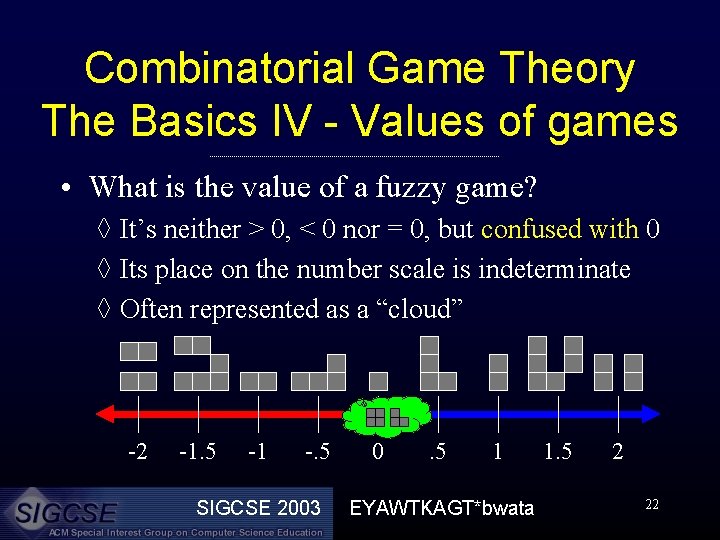
Combinatorial Game Theory The Basics IV - Values of games • What is the value of a fuzzy game? ◊ It’s neither > 0, < 0 nor = 0, but confused with 0 ◊ Its place on the number scale is indeterminate ◊ Often represented as a “cloud” -2 -1. 5 -1 -. 5 SIGCSE 2003 0 . 5 1 EYAWTKAGT*bwata 1. 5 2 22
Combinatorial Game Theory The Basics V - Final thoughts • There’s much more! ◊ More values • Up, Down, Tiny, etc. ◊ ◊ ◊ How games add Simplicity, Mex rule Dominating options Reversible moves Number avoidance Temperatures SIGCSE 2003 • Normal form games ◊ ◊ ◊ Last to move wins, no ties Whose turn not in game Rich mathematics Key: Sums of games Many (most? ) games are not normal form! • What do we do then? • Computational GT! EYAWTKAGT*bwata 23
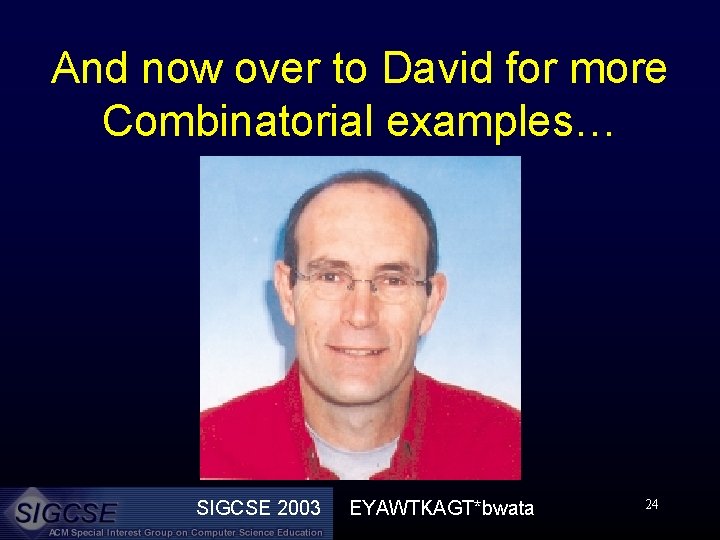
And now over to David for more Combinatorial examples… SIGCSE 2003 EYAWTKAGT*bwata 24
Computational Game Theory (for non-normal play games) • Large games ◊ Can theorize strategies, build AI systems to play ◊ Can study endgames, smaller version of original • Examples: Quick Chess, 9 x 9 Go, 6 x 6 Checkers, etc. • Small-to-medium games ◊ Can have computer solve and teach us strategy ◊ I wrote a system called GAMESMAN which I use in CS 0 (a SIGCSE 2002 Nifty Assignment) SIGCSE 2003 EYAWTKAGT*bwata 25
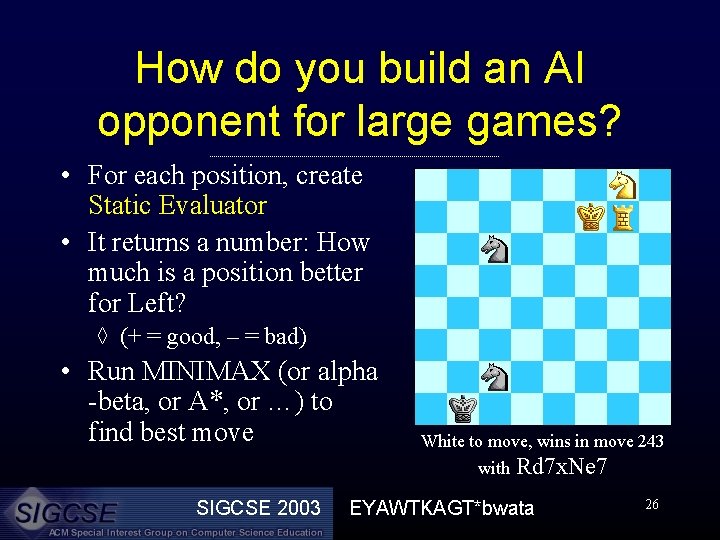
How do you build an AI opponent for large games? • For each position, create Static Evaluator • It returns a number: How much is a position better for Left? ◊ (+ = good, – = bad) • Run MINIMAX (or alpha -beta, or A*, or …) to find best move White to move, wins in move 243 with SIGCSE 2003 Rd 7 x. Ne 7 EYAWTKAGT*bwata 26
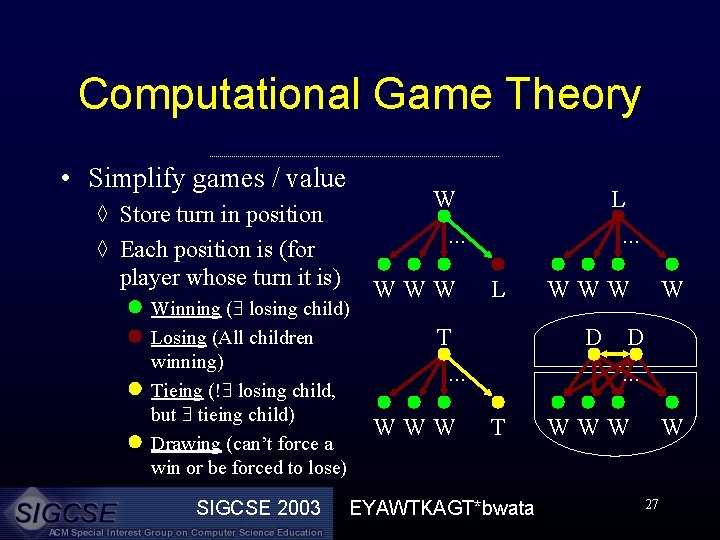
Computational Game Theory • Simplify games / value W. . . ◊ Store turn in position ◊ Each position is (for player whose turn it is) • Winning ( losing child) • Losing (All children winning) • Tieing (! losing child, but tieing child) • Drawing (can’t force a win or be forced to lose) SIGCSE 2003 WWW L. . . L T. . . WWW D T EYAWTKAGT*bwata W D. . . WWW W 27
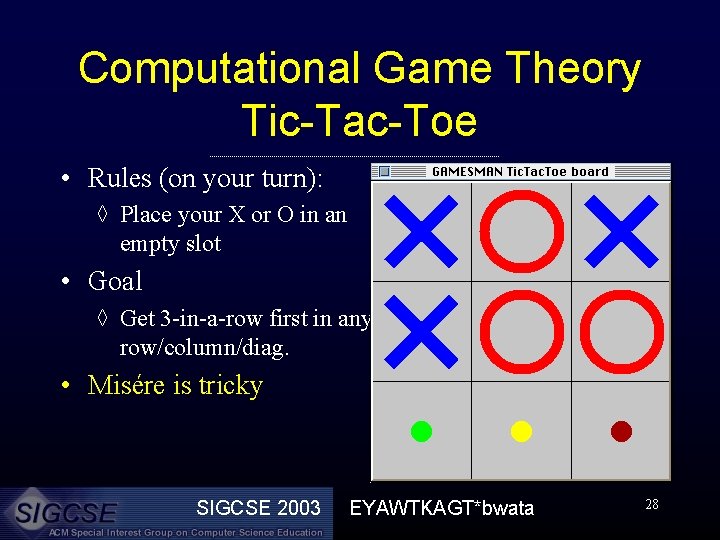
Computational Game Theory Tic-Tac-Toe • Rules (on your turn): ◊ Place your X or O in an empty slot • Goal ◊ Get 3 -in-a-row first in any row/column/diag. • Misére is tricky SIGCSE 2003 EYAWTKAGT*bwata 28
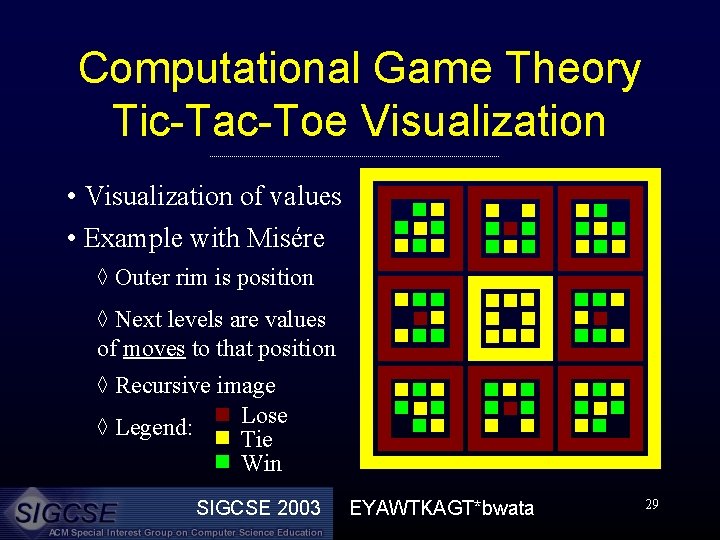
Computational Game Theory Tic-Tac-Toe Visualization • Visualization of values • Example with Misére ◊ Outer rim is position ◊ Next levels are values of moves to that position ◊ Recursive image Lose ◊ Legend: Tie Win SIGCSE 2003 EYAWTKAGT*bwata 29
Use of games in projects (CS 0) Language: Scheme & C • Every semester… ◊ New games chosen ◊ Students choose their own graphics & rules (I. e. , open-ended) ◊ Final Presentation, best project chosen, prizes • Demonstrated at SIGCSE 2002 Nifty Assignments SIGCSE 2003 EYAWTKAGT*bwata 30
And now over to Peter… • Two player games • More motivation • Prisoner’s Dilemma SIGCSE 2003 EYAWTKAGT*bwata 31
Summary • Games are wonderful pedagogic tools ◊ Rich, colorful, easy to state problems ◊ Useful in lecture or for homework / projects ◊ Can demonstrate so many CS concepts • We’ve tried to give broad theoretical foundations & provided some nuggets… SIGCSE 2003 EYAWTKAGT*bwata 32
Resources • www. cs. berkeley. edu/~ddgarcia/eyawtkagtbwata/ • www. cut-the-knot. org • E. Berlekamp, J. Conway & R. Guy: Winning Ways I & II [1982] • R. Bell and M. Cornelius: Board Games around the World [1988] • K. Binmore: A Text on Game Theory [1992] SIGCSE 2003 EYAWTKAGT*bwata 33
- Slides: 33