
Every Student Succeeds Act ESSA Turning Legislative Success

- Slides: 23
Every Student Succeeds Act (ESSA): Turning Legislative Success into Gains for Gifted Learners March 7, 2016 Jane Clarenbach Director, Public Education M. René Islas Executive Director
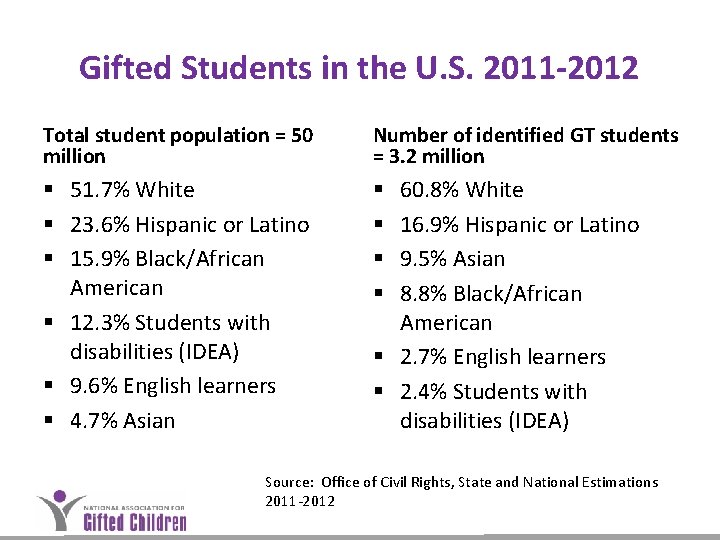
Gifted Students in the U. S. 2011 -2012 Total student population = 50 million Number of identified GT students = 3. 2 million § 51. 7% White § 23. 6% Hispanic or Latino § 15. 9% Black/African American § 12. 3% Students with disabilities (IDEA) § 9. 6% English learners § 4. 7% Asian § § 60. 8% White 16. 9% Hispanic or Latino 9. 5% Asian 8. 8% Black/African American § 2. 7% English learners § 2. 4% Students with disabilities (IDEA) Source: Office of Civil Rights, State and National Estimations 2011 -2012
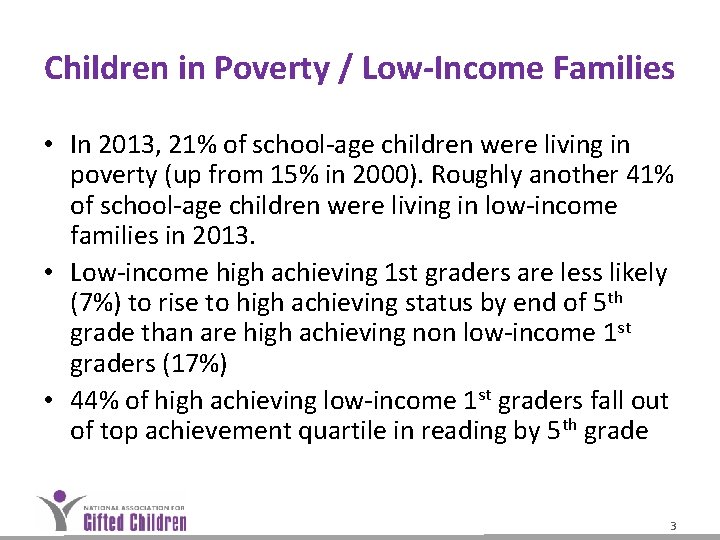
Children in Poverty / Low-Income Families • In 2013, 21% of school-age children were living in poverty (up from 15% in 2000). Roughly another 41% of school-age children were living in low-income families in 2013. • Low-income high achieving 1 st graders are less likely (7%) to rise to high achieving status by end of 5 th grade than are high achieving non low-income 1 st graders (17%) • 44% of high achieving low-income 1 st graders fall out of top achievement quartile in reading by 5 th grade 3
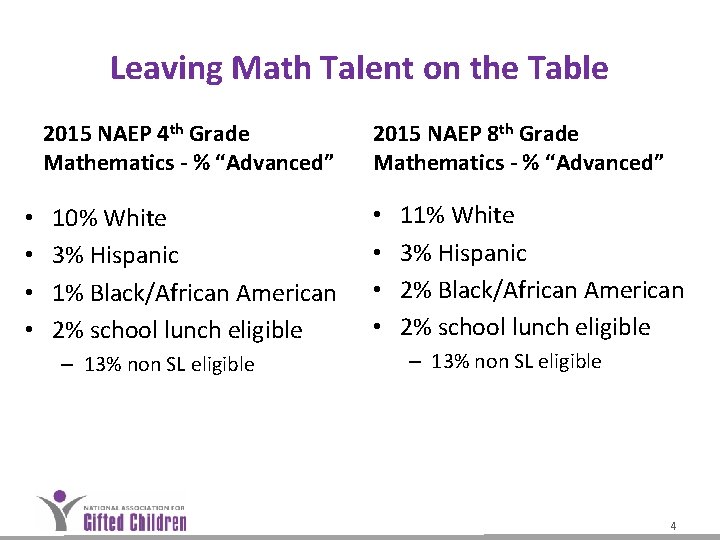
Leaving Math Talent on the Table 2015 NAEP 4 th Grade Mathematics - % “Advanced” • • 10% White 3% Hispanic 1% Black/African American 2% school lunch eligible – 13% non SL eligible 2015 NAEP 8 th Grade Mathematics - % “Advanced” • • 11% White 3% Hispanic 2% Black/African American 2% school lunch eligible – 13% non SL eligible 4
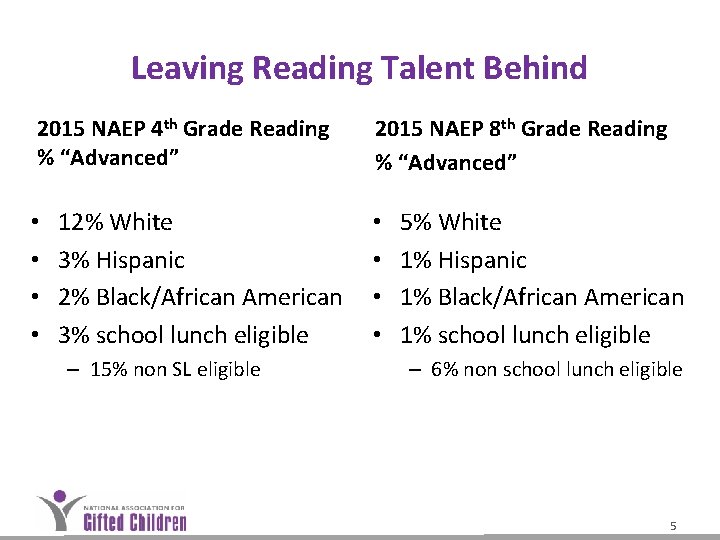
Leaving Reading Talent Behind 2015 NAEP 4 th Grade Reading % “Advanced” • • 12% White 3% Hispanic 2% Black/African American 3% school lunch eligible – 15% non SL eligible 2015 NAEP 8 th Grade Reading % “Advanced” • • 5% White 1% Hispanic 1% Black/African American 1% school lunch eligible – 6% non school lunch eligible 5
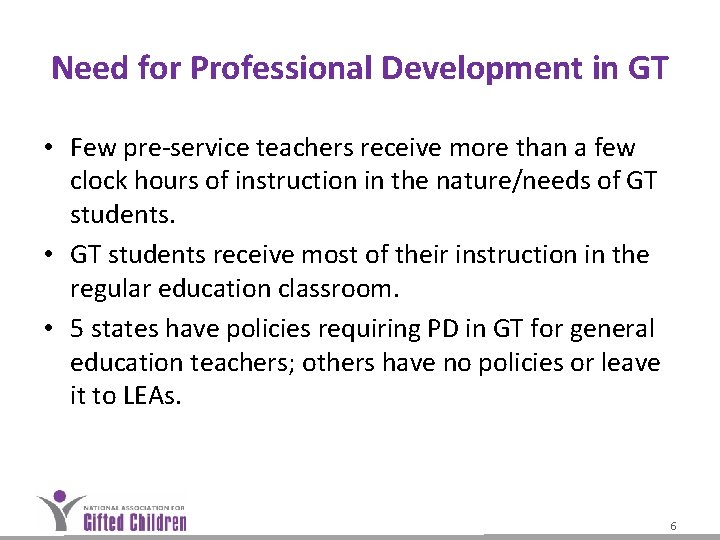
Need for Professional Development in GT • Few pre-service teachers receive more than a few clock hours of instruction in the nature/needs of GT students. • GT students receive most of their instruction in the regular education classroom. • 5 states have policies requiring PD in GT for general education teachers; others have no policies or leave it to LEAs. 6
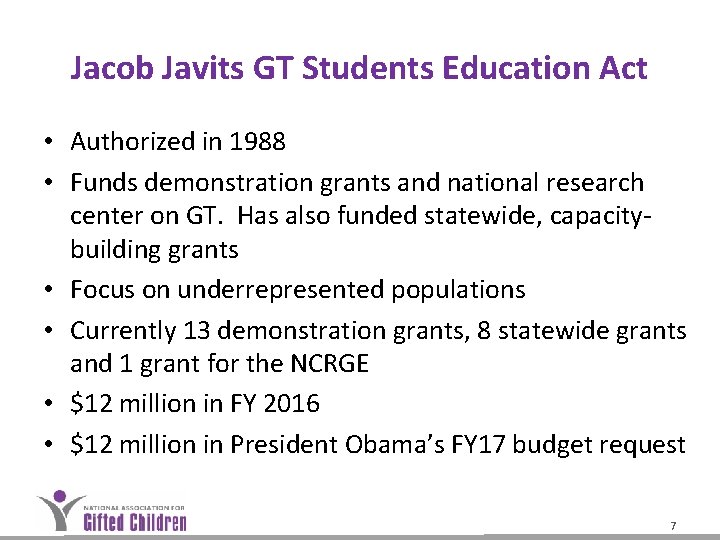
Jacob Javits GT Students Education Act • Authorized in 1988 • Funds demonstration grants and national research center on GT. Has also funded statewide, capacitybuilding grants • Focus on underrepresented populations • Currently 13 demonstration grants, 8 statewide grants and 1 grant for the NCRGE • $12 million in FY 2016 • $12 million in President Obama’s FY 17 budget request 7
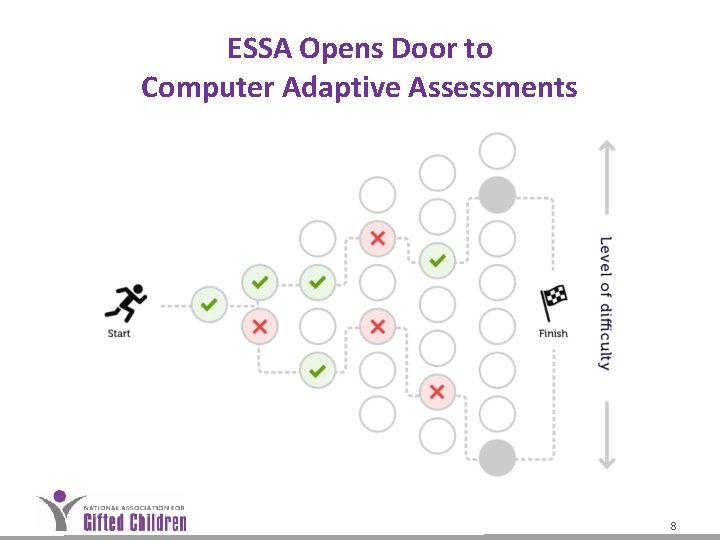
ESSA Opens Door to Computer Adaptive Assessments 8
Federal GT Advocacy Messages (TALENT Act) • Close achievement gaps at the advanced level • Lack of accountability for learning of students above proficient level • Lack of attention to high-ability students in poverty • Lack of data on GT students • Assessments not able to pinpoint student mastery • Teachers not prepared (pre-service, in-service) to spot talent and support it New provisions in ESSA address virtually all of these concerns @NAGCGIFTED 9
Every Student Succeeds Act (ESSA) • ESSA is the 2015 reauthorization of the 1965 Elementary & Secondary Education Act (ESEA) • Replaces No Child Left Behind • For the first time, addresses learning needs of gifted and talented students and will require districts and states to make changes @NAGCGIFTED 10
Title I: Improving Academic Achievement of Disadvantaged Students (1) Funds may be used to identify and serve gifted and talented students (2) Requires disaggregation of student achievement data at each achievement level on state & local report cards (3) States may develop computer adaptive assessments used for accountability purposes @NAGCGIFTED 11
Title II: Professional Development (1) State plans must address gifted students (2) Districts receiving Title II funds must provide training to address the learning of gifted and talented students (3) Districts may provide training to support the ID of GT students, including high-ability students who have not been formally identified as GT [includes examples of strategies that may be taught] @NAGCGIFTED 12
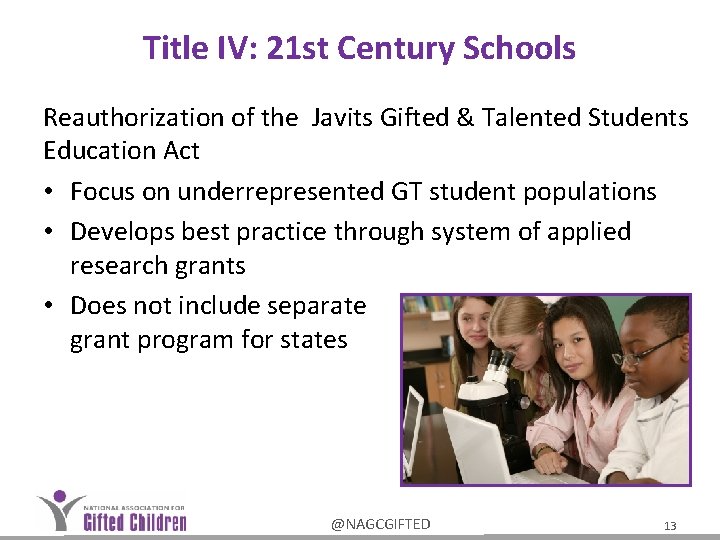
Title IV: 21 st Century Schools Reauthorization of the Javits Gifted & Talented Students Education Act • Focus on underrepresented GT student populations • Develops best practice through system of applied research grants • Does not include separate grant program for states @NAGCGIFTED 13
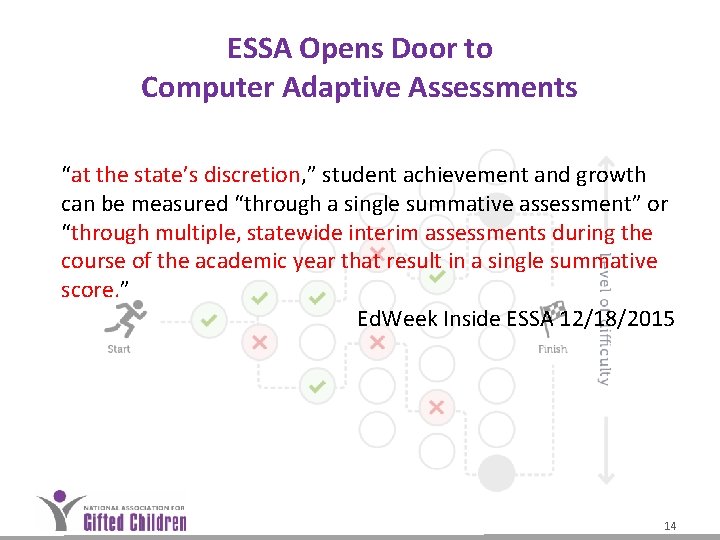
ESSA Opens Door to Computer Adaptive Assessments “at the state’s discretion, ” student achievement and growth can be measured “through a single summative assessment” or “through multiple, statewide interim assessments during the course of the academic year that result in a single summative score. ” Ed. Week Inside ESSA 12/18/2015 14
ESSA Opens Door to Computer Adaptive Assessments (Sec. 1111(b)(1)(J) such assessment— “(aa) shall measure, at a minimum, each student’s academic proficiency based on the challenging State academic standards for the student’s grade level and growth toward such standards; and “(bb) may measure the student’s level of academic proficiency and growth using items above or below the student’s grade level, including for use as a part of a State’s accountability system under subsection (c). 15
Implementation • New law will take effect in stages. • NCLB Waiver provisions end on July 31, 2016 • Most Title II provisions go into effect in 2016 -2017 school year • Title I accountability provisions (including new report card format) go into effect in 2017 -18 school • TALENT Act is now dormant, will expire at the end of the 114 th Congress. 16
Practicing Your Pitch to Title I & Title II Directors @NAGCGIFTED 17
Messages for Capitol Hill - ESSA Funding for Javits Program • Thank you for including GT students in ESSA; the new provisions can make a real difference. • Please hold the Dept of Ed and states accountable for implementing the new provisions in ESSA through Congressional oversight. • Please support continued funding of $12 million for the Javits Gifted & Talented Students program in fiscal year 2017. Senate: please cosign the Grassley-Casey letter on javits. House: please include a request in your letters to the Labor/HHS approps subcmttee 18
Legislative Materials Hill Packets • • • State of the Nation State Fact Sheet for Javits Funding Sheet for ESSA “Dear Colleague” letter for Senate (need 2) Also for your Visits • Visit report sheets (take a couple; form is online) • Hill Map • Congressional directory MEET AT 7: 30 am in Lobby 19
THANK YOU!! 20
Use of Title I funds for GT Sec. 1112. Local Education Agency Plans (p 131) (b) Plan Provisions (p 134) (13) any other information on how the local educational agency proposes to use funds to meet the purposes of this part, and that the local educational agency determines appropriate to provide, which may include how the local educational agency will— (A) assist schools in identifying and serving gifted and talented students; (p 138) 21
Title II – Include GT in State Plans Sec. 2101 Formula Grants to States (p 308) (d)(2) (p 326)) State Application Contents: Each application described under paragraph (1) shall include the following: (J) A description of how the State educational agency will improve the skills of teachers, principals, or other school leaders in order to enable them to identify students with specific learning needs, particularly children with disabilities, English learners, students who are gifted and talented, and students with low literacy levels, and provide instruction based on the needs of such students. (p 328) 22
Title II – LEAs include needs of GT Sec. 2103. Local Uses of Funds (p 335) (b)(2) Types of required activities (p 336) (b) TYPES OF ACTIVITIES. —The programs and activities described in this subsection— (2) shall address the learning needs of all students, including children with disabilities, English learners, and gifted and talented students; 23