
Every Student Succeeds Act ESSA Comprehensive Needs Assessment


- Slides: 54
Every Student Succeeds Act (ESSA) Comprehensive Needs Assessment and SAU Consolidated Plan February 13, 2018
Maine’s ESSA plan is moving away from compliance and regulation toward a model that supports and assists schools and educators, especially in areas where students are at a disadvantage. Maine Department of Education Commissioner, Robert G. Hasson Jr.
Comprehensive Needs Assessment (CNA): • Each public school must complete a CNA in order to receive federal funds. • The review of the CNA data will drive the SAU Consolidated Plan: • Each SAU will collapse the information from each school’s CNA into one SAU consolidated plan template to submit to Maine DOE. Title I Schoolwide Plan (SWP): • All schools seeking Title I schoolwide authority must complete section 10 of the SAU Plan.
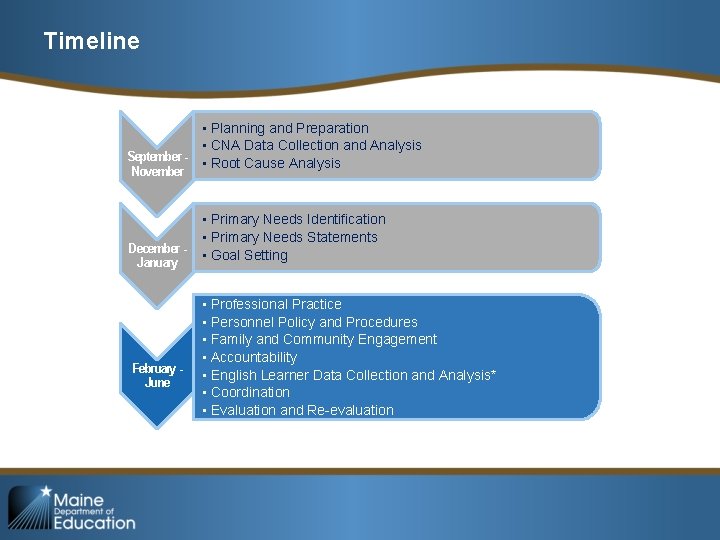
Timeline • Planning and Preparation • CNA Data Collection and Analysis September • Root Cause Analysis November • Primary Needs Identification • Primary Needs Statements December • Goal Setting January February June • Professional Practice • Personnel Policy and Procedures • Family and Community Engagement • Accountability • English Learner Data Collection and Analysis* • Coordination • Evaluation and Re-evaluation
Comprehensive Needs Assessment (CNA)/SAU Consolidated Plan will be the only needs assessment required by Maine DOE submitted on a 5 year cycle. • should inform the direction of each federal program funding source • will require one academic year of planning • is a reflection of the school’s current state, practices, and functionality • creates a clear plan including the school’s current areas of strength, areas for improvement, and action steps
SAU Consolidated Plan The intent of the document is: • to create alignment between SAU and school goals • to prevent the duplication of work and reporting to Maine DOE • to create a purposeful and meaningful approach to leverage state, local and federal funding, inform data driven decisions and move away from a compliance mindset
Schoolwide Eligibility Criteria • At least 40% of the students are from economically disadvantaged families for the initial submission year • Be able to build a team of instructional staff, administrators, parents, and community members that are committed to developing a comprehensive plan, using relevant data and research-based best practices, to create a comprehensive plan enabling all students to meet and exceed the Maine Learning Results • A school can apply for a waiver from the 40% requirement. The document is located at www. maine. gov/doe/essa
Rationale Evidence documents high achievement in schools with the following components: • • • A clear vision High expectations for ALL students and staff members Environment focused on learning Strong leadership Curriculum, instruction, and assessment aligned with standards High-quality professional development A collaborative spirit and structures in place schoolwide Meaningful and engaging family engagement efforts A commitment to continuous review and improvement at the classroom, schoolwide, and SAU levels
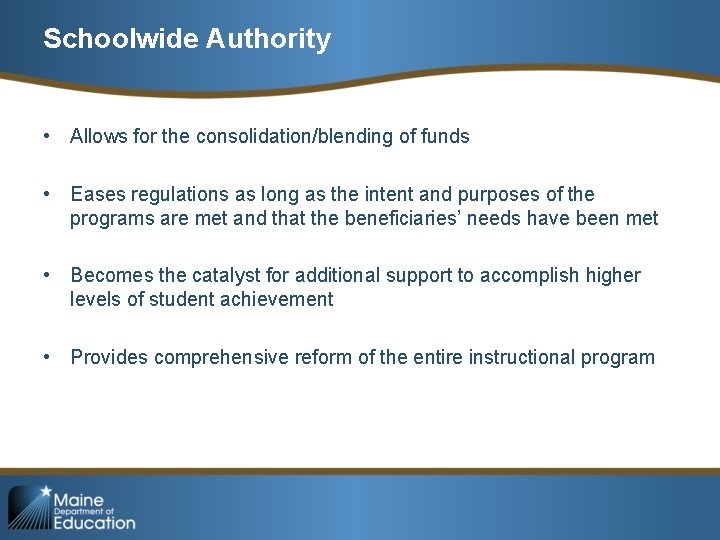
Schoolwide Authority • Allows for the consolidation/blending of funds • Eases regulations as long as the intent and purposes of the programs are met and that the beneficiaries’ needs have been met • Becomes the catalyst for additional support to accomplish higher levels of student achievement • Provides comprehensive reform of the entire instructional program
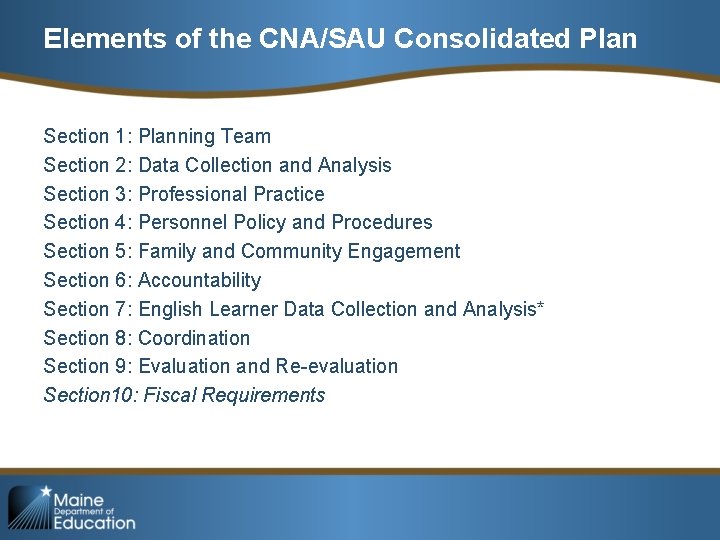
Elements of the CNA/SAU Consolidated Plan Section 1: Planning Team Section 2: Data Collection and Analysis Section 3: Professional Practice Section 4: Personnel Policy and Procedures Section 5: Family and Community Engagement Section 6: Accountability Section 7: English Learner Data Collection and Analysis* Section 8: Coordination Section 9: Evaluation and Re-evaluation Section 10: Fiscal Requirements
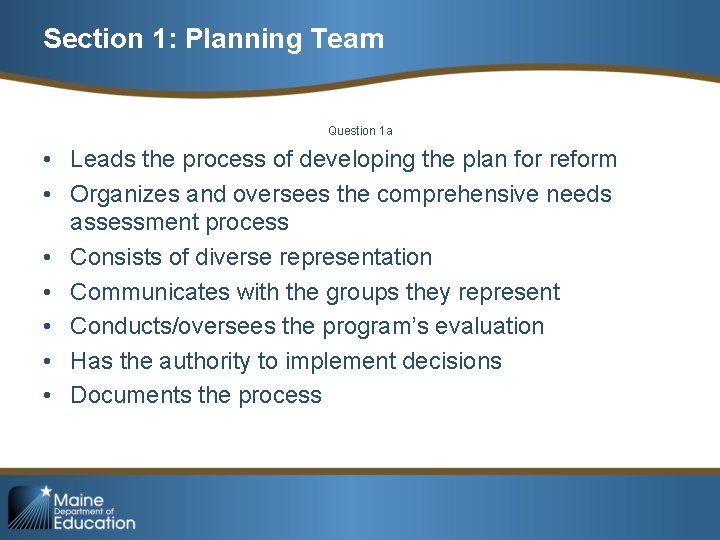
Section 1: Planning Team Question 1 a • Leads the process of developing the plan for reform • Organizes and oversees the comprehensive needs assessment process • Consists of diverse representation • Communicates with the groups they represent • Conducts/oversees the program’s evaluation • Has the authority to implement decisions • Documents the process
Why? • Why is this data important to the SAU Consolidated Plan? • Why are we collecting the data? • How is this data being used?
Section 2: Data Analysis The school’s Comprehensive Needs Assessment: • guides the development of the final SAU Consolidated Plan • suggests benchmarks for its evaluation • links to all aspects of SAU program implementation The Comprehensive Needs Assessment is based on information about all students in the school.
Section 2: Data Analysis Vision Clarify the direction the consolidated plan will take. • What are our central program goals? • After implementing our comprehensive program, how will the school be different and improved for students?
Turn and talk With the person seated either to your left or right, discuss where you will access school and SAU level data.
Types of student counts Responsible SAU • SAU responsible for educating student as a result of a superintendent agreement. Resident count • Where the student lives as of October 1. Attending count • Where the student attends school as of October 1.
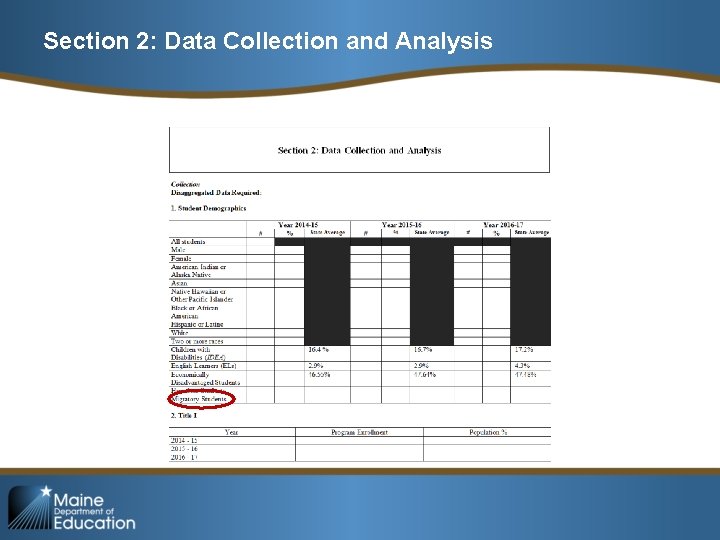
Section 2: Data Collection and Analysis
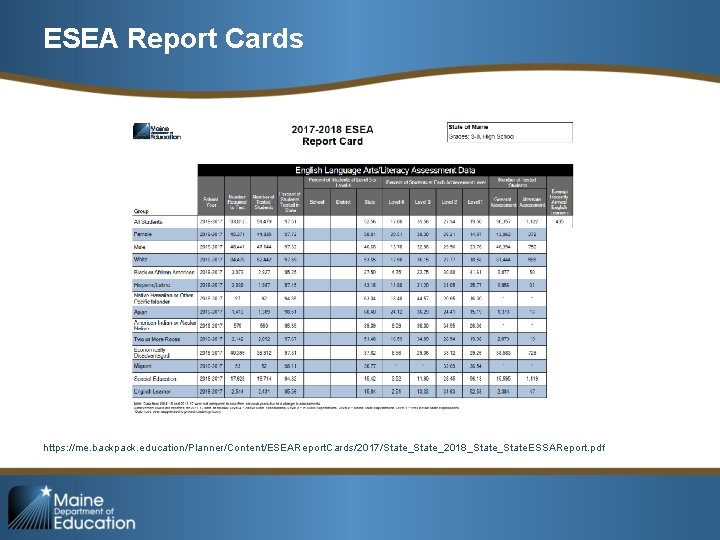
ESEA Report Cards https: //me. backpack. education/Planner/Content/ESEAReport. Cards/2017/State_2018_State. ESSAReport. pdf
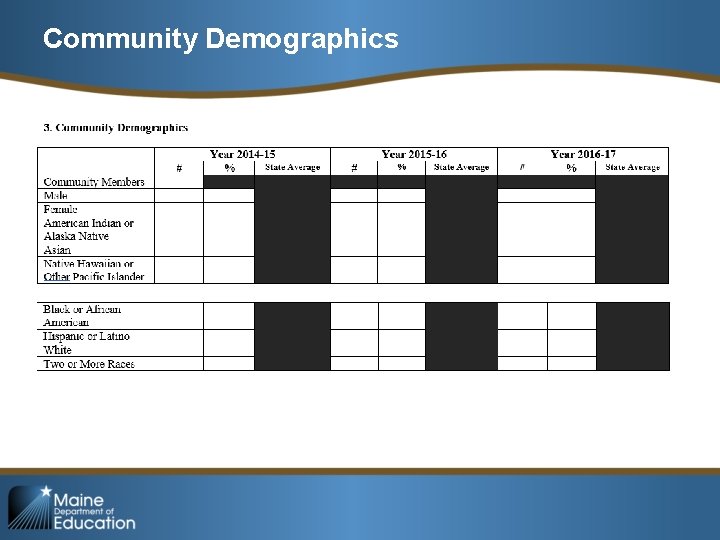
Community Demographics
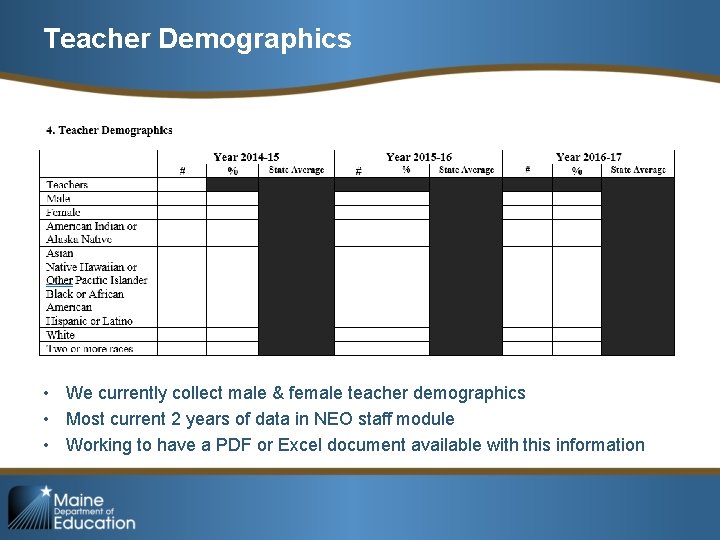
Teacher Demographics • We currently collect male & female teacher demographics • Most current 2 years of data in NEO staff module • Working to have a PDF or Excel document available with this information
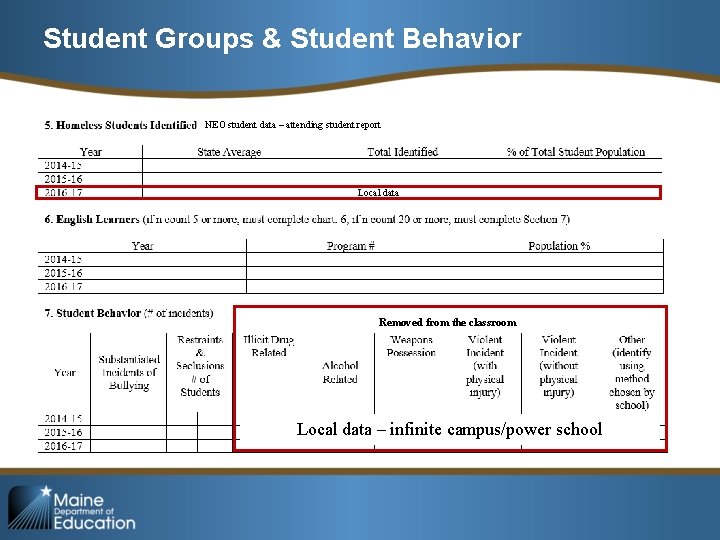
Student Groups & Student Behavior NEO student data – attending student report Local data Removed from the classroom Local data – infinite campus/power school
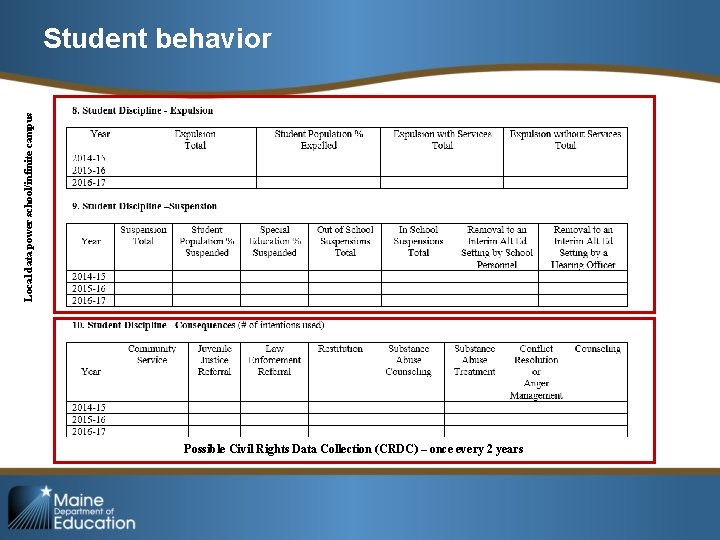
Local data power school/infinite campus Student behavior Possible Civil Rights Data Collection (CRDC) – once every 2 years
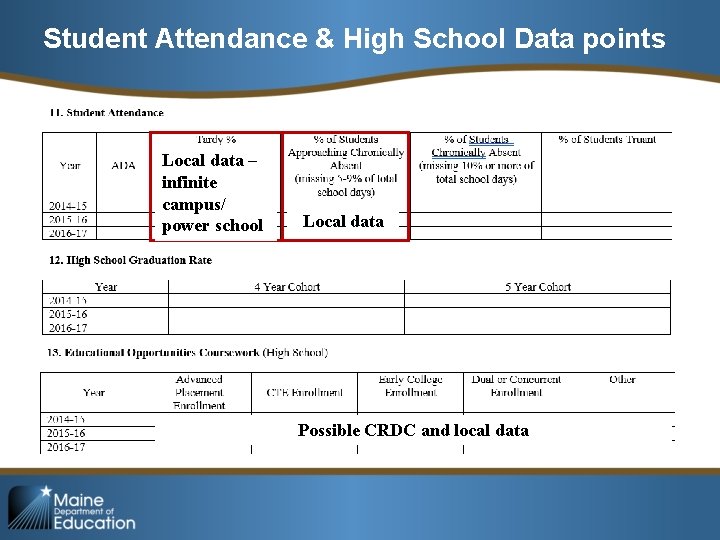
Student Attendance & High School Data points Local data – infinite campus/ power school Local data Possible CRDC and local data
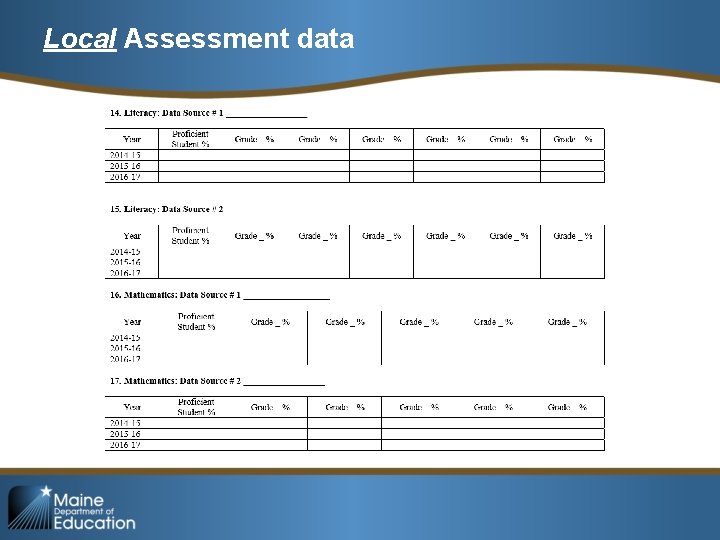
Turn and Talk With the person seated either to your left or right, discuss what local assessment data your school and SAU may be collecting.
Local Assessment data
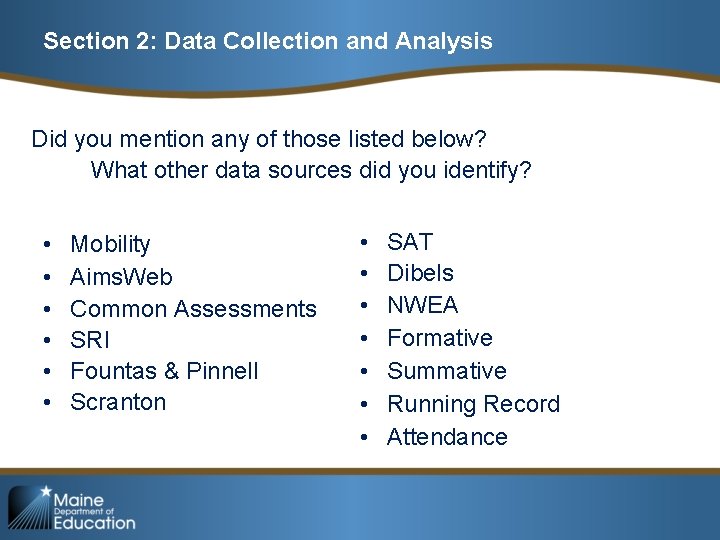
Section 2: Data Collection and Analysis Did you mention any of those listed below? What other data sources did you identify? • • • Mobility Aims. Web Common Assessments SRI Fountas & Pinnell Scranton • • SAT Dibels NWEA Formative Summative Running Record Attendance
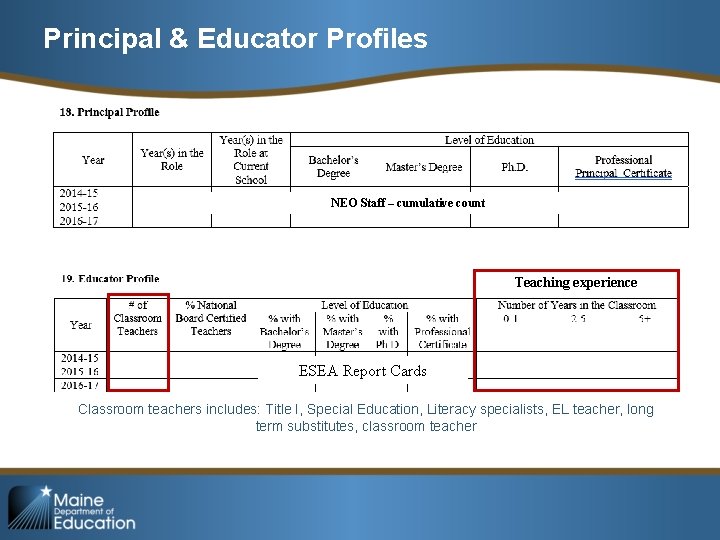
Principal & Educator Profiles NEO Staff – cumulative count Teaching experience ESEA Report Cards Classroom teachers includes: Title I, Special Education, Literacy specialists, EL teacher, long term substitutes, classroom teacher
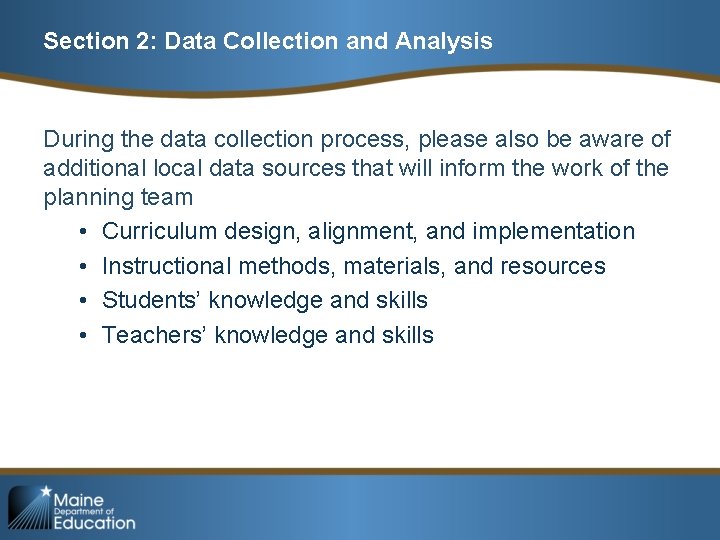
Section 2: Data Collection and Analysis During the data collection process, please also be aware of additional local data sources that will inform the work of the planning team • Curriculum design, alignment, and implementation • Instructional methods, materials, and resources • Students’ knowledge and skills • Teachers’ knowledge and skills
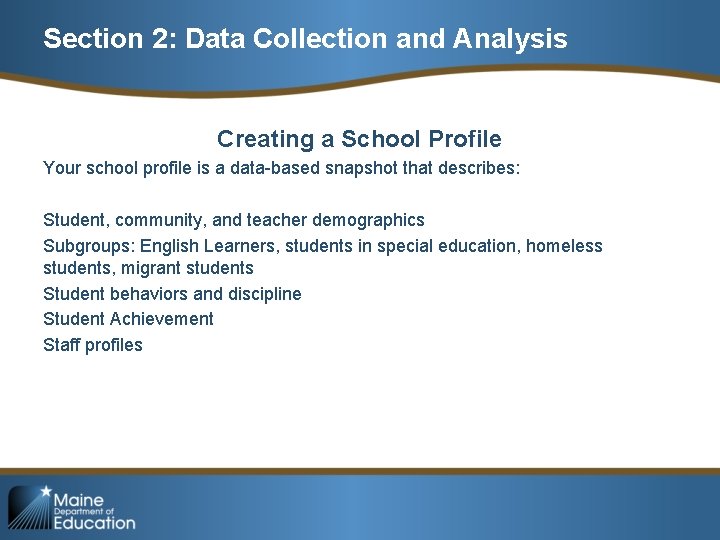
Section 2: Data Collection and Analysis Creating a School Profile Your school profile is a data-based snapshot that describes: Student, community, and teacher demographics Subgroups: English Learners, students in special education, homeless students, migrant students Student behaviors and discipline Student Achievement Staff profiles
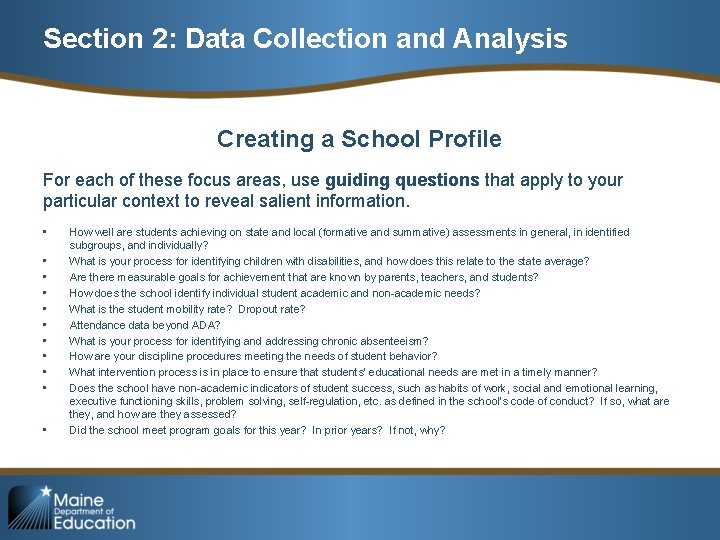
Section 2: Data Collection and Analysis Creating a School Profile For each of these focus areas, use guiding questions that apply to your particular context to reveal salient information. • • • How well are students achieving on state and local (formative and summative) assessments in general, in identified subgroups, and individually? What is your process for identifying children with disabilities, and how does this relate to the state average? Are there measurable goals for achievement that are known by parents, teachers, and students? How does the school identify individual student academic and non-academic needs? What is the student mobility rate? Dropout rate? Attendance data beyond ADA? What is your process for identifying and addressing chronic absenteeism? How are your discipline procedures meeting the needs of student behavior? What intervention process is in place to ensure that students’ educational needs are met in a timely manner? Does the school have non-academic indicators of student success, such as habits of work, social and emotional learning, executive functioning skills, problem solving, self-regulation, etc. as defined in the school’s code of conduct? If so, what are they, and how are they assessed? Did the school meet program goals for this year? In prior years? If not, why?
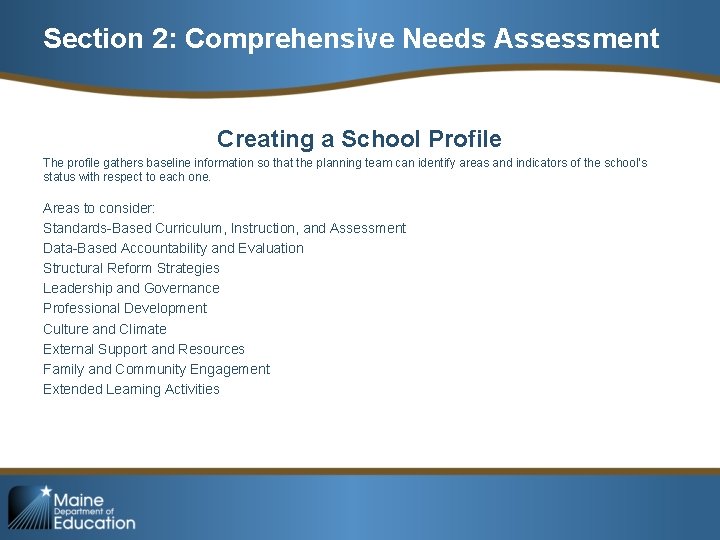
Section 2: Comprehensive Needs Assessment Creating a School Profile The profile gathers baseline information so that the planning team can identify areas and indicators of the school’s status with respect to each one. Areas to consider: Standards-Based Curriculum, Instruction, and Assessment Data-Based Accountability and Evaluation Structural Reform Strategies Leadership and Governance Professional Development Culture and Climate External Support and Resources Family and Community Engagement Extended Learning Activities
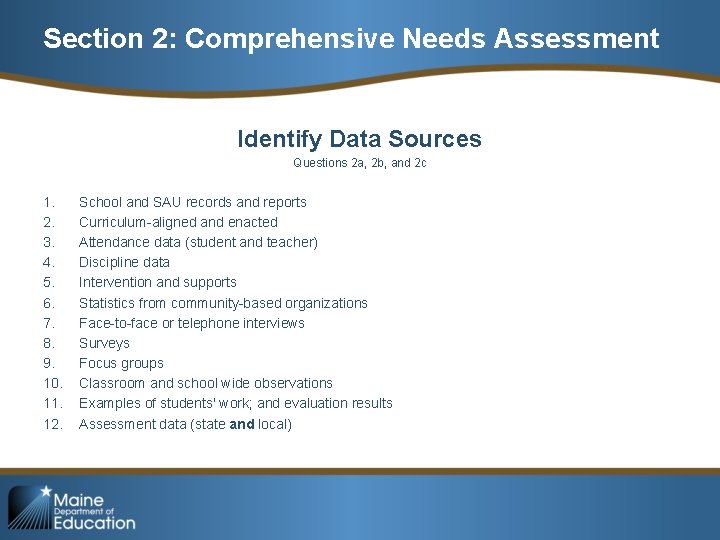
Section 2: Comprehensive Needs Assessment Identify Data Sources Questions 2 a, 2 b, and 2 c 1. 2. 3. 4. 5. 6. 7. 8. 9. 10. 11. 12. School and SAU records and reports Curriculum-aligned and enacted Attendance data (student and teacher) Discipline data Intervention and supports Statistics from community-based organizations Face-to-face or telephone interviews Surveys Focus groups Classroom and school wide observations Examples of students' work; and evaluation results Assessment data (state and local)
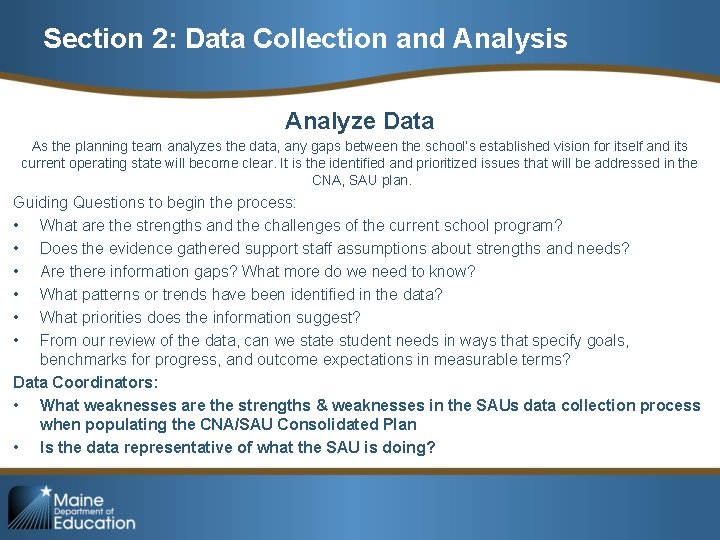
Section 2: Data Collection and Analysis Analyze Data As the planning team analyzes the data, any gaps between the school’s established vision for itself and its current operating state will become clear. It is the identified and prioritized issues that will be addressed in the CNA, SAU plan. Guiding Questions to begin the process: • What are the strengths and the challenges of the current school program? • Does the evidence gathered support staff assumptions about strengths and needs? • Are there information gaps? What more do we need to know? • What patterns or trends have been identified in the data? • What priorities does the information suggest? • From our review of the data, can we state student needs in ways that specify goals, benchmarks for progress, and outcome expectations in measurable terms? Data Coordinators: • What weaknesses are the strengths & weaknesses in the SAUs data collection process when populating the CNA/SAU Consolidated Plan • Is the data representative of what the SAU is doing?
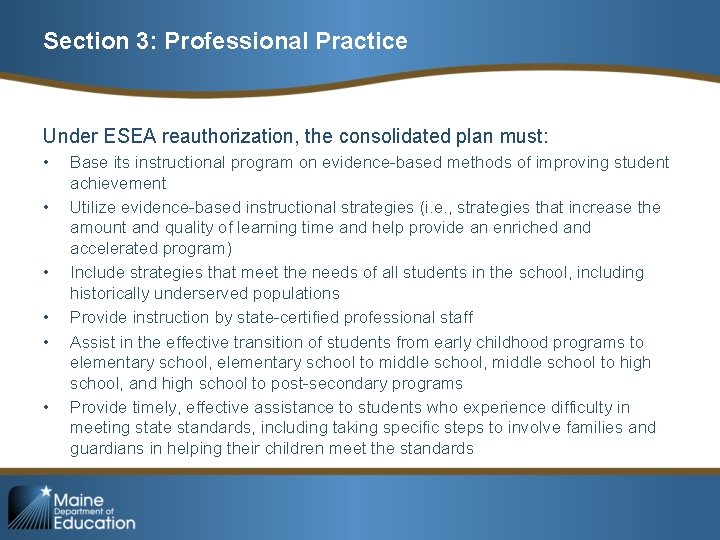
Section 3: Professional Practice Under ESEA reauthorization, the consolidated plan must: • • • Base its instructional program on evidence-based methods of improving student achievement Utilize evidence-based instructional strategies (i. e. , strategies that increase the amount and quality of learning time and help provide an enriched and accelerated program) Include strategies that meet the needs of all students in the school, including historically underserved populations Provide instruction by state-certified professional staff Assist in the effective transition of students from early childhood programs to elementary school, elementary school to middle school, middle school to high school, and high school to post-secondary programs Provide timely, effective assistance to students who experience difficulty in meeting state standards, including taking specific steps to involve families and guardians in helping their children meet the standards
Section 3: Professional Practice Achievement Goals and Instructional Changes Question 3 e Use the data from the CNA to determine goals that are specific, measurable, assignable, realistic, and most importantly, focused on increasing achievement for all students in the school. Each effective goal also implicitly contains an evaluation question, indicating how the school will know if the goal has been achieved. Because goal statements are broad indicators of intention, they must be connected to specific objectives, strategies, and action steps to become effective targets that truly guide schoolwide activities. Describe the specific supplemental intervention/strategies you will use to address the weaknesses and build on the strengths. What will be provided to ensure that all students are making gains?
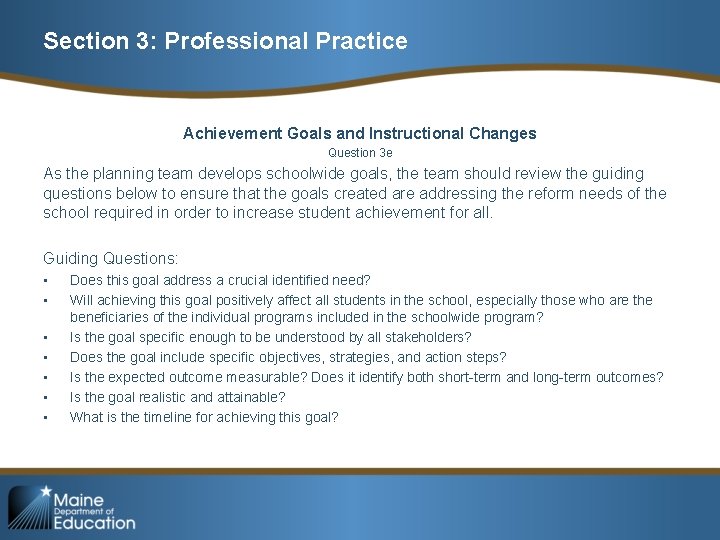
Section 3: Professional Practice Achievement Goals and Instructional Changes Question 3 e As the planning team develops schoolwide goals, the team should review the guiding questions below to ensure that the goals created are addressing the reform needs of the school required in order to increase student achievement for all. Guiding Questions: • • Does this goal address a crucial identified need? Will achieving this goal positively affect all students in the school, especially those who are the beneficiaries of the individual programs included in the schoolwide program? Is the goal specific enough to be understood by all stakeholders? Does the goal include specific objectives, strategies, and action steps? Is the expected outcome measurable? Does it identify both short-term and long-term outcomes? Is the goal realistic and attainable? What is the timeline for achieving this goal?
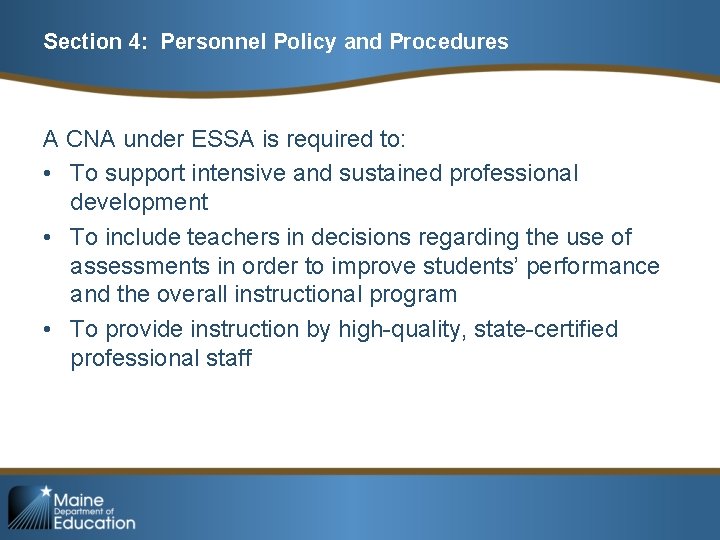
Section 4: Personnel Policy and Procedures A CNA under ESSA is required to: • To support intensive and sustained professional development • To include teachers in decisions regarding the use of assessments in order to improve students’ performance and the overall instructional program • To provide instruction by high-quality, state-certified professional staff
Section 4: Personnel Policy and Procedures Guiding Questions: • Describe the process used to determine the professional development needs of teachers. • What kinds of professional development are offered to teachers? To paraprofessionals? To other staff? • Is professional development voluntary or mandatory? To what degree does staff participate? • Is professional development related to classroom instruction? • How frequently is professional development offered? What follow-up activities take place? Is the professional development ongoing and incorporated into the day-to-day routine of the staff? • Do teachers have the opportunity to collaborate as team members and/or mentors during these sessions? • Who provides professional development? Are external resources used to provide staff development for the school? How often does this occur? • Does the daily teacher schedule allow for common planning time across grade levels and content areas? • How is professional development evaluated, and how are mid-course corrections made if needed?
Discussion What Guiding Question is MOST critical to YOUR work as a team that would help you develop a CNA that is inclusive of all stakeholders?
Section 5: Family and Community Engagement The CNA/SAU Consolidated Plan will describe how: • Families are involved in the development of the school’s instructional programming; • Community support is necessary to help schools in implementing effective family engagement activities; and • An annual evaluation is conducted in order to improve academic quality and to design strategies to support successful school and family interactions and engagement.
Section 5: Family and Community Engagement • Look at Student Demographics data to represent diverse family perspectives. – Which families are or are not involved in other school related activities? • Inclusion of multilingual and multicultural students – The Civil Rights Team Project • Assessing School Climate – https: //safesupportivelearning. ed. gov/edscls • Community based services and programs – What resources are available in the greater community that can support schoolwide goals?
Family Engagement Data • What family engagement data sets are currently available to the SAU? • How do the SAU staff and data coordinators effectively and purposefully communicate with each other respect to family engagement data? • How is family engagement data used to inform program planning?
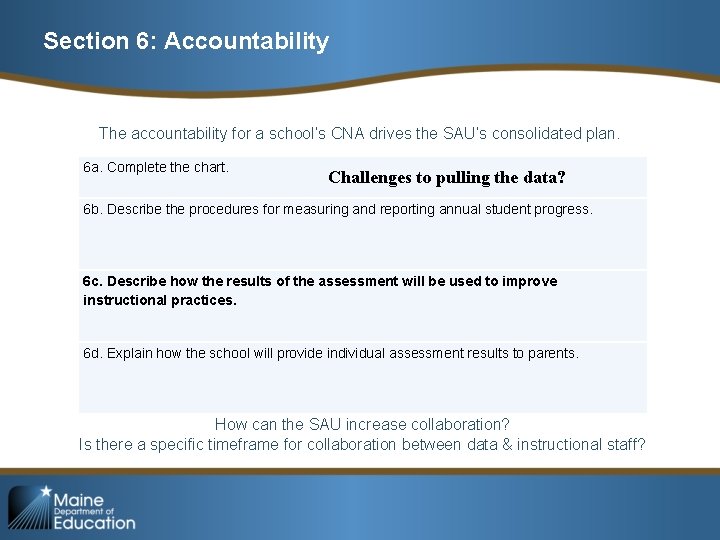
Section 6: Accountability The accountability for a school’s CNA drives the SAU’s consolidated plan. 6 a. Complete the chart. Challenges to pulling the data? 6 b. Describe the procedures for measuring and reporting annual student progress. 6 c. Describe how the results of the assessment will be used to improve instructional practices. 6 d. Explain how the school will provide individual assessment results to parents. How can the SAU increase collaboration? Is there a specific timeframe for collaboration between data & instructional staff?
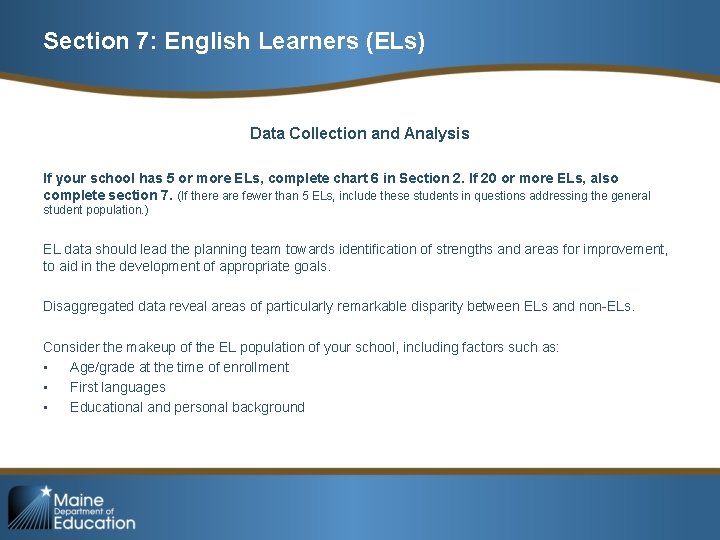
Section 7: English Learners (ELs) Data Collection and Analysis If your school has 5 or more ELs, complete chart 6 in Section 2. If 20 or more ELs, also complete section 7. (If there are fewer than 5 ELs, include these students in questions addressing the general student population. ) EL data should lead the planning team towards identification of strengths and areas for improvement, to aid in the development of appropriate goals. Disaggregated data reveal areas of particularly remarkable disparity between ELs and non-ELs. Consider the makeup of the EL population of your school, including factors such as: • Age/grade at the time of enrollment • First languages • Educational and personal background
Section 7: English Learner (EL) Data Collection and Analysis If your school has 5 or more ELs, complete chart 6 in section 2. If your school has 20 or more ELs, also complete section 7. (If there are fewer than 5 ELs, include data on these students in all questions in section 2. ) EL data should lead the entire planning team towards identification of strengths and areas for improvement, to aid in the development of appropriate goals. Disaggregated data reveal areas of particularly remarkable disparity between ELs and non-ELs.
Section 7: English Learner (EL) Data Collection and Analysis Discuss with a partner. • What’s an example of an anticipated disparity? • What would be an unanticipated disparity? • What are possible causes for these disparities?
Section 7: English Learner (EL) Data Collection and Analysis Consider the makeup of the EL population of your school, including factors such as: • • • Age/grade at the time of enrollment First languages Educational and personal background Learning disabilities Socioeconomic status Family engagement
Section 8: Coordination Explain coordination efforts with other programs and agencies including: • Assisting preschool children in the transition from early childhood programs, such as Even Start, or a Head Start/ECEAP Prekindergarten or Title I preschool program, Momentum Literacy Pilot, to local elementary school programs. • In secondary school plans, where appropriate, developing the schoolwide program plan in coordination with programs under the School-To-Work Opportunities Act, the Carl D. Perkins Vocational, and other appropriate programs. • Coordinating and integrating family involvement activities with other programs. Data Coordinators: How did you collaborate with community agencies & partners to glean the desired data and then utilize it to drive decision making?
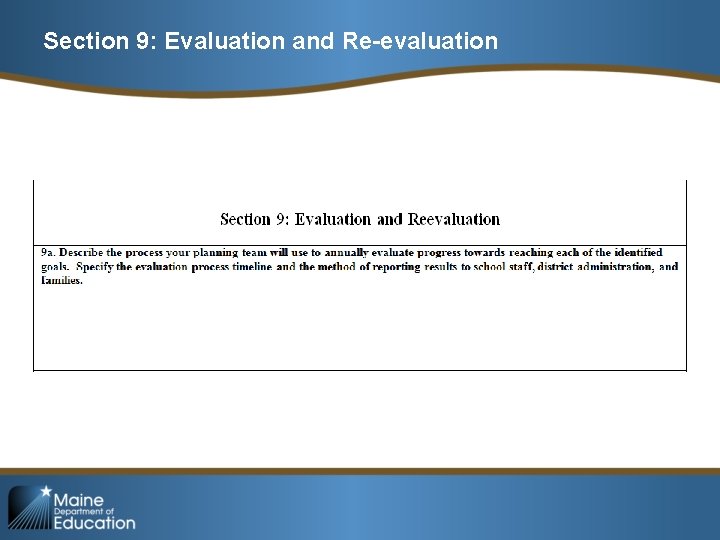
Section 9: Evaluation and Re-evaluation
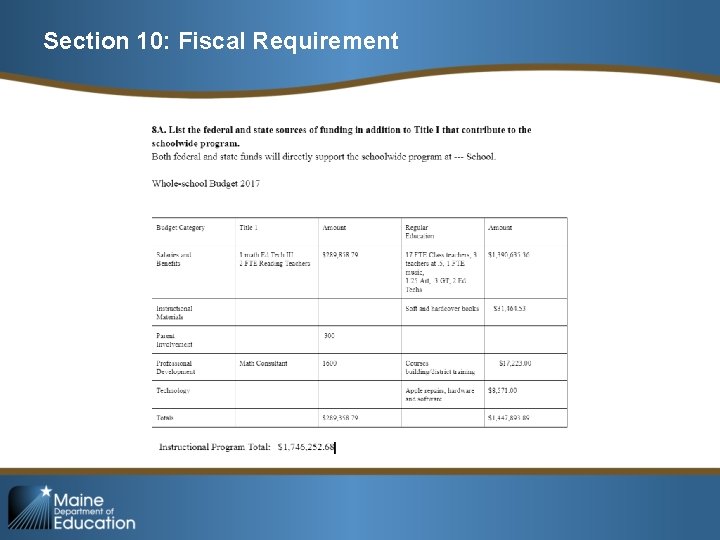
Section 10: Fiscal Requirement
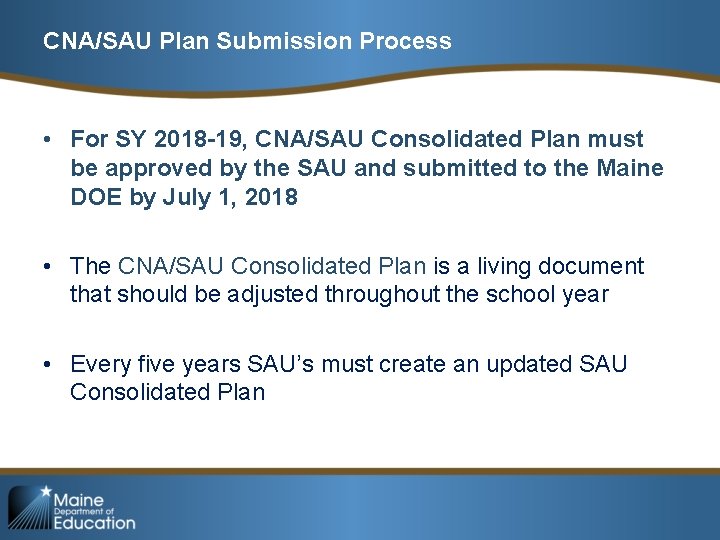
CNA/SAU Plan Submission Process • For SY 2018 -19, CNA/SAU Consolidated Plan must be approved by the SAU and submitted to the Maine DOE by July 1, 2018 • The CNA/SAU Consolidated Plan is a living document that should be adjusted throughout the school year • Every five years SAU’s must create an updated SAU Consolidated Plan
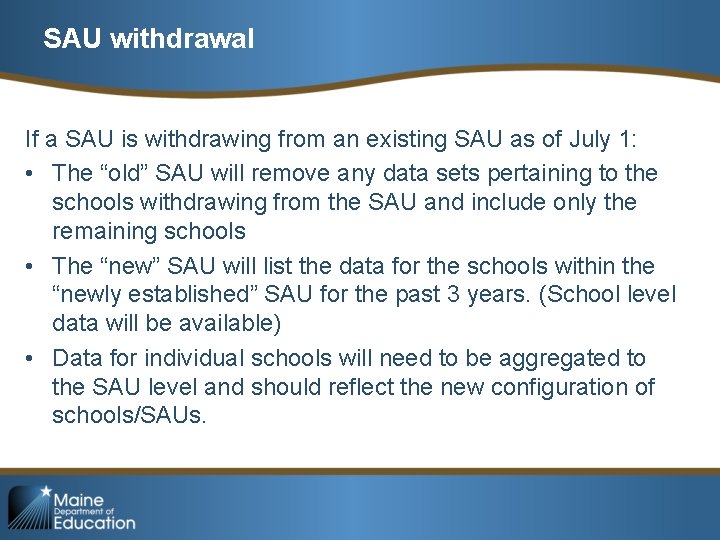
SAU withdrawal If a SAU is withdrawing from an existing SAU as of July 1: • The “old” SAU will remove any data sets pertaining to the schools withdrawing from the SAU and include only the remaining schools • The “new” SAU will list the data for the schools within the “newly established” SAU for the past 3 years. (School level data will be available) • Data for individual schools will need to be aggregated to the SAU level and should reflect the new configuration of schools/SAUs.
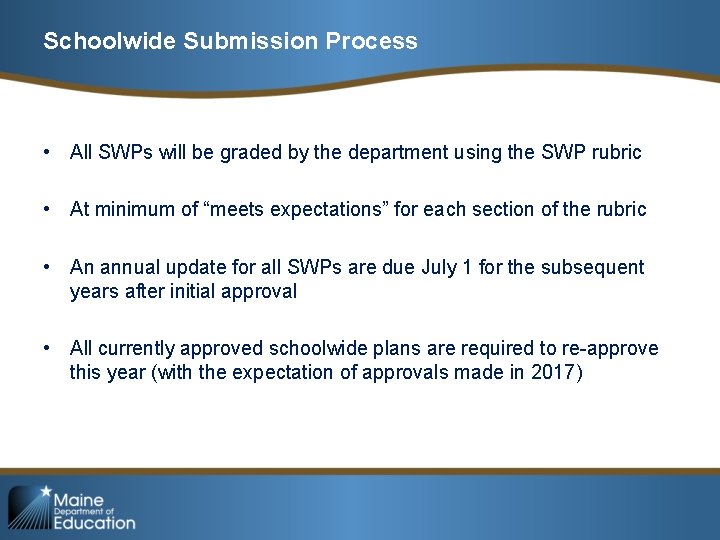
Schoolwide Submission Process • All SWPs will be graded by the department using the SWP rubric • At minimum of “meets expectations” for each section of the rubric • An annual update for all SWPs are due July 1 for the subsequent years after initial approval • All currently approved schoolwide plans are required to re-approve this year (with the expectation of approvals made in 2017)
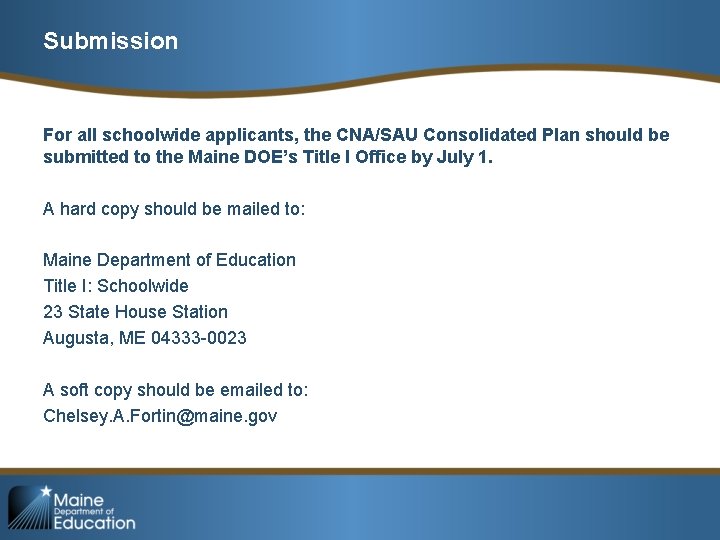
Submission For all schoolwide applicants, the CNA/SAU Consolidated Plan should be submitted to the Maine DOE’s Title I Office by July 1. A hard copy should be mailed to: Maine Department of Education Title I: Schoolwide 23 State House Station Augusta, ME 04333 -0023 A soft copy should be emailed to: Chelsey. A. Fortin@maine. gov