
Every picture tells a story 1 What do
- Slides: 9
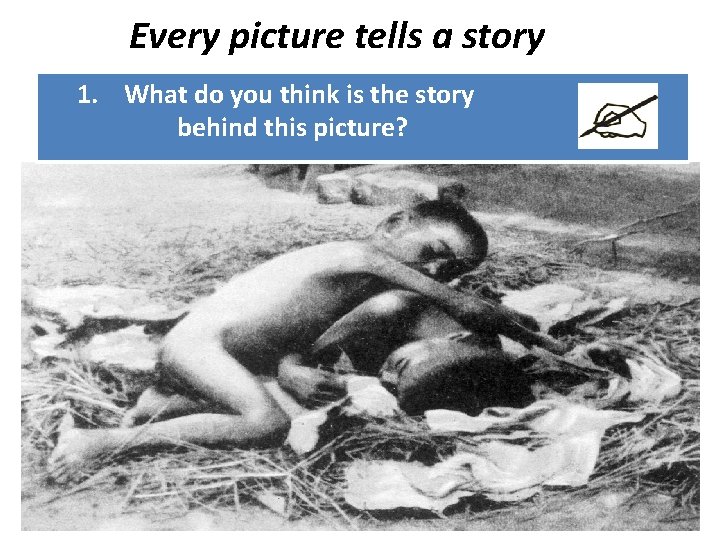
Every picture tells a story 1. What do you think is the story behind this picture?
The picture is of two girls known as “the wolf children” In 1920 in India the Reverend Singh found two quite young girls roaming around alone. He ran an orphanage with his wife so he took them back to the orphanage (a care home for children with no parents). They had an animal like smell and though they were washed, the smell would not disappear. Every night around 10 p. m at the orphanage near Midnapore, India, it is said that two small girls crawled from their beds to howl at the moon. When they tried to give them food, they wouldn’t eat it. So Mr. Singh made a siphon like a straw out of a torn up handkerchief and dipped it into a teacup of tea. The children then both sucked the tea up like babies. (continued on the next page)
The Wolf Children continued p. 2 At first the girls would only drink, mainly milk from babies’ bottles. Then one day when some dogs were being fed in the courtyard, the elder girl went up to them and joined in. At first the dogs sniffed at her and tried to push her away but she refused to move. Eventually they let her share the meat and bones that they were eating. The girl lowered her face to the dog bowl and seized the food and bolted it down with convulsive shakes. Then she grabbed a large bone and ran off with it to a corner where she lay down with it and gnawed at it occasionally pushing it along the ground to remove the meat on it. The children wouldn’t stay inside the orphanage. They even slept outside in a shed. They were given blankets but didn’t use them and slept on the floor. They were also given clothes but wouldn’t wear them. They didn’t seem to feel the cold. (continued on the next page)
The Wolf Children continued p. 3 They seemed to be afraid of the Reverend Singh and his wife. They didn’t like to be touched and if someone tried to touch them, they drew back their lips from their teeth and growled. However one day they let a one year old boy, Benjamin, touch them. But then ten days later they turned on him and bit and scratched him. They seemed to show no emotion. Their faces were mask like. They never smiled or laughed or cried. The only time they seemed to enjoy themselves was when they went out for a walk and were allowed to run around. The children only lived for about 9 years at the orphanage and died in their teens.
Questions to answer 2. Why do you think these children were like this? What do you think had happened to them? 3. Google “timeline. com reverend singh” to find out what had happened. Write a short summary of what it suggests made the children like this.
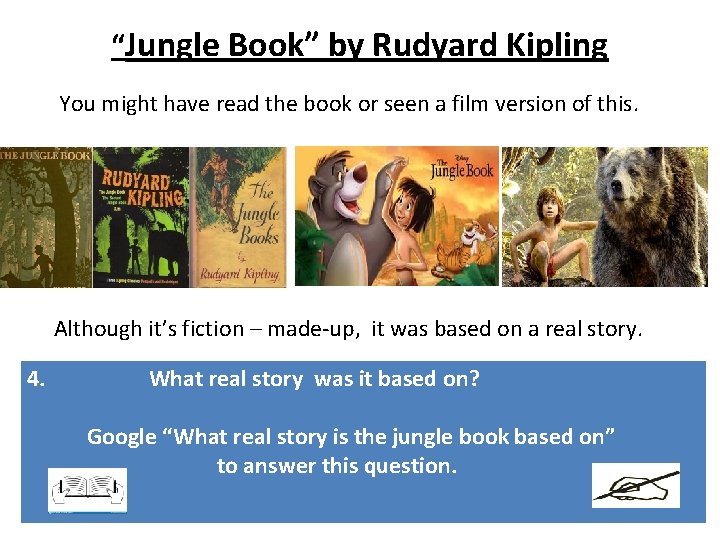
“Jungle Book” by Rudyard Kipling You might have read the book or seen a film version of this. Although it’s fiction – made-up, it was based on a real story. 4. What real story was it based on? Google “What real story is the jungle book based on” to answer this question.
Growing up in the wild Children growing up in the wild is of course unusual but there are more examples of this than you might expect. Often these children are described as “feral”. 5. Read about or listen to the stories of such children: Google “feral children” or the following 2 sites: a) Read “ 7 Modern Cases Of Feral Children Raised In The Wild” or b) Watch “ 10 Children raised by wild animals” on youtube and make notes on the story which most interested you
Child from the Wild Start with a good headline – catch people’s attention - use emotive language and/or other devices eg. alliteration, a simile, a list, a play on words, a superlative, rhyme. Use more than one of these if you can.
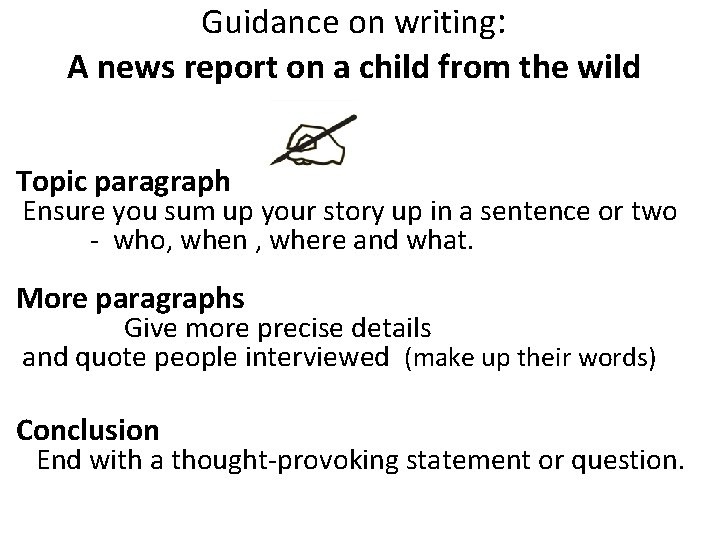
Guidance on writing: A news report on a child from the wild Topic paragraph Ensure you sum up your story up in a sentence or two - who, when , where and what. More paragraphs Give more precise details and quote people interviewed (make up their words) Conclusion End with a thought-provoking statement or question.