
every day a better way 1 Operational Excellence
every day, a better way 1 Operational Excellence Suncor Distribution Contractor Process Safety Awareness Copyright © 2011 Du. Pont. All rights reserved. The Du. Pont Oval Logo, Du. Pont™, and The miracles of science™ are registered trademarks or trademarks of Du. Pont or its affiliates.
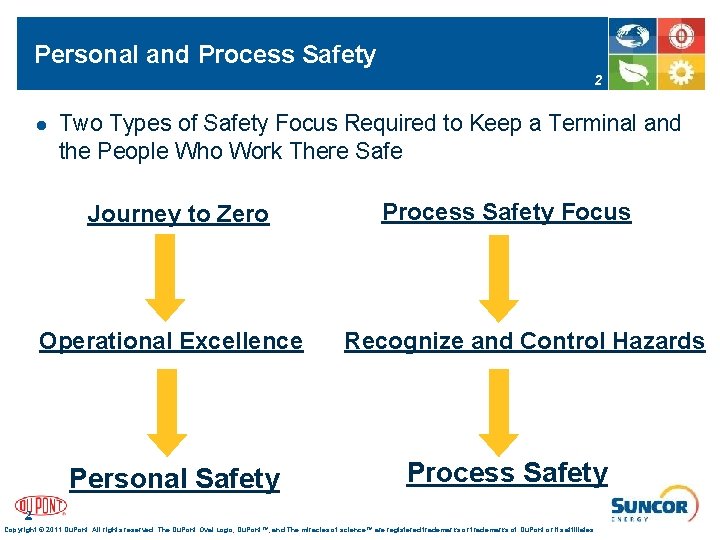
Personal and Process Safety 2 l Two Types of Safety Focus Required to Keep a Terminal and the People Who Work There Safe Journey to Zero Operational Excellence Personal Safety Process Safety Focus Recognize and Control Hazards Process Safety 2 Copyright © 2011 Du. Pont. All rights reserved. The Du. Pont Oval Logo, Du. Pont™, and The miracles of science™ are registered trademarks or trademarks of Du. Pont or its affiliates.
Why Process Safety is Needed 3 Process incidents typically “ALWAYS” result from errors or conditions that can ultimately be traced to breakdowns in management systems. Copyright © 2011 Du. Pont. All rights reserved. The Du. Pont Oval Logo, Du. Pont™, and The miracles of science™ are registered trademarks or trademarks of Du. Pont or its affiliates.

Serious Process Incidents typically involve multiple element failures Barriers or Controls Risk Assessment Hazard/ Risk 4 Permit to Work Audit Emergency Response System, etc. LOSS Copyright © 2011 Du. Pont. All rights reserved. The Du. Pont Oval Logo, Du. Pont™, and The miracles of science™ are registered trademarks or trademarks of Du. Pont or its affiliates.

What is Process Safety Management? 5 l PSM definition: – Process Safety Management is the application of management systems and controls (standards, procedures, programs, audits, evaluations) to a manufacturing process in a way that process hazards are identified, understood and controlled l PSM focuses on three key areas: – Technology – Facilities – Personnel Copyright © 2011 Du. Pont. All rights reserved. The Du. Pont Oval Logo, Du. Pont™, and The miracles of science™ are registered trademarks or trademarks of Du. Pont or its affiliates.
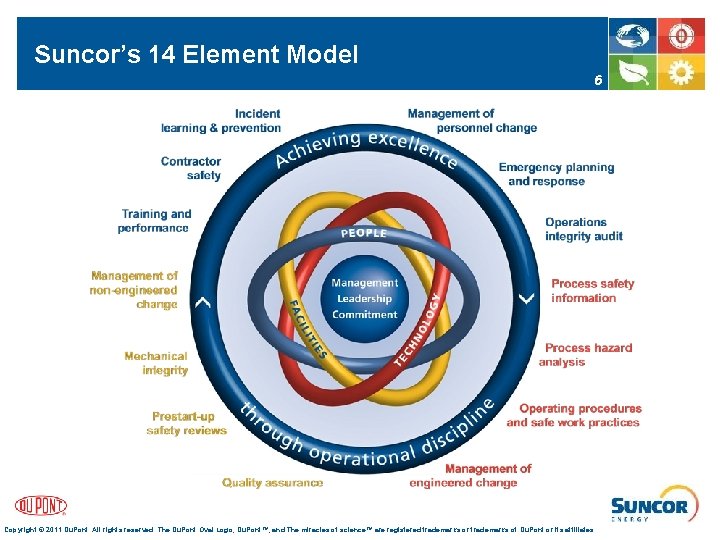
Suncor’s 14 Element Model 6 Copyright © 2011 Du. Pont. All rights reserved. The Du. Pont Oval Logo, Du. Pont™, and The miracles of science™ are registered trademarks or trademarks of Du. Pont or its affiliates.
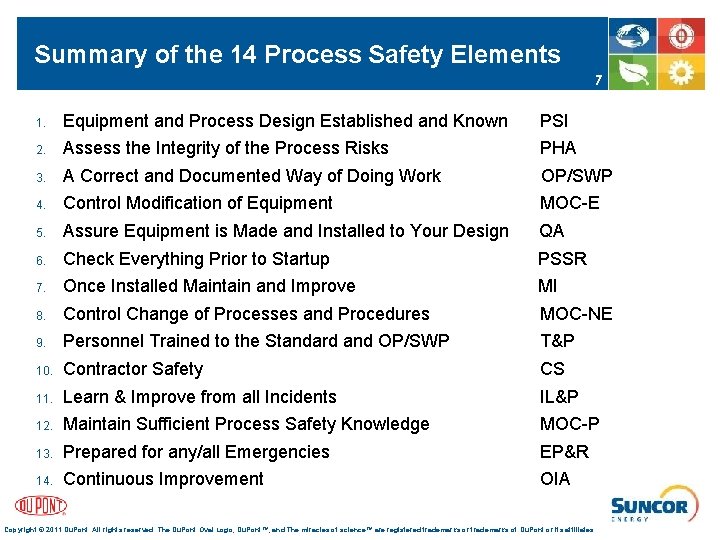
Summary of the 14 Process Safety Elements 7 1. Equipment and Process Design Established and Known PSI 2. Assess the Integrity of the Process Risks PHA 3. A Correct and Documented Way of Doing Work OP/SWP 4. Control Modification of Equipment MOC-E 5. Assure Equipment is Made and Installed to Your Design QA 6. Check Everything Prior to Startup PSSR 7. Once Installed Maintain and Improve MI 8. Control Change of Processes and Procedures MOC-NE 9. Personnel Trained to the Standard and OP/SWP T&P 10. Contractor Safety CS 11. Learn & Improve from all Incidents IL&P 12. Maintain Sufficient Process Safety Knowledge MOC-P 13. Prepared for any/all Emergencies EP&R 14. Continuous Improvement OIA Copyright © 2011 Du. Pont. All rights reserved. The Du. Pont Oval Logo, Du. Pont™, and The miracles of science™ are registered trademarks or trademarks of Du. Pont or its affiliates.

Management System Hierarchy 8 Values, Strategy, Policy Y WH Operational Excellence OEMS Management System Requirements AT WH PSM Business Processes, Standards, Guidelines Company-wide Business Unit Facility/Asset Functions 8 Copyright © 2011 Du. Pont. All rights reserved. The Du. Pont Oval Logo, Du. Pont™, and The miracles of science™ are registered trademarks or trademarks of Du. Pont or its affiliates. W HO Procedures, Instructions, Specifications & Tools
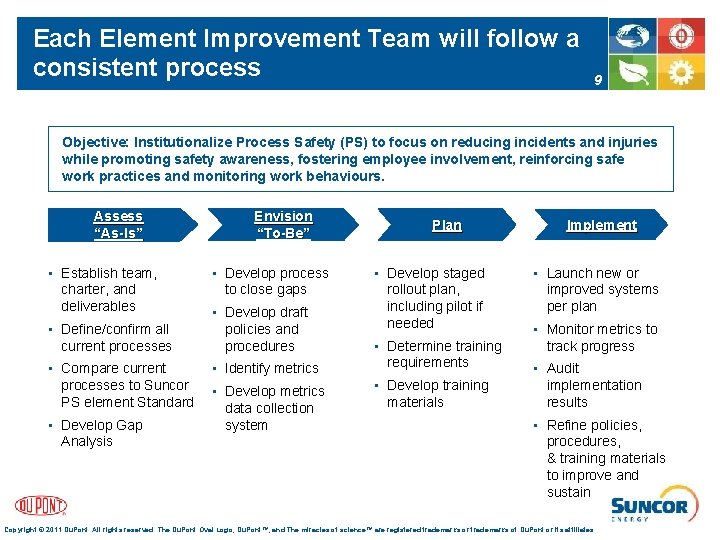
Each Element Improvement Team will follow a consistent process 9 Objective: Institutionalize Process Safety (PS) to focus on reducing incidents and injuries while promoting safety awareness, fostering employee involvement, reinforcing safe work practices and monitoring work behaviours. Assess “As-Is” • Establish team, charter, and deliverables • Define/confirm all current processes • Compare current processes to Suncor PS element Standard • Develop Gap Analysis Envision “To-Be” • Develop process to close gaps • Develop draft policies and procedures • Identify metrics • Develop metrics data collection system Plan • Develop staged rollout plan, including pilot if needed • Determine training requirements • Develop training materials Implement • Launch new or improved systems per plan • Monitor metrics to track progress • Audit implementation results • Refine policies, procedures, & training materials to improve and sustain Copyright © 2011 Du. Pont. All rights reserved. The Du. Pont Oval Logo, Du. Pont™, and The miracles of science™ are registered trademarks or trademarks of Du. Pont or its affiliates.
PSM Element Team Roles 10 q. Sponsor- Accountable to the organization for the impact of the team’s activities and to the Team Leader and Team members for providing meaningful support. q. Team Leader- Accountable to the team sponsor for the fulfillment of the team charter and to the team for providing effective leadership. q. Team Members- Accountable to the leader for the completion of individual and joint tasks to achieve the chartered goals. q. Du. Pont Consultant- Accountable to provide effective content and process input to the team as well as training and mentoring. Copyright © 2011 Du. Pont. All rights reserved. The Du. Pont Oval Logo, Du. Pont™, and The miracles of science™ are registered trademarks or trademarks of Du. Pont or its affiliates.
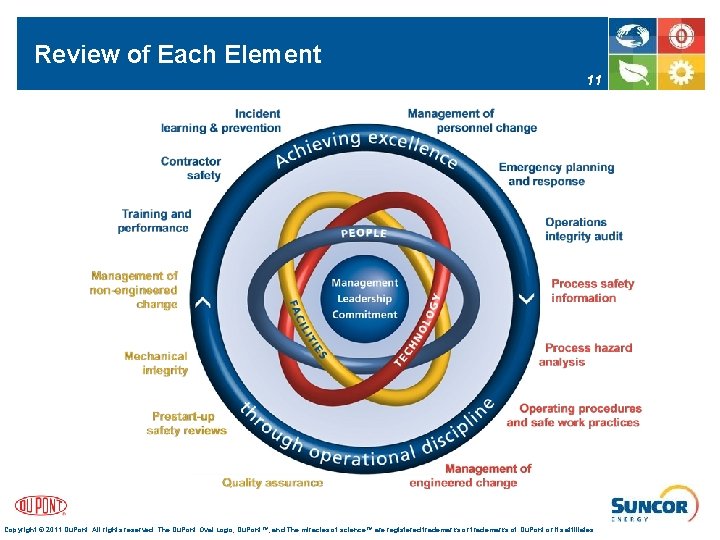
Review of Each Element 11 Copyright © 2011 Du. Pont. All rights reserved. The Du. Pont Oval Logo, Du. Pont™, and The miracles of science™ are registered trademarks or trademarks of Du. Pont or its affiliates.
Process Safety Information (PSI) 12 Copyright © 2011 Du. Pont. All rights reserved. The Du. Pont Oval Logo, Du. Pont™, and The miracles of science™ are registered trademarks or trademarks of Du. Pont or its affiliates.
Process Safety Information 13 l What: l Importance: – Process Safety Information compiles written information that enables employees to identify and understand potential hazards. – Foundational for PSM – PSI includes: – Needed for operating procedures – Documentation of the hazards of chemicals; raw materials, intermediates, waste products, finished products – The technology used in the design; process chemistry, process steps and limits – Up to date P&ID’s – Necessary to perform Process Hazard Analysis (PHA) – Input for emergency planning – Must be accessible to all employees – Documentation of the equipment; equipment design, codes and standards used in fabrication Copyright © 2011 Du. Pont. All rights reserved. The Du. Pont Oval Logo, Du. Pont™, and The miracles of science™ are registered trademarks or trademarks of Du. Pont or its affiliates.
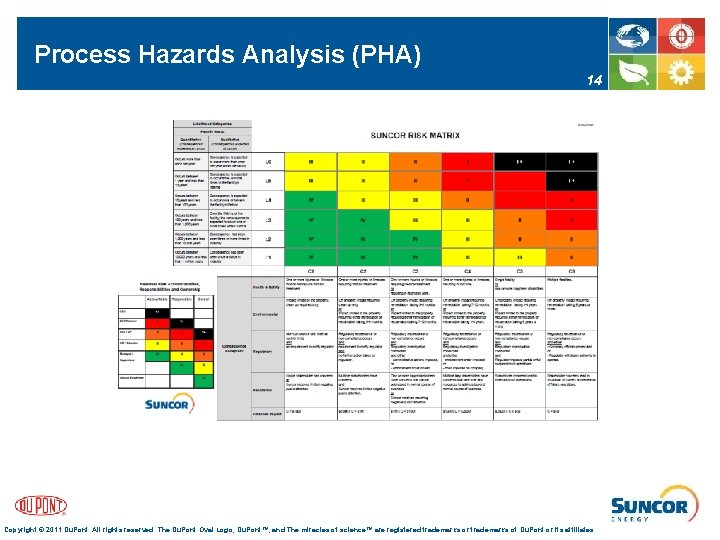
Process Hazards Analysis (PHA) 14 Copyright © 2011 Du. Pont. All rights reserved. The Du. Pont Oval Logo, Du. Pont™, and The miracles of science™ are registered trademarks or trademarks of Du. Pont or its affiliates.

Process Hazard Analysis 15 l What: – Process Hazard Analysis (PHA) is a thorough, orderly, and systematic approach to identify, evaluate, and control potential hazard scenarios. – Proactive approach l Importance: – Identifies potential hazardous events – Provides framework for understanding the hazardous events and responses to them – Identifies actions to eliminate and/or reduce risks – Identifies consequences and impact on other PSM elements Copyright © 2011 Du. Pont. All rights reserved. The Du. Pont Oval Logo, Du. Pont™, and The miracles of science™ are registered trademarks or trademarks of Du. Pont or its affiliates.

Process Hazards Analysis 16 l Process hazards analysis (PHA) includes the following: – Identifying hazards – Analyzing consequences – Evaluating hazards a. Hazards evaluation b. Facility siting c. Human factors d. Inherently safer process – Developing and managing recommendations – Establishing documentation Copyright © 2011 Du. Pont. All rights reserved. The Du. Pont Oval Logo, Du. Pont™, and The miracles of science™ are registered trademarks or trademarks of Du. Pont or its affiliates.
When is PHA Needed? 17 l New process and facilities (several reviews during different stages of development) – Screening in early development stage – Design review at design completion – Final project safety report—before startup – Baseline PHA—after any startup changes l Existing facilities – Cyclic analyses—frequency depends on hazards – Revalidation of previous review at least every five years – Technology and facilities changes l Incident Investigation and MOC review key inputs l Mothballing and/or dismantling of process facilities Copyright © 2011 Du. Pont. All rights reserved. The Du. Pont Oval Logo, Du. Pont™, and The miracles of science™ are registered trademarks or trademarks of Du. Pont or its affiliates.
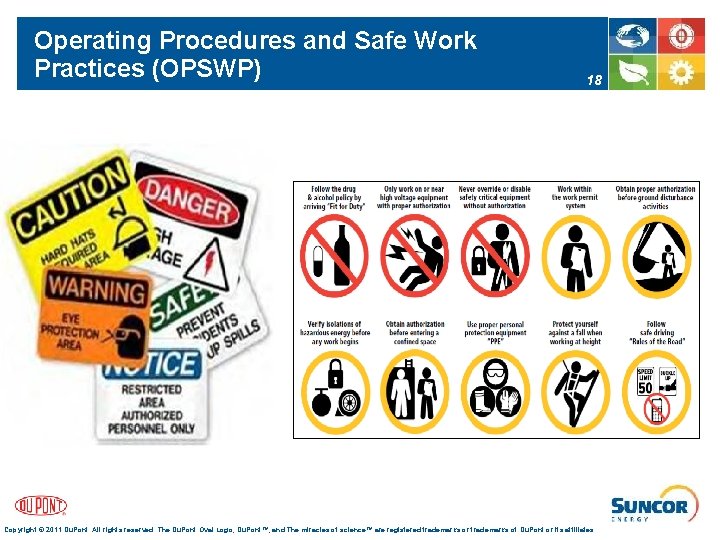
Operating Procedures and Safe Work Practices (OPSWP) 18 Copyright © 2011 Du. Pont. All rights reserved. The Du. Pont Oval Logo, Du. Pont™, and The miracles of science™ are registered trademarks or trademarks of Du. Pont or its affiliates.
Operating Procedures and Safe Work Practices l 19 Operating procedures provide a clear understanding of parameters for safe operation for those who are operating the process. Operating procedures must be written, accessible to the people that use them, and updated whenever there are changes. They must be reviewed at a 3 year frequency. – In addition to normal operation, written procedures should include emergency operation, emergency shut down and temporary operations and include assignment of emergency activities to qualified personnel. l Safe Work practices provide a carefully planned system of procedures and/or permits involving checks and authorizations prior to doing non-routine work in process areas. – Apply to both site and contract personnel Copyright © 2011 Du. Pont. All rights reserved. The Du. Pont Oval Logo, Du. Pont™, and The miracles of science™ are registered trademarks or trademarks of Du. Pont or its affiliates.
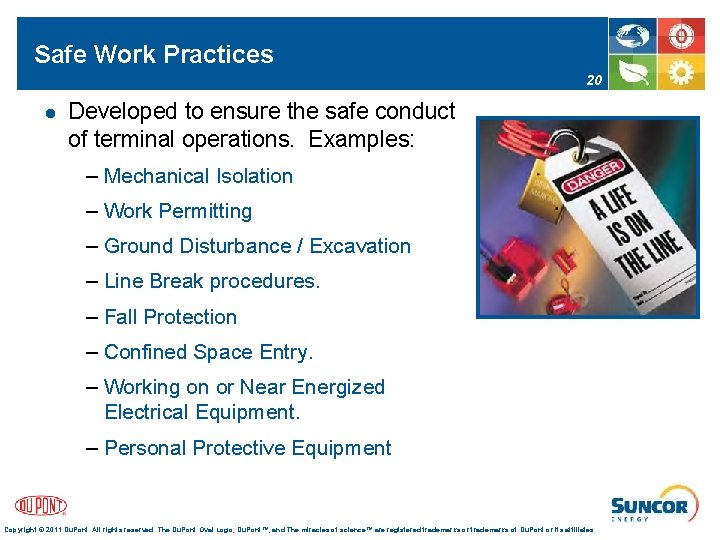
Safe Work Practices 20 l Developed to ensure the safe conduct of terminal operations. Examples: – Mechanical Isolation – Work Permitting – Ground Disturbance / Excavation – Line Break procedures. – Fall Protection – Confined Space Entry. – Working on or Near Energized Electrical Equipment. – Personal Protective Equipment Copyright © 2011 Du. Pont. All rights reserved. The Du. Pont Oval Logo, Du. Pont™, and The miracles of science™ are registered trademarks or trademarks of Du. Pont or its affiliates.
Management of Change ( MOC) 21 l The objective of MOC is to ensure that all changes to the equipment, procedures and personnel are properly reviewed, approved and that any hazards introduced by the implementation of the change are identified and controlled prior to resuming operation. l Three types of management of change – Management of Engineered Change – Management of Non-Engineered Change – Management of Personnel Change Copyright © 2011 Du. Pont. All rights reserved. The Du. Pont Oval Logo, Du. Pont™, and The miracles of science™ are registered trademarks or trademarks of Du. Pont or its affiliates.
Management of Engineered Change ( MOC E ) 22 l The objective of MOC E is to ensure that all changes to the equipment and procedures are properly reviewed and that any hazards introduced by the implementation of the change are identified and controlled prior to resuming operation. l A management of engineered change is any change that is a specified addition, alteration, or removal of equipment, facilities, infrastructure, or software. Alternatively, any change to standards or specifications that may result in new components, materials, processes or procedures being introduced. This includes any alterations to the process safety information for a hazardous process. Copyright © 2011 Du. Pont. All rights reserved. The Du. Pont Oval Logo, Du. Pont™, and The miracles of science™ are registered trademarks or trademarks of Du. Pont or its affiliates.
Management of Engineered Change Requirements l 23 Document Authorized Changes – Purpose – Description of change – Technical basis – Safety, health, and environmental impact – Determination if PHA is required – Amended PSI is required l Changes in operating procedures l Training and communication needs l Approval and authorization Copyright © 2011 Du. Pont. All rights reserved. The Du. Pont Oval Logo, Du. Pont™, and The miracles of science™ are registered trademarks or trademarks of Du. Pont or its affiliates.
Management of Non-Engineered Change (MOC NE) 24 Copyright © 2011 Du. Pont. All rights reserved. The Du. Pont Oval Logo, Du. Pont™, and The miracles of science™ are registered trademarks or trademarks of Du. Pont or its affiliates.
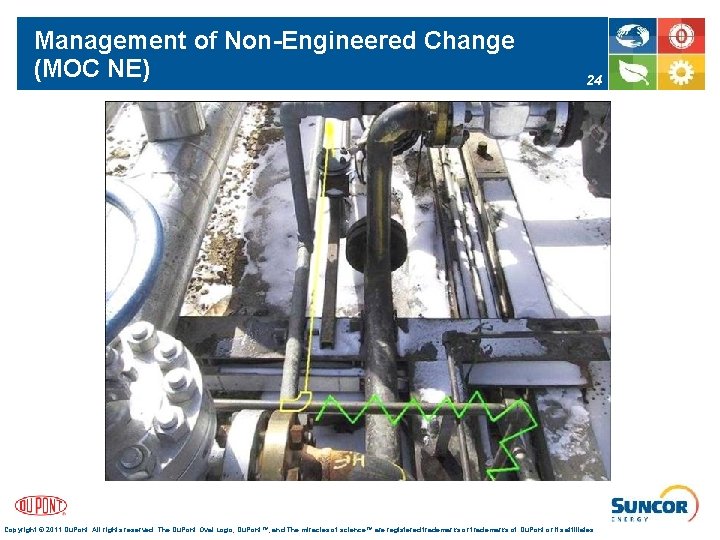
Management of Non-Engineered Change 25 l Management of a non-engineered is a change of process control systems or operations, graphic configurations, equipment titles, descriptions, equipment, and similar related items where engineered specifications or process safety information are not affected. l Includes subtle changes that are not replacement-in-kind, to assets or software potentially impacting hazardous processes. l Business areas shall establish and implement written procedures to manage non-engineered changes to assets. Copyright © 2011 Du. Pont. All rights reserved. The Du. Pont Oval Logo, Du. Pont™, and The miracles of science™ are registered trademarks or trademarks of Du. Pont or its affiliates.
Management of Non-Engineered Change 26 l The bottom line in using a management of change system is that all modifications: 1. Receive prudent review, including process safety considerations. 2. Are appropriately documented, and 3. Are authorized by appropriate levels of management. Copyright © 2011 Du. Pont. All rights reserved. The Du. Pont Oval Logo, Du. Pont™, and The miracles of science™ are registered trademarks or trademarks of Du. Pont or its affiliates.
Management of Personnel Change (MOC-P) 27 Copyright © 2011 Du. Pont. All rights reserved. The Du. Pont Oval Logo, Du. Pont™, and The miracles of science™ are registered trademarks or trademarks of Du. Pont or its affiliates.
Management of Personnel Change 28 l Site and higher levels of management are responsible for developing and implementing criteria and guidelines regarding management of personnel change so that a minimum level of skills is maintained. l MOC Concepts are applied in the event of: – Promotions/transfers – Resignations/retirements – Illnesses/deaths – Organizational structure changes Copyright © 2011 Du. Pont. All rights reserved. The Du. Pont Oval Logo, Du. Pont™, and The miracles of science™ are registered trademarks or trademarks of Du. Pont or its affiliates.
Quality Assurance - QA 29 Copyright © 2011 Du. Pont. All rights reserved. The Du. Pont Oval Logo, Du. Pont™, and The miracles of science™ are registered trademarks or trademarks of Du. Pont or its affiliates.
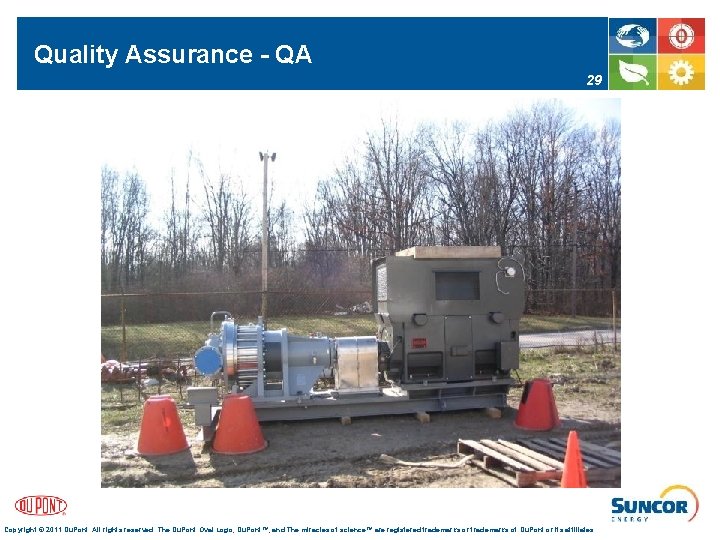
Quality Assurance 30 l Principle: – Quality assurance efforts focus on ensuring that process equipment is: – Fabricated in accordance with design specifications. – Assembled and installed properly. l Features: – Design bases and criteria documented and communicated to vendor and operating/maintenance personnel. – Written quality control procedures addressing fabrication. – Appropriate checks and inspections to ensure critical equipment is fabricated and installed consistent with design specifications. Copyright © 2011 Du. Pont. All rights reserved. The Du. Pont Oval Logo, Du. Pont™, and The miracles of science™ are registered trademarks or trademarks of Du. Pont or its affiliates.
Pre-Startup Safety Reviews 31 Copyright © 2011 Du. Pont. All rights reserved. The Du. Pont Oval Logo, Du. Pont™, and The miracles of science™ are registered trademarks or trademarks of Du. Pont or its affiliates.
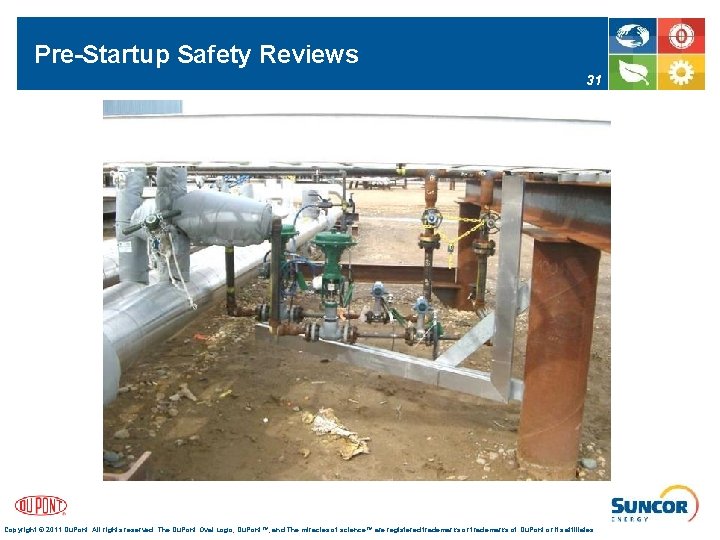
Pre-Startup Safety Reviews 32 l The objective of the pre-startup safety review (PSSR) is to ensure the following prior to startup of new and modified equipment: 1. The equipment and the installation is in accordance with design specification. 2. Safety, operating, maintenance, and emergency procedures are in place and adequate. 3. Modified facilities meet the requirements of all appropriate PSM elements. 4. The training of each employee involved in operating the process has been completed. Copyright © 2011 Du. Pont. All rights reserved. The Du. Pont Oval Logo, Du. Pont™, and The miracles of science™ are registered trademarks or trademarks of Du. Pont or its affiliates.
Pre-Startup Safety Review 33 l The Prestart-Up Safety Review (PSSR) provides a final check of new and modified equipment to confirm that all appropriate elements of process safety have been addressed satisfactorily and the facility is safe to operate. l The PSSRs shall be conducted by multidisciplinary teams consisting of manufacturing (including operator), technical, design, maintenance, and appropriate safety representatives on an as-needed basis. Copyright © 2011 Du. Pont. All rights reserved. The Du. Pont Oval Logo, Du. Pont™, and The miracles of science™ are registered trademarks or trademarks of Du. Pont or its affiliates.
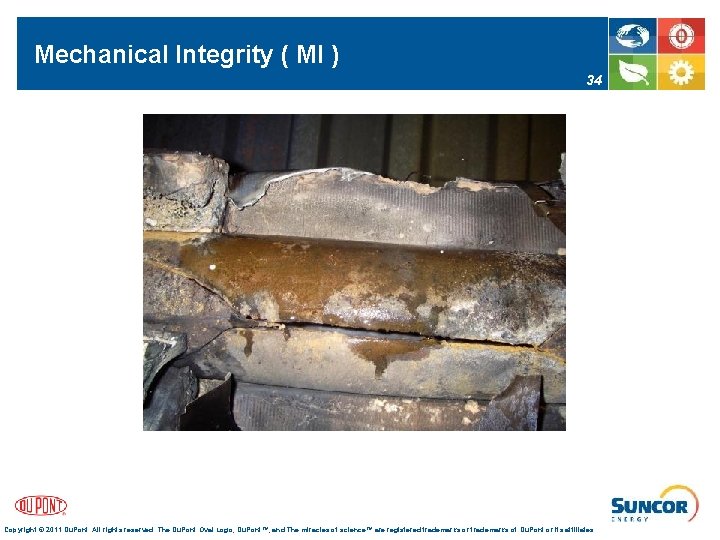
Mechanical Integrity ( MI ) 34 Copyright © 2011 Du. Pont. All rights reserved. The Du. Pont Oval Logo, Du. Pont™, and The miracles of science™ are registered trademarks or trademarks of Du. Pont or its affiliates.
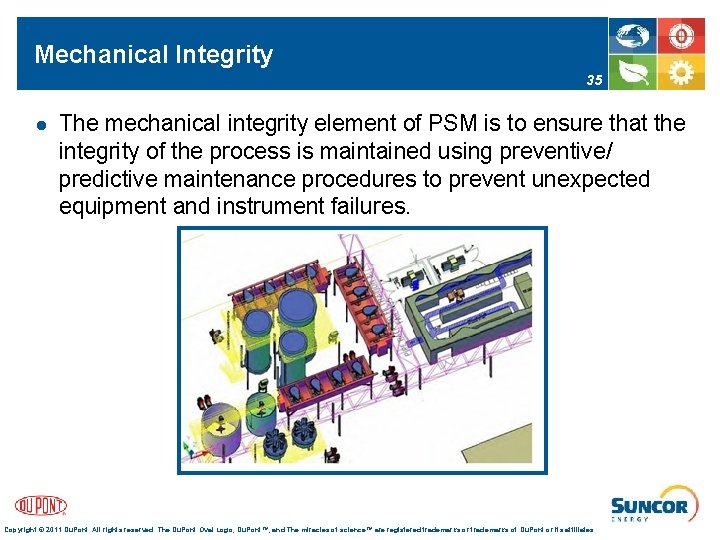
Mechanical Integrity 35 l The mechanical integrity element of PSM is to ensure that the integrity of the process is maintained using preventive/ predictive maintenance procedures to prevent unexpected equipment and instrument failures. Copyright © 2011 Du. Pont. All rights reserved. The Du. Pont Oval Logo, Du. Pont™, and The miracles of science™ are registered trademarks or trademarks of Du. Pont or its affiliates.
Mechanical Integrity 36 l The MI program must include written procedures and mechanical employee training for maintaining the on going integrity of the process equipment, including instruments. l The program should also include equipment inspection and testing procedures, frequency and documentation. l The program also includes quality control of procurement, storage, and use of spare parts Copyright © 2011 Du. Pont. All rights reserved. The Du. Pont Oval Logo, Du. Pont™, and The miracles of science™ are registered trademarks or trademarks of Du. Pont or its affiliates.
Training and Performance ( T&P ) 37 Copyright © 2011 Du. Pont. All rights reserved. The Du. Pont Oval Logo, Du. Pont™, and The miracles of science™ are registered trademarks or trademarks of Du. Pont or its affiliates.
Training and Performance 38 l The objective of the training element of PSM is to ensure that employees responsible for operating and maintaining the process are adequately trained in safe operating, maintenance, and shutdown practices. l Business areas shall implement procedures that are designed to assure that personnel handling hazardous materials are fit for duty. l The training program shall include provisions for initial and refresher training, and shall document the identity of the employee, date of training, and the means used to verify competency. Copyright © 2011 Du. Pont. All rights reserved. The Du. Pont Oval Logo, Du. Pont™, and The miracles of science™ are registered trademarks or trademarks of Du. Pont or its affiliates.
Contractor Safety 39 Copyright © 2011 Du. Pont. All rights reserved. The Du. Pont Oval Logo, Du. Pont™, and The miracles of science™ are registered trademarks or trademarks of Du. Pont or its affiliates.

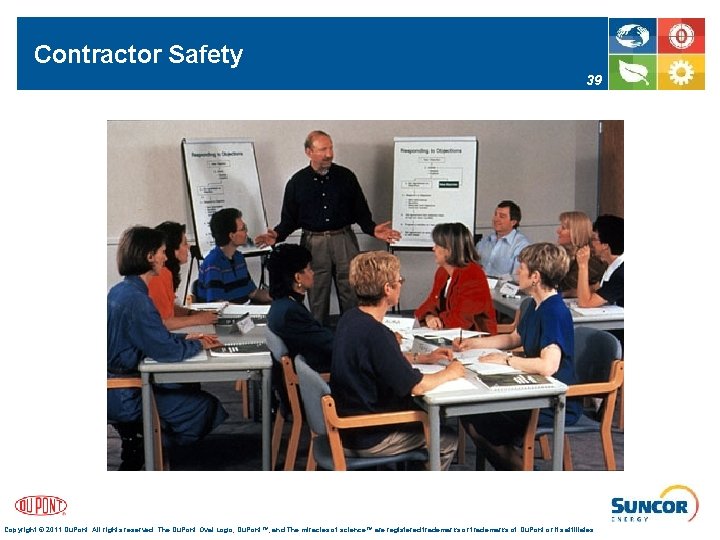
Contractor Safety 40 l The objective of the contractor element of PSM is to ensure that contractors and their employees are aware of the potential hazards involved in the process and how their actions may impact Process Safety. l Assure that compliance with all safety requirements is an integral part any contract. Contractor’s safety performance will be periodically evaluated for use in future Contractor selection opportunities. Copyright © 2011 Du. Pont. All rights reserved. The Du. Pont Oval Logo, Du. Pont™, and The miracles of science™ are registered trademarks or trademarks of Du. Pont or its affiliates.
Contractor Safety 41 l All tasks must be completed safely and performed in accordance with established procedures and/or safe work practices, consistent with the principles of good PSM, whether the tasks are completed by site personnel or by contract personnel. l Efforts must be made to ensure that contractor employees are properly trained and informed as to hazards and proper methods of operation. Copyright © 2011 Du. Pont. All rights reserved. The Du. Pont Oval Logo, Du. Pont™, and The miracles of science™ are registered trademarks or trademarks of Du. Pont or its affiliates.
Incident Learning & Prevention ( ILP ) 42 l The intent of the Incident Management process is to learn from incidents and educate to prevent recurrence of incidents, which can put the company and its employees at risk. This is accomplished by promptly investigating all incidents, both with and without loss, correcting identified failures in management systems and processes, and communicating learning’s. l This standard supports Suncor’s policy of “All Incidents can be Prevented”. Copyright © 2011 Du. Pont. All rights reserved. The Du. Pont Oval Logo, Du. Pont™, and The miracles of science™ are registered trademarks or trademarks of Du. Pont or its affiliates.
Defining Incident Learning and Prevention 43 • Continuous improvement is supported through; Ø Reporting incidents Ø Investigating incidents to identify root causes. Ø Implementing corrective actions to prevent reoccurrence Ø Communication of lessons learned Ø Detecting trends l Incidents include: – An occurrence that caused or could have caused one or more of the following: – Employee injury or illness. – Significant environmental or health impact. – Unfavorable impact on the public. – Significant property damage. – Business interruption. Copyright © 2011 Du. Pont. All rights reserved. The Du. Pont Oval Logo, Du. Pont™, and The miracles of science™ are registered trademarks or trademarks of Du. Pont or its affiliates.
Implementing Incident Learning and Prevention 44 An Effective Incident Learning System Consists of Five Themes: l 1. Initial Response and Management of an Incident l 2. Incident Reporting l 3. Assessment of Risk and Consequence l 4. Incident Investigation and Causal Analysis l 5. Action Management and Follow-up Copyright © 2011 Du. Pont. All rights reserved. The Du. Pont Oval Logo, Du. Pont™, and The miracles of science™ are registered trademarks or trademarks of Du. Pont or its affiliates.
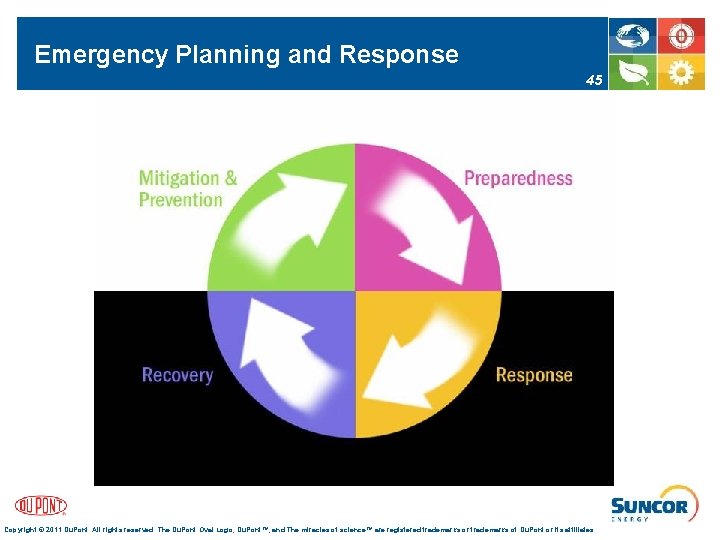
Emergency Planning and Response 45 Copyright © 2011 Du. Pont. All rights reserved. The Du. Pont Oval Logo, Du. Pont™, and The miracles of science™ are registered trademarks or trademarks of Du. Pont or its affiliates.
Emergency Planning and Response 46 l In-depth planning for potential emergencies is required so that timely and effective response by the site along with the community can mitigate the impact on people, the environment, and facilities. l Appropriate response procedures must be established for the entire spectrum of emergencies. l Responsible positions and personnel for EPR must be defined. l Training and periodic drills are a vital part of EPR – including local emergency response agencies. Copyright © 2011 Du. Pont. All rights reserved. The Du. Pont Oval Logo, Du. Pont™, and The miracles of science™ are registered trademarks or trademarks of Du. Pont or its affiliates.
Operations Integrity Auditing 47 l The audit element of PSM establishes a procedure to evaluate the effectiveness of the PSM program by identifying deficiencies and recommending corrective action. The audits also illuminate pockets of excellence. WHAT GETS MEASURED GETS DONE ! Copyright © 2011 Du. Pont. All rights reserved. The Du. Pont Oval Logo, Du. Pont™, and The miracles of science™ are registered trademarks or trademarks of Du. Pont or its affiliates.
Summary 48 l We have focused our presentation on the following objectives: – Defining PSM and explaining why PSM is needed. – Listing and describing what needs to be in place to to implement a comprehensive PSM program. – Briefly described each of the fourteen elements l Are There Any Final Questions/Comments? Copyright © 2011 Du. Pont. All rights reserved. The Du. Pont Oval Logo, Du. Pont™, and The miracles of science™ are registered trademarks or trademarks of Du. Pont or its affiliates.
- Slides: 48