
Events Event types Catching different event types Getting
- Slides: 23
Events • Event types • Catching different event types • Getting information from components and events • Distinguishing between events of the same type 12/5/00 SEM 107, Kamin & Reddy 34
The Java event model • An event is any occurrence an applets might want to respond to, e. g. user clicks mouse on button, user moves mouse, user enters text into text field. • Java event model is a method of allowing applets to respond to events. • The Java event model is based on classifying events into different types. 12/5/00 SEM 107, Kamin & Reddy 35
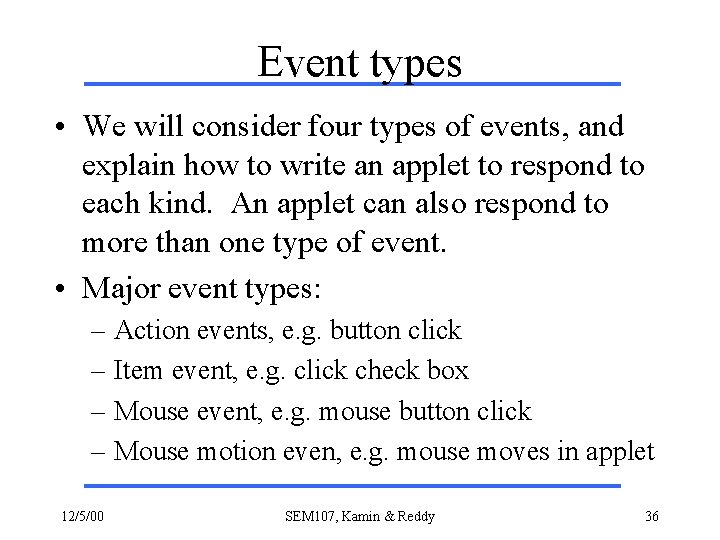
Event types • We will consider four types of events, and explain how to write an applet to respond to each kind. An applet can also respond to more than one type of event. • Major event types: – Action events, e. g. button click – Item event, e. g. click check box – Mouse event, e. g. mouse button click – Mouse motion even, e. g. mouse moves in applet 12/5/00 SEM 107, Kamin & Reddy 36
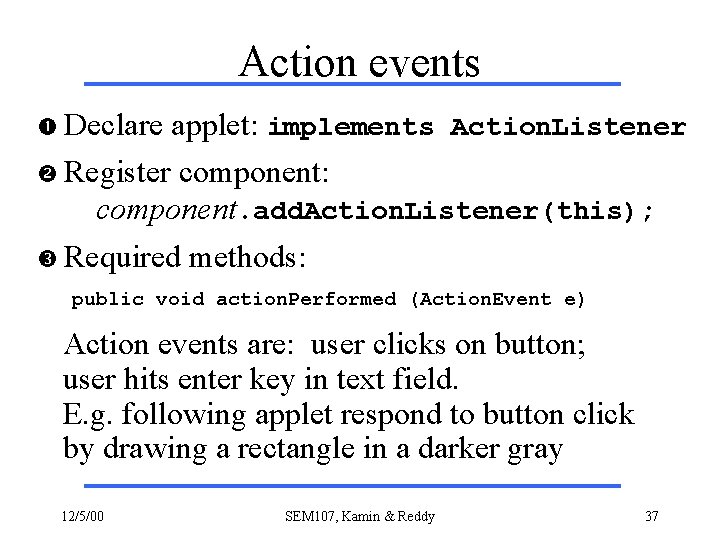
Action events Declare applet: implements Action. Listener Register component: component. add. Action. Listener(this); Required methods: public void action. Performed (Action. Event e) Action events are: user clicks on button; user hits enter key in text field. E. g. following applet respond to button click by drawing a rectangle in a darker gray 12/5/00 SEM 107, Kamin & Reddy 37
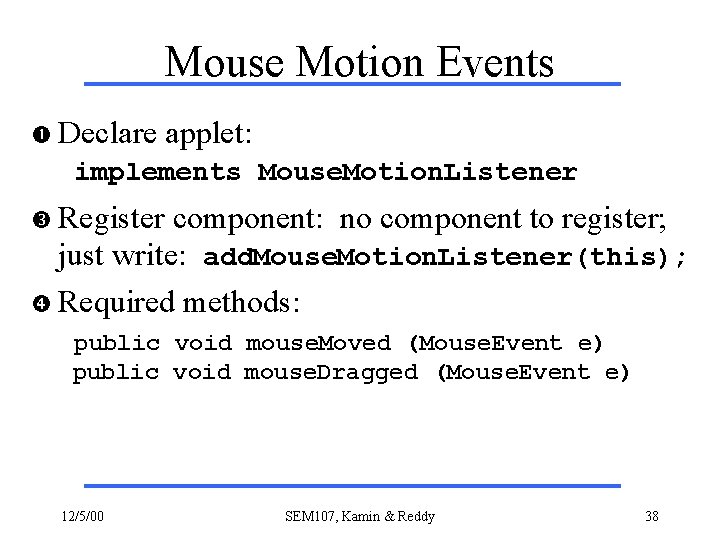
Mouse Motion Events Declare applet: implements Mouse. Motion. Listener Register component: no component to register; just write: add. Mouse. Motion. Listener(this); Required methods: public void mouse. Moved (Mouse. Event e) public void mouse. Dragged (Mouse. Event e) 12/5/00 SEM 107, Kamin & Reddy 38
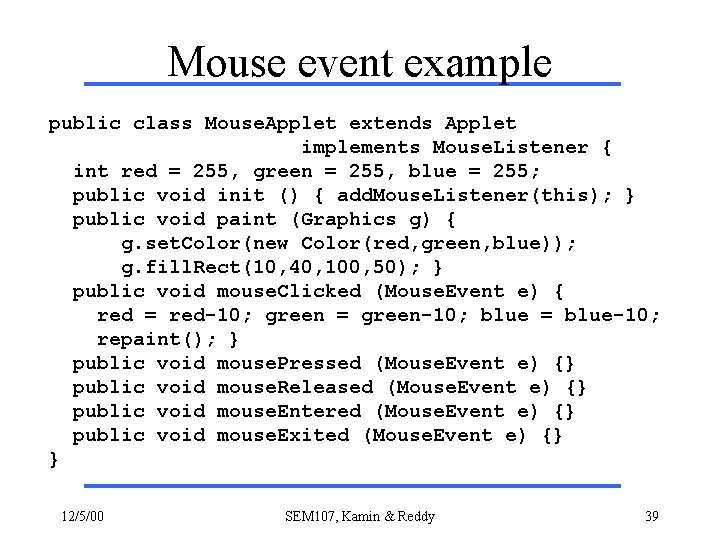
Mouse event example public class Mouse. Applet extends Applet implements Mouse. Listener { int red = 255, green = 255, blue = 255; public void init () { add. Mouse. Listener(this); } public void paint (Graphics g) { g. set. Color(new Color(red, green, blue)); g. fill. Rect(10, 40, 100, 50); } public void mouse. Clicked (Mouse. Event e) { red = red-10; green = green-10; blue = blue-10; repaint(); } public void mouse. Pressed (Mouse. Event e) {} public void mouse. Released (Mouse. Event e) {} public void mouse. Entered (Mouse. Event e) {} public void mouse. Exited (Mouse. Event e) {} } 12/5/00 SEM 107, Kamin & Reddy 39
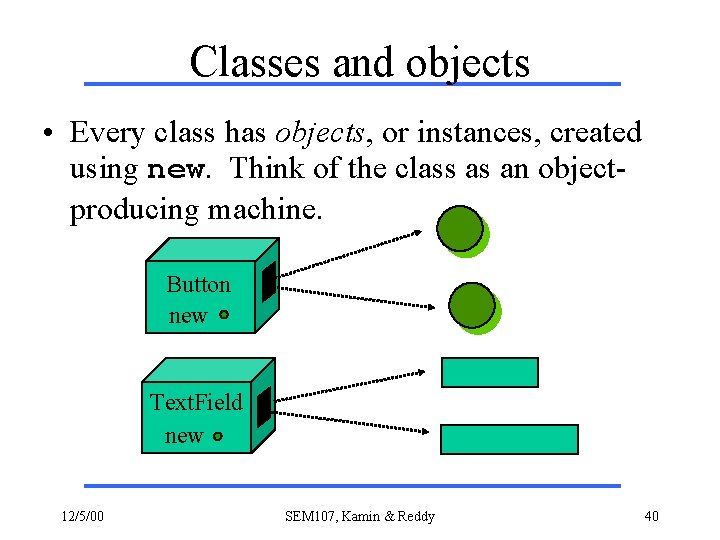
Classes and objects • Every class has objects, or instances, created using new. Think of the class as an objectproducing machine. Button new Text. Field new 12/5/00 SEM 107, Kamin & Reddy 40
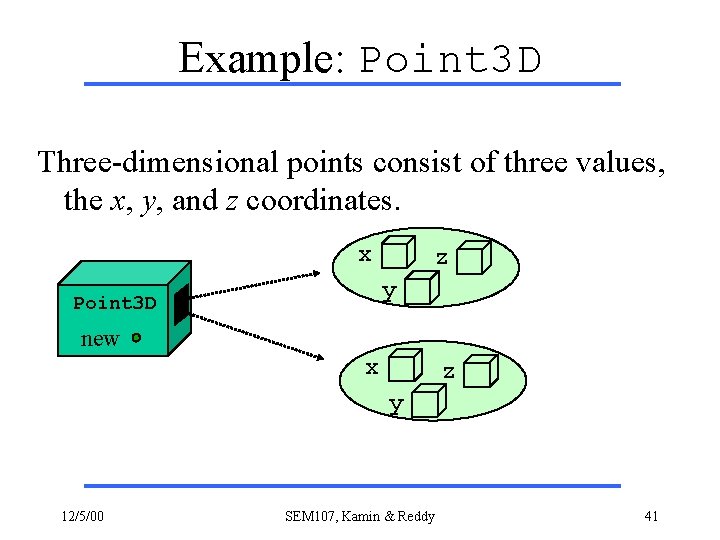
Example: Point 3 D Three-dimensional points consist of three values, the x, y, and z coordinates. x z y Point 3 D new x z y 12/5/00 SEM 107, Kamin & Reddy 41
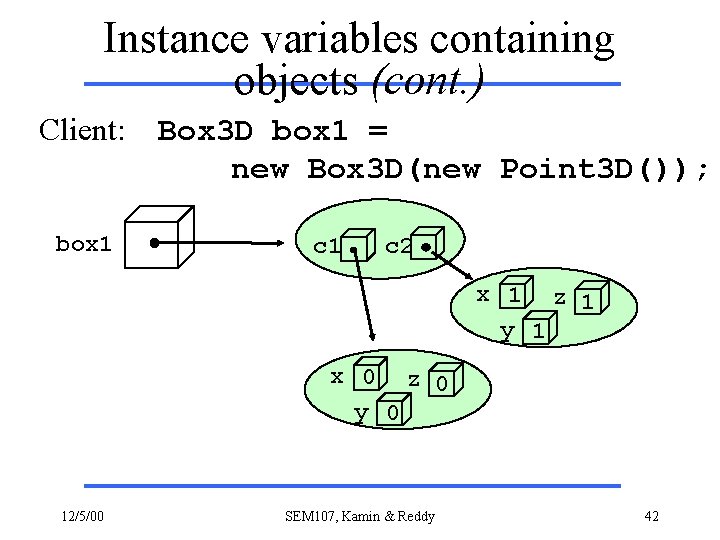
Instance variables containing objects (cont. ) Client: box 1 Box 3 D box 1 = new Box 3 D(new Point 3 D()); c 1 c 2 x 1 z 1 y 1 x 0 z 0 y 0 12/5/00 SEM 107, Kamin & Reddy 42
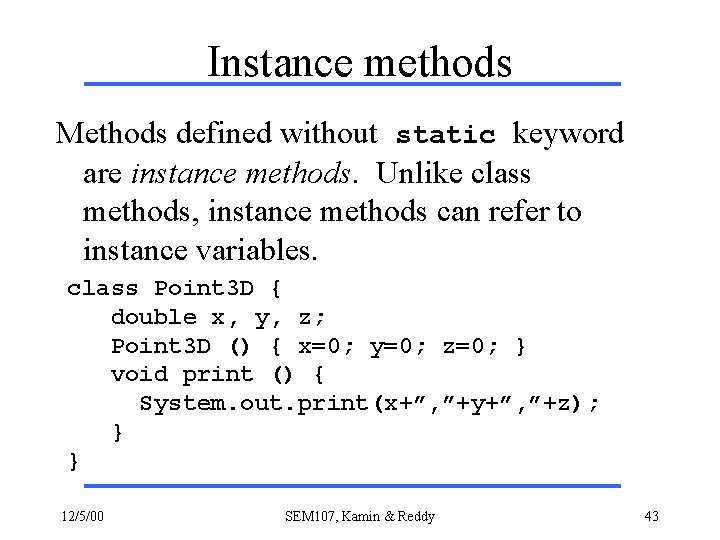
Instance methods Methods defined without static keyword are instance methods. Unlike class methods, instance methods can refer to instance variables. class Point 3 D { double x, y, z; Point 3 D () { x=0; y=0; z=0; } void print () { System. out. print(x+”, ”+y+”, ”+z); } } 12/5/00 SEM 107, Kamin & Reddy 43
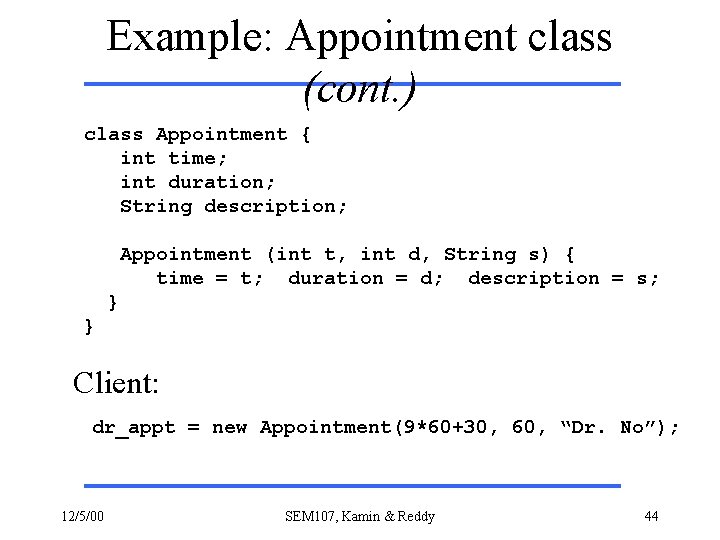
Example: Appointment class (cont. ) class Appointment { int time; int duration; String description; Appointment (int t, int d, String s) { time = t; duration = d; description = s; } } Client: dr_appt = new Appointment(9*60+30, 60, “Dr. No”); 12/5/00 SEM 107, Kamin & Reddy 44
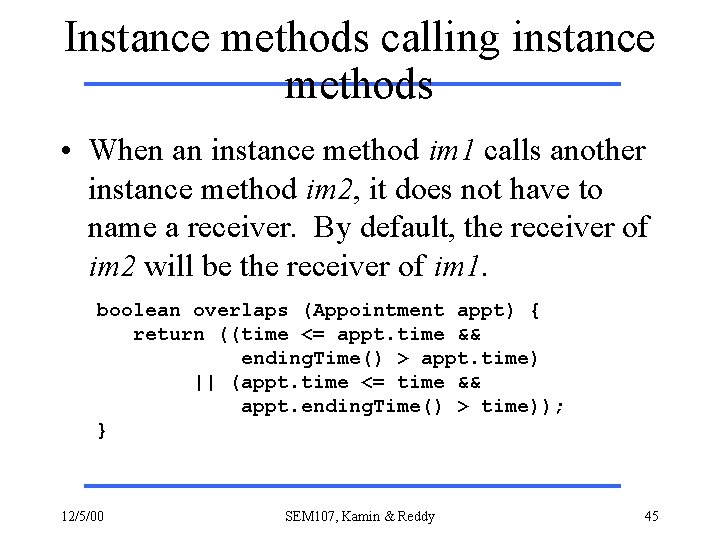
Instance methods calling instance methods • When an instance method im 1 calls another instance method im 2, it does not have to name a receiver. By default, the receiver of im 2 will be the receiver of im 1. boolean overlaps (Appointment appt) { return ((time <= appt. time && ending. Time() > appt. time) || (appt. time <= time && appt. ending. Time() > time)); } 12/5/00 SEM 107, Kamin & Reddy 45
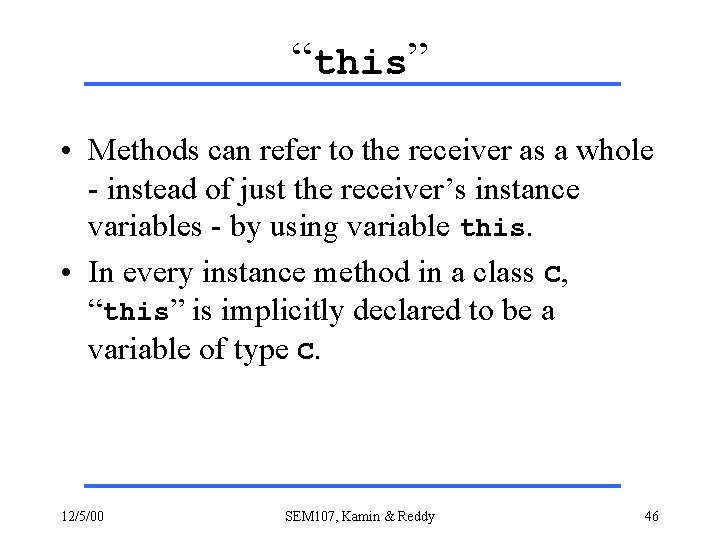
“this” • Methods can refer to the receiver as a whole - instead of just the receiver’s instance variables - by using variable this. • In every instance method in a class C, “this” is implicitly declared to be a variable of type C. 12/5/00 SEM 107, Kamin & Reddy 46
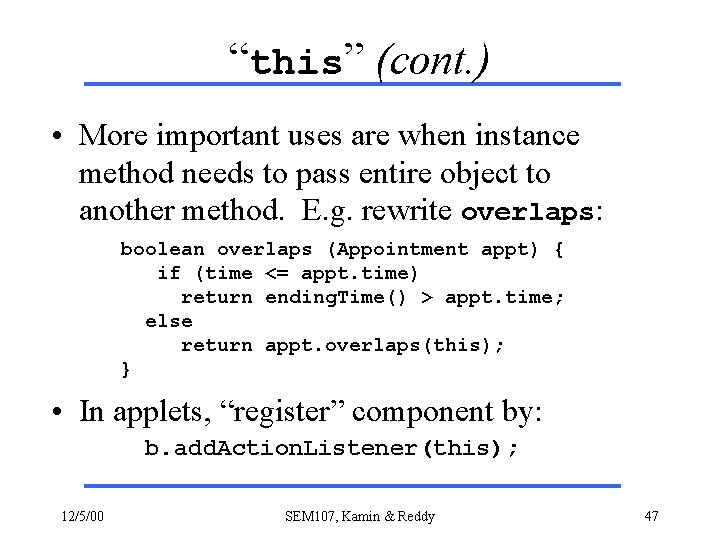
“this” (cont. ) • More important uses are when instance method needs to pass entire object to another method. E. g. rewrite overlaps: boolean overlaps (Appointment appt) { if (time <= appt. time) return ending. Time() > appt. time; else return appt. overlaps(this); } • In applets, “register” component by: b. add. Action. Listener(this); 12/5/00 SEM 107, Kamin & Reddy 47
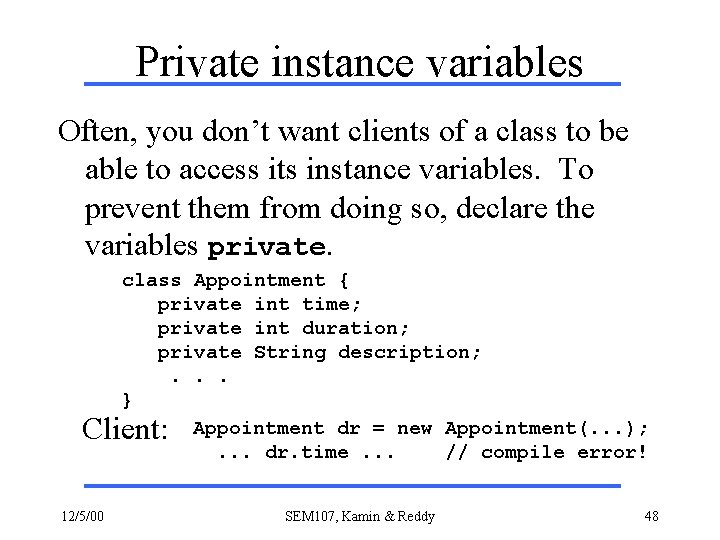
Private instance variables Often, you don’t want clients of a class to be able to access its instance variables. To prevent them from doing so, declare the variables private. class Appointment { private int time; private int duration; private String description; . . . } Appointment dr = new Appointment(. . . ); . . . dr. time. . . // compile error! Client: 12/5/00 SEM 107, Kamin & Reddy 48
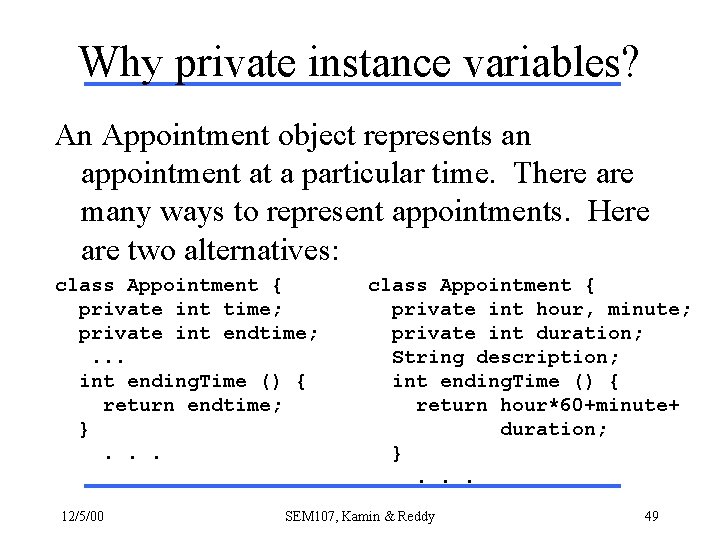
Why private instance variables? An Appointment object represents an appointment at a particular time. There are many ways to represent appointments. Here are two alternatives: class Appointment { private int time; private int endtime; . . . int ending. Time () { return endtime; }. . . 12/5/00 class Appointment { private int hour, minute; private int duration; String description; int ending. Time () { return hour*60+minute+ duration; }. . . SEM 107, Kamin & Reddy 49
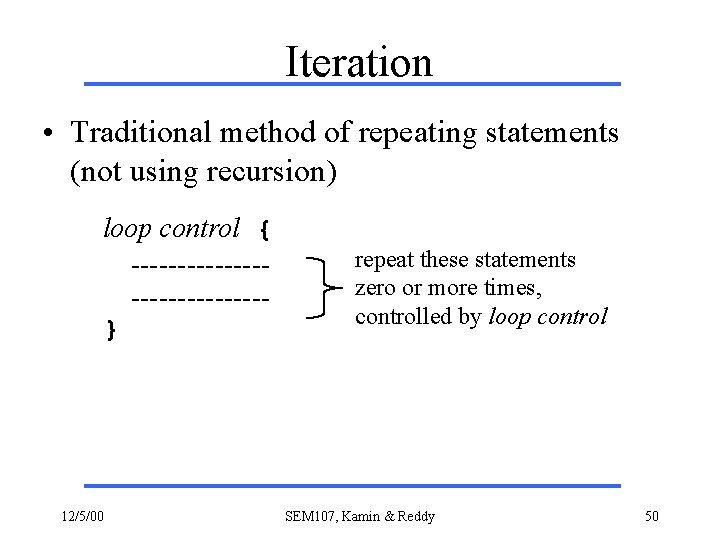
Iteration • Traditional method of repeating statements (not using recursion) loop control { --------------} 12/5/00 repeat these statements zero or more times, controlled by loop control SEM 107, Kamin & Reddy 50
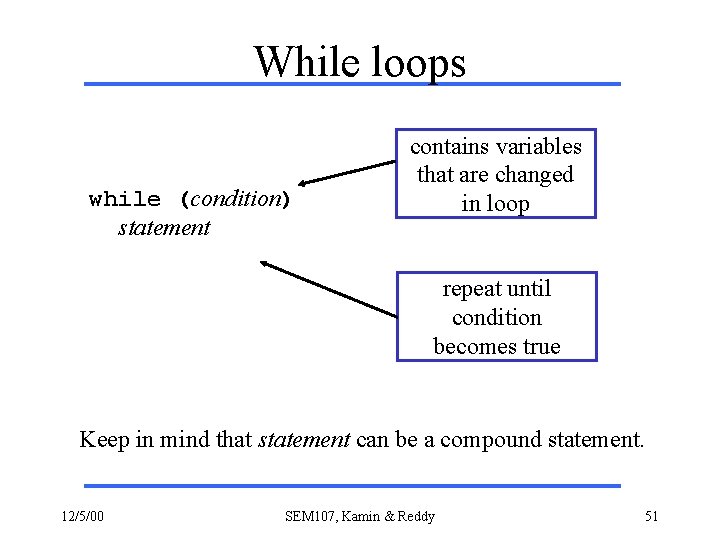
While loops while (condition) statement contains variables that are changed in loop repeat until condition becomes true Keep in mind that statement can be a compound statement. 12/5/00 SEM 107, Kamin & Reddy 51
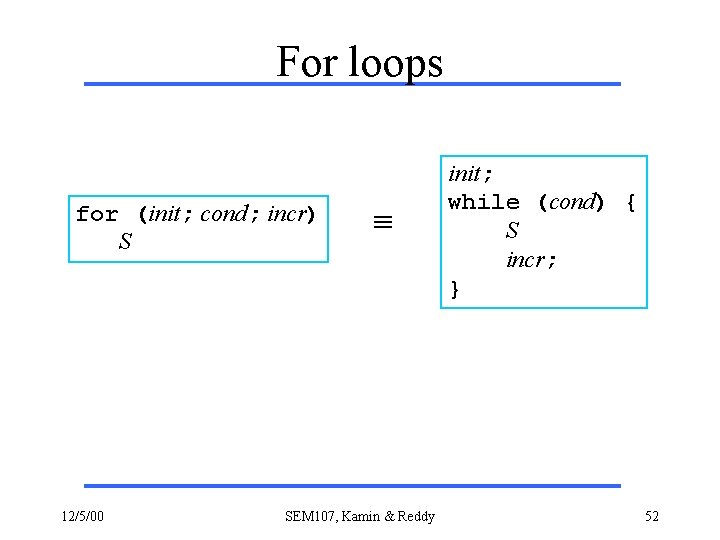
For loops for (init; cond; incr) S 12/5/00 SEM 107, Kamin & Reddy init; while (cond) { S incr; } 52
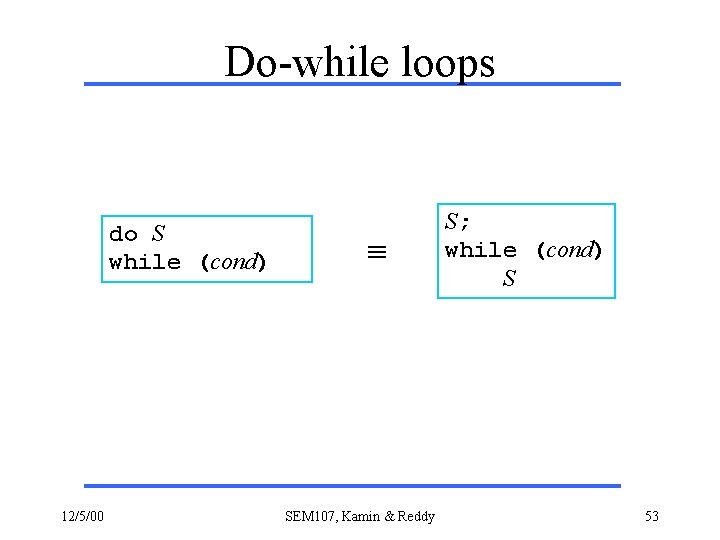
Do-while loops do S while (cond) 12/5/00 SEM 107, Kamin & Reddy S; while (cond) S 53
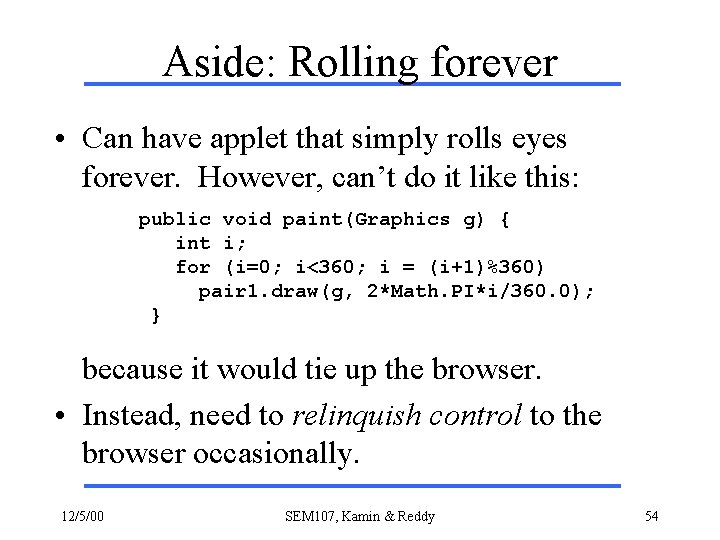
Aside: Rolling forever • Can have applet that simply rolls eyes forever. However, can’t do it like this: public void paint(Graphics g) { int i; for (i=0; i<360; i = (i+1)%360) pair 1. draw(g, 2*Math. PI*i/360. 0); } because it would tie up the browser. • Instead, need to relinquish control to the browser occasionally. 12/5/00 SEM 107, Kamin & Reddy 54
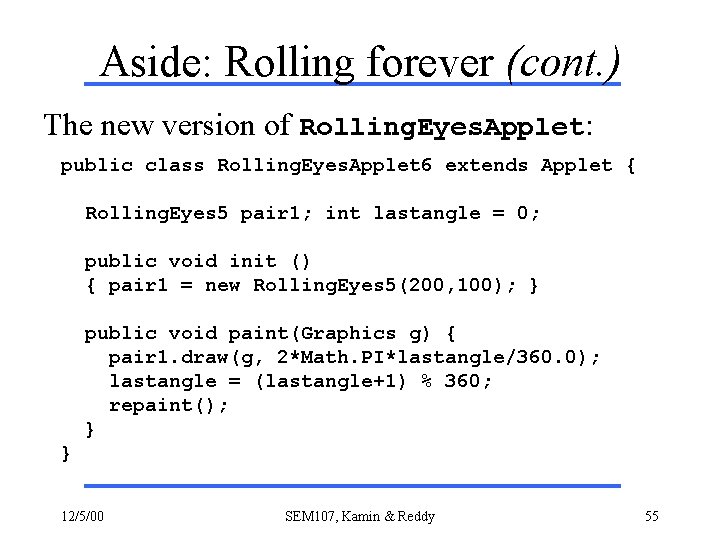
Aside: Rolling forever (cont. ) The new version of Rolling. Eyes. Applet: public class Rolling. Eyes. Applet 6 extends Applet { Rolling. Eyes 5 pair 1; int lastangle = 0; public void init () { pair 1 = new Rolling. Eyes 5(200, 100); } public void paint(Graphics g) { pair 1. draw(g, 2*Math. PI*lastangle/360. 0); lastangle = (lastangle+1) % 360; repaint(); } } 12/5/00 SEM 107, Kamin & Reddy 55
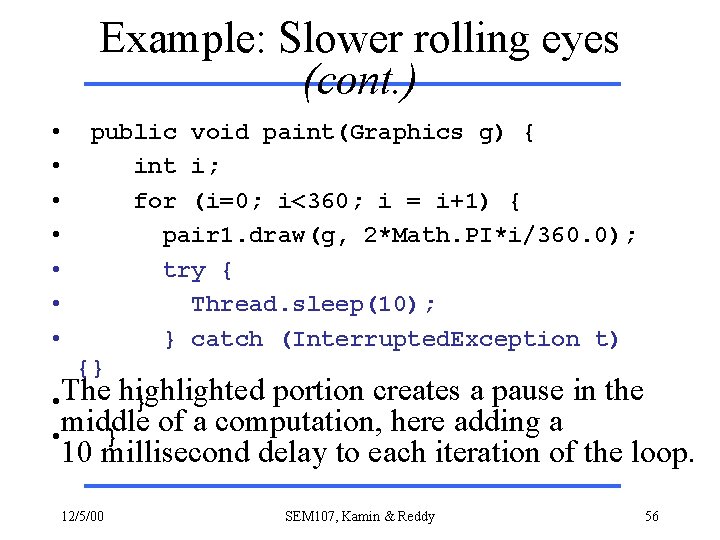
Example: Slower rolling eyes (cont. ) • • public void paint(Graphics g) { int i; for (i=0; i<360; i = i+1) { pair 1. draw(g, 2*Math. PI*i/360. 0); try { Thread. sleep(10); } catch (Interrupted. Exception t) {} portion creates a pause in the • The highlighted } middle of a computation, here adding a • } 10 millisecond delay to each iteration of the loop. 12/5/00 SEM 107, Kamin & Reddy 56