
Event Wagering Systems Main Areas General Requirements for



- Slides: 25
Event Wagering Systems
Main Areas • General Requirements for Wagering • Types of Wagering Games • Wagering System(Back End) • Wagering Devices • ISS • GLI – 33 Key Points
General Requirements For Wagering All information regarding the wagering games should be complete, clear and unambiguous. Such information include: • Game Rules • Payout information • Rules of participation
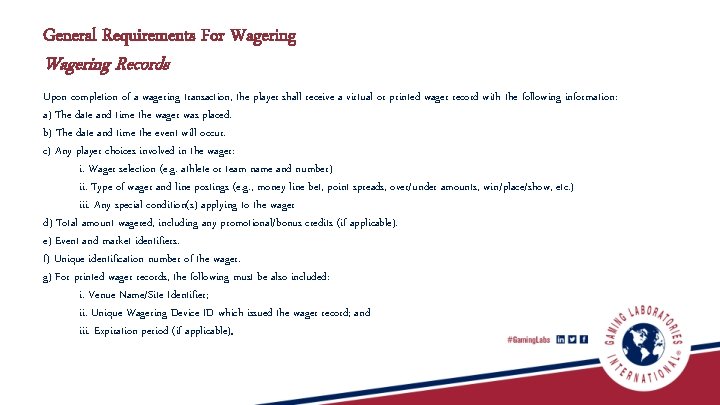
General Requirements For Wagering Records Upon completion of a wagering transaction, the player shall receive a virtual or printed wager record with the following information: a) The date and time the wager was placed. b) The date and time the event will occur. c) Any player choices involved in the wager: i. Wager selection (e. g. athlete or team name and number) ii. Type of wager and line postings (e. g. , money line bet, point spreads, over/under amounts, win/place/show, etc. ) iii. Any special condition(s) applying to the wager d) Total amount wagered, including any promotional/bonus credits (if applicable). e) Event and market identifiers. f) Unique identification number of the wager. g) For printed wager records, the following must be also included: i. Venue Name/Site Identifier; ii. Unique Wagering Device ID which issued the wager record; and iii. Expiration period (if applicable).
General Requirements For Wagering Results, Cancelations, Winnings Players must be able to view the results of their wagers (once they have been confirmed) including any change on them (i. e. due to statistics correction) Wagers placed by players may be canceled in accordance with the cancelation policy of the operator. Such policy should be accessible by the player. Once the results of the wagers have been determined the player may receive payment for their winnings. If any rounding is to be applied on the winning amount, this needs to be provided to the player (i. e. level of rounding, rounding direction, metering of rounding amounts)
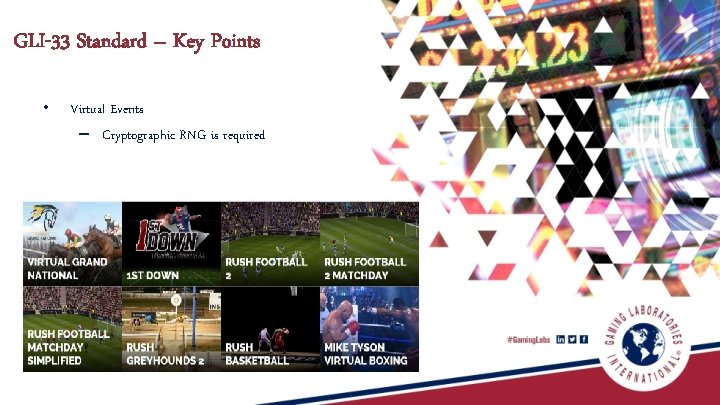
Types of Wagering The following types of Wagering are supported by the GLI – 33 Standard: • Fixed odds Wagering • Pari-Mutuel Wagers • Virtual Event Wagering
Wagering System (Back End) The back end of the wagering System covers a variety of functional roles of the wagering system. Some of them are: • Player account management • Reporting system • Various functional requirements
Wagering System (Back End) Player Account Management Key elements of the Player Account Management Includes: • Registration of Player accounts • Verification of Player accounts • Terms and Conditions • Player account controls o Player or Operator imposed limits o Player or Operator imposed Exclusions o Disputes/Complains o Player funds o Transaction logs or Account Statements
Wagering System (Back End) Reporting System The wagering system needs to be able to generate reports on the following areas: • Revenue Report • Liability Report • Promotion/Bonus Report • Future Events Report • Significant events Report • User access listing Report
Wagering System (Back End) Functionality Requirements Wagering System need to comply with general functionality requirements. Some key point of these are: • System Clock • Control Program(self-verification) • Shutdown and recovery • Wagering Control • Information to be maintained (wager information, Player Account information, significant events)
Wagering Devices Wagering system can support different types of devices to offer wagering to the players that can be split in two categories. • Self-service wagering devices (Landbase) • Remote wagering devices (Online)
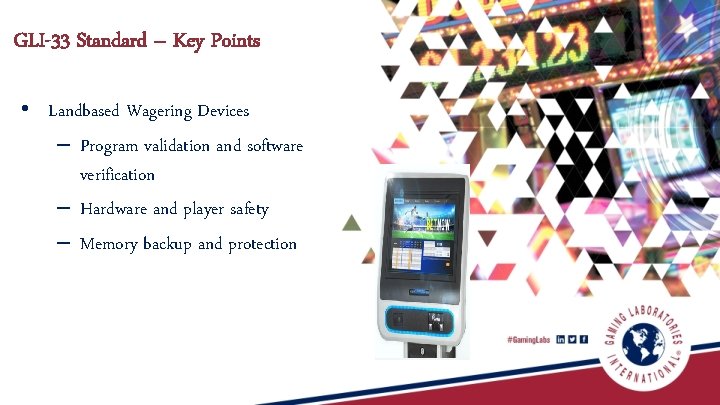
Wagering Devices Self-service wagering devices Requirements for Self-service devices are really similar to the requirements of gaming machine in terms of the Hardware and cabinet. Key points that need attention are the following: • ESD (Electro-Static Discharge) • Device Identification • Hardware requirements(Circuit boards, wiring, switches, ports) • Electric Power requirements • Peripheral devices(Bill validators, Card Readers, Printers) • Doors and Security of the Device • Critical Non-Volatile memory
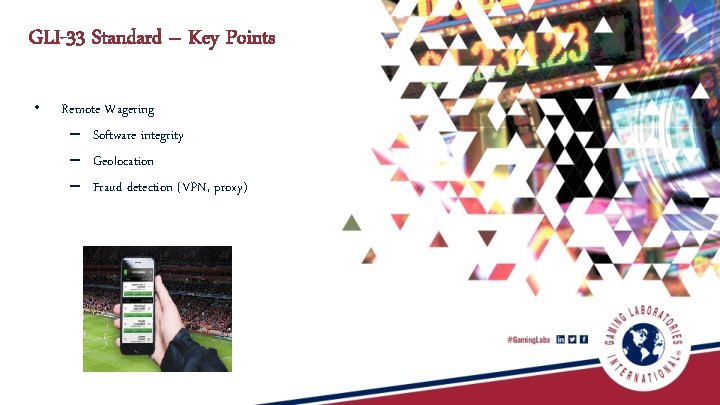
Wagering Devices Remote wagering devices Requirements for Remote wagering devices are really similar to the requirements of online gaming. Key points that need attention are the following: • Client software functionality (Autofill passwords, data transfers between players) • Compatibility verification • Integrity of remote wagering device • Location Detection
System Security (ISS) The Wagering System needs to comply with the System security requirements. Some key points are the following: • Physical Security(location and access control) • Data integrity and alteration • Communication Requirements • Communication Protocol • Connectivity • Communication over Public Networks • Network Security Management • Backup and Restore • Cryptographic Controls • Remote Access and firewalls • Change Management
Regulation GLI-33: Event Wagering Systems – One year process, with draft for comment released to industry on May 18, 2018. – Developed with insight gained from the following organizations: a) Nevada Gaming Commission and Gaming Control Board. b) British Columbia Gaming Policy and Enforcement Branch (GPEB). c) Association of Racing Commissioners International (ARCI). d) Tasmanian Liquor and Gaming Commission. e) Northern Territory Racing Commission. f) Victorian Commission for Gambling and Liquor Regulation. g) Danish Gambling Authority. h) Spanish Directorate General for the Regulation of Gambling (DGOJ). i) South African Bureau of Standards (SABS).
GLI-33 Standard Purposely named “Event Wagering Systems” – Not only sports Focus on remaining flexible – No limitation of technology Encompass both landbased and online wagering – Point-of-sale: Wagering via attendant at property – Self-Service: Wagering via kiosk or peripheral device – Remote: Wagering online or via in-venue wireless network
GLI-33 Standard – Key Points • Player fairness – Example: Identify situations where the player has placed a wager for which the associated odds/payouts have changed, but not yet refreshed on the Wagering Device or external display, and notify the player accordingly to confirm the wager given the new odds/payouts
GLI-33 Standard – Key Points • Virtual Events – Cryptographic RNG is required
GLI-33 Standard – Key Points • Landbased Wagering Devices – Program validation and software verification – Hardware and player safety – Memory backup and protection
GLI-33 Standard – Key Points • Remote Wagering – Software integrity – Geolocation – Fraud detection (VPN, proxy)
GLI-33 Standard – Key Points • Player Account – Age/Identity Verification – Player protection and limits/exclusion • Responsible play information • Self-imposed and Operatorimposed/exclusion limits – Transaction logs
GLI-33 Standard – Key Points • Information Managed by System – Wagers • Date/time, Amount, Type, Results – Events • Date/time(wagering period/event), Amount totals, Status – Wagering Devices • Identification, Adjustments, Significant Events – Player Accounts • Identification, Account details, Exclusions/limits, Transactions – Significant Events • Failed logins, Program errors, Large wagers/wins, Changes to parameters
Summary • Sports betting is growing, transitioning to legality. • Standardization helps all parties involved • Technology is ever-evolving, standards must be adaptive.
Questions www. gaminglabs. com
Thank you! www. gaminglabs. com Pierre Otto Compliance and Quality Manager p. otto@gaminglabs. com Tel: +27 (0)11 314 6877 Cell: +27 (0) 78 894 0657 Skype: pierre_otto