
Event simulation and reconstruction algorithms for modern HEP


- Slides: 53
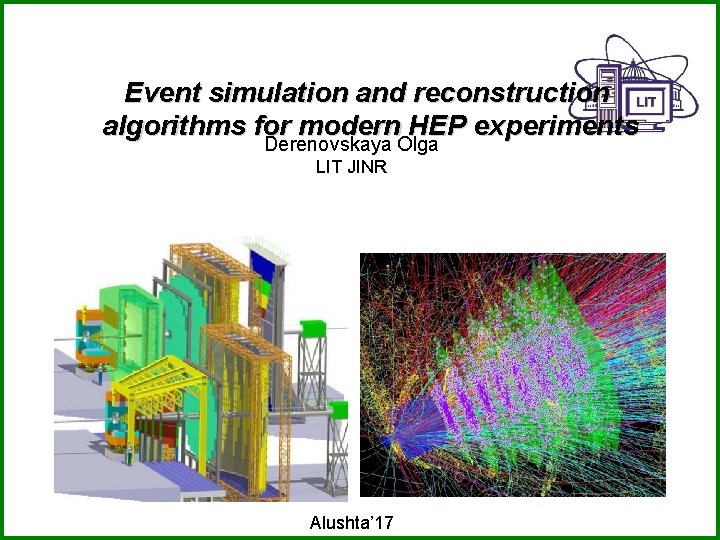
Event simulation and reconstruction algorithms for modern HEP experiments Derenovskaya Olga LIT JINR Alushta’ 17
What is event reconstruction?
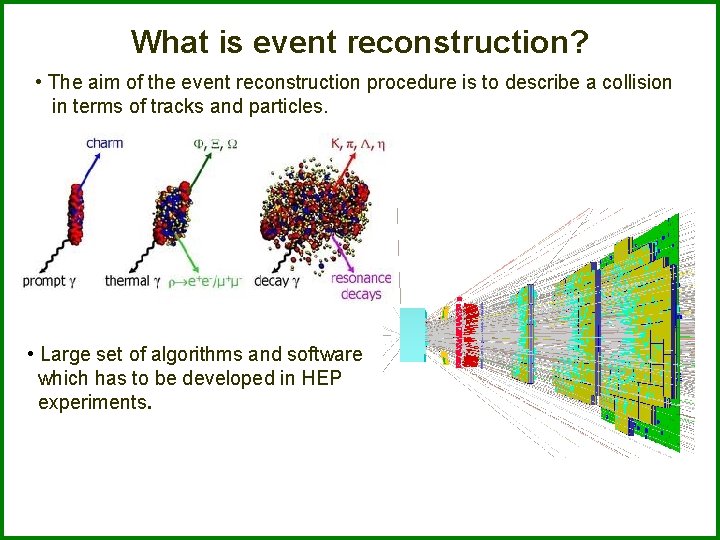
What is event reconstruction? • The aim of the event reconstruction procedure is to describe a collision in terms of tracks and particles. • Large set of algorithms and software which has to be developed in HEP experiments.
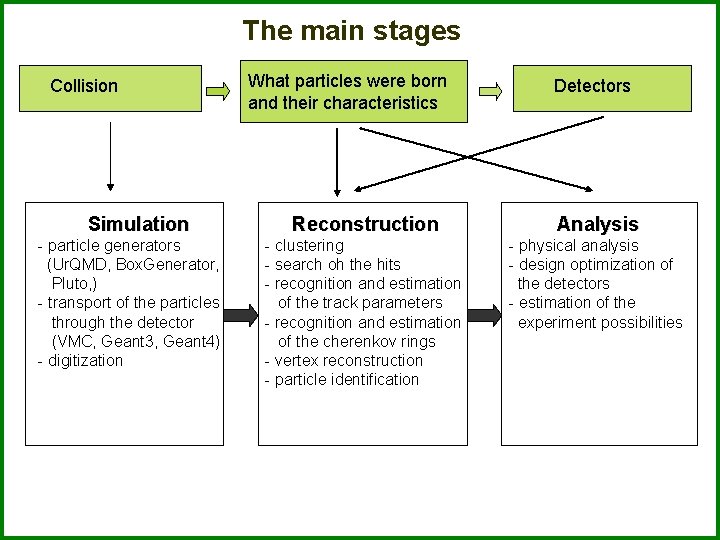
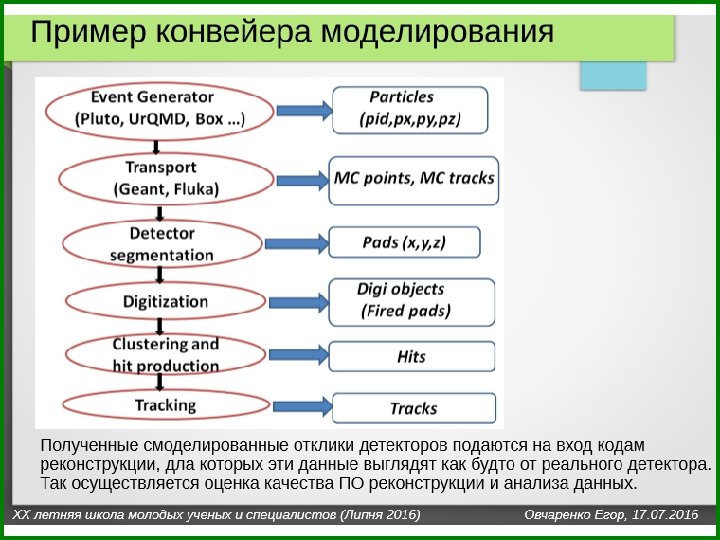
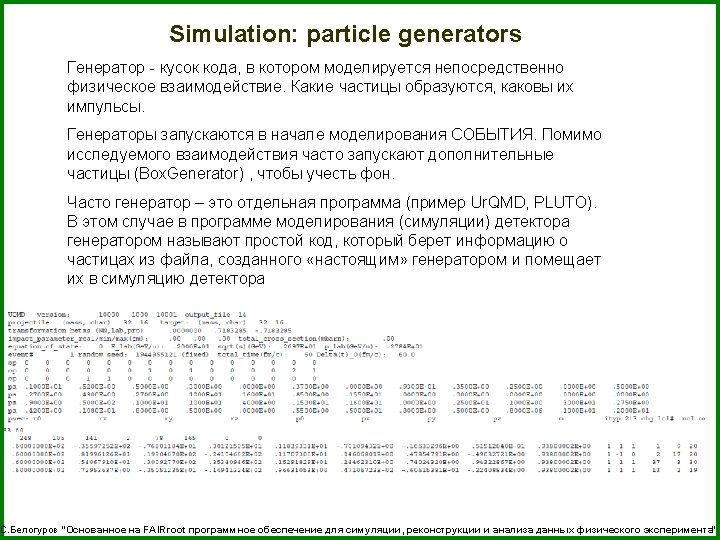
The main stages Collision Simulation - particle generators (Ur. QMD, Box. Generator, Pluto, ) - transport of the particles through the detector (VMC, Geant 3, Geant 4) - digitization What particles were born and their characteristics Detectors Reconstruction Analysis - clustering - search oh the hits - recognition and estimation of the track parameters - recognition and estimation of the cherenkov rings - vertex reconstruction - particle identification - physical analysis - design optimization of the detectors - estimation of the experiment possibilities
Geant 3
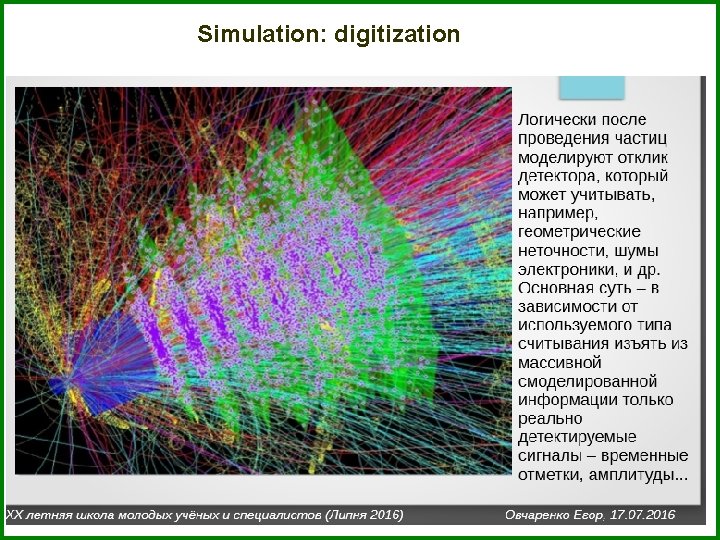
Simulation: digitization
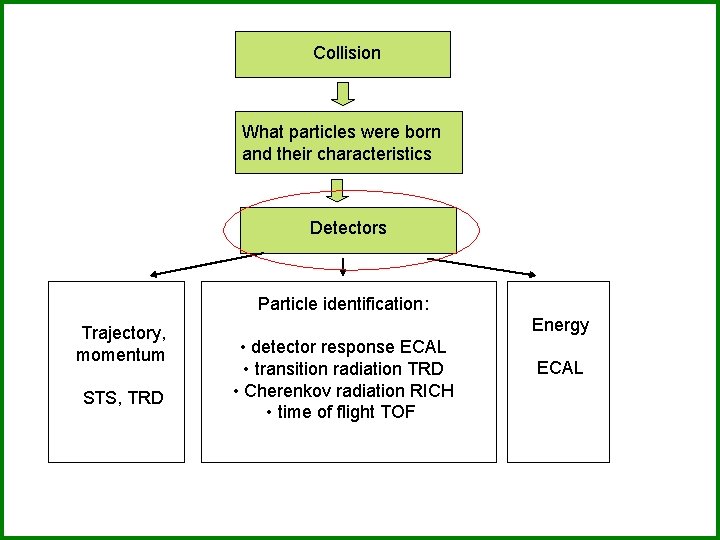
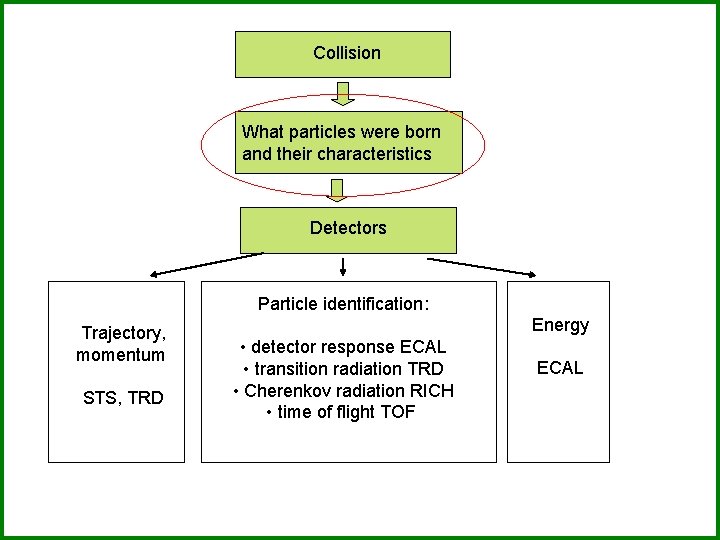
Collision What particles were born and their characteristics Detectors Particle identification: Trajectory, momentum STS, TRD Energy • detector response ECAL • transition radiation TRD • Cherenkov radiation RICH • time of flight TOF ECAL
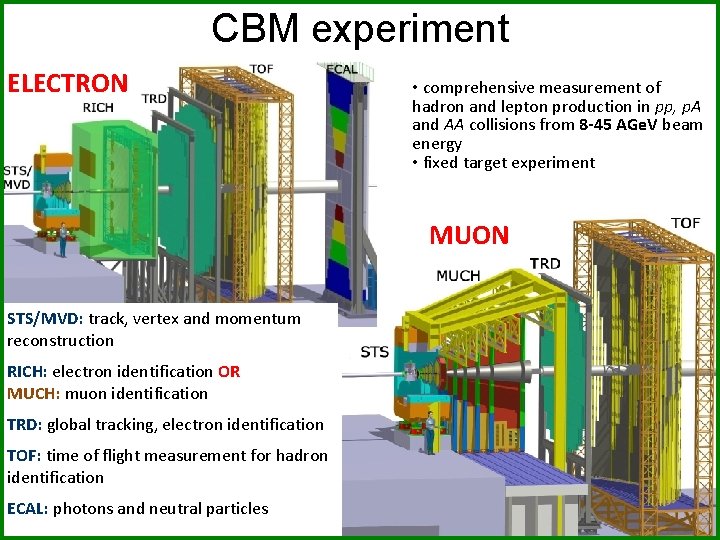
CBM experiment ELECTRON • comprehensive measurement of hadron and lepton production in pp, p. A and AA collisions from 8 -45 AGe. V beam energy • fixed target experiment MUON STS/MVD: track, vertex and momentum reconstruction RICH: electron identification OR MUCH: muon identification TRD: global tracking, electron identification TOF: time of flight measurement for hadron identification ECAL: photons and neutral particles
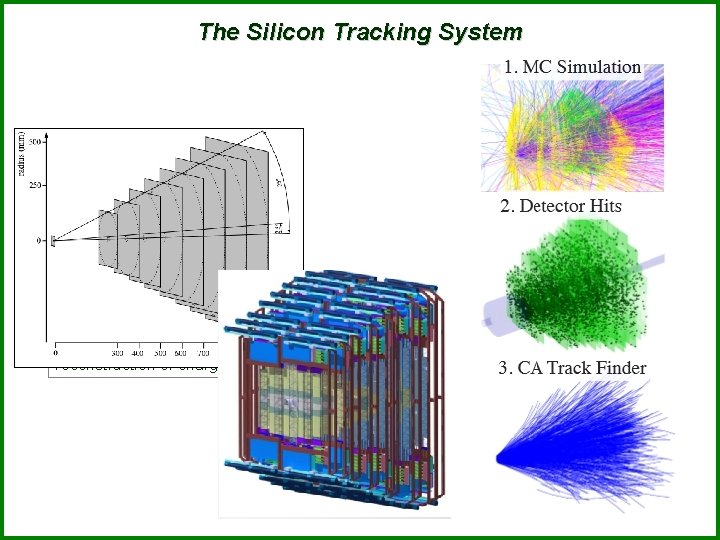
The Silicon Tracking System Task: Task trajectories and momentum reconstruction of charged particles
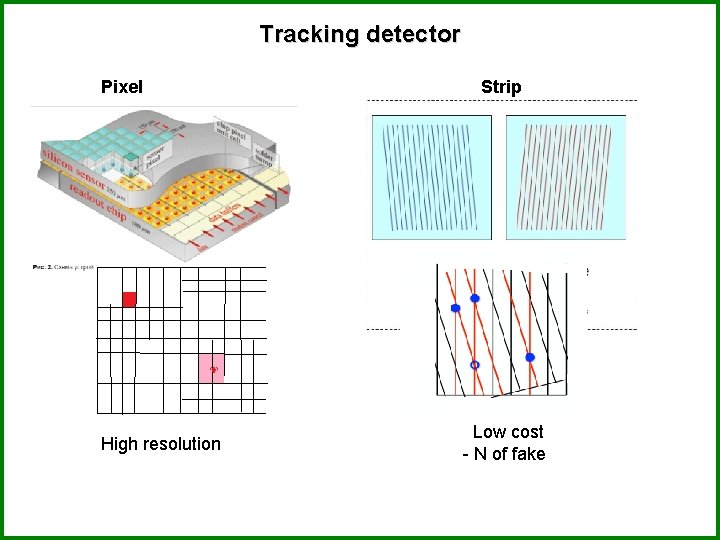
Tracking detector Pixel High resolution Strip Low cost - N of fake
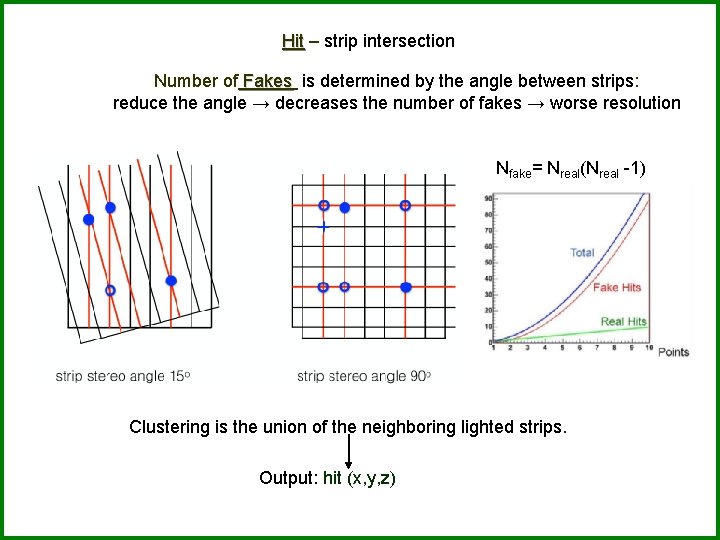
Hit – strip intersection Number of Fakes is determined by the angle between strips: reduce the angle → decreases the number of fakes → worse resolution Nfake= Nreal(Nreal -1) Clustering is the union of the neighboring lighted strips. Output: hit (x, y, z)
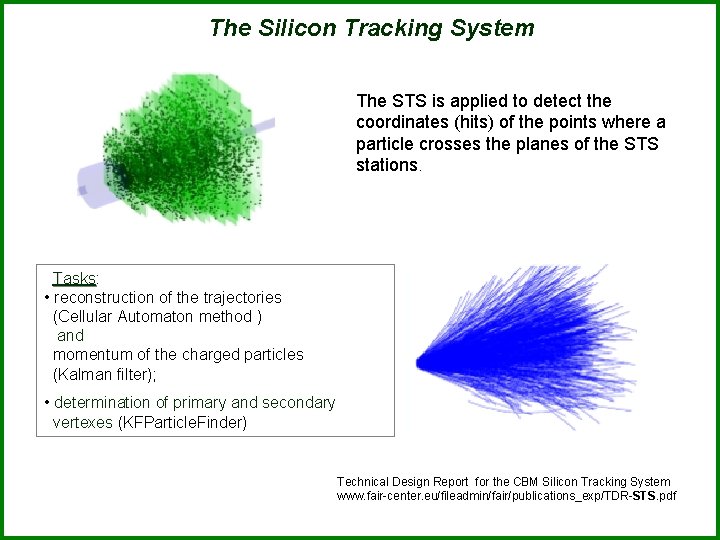
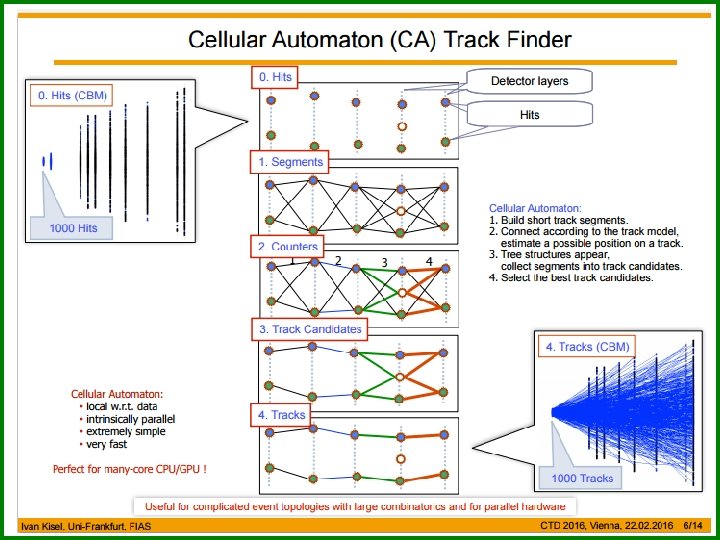
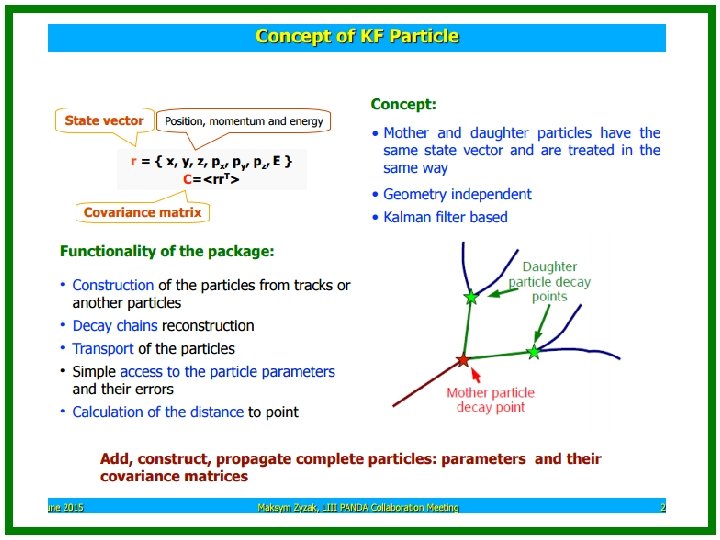
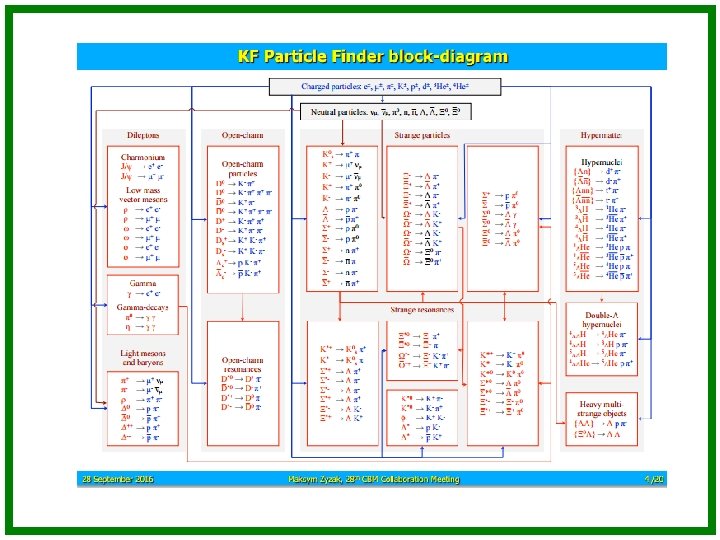
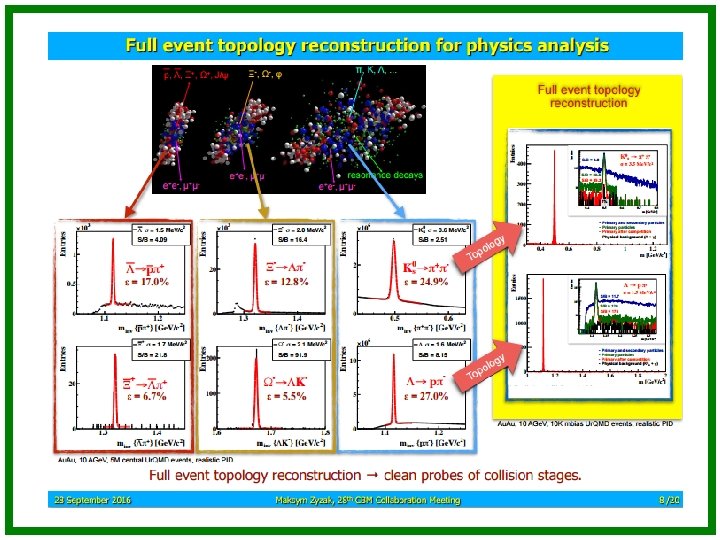
The Silicon Tracking System The STS is applied to detect the coordinates (hits) of the points where a particle crosses the planes of the STS stations. Tasks: • reconstruction of the trajectories (Cellular Automaton method ) and momentum of the charged particles (Kalman filter); • determination of primary and secondary vertexes (KFParticle. Finder) Technical Design Report for the CBM Silicon Tracking System www. fair-center. eu/fileadmin/fair/publications_exp/TDR-STS. pdf
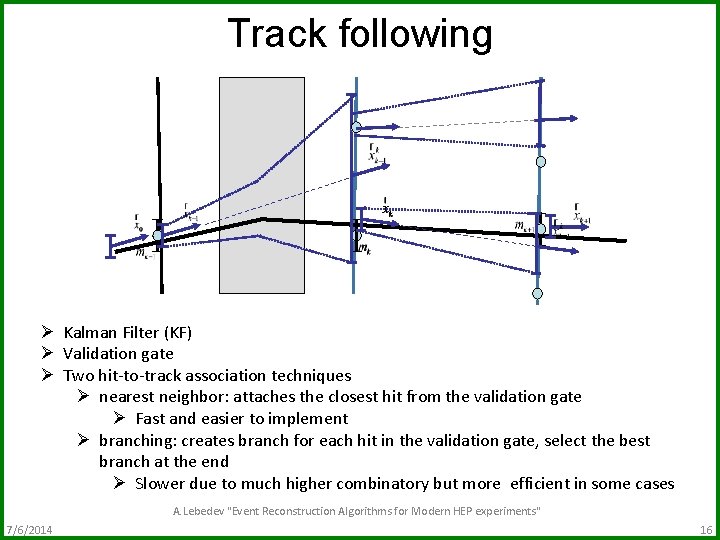
Track following Ø Kalman Filter (KF) Ø Validation gate Ø Two hit-to-track association techniques Ø nearest neighbor: attaches the closest hit from the validation gate Ø Fast and easier to implement Ø branching: creates branch for each hit in the validation gate, select the best branch at the end Ø Slower due to much higher combinatory but more efficient in some cases A. Lebedev "Event Reconstruction Algorithms for Modern HEP experiments" 7/6/2014 16
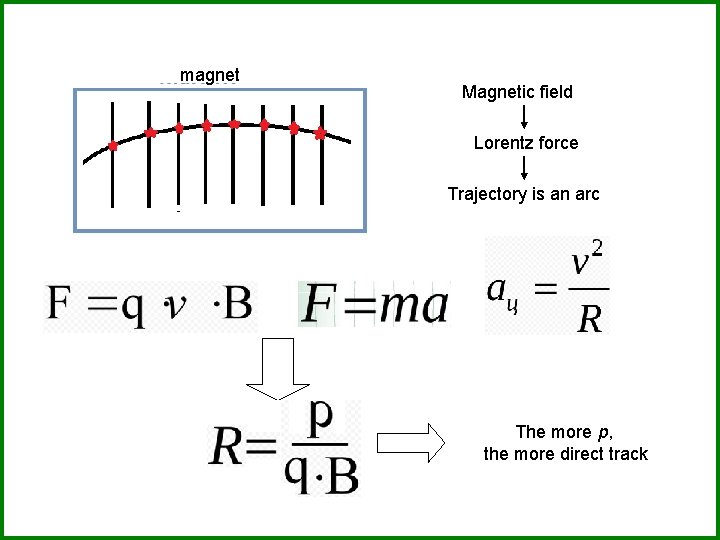
magnet Magnetic field Lorentz force Trajectory is an arc The more p, the more direct track
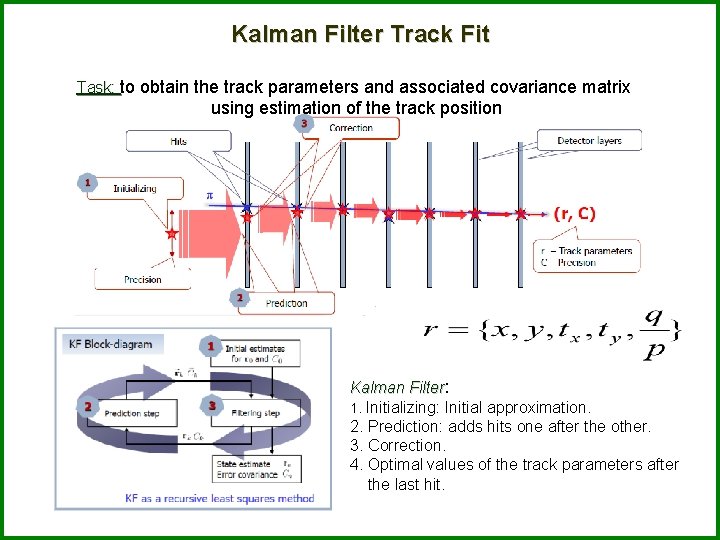
Kalman Filter Track Fit Task: to obtain the track parameters and associated covariance matrix using estimation of the track position Kalman Filter: 1. Initializing: Initial approximation. 2. Prediction: adds hits one after the other. 3. Correction. 4. Optimal values of the track parameters after the last hit.
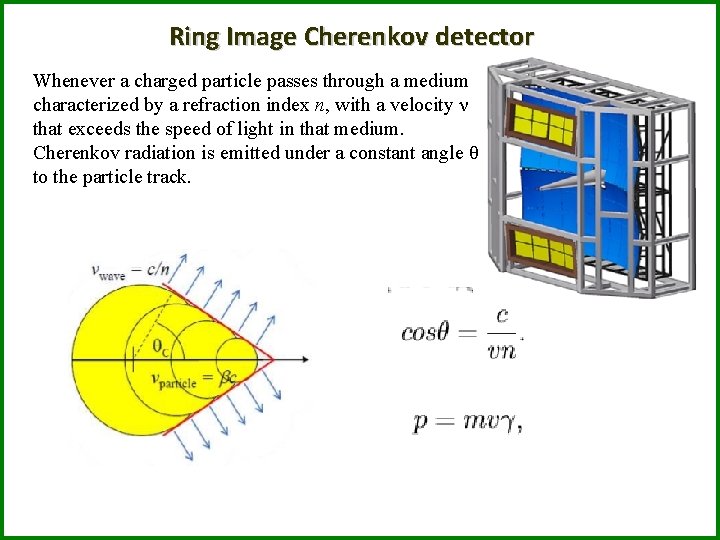
Ring Image Cherenkov detector Whenever a charged particle passes through a medium characterized by a refraction index n, with a velocity ν that exceeds the speed of light in that medium. Cherenkov radiation is emitted under a constant angle θ to the particle track.
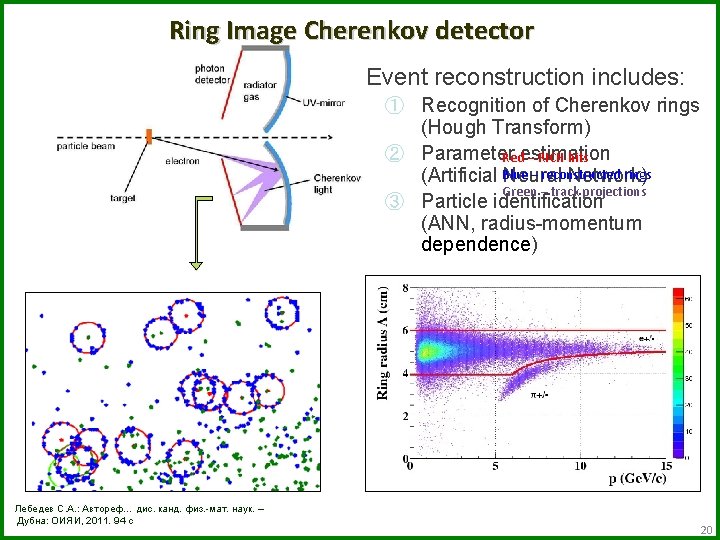
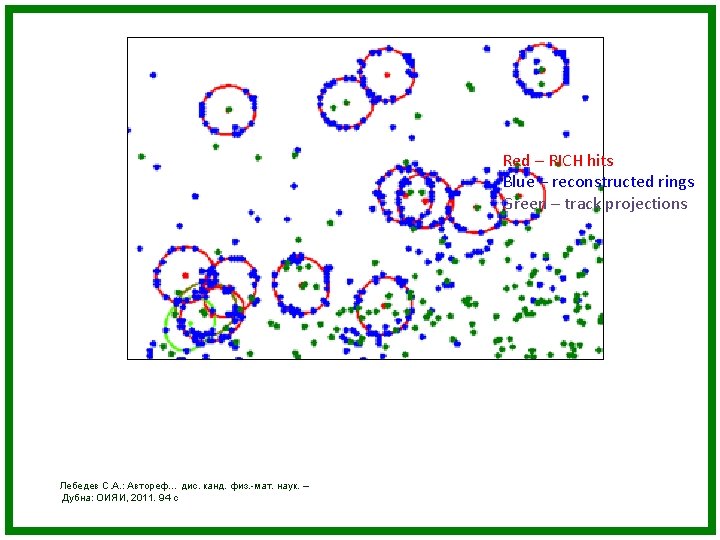
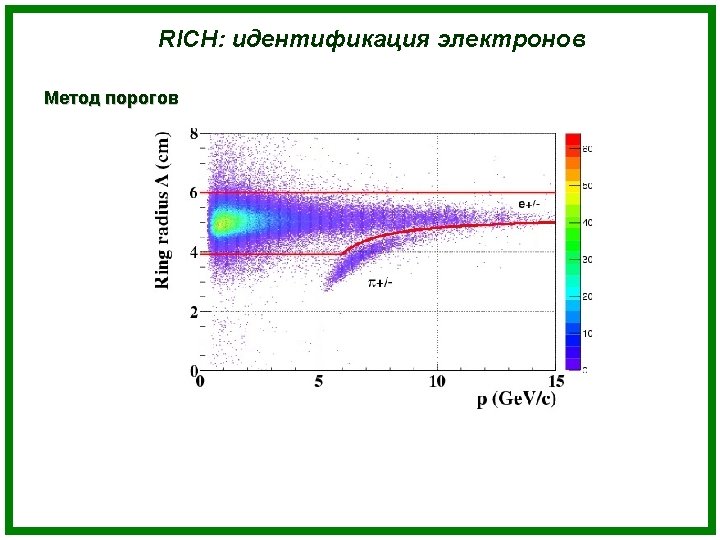
Ring Image Cherenkov detector Event reconstruction includes: ① Recognition of Cherenkov rings (Ноugh Transform) ② Parameter Redestimation – RICH hits – reconstructed rings (Artificial Blue Neural Network) Green – track projections ③ Particle identification (ANN, radius-momentum dependence) Лебедев С. А. : Автореф… дис. канд. физ. -мат. наук. – Дубна: ОИЯИ, 2011. 94 с. 20
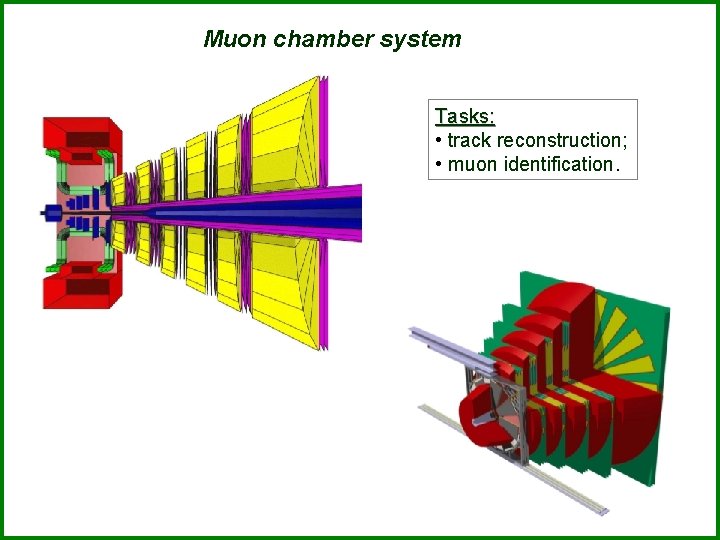
Muon chamber system Tasks: • track reconstruction; • muon identification.
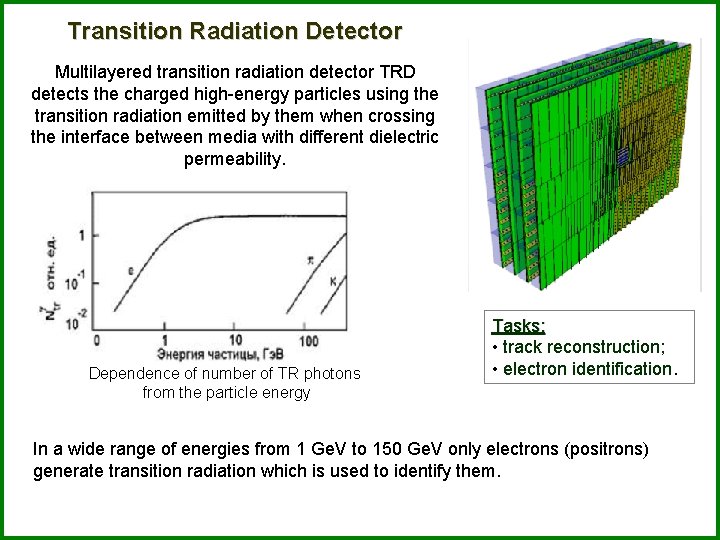
Transition Radiation Detector Multilayered transition radiation detector TRD detects the charged high-energy particles using the transition radiation emitted by them when crossing the interface between media with different dielectric permeability. Dependence of number of TR photons from the particle energy Tasks: • track reconstruction; • electron identification. In a wide range of energies from 1 Ge. V to 150 Ge. V only electrons (positrons) generate transition radiation which is used to identify them.
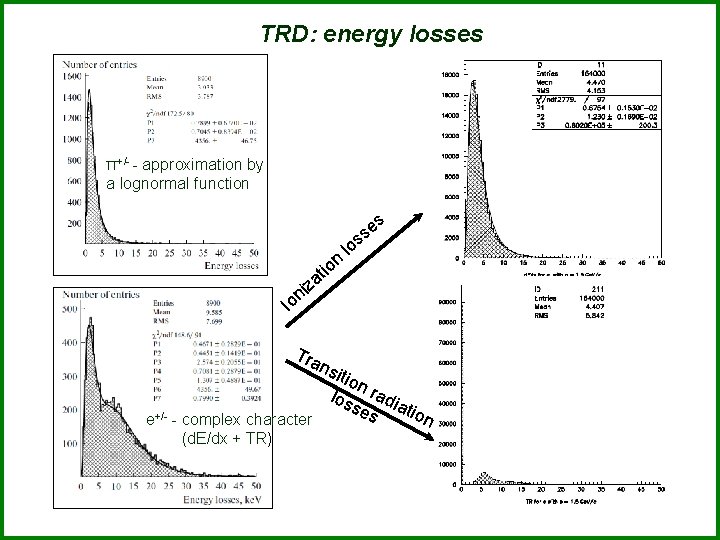
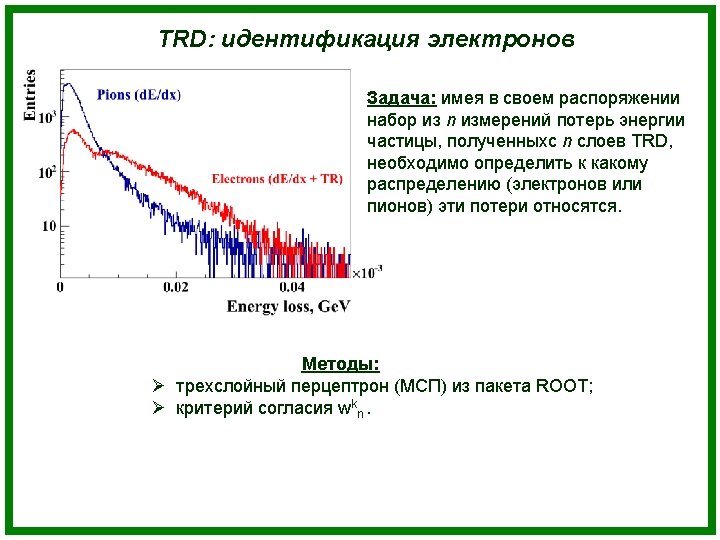
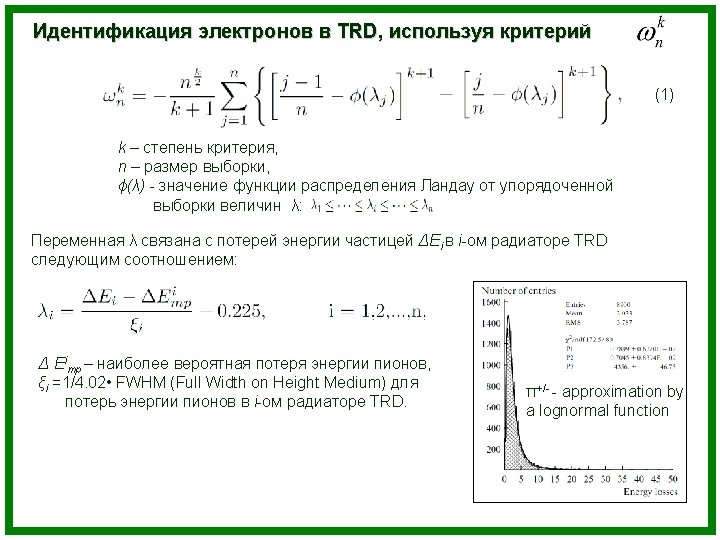
TRD: energy losses π+/- - approximation by a lognormal function z i n Io io at Tra n nsi s e s s lo tion los radi ses atio +/n e - complex character (d. E/dx + TR)
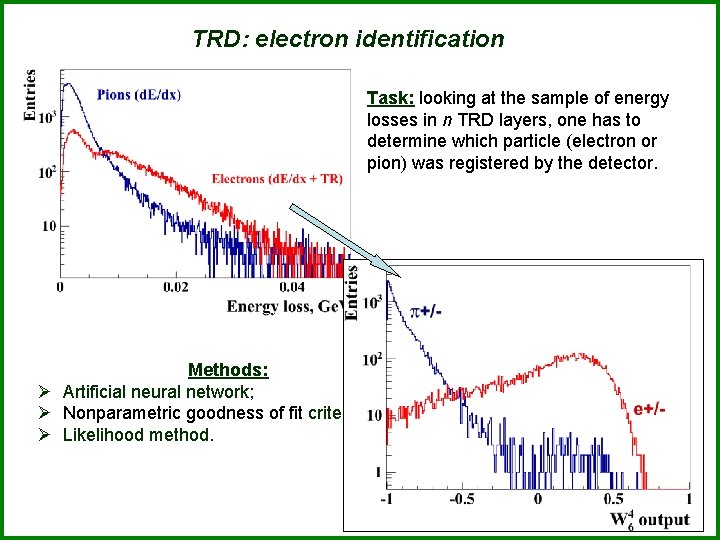
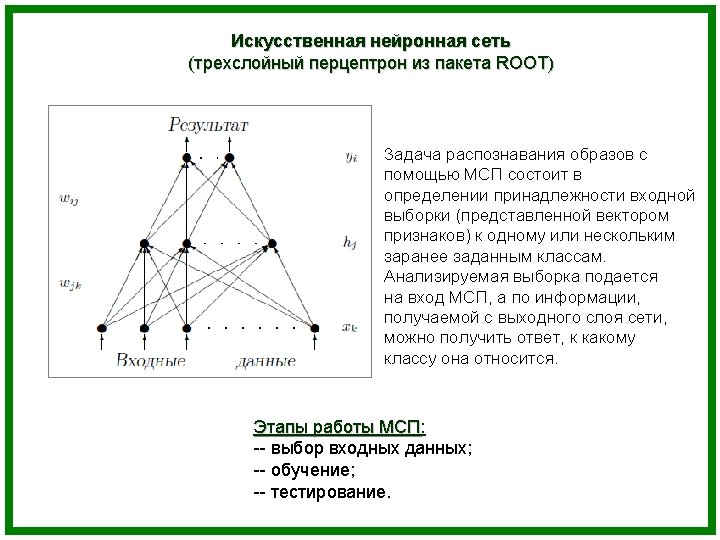
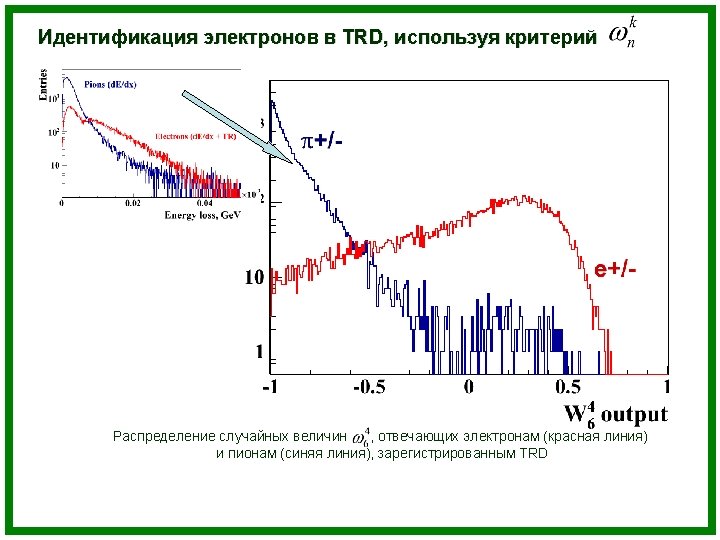
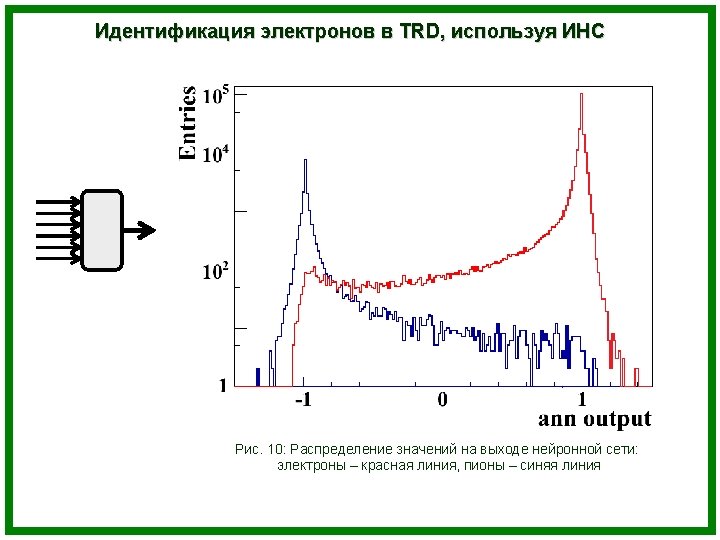
TRD: electron identification Task: looking at the sample of energy losses in n TRD layers, one has to determine which particle (electron or pion) was registered by the detector. Methods: Ø Artificial neural network; Ø Nonparametric goodness of fit criterion wkn ; Ø Likelihood method.
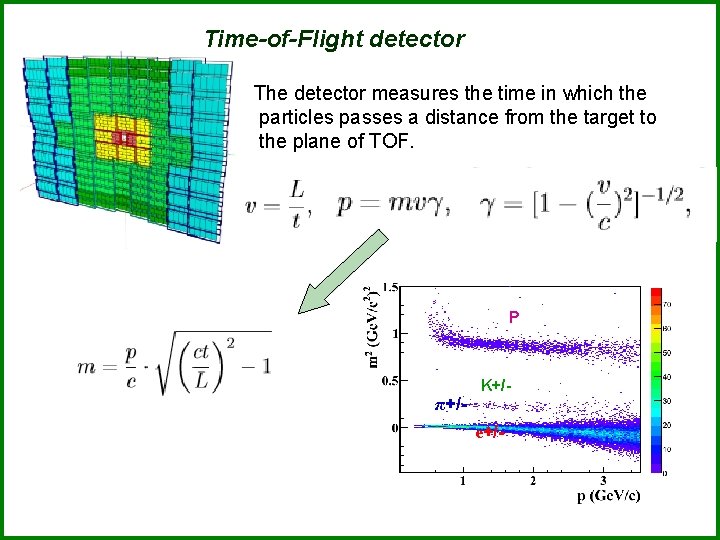
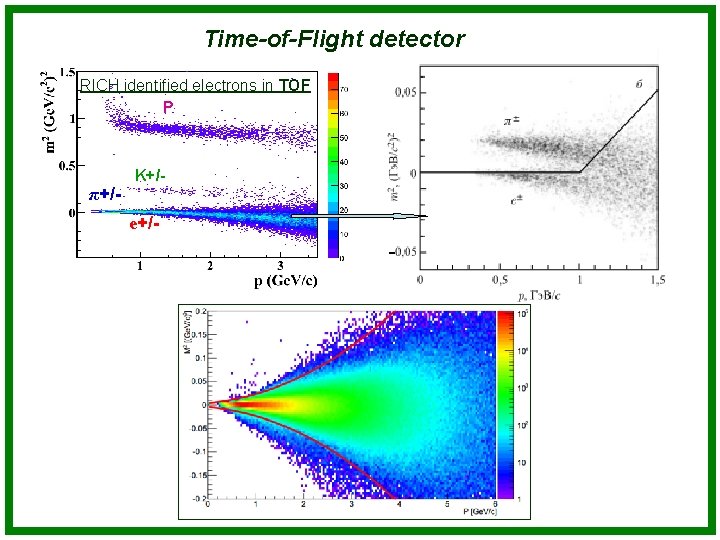
Time-of-Flight detector The detector measures the time in which the particles passes a distance from the target to the plane of TOF. P π+/- K+/- e+/-
Collision What particles were born and their characteristics Detectors Particle identification: Trajectory, momentum STS, TRD Energy • detector response ECAL • transition radiation TRD • Cherenkov radiation RICH • time of flight TOF ECAL
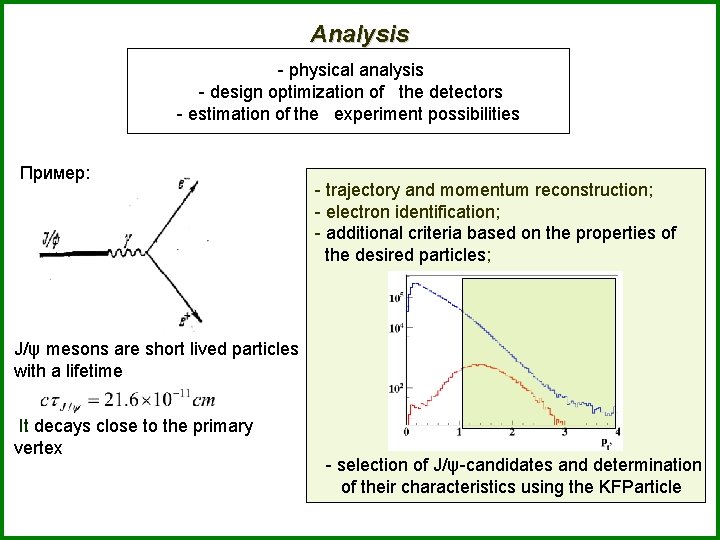
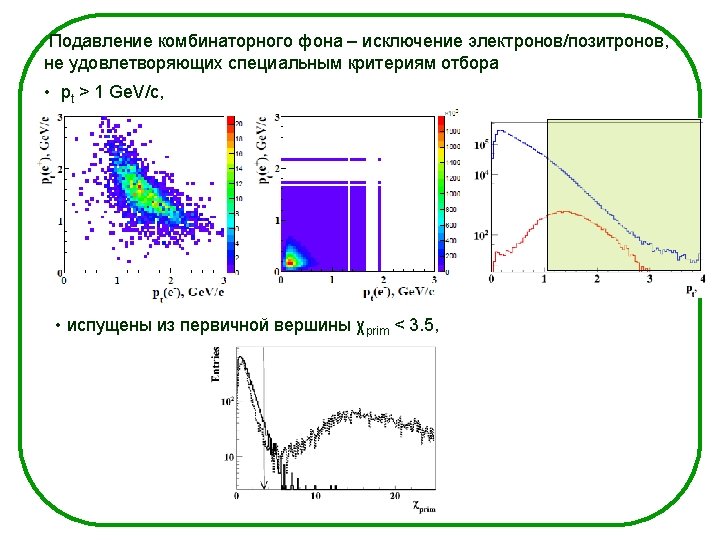
Analysis - physical analysis - design optimization of the detectors - estimation of the experiment possibilities Пример: - trajectory and momentum reconstruction; - electron identification; - additional criteria based on the properties of the desired particles; J/ψ mesons are short lived particles with a lifetime It decays close to the primary vertex - selection of J/ψ-candidates and determination of their characteristics using the KFParticle
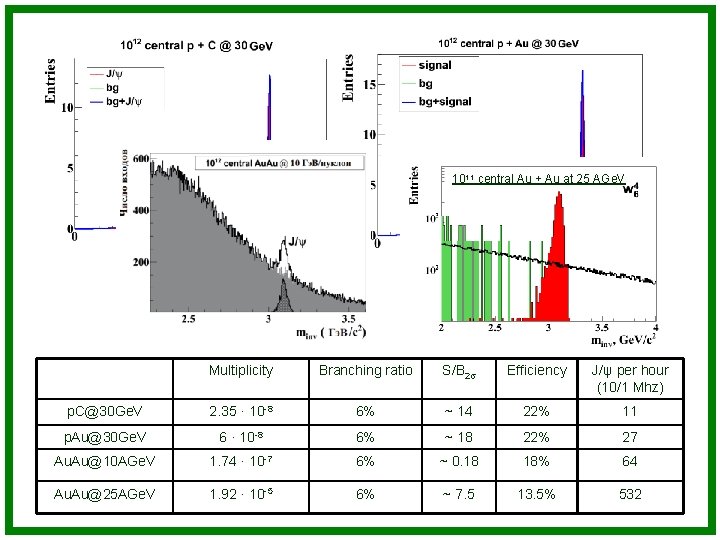
1011 central Au + Au at 25 AGe. V Multiplicity Branching ratio S/B 2σ Efficiency J/ψ per hour (10/1 Mhz) p. C@30 Ge. V 2. 35 · 10 -8 6% ~ 14 22% 11 p. Au@30 Ge. V 6 · 10 -8 6% ~ 18 22% 27 Au. Au@10 AGe. V 1. 74 · 10 -7 6% ~ 0. 18 18% 64 Au. Au@25 AGe. V 1. 92 · 10 -5 6% ~ 7. 5 13. 5% 532
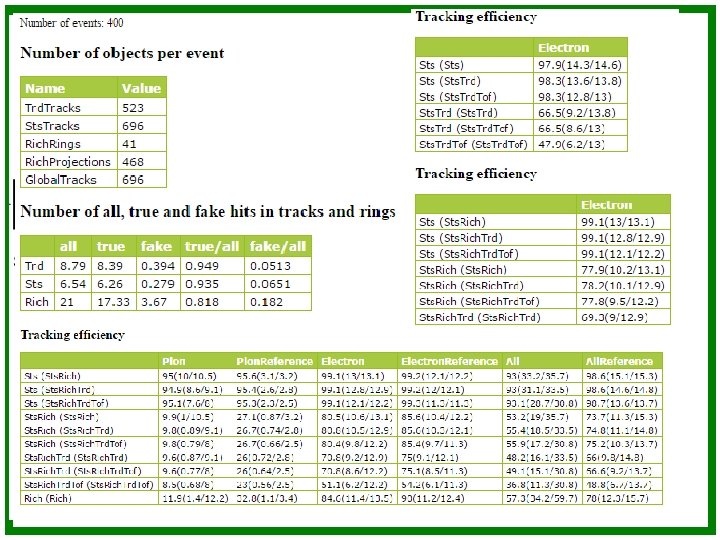
The quality assurance tools The problem of the software quality assurance and testing is of special importance for large complex software systems. In general automatization of regularly performed task is an important component of a well organized software development process. Good and automatized testing procedure can considerably improve the development process, since the developer can be sure that changes made in the code do not crash the program or lead to incorrect simulation results. Currently tracking performance tool allows to calculate: • tracking efficiency in STS, TRD, MUCH, TOF detectors • global tracking efficiency, • ring reconstruction efficiency in RICH detector, • electron identification, • pion suppression performance and other useful quality values.
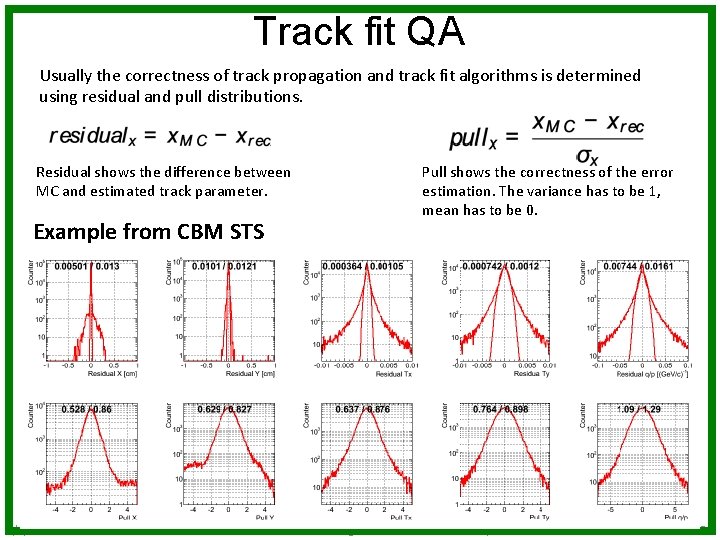
Track fit QA Usually the correctness of track propagation and track fit algorithms is determined using residual and pull distributions. Residual shows the difference between MC and estimated track parameter. Example from CBM STS 7/6/2014 Pull shows the correctness of the error estimation. The variance has to be 1, mean has to be 0. A. Lebedev "Event Reconstruction Algorithms for Modern HEP experiments" 34
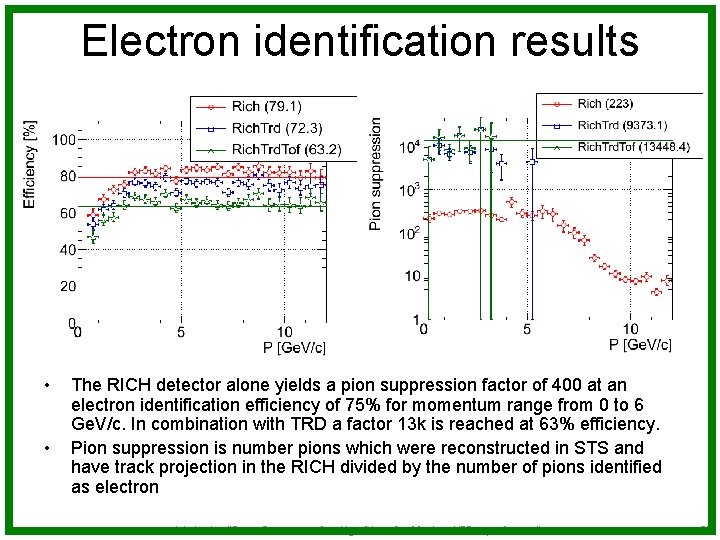
Electron identification results • • The RICH detector alone yields a pion suppression factor of 400 at an electron identification efficiency of 75% for momentum range from 0 to 6 Ge. V/c. In combination with TRD a factor 13 k is reached at 63% efficiency. Pion suppression is number pions which were reconstructed in STS and have track projection in the RICH divided by the number of pions identified as electron A. Lebedev "Event Reconstruction Algorithms for Modern HEP experiments" 35
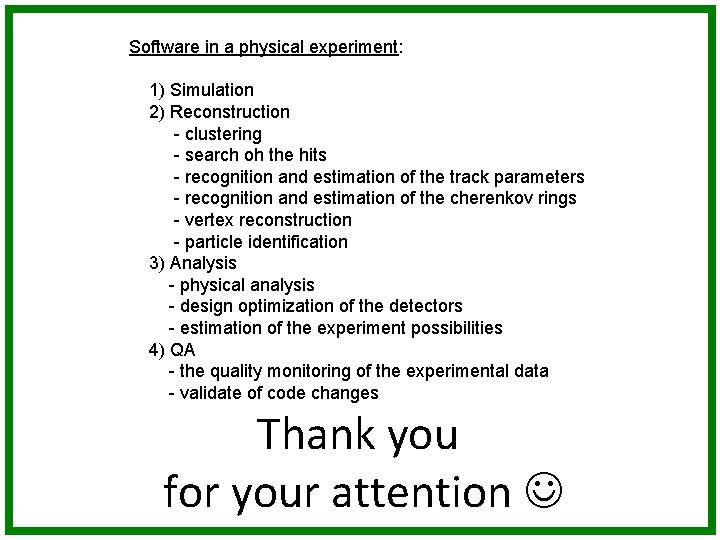
Software in a physical experiment: 1) Simulation 2) Reconstruction - clustering - search oh the hits - recognition and estimation of the track parameters - recognition and estimation of the cherenkov rings - vertex reconstruction - particle identification 3) Analysis - physical analysis - design optimization of the detectors - estimation of the experiment possibilities 4) QA - the quality monitoring of the experimental data - validate of code changes Thank you for your attention
Back up
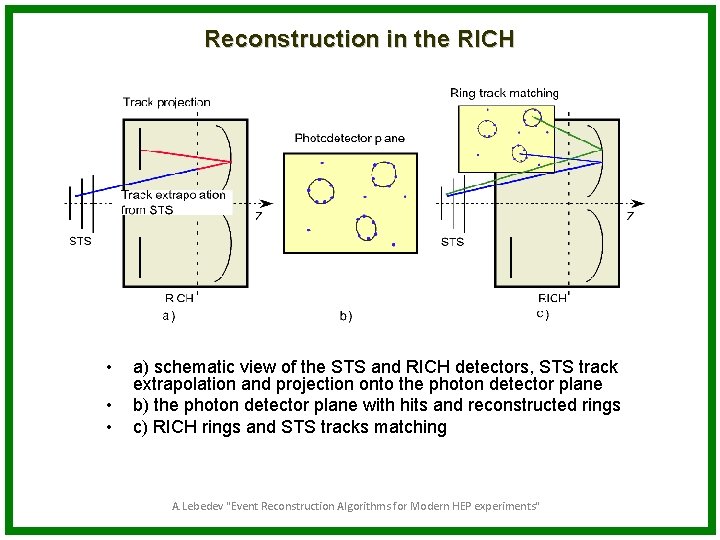
Reconstruction in the RICH • • • a) schematic view of the STS and RICH detectors, STS track extrapolation and projection onto the photon detector plane b) the photon detector plane with hits and reconstructed rings c) RICH rings and STS tracks matching A. Lebedev "Event Reconstruction Algorithms for Modern HEP experiments"
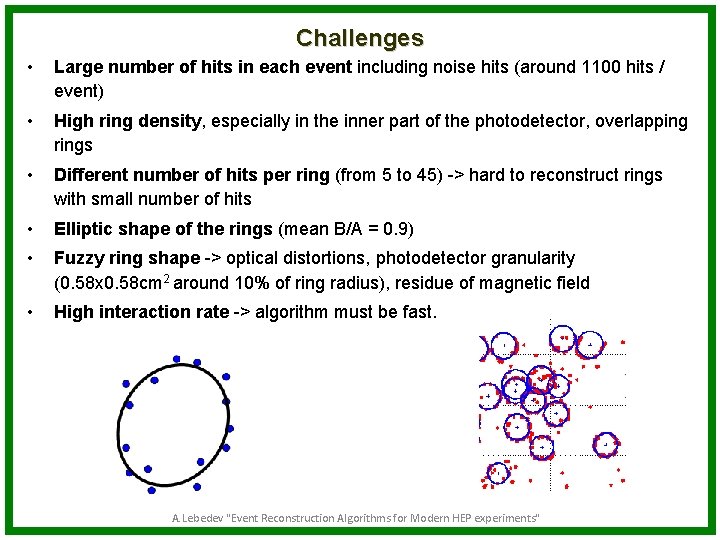
Challenges • Large number of hits in each event including noise hits (around 1100 hits / event) • High ring density, especially in the inner part of the photodetector, overlapping rings • Different number of hits per ring (from 5 to 45) -> hard to reconstruct rings with small number of hits • Elliptic shape of the rings (mean B/A = 0. 9) • Fuzzy ring shape -> optical distortions, photodetector granularity (0. 58 x 0. 58 cm 2 around 10% of ring radius), residue of magnetic field • High interaction rate -> algorithm must be fast. A. Lebedev "Event Reconstruction Algorithms for Modern HEP experiments"
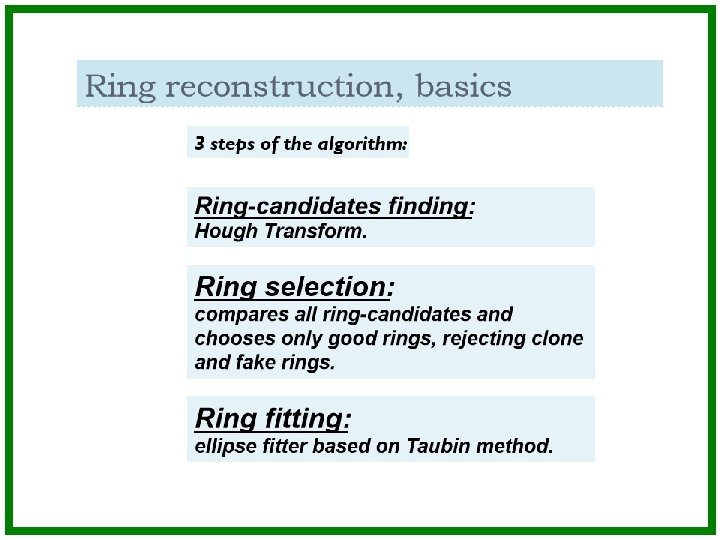
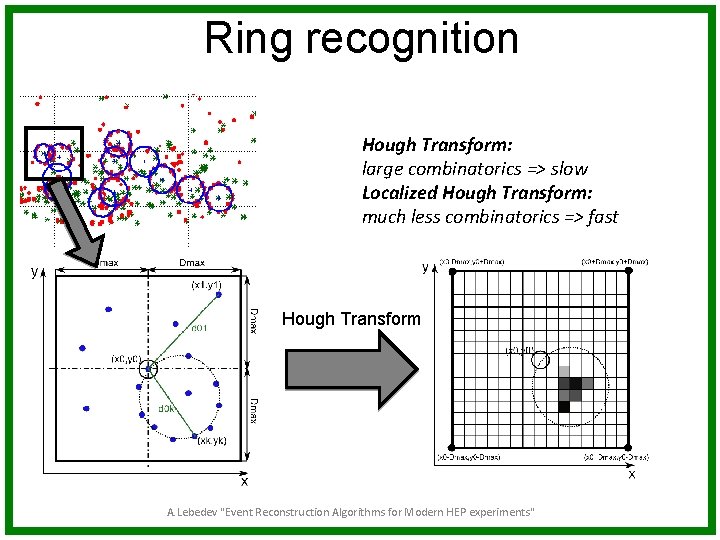
Ring recognition Hough Transform: large combinatorics => slow Localized Hough Transform: much less combinatorics => fast Hough Transform A. Lebedev "Event Reconstruction Algorithms for Modern HEP experiments"
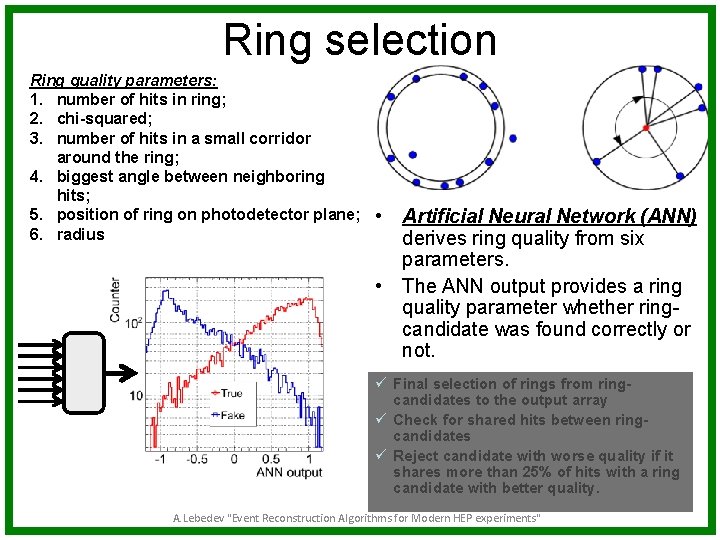
Ring selection Ring quality parameters: 1. number of hits in ring; 2. chi-squared; 3. number of hits in a small corridor around the ring; 4. biggest angle between neighboring hits; 5. position of ring on photodetector plane; 6. radius • Artificial Neural Network (ANN) derives ring quality from six parameters. • The ANN output provides a ring quality parameter whether ringcandidate was found correctly or not. ü Final selection of rings from ringcandidates to the output array ü Check for shared hits between ringcandidates ü Reject candidate with worse quality if it shares more than 25% of hits with a ring candidate with better quality. A. Lebedev "Event Reconstruction Algorithms for Modern HEP experiments"
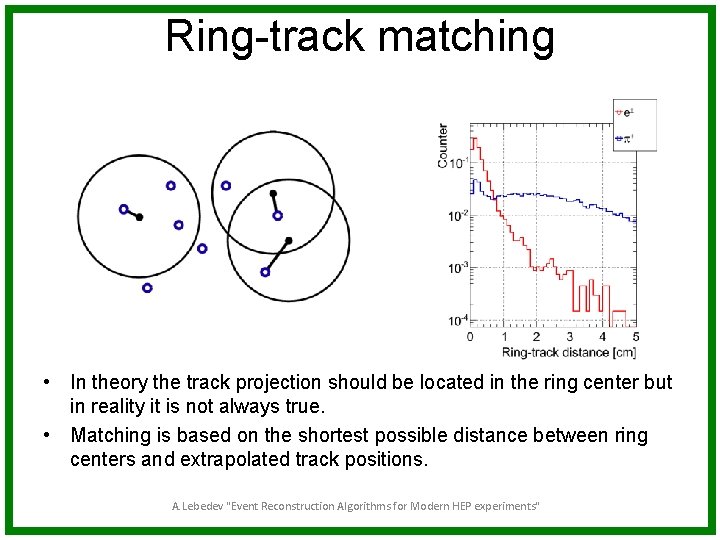
Ring-track matching • In theory the track projection should be located in the ring center but in reality it is not always true. • Matching is based on the shortest possible distance between ring centers and extrapolated track positions. A. Lebedev "Event Reconstruction Algorithms for Modern HEP experiments"
Time-of-Flight detector RICH identified electrons in TOF P π+/- K+/- e+/-