
Even faster point set pattern matching in 3


- Slides: 11
Even faster point set pattern matching in 3 -d Laurence Boxer Niagara University and SUNY - Buffalo boxer@niagara. edu Research partially supported by a grant from the Niagara University Research Council SPIE Vision Geometry - July '99
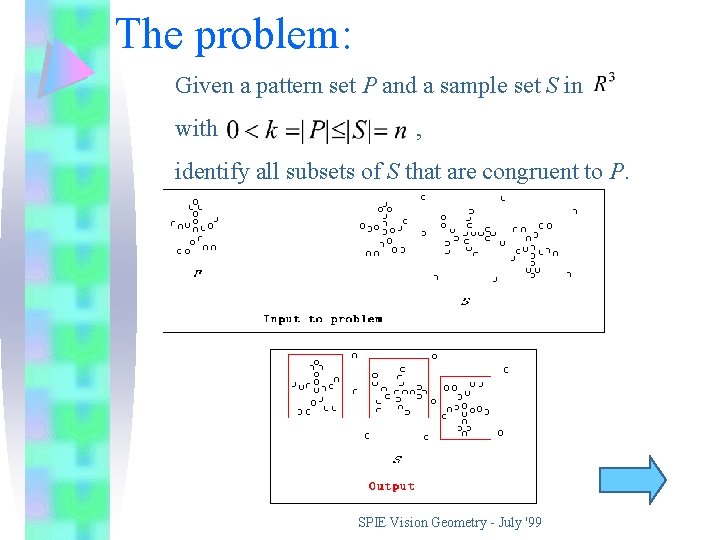
The problem: Given a pattern set P and a sample set S in with , identify all subsets of S that are congruent to P. SPIE Vision Geometry - July '99
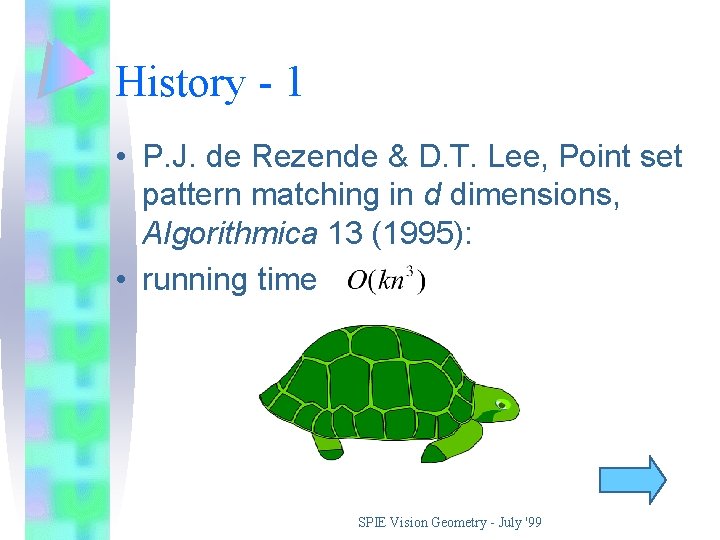
History - 1 • P. J. de Rezende & D. T. Lee, Point set pattern matching in d dimensions, Algorithmica 13 (1995): • running time SPIE Vision Geometry - July '99
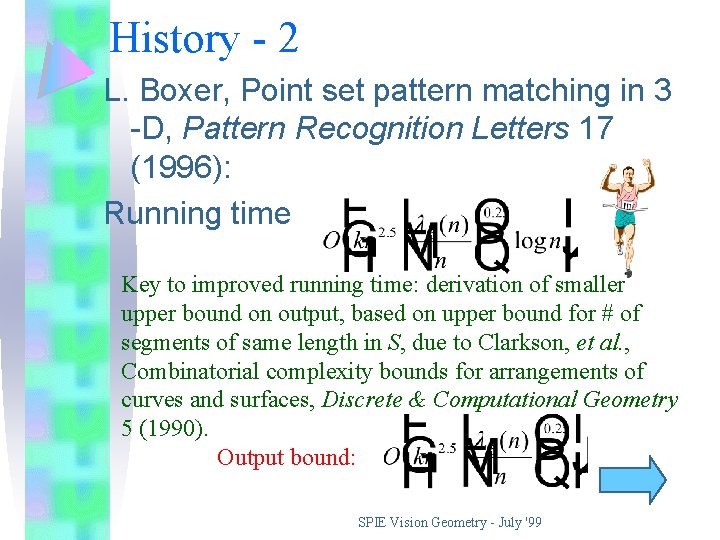
History - 2 L. Boxer, Point set pattern matching in 3 -D, Pattern Recognition Letters 17 (1996): Running time Key to improved running time: derivation of smaller upper bound on output, based on upper bound for # of segments of same length in S, due to Clarkson, et al. , Combinatorial complexity bounds for arrangements of curves and surfaces, Discrete & Computational Geometry 5 (1990). Output bound: SPIE Vision Geometry - July '99
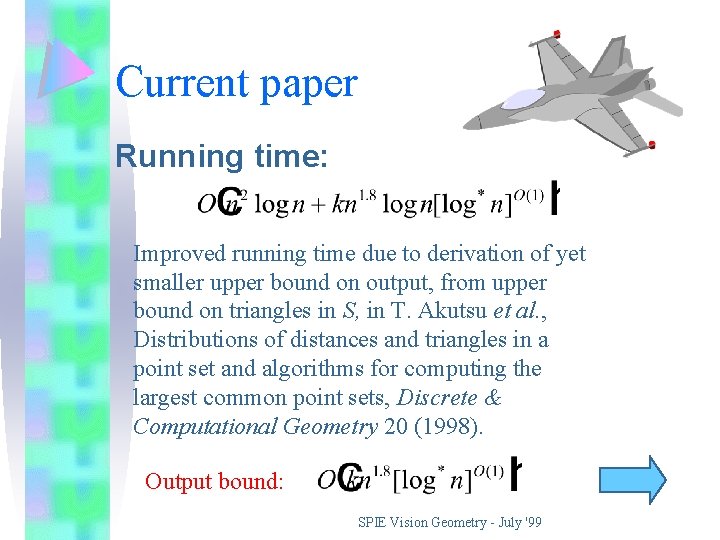
Current paper Running time: Improved running time due to derivation of yet smaller upper bound on output, from upper bound on triangles in S, in T. Akutsu et al. , Distributions of distances and triangles in a point set and algorithms for computing the largest common point sets, Discrete & Computational Geometry 20 (1998). Output bound: SPIE Vision Geometry - July '99
Sketch of algorithm - 1 1. Sort S lexicographically. 2. Determine whether P is collinear. If so, handle via special (faster) algorithm for this case. If not, note a noncollinear triple T in P. 3. Find each triple T’ in S that matches T. Avoid considering all triples by forming line segments, sorting by length & endpoints, searching. 4. For each T’, compute the (at most constant # of) rigid transformations f such that f(T)=T’. SPIE Vision Geometry - July '99
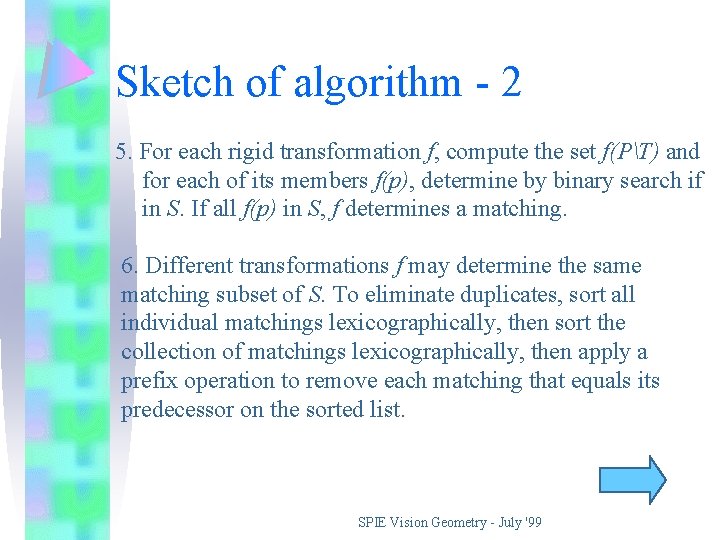
Sketch of algorithm - 2 5. For each rigid transformation f, compute the set f(PT) and for each of its members f(p), determine by binary search if in S. If all f(p) in S, f determines a matching. 6. Different transformations f may determine the same matching subset of S. To eliminate duplicates, sort all individual matchings lexicographically, then sort the collection of matchings lexicographically, then apply a prefix operation to remove each matching that equals its predecessor on the sorted list. SPIE Vision Geometry - July '99
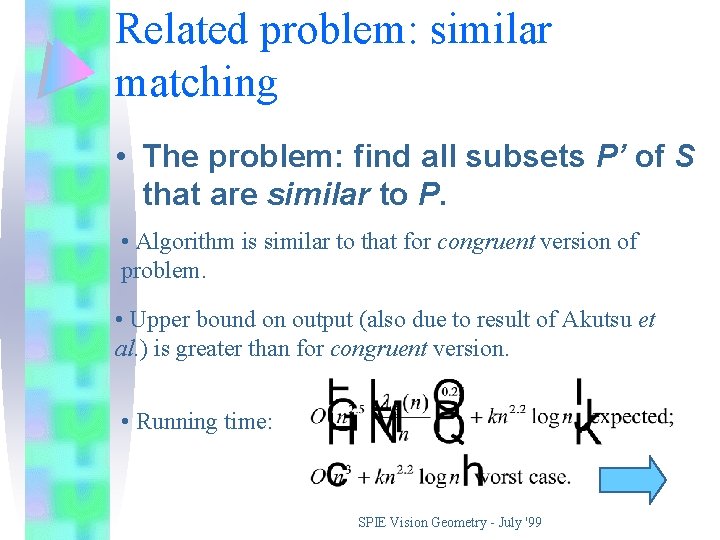
Related problem: similar matching • The problem: find all subsets P’ of S that are similar to P. • Algorithm is similar to that for congruent version of problem. • Upper bound on output (also due to result of Akutsu et al. ) is greater than for congruent version. • Running time: SPIE Vision Geometry - July '99
Related problem: congruent copy detection (CCD) • The problem: find some congruent copy P’ of P in S • Note any solution to PSPM Problem solves CCD. • Therefore our solution to PSPM Problem gives (slight) improvement on solution to CCD in Akutsu et al. SPIE Vision Geometry - July '99
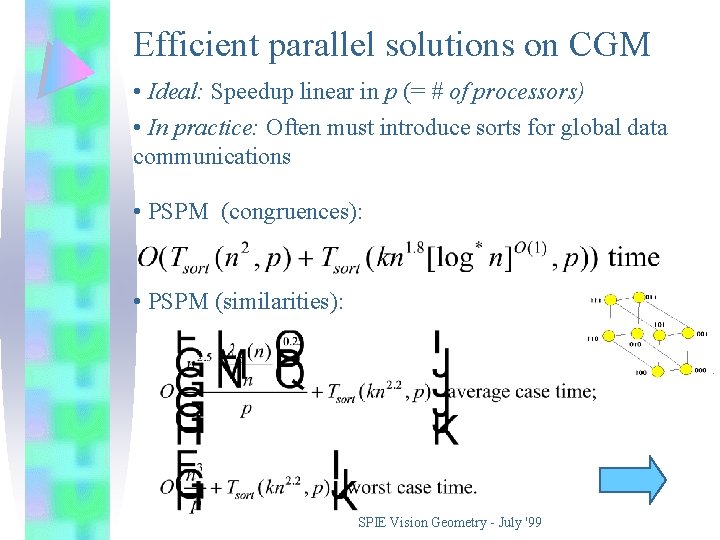
Efficient parallel solutions on CGM • Ideal: Speedup linear in p (= # of processors) • In practice: Often must introduce sorts for global data communications • PSPM (congruences): • PSPM (similarities): SPIE Vision Geometry - July '99
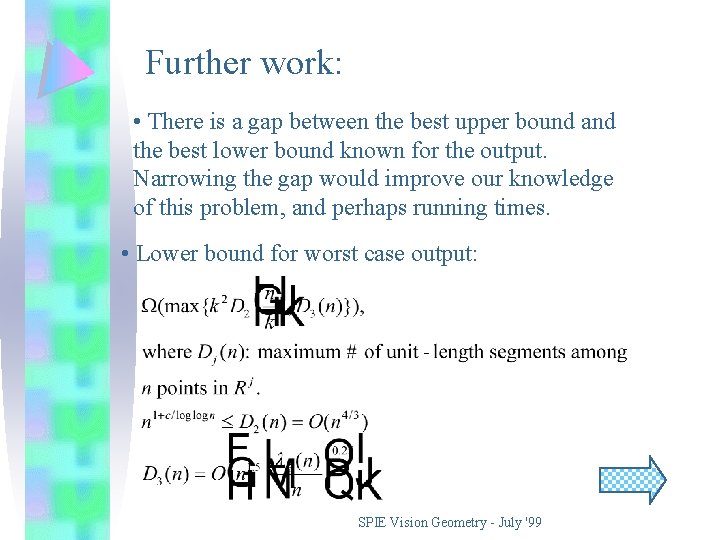
Further work: • There is a gap between the best upper bound and the best lower bound known for the output. Narrowing the gap would improve our knowledge of this problem, and perhaps running times. • Lower bound for worst case output: SPIE Vision Geometry - July '99