
Evaporative DropletParticle Collision Dynamics LiangShih Fan Department of
- Slides: 1
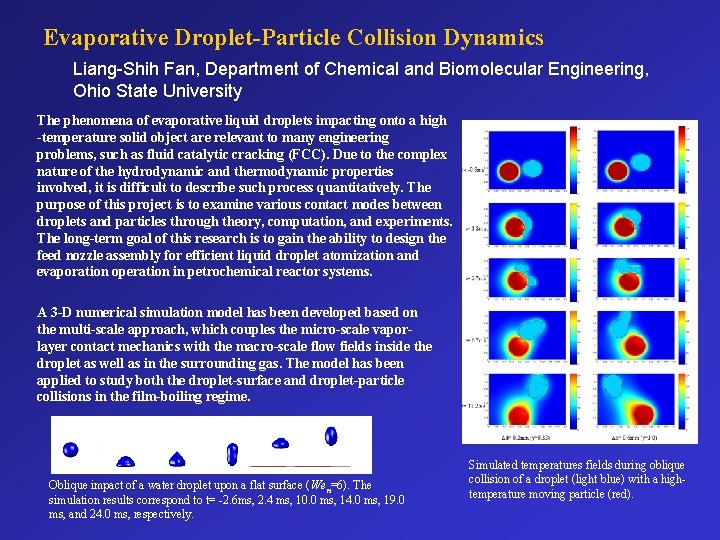
Evaporative Droplet-Particle Collision Dynamics Liang-Shih Fan, Department of Chemical and Biomolecular Engineering, Ohio State University The phenomena of evaporative liquid droplets impacting onto a high -temperature solid object are relevant to many engineering problems, such as fluid catalytic cracking (FCC). Due to the complex nature of the hydrodynamic and thermodynamic properties involved, it is difficult to describe such process quantitatively. The purpose of this project is to examine various contact modes between droplets and particles through theory, computation, and experiments. The long-term goal of this research is to gain the ability to design the feed nozzle assembly for efficient liquid droplet atomization and evaporation operation in petrochemical reactor systems. A 3 -D numerical simulation model has been developed based on the multi-scale approach, which couples the micro-scale vaporlayer contact mechanics with the macro-scale flow fields inside the droplet as well as in the surrounding gas. The model has been applied to study both the droplet-surface and droplet-particle collisions in the film-boiling regime. Oblique impact of a water droplet upon a flat surface (Wen=6). The simulation results correspond to t= -2. 6 ms, 2. 4 ms, 10. 0 ms, 14. 0 ms, 19. 0 ms, and 24. 0 ms, respectively. Simulated temperatures fields during oblique collision of a droplet (light blue) with a hightemperature moving particle (red).