
Evaluation Treatment of Swallowing Disorder Pooling Residual Drooling












- Slides: 45
Evaluation & Treatment of Swallowing Disorder
• • Pooling Residual Drooling Bolus Aspiration Penetration Chin-tuck(Chin-down) Larynx elevation
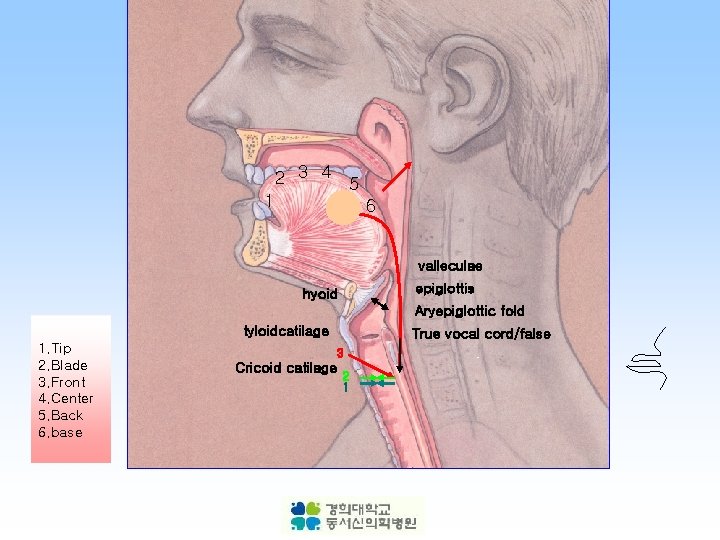
2 3 4 5 1 6 valleculae epiglottis hyoid Aryepiglottic fold tyloidcatilage 1. Tip 2. Blade 3. Front 4. Center 5. Back 6. base True vocal cord/false 3 Cricoid catilage 2 1
일반적인 평가 과정 • • • (Common Assessment Procedure) 환자/ 보호자 인터뷰, bedside or chairside assessment, videofluoroscopy 또는 modified barium swallow study(MBS) fiberoptic endoscopic evaluation of swallowing(FEES) SEMG Mamometry
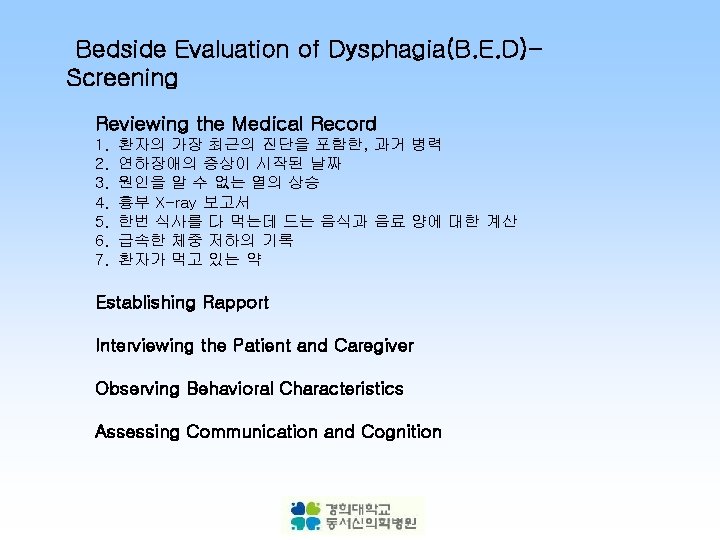
Bedside Evaluation of Dysphagia(B. E. D)Screening Reviewing the Medical Record 1. 환자의 가장 최근의 진단을 포함한, 과거 병력 2. 연하장애의 증상이 시작된 날짜 3. 원인을 알 수 없는 열의 상승 4. 흉부 X-ray 보고서 5. 한번 식사를 다 먹는데 드는 음식과 음료 양에 대한 계산 6. 급속한 체중 저하의 기록 7. 환자가 먹고 있는 약 Establishing Rapport Interviewing the Patient and Caregiver Observing Behavioral Characteristics Assessing Communication and Cognition
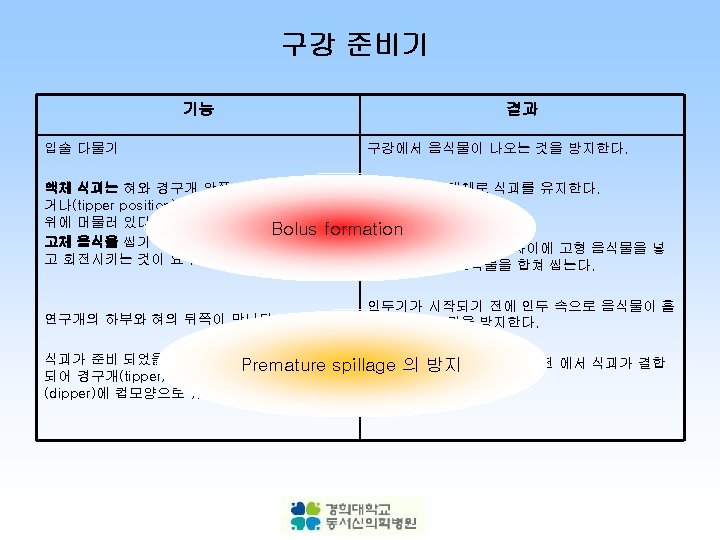
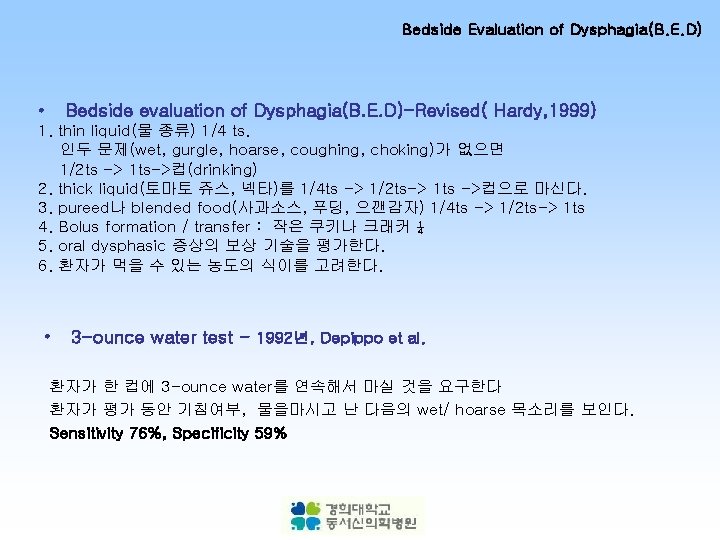
Bedside Evaluation of Dysphagia(B. E. D) • Bedside evaluation of Dysphagia(B. E. D)-Revised( Hardy, 1999) 1. thin liquid(물 종류) 1/4 ts. 인두 문제(wet, gurgle, hoarse, coughing, choking)가 없으면 1/2 ts -> 1 ts->컵(drinking) 2. thick liquid(토마토 쥬스, 넥타)를 1/4 ts -> 1/2 ts-> 1 ts ->컵으로 마신다. 3. pureed나 blended food(사과소스, 푸딩, 으깬감자) 1/4 ts -> 1/2 ts-> 1 ts 4. Bolus formation / transfer : 작은 쿠키나 크래커 ¼ 5. oral dysphasic 증상의 보상 기술을 평가한다. 6. 환자가 먹을 수 있는 농도의 식이를 고려한다. • 3 -ounce water test - 1992년, Depippo et al. 환자가 한 컵에 3 -ounce water를 연속해서 마실 것을 요구한다 환자가 평가 동안 기침여부, 물을마시고 난 다음의 wet/ hoarse 목소리를 보인다. Sensitivity 76%, Specificity 59%
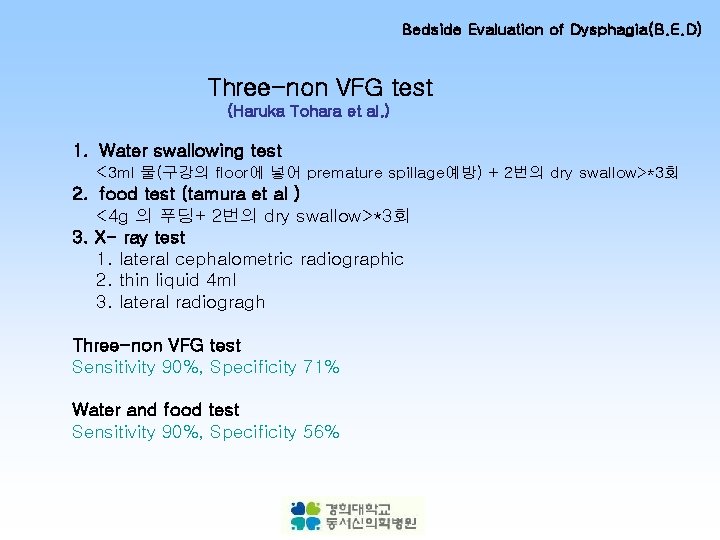
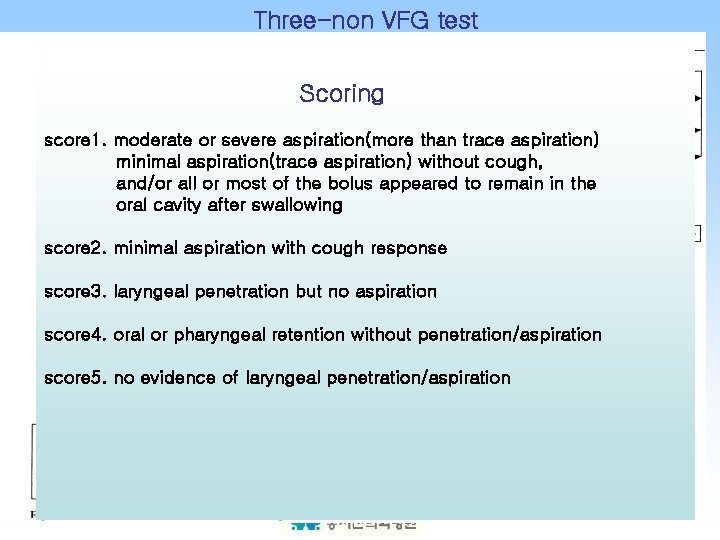
Bedside Evaluation of Dysphagia(B. E. D) Three-non VFG test (Haruka Tohara et al. ) 1. Water swallowing test <3 ml 물(구강의 floor에 넣어 premature spillage예방) + 2번의 dry swallow>*3회 2. food test (tamura et al ) <4 g 의 푸딩+ 2번의 dry swallow>*3회 3. X- ray test 1. lateral cephalometric radiographic 2. thin liquid 4 ml 3. lateral radiogragh Three-non VFG test Sensitivity 90%, Specificity 71% Water and food test Sensitivity 90%, Specificity 56%
Three-non VFG test Scoring score 1. moderate or severe aspiration(more than trace aspiration) minimal aspiration(trace aspiration) without cough, and/or all or most of the bolus appeared to remain in the oral cavity after swallowing score 2. minimal aspiration with cough response score 3. laryngeal penetration but no aspiration score 4. oral or pharyngeal retention without penetration/aspiration score 5. no evidence of laryngeal penetration/aspiration
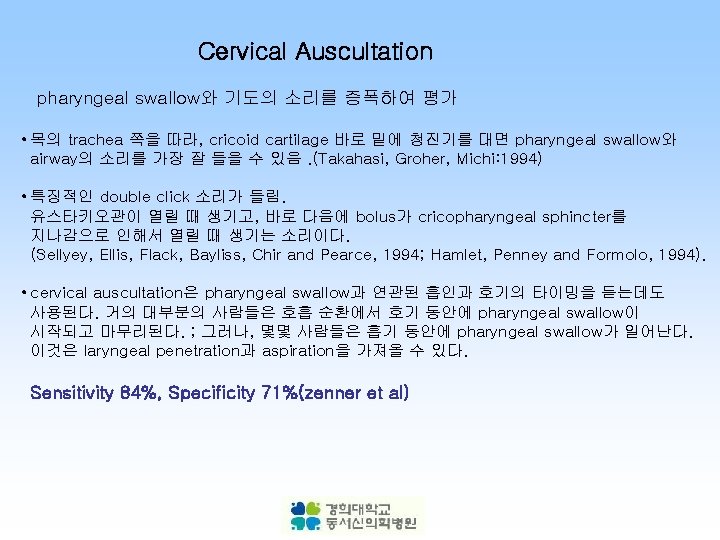
Cervical Auscultation pharyngeal swallow와 기도의 소리를 증폭하여 평가 • 목의 trachea 쪽을 따라, cricoid cartilage 바로 밑에 청진기를 대면 pharyngeal swallow와 airway의 소리를 가장 잘 들을 수 있음. (Takahasi, Groher, Michi: 1994) • 특징적인 double click 소리가 들림. 유스타키오관이 열릴 때 생기고, 바로 다음에 bolus가 cricopharyngeal sphincter를 지나감으로 인해서 열릴 때 생기는 소리이다. (Sellyey, Ellis, Flack, Bayliss, Chir and Pearce, 1994; Hamlet, Penney and Formolo, 1994). • cervical auscultation은 pharyngeal swallow과 연관된 흡인과 호기의 타이밍을 듣는데도 사용된다. 거의 대부분의 사람들은 호흡 순환에서 호기 동안에 pharyngeal swallow이 시작되고 마무리된다. ; 그러나, 몇몇 사람들은 흡기 동안에 pharyngeal swallow가 일어난다. 이것은 laryngeal penetration과 aspiration을 가져올 수 있다. Sensitivity 84%, Specificity 71%(zenner et al)
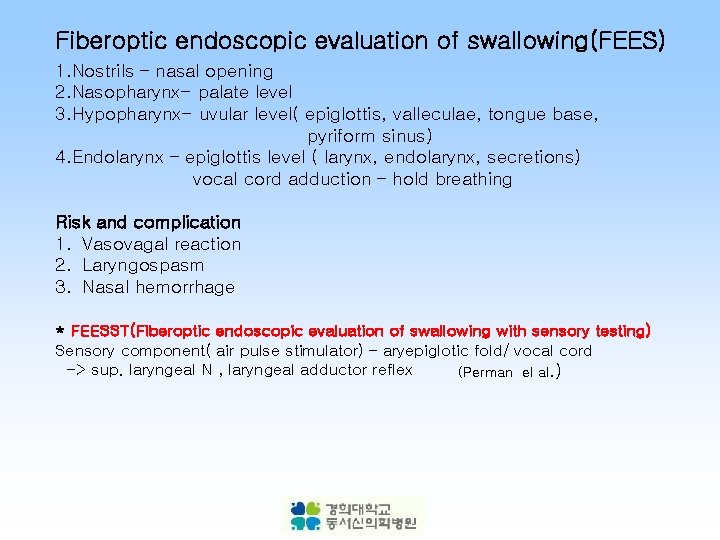
Fiberoptic endoscopic evaluation of swallowing(FEES) 1. Nostrils – nasal opening 2. Nasopharynx- palate level 3. Hypopharynx- uvular level( epiglottis, valleculae, tongue base, pyriform sinus) 4. Endolarynx – epiglottis level ( larynx, endolarynx, secretions) vocal cord adduction – hold breathing Risk and complication 1. Vasovagal reaction 2. Laryngospasm 3. Nasal hemorrhage * FEESST(Fiberoptic endoscopic evaluation of swallowing with sensory testing) Sensory component( air pulse stimulator) – aryepiglotic fold/ vocal cord -> sup. laryngeal N , laryngeal adductor reflex (Perman el al. )
Oral Preperatory and Oral Stage Swallowing Disturbances • • • Decreased Lip Seal Buccal-Facial Paresis /Paralysis Reduced Oral Sensation Reduced Tongue Function Dry Mouth
Pharyngeal Stage Swallowing Disturbances • • • Delayed or Absent Triggering of the Pharyngeal Swallow Reduced Velopharyngeal Function Reduced Tongue Base Retraction Reduced Pharyngeal Wall contraction Unilateral Pharyngeal Wall Paralysis / Paresis Reduction in Hyoid Movement Impaired Epiglottic Function Laryngeal Penetration Aspiration Reduced Laryngeal Elevation and Anterior Movement Reduced Laryngeal Closure
Treatment
Sour Lemon Bolus Swallow 목적 oral pharyngeal awareness를 자극 tongue base retraction의 증진 pharyngeal swallow의 triggering을 증진 대상 aspiration의 위험 없이 thick liquid를 삼킬 수 있는 환자에게 사용 과민한 gag reflex를 가지고 있거나 thermal - tactile stimulation을 참을 수 없는 환자에게 유용 Procedure sour lemon bolus 만들기 16 티스푼 또는 80 cc 시큼한 분말 lemonade향료 8 티스푼 또는 40 cc 상업용 분말 thickener 1 티스푼 설탕 또는 1 팩의 인공 sweetener (감미료) 1/8 티스푼 소금 16 온스 물 -> slushy상태로 사용 효과 1/3에서 1/2 티스푼을 시행 anterior faucial arch를 자극 oral sensitivity pharyngeal swallow의 triggering
Oral - Motor Exercise 목적 bolus manipulation과 propulsion을 촉진 대상 exercise는 oral / pharyngeal transit time이 긴 환자 감소된 혀의 움직임 감소된 oral 감각 oral discoordination bolus의 manipulation 감소 입술과 안면의 weakness / incoordination tongue base의 retraction의 감소 방법 Oral - motor exercise는 적어도 하루에 두 번 치료 session Labial and Facial Exercise Labial Range of Motion Lip Retraction Lip Protrusion Lip Retraction and Protrusion Labial Closure Lip Press
Super - Supraglottic Swallow Technique 목적 false vocal fold를 단단히 닫고, 더 나아가 larynx를 보호한다. laryngeal elevation은 arytenoid cartilage 를 epiglottis의 뒤쪽 표면에 가깝게 해서, arytenoid의 앞쪽 움직임을 적 게 한다. 즉 laryngeal elevation이 swallow 시작에 발생하고 airway 보호를 증진시키다. 대상 1. supraglottic laryngectomy의 결과로 연하장애가 생긴 환자 supraglottic laryngectomy는 true vocal fold level 위의 laryngeal 구조의 일부를 제거하는 수술. 제거된 구조는 laryngeal cartilage위쪽 부분, false vocal fold, epiglottis and aryepiglottic fold을 포함 2. airway protection과 pharyngeal 과정의 weakness의 특징이 있는 신경성의 연하장애 환자 방법 supraglottic swallow + Effortful swallow -> airway를 닫는데 도움이 된다. super-supraglottic swallow를 사용할 때, 삼키는 동안이나 전에 arytenoid cartilage가 앞쪽 으로 기울어지고 epiglottis의 base에 닿는다.
Head holing( head lifting) maneuver (sharker et al. ) 목적 Cricopharyngeal opening과 감소된 bolus pressure 증진 인/후두 근육의 muscle strength 방법 Supine 자세에서 Isotonic, isometric head-lifting movement( 10초 동안 유지) Long-term effect Head holing( head lifting) maneuver Tongue holding manuever( masako maneuver) (fujiu et al. ) 목적 방법 Posterior pharyngeal wall movement의 증진 Pharyngeal contraction증진 하품하는 흉내를 내며 혀를 뒤로 잡아단긴다. 가글하는 소리를 내며 혀를 뒤로 잡아당긴다. 과장되게 혀를 일직선이 되게 한후 1초간 잡아 당긴다. Electrical stimulation Biofeedback
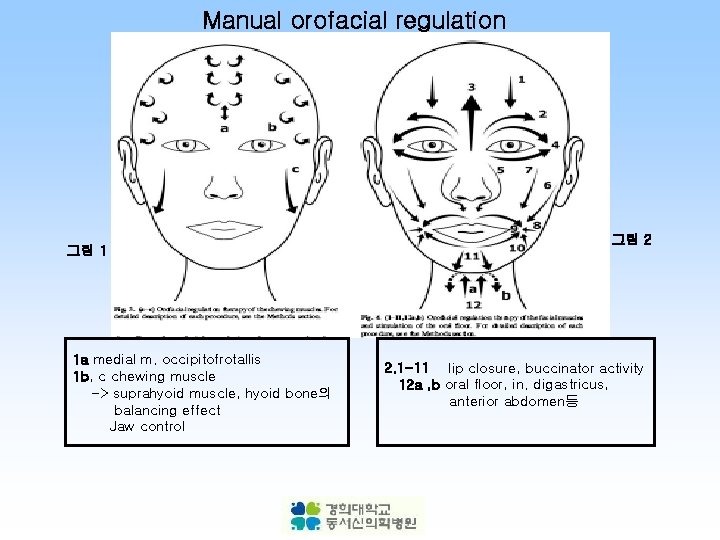
Motor and sensory Stimulation (Mary Hagg et al. ) 1. Castillo Morales(1991)에 의해 down syndrome pt를 위해 개발된 orofacial regulation에서 develop 2. 목적은 Muscle ex와 sensory-motor reflex arc의 증진 3. 삼킴과 연관된 face와 oropharynx의 기능은 호흡뿐 아니라 전체적인 body posture 와 밀접한 관계가 있다. 4. 치료는 다음과 같이 구성되어있다. body regulation manual orofacial regulation palatal plate application velopharyngeal closure training 5. Tx Schedule – 5주 주 1회 /1시간 home program manual orofacial regulation palatal plate application velopharyngeal closure training
Manual orofacial regulation 그림 1 1 a medial m. occipitofrotallis 1 b, c chewing muscle -> suprahyoid muscle, hyoid bone의 balancing effect Jaw control 그림 2 2. 1 -11 lip closure, buccinator activity 12 a , b oral floor, in. digastricus, anterior abdomen등
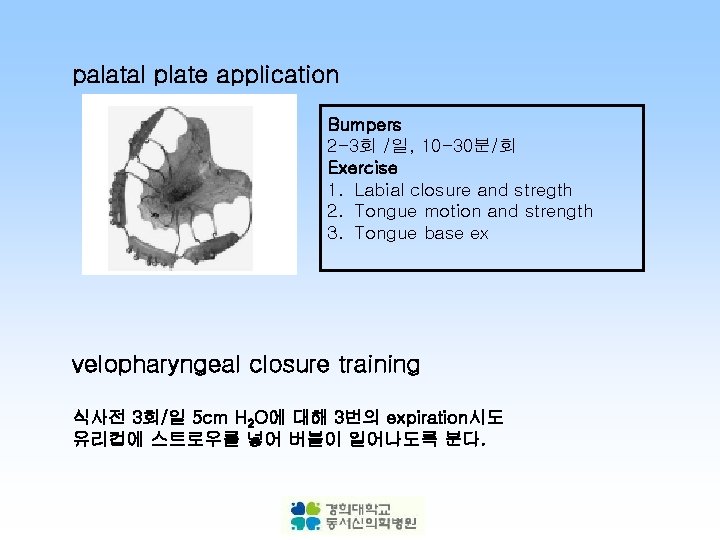
palatal plate application Bumpers 2 -3회 /일, 10 -30분/회 Exercise 1. Labial closure and stregth 2. Tongue motion and strength 3. Tongue base ex velopharyngeal closure training 식사전 3회/일 5 cm H 2 O에 대해 3번의 expiration시도 유리컵에 스트로우를 넣어 버블이 일어나도록 분다.