
Evaluation Support Scotland www evaluationsupportscotland org uk We
- Slides: 51
Evaluation Support Scotland www. evaluationsupportscotland. org. uk We work with the third sector and funders so they can measure and report on their impact and use learning to improve practice and inform policy
This resource shares learning from ESS’s work with the third sector about how to evaluate prevention We hope it will give third sector and funders an approach to how to evaluate ‘prevention’ activities and outcomes. This resource is not itself a toolkit but we provide links to practical tools and support. We aim to contribute to the Scottish Government priority: “To promote a bias towards prevention, help people understand why this is the right thing to do, the choices it implies as well as the benefits it can bring. ” (SG website)
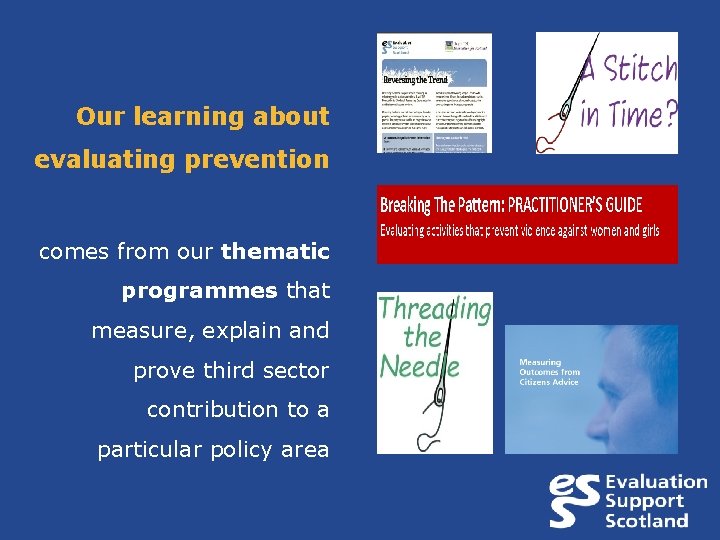
Our learning about evaluating prevention comes from our thematic programmes that measure, explain and prove third sector contribution to a particular policy area
Some tough questions about evaluating prevention ? ? How do you measure something that hasn’t happened? How do you know which intervention made the difference long term? How do you evaluate long term when funding is short term? How can you take a positive approach when prevention is basically a negative idea?
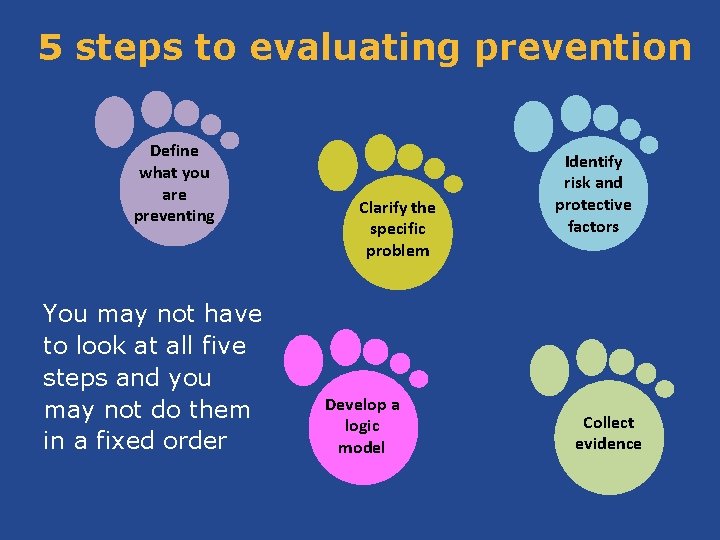
5 steps to evaluating prevention Define what you are preventing You may not have to look at all five steps and you may not do them in a fixed order Clarify the specific problem Develop a logic model Identify risk and protective factors Collect evidence
Define what you are preventing Decide what you are trying to prevent and who for
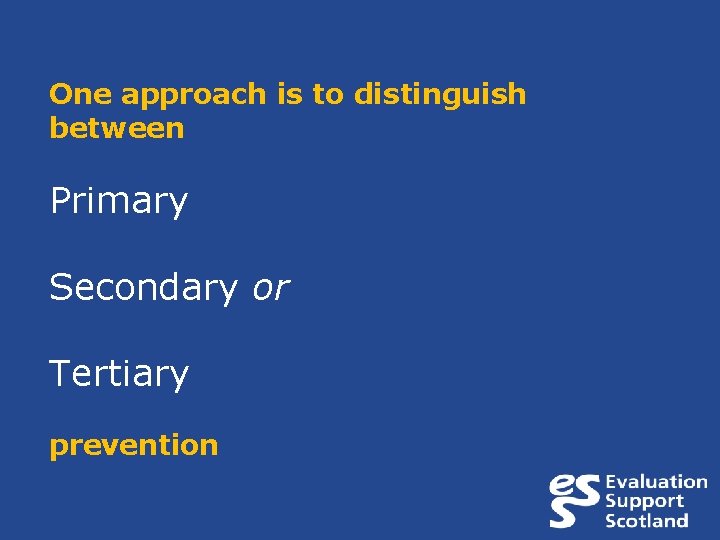
One approach is to distinguish between Primary Secondary or Tertiary prevention
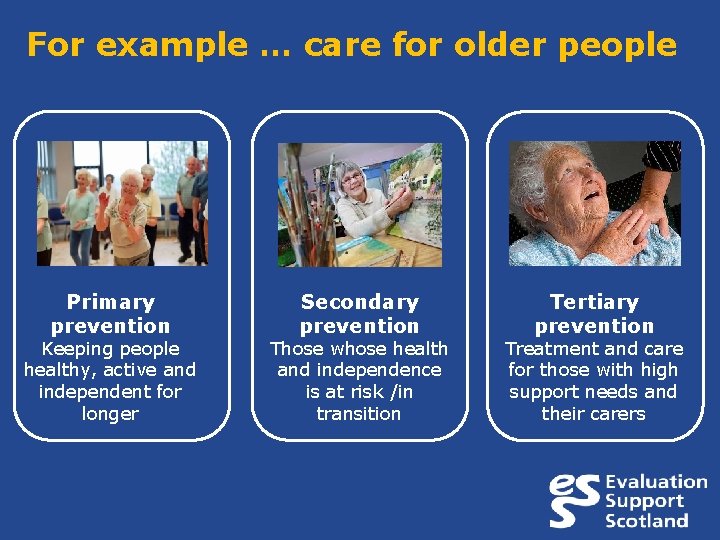
For example … care for older people Primary prevention Keeping people healthy, active and independent for longer Secondary prevention Those whose health and independence is at risk /in transition Tertiary prevention Treatment and care for those with high support needs and their carers
A second way is to distinguish between Prevention and Early intervention Define what you are preventing
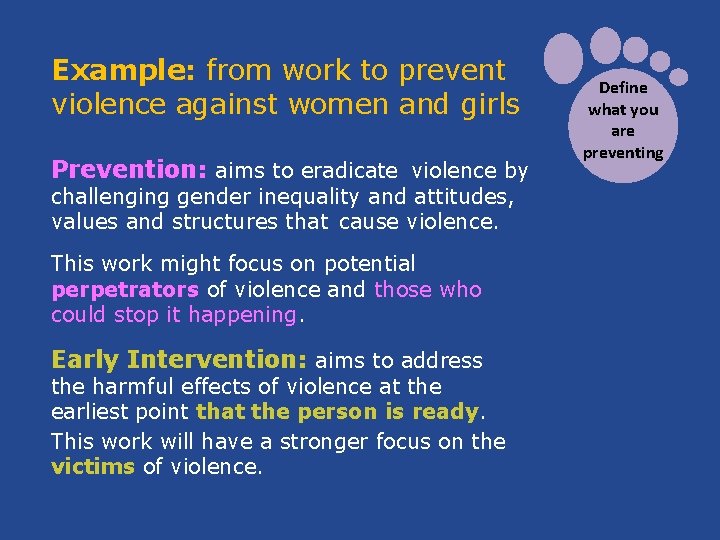
Example: from work to prevent violence against women and girls Prevention: aims to eradicate violence by challenging gender inequality and attitudes, values and structures that cause violence. This work might focus on potential perpetrators of violence and those who could stop it happening. Early Intervention: aims to address the harmful effects of violence at the earliest point that the person is ready. This work will have a stronger focus on the victims of violence. Define what you are preventing
A third way is to distinguish amongst Diversion Prevention Mitigation Define what you are preventing
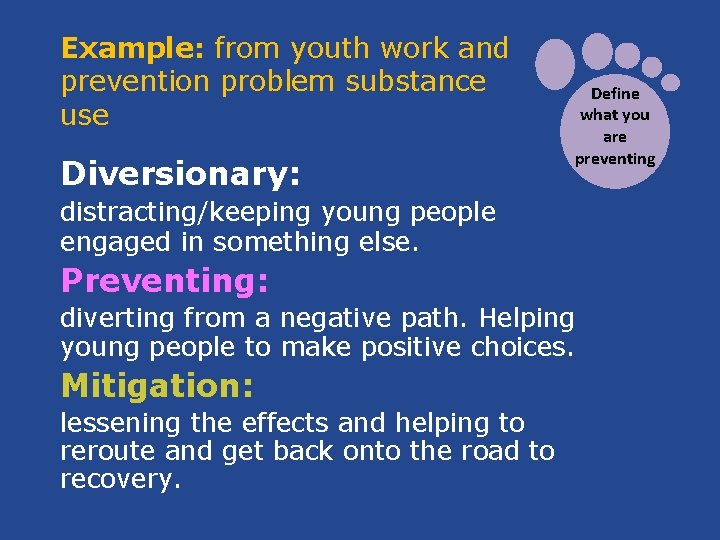
Example: from youth work and prevention problem substance use Diversionary: Define what you are preventing distracting/keeping young people engaged in something else. Preventing: diverting from a negative path. Helping young people to make positive choices. Mitigation: lessening the effects and helping to reroute and get back onto the road to recovery.
The next step is to think specifically about the problem you are trying to solve for the people you are working with. Understanding the problem helps define the solution, and also to articulate what success looks like. Clarify the specific problem
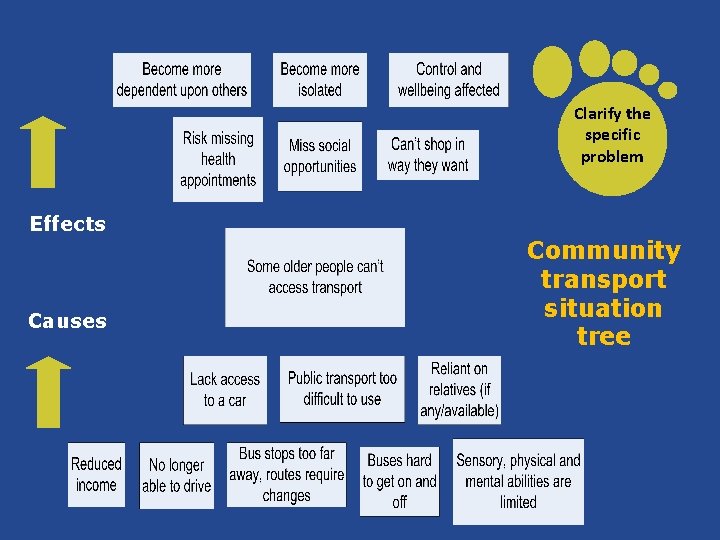
One way to think about the problem you are trying to solve is to build a situation tree On the next slide is a diagram that shows the root causes of a problem and the effects or consequences (the branches). Clarify the specific problem
Clarify the specific problem Effects Causes Community transport situation tree
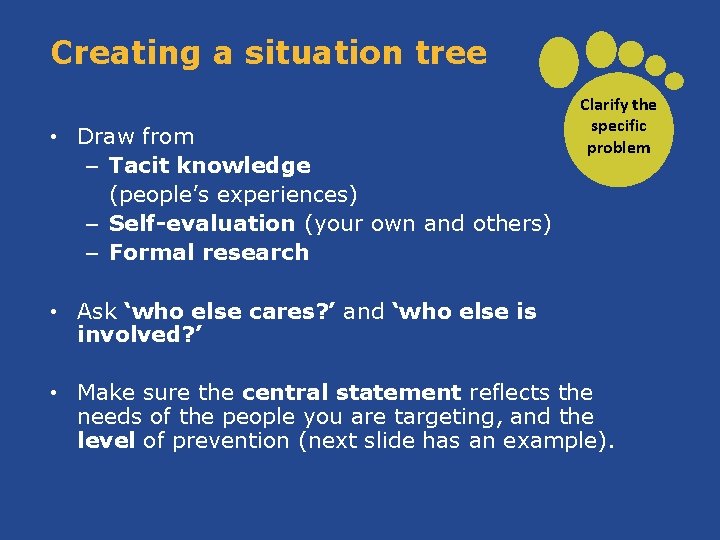
Creating a situation tree • Draw from – Tacit knowledge (people’s experiences) – Self-evaluation (your own and others) – Formal research Clarify the specific problem • Ask ‘who else cares? ’ and ‘who else is involved? ’ • Make sure the central statement reflects the needs of the people you are targeting, and the level of prevention (next slide has an example).
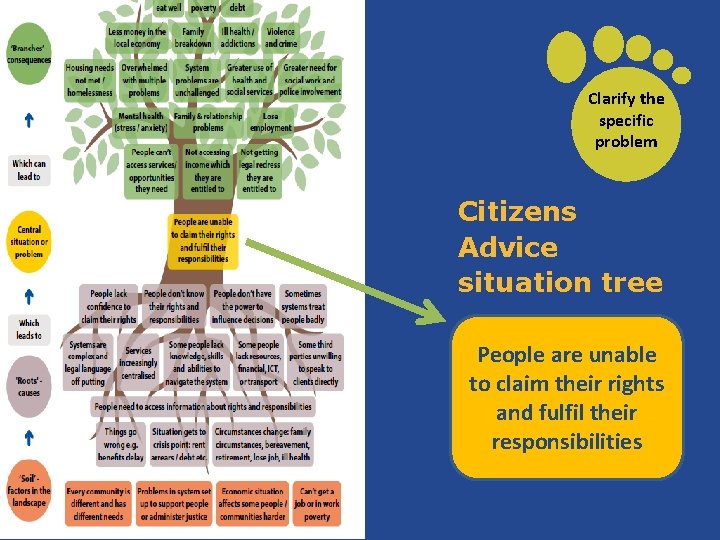
Clarify the specific problem Citizens Advice situation tree People are unable to claim their rights and fulfil their responsibilities
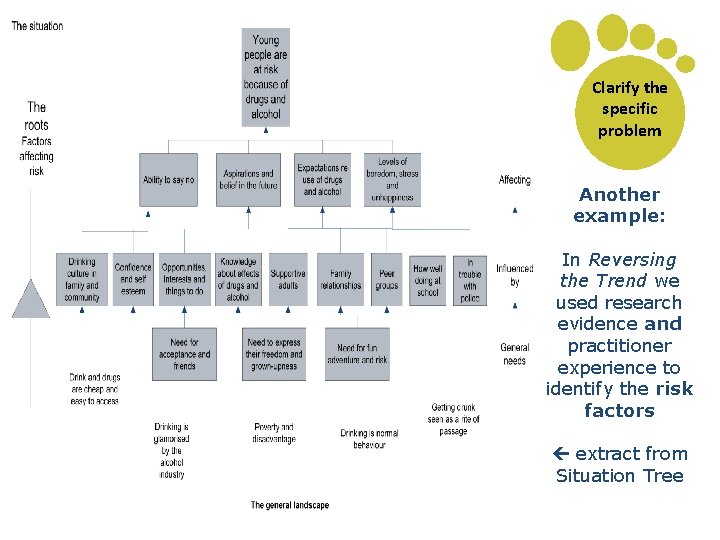
Clarify the specific problem Another example: In Reversing the Trend we used research evidence and practitioner experience to identify the risk factors extract from Situation Tree
That brings us to risk and protective factors A key to evaluating prevention is to show: • You are working with people who are at greater risk of having bad things happen • You are building their protective factors Identify risk and protective factors
For example • Edinburgh Leisure’s Steady Steps programme worked with older people at risk of falling* Identify risk and protective factors • The programme built people’s protective factors. This included physical skills like balance and exercise, and personal and social outcomes such as an improved sense of control, reduced anxiety and improved social connections. Click for Steady steps case study *risk = had a fall or a near fall or felt unsteady
Another example is where risk comes from being a member of a particular disadvantaged group Identify risk and protective factors For example LGBT: see this example … The LGBT Age Project Case Study: Explaining and measuring outcomes from the projects
But prevention work does not always directly target those ‘at risk’ Identify risk and protective factors • Some prevention work – particularly primary prevention – is aimed at whole ‘populations’ (such as all the young people in a school) • This is because targeting might stigmatise people. Also you can’t spot everyone at risk in advance. • So start by providing services/activities that are attractive and accessible. And then identify the people who need a bit more support or appear to be more at risk.
By targeting everyone … Identify risk and protective factors • You may build everyone’s protective factors. That may be hard to evaluate. • But you could do some light touch evaluation about improved awareness. AND • Measure if there is an increase in requests for support from specialist services by people at greater risk.
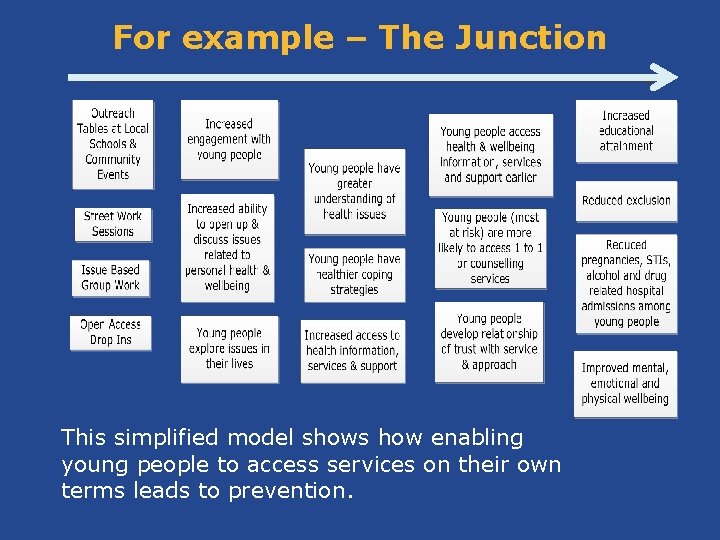
For example – The Junction This simplified model shows how enabling young people to access services on their own terms leads to prevention.
Setting outcomes • We are now starting to identify shorter term outcomes Develop a logic model • These short term outcomes are about reducing the risks of bad things happening to the people you work with and building their protective factors • To make the link between those shorter term outcomes and longer term outcomes you might find it helpful to develop a logic model.
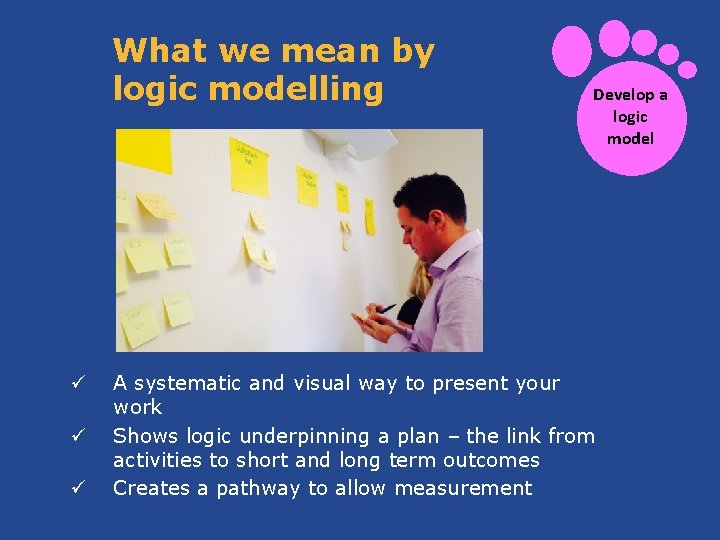
What we mean by logic modelling ü ü ü Develop a logic model A systematic and visual way to present your work Shows logic underpinning a plan – the link from activities to short and long term outcomes Creates a pathway to allow measurement
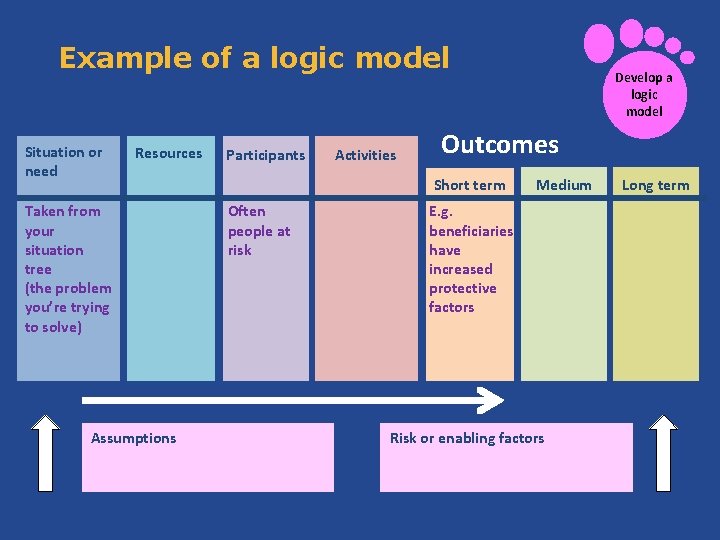
Example of a logic model Situation or need Resources Taken from your situation tree (the problem you’re trying to solve) Assumptions Participants Activities Outcomes Short term Often people at risk Develop a logic model Medium E. g. beneficiaries have increased protective factors Risk or enabling factors Long term
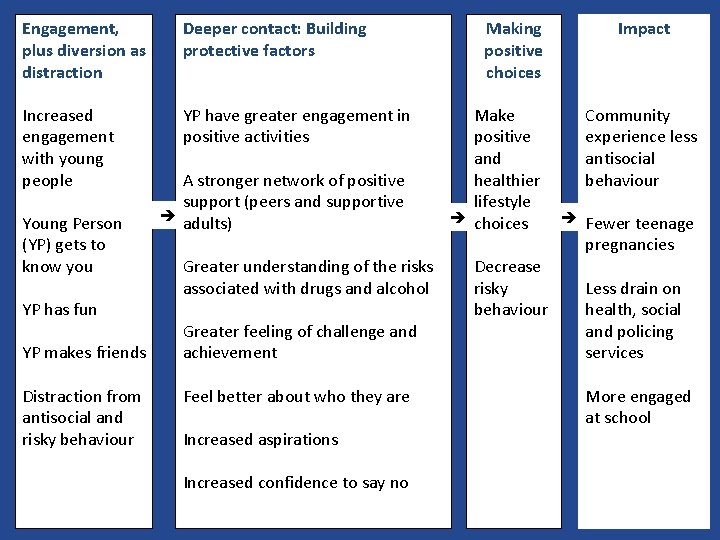
On the next slide is a simplified logic model for preventing problem substance misuse among young people… Develop a logic model
Engagement, plus diversion as distraction Deeper contact: Building protective factors Increased engagement with young people YP have greater engagement in positive activities Young Person (YP) gets to know you YP has fun YP makes friends Distraction from antisocial and risky behaviour A stronger network of positive support (peers and supportive adults) Greater understanding of the risks associated with drugs and alcohol Greater feeling of challenge and achievement Feel better about who they are Increased aspirations Increased confidence to say no Making positive choices Make positive and healthier lifestyle choices Decrease risky behaviour Impact Community experience less antisocial behaviour Fewer teenage pregnancies Less drain on health, social and policing services More engaged at school
Develop a logic model The stitch in time? logic model shows the key outcomes that lead to older people’s health and wellbeing (and reduce negative outcomes)
The outcomes in the A Stitch in Time? logic model are all framed positively and don’t actually use ‘prevention’ words. In the case of older people things like delayed discharge, inappropriate hospital admissions, cost savings are all measures of poor outcomes. They are not the outcomes themselves. Develop a logic model
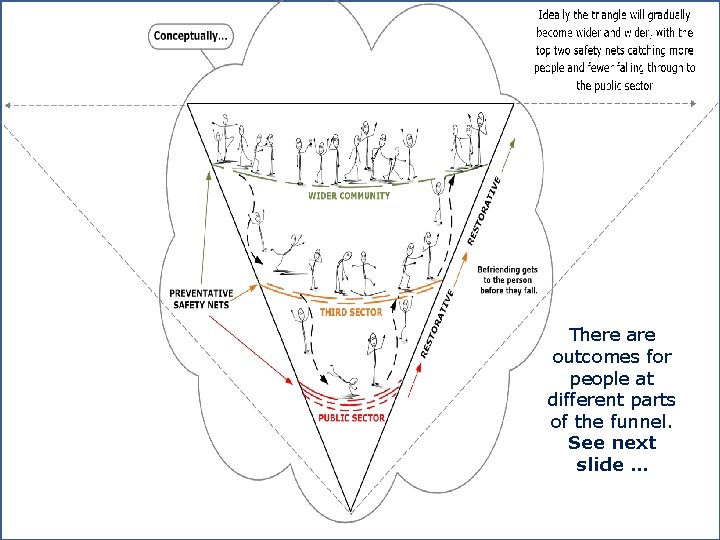
The next slide is a different way of showing a prevention model It is for Fife’s Integrated Care Fund befriending programme. It shows primary, secondary and tertiary prevention as a funnel with different services and sectors acting as a safety net to stop people falling further if they don’t need to.
There are outcomes for people at different parts of the funnel. See next slide …
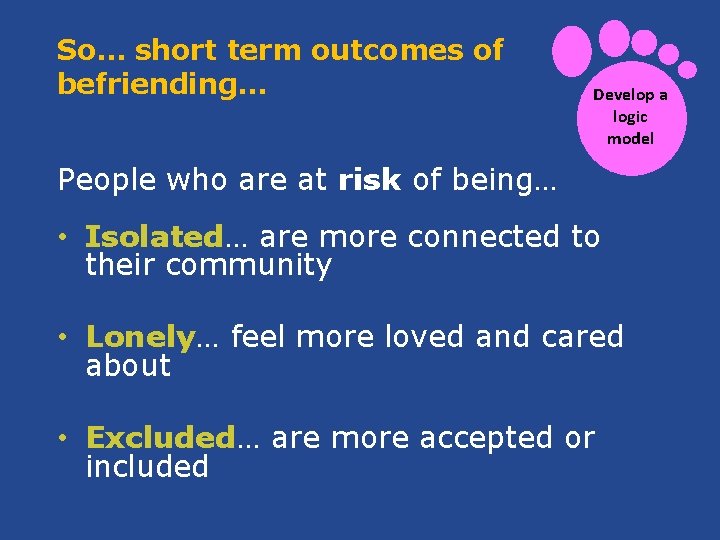
So… short term outcomes of befriending… Develop a logic model People who are at risk of being… • Isolated… are more connected to their community • Lonely… feel more loved and cared about • Excluded… are more accepted or included
Building the logic model • As with the situation tree, draw from – Tacit knowledge (people’s experiences) – Self-evaluation (your own and others) – Formal research • In particular, ask your clients/beneficiaries/service users what matters to them • What are their needs, and how do they think that by meeting those needs it might prevent something longer term? Develop a logic model
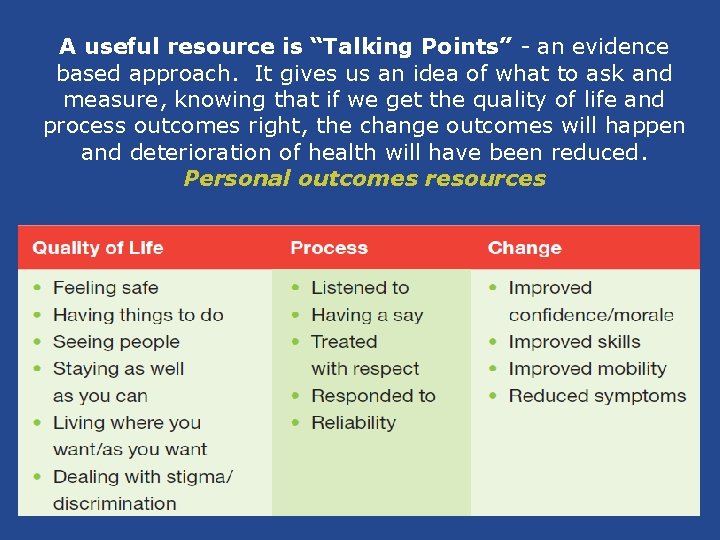
A useful resource is “Talking Points” - an evidence based approach. It gives us an idea of what to ask and measure, knowing that if we get the quality of life and process outcomes right, the change outcomes will happen and deterioration of health will have been reduced. Personal outcomes resources
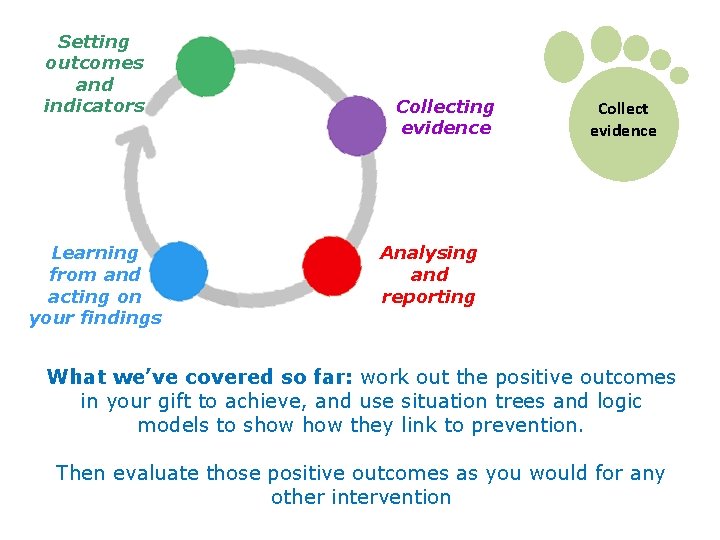
Setting outcomes and indicators Learning from and acting on your findings Collecting evidence Collect evidence Analysing and reporting What we’ve covered so far: work out the positive outcomes in your gift to achieve, and use situation trees and logic models to show they link to prevention. Then evaluate those positive outcomes as you would for any other intervention
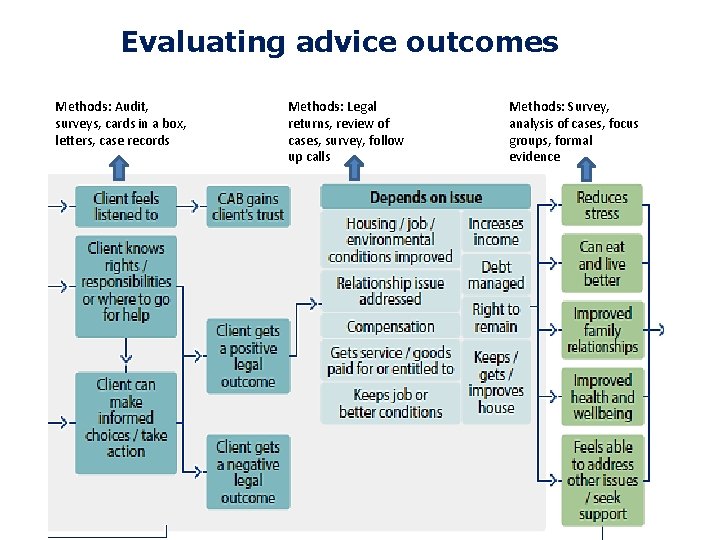
Collecting evidence • Use the logic model to collate evidence • Self-evaluate outcomes within your control • Sample later outcomes to test theory of change. • If appropriate, also collect information about your beneficiaries so you can show you are working with those most at risk. • The following slides show examples from advice work and from services for older adults. Collect evidence
Evaluating advice outcomes Methods: Audit, surveys, cards in a box, letters, case records Methods: Legal returns, review of cases, survey, follow up calls Methods: Survey, analysis of cases, focus groups, formal evidence
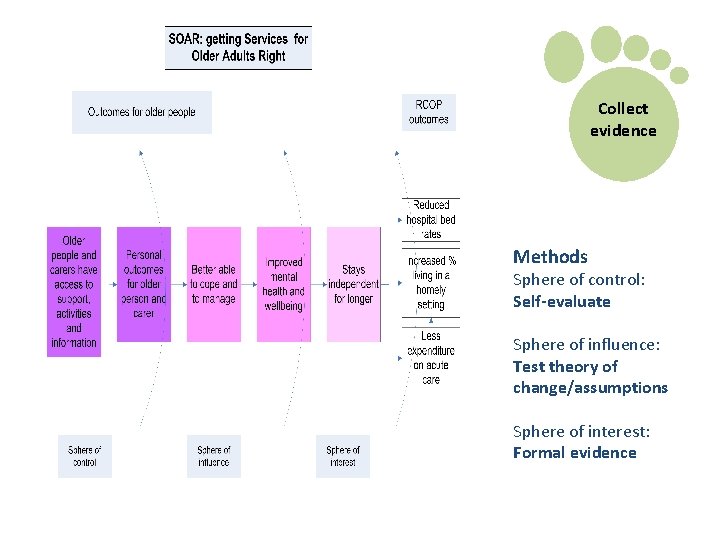
Collect evidence Methods Sphere of control: Self-evaluate Sphere of influence: Test theory of change/assumptions Sphere of interest: Formal evidence
You may have noticed, the previous slide uses the terms: • control (or impact) • influence • interest Collect evidence rather than ‘short’, ‘medium’, ‘long term’ outcomes. This might be a useful way to present your logic model if time is not necessarily the main issue.
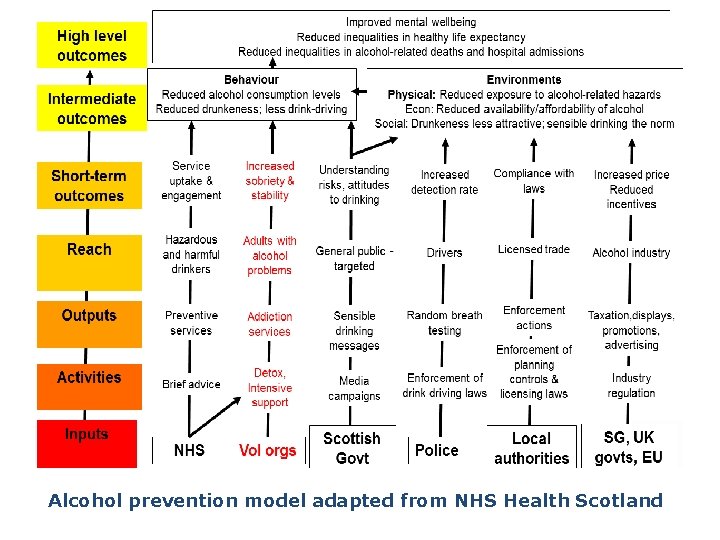
Locating your place in the prevention world Collect evidence Another evaluation approach you could take is to show that your work is an important part of the prevention system. For example, the following slide shows all the different components required to prevent problem alcohol use.
Alcohol prevention model adapted from NHS Health Scotland
Locating your place in the prevention world Collect evidence So if such a model exists for your area of prevention, you could show that you are providing one of the key sets of activities that contribute to prevention. And then measure whether you are: • delivering those activities effectively and • joined up with other agencies contributing to prevention.
Testing assumptions… Collect evidence Another thing to measure is the assumptions you are making so you don’t over-claim. Focus on measuring the outcomes directly in your gift – outcomes that you can claim. AND Some “good things” happen anyway. For example, some young people at greatest risk of reoffending desist naturally as they grow older.
And on the other hand… Collect evidence External factors can get in the way – such as economic slumps, policy changes, and so on. SO Evaluate external factors as part of your evaluation. If you find that you didn’t make as much of a positive impact as you hoped for external reasons, that is disappointing but is useful learning.
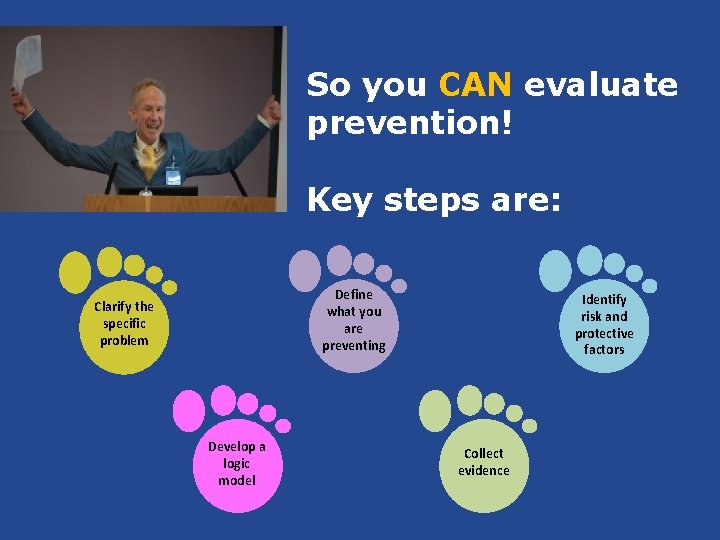
So you CAN evaluate prevention! Key steps are: Define what you are preventing Clarify the specific problem Develop a logic model Identify risk and protective factors Collect evidence
Don’t just take our word for it… • Scottish Legal Aid Board – inequalities and prevention briefing [in our resources] http: //www. slab. org. uk/about-us/what-wedo/policyanddevelopmentoverview/Planninga ndcoordination/ • NHS Health Scotland – the economics of prevention • What works Scotland has some prevention resources • One aspect of CCPS Better Futures outcomes tool is to record service users’ views on what has been prevented through engagement with services.
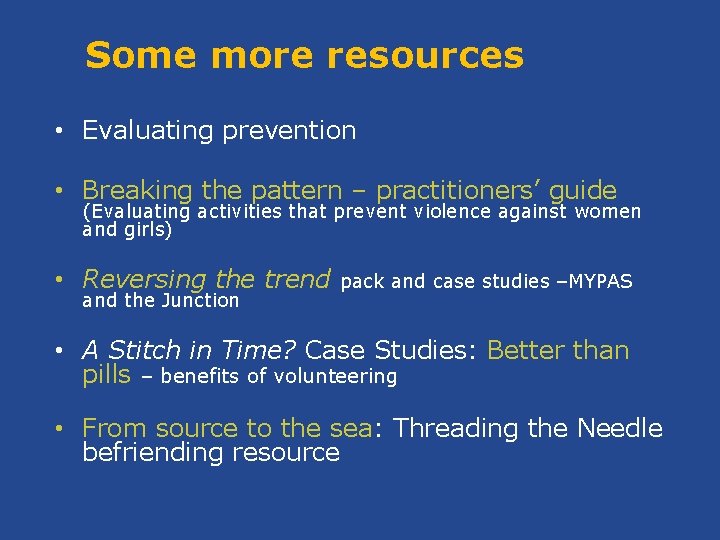
Some more resources • Evaluating prevention • Breaking the pattern – practitioners’ guide (Evaluating activities that prevent violence against women and girls) • Reversing the trend and the Junction pack and case studies –MYPAS • A Stitch in Time? Case Studies: Better than pills – benefits of volunteering • From source to the sea: Threading the Needle befriending resource
And finally… We hope this resource is useful and would welcome your comments on both the content and presentation. If you have developed or know of resources to evaluate prevention that are not mentioned in this resource please let us know by emailing info@evaluationsupportcotland. org. uk
The work described in these slides was funded by The Scottish Government, Citizens Advice Scotland, Lloyds TSB Foundation for Scotland Voluntary Action Fund. Please see our Thematic programmes webpages for more information You may copy or use the slides in this presentation in part or whole for non-commercial reasons with the exception of the photographs. Please credit Evaluation Support Scotland. 5 Rose Street, Edinburgh, EH 2 2 PR 0131 243 2770 Email: info@evaluationsupportscotland. org. uk www. evaluationsupportscotland. org. uk Tweet us @Eval. Sup. Scot and follow us on Linked. In VAT No. 923 2102 72 Company No. SC 284843 Charity No. SC 036529