
Evaluation Plans Measuring Outcomes Evaluation Plan Setting Goals


- Slides: 46
Evaluation Plans & Measuring Outcomes
Evaluation Plan: Setting Goals and Monitoring Progress
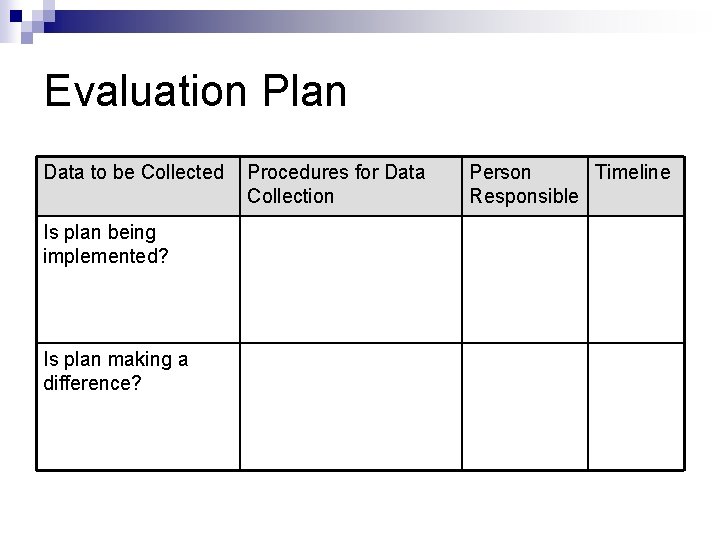
Evaluation Plan Data to be Collected Is plan being implemented? Is plan making a difference? Procedures for Data Collection Person Timeline Responsible
Evaluation Plan Data to be Collected Is plan being implemented? Are staff implementing tasks as assigned in BIP Implementation Plan? Is plan making a difference? Procedures for Data Collection Person Timeline Responsible Staff monitor task completion daily with 3 x 5 inch notecard As assigned in BIP Implementation Plan Implement as of 2/27, ongoing Review at BIP Rev Mtg Teacher/Asst 2/27 ongoing Teacher/Asst 2/27 ongoing Review tasks at BIP Review meeting # of tantrums/ week Teacher notes occurrences of tantrums in math Student use of hand-raising to request escape Teacher notes occurrences in math # math problems completed in class/ total problem Teacher notes in class Plan Review Date 5/31/05
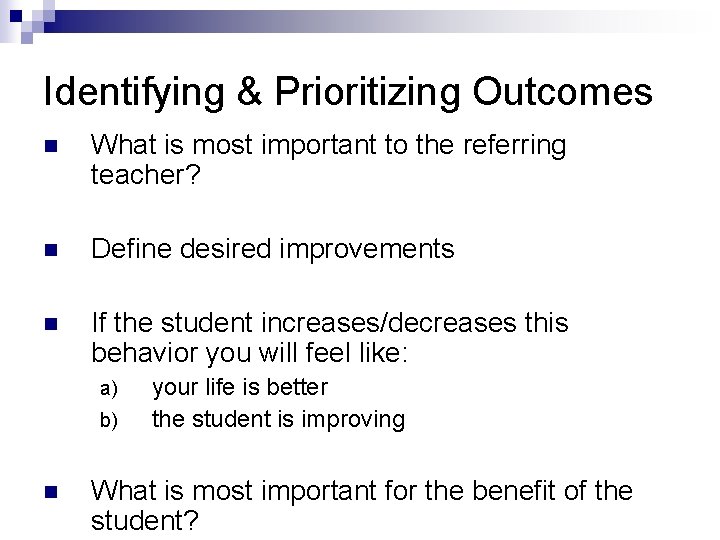
Identifying & Prioritizing Outcomes n What is most important to the referring teacher? n Define desired improvements n If the student increases/decreases this behavior you will feel like: a) b) n your life is better the student is improving What is most important for the benefit of the student?
Competing Behavior Pathway
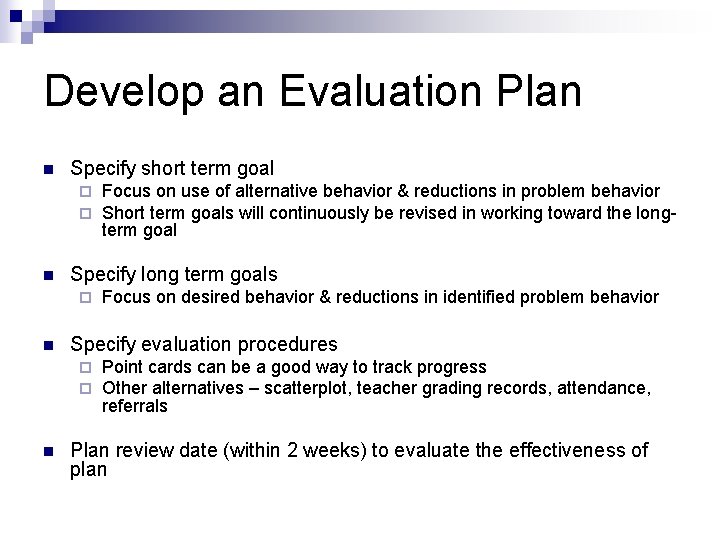
Develop an Evaluation Plan n Specify short term goal ¨ ¨ n Specify long term goals ¨ n Focus on desired behavior & reductions in identified problem behavior Specify evaluation procedures ¨ ¨ n Focus on use of alternative behavior & reductions in problem behavior Short term goals will continuously be revised in working toward the longterm goal Point cards can be a good way to track progress Other alternatives – scatterplot, teacher grading records, attendance, referrals Plan review date (within 2 weeks) to evaluate the effectiveness of plan
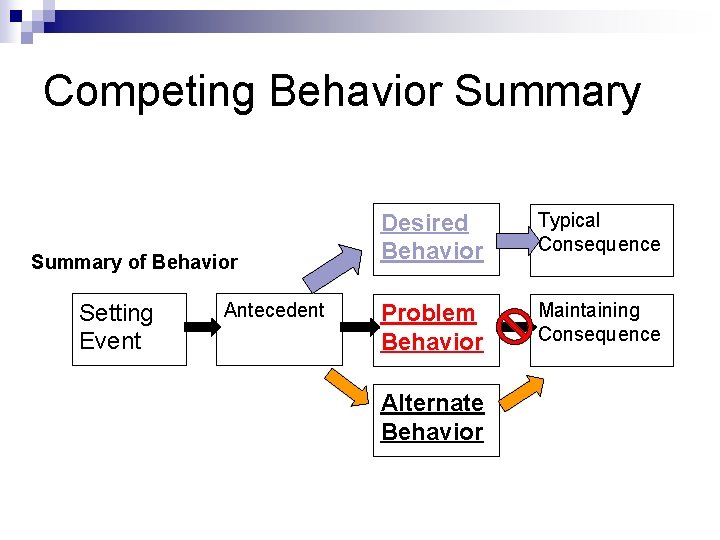
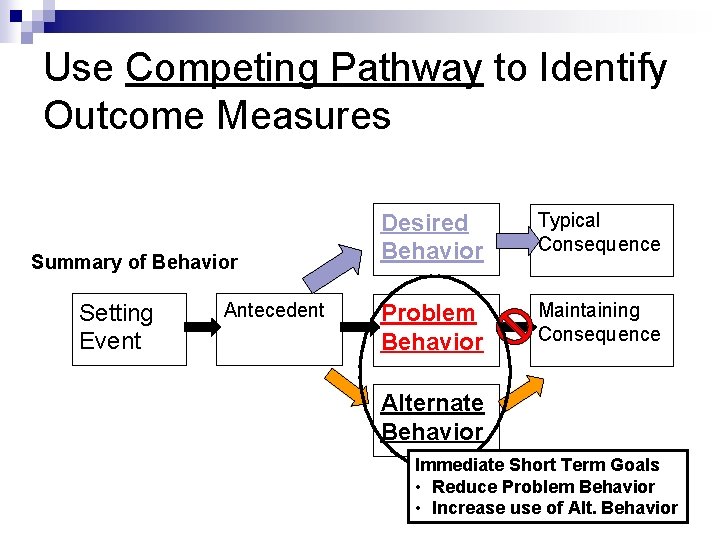
Competing Behavior Summary of Behavior Setting Event Antecedent Desired Behavior Typical Consequence Problem Behavior Maintaining Consequence Alternate Behavior
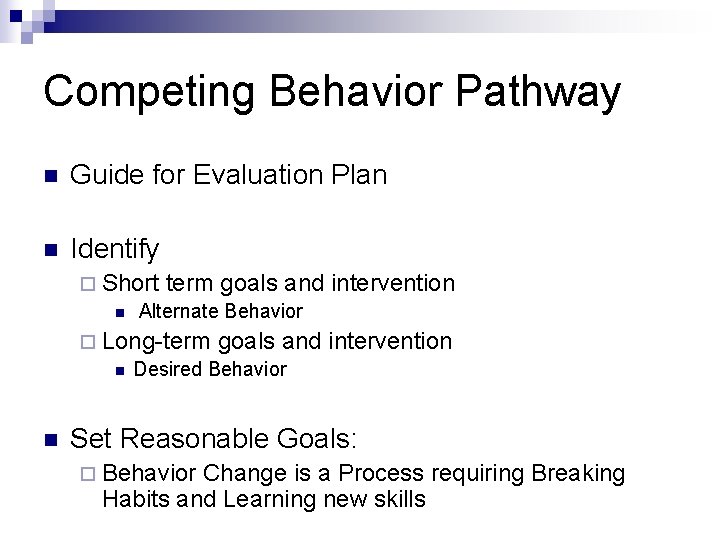
Competing Behavior Pathway n Guide for Evaluation Plan n Identify n ¨ Short term goals and n Alternate Behavior intervention ¨ Long-term goals and n Desired Behavior intervention Set Reasonable Goals: ¨ Behavior Change is a Process requiring Breaking Habits and Learning new skills
Start with the Short Term Goals Increasing the Alternate Behavior & Decreasing Problem Behavior
Use Competing Pathway to Identify Outcome Measures Summary of Behavior Setting Event Antecedent Desired Behavior Typical Consequence Problem Behavior Maintaining Consequence Alternate Behavior Immediate Short Term Goals • Reduce Problem Behavior • Increase use of Alt. Behavior
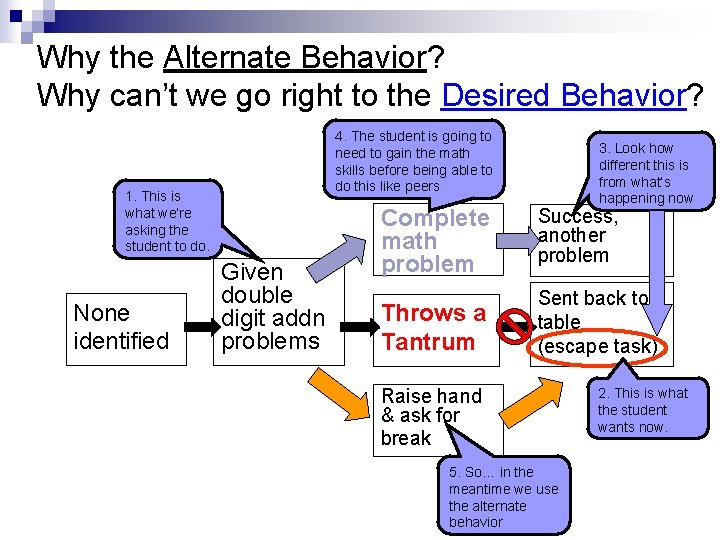
Why the Alternate Behavior? Why can’t we go right to the Desired Behavior? 4. The student is going to need to gain the math skills before being able to do this like peers 1. This is what we’re asking the student to do. None identified Given double digit addn problems 3. Look how different this is from what’s happening now Complete math problem Success, another problem Throws a Tantrum Sent back to table (escape task) Raise hand & ask for break 5. So… in the meantime we use the alternate behavior 2. This is what the student wants now.
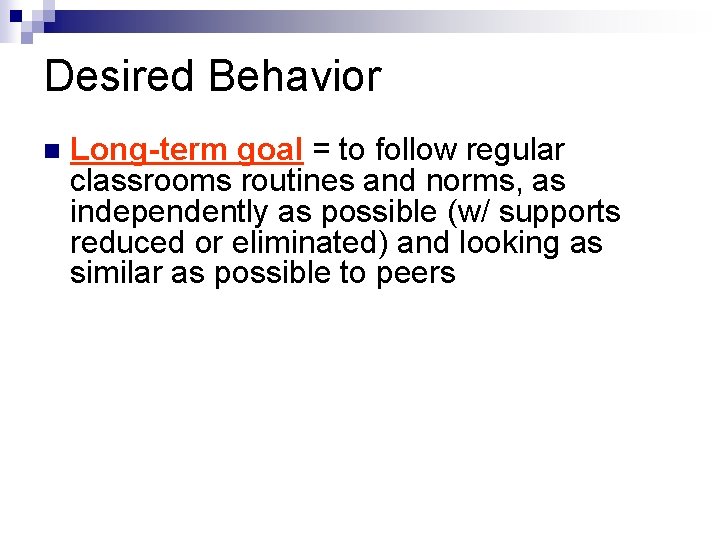
Desired Behavior n Long-term goal = to follow regular classrooms routines and norms, as independently as possible (w/ supports reduced or eliminated) and looking as similar as possible to peers
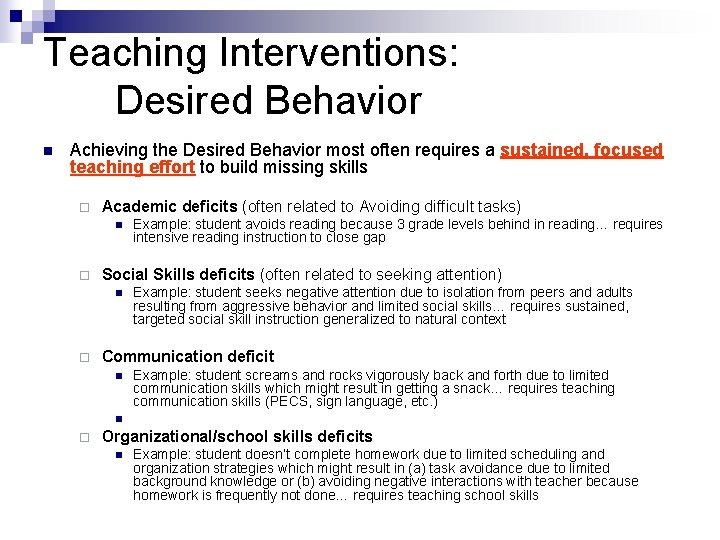
Teaching Interventions: Desired Behavior n Achieving the Desired Behavior most often requires a sustained, focused teaching effort to build missing skills ¨ Academic deficits (often related to Avoiding difficult tasks) n ¨ Social Skills deficits (often related to seeking attention) n ¨ Example: student avoids reading because 3 grade levels behind in reading… requires intensive reading instruction to close gap Example: student seeks negative attention due to isolation from peers and adults resulting from aggressive behavior and limited social skills… requires sustained, targeted social skill instruction generalized to natural context Communication deficit n Example: student screams and rocks vigorously back and forth due to limited communication skills which might result in getting a snack… requires teaching communication skills (PECS, sign language, etc. ) n ¨ Organizational/school skills deficits n Example: student doesn’t complete homework due to limited scheduling and organization strategies which might result in (a) task avoidance due to limited background knowledge or (b) avoiding negative interactions with teacher because homework is frequently not done… requires teaching school skills
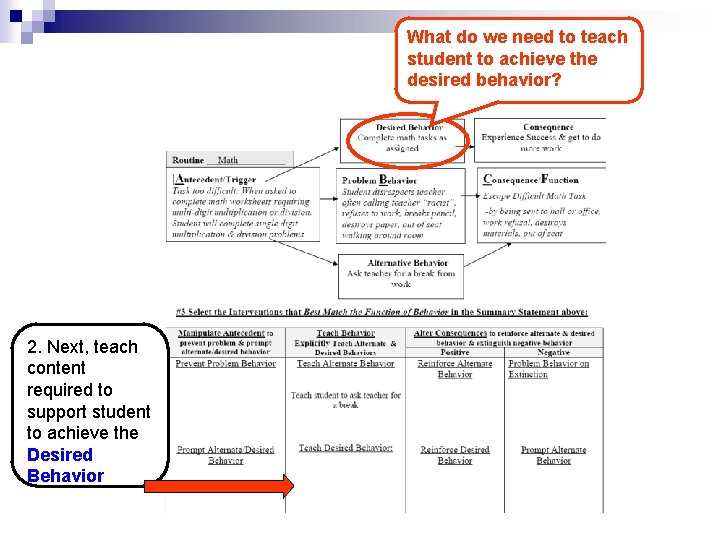
What do we need to teach student to achieve the desired behavior? 2. Next, teach content required to support student to achieve the Desired Behavior
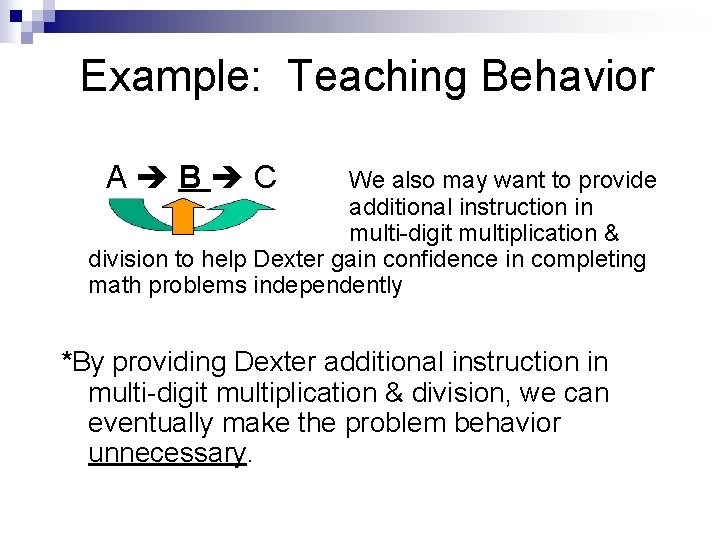
Example: Teaching Behavior A B C We also may want to provide additional instruction in multi-digit multiplication & division to help Dexter gain confidence in completing math problems independently *By providing Dexter additional instruction in multi-digit multiplication & division, we can eventually make the problem behavior unnecessary.
So… back to a short term goal n Develop a goal to review in 2 weeks at initial follow-up meeting n Focus on: ¨ Reducing problem behavior ¨ Increasing use of alternate behavior n How can we measure this in a feasible, but effective way?
Short term Goal Reduce frequency of problem behavior n Increase use of alternative/replacement behavior n How do we measure this? n ¨ Depends behavior on the frequency & type of problem
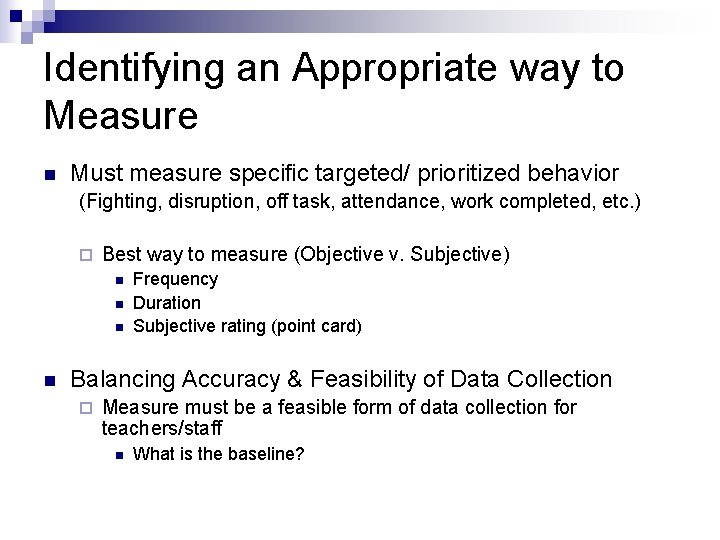
Identifying an Appropriate way to Measure n Must measure specific targeted/ prioritized behavior (Fighting, disruption, off task, attendance, work completed, etc. ) ¨ Best way to measure (Objective v. Subjective) n n Frequency Duration Subjective rating (point card) Balancing Accuracy & Feasibility of Data Collection ¨ Measure must be a feasible form of data collection for teachers/staff n What is the baseline?
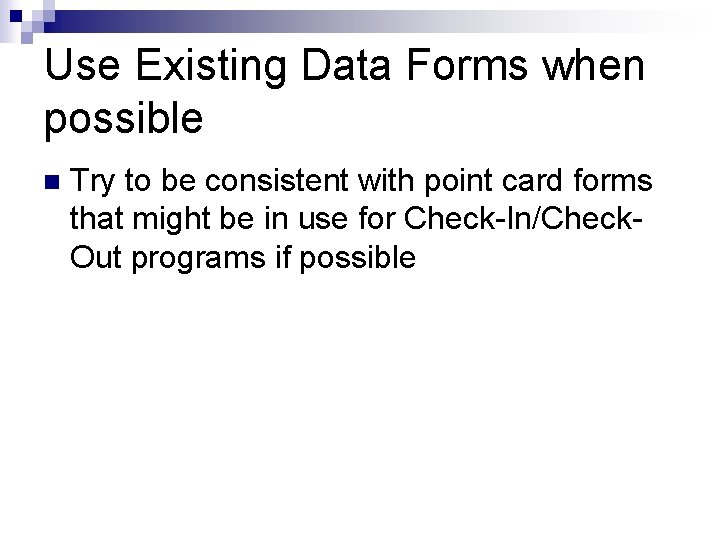
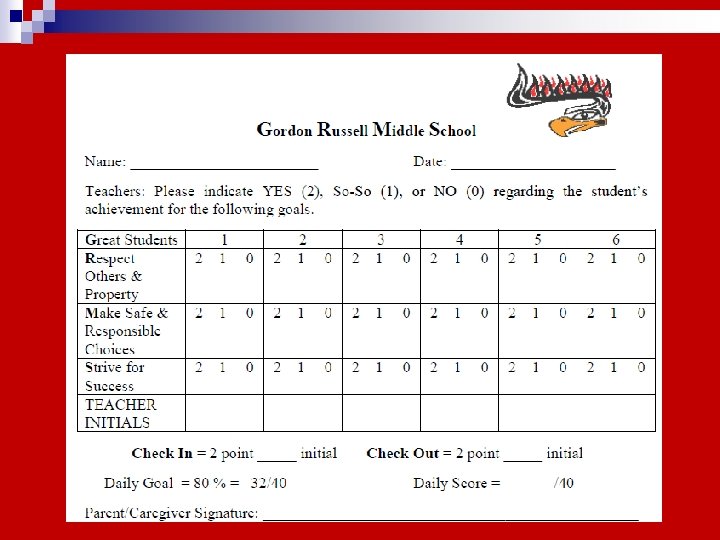
Use Existing Data Forms when possible n Try to be consistent with point card forms that might be in use for Check-In/Check. Out programs if possible
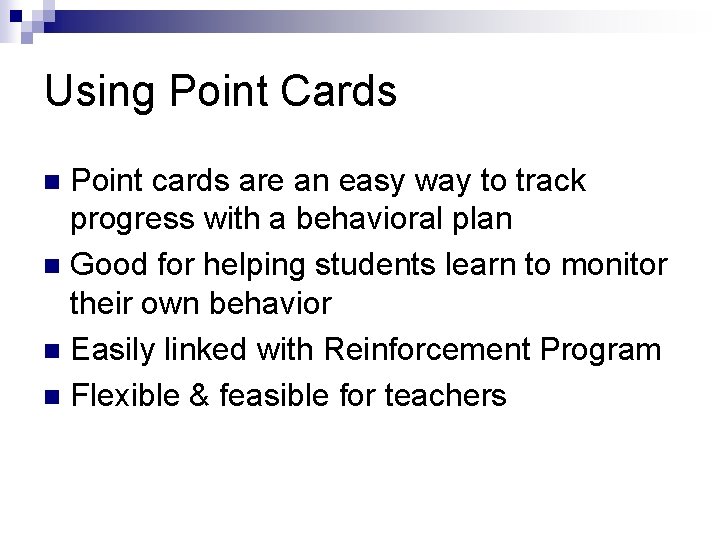
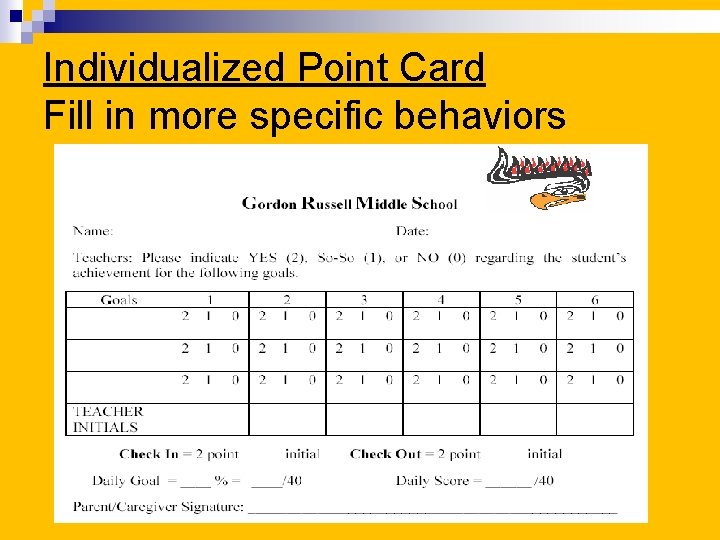
Using Point Cards Point cards are an easy way to track progress with a behavioral plan n Good for helping students learn to monitor their own behavior n Easily linked with Reinforcement Program n Flexible & feasible for teachers n
Individualized Point Card Fill in more specific behaviors
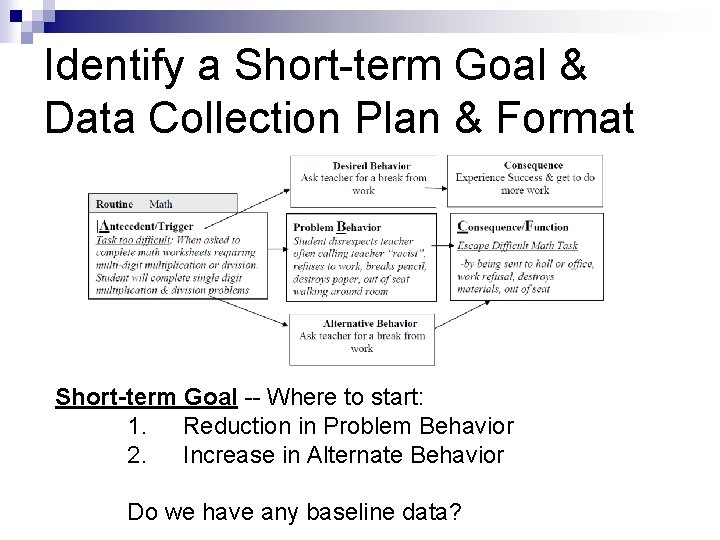
Identify a Short-term Goal & Data Collection Plan & Format Short-term Goal -- Where to start: 1. Reduction in Problem Behavior 2. Increase in Alternate Behavior Do we have any baseline data?
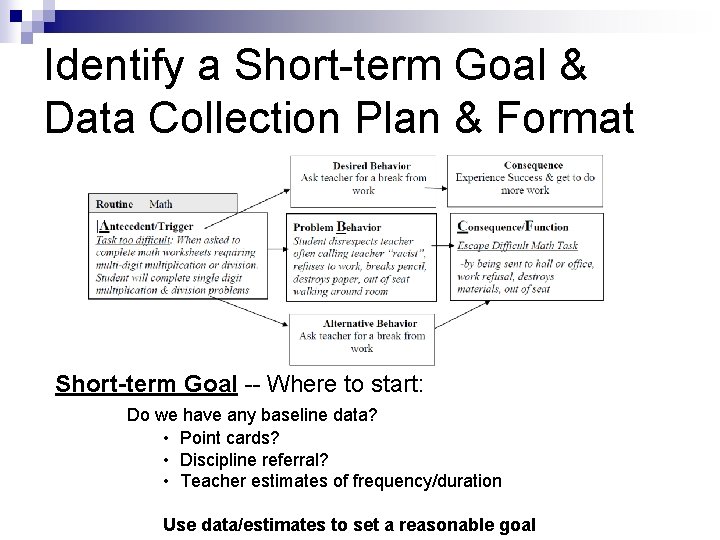
Identify a Short-term Goal & Data Collection Plan & Format Short-term Goal -- Where to start: Do we have any baseline data? • Point cards? • Discipline referral? • Teacher estimates of frequency/duration Use data/estimates to set a reasonable goal
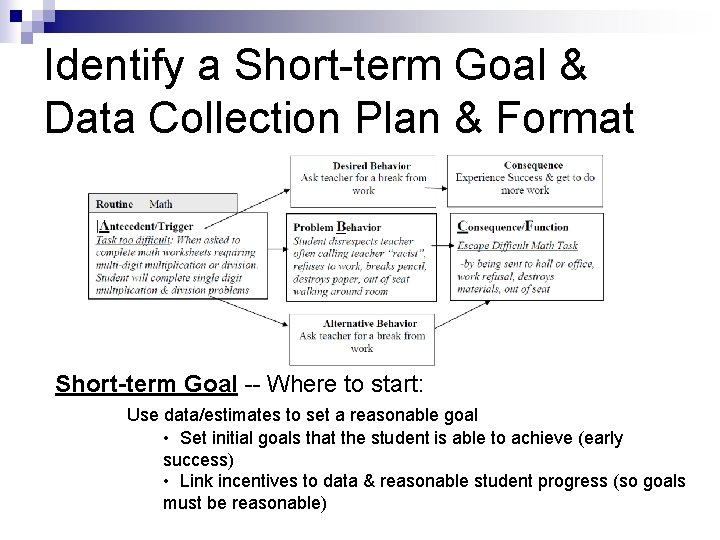
Identify a Short-term Goal & Data Collection Plan & Format Short-term Goal -- Where to start: Use data/estimates to set a reasonable goal • Set initial goals that the student is able to achieve (early success) • Link incentives to data & reasonable student progress (so goals must be reasonable)
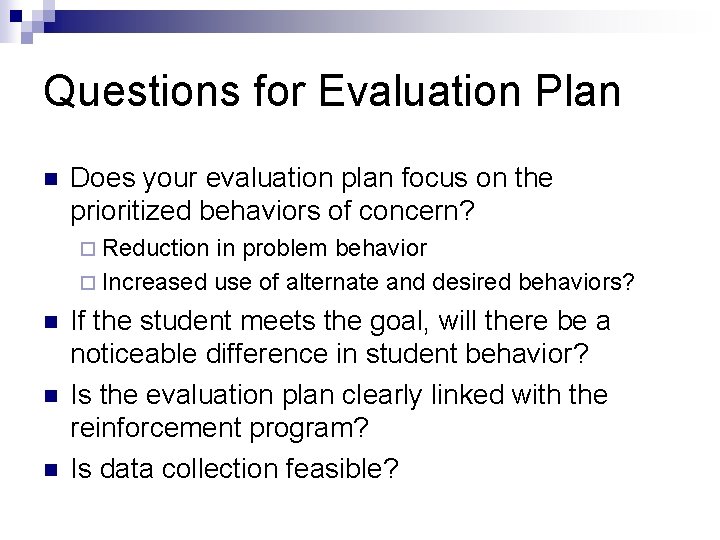
Questions for Evaluation Plan n Does your evaluation plan focus on the prioritized behaviors of concern? ¨ Reduction in problem behavior ¨ Increased use of alternate and desired behaviors? n n n If the student meets the goal, will there be a noticeable difference in student behavior? Is the evaluation plan clearly linked with the reinforcement program? Is data collection feasible?
Initial Success: Transitioning to Desired/ Long-Term Goals
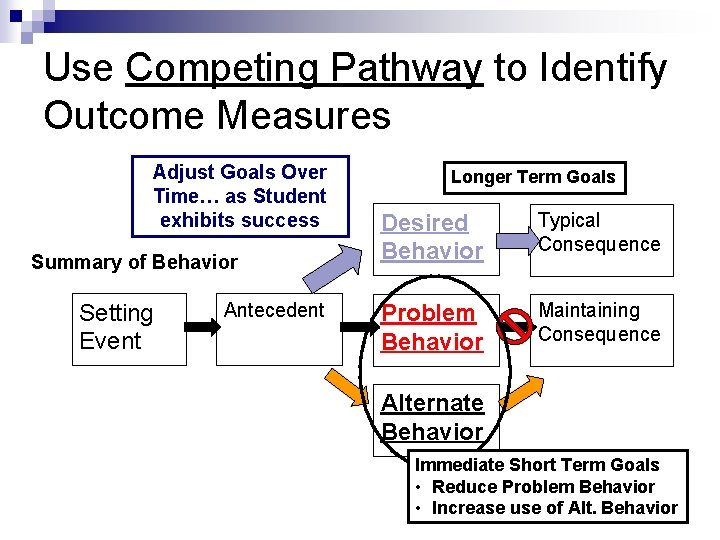
Use Competing Pathway to Identify Outcome Measures Adjust Goals Over Time… as Student exhibits success Summary of Behavior Setting Event Antecedent Longer Term Goals Desired Behavior Typical Consequence Problem Behavior Maintaining Consequence Alternate Behavior Immediate Short Term Goals • Reduce Problem Behavior • Increase use of Alt. Behavior
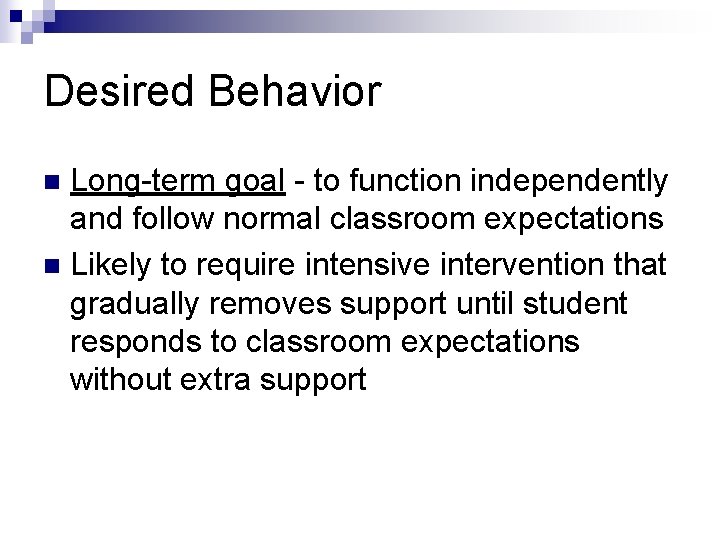
Desired Behavior Long-term goal - to function independently and follow normal classroom expectations n Likely to require intensive intervention that gradually removes support until student responds to classroom expectations without extra support n
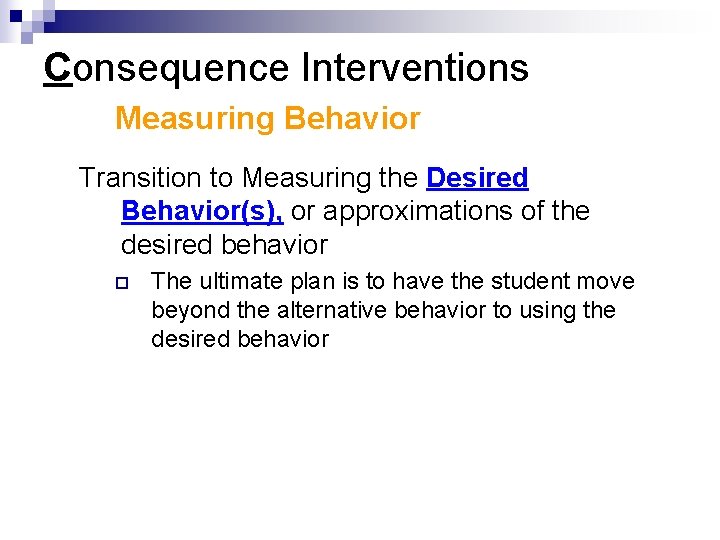
Consequence Interventions Measuring Behavior Transition to Measuring the Desired Behavior(s), or approximations of the desired behavior ¨ The ultimate plan is to have the student move beyond the alternative behavior to using the desired behavior
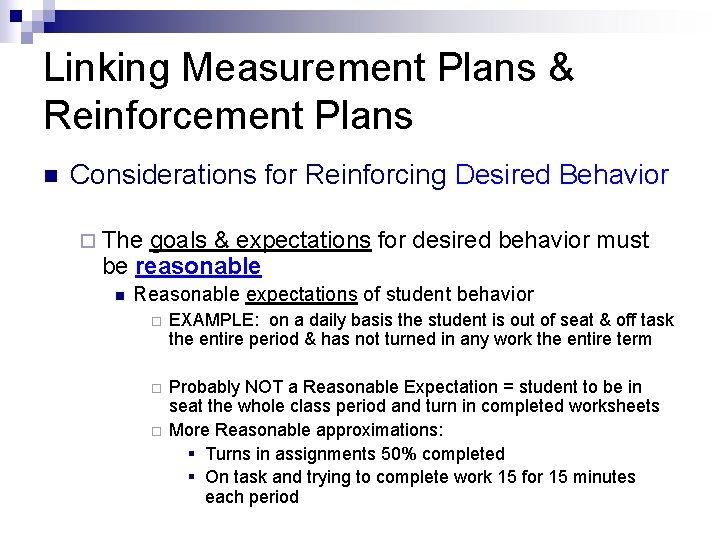
Linking Measurement Plans & Reinforcement Plans n Considerations for Reinforcing Desired Behavior ¨ The goals & expectations for desired behavior must be reasonable n Reasonable expectations of student behavior ¨ EXAMPLE: on a daily basis the student is out of seat & off task the entire period & has not turned in any work the entire term ¨ Probably NOT a Reasonable Expectation = student to be in seat the whole class period and turn in completed worksheets More Reasonable approximations: § Turns in assignments 50% completed § On task and trying to complete work 15 for 15 minutes each period ¨
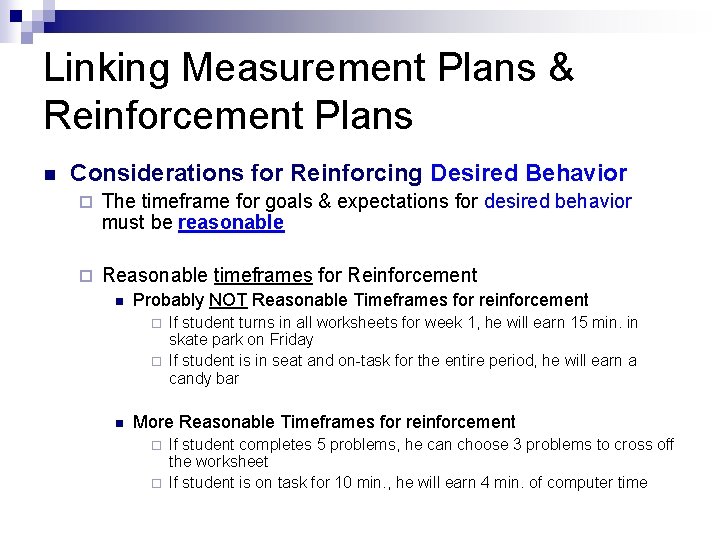
Linking Measurement Plans & Reinforcement Plans n Considerations for Reinforcing Desired Behavior ¨ The timeframe for goals & expectations for desired behavior must be reasonable ¨ Reasonable timeframes for Reinforcement n Probably NOT Reasonable Timeframes for reinforcement ¨ ¨ n If student turns in all worksheets for week 1, he will earn 15 min. in skate park on Friday If student is in seat and on-task for the entire period, he will earn a candy bar More Reasonable Timeframes for reinforcement ¨ ¨ If student completes 5 problems, he can choose 3 problems to cross off the worksheet If student is on task for 10 min. , he will earn 4 min. of computer time
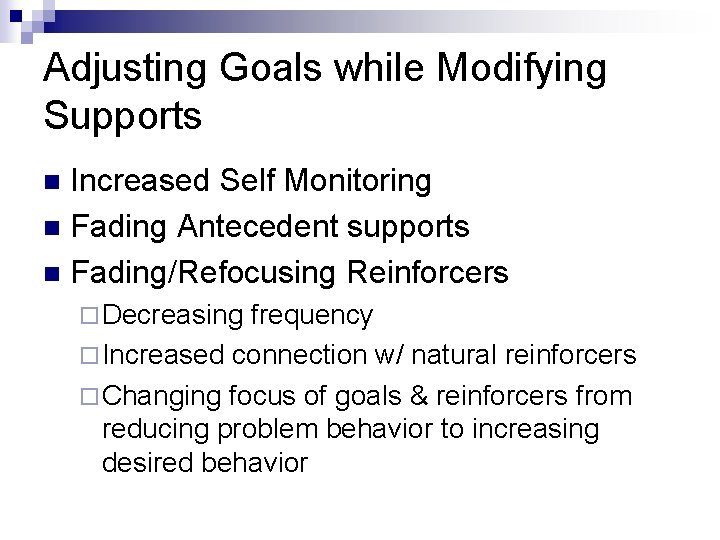
Adjusting Goals while Modifying Supports Increased Self Monitoring n Fading Antecedent supports n Fading/Refocusing Reinforcers n ¨ Decreasing frequency ¨ Increased connection w/ natural reinforcers ¨ Changing focus of goals & reinforcers from reducing problem behavior to increasing desired behavior
Feedback & Progress Monitoring as Intervention
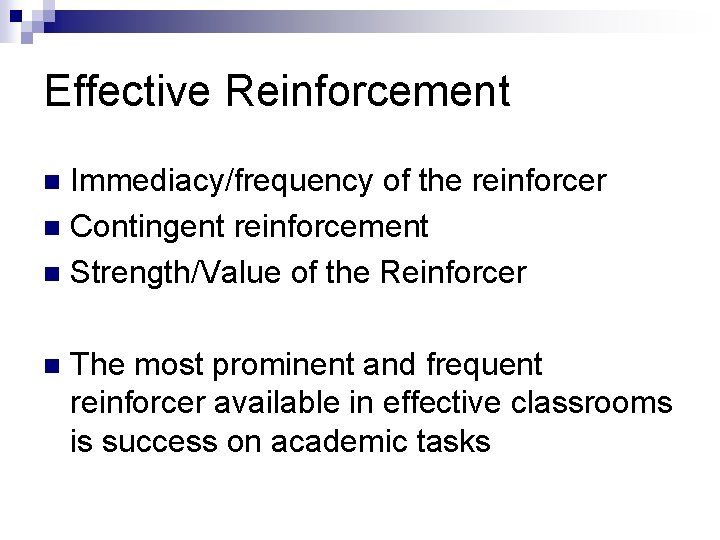
Effective Reinforcement Immediacy/frequency of the reinforcer n Contingent reinforcement n Strength/Value of the Reinforcer n n The most prominent and frequent reinforcer available in effective classrooms is success on academic tasks
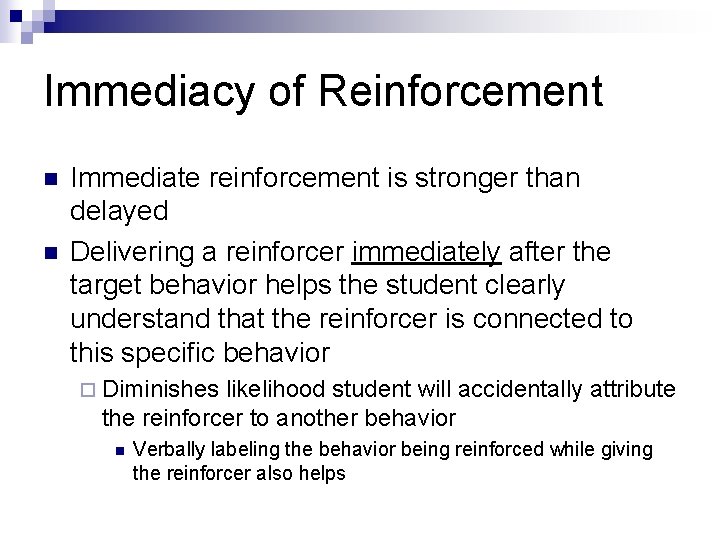
Immediacy of Reinforcement n n Immediate reinforcement is stronger than delayed Delivering a reinforcer immediately after the target behavior helps the student clearly understand that the reinforcer is connected to this specific behavior ¨ Diminishes likelihood student will accidentally attribute the reinforcer to another behavior n Verbally labeling the behavior being reinforced while giving the reinforcer also helps
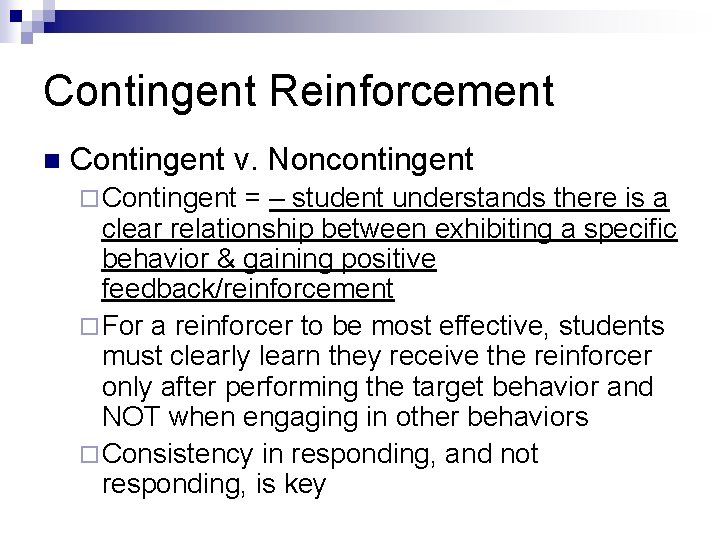
Contingent Reinforcement n Contingent v. Noncontingent ¨ Contingent = – student understands there is a clear relationship between exhibiting a specific behavior & gaining positive feedback/reinforcement ¨ For a reinforcer to be most effective, students must clearly learn they receive the reinforcer only after performing the target behavior and NOT when engaging in other behaviors ¨ Consistency in responding, and not responding, is key
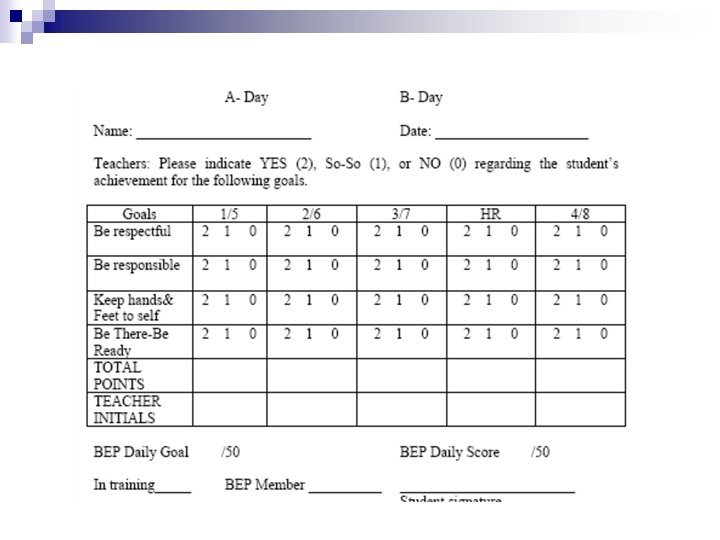
Contingent Reinforcement n Be Respectful is less clear & specific then Keep your hands and feet to your self ¨ Focusing on fewer more specific behavior is a way to strengthen a reinforcement system for a resistant student n n We can make clearer the behavior that is going to be reinforced We also want to make sure to consistently present the reinforcer following occurrences of the specified behavior
Value/Strength of a Reinforcer n n We need to understand what will be reinforcing for the student Preconceived notions about what should be reinforcing for a child are frequent reasons for the failure of reward programs ¨ Ask n student, observe student, see what they value Deprivation v. satiation ¨ We need to change up reinforcers periodically to keep it interesting
Strengthening an Individual Student Reinforcement System n Make reinforcement more frequent Don’t wait too long for student to earn incentive ¨ Student must be able to succeed ¨ n Target specific behaviors to be the focus of the reinforcement program ¨ n Provide immediate reinforcement ¨ n Focusing on fewer behaviors may be beneficial, particularly when beginning a reinforcement program Keep delay between performing behavior & receiving incentive to a minimum Make sure incentive is highly valued by the student ¨ Do not assume it will be highly valued
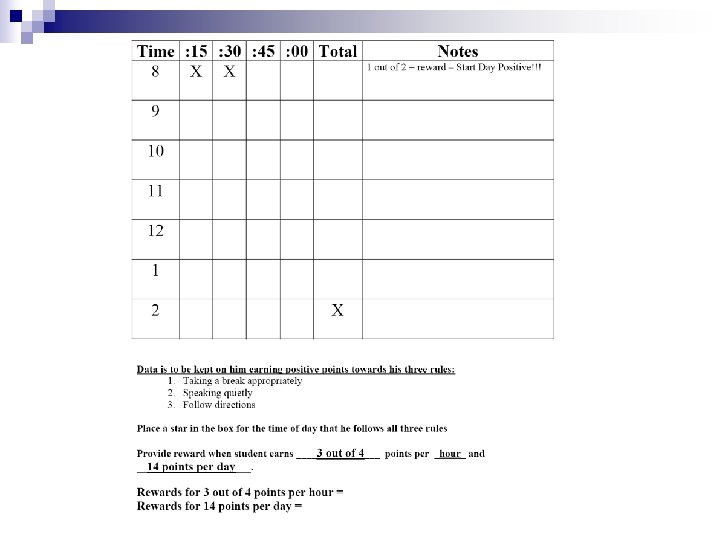
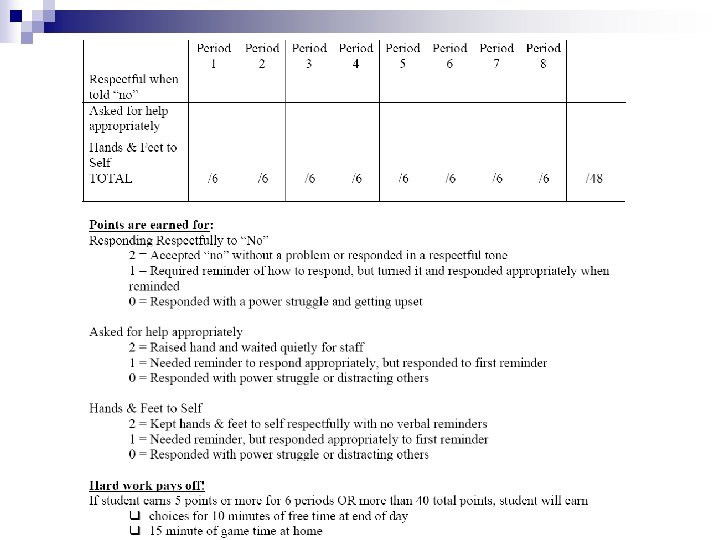
Evaluating & Strengthening/Fading Point Cards n n Look at the following point cards Identify variables on the point cards related to: ¨ Immediacy/frequency of feedback & reinforcement ¨ Specificity of behavioral expectations targeted n Discuss how to manipulate the point cards to make them stronger and how to fade them
Team Activity n Develop an Evaluation Plan for your student ¨ Remember to focus goals and data collection on your alternate behavior & desired behavior ¨ We want numeric data that we can present in graph form for progress monitoring n Data collection must also be manageable for staff