
EVALUATION OF THE EFFICACY OF VAITARANABASTI IN AMAVATA
EVALUATION OF THE EFFICACY OF VAITARANABASTI IN AMAVATA AN OBSERVATIONAL STUDY PRESENTER Dr. Siba Prasad M. D. (Panchakarma) Lec. In Dept. Of Panchakarma Guru Nanak Ayurvedic Meical Collehe & Hospital Shri Muktsar Sahib, Punjab.
contents 2 � INTRODUCTION � OBJECTIVES � VASTI � EFFECTS OF THE VASTI � CURATIVE ASPECT � SAMPRAPTI GHATAKA � CHIKITSA � DRUGS OF VAITARANA VASTI � ASSESSMENT OF TREATMENT � RESULTS � CONCLUSION VAITARANA VASTI IN AMAVATA
INTRODUCTION 3 Rheumatoid Arthritis occurs throughout the world and in all ethnic groups. The prevalence is highest in Indians. In Caucasians it is around 1 -1. 5% with a female: male ratio. The onset of Rheumatoid Arthritis may occur at any time of the life approximately 70% of RA occurs between the 3 rd to 5 th decades. The crippling nature, repetitive attacks and chronic course of Amavata, forced the scientific world to conduct extensive studies on VAITARANA Amavata. VASTI IN AMAVATA
Objective s 4 The lives of more than one million people are physically impaired due to Rheumatic disorders and one fifth of these are severely disabled. 1. Evaluation of the effect of Bastikarma in Amavata. 2. Evaluation of the efficacy of Vaitaranabasti in Amavata. VAITARANA VASTI IN AMAVATA
Vast i 5 Shodhana Shamana Lekhana Bruhana Vajikarana Vayasthapana VAITARANA VASTI IN AMAVA TA
VAITARANABASTI 6 Vaitaranabasti is indicated in Amavata as well as in Shula. The ingredients of Vaitaranabasti are cheap and easily available The ingredients of the Vaitaranabasti are having the quality of � Deepana, � Pachana gunas � Directly influences the Koshtagni and Dhatwagni � VAITARANA VASTI IN AMAVAT Vatanulomana and Vata Shlesmahara properties. A
EFFECTS OF THE VASTI 7 Promotive aspects Curative aspects Preventive aspects Effect on dhatu Effect on Brain and Psychology Effective at any age and in any season VAITARANA VASTI IN AMAVATA
8 CURATIVE ASPECT Relieves Stiffness Effective in disorders of GI tract Relieves contractions and Effective in diseases of Shakha adhesions. and Kostha. Effective in paralytic conditions Effective in dislocation and upper extremities localized or fracture conditions general parts. Effective in Those conditions where vata aggravated in Shakha Effective in diseases of vital parts, Beneficial to debilated and weak persons. Relieves pain VAITARANA VASTI IN AMAVATA
AMAVAT A 9 ‘Amena samhita vata Amavata’. The virulent Ama circulates in the whole body propelled by the vitiated Vata Doshas producing block in the body channels that stations itself in the sandhi giving rise to Amavata. VAITARANA VASTI IN AMAVATA
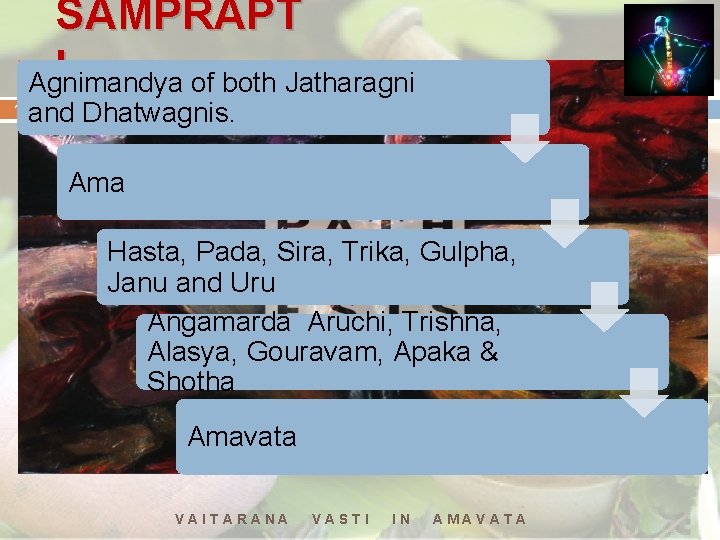
SAMPRAPT I Agnimandya of both Jatharagni 10 and Dhatwagnis. Ama Hasta, Pada, Sira, Trika, Gulpha, Janu and Uru Angamarda Aruchi, Trishna, Alasya, Gouravam, Apaka & Shotha Amavata VAITARANA VASTI IN AMAVATA
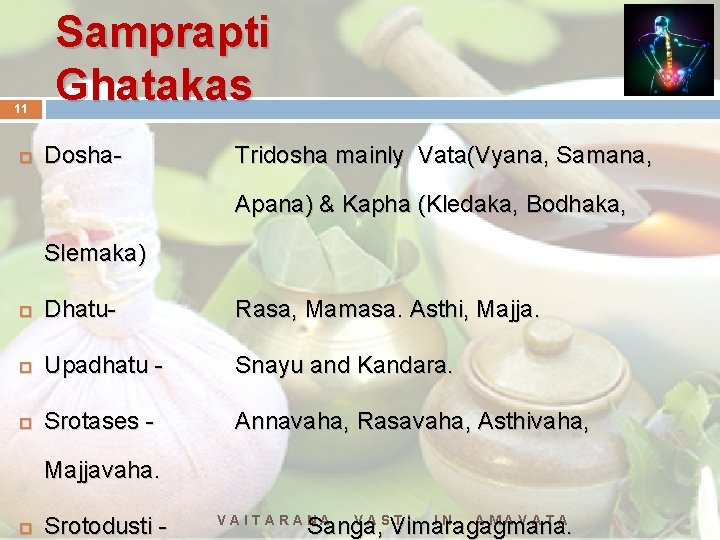
11 Samprapti Ghatakas Dosha- Tridosha mainly Vata(Vyana, Samana, Apana) & Kapha (Kledaka, Bodhaka, Slemaka) Dhatu- Rasa, Mamasa. Asthi, Majja. Upadhatu - Snayu and Kandara. Srotases - Annavaha, Rasavaha, Asthivaha, Majjavaha. Srotodusti - VAITARANA VASTI IN AMAVATA Sanga, Vimaragagmana.
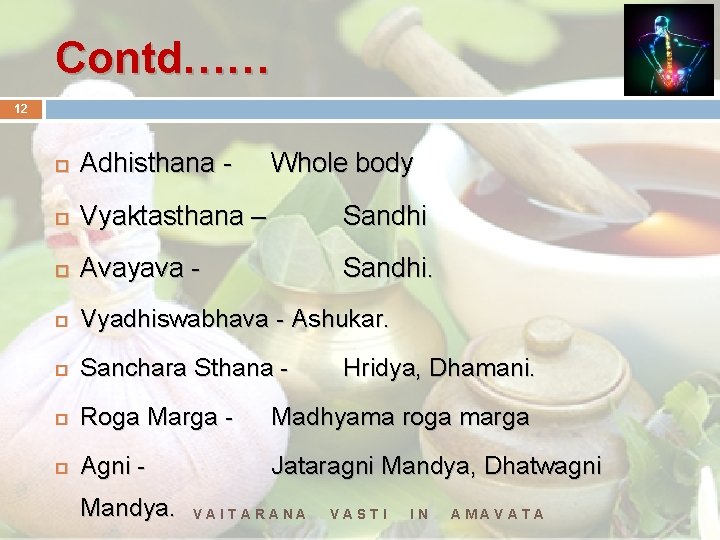
Contd…… 12 Adhisthana - Vyaktasthana – Sandhi Avayava - Sandhi. Vyadhiswabhava - Ashukar. Sanchara Sthana - Roga Marga - Madhyama roga marga Agni - Jataragni Mandya, Dhatwagni Mandya. Whole body VAITARANA Hridya, Dhamani. VASTI IN AMAVATA
13 Functions of Vata Tantrayanradhara Sabdasparsa Prakrti Cheshta Pravartaka Srota sparsana mula Mano Niyanta & Praneta Harsha utsahayoni Sharvendriya Uttyojaka Agni samirana Sharvendriya Artha Mala ksepta Sharva sharira dhatu Grabhakrti Karta Vyuhakara Ayusha Anuvratti Abhivodha Sharira Sandhanakar Vak pravartaka VAITARANA VASTI IN AMAVATA
Chikitsa 14 Langhana Swedana Tikta , Katu & Deepena drugs Virechana Snehapana Anuvasana and Kshara abasti Ruksha Upanaha Sankara sweda VAITARANA VASTI IN AMAVATA
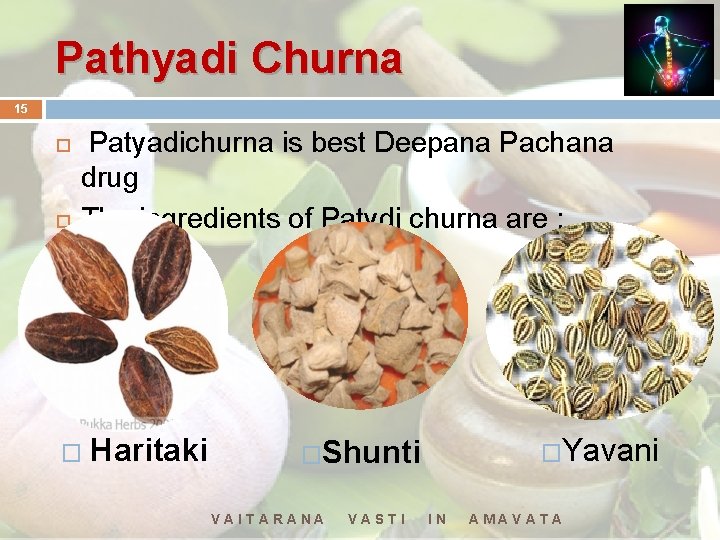
Pathyadi Churna 15 Patyadichurna is best Deepana Pachana drug The ingredients of Patydi churna are : � Haritaki �Yavani �Shunti VAITARANA VASTI IN AMAVATA
VAITARANA VASTI FORMULATION 16 Saindhava lavana -- 12 gms Guda -- 24 gms Chincha -- 48 gms Murchitatilataila -- 120 ml Gomutra VAITARANA -- 192 ml VASTI IN AMAVATA
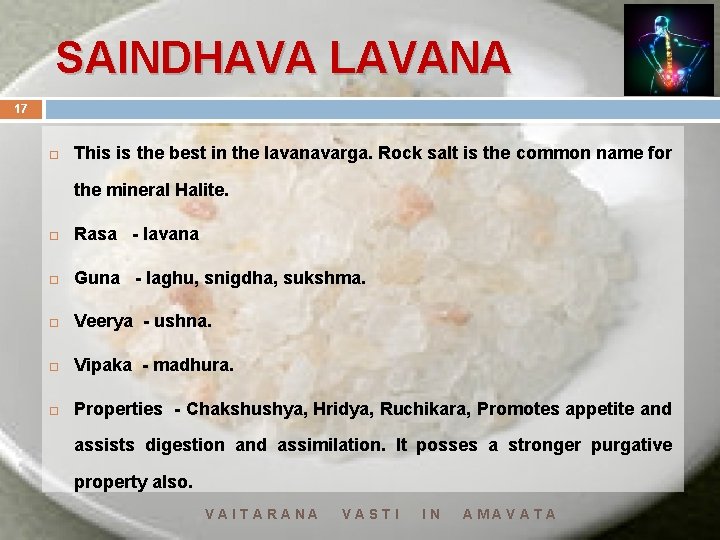
SAINDHAVA LAVANA 17 This is the best in the lavanavarga. Rock salt is the common name for the mineral Halite. Rasa - lavana Guna - laghu, snigdha, sukshma. Veerya - ushna. Vipaka - madhura. Properties - Chakshushya, Hridya, Ruchikara, Promotes appetite and assists digestion and assimilation. It posses a stronger purgative property also. VAITARANA VASTI IN AMAVATA
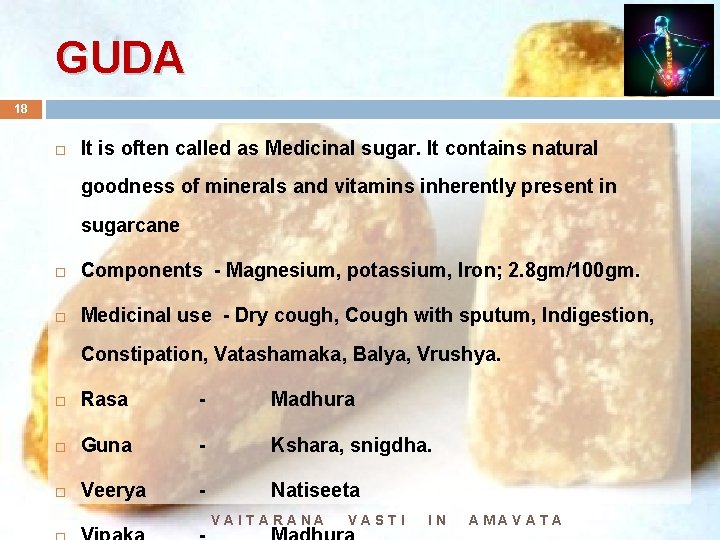
GUDA 18 It is often called as Medicinal sugar. It contains natural goodness of minerals and vitamins inherently present in sugarcane Components - Magnesium, potassium, Iron; 2. 8 gm/100 gm. Medicinal use - Dry cough, Cough with sputum, Indigestion, Constipation, Vatashamaka, Balya, Vrushya. Rasa - Madhura Guna - Kshara, snigdha. Veerya - Natiseeta VAITARANA VASTI IN AMAVATA
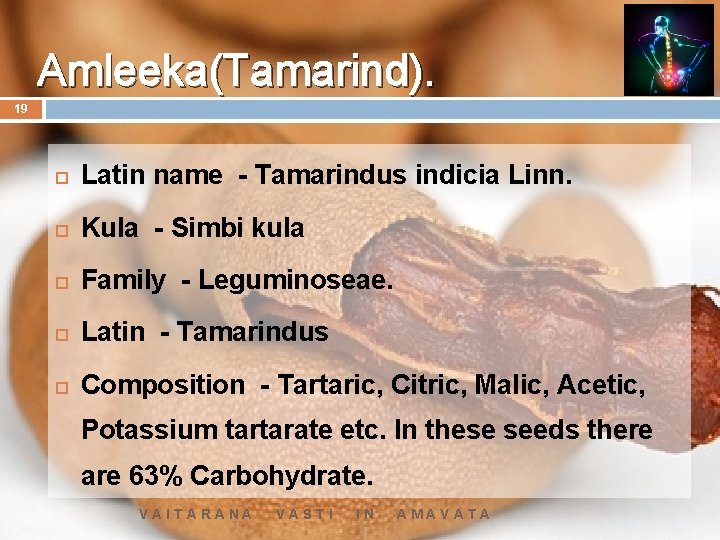
Amleeka(Tamarind). 19 Latin name - Tamarindus indicia Linn. Kula - Simbi kula Family - Leguminoseae. Latin - Tamarindus Composition - Tartaric, Citric, Malic, Acetic, Potassium tartarate etc. In these seeds there are 63% Carbohydrate. VAITARANA VASTI IN AMAVATA
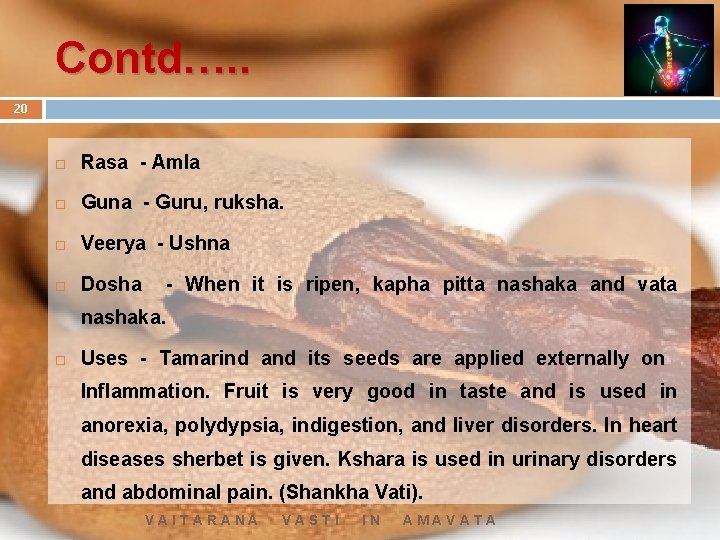
Contd…. . 20 Rasa - Amla Guna - Guru, ruksha. Veerya - Ushna Dosha - When it is ripen, kapha pitta nashaka and vata nashaka. Uses - Tamarind and its seeds are applied externally on Inflammation. Fruit is very good in taste and is used in anorexia, polydypsia, indigestion, and liver disorders. In heart diseases sherbet is given. Kshara is used in urinary disorders and abdominal pain. (Shankha Vati). VAITARANA VASTI IN AMAVATA
GO MUTRA 21 Indication - Raktapitta, Gulma, Unmada, Kasa, Sotha, Ruja, Anaha and Ama Properties - Guna Teeksna, Ushna, Laghu & Khsara - Kapha and Vata gunas. Rasa - Katu, Tikta and Kashaya VASTI IN AMAVATA VAITARANA
TAILA 22 Composition - Palmitic acid (9. 1%), stearic acid (4. 3%), arachidic acid (0. 8%), oleic acid (45. 4%), linoleic acid (40. 4%). Properties � Vatagni � Aggravates Pitta, does not aggravate Kapha � Ddeepana & pachana � Brimhana, Balya, Preenana, Lekhana � Promotes skin health, Complexion � Increases Intellect, Digestive power, Health of eyes � Strength and stability of Mamsadhatu, Krimighna � Reduces the quantity of Urine, Cleanses the Garbhasaya Yoni, in V A I T and ARAN A V Helps ASTI I N overcoming A M A V A T A Aging
23 Method of Preparation and Administration of Basti Mix jaggery in water and evaporate the required amount of water till it becomes dense as to be used as honey. Prescribed quantity of Saindhava Lavana is added and churned thoroughly. After proper mixing of above constituents, the Moorchita tila taila should be added slowly while churning in a slightly heated temperature. Tamarind is mixed and squeezed well in hot water and to be used as Kalka. The above kalka is to be added into the vessel and continue the churning. VAITARANA VASTI N AMAVATA Finally Gomutra of prescribed amount is Iadded very slowly while the
PROPERTIES OF VAITARANA VASTI 24 The ingredients of Vaitaranabasti mainly possess Deepana, Pachana, Ushna, Sukshma, Laghu, Teekshna and Lekhana gunas. These gunas helps to alleviate Ama, Vata & Kapha in the body resulting liquefaction, which decreases the Abhishyandi, Picchila, and Guru etc guna. At the same time it does the Srotovishodhana there by decreasing the Srotobhishyandana which intern leads to Vatanulomana VAITARANA VASTI IN AMAVATA
25 The significant improvement in Shoola, Shotha, Stabdata and Ushnata. So it justifies that basti is most efficient treatment for Amavta. Basti has got both Doshapratyanika and Vyadhi pratyanika effect on the disease Amavata. VAITARANA VASTI IN AMAVATA
Selection criteria 26 Patients were selected strictly as per present inclusive and exclusive criteria Inclusive criteria: � Classical signs and symptoms will be considered for the selection of patients. � Patients of Amavata having the history of less than 5 years. � Patients of Amavata between the age group of 20 to 60 years of either sex. � Patient fit for Bastikarma. VAITARANA VASTI IN AMAVATA
27 Exclusive criteria : � The patient of Amavata having the systemic diseases like Diabetes mellitus, � Asthma, Hypertension, Rheumatic heart disease & Heart diseases etc. � Pregnant women and lactating mothers. � Patient with marked joint deformities � Patients suffering from gout, septic arthritis and allied joint VAITARANA VASTI IN AMAVATA
Investigations and selection of patient 28 Objective Subjective parameters � Hb% � Bahusandhishula �E SR � Bahusandhishota �C RP � Stabdata � RA � Spershasahishnuta VAITARANA VASTI IN AMAVATA
Assessment of the treatment 29 Bahusandhishoola (Joint Pain): � Among 30 patients 3 patients have got more than 75% improvement, 4 patients have got 66% improvement, and 23 patients have got 50% improvement Bahusandhishota (Swelling of Joints): � Among 30 patients 18 patients have got more than 75% improvement, patients have got 50% improvement, and 9 patients have not got any improvement. VAITARANA VASTI IN AMAVATA
Assessment of the treatment 30 Bahusandhigraha (Morning stiffness): � Among 30 patients 22 patients have got more than 75% improvement, and 9 patients have not got any improvement. Spershasahishnuta (Tenderness): � Among 30 patients all patients have got 100% improvement VAITARANA VASTI IN AMAVATA
31 Overall Assessment of the treatment The results were classified in to four groups as listed below � Completely � Good response � Moderate � No relieved response VAITARANA VASTI IN AMAVATA
RESULTS 32 The results of the study confirmed that Vaitaranabasti have their own role in the management of Amavata, as the patients shows remarkable reduction in the symptoms. Good improvement was observed in 13 patients (43. 33%) Moderate improvement was observed in 17 patients VAITARANA VASTI IN AMAVATA (56. 66%) among the 30 patients.
CONCLUSION 33 As the disease is genetic and autoimmune in origin the permanent complete remission is not possible. The specific Ayurvedic line of management and drugs helps in decreasing the auto antigens and may acts as modifying the immune response to auto antigens. At the same time the drugs are safe can be given for longer duration without any adverse effects. The active principles of Vaitaranabasti are antagonistic to ama and may acts as anti-inflammatory. Vaitaranabasti have their specific Vrole in the management of Amavata. VAITARANA ASTI IN AMAVATA

34 VAITARANA VASTI IN AMAVATA
- Slides: 34