
Evaluation of the Dizzy Patient Tom A Hamilton

- Slides: 29
Evaluation of the Dizzy Patient Tom A. Hamilton, DO Program Director Oklahoma State University Otolaryngology-Head and Neck Facial Plastic Surgery
Disclosure I have no relevant financial relationships or affiliations with commercial interests to disclose.
Objectives ■ Define balance system ■ Define vertigo ■ Differential Diagnosis ■ Bedside Tools for Diagnosis ■ Specialized testing
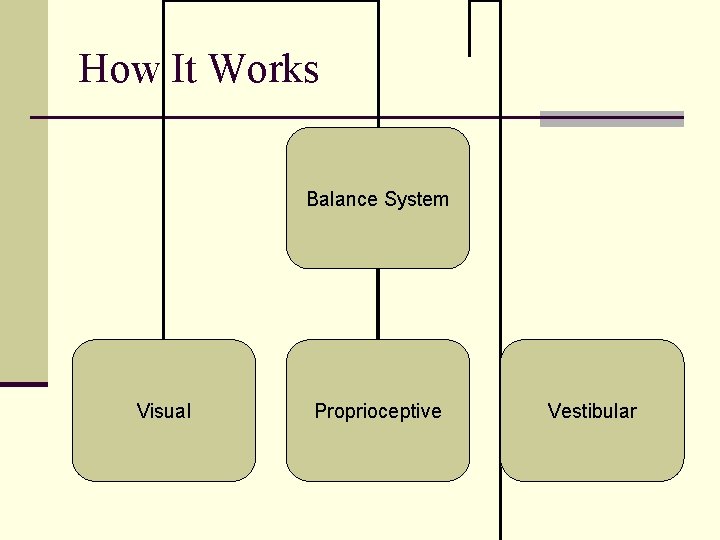
How It Works Balance System Visual Proprioceptive Vestibular
Fast Facts ■ 5 million office visits per year for dizziness ■ 40% of patients over 65 will fall each year ■ 80% of patients over 65 have experienced dizziness ■ Most common complaint for patients over 75 ■ Falls are the leading cause of injury for older patients and leading cause of accidental death over age 85
Dizziness ■ Vertigo ■ Disequilibrium ■ Oscillopsia ■ Lightheadedness ■ Physiologic ■ Multisensory
True Vertigo Usually described as spinning, whirling, or turning ■ Illusion of rotational, linear, or tilting of surroundings ■ Will not cause syncope ■ Problem with Brain or Inner Ear
Dysequilibrium ■ Sensation of Instability of body positions ■ Either walking, standing ■ Feeling of being “off balance or imbalance” ■ Usually a problem with Proprioception but can be caused by common cold or allergic rhinitis causing eustacian tube dysfunction
Oscillopsia ■ Inability to focus on object with movement ■ Difficulty reading while pushing shopping cart ■ Difficulty reading sign while walking ■ Problem with both Inner Ears ■ Usually from Ototoxic drugs such as chemotherapy or vancomycin
Lightheadedness ■ Sense of Impending Faint ■ Presyncope ■ Caused by hyperventilation, orthostatic hypotension, vasovagal stimulation, recent changes in medications
Physiologic ■ Height Vertigo ■ Usually seen above 3 meters ■ Visual cues for body sway correction decreased due to height ■ Motion Sickness ■ Rare under 2 years ■ Vision focused on stationary object with body in motion
Multisensory ■ Diabetes ■ Age related decompensation
Differential DX ■ Start with a good history of symptoms ■ 90% of work up ■ Is there any hearing loss or tinnitus ■ Medications ■ History of Trauma ■ Cardiac symptoms ■ Anxiety ■ Aura ■ Vision change ■ Focal neurologic symptoms
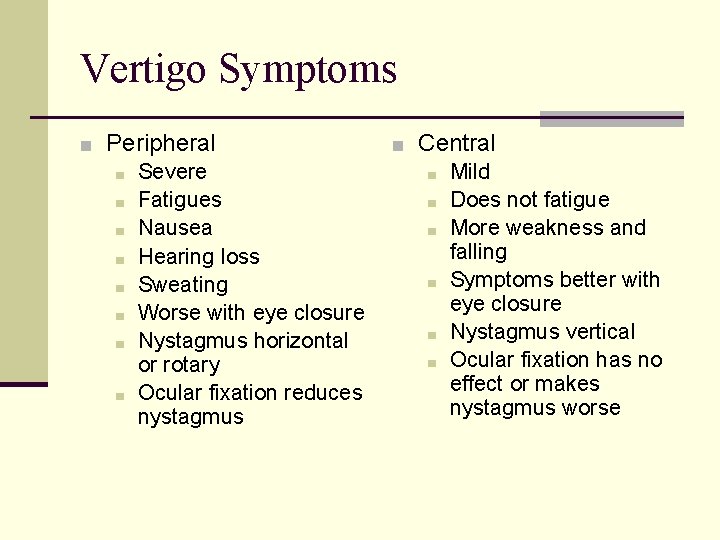
Vertigo Symptoms ■ Peripheral ■ Severe ■ Fatigues ■ Nausea ■ Hearing loss ■ Sweating ■ Worse with eye closure ■ Nystagmus horizontal or rotary ■ Ocular fixation reduces nystagmus ■ Central ■ Mild ■ Does not fatigue ■ More weakness and falling ■ Symptoms better with eye closure ■ Nystagmus vertical ■ Ocular fixation has no effect or makes nystagmus worse
Peripheral Vertigo ■ Benign Paroxysmal Positional Vertigo ■ Meniere’s Disease ■ Vestibular Neuronitis ■ Labyrinthitis
BPPV ■ Most common cause of true vertigo ■ Symptoms last for seconds to a minute ■ Very positional: occurs when sitting up or rolling over. Also when looking up on top shelf ■ Fatigable ■ May follow head trauma, joint operation, or bedrest
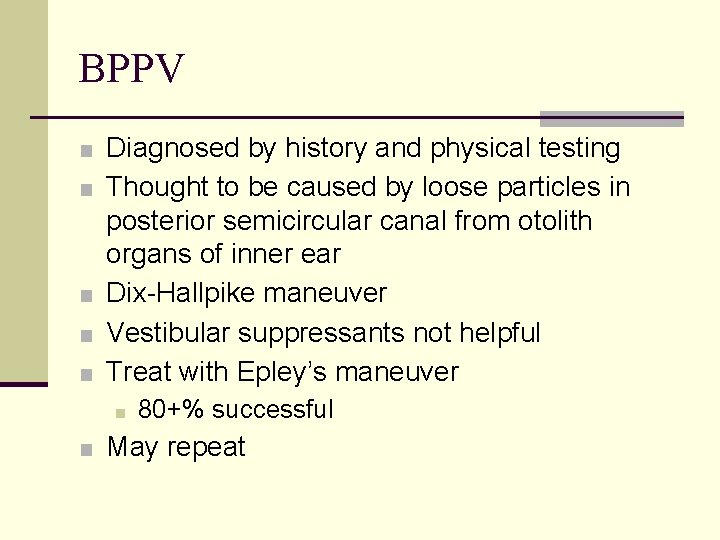
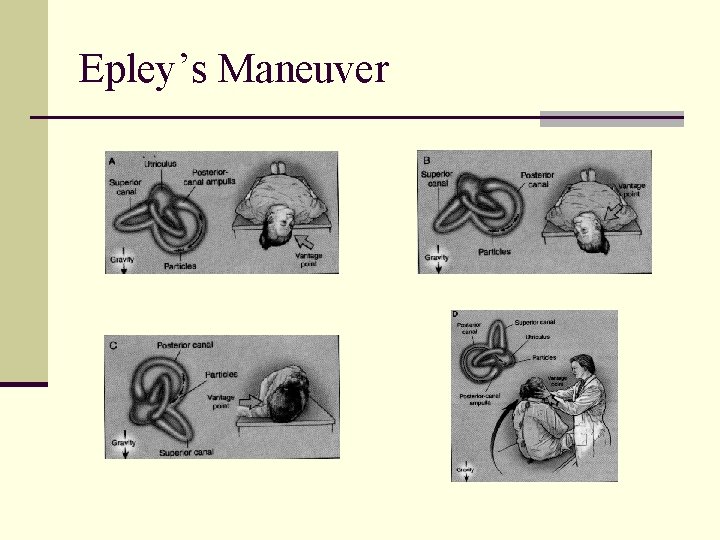
BPPV ■ Diagnosed by history and physical testing ■ Thought to be caused by loose particles in posterior semicircular canal from otolith organs of inner ear ■ Dix-Hallpike maneuver ■ Vestibular suppressants not helpful ■ Treat with Epley’s maneuver ■ 80+% successful ■ May repeat
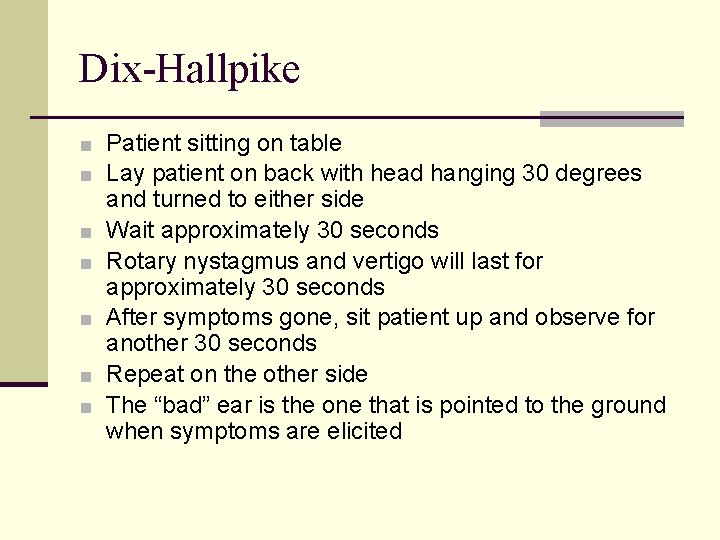
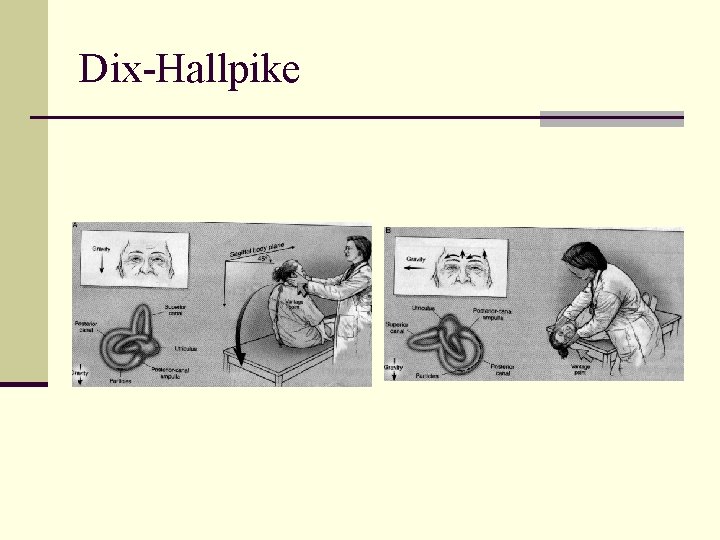
Dix-Hallpike ■ Patient sitting on table ■ Lay patient on back with head hanging 30 degrees ■ ■ ■ and turned to either side Wait approximately 30 seconds Rotary nystagmus and vertigo will last for approximately 30 seconds After symptoms gone, sit patient up and observe for another 30 seconds Repeat on the other side The “bad” ear is the one that is pointed to the ground when symptoms are elicited
Dix-Hallpike
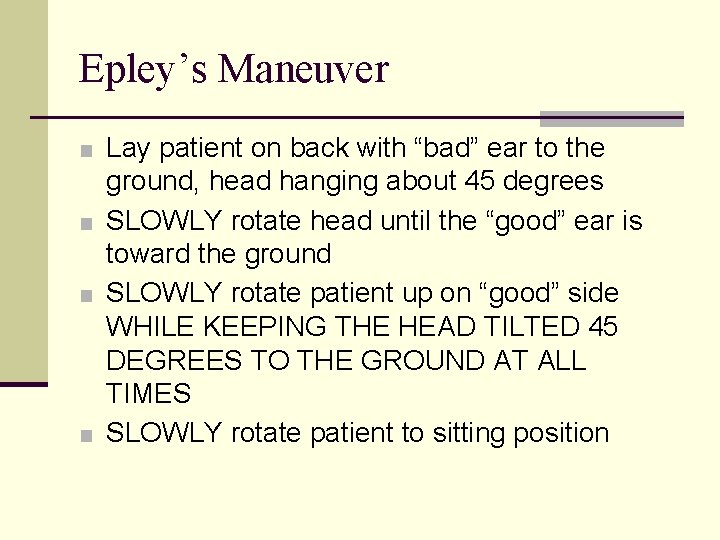
Epley’s Maneuver ■ Lay patient on back with “bad” ear to the ground, head hanging about 45 degrees ■ SLOWLY rotate head until the “good” ear is toward the ground ■ SLOWLY rotate patient up on “good” side WHILE KEEPING THE HEAD TILTED 45 DEGREES TO THE GROUND AT ALL TIMES ■ SLOWLY rotate patient to sitting position
Epley’s Maneuver
Meniere’s Disease Fluctuating Sensorineural Hearing Loss Nystagmus Intermittent Vertigo: hours to days Low pitched roaring Aural fullness Diagnosis of exclusion Need at least two audiograms, usually pre and post treatment ■ Low sodium diet, control allergies, HCTZ, occasionally short course of oral steroids ■ Rarely surgery or chemoablation ■ ■ ■ ■
Vestibular Neuronitis/Labyrinthitis ■ Usually normal hearing with neuronitis, ■ ■ ■ labyrinthitis usually with hearing loss Nystagmus May be after a recent URI or flu like illness Severe vertigo may last up to one week Some generalized unsteadiness can persist for up to 6 weeks Valium useful for severe symptoms, then taper off. Vestibular rehabilitation can speed recovery
Metabolic Disorders ■ Diabetes is the biggest offender ■ Treat underlying disorder ■ Patient may need vestibular rehabilitation
Bedside Testing ■ Gait test ■ Preponderance to 1 side ■ Oculomotor exam ■ Nystagmus ■ Rhomberg ■ Sharpened: heel to toe ■ Fukuda test ■ March in place for 30 sec: turn to lesion ■ Dix-Hallpike
The Next Step ■ If no clear etiology proceed with specialized ■ ■ ■ ■ testing Complete Audiogram Electronystagmogram Visually evoked myogenic potentials Auditory Brainstem Response Electrocochleography Posturography MRI brain with gadolinium or MRA
Recap ■ Start with thorough history ■ Focused neurologic exam ■ Basic office testing ■ Treat what you see ■ If no clear etiology, proceed with more specialized testing ■ Enhance the normal compensation/healing response
Questions
Life is too short for bad music, bad food or bad friends