
Evaluation of Reference Sources The importance of evaluation
- Slides: 13
Evaluation of Reference Sources
The importance of evaluation • William Katz (2002) states, “How does the librarian know whether a reference source is good, bad or indifferent? . . . [A] good reference source is one that answers questions, and a poor reference source is one that fails to answer questions. Constant use in practice will help in identifying any source, (whether a book or a database) with one of these two categories. ”
Why evaluation? • quality of sources determined; suitability for inclusion in the library’s reference collection • evaluation criteria for print sources, non-print (manuscripts, multimedia, electronic) • criteria that apply to all sources (Bopp & Smith, p. 312316) • special evaluation criteria for a type of source (Bopp & Smith, Katz)
General Evaluation Criteria Format Scope Relation to similar works Authority Treatment Arrangement Special features Cost
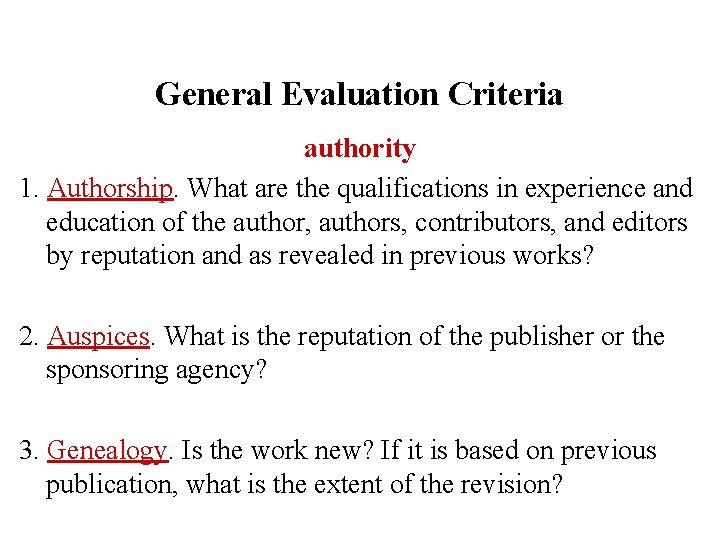
General Evaluation Criteria authority 1. Authorship. What are the qualifications in experience and education of the author, authors, contributors, and editors by reputation and as revealed in previous works? 2. Auspices. What is the reputation of the publisher or the sponsoring agency? 3. Genealogy. Is the work new? If it is based on previous publication, what is the extent of the revision?
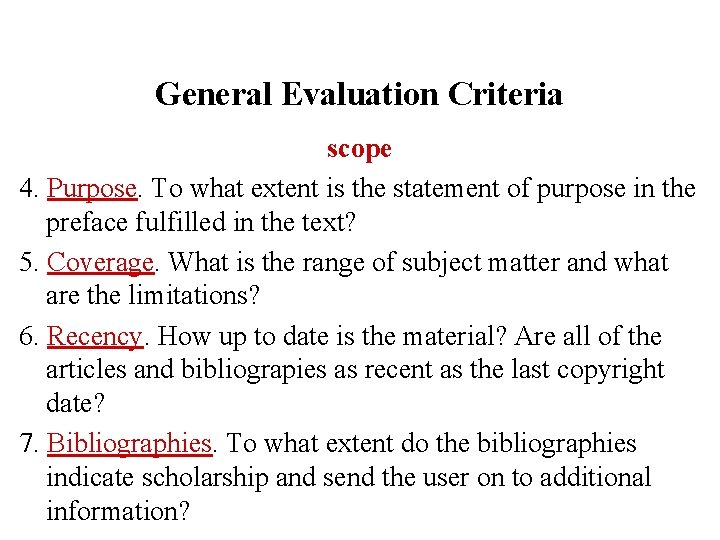
General Evaluation Criteria scope 4. Purpose. To what extent is the statement of purpose in the preface fulfilled in the text? 5. Coverage. What is the range of subject matter and what are the limitations? 6. Recency. How up to date is the material? Are all of the articles and bibliograpies as recent as the last copyright date? 7. Bibliographies. To what extent do the bibliographies indicate scholarship and send the user on to additional information?
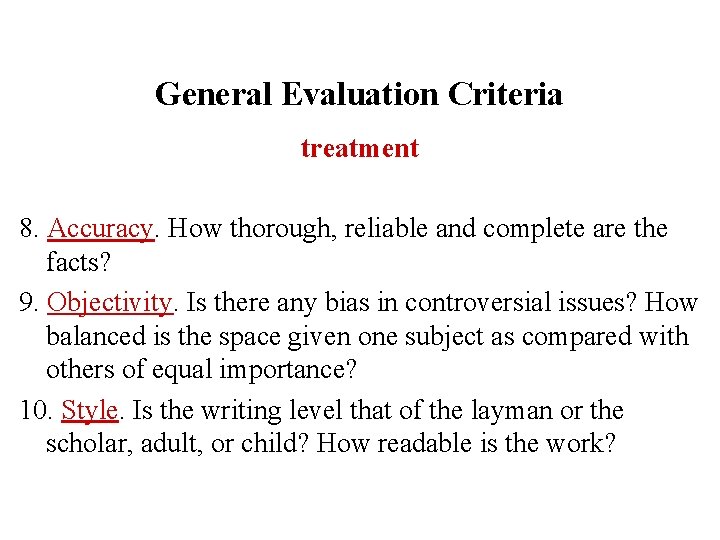
General Evaluation Criteria treatment 8. Accuracy. How thorough, reliable and complete are the facts? 9. Objectivity. Is there any bias in controversial issues? How balanced is the space given one subject as compared with others of equal importance? 10. Style. Is the writing level that of the layman or the scholar, adult, or child? How readable is the work?
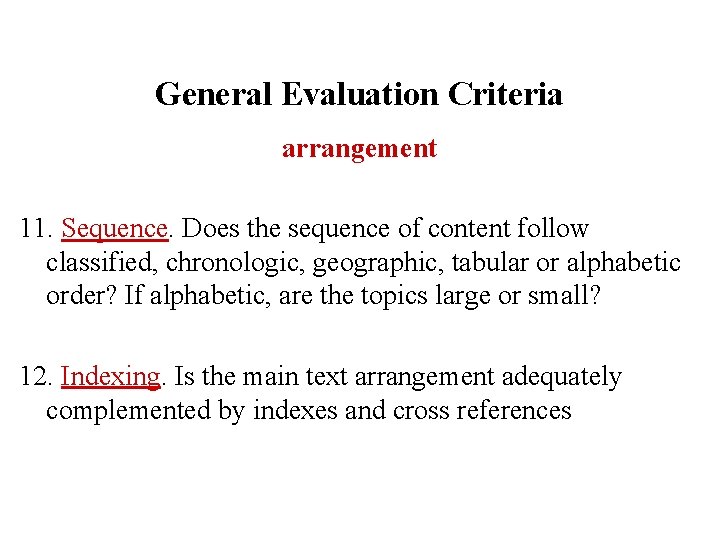
General Evaluation Criteria arrangement 11. Sequence. Does the sequence of content follow classified, chronologic, geographic, tabular or alphabetic order? If alphabetic, are the topics large or small? 12. Indexing. Is the main text arrangement adequately complemented by indexes and cross references
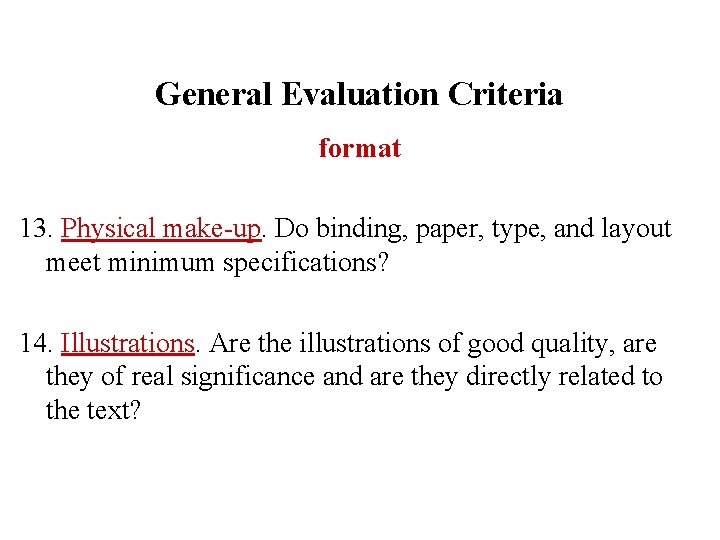
General Evaluation Criteria format 13. Physical make-up. Do binding, paper, type, and layout meet minimum specifications? 14. Illustrations. Are the illustrations of good quality, are they of real significance and are they directly related to the text?
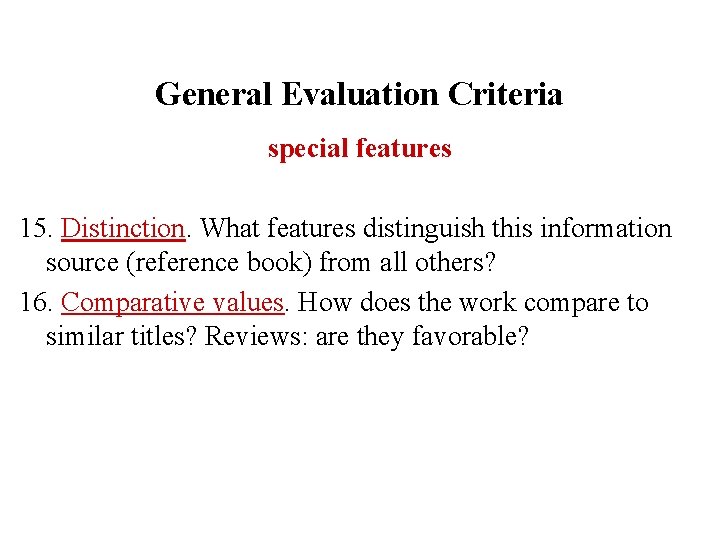
General Evaluation Criteria special features 15. Distinction. What features distinguish this information source (reference book) from all others? 16. Comparative values. How does the work compare to similar titles? Reviews: are they favorable?
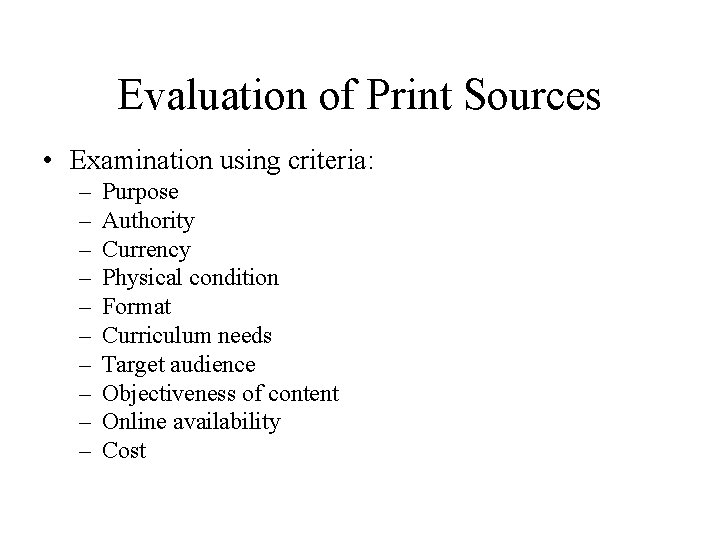
Evaluation of Print Sources • Examination using criteria: – – – – – Purpose Authority Currency Physical condition Format Curriculum needs Target audience Objectiveness of content Online availability Cost
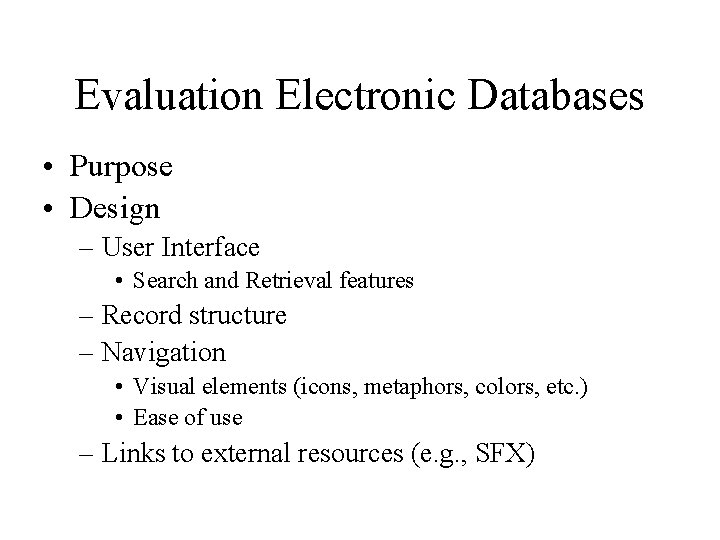
Evaluation Electronic Databases • Purpose • Design – User Interface • Search and Retrieval features – Record structure – Navigation • Visual elements (icons, metaphors, colors, etc. ) • Ease of use – Links to external resources (e. g. , SFX)
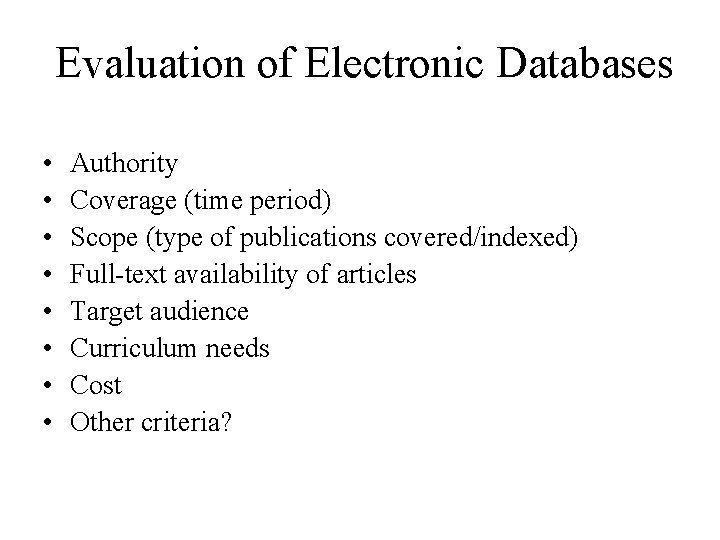
Evaluation of Electronic Databases • • Authority Coverage (time period) Scope (type of publications covered/indexed) Full-text availability of articles Target audience Curriculum needs Cost Other criteria?