
Evaluation of OPA 569 BridgeTiedLoad Errol Leon and

Evaluation of OPA 569 Bridge-Tied-Load Errol Leon and Thomas Kuehl Precision Linear Analog Applications January 26, 2016 1
OPA 569 bridge-tied-load analysis outline 1) Statement of customer issue 2) Comparison of TIPD 103 and customer circuit 3) I-monitor pin limitations as feedback and Rmax 4) Tina. TI model verification of output swing limitation and Rload 5) Test set-up of customer’s circuit varying Rload 6) Summary of Analysis and Recommendations 2

Statement of customer issue 3
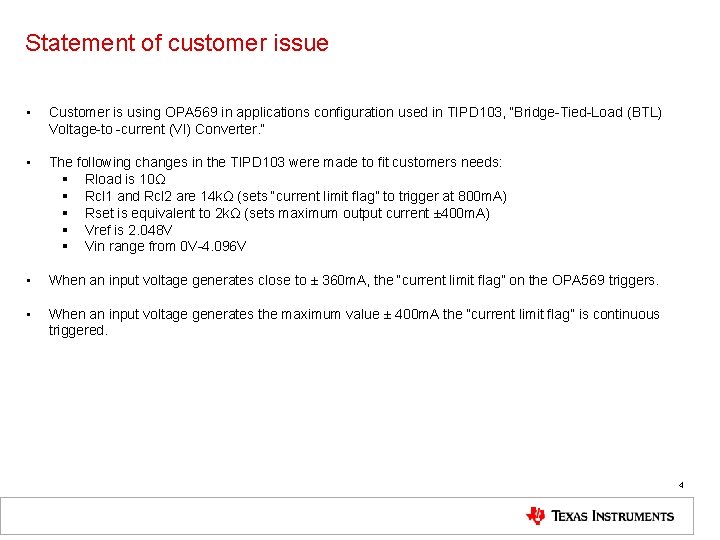
Statement of customer issue • Customer is using OPA 569 in applications configuration used in TIPD 103, “Bridge-Tied-Load (BTL) Voltage-to -current (VI) Converter. ” • The following changes in the TIPD 103 were made to fit customers needs: § Rload is 10Ω § Rcl 1 and Rcl 2 are 14 kΩ (sets “current limit flag” to trigger at 800 m. A) § Rset is equivalent to 2 kΩ (sets maximum output current ± 400 m. A) § Vref is 2. 048 V § Vin range from 0 V-4. 096 V • When an input voltage generates close to ± 360 m. A, the “current limit flag” on the OPA 569 triggers. • When an input voltage generates the maximum value ± 400 m. A the “current limit flag” is continuous triggered. 4
Comparison of TIPD 103 and customer configuration 5
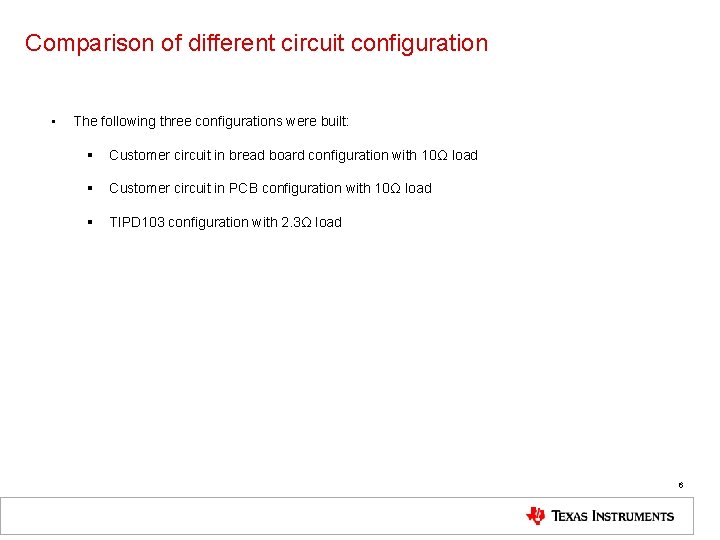
Comparison of different circuit configuration • The following three configurations were built: § Customer circuit in bread board configuration with 10Ω load § Customer circuit in PCB configuration with 10Ω load § TIPD 103 configuration with 2. 3Ω load 6
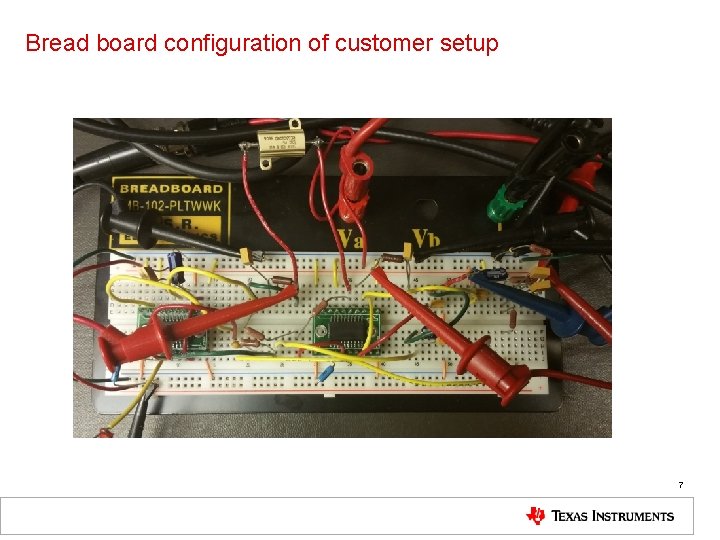
Bread board configuration of customer setup 7
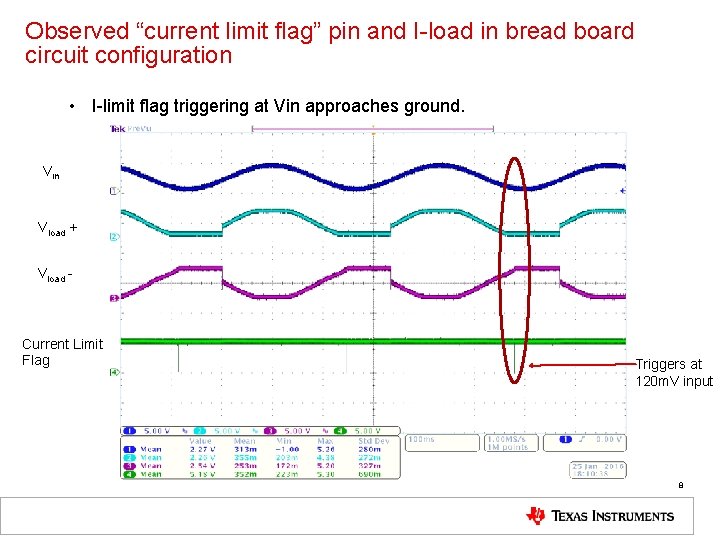
Observed “current limit flag” pin and I-load in bread board circuit configuration • I-limit flag triggering at Vin approaches ground. Vin Vload + Vload - Current Limit Flag Triggers at 120 m. V input 8
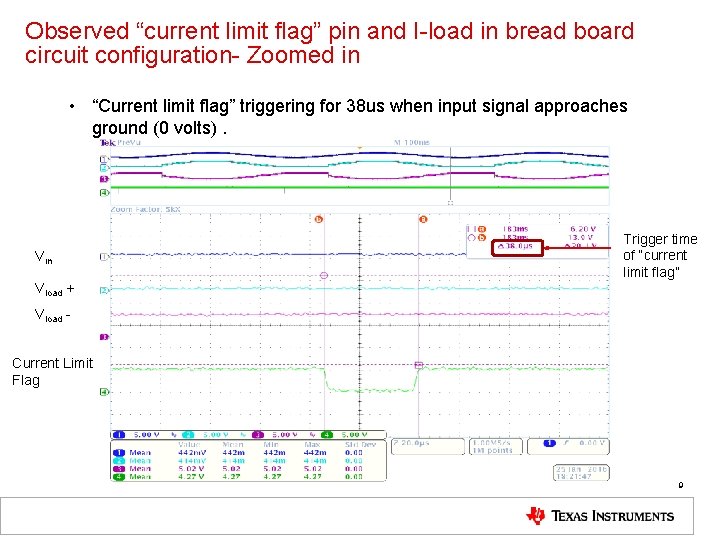
Observed “current limit flag” pin and I-load in bread board circuit configuration- Zoomed in • “Current limit flag” triggering for 38 us when input signal approaches ground (0 volts). Vin Trigger time of “current limit flag” Vload + Vload Current Limit Flag 9
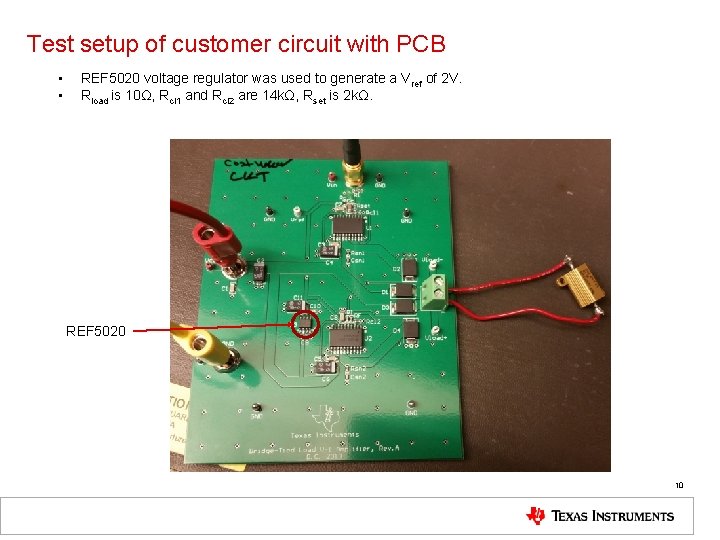
Test setup of customer circuit with PCB • • REF 5020 voltage regulator was used to generate a Vref of 2 V. Rload is 10Ω, Rcl 1 and Rcl 2 are 14 kΩ, Rset is 2 kΩ. REF 5020 10
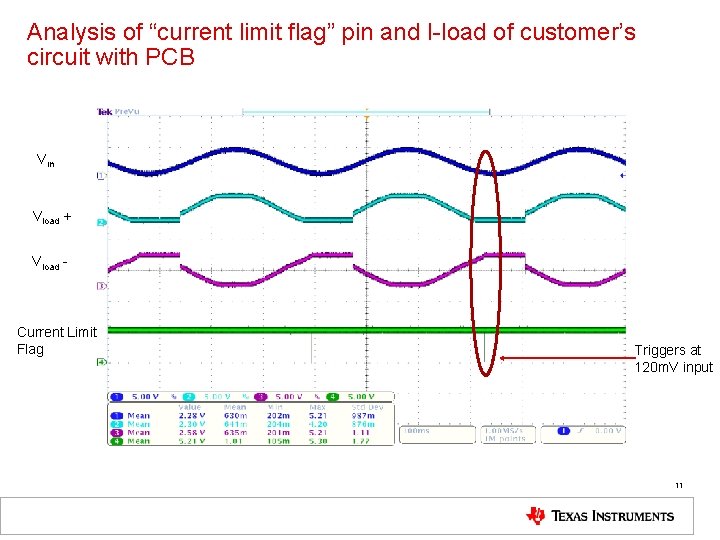
Analysis of “current limit flag” pin and I-load of customer’s circuit with PCB Vin Vload + Vload - Current Limit Flag Triggers at 120 m. V input 11
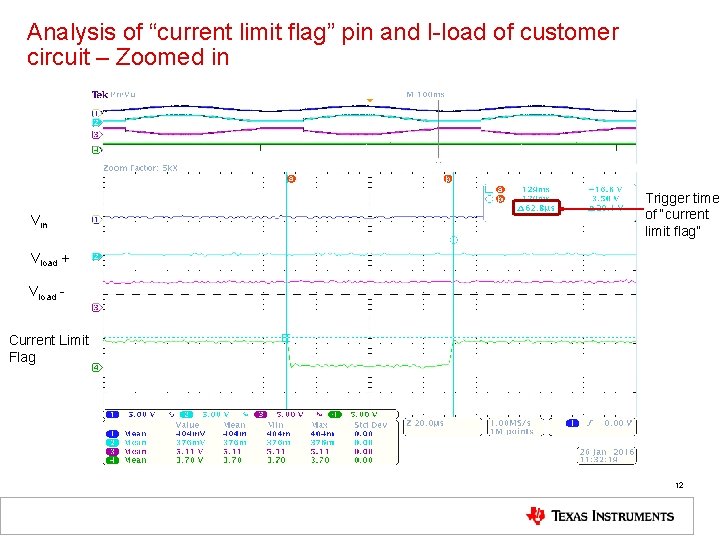
Analysis of “current limit flag” pin and I-load of customer circuit – Zoomed in Vin Trigger time of “current limit flag” Vload + Vload Current Limit Flag 12
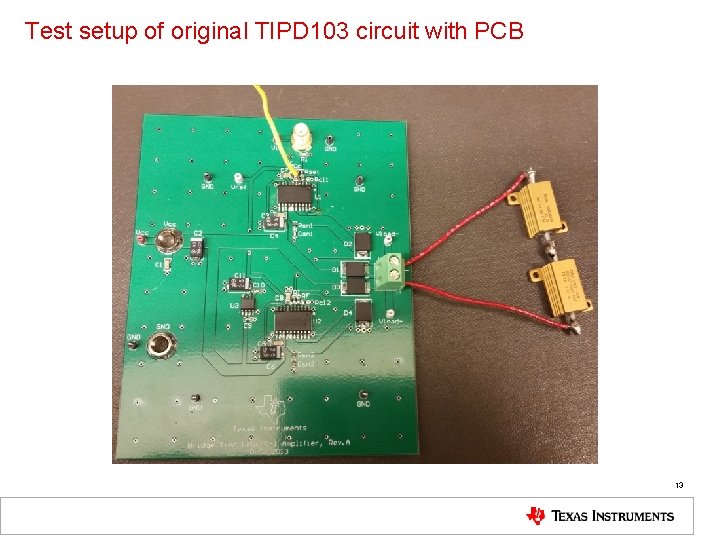
Test setup of original TIPD 103 circuit with PCB 13
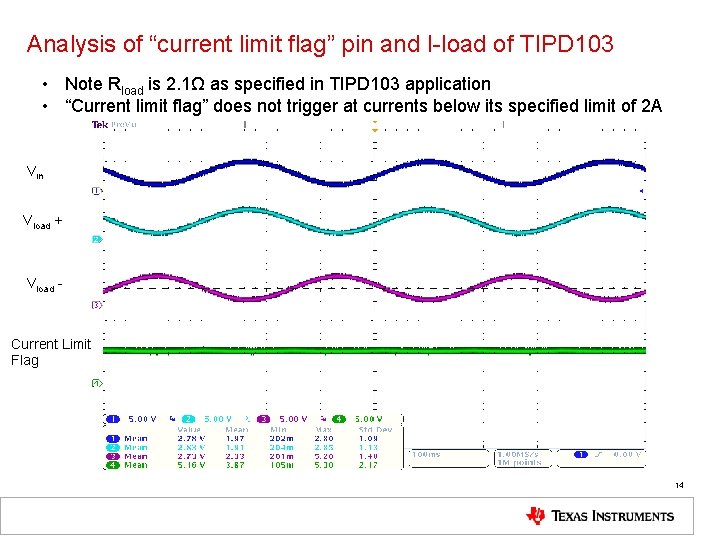
Analysis of “current limit flag” pin and I-load of TIPD 103 • Note Rload is 2. 1Ω as specified in TIPD 103 application • “Current limit flag” does not trigger at currents below its specified limit of 2 A Vin Vload + Vload - Current Limit Flag 14
I-monitor pin limitations as feedback and Rload(max) 15
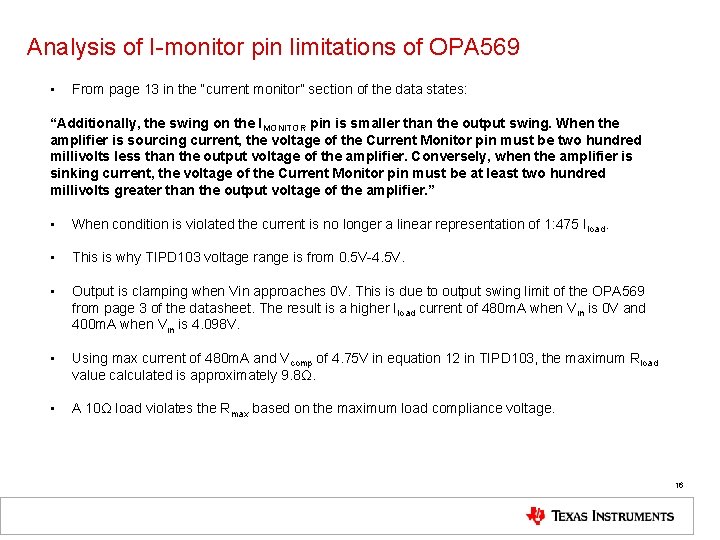
Analysis of I-monitor pin limitations of OPA 569 • From page 13 in the “current monitor” section of the data states: “Additionally, the swing on the IMONITOR pin is smaller than the output swing. When the amplifier is sourcing current, the voltage of the Current Monitor pin must be two hundred millivolts less than the output voltage of the amplifier. Conversely, when the amplifier is sinking current, the voltage of the Current Monitor pin must be at least two hundred millivolts greater than the output voltage of the amplifier. ” • When condition is violated the current is no longer a linear representation of 1: 475 Iload. • This is why TIPD 103 voltage range is from 0. 5 V-4. 5 V. • Output is clamping when Vin approaches 0 V. This is due to output swing limit of the OPA 569 from page 3 of the datasheet. The result is a higher Iload current of 480 m. A when Vin is 0 V and 400 m. A when Vin is 4. 098 V. • Using max current of 480 m. A and Vcomp of 4. 75 V in equation 12 in TIPD 103, the maximum Rload value calculated is approximately 9. 8Ω. • A 10Ω load violates the Rmax based on the maximum load compliance voltage. 16

TINA-TI model verification of output swing limit and Rload 17
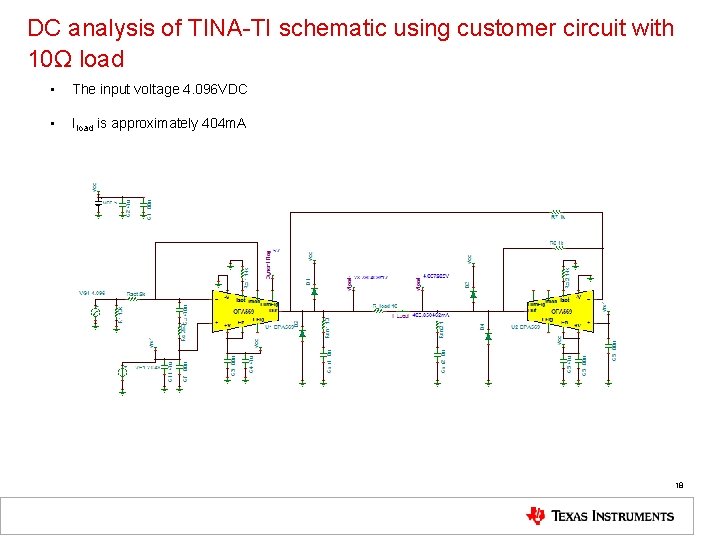
DC analysis of TINA-TI schematic using customer circuit with 10Ω load • The input voltage 4. 096 VDC • Iload is approximately 404 m. A 18
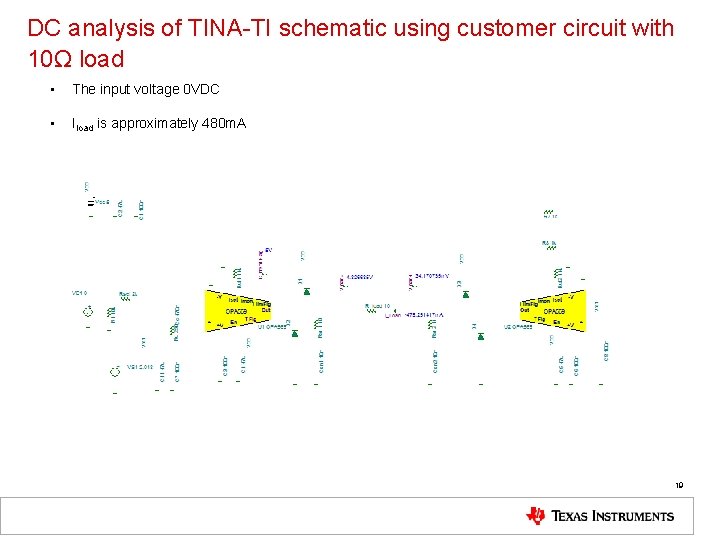
DC analysis of TINA-TI schematic using customer circuit with 10Ω load • The input voltage 0 VDC • Iload is approximately 480 m. A 19
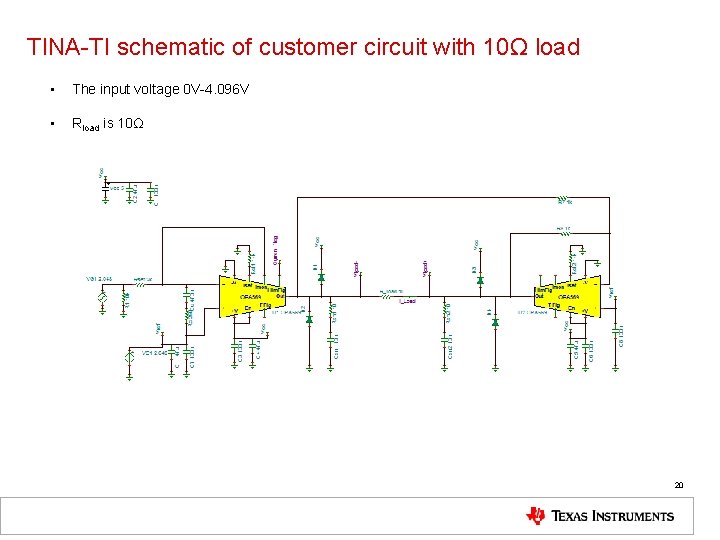
TINA-TI schematic of customer circuit with 10Ω load • The input voltage 0 V-4. 096 V • Rload is 10Ω 20
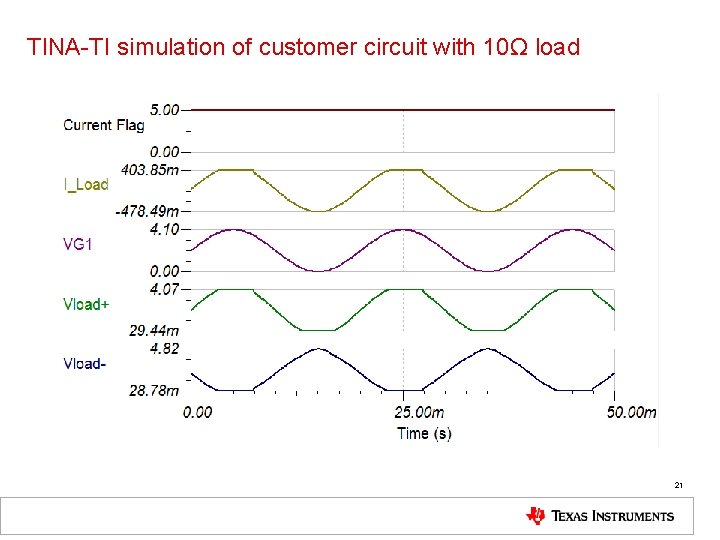
TINA-TI simulation of customer circuit with 10Ω load 21
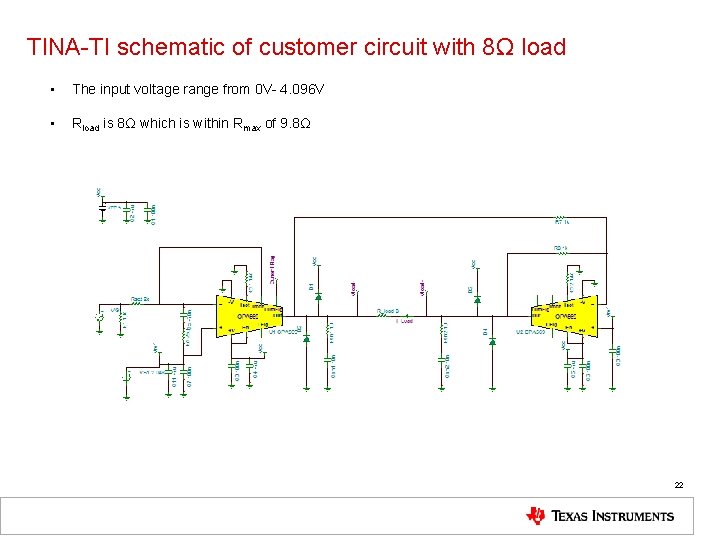
TINA-TI schematic of customer circuit with 8Ω load • The input voltage range from 0 V- 4. 096 V • Rload is 8Ω which is within Rmax of 9. 8Ω 22
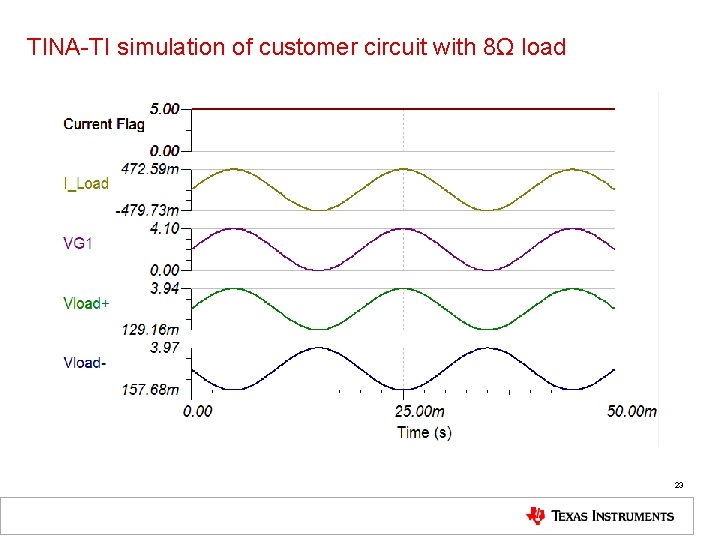
TINA-TI simulation of customer circuit with 8Ω load 23
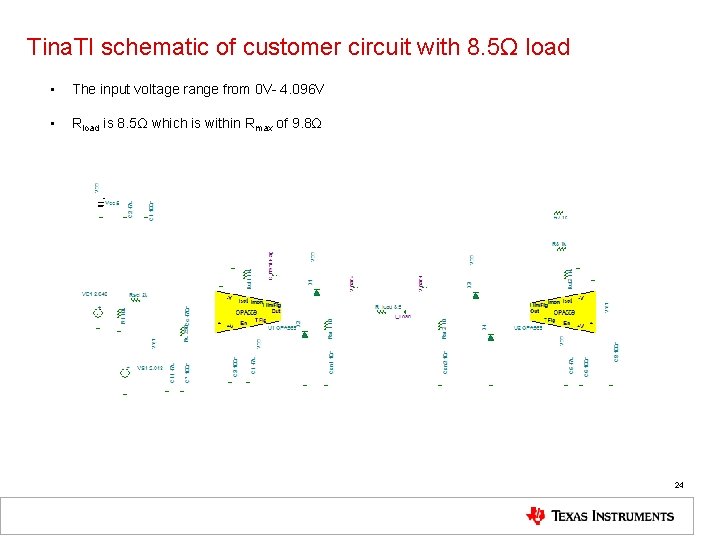
Tina. TI schematic of customer circuit with 8. 5Ω load • The input voltage range from 0 V- 4. 096 V • Rload is 8. 5Ω which is within Rmax of 9. 8Ω 24
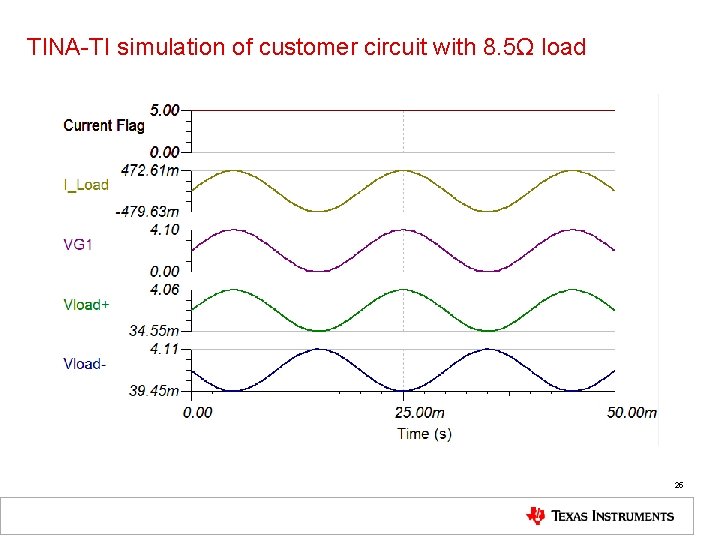
TINA-TI simulation of customer circuit with 8. 5Ω load 25
Test setup of customer’s circuit varying Rload 26
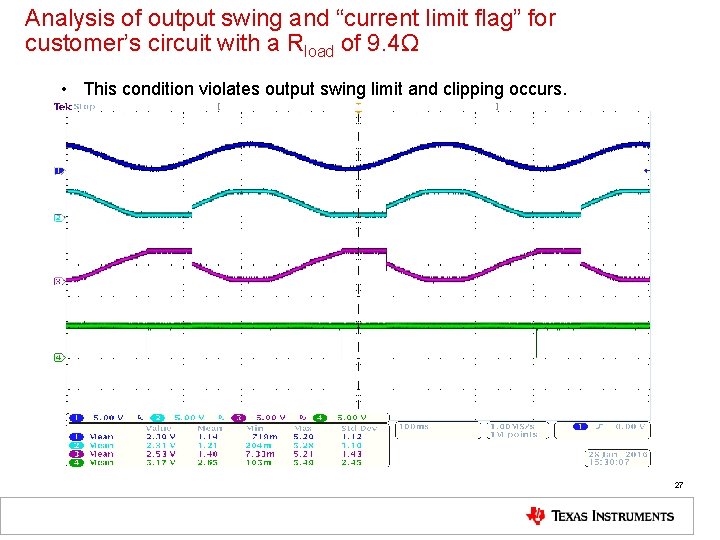
Analysis of output swing and “current limit flag” for customer’s circuit with a Rload of 9. 4Ω • This condition violates output swing limit and clipping occurs. 27
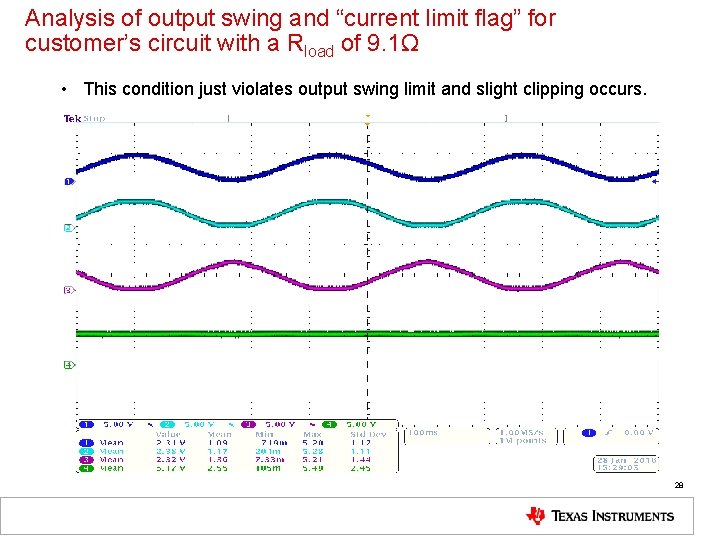
Analysis of output swing and “current limit flag” for customer’s circuit with a Rload of 9. 1Ω • This condition just violates output swing limit and slight clipping occurs. 28
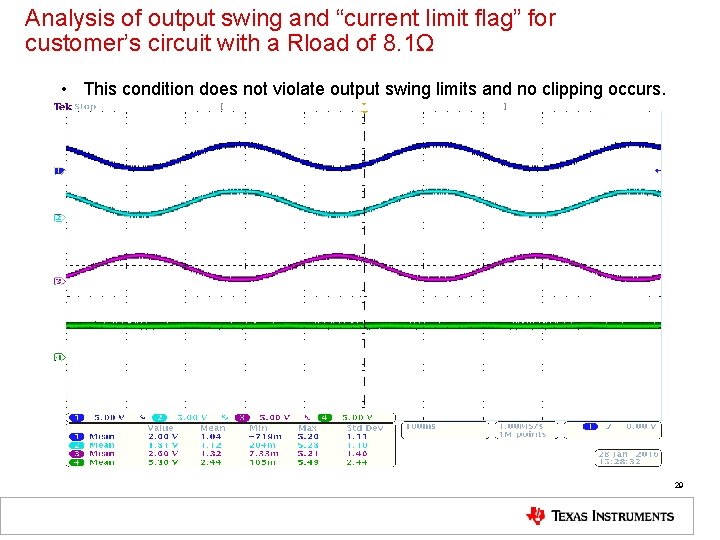
Analysis of output swing and “current limit flag” for customer’s circuit with a Rload of 8. 1Ω • This condition does not violate output swing limits and no clipping occurs. 29

Summary of analysis 30
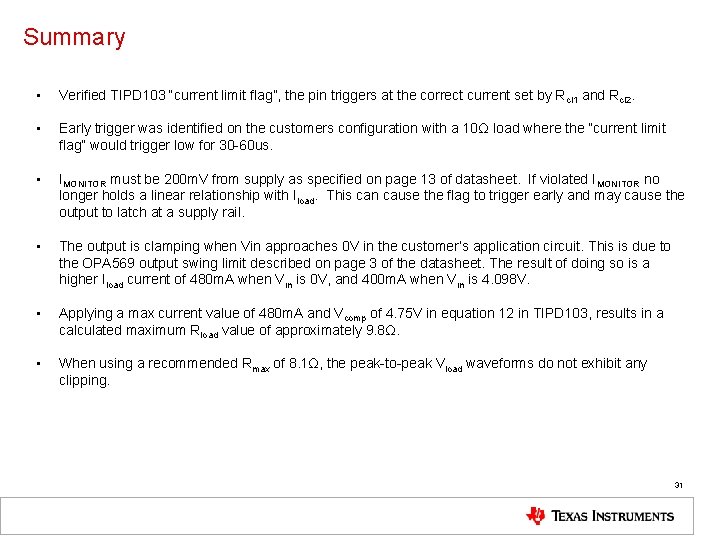
Summary • Verified TIPD 103 “current limit flag”, the pin triggers at the correct current set by R cl 1 and Rcl 2. • Early trigger was identified on the customers configuration with a 10Ω load where the “current limit flag” would trigger low for 30 -60 us. • IMONITOR must be 200 m. V from supply as specified on page 13 of datasheet. If violated IMONITOR no longer holds a linear relationship with Iload. This can cause the flag to trigger early and may cause the output to latch at a supply rail. • The output is clamping when Vin approaches 0 V in the customer’s application circuit. This is due to the OPA 569 output swing limit described on page 3 of the datasheet. The result of doing so is a higher Iload current of 480 m. A when Vin is 0 V, and 400 m. A when Vin is 4. 098 V. • Applying a max current value of 480 m. A and Vcomp of 4. 75 V in equation 12 in TIPD 103, results in a calculated maximum Rload value of approximately 9. 8Ω. • When using a recommended Rmax of 8. 1Ω, the peak-to-peak Vload waveforms do not exhibit any clipping. 31
- Slides: 31