
Evaluation of one API for FPGAs Presented by
Evaluation of one. API for FPGAs Presented by: Nicholas Miller, Jeanine Cook, and Clayton Hughes Sandia National Laboratories is a multimission laboratory managed and operated by National Technology & Engineering Solutions of Sandia, LLC, a wholly owned subsidiary of Honeywell International Inc. , for the U. S. Department of Energy’s National Nuclear Security Administration under contract DE-NA 0003525. SAND 2021 -7308 C
Introduction
3 Motivation FPGAs have historically faced challenges for HPC § Development environment not amenable to agile application and hardware codesign § System integration and deployment complexity Application-specific accelerators (ASAs) have shown promising results in both power and performance but are costly to build and deploy With recent investments in high-level synthesis tools, FPGAs could serve as a stepping stone for ASAs Evaluate Intel’s one. API tools for FPGA Programmability and Performance
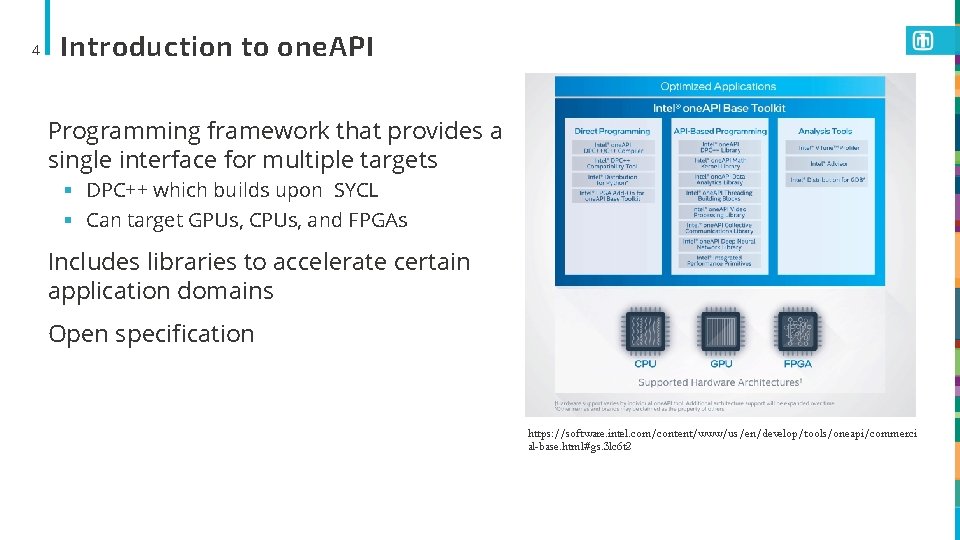
4 Introduction to one. API Programming framework that provides a single interface for multiple targets § DPC++ which builds upon SYCL § Can target GPUs, CPUs, and FPGAs Includes libraries to accelerate certain application domains Open specification https: //software. intel. com/content/www/us/en/develop/tools/oneapi/commerci al-base. html#gs. 3 lc 6 t 2
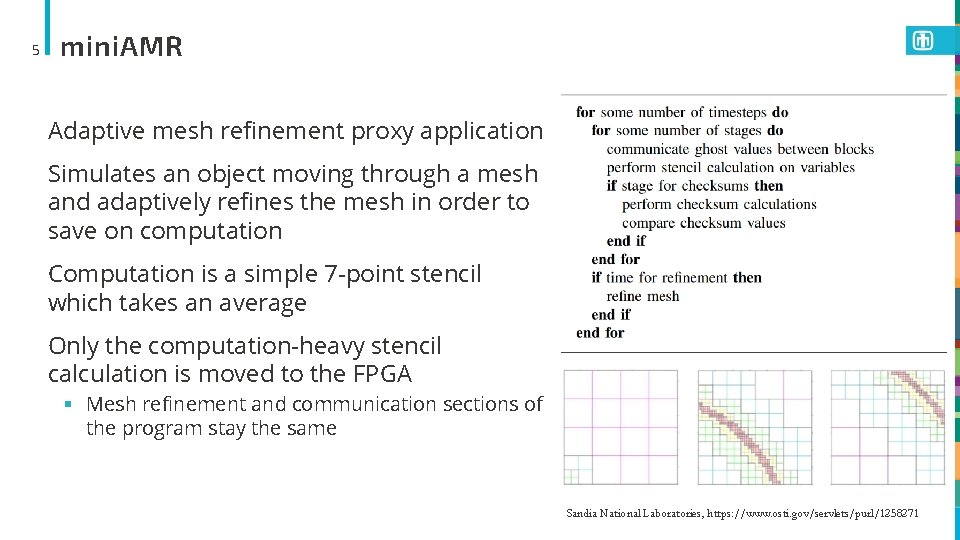
5 mini. AMR Adaptive mesh refinement proxy application Simulates an object moving through a mesh and adaptively refines the mesh in order to save on computation Computation is a simple 7 -point stencil which takes an average Only the computation-heavy stencil calculation is moved to the FPGA § Mesh refinement and communication sections of the program stay the same Sandia National Laboratories, https: //www. osti. gov/servlets/purl/1258271
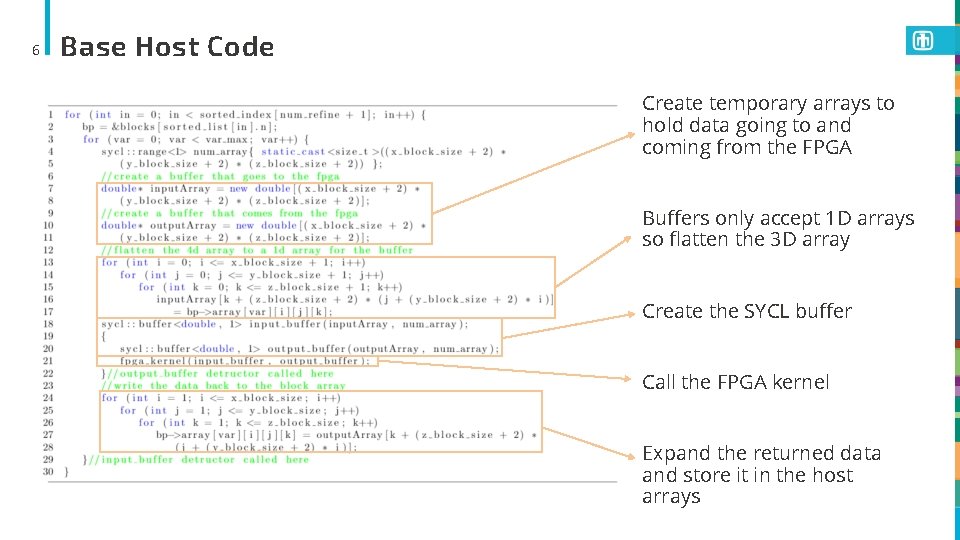
6 Base Host Code Create temporary arrays to hold data going to and coming from the FPGA Buffers only accept 1 D arrays so flatten the 3 D array Create the SYCL buffer Call the FPGA kernel Expand the returned data and store it in the host arrays
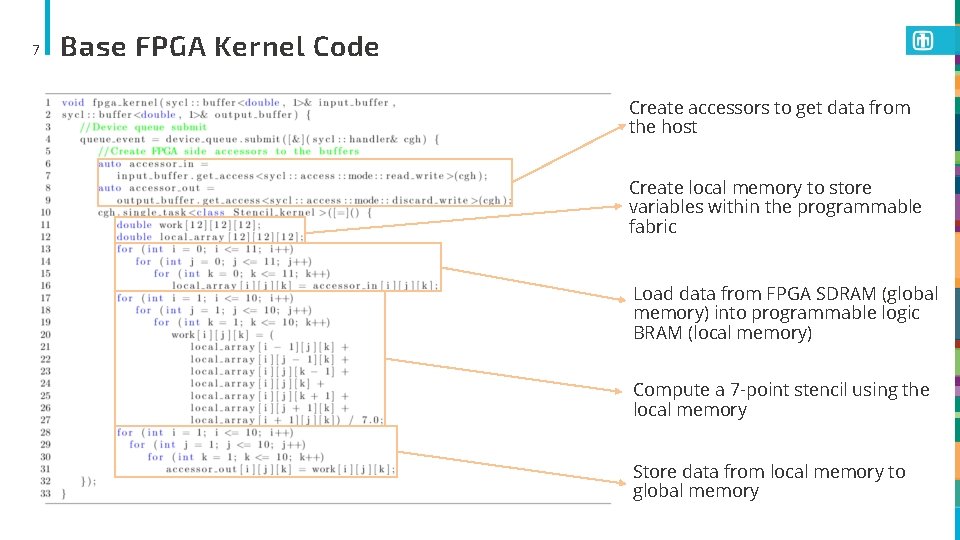
7 Base FPGA Kernel Code Create accessors to get data from the host Create local memory to store variables within the programmable fabric Load data from FPGA SDRAM (global memory) into programmable logic BRAM (local memory) Compute a 7 -point stencil using the local memory Store data from local memory to global memory
Optimizations
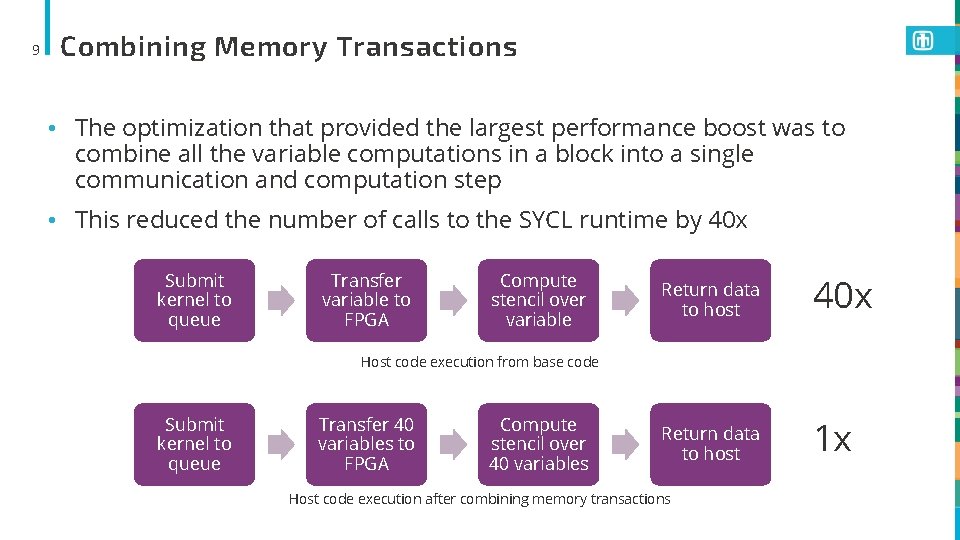
9 Combining Memory Transactions • The optimization that provided the largest performance boost was to combine all the variable computations in a block into a single communication and computation step • This reduced the number of calls to the SYCL runtime by 40 x Submit kernel to queue Transfer variable to FPGA Compute stencil over variable Return data to host 40 x Return data to host 1 x Host code execution from base code Submit kernel to queue Transfer 40 variables to FPGA Compute stencil over 40 variables Host code execution after combining memory transactions
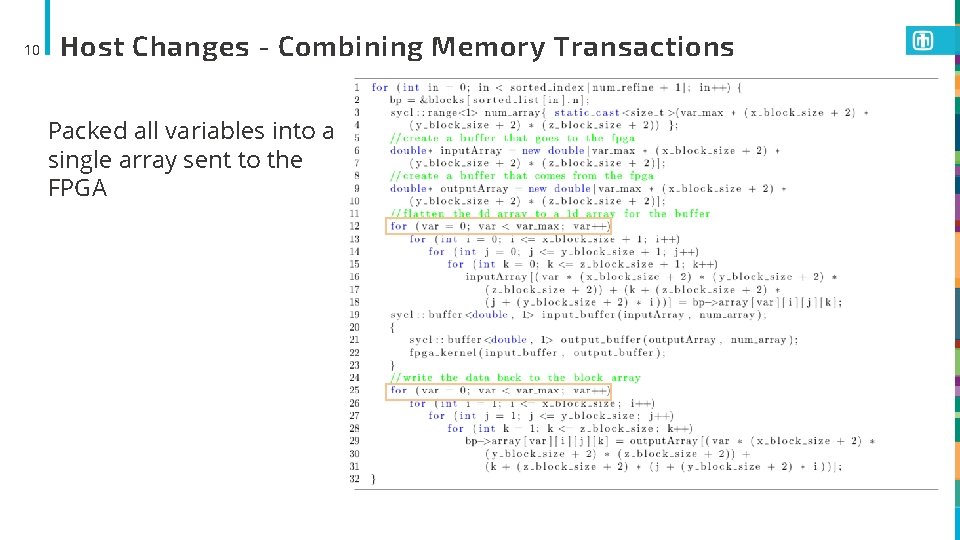
10 Host Changes - Combining Memory Transactions Packed all variables into a single array sent to the FPGA
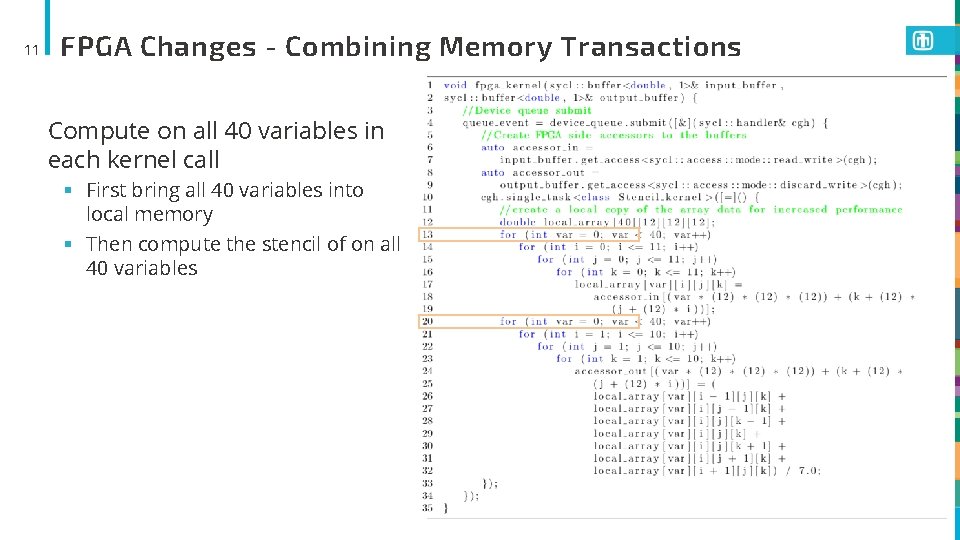
11 FPGA Changes - Combining Memory Transactions Compute on all 40 variables in each kernel call § First bring all 40 variables into local memory § Then compute the stencil of on all 40 variables
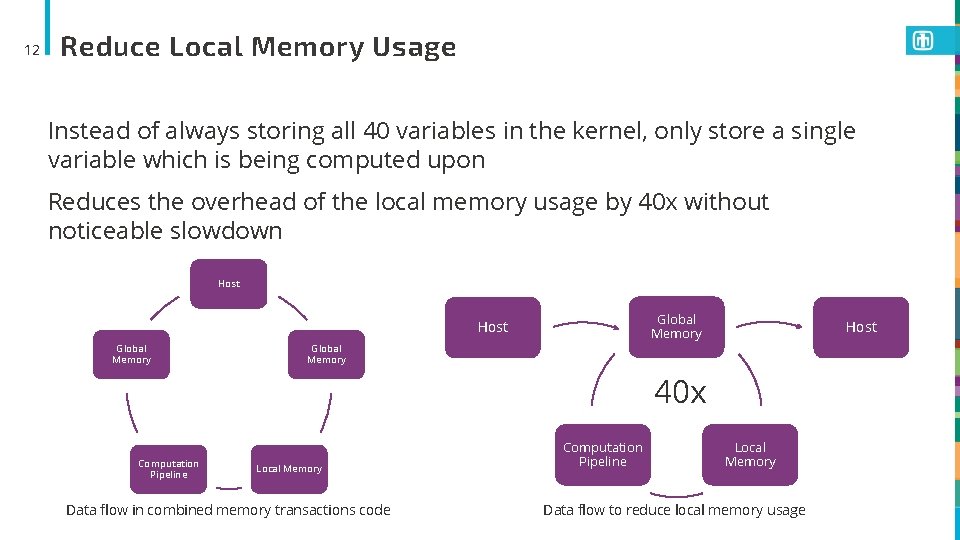
12 Reduce Local Memory Usage Instead of always storing all 40 variables in the kernel, only store a single variable which is being computed upon Reduces the overhead of the local memory usage by 40 x without noticeable slowdown Host Global Memory Host 40 x Computation Pipeline Local Memory Data flow in combined memory transactions code Computation Pipeline Local Memory Data flow to reduce local memory usage
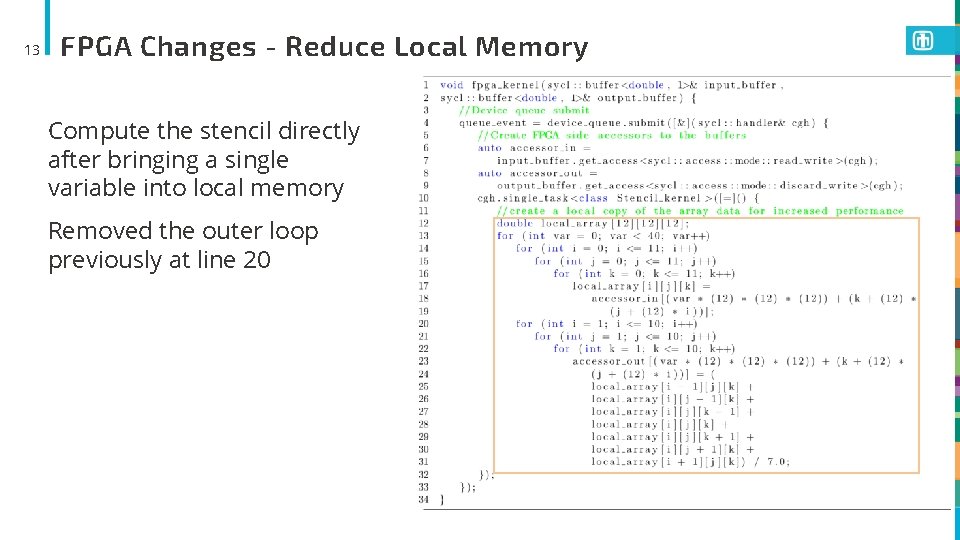
13 FPGA Changes - Reduce Local Memory Compute the stencil directly after bringing a single variable into local memory Removed the outer loop previously at line 20
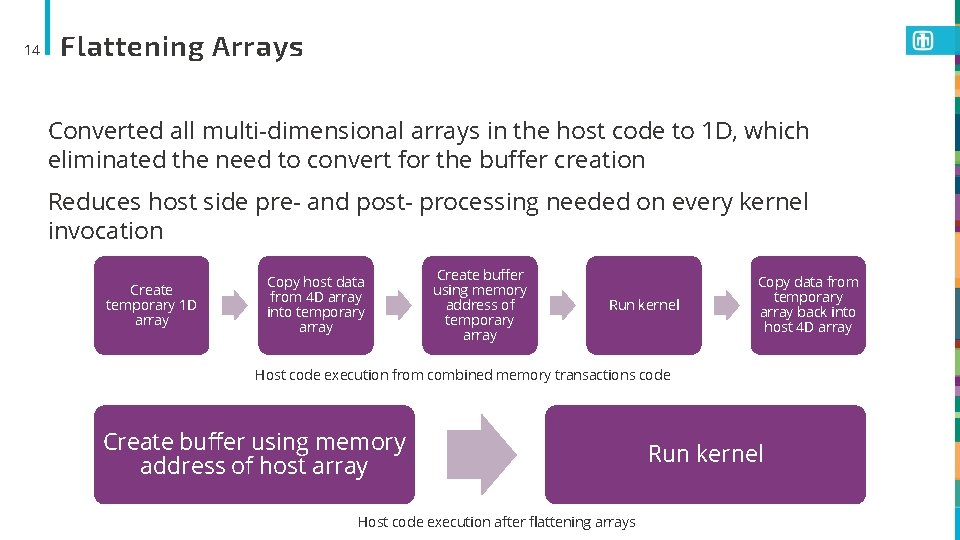
14 Flattening Arrays Converted all multi-dimensional arrays in the host code to 1 D, which eliminated the need to convert for the buffer creation Reduces host side pre- and post- processing needed on every kernel invocation Create temporary 1 D array Copy host data from 4 D array into temporary array Create buffer using memory address of temporary array Run kernel Copy data from temporary array back into host 4 D array Host code execution from combined memory transactions code Create buffer using memory address of host array Host code execution after flattening arrays Run kernel
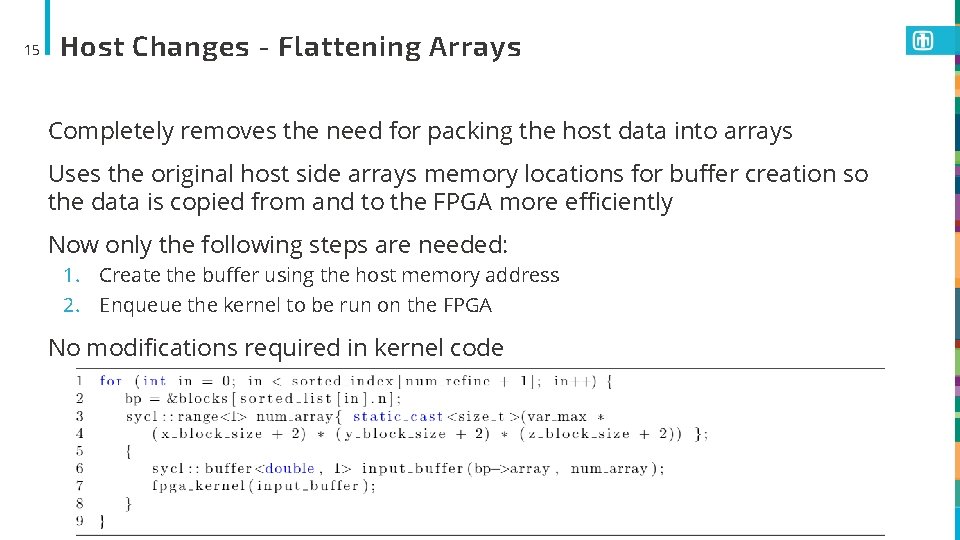
15 Host Changes - Flattening Arrays Completely removes the need for packing the host data into arrays Uses the original host side arrays memory locations for buffer creation so the data is copied from and to the FPGA more efficiently Now only the following steps are needed: 1. Create the buffer using the host memory address 2. Enqueue the kernel to be run on the FPGA No modifications required in kernel code
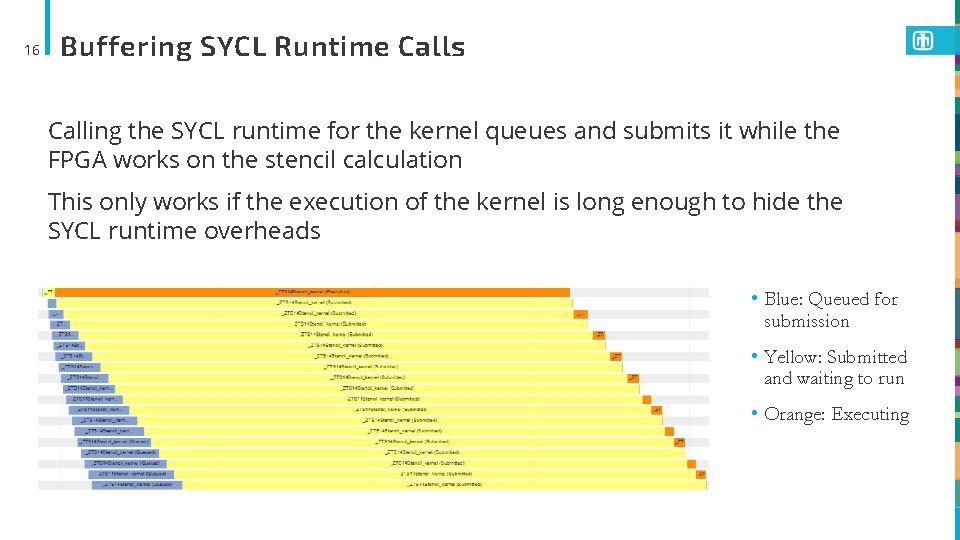
16 Buffering SYCL Runtime Calls Calling the SYCL runtime for the kernel queues and submits it while the FPGA works on the stencil calculation This only works if the execution of the kernel is long enough to hide the SYCL runtime overheads • Blue: Queued for submission • Yellow: Submitted and waiting to run • Orange: Executing
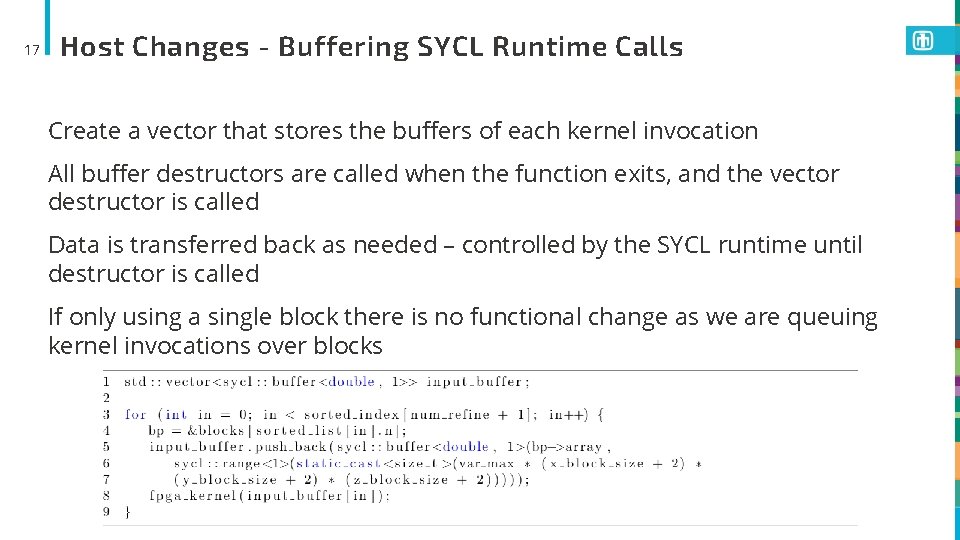
17 Host Changes - Buffering SYCL Runtime Calls Create a vector that stores the buffers of each kernel invocation All buffer destructors are called when the function exits, and the vector destructor is called Data is transferred back as needed – controlled by the SYCL runtime until destructor is called If only using a single block there is no functional change as we are queuing kernel invocations over blocks
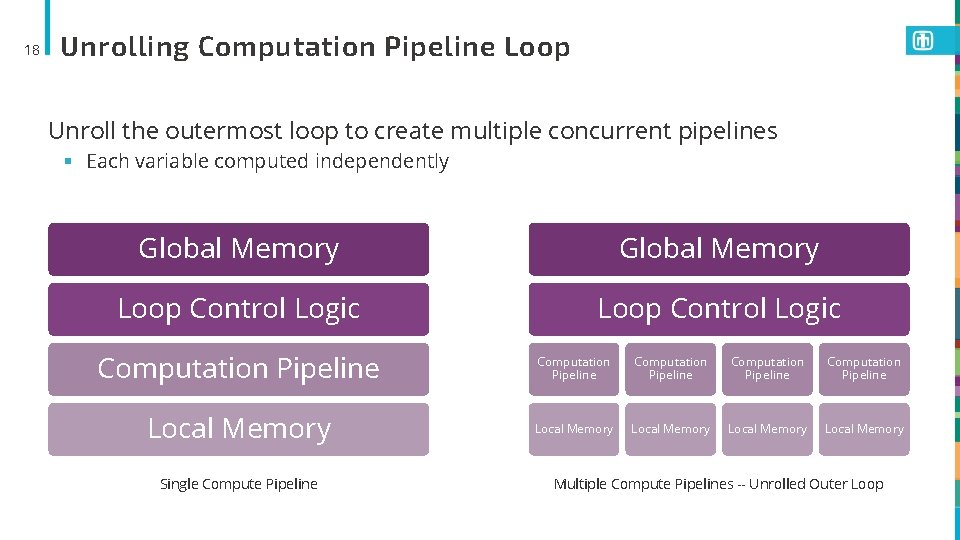
18 Unrolling Computation Pipeline Loop Unroll the outermost loop to create multiple concurrent pipelines § Each variable computed independently Global Memory Loop Control Logic Computation Pipeline Computation Pipeline Local Memory Local Memory Single Compute Pipeline Multiple Compute Pipelines -- Unrolled Outer Loop
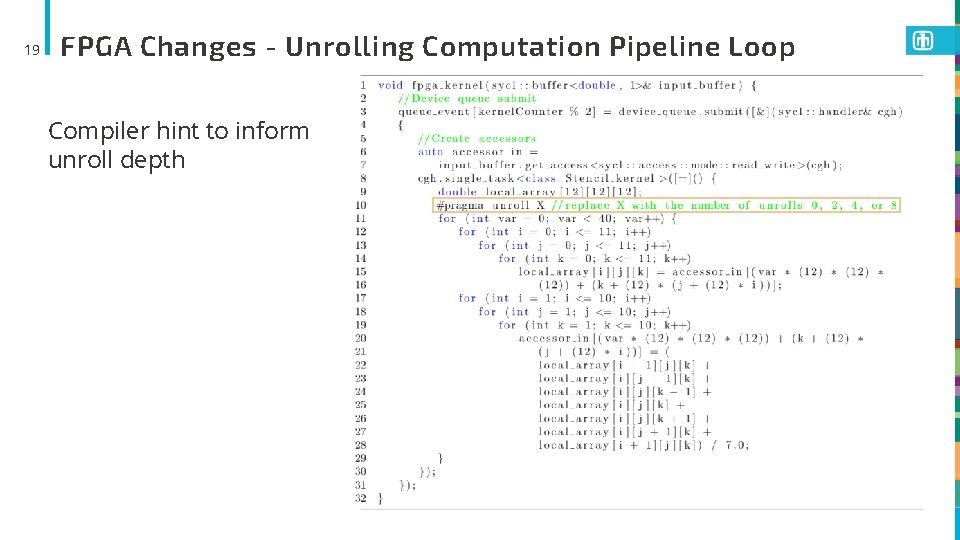
19 FPGA Changes - Unrolling Computation Pipeline Loop Compiler hint to inform unroll depth
Results
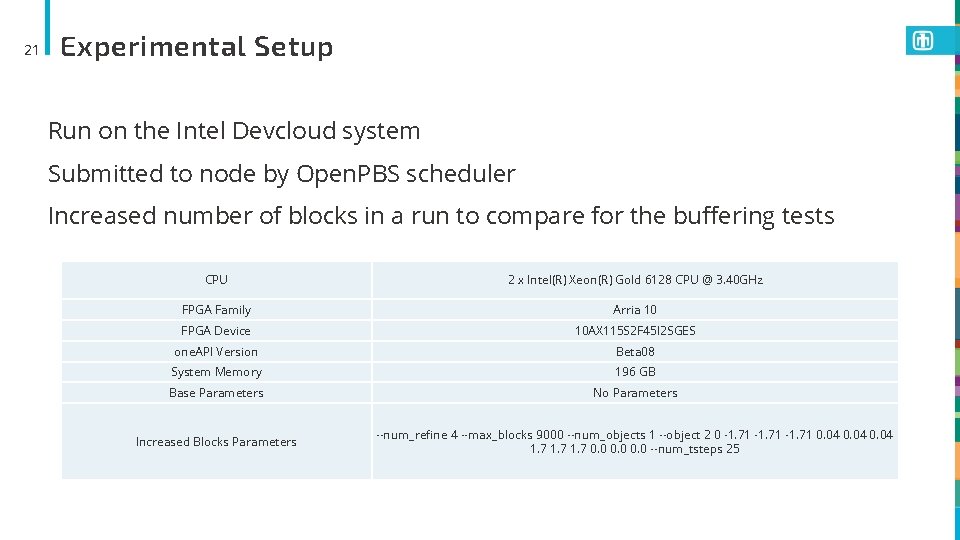
21 Experimental Setup Run on the Intel Devcloud system Submitted to node by Open. PBS scheduler Increased number of blocks in a run to compare for the buffering tests CPU 2 x Intel(R) Xeon(R) Gold 6128 CPU @ 3. 40 GHz FPGA Family Arria 10 FPGA Device 10 AX 115 S 2 F 45 I 2 SGES one. API Version Beta 08 System Memory 196 GB Base Parameters No Parameters Increased Blocks Parameters --num_refine 4 --max_blocks 9000 --num_objects 1 --object 2 0 -1. 71 0. 04 1. 7 0. 0 --num_tsteps 25
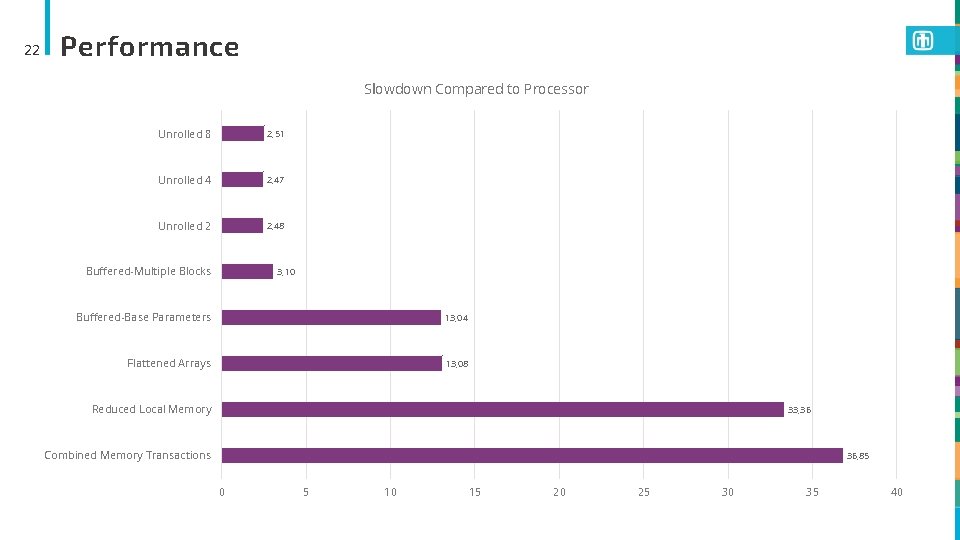
22 Performance Slowdown Compared to Processor Unrolled 8 2, 51 Unrolled 4 2, 47 Unrolled 2 2, 48 Buffered-Multiple Blocks 3, 10 Buffered-Base Parameters 13, 04 Flattened Arrays 13, 08 Reduced Local Memory 33, 36 Combined Memory Transactions 36, 85 0 5 10 15 20 25 30 35 40
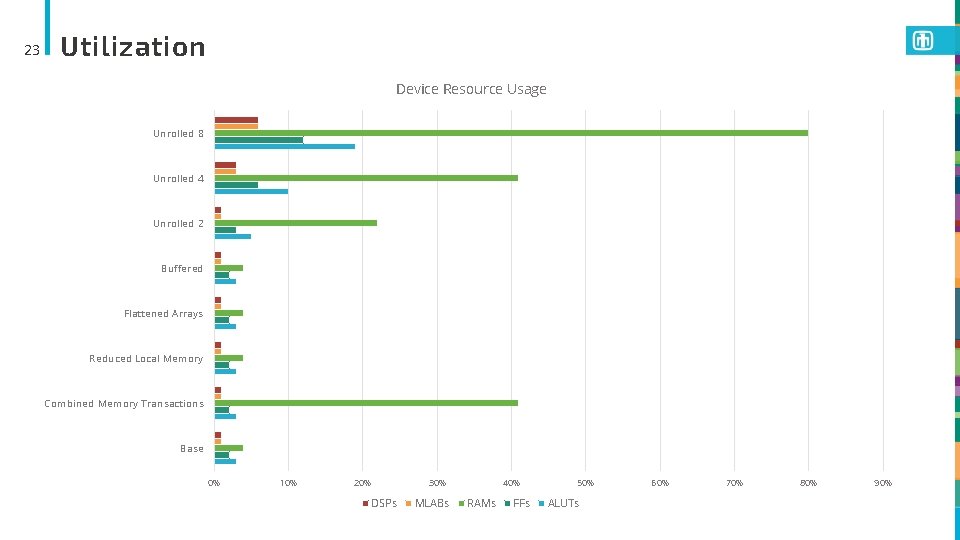
23 Utilization Device Resource Usage Unrolled 8 Unrolled 4 Unrolled 2 Buffered Flattened Arrays Reduced Local Memory Combined Memory Transactions Base 0% 10% 20% DSPs 30% MLABs 40% RAMs FFs 50% ALUTs 60% 70% 80% 90%
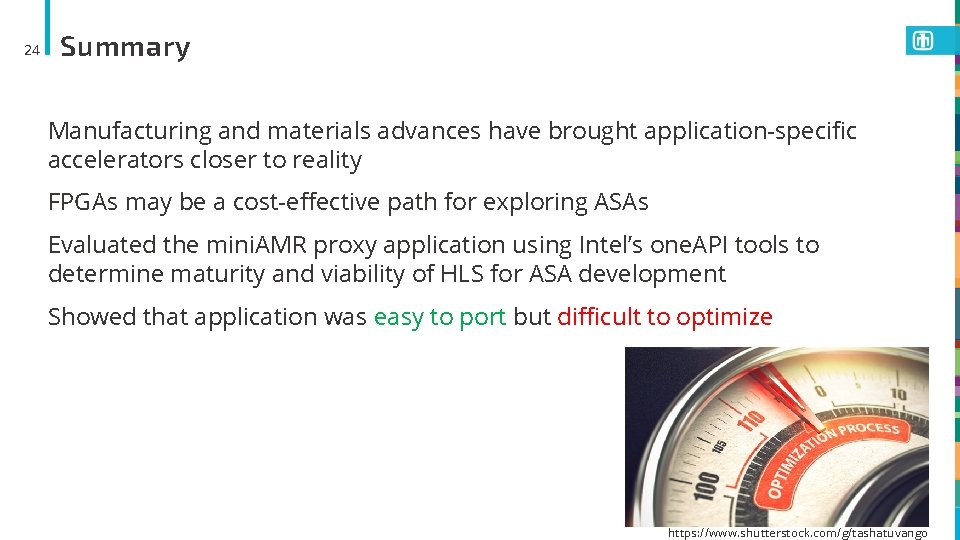
24 Summary Manufacturing and materials advances have brought application-specific accelerators closer to reality FPGAs may be a cost-effective path for exploring ASAs Evaluated the mini. AMR proxy application using Intel’s one. API tools to determine maturity and viability of HLS for ASA development Showed that application was easy to port but difficult to optimize https: //www. shutterstock. com/g/tashatuvango
Questions?
- Slides: 25