
Evaluation of Multigrid Solutions for Turbulent Flows James

Evaluation of Multigrid Solutions for Turbulent Flows James L. Thomas, NASA La. RC Boris Diskin, and Hiroaki Nishikawa, NIA CFD Seminar February 18, 2014
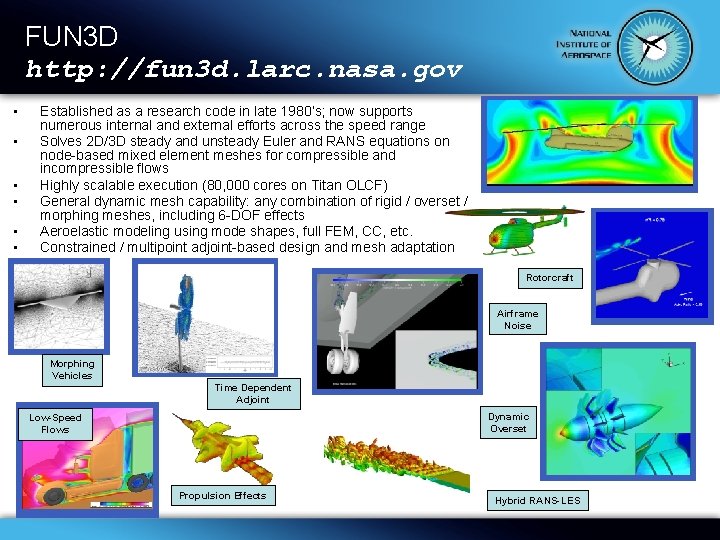
FUN 3 D http: //fun 3 d. larc. nasa. gov • • • Established as a research code in late 1980’s; now supports numerous internal and external efforts across the speed range Solves 2 D/3 D steady and unsteady Euler and RANS equations on node-based mixed element meshes for compressible and incompressible flows Highly scalable execution (80, 000 cores on Titan OLCF) General dynamic mesh capability: any combination of rigid / overset / morphing meshes, including 6 -DOF effects Aeroelastic modeling using mode shapes, full FEM, CC, etc. Constrained / multipoint adjoint-based design and mesh adaptation Rotorcraft Airframe Noise Morphing Vehicles Time Dependent Adjoint Dynamic Overset Low-Speed Flows Propulsion Effects Hybrid RANS-LES

Outline • Multigrid methods in FUN 3 D – Guiding Principles – Recent Developments – Primal (Pr. MG) and Agglomeration (Ag. MG) Methods • Methods for Evaluation of Multigrid Solutions – Tau. Bench Work Unit to evaluate time to solution • Turbulent flow benchmarks: – Turbulence Modeling Resource (TMR) configurations – DPW configurations • Grid refinement study on high-density grids – Enabled by multigrid efficiency • Conclusions
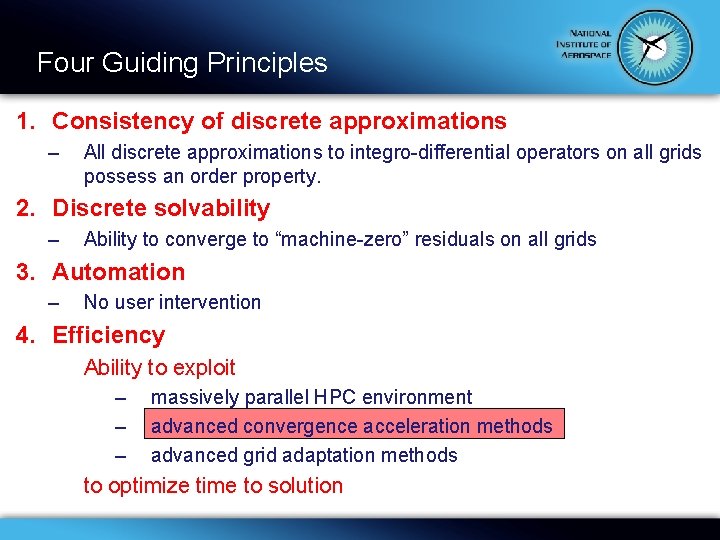
Four Guiding Principles 1. Consistency of discrete approximations – All discrete approximations to integro-differential operators on all grids possess an order property. 2. Discrete solvability – Ability to converge to “machine-zero” residuals on all grids 3. Automation – No user intervention 4. Efficiency Ability to exploit – – – massively parallel HPC environment advanced convergence acceleration methods advanced grid adaptation methods to optimize time to solution
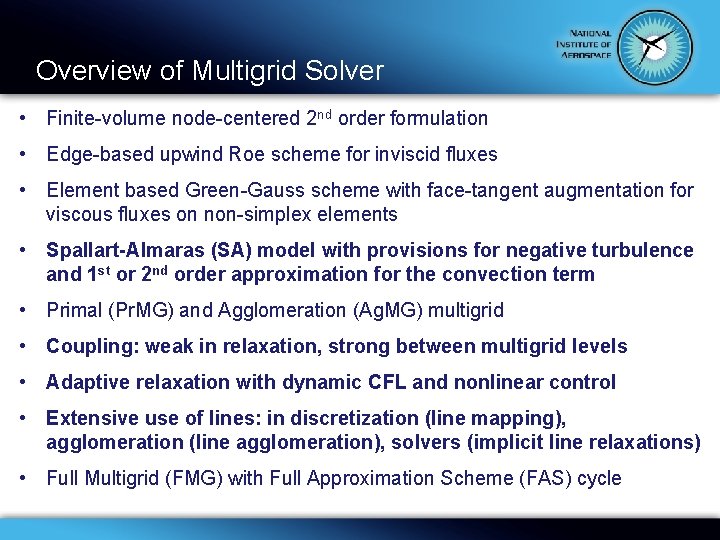
Overview of Multigrid Solver • Finite-volume node-centered 2 nd order formulation • Edge-based upwind Roe scheme for inviscid fluxes • Element based Green-Gauss scheme with face-tangent augmentation for viscous fluxes on non-simplex elements • Spallart-Almaras (SA) model with provisions for negative turbulence and 1 st or 2 nd order approximation for the convection term • Primal (Pr. MG) and Agglomeration (Ag. MG) multigrid • Coupling: weak in relaxation, strong between multigrid levels • Adaptive relaxation with dynamic CFL and nonlinear control • Extensive use of lines: in discretization (line mapping), agglomeration (line agglomeration), solvers (implicit line relaxations) • Full Multigrid (FMG) with Full Approximation Scheme (FAS) cycle
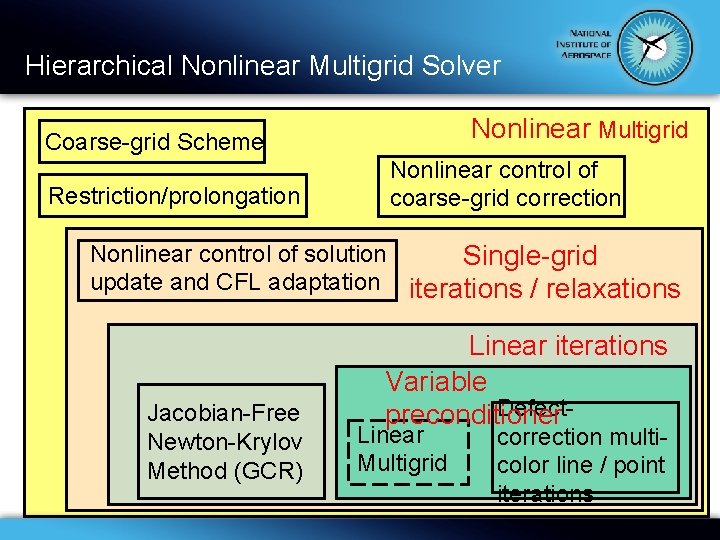
Hierarchical Nonlinear Multigrid Solver Nonlinear Multigrid Coarse-grid Scheme Restriction/prolongation Nonlinear control of coarse-grid correction Nonlinear control of solution Single-grid update and CFL adaptation iterations / relaxations Jacobian-Free Newton-Krylov Method (GCR) Linear iterations Variable Defectpreconditioner Linear Multigrid correction multicolor line / point iterations
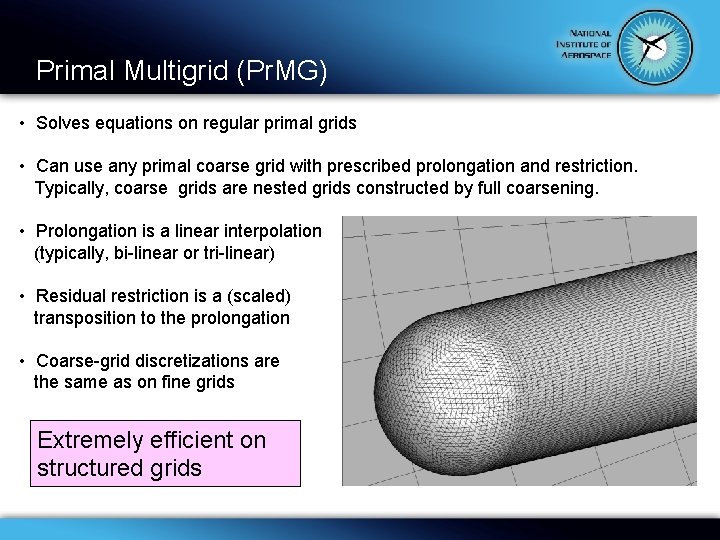
Primal Multigrid (Pr. MG) • Solves equations on regular primal grids • Can use any primal coarse grid with prescribed prolongation and restriction. Typically, coarse grids are nested grids constructed by full coarsening. • Prolongation is a linear interpolation (typically, bi-linear or tri-linear) • Residual restriction is a (scaled) transposition to the prolongation • Coarse-grid discretizations are the same as on fine grids Extremely efficient on structured grids
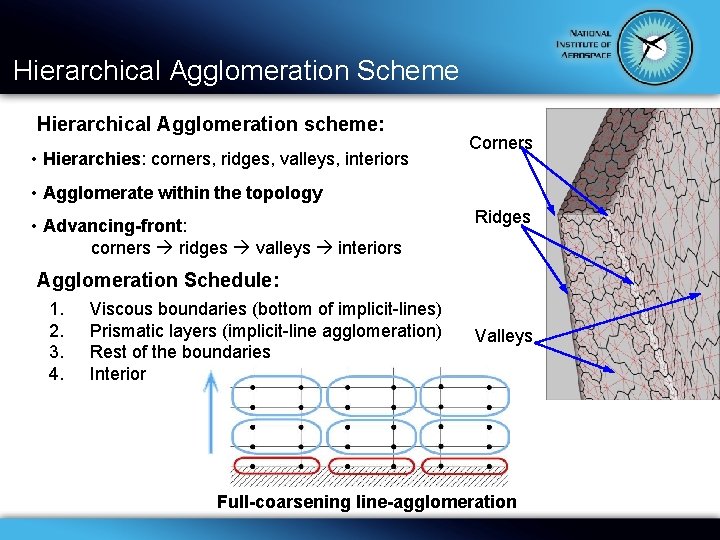
Hierarchical Agglomeration Scheme Hierarchical Agglomeration scheme: • Hierarchies: corners, ridges, valleys, interiors Corners • Agglomerate within the topology • Advancing-front: corners ridges valleys interiors Ridges Agglomeration Schedule: 1. 2. 3. 4. Viscous boundaries (bottom of implicit-lines) Prismatic layers (implicit-line agglomeration) Rest of the boundaries Interior Valleys Full-coarsening line-agglomeration
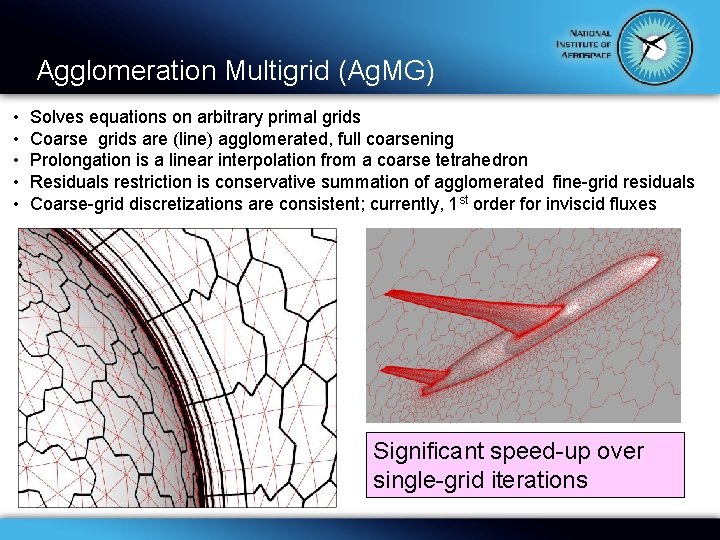
Agglomeration Multigrid (Ag. MG) • • • Solves equations on arbitrary primal grids Coarse grids are (line) agglomerated, full coarsening Prolongation is a linear interpolation from a coarse tetrahedron Residuals restriction is conservative summation of agglomerated fine-grid residuals Coarse-grid discretizations are consistent; currently, 1 st order for inviscid fluxes Significant speed-up over single-grid iterations
Agglomeration Multigrid (Ag. MG) in FUN 3 D • Developed and applied unique idealized multigrid analysis tools suitable for unstructured grids (2004, 2005, 2010) – Idealized relaxation (tests coarse grid correction) – Idealized coarse grid (tests relaxation) • Extended hierarchical structured-grid multigrid (1999) to unstructured-grid applications – – – Developed Ag. MG method preserving features of geometry (2010) Critically assessed and improved Ag. MG for diffusion (2010) Applied Ag. MG to complex inviscid/laminar/turbulent flows (2010) Extended Ag. MG for parallel computations (2011) Improved robustness and efficiency of relaxation (2013)
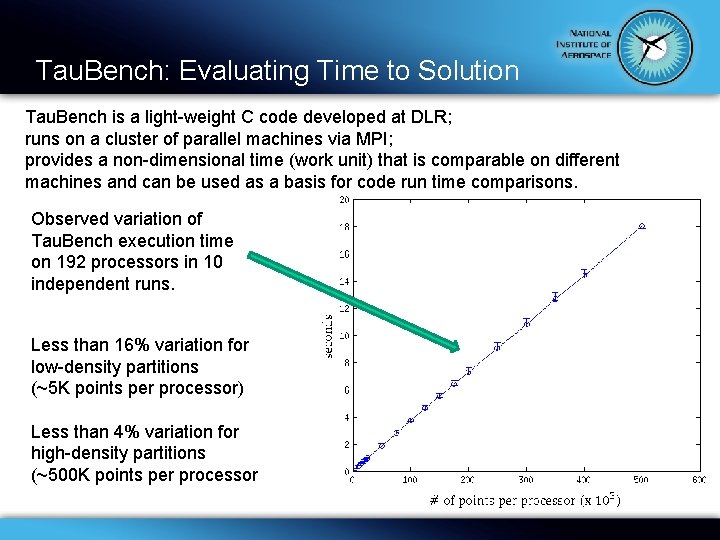
Tau. Bench: Evaluating Time to Solution Tau. Bench is a light-weight C code developed at DLR; runs on a cluster of parallel machines via MPI; provides a non-dimensional time (work unit) that is comparable on different machines and can be used as a basis for code run time comparisons. Observed variation of Tau. Bench execution time on 192 processors in 10 independent runs. Less than 16% variation for low-density partitions (~5 K points per processor) Less than 4% variation for high-density partitions (~500 K points per processor

Additional Goal: Reevaluate Turbulent Solutions on Tetrahedral Grids with 2 nd Order Convective Terms in Turbulence Model
Current Standards for Practical Turbulent Solutions Current standards: mixed-element grids with prismatic cells in boundary layers and 1 st-order convective terms in turbulence models Benefits of prismatic grids in boundary layers: • provide a line structure for boundary layers • anecdotal/empirical evidence that accuracy of turbulent solutions on tetrahedral grids lags behind accuracy on grids with prismatic cells within boundary layers for comparable number of degrees of freedom Previous experience with 2 nd order turbulence convection: • does not strongly benefit turbulent solutions on grids with prismatic elements in boundary layers • significantly more difficult to converge, was not used on tetrahedral grids Would solutions on tetrahedral grids with lines in boundary layers improve with 2 nd order turbulence convection?
Why Do We Care About Tetrahedral Grids? Potential benefits of tetrahedral grids: • • more edge-connected neighbors can improve accuracy and stability smaller operation count per dof in computing residuals and Jacobians naturally edge-based, may allow elimination of the element loop more flexibility for anisotropic grid adaptation Warning: Convergence of current Ag. MG methods with line agglomeration deteriorates on anisotropic tetrahedral grids New recent developments: • a version of the SA model with provisions for negative turbulence • strong adaptive solvers converging higher-order discretizations The effects of tetrahedral grids in boundary layers and 2 ndorder convective terms in the SA turbulence model equation are reevaluated for 2 D turbulent flows

Test Cases
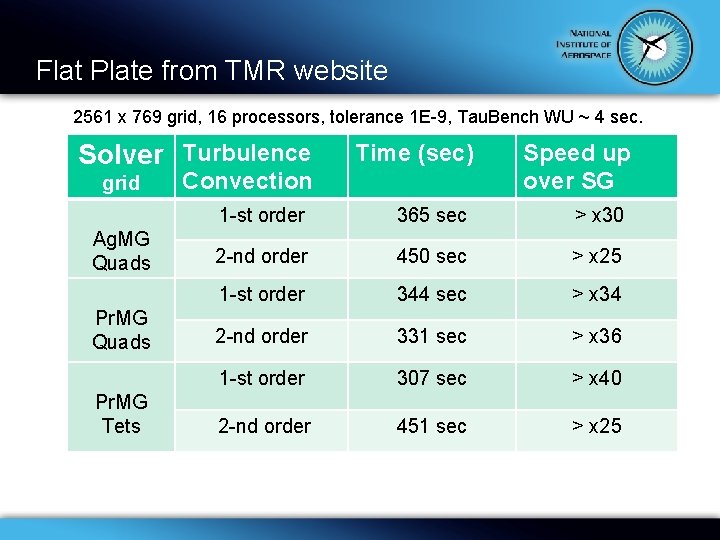
Flat Plate from TMR website 2561 x 769 grid, 16 processors, tolerance 1 E-9, Tau. Bench WU ~ 4 sec. Solver Turbulence grid Ag. MG Quads Pr. MG Tets Time (sec) Convection Speed up over SG 1 -st order 365 sec > x 30 2 -nd order 450 sec > x 25 1 -st order 344 sec > x 34 2 -nd order 331 sec > x 36 1 -st order 307 sec > x 40 2 -nd order 451 sec > x 25
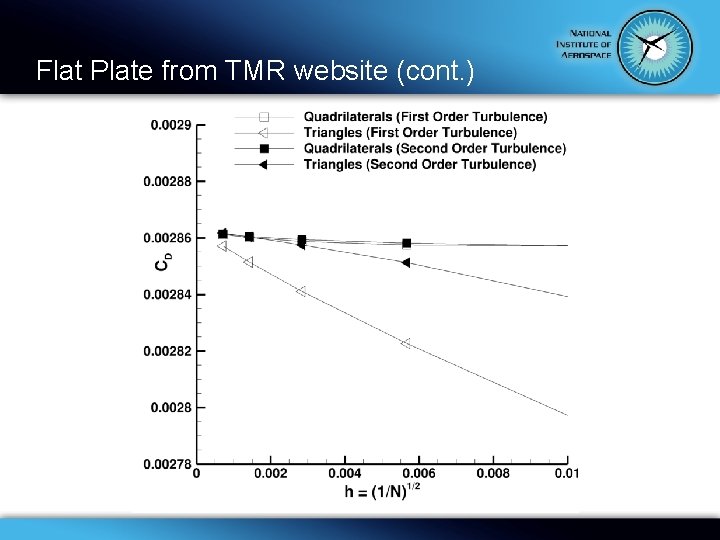
Flat Plate from TMR website (cont. )
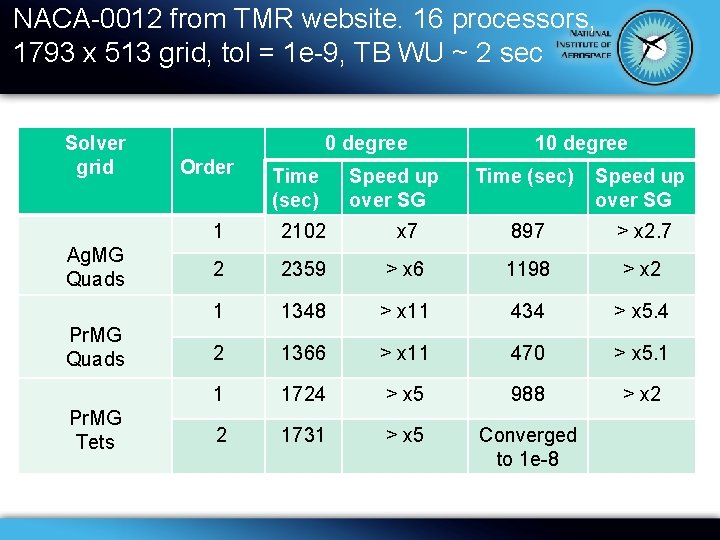
NACA-0012 from TMR website. 16 processors, 1793 x 513 grid, tol = 1 e-9, TB WU ~ 2 sec Solver grid Ag. MG Quads Pr. MG Tets 0 degree Order Time (sec) Speed up over SG 10 degree Time (sec) Speed up over SG 1 2102 x 7 897 > x 2. 7 2 2359 > x 6 1198 > x 2 1 1348 > x 11 434 > x 5. 4 2 1366 > x 11 470 > x 5. 1 1 1724 > x 5 988 > x 2 2 1731 > x 5 Converged to 1 e-8
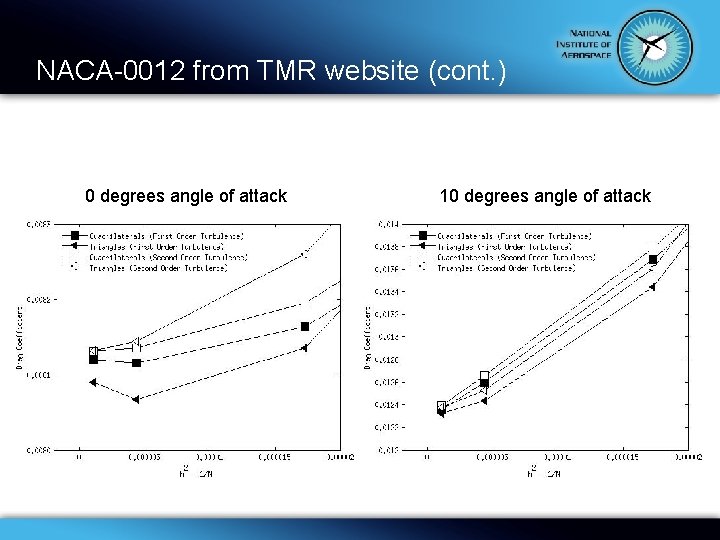
NACA-0012 from TMR website (cont. ) 0 degrees angle of attack 10 degrees angle of attack
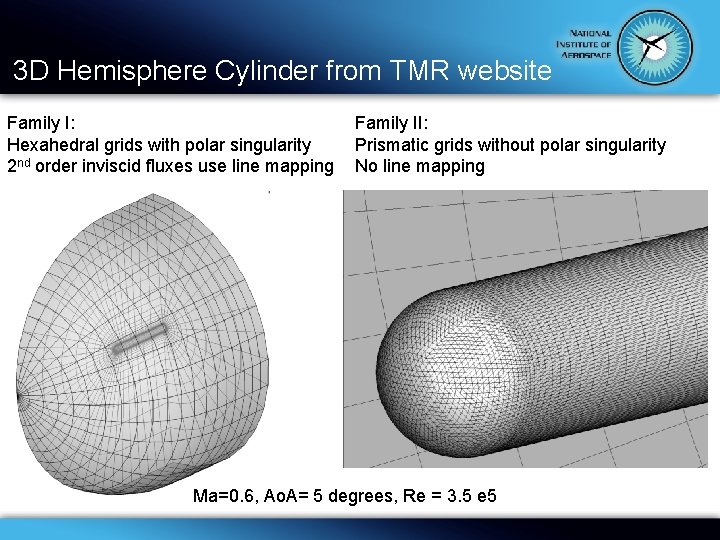
3 D Hemisphere Cylinder from TMR website Family I: Hexahedral grids with polar singularity 2 nd order inviscid fluxes use line mapping Family II: Prismatic grids without polar singularity No line mapping Ma=0. 6, Ao. A= 5 degrees, Re = 3. 5 e 5
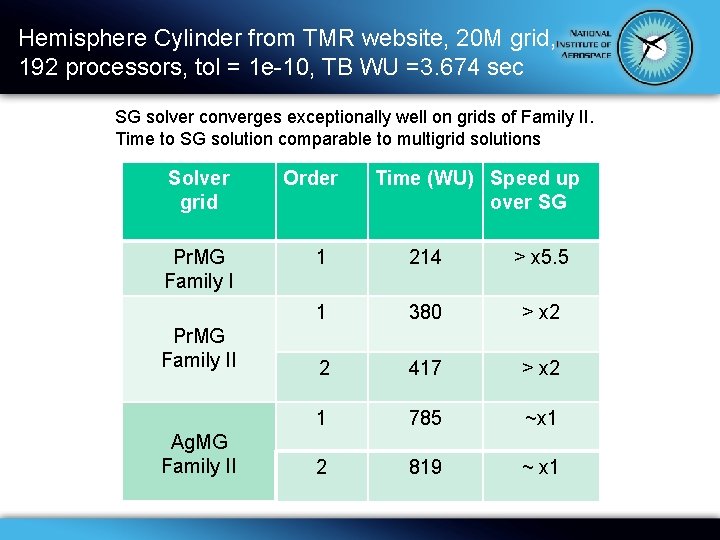
Hemisphere Cylinder from TMR website, 20 M grid, 192 processors, tol = 1 e-10, TB WU =3. 674 sec SG solver converges exceptionally well on grids of Family II. Time to SG solution comparable to multigrid solutions Solver grid Pr. MG Family II Ag. MG Family II Order Time (WU) Speed up over SG 1 214 > x 5. 5 1 380 > x 2 2 417 > x 2 1 785 ~x 1 2 819 ~ x 1
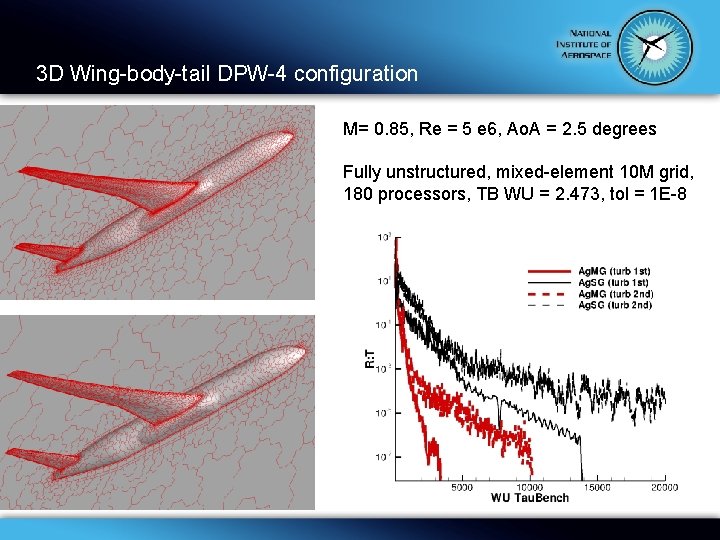
3 D Wing-body-tail DPW-4 configuration M= 0. 85, Re = 5 e 6, Ao. A = 2. 5 degrees Fully unstructured, mixed-element 10 M grid, 180 processors, TB WU = 2. 473, tol = 1 E-8
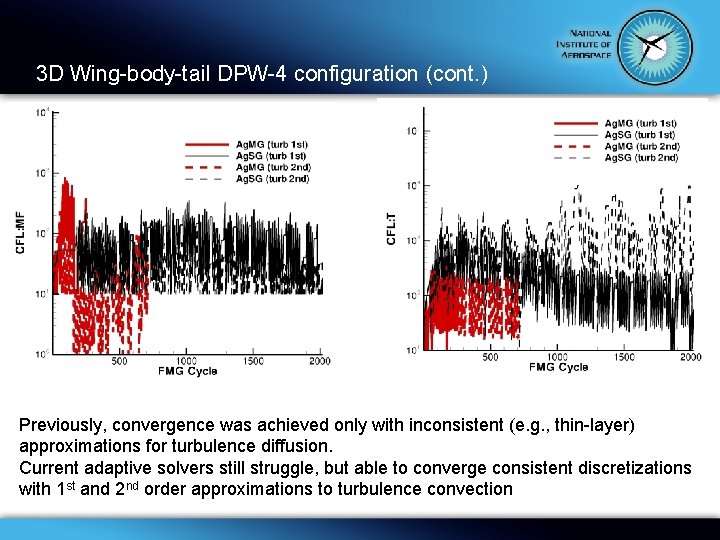
3 D Wing-body-tail DPW-4 configuration (cont. ) Previously, convergence was achieved only with inconsistent (e. g. , thin-layer) approximations for turbulence diffusion. Current adaptive solvers still struggle, but able to converge consistent discretizations with 1 st and 2 nd order approximations to turbulence convection
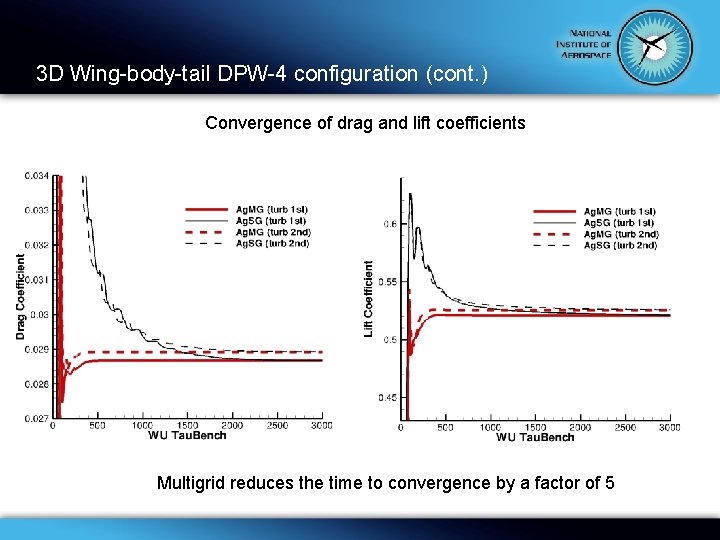
3 D Wing-body-tail DPW-4 configuration (cont. ) Convergence of drag and lift coefficients Multigrid reduces the time to convergence by a factor of 5
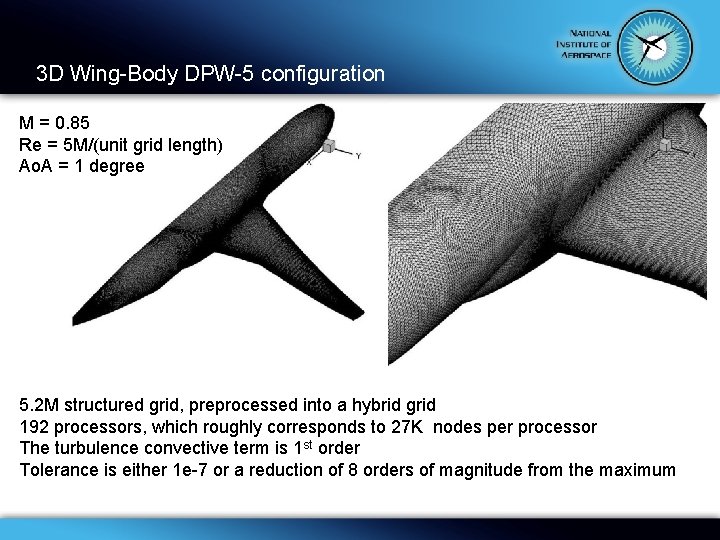
3 D Wing-Body DPW-5 configuration M = 0. 85 Re = 5 M/(unit grid length) Ao. A = 1 degree 5. 2 M structured grid, preprocessed into a hybrid grid 192 processors, which roughly corresponds to 27 K nodes per processor The turbulence convective term is 1 st order Tolerance is either 1 e-7 or a reduction of 8 orders of magnitude from the maximum
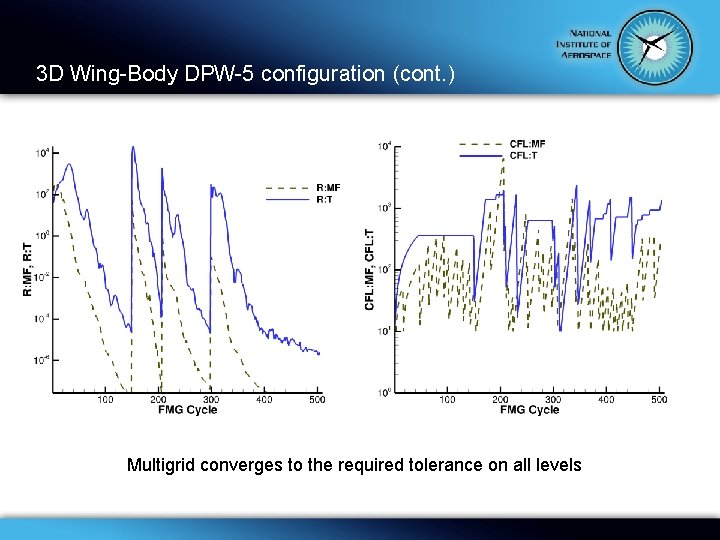
3 D Wing-Body DPW-5 configuration (cont. ) Multigrid converges to the required tolerance on all levels
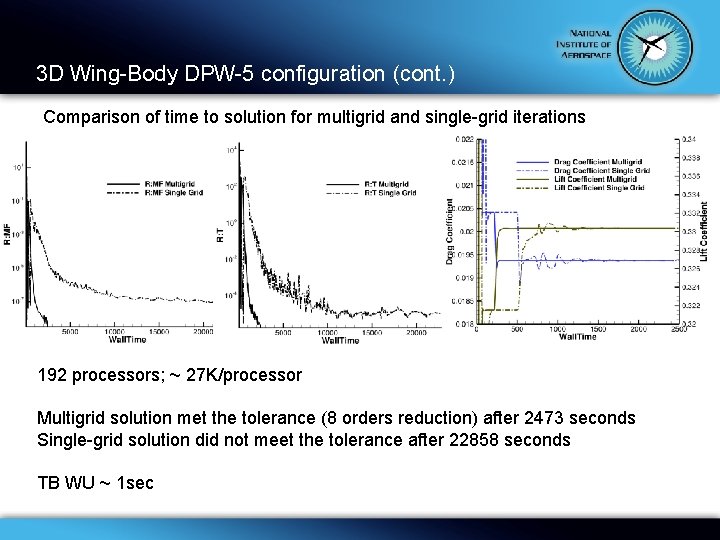
3 D Wing-Body DPW-5 configuration (cont. ) Comparison of time to solution for multigrid and single-grid iterations 192 processors; ~ 27 K/processor Multigrid solution met the tolerance (8 orders reduction) after 2473 seconds Single-grid solution did not meet the tolerance after 22858 seconds TB WU ~ 1 sec

Grid Refinement Study
NACA-0012 validation case at TMR website: Ao. A = 10 degrees, M= 0. 15, Re = 6 M Brief summary of TMR results: 5 quadrilateral grids are available finest grid is 1793 x 513 (~1 M points) Lift and drag coefficients collected from 7 codes; 6 codes computed on the 2 nd finest 897 x 257 grid; 1 code applied grid adaptation The pitching moment is not reported The results spread about 2 drag counts (4% difference) about 1% difference in lift Can we extrapolate coefficients computed on the TMR grids to estimate the grid-refinement limit?
Grid Refinement Study The grid-refinement study was initially conducted on 4 finest TMR grids (Pr. MG solver on 16 processors with a turnaround time of 338 seconds). Surprisingly, the grid-refined values of the lift (and the pitching moment) coefficient were more problematic to use for infinite-grid solution extrapolation than the drag coefficient values on the corresponding grids. • The lift values increase with grid refinement and then decrease on the finest grid. • The finest-grid lift coefficient is on the lower fringe of the collective results shown on the TMR website. • The pitching moment coefficients increase with grid refinement, but show an order property considerably less than 2 -nd order. It was observed that the trailing edge resolution is not sufficient on the TMR grids
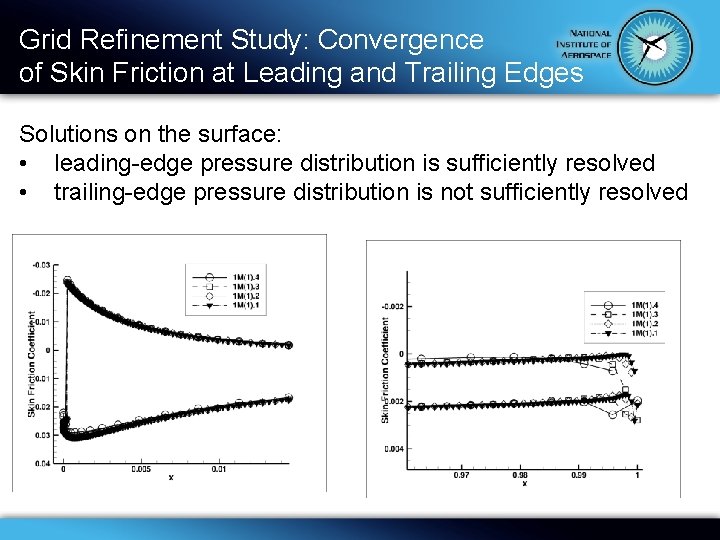
Grid Refinement Study: Convergence of Skin Friction at Leading and Trailing Edges Solutions on the surface: • leading-edge pressure distribution is sufficiently resolved • trailing-edge pressure distribution is not sufficiently resolved
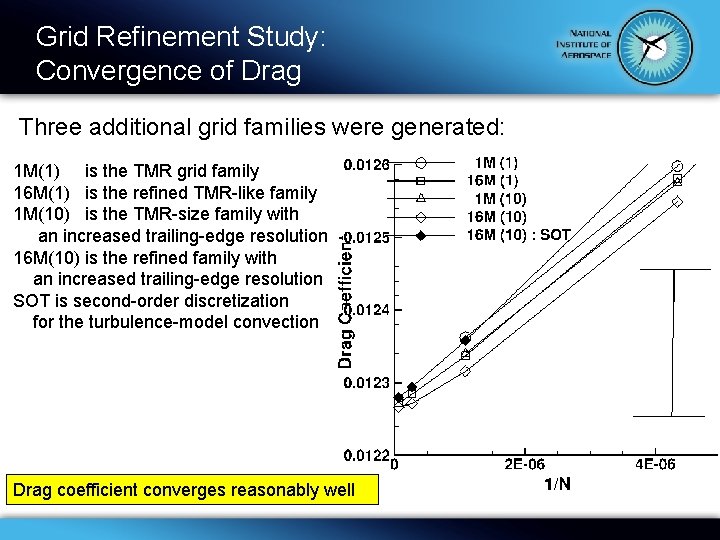
Grid Refinement Study: Convergence of Drag Three additional grid families were generated: 1 M(1) is the TMR grid family 16 M(1) is the refined TMR-like family 1 M(10) is the TMR-size family with an increased trailing-edge resolution 16 M(10) is the refined family with an increased trailing-edge resolution SOT is second-order discretization for the turbulence-model convection Drag coefficient converges reasonably well
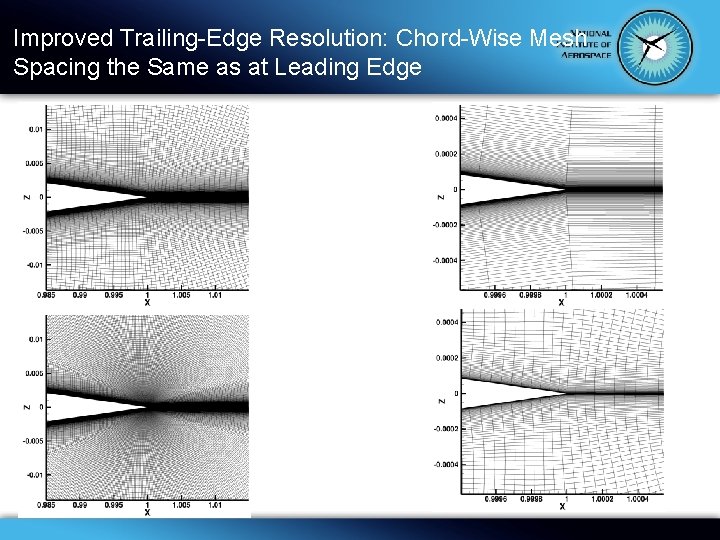
Improved Trailing-Edge Resolution: Chord-Wise Mesh Spacing the Same as at Leading Edge
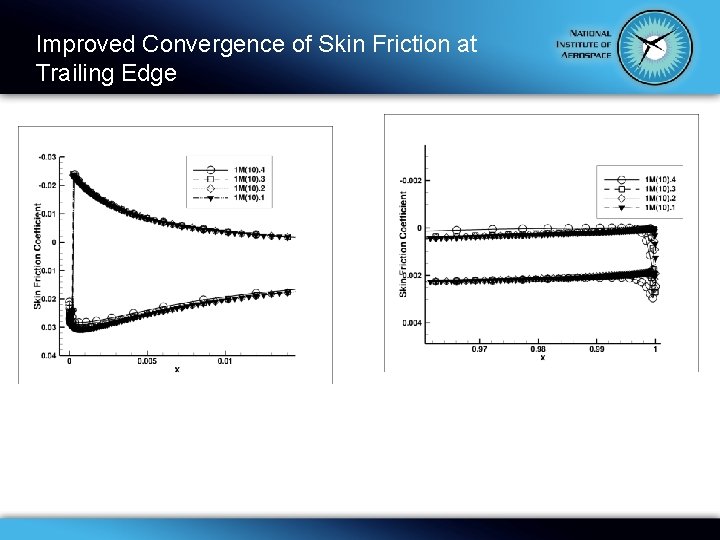
Improved Convergence of Skin Friction at Trailing Edge
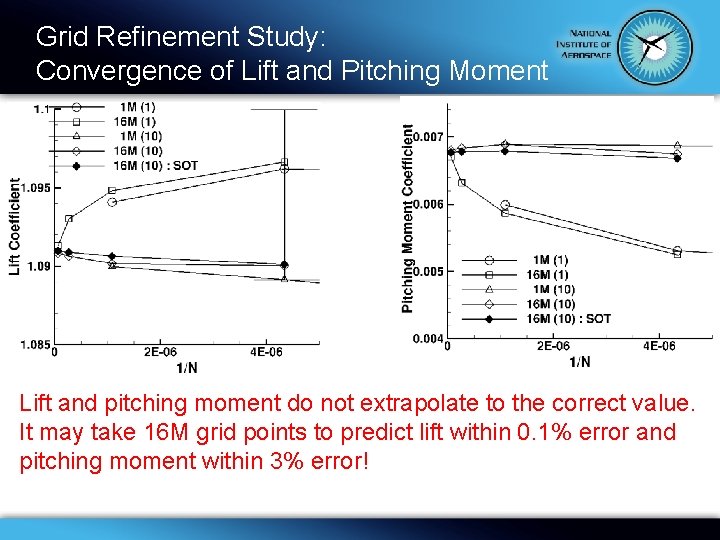
Grid Refinement Study: Convergence of Lift and Pitching Moment Lift and pitching moment do not extrapolate to the correct value. It may take 16 M grid points to predict lift within 0. 1% error and pitching moment within 3% error!
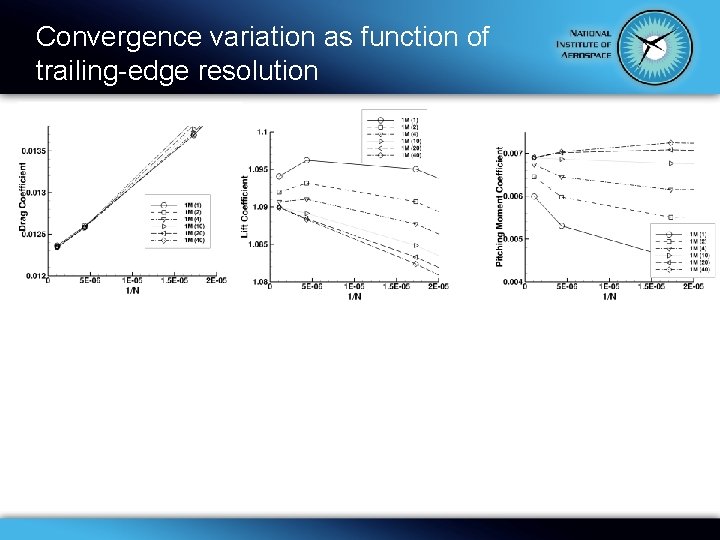
Convergence variation as function of trailing-edge resolution
Conclusions
Conclusions: Multigrid • Multigrid dramatically accelerate time to convergence for simple and complex turbulent flows • Pr. MG solver was fastest in all computations on structured grids • Ag. MG solver shows comparable to Pr. MG efficiency on structured grids and significant speed-up over the SG solver on all grids • Multigrid robustness similar to robustness characteristics of the corresponding SG solver. While not specifically emphasized in this presentation, multigrid converges to the requested tolerance for all cases, for which the SG solver was able to converge
Conclusions: Efficiency Evaluation • Tau. Bench Work Unit (WU) is a good first step toward an adequate tool to compare performance of different solvers in different environments • It is desirable to better account for work expenses typical for implicit computations (Jacobian computations, much larger memory, etc. ) • Time to convergence in WU is shown for FUN 3 D multigrid solutions for the TMR and DPW benchmark computations • It is recommended for large-scale CFD codes to adopt the Tau. Bench work-unit approach as a way to evaluate efficiency and collect those evaluations for common benchmark problems to establish the state of the art in turbulent flow computations
Conclusions: Accuracy and Grid Resolution • Accuracy of some 2 D turbulent flow solutions on triangular grids with 2 nd order turbulence-model convection is comparable to accuracy of solutions on quadrilateral grids. A more detailed study is required in 3 D • Accurate prediction of aerodynamic coefficients (e. g. , lift and pitching moment) requires extremely fine resolution 16 M nodes for a 2 D airfoil; similar 3 D resolution is 64 B nodes • Multigrid efficiency enables 2 D solutions on sufficiently fine grids to accurately predict forces and moments • In 3 D, multigrid efficiency must be complemented with adequate grid adaptation capabilities to provide sufficiently accurate and reliable predictions of aerodynamic coefficients.

Thank You!
- Slides: 41