
EVALUATION OF MAMMOGRAPHY QUALITY CONTROL RADIATION DOSE AND
- Slides: 2
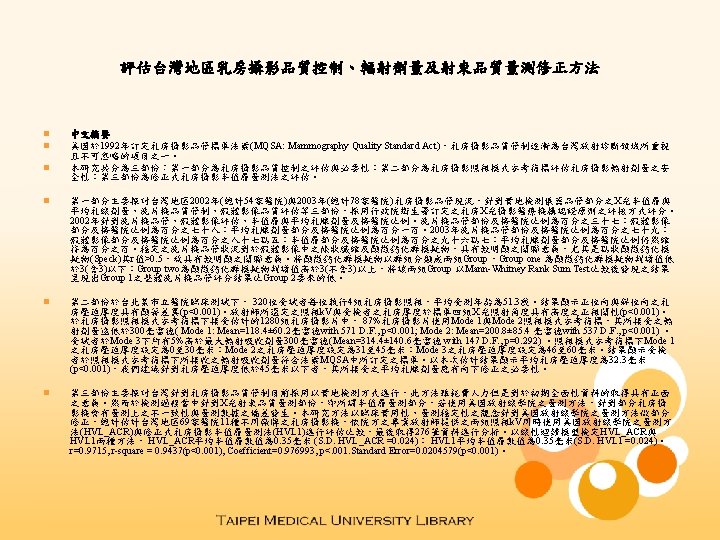
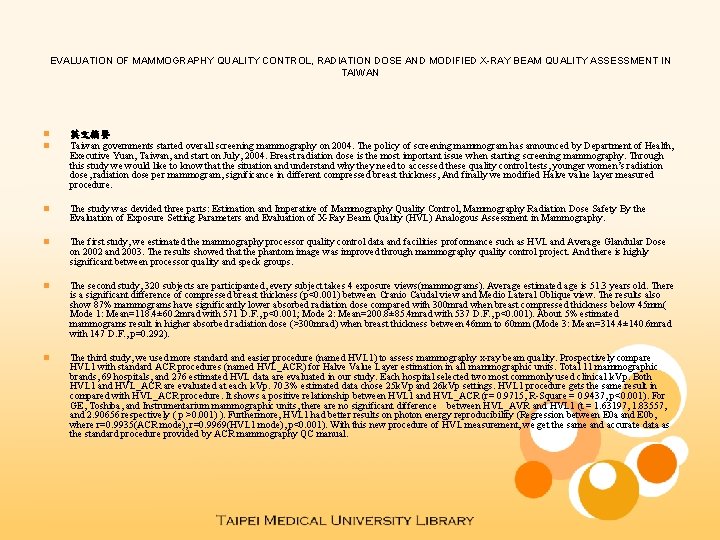
EVALUATION OF MAMMOGRAPHY QUALITY CONTROL, RADIATION DOSE AND MODIFIED X-RAY BEAM QUALITY ASSESSMENT IN TAIWAN n n 英文摘要 Taiwan governments started overall screening mammography on 2004. The policy of screening mammogram has announced by Department of Health, Executive Yuan, Taiwan, and start on July, 2004. Breast radiation dose is the most important issue when starting screening mammography. Through this study we would like to know that the situation and understand why they need to accessed these quality control tests, younger women’s radiation dose, radiation dose per mammogram, significance in different compressed breast thickness, And finally we modified Halve value layer measured procedure. n The study was devided three parts: Estimation and Imperative of Mammography Quality Control, Mammography Radiation Dose Safety By the Evaluation of Exposure Setting Parameters and Evaluation of X-Ray Beam Quality (HVL) Analogous Assessment in Mammography. n The first study, we estimated the mammography processor quality control data and facilities proformance such as HVL and Average Glandular Dose on 2002 and 2003. The results showed that the phantom image was improved through mammography quality control project. And there is highly significant between processor quality and speck groups. n The second study, 320 subjects are participanted, every subject takes 4 exposure views(mammograms). Average estimated age is 51. 3 years old. There is a significant difference of compressed breast thickness (p<0. 001) between Cranio Caudal view and Medio Lateral Oblique view. The results also show 87% mammograms have significantly lower absorbed radiation dose compared with 300 mrad when breast compressed thickness below 45 mm( Mode 1: Mean=118. 4± 60. 2 mrad with 571 D. F. , p<0. 001; Mode 2: Mean=200. 8± 85. 4 mrad with 537 D. F. , p<0. 001). About 5% estimated mammograms result in higher absorbed radiation dose (>300 mrad) when breast thickness between 46 mm to 60 mm (Mode 3: Mean=314. 4± 140. 6 mrad with 147 D. F. , p=0. 292). n The third study, we used more standard and easier procedure (named HVL 1) to assess mammography x-ray beam quality. Prospectively compare HVL 1 with standard ACR procedures (named HVL_ACR) for Halve Value Layer estimation in all mammographic units. Total 11 mammographic brands, 69 hospitals, and 276 estimated HVL data are evaluated in our study. Each hospital selected two most commonly used clinical k. Vp. Both HVL 1 and HVL_ACR are evaluated at each k. Vp. 70. 3% estimated data chose 25 k. Vp and 26 k. Vp settings. HVL 1 procedure gets the same result in compared with HVL_ACR procedure. It shows a positive relationship between HVL 1 and HVL_ACR (r= 0. 9715, R-Square = 0. 9437, p<0. 001). For GE, Toshiba, and Instrumentarium mammographic units, there are no significant difference between HVL_AVR and HVL 1 (t = 1. 63197, 1. 83557, and 2. 90656 respectively ( p >0. 001) ). Furthermore, HVL 1 had better results on photon energy reproducibility (Regression between E 0 a and E 0 b, where r=0. 9935(ACR mode), r=0. 9969(HVL 1 mode), p<0. 001). With this new procedure of HVL measurement, we get the same and accurate data as the standard procedure provided by ACR mammography QC manual.