
Evaluation of land model simulations across multiple sites


- Slides: 18
Evaluation of land model simulations across multiple sites and multiple models: Results from the NACP site-level synthesis effort Peter Thornton 1, Gautam Bisht 1, Dan Ricciuto 1, NACP Site-Level Synthesis Participants 1 Oak Ridge National Laboratory, Environmental Sciences Division and ORNL Climate Change Science Institute
Sponsors • NASA Terrestrial Ecology Program • DOE, Office of Biological and Environmental Research, Climate and Environmental Sciences Division, Terrestrial Ecosystem Science Program
Premise • Models can and should serve as tools for the integration and synthesis of our best understanding and knowledge • Models can and should provide testable (falsifiable) hypotheses • Through model-data synthesis efforts, those hypotheses can and should be tested, and discarded or improved when confidence is shown to be low
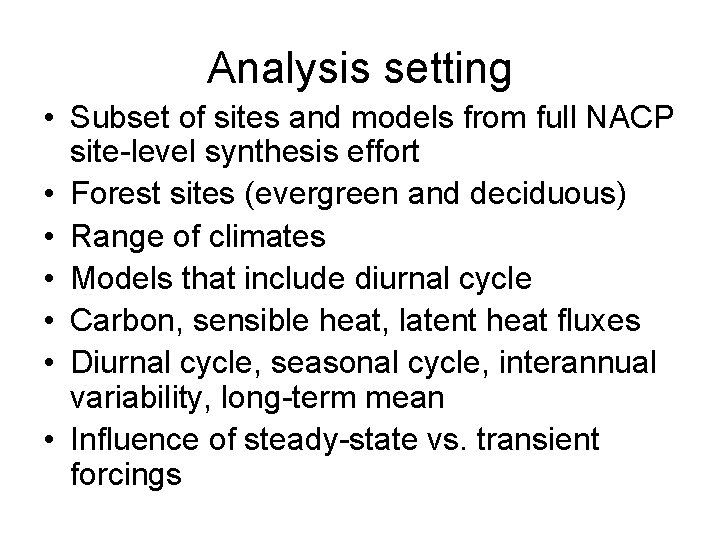
Analysis setting • Subset of sites and models from full NACP site-level synthesis effort • Forest sites (evergreen and deciduous) • Range of climates • Models that include diurnal cycle • Carbon, sensible heat, latent heat fluxes • Diurnal cycle, seasonal cycle, interannual variability, long-term mean • Influence of steady-state vs. transient forcings
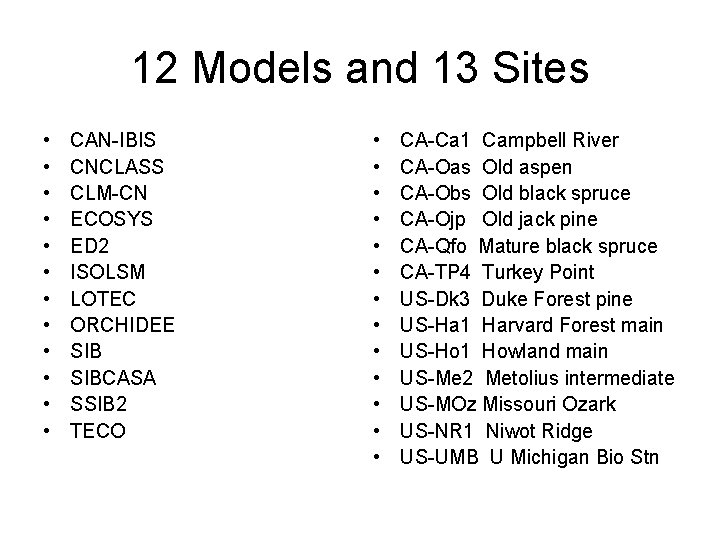
12 Models and 13 Sites • • • CAN-IBIS CNCLASS CLM-CN ECOSYS ED 2 ISOLSM LOTEC ORCHIDEE SIBCASA SSIB 2 TECO • • • • CA-Ca 1 Campbell River CA-Oas Old aspen CA-Obs Old black spruce CA-Ojp Old jack pine CA-Qfo Mature black spruce CA-TP 4 Turkey Point US-Dk 3 Duke Forest pine US-Ha 1 Harvard Forest main US-Ho 1 Howland main US-Me 2 Metolius intermediate US-MOz Missouri Ozark US-NR 1 Niwot Ridge US-UMB U Michigan Bio Stn
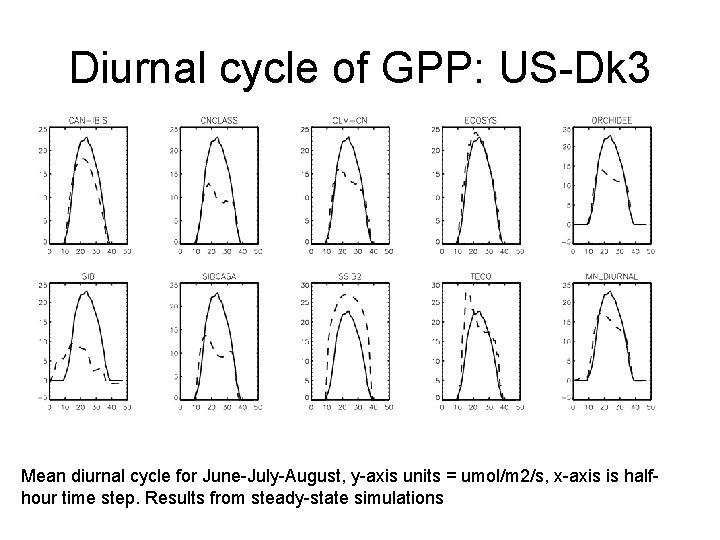
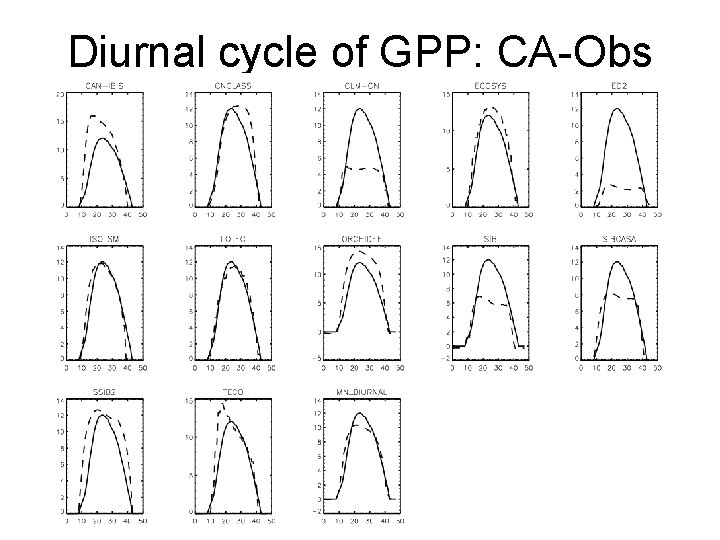
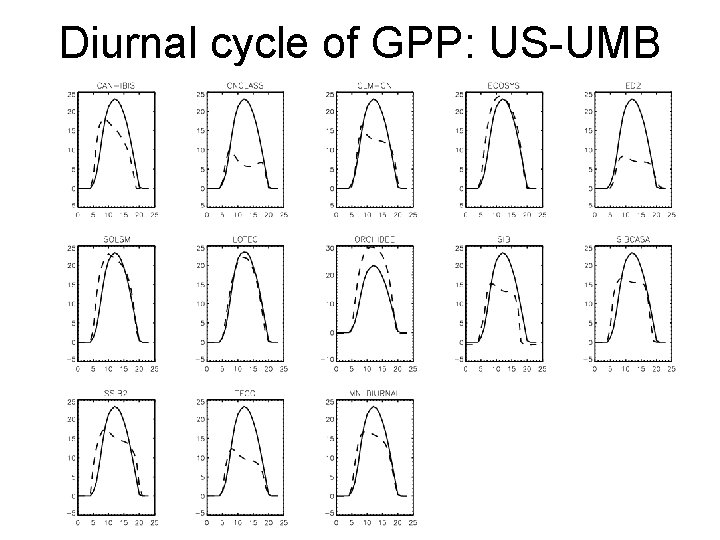
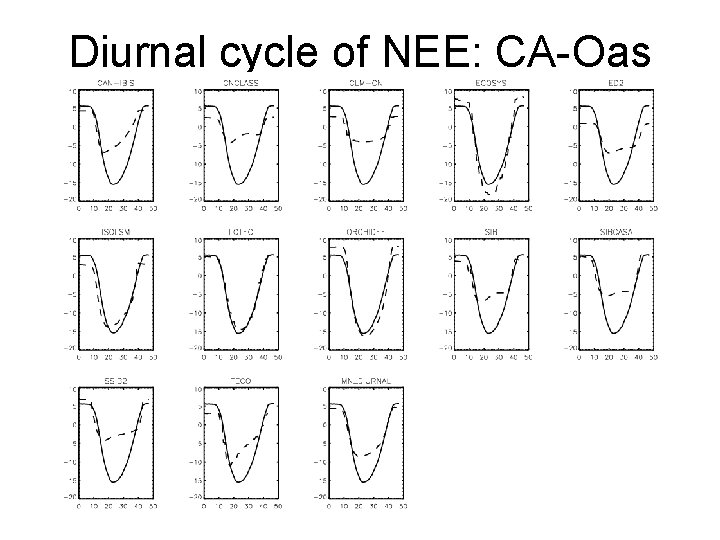
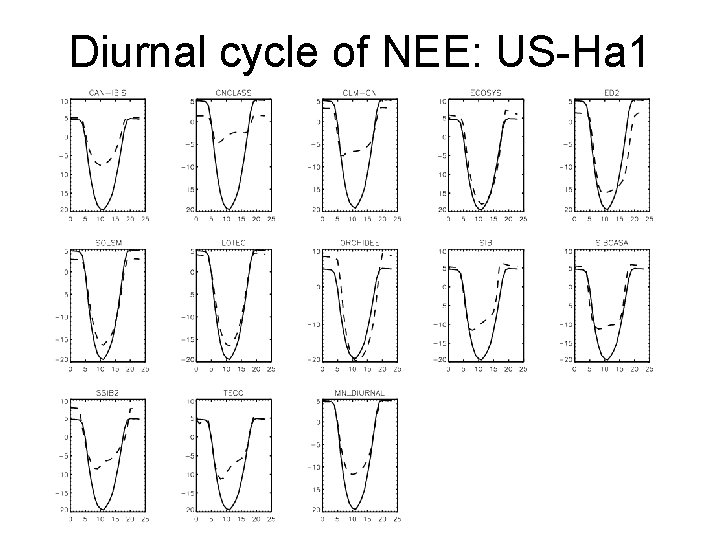
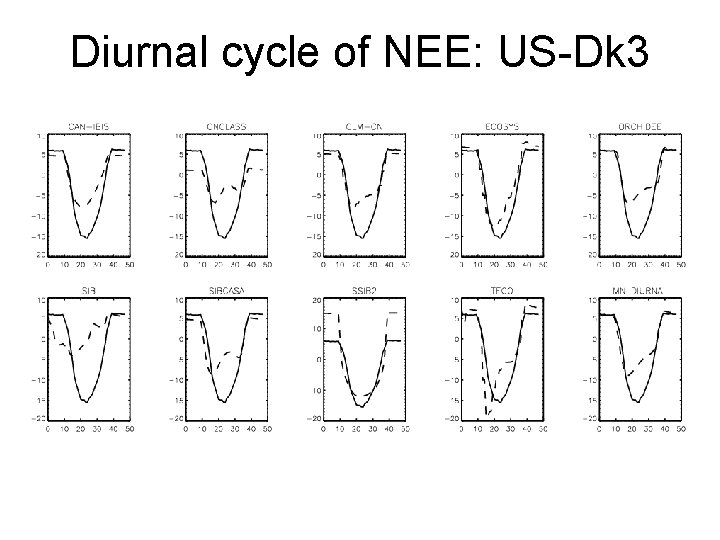
Diurnal cycle of GPP: US-Dk 3 Mean diurnal cycle for June-July-August, y-axis units = umol/m 2/s, x-axis is halfhour time step. Results from steady-state simulations
Diurnal cycle of GPP: CA-Obs
Diurnal cycle of GPP: US-UMB
Diurnal cycle of NEE: CA-Oas
Diurnal cycle of NEE: US-Ha 1
Diurnal cycle of NEE: US-Dk 3
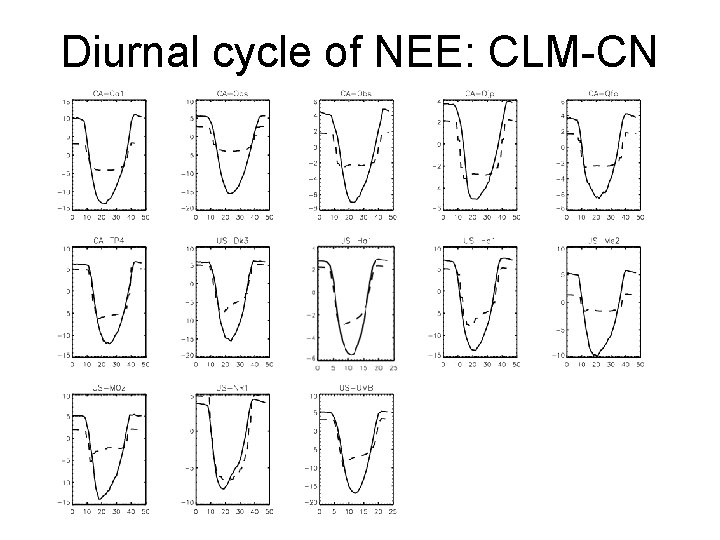
Diurnal cycle of NEE: CLM-CN
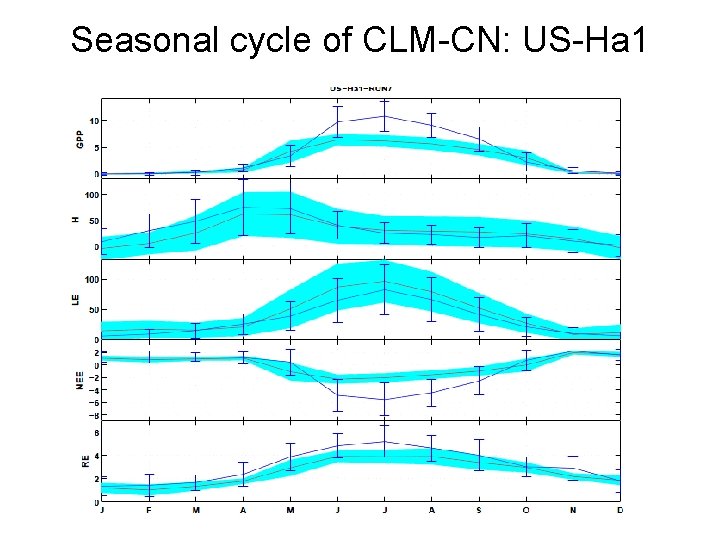
Seasonal cycle of CLM-CN: US-Ha 1
Findings: 1 • Time-scale of N-limitation mechanism in CLM-CN is wrong. – Evident at both diurnal and seasonal – Original hypothesis that plants respond to N availability on sub-daily time scale should be rejected – Introducing new mechanism to buffer N availability in time
Findings: 2 • Evaluation of LE suggests that current basis for estimation of stomatal conductance in CLM-CN is reasonable – This result should be revisited once new N storage mechanism is added
Findings: 3 • CLM-CN is very sensitive to fine root : leaf allocation patterns – Difficult measurement – Likely candidate parameter for data assimilation – Evidence emerging from global-scale studies and comparison to root turnover data that model fine root longevity needs to be modified • Other models sensitive to this as well?
Findings: 4 (underway) • Introducing transient forcing (disturbance, rising atmospheric CO 2, changing N deposition) seems to improve estimate of decadal-scale NEE – Doesn’t seem to change conclusions obtained from steady-state simulations – This is the most critical flux for evaluation of long-term climate-carbon cycle feedbacks
Conclusions • Approach has proved very useful in identifying strengths and weaknesses in CLM-CN • This kind of critical evaluation across multiple models provides a path forward for improved future model generations • Improving modelers’ ability to know what to ask for from observationalists and experimentalists.