
Evaluation of HighEarly Strength Concrete for Connection of
- Slides: 1
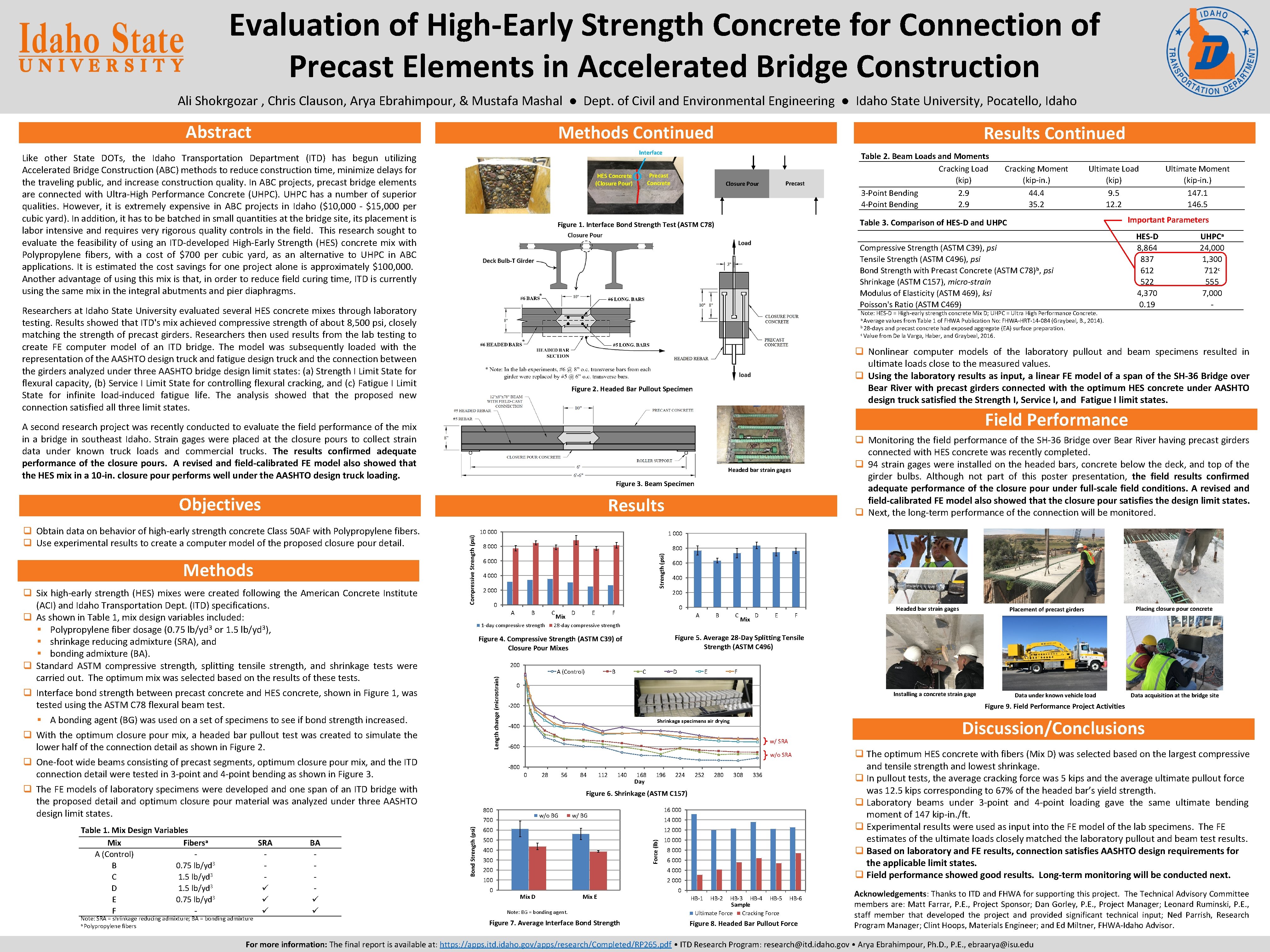
Evaluation of High-Early Strength Concrete for Connection of Precast Elements in Accelerated Bridge Construction Ali Shokrgozar , Chris Clauson, Arya Ebrahimpour, & Mustafa Mashal ● Dept. of Civil and Environmental Engineering ● Idaho State University, Pocatello, Idaho Abstract Methods Continued Interface Like other State DOTs, the Idaho Transportation Department (ITD) has begun utilizing Accelerated Bridge Construction (ABC) methods to reduce construction time, minimize delays for the traveling public, and increase construction quality. In ABC projects, precast bridge elements are connected with Ultra-High Performance Concrete (UHPC). UHPC has a number of superior qualities. However, it is extremely expensive in ABC projects in Idaho ($10, 000 - $15, 000 per cubic yard). In addition, it has to be batched in small quantities at the bridge site, its placement is labor intensive and requires very rigorous quality controls in the field. This research sought to evaluate the feasibility of using an ITD-developed High-Early Strength (HES) concrete mix with Polypropylene fibers, with a cost of $700 per cubic yard, as an alternative to UHPC in ABC applications. It is estimated the cost savings for one project alone is approximately $100, 000. Another advantage of using this mix is that, in order to reduce field curing time, ITD is currently using the same mix in the integral abutments and pier diaphragms. Important Parameters HES-D 8, 864 837 612 522 4, 370 0. 19 UHPCa 24, 000 1, 300 712 c 555 7, 000 - Field Performance q Monitoring the field performance of the SH-36 Bridge over Bear River having precast girders connected with HES concrete was recently completed. q 94 strain gages were installed on the headed bars, concrete below the deck, and top of the girder bulbs. Although not part of this poster presentation, the field results confirmed adequate performance of the closure pour under full-scale field conditions. A revised and field-calibrated FE model also showed that the closure pour satisfies the design limit states. q Next, the long-term performance of the connection will be monitored. Headed bar strain gages Figure 3. Beam Specimen 1 000 800 Strength (psi) 10 000 6 000 4 000 2 000 600 400 200 0 A B C 1 -day compressive strength Mix D E 0 F A Length change (microstrain) C A (Control) B Mix D E F Headed bar strain gages Placement of precast girders Placing closure pour concrete Figure 5. Average 28 -Day Splitting Tensile Strength (ASTM C 496) Figure 4. Compressive Strength (ASTM C 39) of Closure Pour Mixes 200 B 28 -day compressive strength C D E F 0 Installing a concrete strain gage Data under known vehicle load Data acquisition at the bridge site Figure 9. Field Performance Project Activities -200 Discussion/Conclusions Shrinkage specimens air drying -400 w/ SRA -600 w/o SRA -800 0 28 56 84 112 140 168 Day 196 224 252 280 HB-1 HB-2 308 336 Figure 6. Shrinkage (ASTM C 157) 800 w/o BG 700 16 000 w/ BG 14 000 600 12 000 500 10 000 Force (lb) BA Ultimate Moment (kip-in. ) 147. 1 146. 5 q Nonlinear computer models of the laboratory pullout and beam specimens resulted in ultimate loads close to the measured values. q Using the laboratory results as input, a linear FE model of a span of the SH-36 Bridge over Bear River with precast girders connected with the optimum HES concrete under AASHTO design truck satisfied the Strength I, Service I, and Fatigue I limit states. Figure 2. Headed Bar Pullout Specimen Compressive Strength (psi) q Six high-early strength (HES) mixes were created following the American Concrete Institute (ACI) and Idaho Transportation Dept. (ITD) specifications. q As shown in Table 1, mix design variables included: § Polypropylene fiber dosage (0. 75 lb/yd 3 or 1. 5 lb/yd 3), § shrinkage reducing admixture (SRA), and § bonding admixture (BA). q Standard ASTM compressive strength, splitting tensile strength, and shrinkage tests were carried out. The optimum mix was selected based on the results of these tests. q Interface bond strength between precast concrete and HES concrete, shown in Figure 1, was tested using the ASTM C 78 flexural beam test. § A bonding agent (BG) was used on a set of specimens to see if bond strength increased. q With the optimum closure pour mix, a headed bar pullout test was created to simulate the lower half of the connection detail as shown in Figure 2. q One-foot wide beams consisting of precast segments, optimum closure pour mix, and the ITD connection detail were tested in 3 -point and 4 -point bending as shown in Figure 3. q The FE models of laboratory specimens were developed and one span of an ITD bridge with the proposed detail and optimum closure pour material was analyzed under three AASHTO design limit states. Ultimate Load (kip) 9. 5 12. 2 Note: HES-D = High-early strength concrete Mix D; UHPC = Ultra High Performance Concrete. a Average values from Table 1 of FHWA Publication No: FHWA-HRT-14 -084 (Graybeal, B. , 2014). b 28 -days and precast concrete had exposed aggregate (EA) surface preparation. c Value from De la Varga, Haber, and Graybeal, 2016. Bond Strength (psi) Methods Cracking Moment (kip-in. ) 44. 4 35. 2 Table 3. Comparison of HES-D and UHPC Results q Obtain data on behavior of high-early strength concrete Class 50 AF with Polypropylene fibers. q Use experimental results to create a computer model of the proposed closure pour detail. Table 2. Beam Loads and Moments Cracking Load (kip) 3 -Point Bending 2. 9 4 -Point Bending 2. 9 Compressive Strength (ASTM C 39), psi Tensile Strength (ASTM C 496), psi Bond Strength with Precast Concrete (ASTM C 78)b, psi Shrinkage (ASTM C 157), micro-strain Modulus of Elasticity (ASTM 469), ksi Poisson's Ratio (ASTM C 469) Objectives Note: SRA = shrinkage reducing admixture; BA = bonding admixture a Polypropylene fibers Precast Closure Pour Figure 1. Interface Bond Strength Test (ASTM C 78) A second research project was recently conducted to evaluate the field performance of the mix in a bridge in southeast Idaho. Strain gages were placed at the closure pours to collect strain data under known truck loads and commercial trucks. The results confirmed adequate performance of the closure pours. A revised and field-calibrated FE model also showed that the HES mix in a 10 -in. closure pour performs well under the AASHTO design truck loading. SRA Precast Concrete HES Concrete (Closure Pour) Researchers at Idaho State University evaluated several HES concrete mixes through laboratory testing. Results showed that ITD's mix achieved compressive strength of about 8, 500 psi, closely matching the strength of precast girders. Researchers then used results from the lab testing to create FE computer model of an ITD bridge. The model was subsequently loaded with the representation of the AASHTO design truck and fatigue design truck and the connection between the girders analyzed under three AASHTO bridge design limit states: (a) Strength I Limit State for flexural capacity, (b) Service I Limit State for controlling flexural cracking, and (c) Fatigue I Limit State for infinite load-induced fatigue life. The analysis showed that the proposed new connection satisfied all three limit states. Table 1. Mix Design Variables Mix Fibersa A (Control) B 0. 75 lb/yd 3 C 1. 5 lb/yd 3 D 1. 5 lb/yd 3 E 0. 75 lb/yd 3 F - Results Continued 400 300 8 000 6 000 200 4 000 100 2 000 0 0 Mix D Mix E Note: BG = bonding agent. Figure 7. Average Interface Bond Strength HB-3 HB-4 HB-5 Sample Ultimate Force Cracking Force HB-6 Figure 8. Headed Bar Pullout Force q The optimum HES concrete with fibers (Mix D) was selected based on the largest compressive and tensile strength and lowest shrinkage. q In pullout tests, the average cracking force was 5 kips and the average ultimate pullout force was 12. 5 kips corresponding to 67% of the headed bar’s yield strength. q Laboratory beams under 3 -point and 4 -point loading gave the same ultimate bending moment of 147 kip-in. /ft. q Experimental results were used as input into the FE model of the lab specimens. The FE estimates of the ultimate loads closely matched the laboratory pullout and beam test results. q Based on laboratory and FE results, connection satisfies AASHTO design requirements for the applicable limit states. q Field performance showed good results. Long-term monitoring will be conducted next. Acknowledgements: Thanks to ITD and FHWA for supporting this project. The Technical Advisory Committee members are: Matt Farrar, P. E. , Project Sponsor; Dan Gorley, P. E. , Project Manager; Leonard Ruminski, P. E. , staff member that developed the project and provided significant technical input; Ned Parrish, Research Program Manager; Clint Hoops, Materials Engineer; and Ed Miltner, FHWA-Idaho Advisor. For more information: The final report is available at: https: //apps. itd. idaho. gov/apps/research/Completed/RP 265. pdf • ITD Research Program: research@itd. idaho. gov • Arya Ebrahimpour, Ph. D. , P. E. , ebraarya@isu. edu