
Evaluation of flow resistance in unsteady pipe flow











- Slides: 23
Evaluation of flow resistance in unsteady pipe flow: numerical developments and first experimental results www. bhrgroup. co. uk 11 th International Conference on Pressure Surges Lisbon, Portugal, 24 – 26 October 2012
Contents Ø Introduction Ø Data Collection and Analysis Ø Quasi-Two Dimensional Model Ø Numerical Results Ø Conclusions and Future Work 11 th International Conference on Pressure Surges Lisbon, Portugal, 24 – 26 October 2012
INTRODUCTION 11 th International Conference on Pressure Surges Lisbon, Portugal, 24 – 26 October 2012
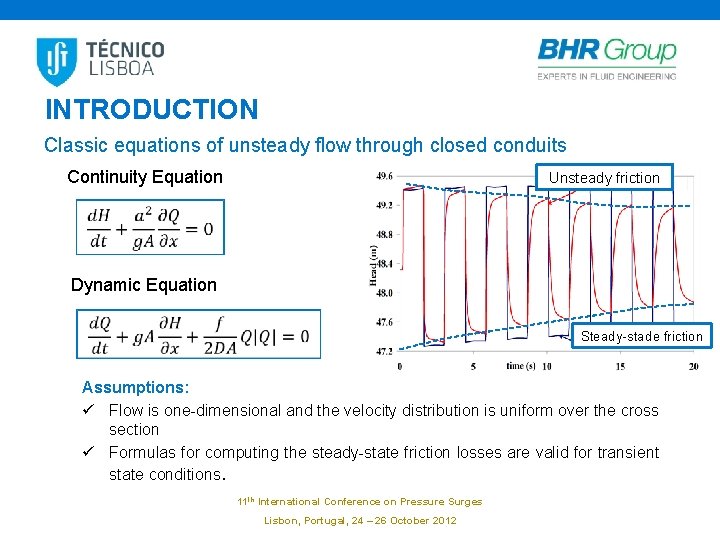
INTRODUCTION Classic equations of unsteady flow through closed conduits Continuity Equation Unsteady friction Dynamic Equation Steady-stade friction Assumptions: ü Flow is one-dimensional and the velocity distribution is uniform over the cross section ü Formulas for computing the steady-state friction losses are valid for transient state conditions. 11 th International Conference on Pressure Surges Lisbon, Portugal, 24 – 26 October 2012
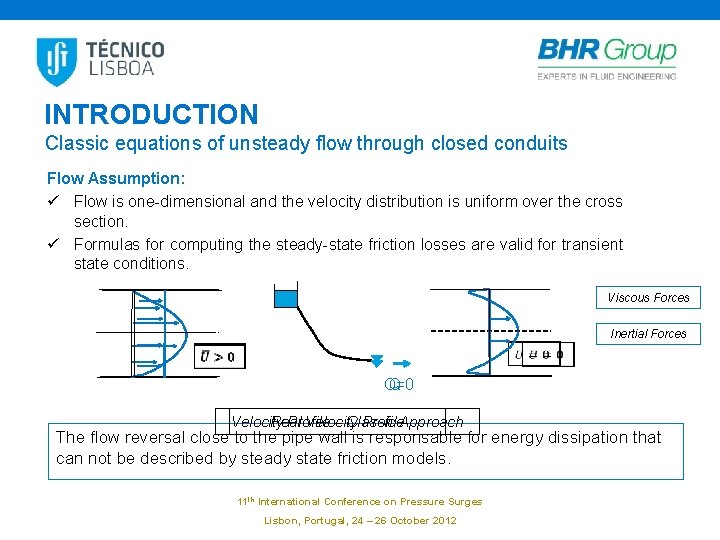
INTRODUCTION Classic equations of unsteady flow through closed conduits Flow Assumption: ü Flow is one-dimensional and the velocity distribution is uniform over the cross section. ü Formulas for computing the steady-state friction losses are valid for transient state conditions. Viscous Forces Inertial Forces Q=0 Q Real Velocity Profile. Approach Velocity Profile – Classic The flow reversal close to the pipe wall is responsable for energy dissipation that can not be described by steady state friction models. 11 th International Conference on Pressure Surges Lisbon, Portugal, 24 – 26 October 2012
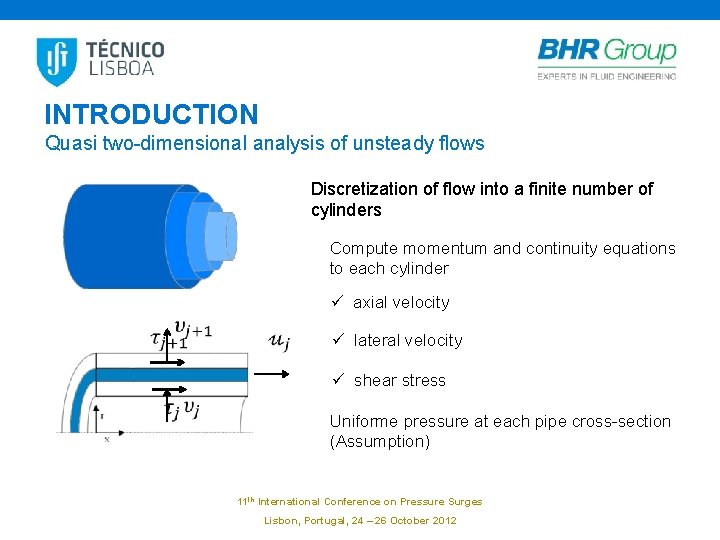
INTRODUCTION Quasi two-dimensional analysis of unsteady flows Discretization of flow into a finite number of cylinders Compute momentum and continuity equations to each cylinder ü axial velocity ü lateral velocity ü shear stress Uniforme pressure at each pipe cross-section (Assumption) 11 th International Conference on Pressure Surges Lisbon, Portugal, 24 – 26 October 2012
DATA COLLECTION AND ANALYSIS 11 th International Conference on Pressure Surges Lisbon, Portugal, 24 – 26 October 2012
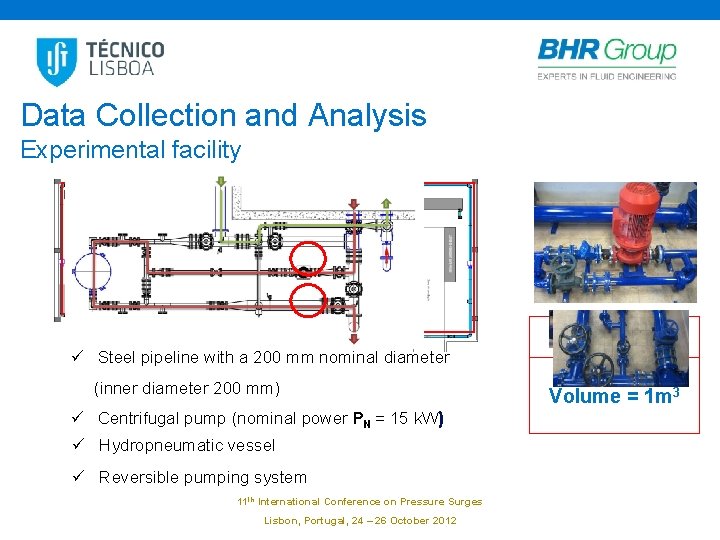
Data Collection and Analysis Experimental facility Total lenght 115 m ü Steel pipeline with a 200 mm nominal diameter (inner diameter 200 mm) ü Centrifugal pump (nominal power PN = 15 k. W) ü Hydropneumatic vessel ü Reversible pumping system 11 th International Conference on Pressure Surges Lisbon, Portugal, 24 – 26 October 2012 QN = 20 l/s HN = 38 m Volume = 1 m 3
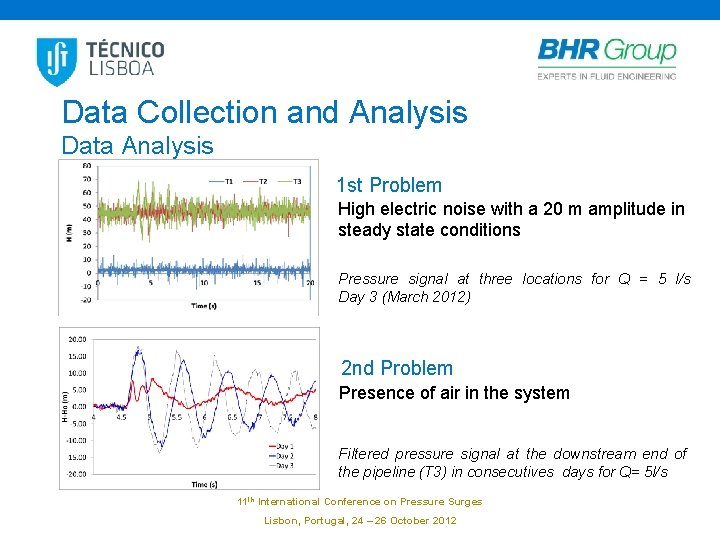
Data Collection and Analysis Data Analysis 1 st Problem High electric noise with a 20 m amplitude in steady state conditions Pressure signal at three locations for Q = 5 l/s Day 3 (March 2012) 2 nd Problem Presence of air in the system Filtered pressure signal at the downstream end of the pipeline (T 3) in consecutives days for Q= 5 l/s 11 th International Conference on Pressure Surges Lisbon, Portugal, 24 – 26 October 2012
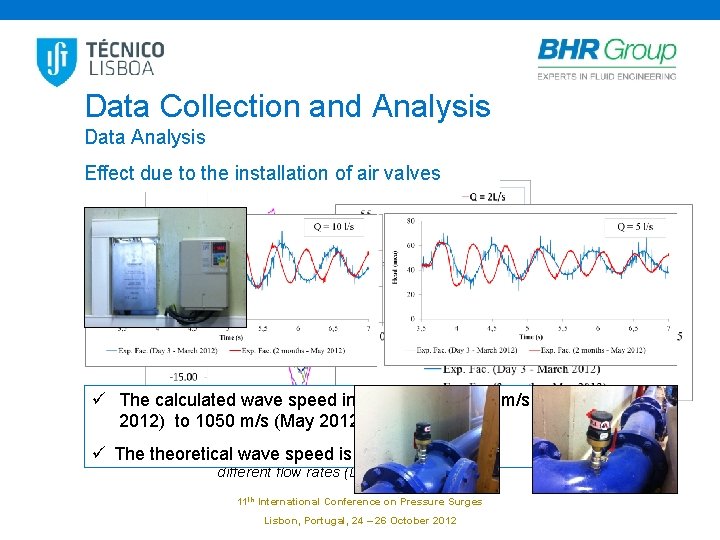
Data Collection and Analysis Data Analysis Effect due to the installation of air valves filter a electric ü The calculated wave speed increased from 900 m/s (Day 3 – March 2012) to 1050 m/s (May 2012). Filtered pressure signalspeed at the downstream end of the pipeline for ü The theoretical wave is 1300 m/s. different flow rates (Day 3 – March 2012) 11 th International Conference on Pressure Surges Lisbon, Portugal, 24 – 26 October 2012
QUASI-TWO DIMENSIONAL MODEL 11 th International Conference on Pressure Surges Lisbon, Portugal, 24 – 26 October 2012
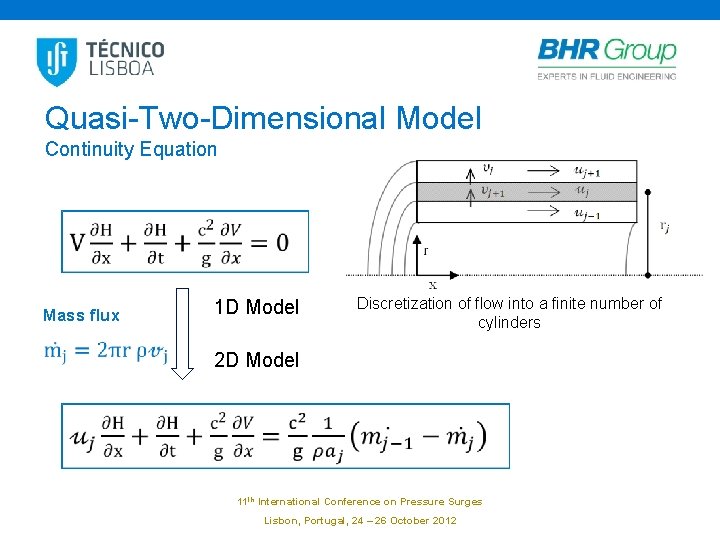
Quasi-Two-Dimensional Model Continuity Equation Mass flux 1 D Model Discretization of flow into a finite number of cylinders 2 D Model 11 th International Conference on Pressure Surges Lisbon, Portugal, 24 – 26 October 2012
Quasi-Two-Dimensional Model Momentum Equation 1 D Model 2 D Model Forces considered in the momentum equation in 2 -D Model 11 th International Conference on Pressure Surges Lisbon, Portugal, 24 – 26 October 2012
Quasi-Two-Dimensional Model Numerical Solution Shear stress calculation Laminar Flow Turbulent Flow Five – Layer Viscosity Distribution 11 th International Conference on Pressure Surges Lisbon, Portugal, 24 – 26 October 2012
NUMERICAL RESULTS 11 th International Conference on Pressure Surges Lisbon, Portugal, 24 – 26 October 2012
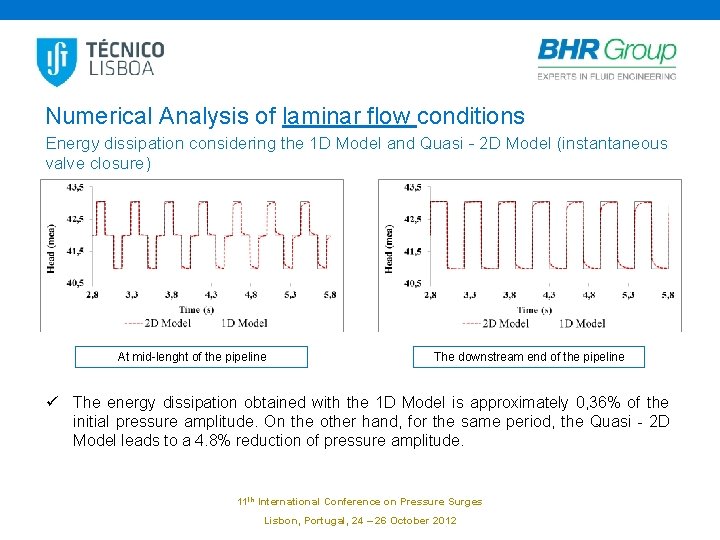
Numerical Analysis of laminar flow conditions Energy dissipation considering the 1 D Model and Quasi - 2 D Model (instantaneous valve closure) At mid-lenght of the pipeline The downstream end of the pipeline ü The energy dissipation obtained with the 1 D Model is approximately 0, 36% of the initial pressure amplitude. On the other hand, for the same period, the Quasi - 2 D Model leads to a 4. 8% reduction of pressure amplitude. 11 th International Conference on Pressure Surges Lisbon, Portugal, 24 – 26 October 2012
Numerical analysis of laminar flow conditions Radial distribution of axial velocity Axis of the conduit t = ti+1, 5 L/c t = ti+0, 5 L/c t = ti+2 L/c 11 th International Conference on Pressure Surges Lisbon, Portugal, 24 – 26 October 2012 t = ti+L/c
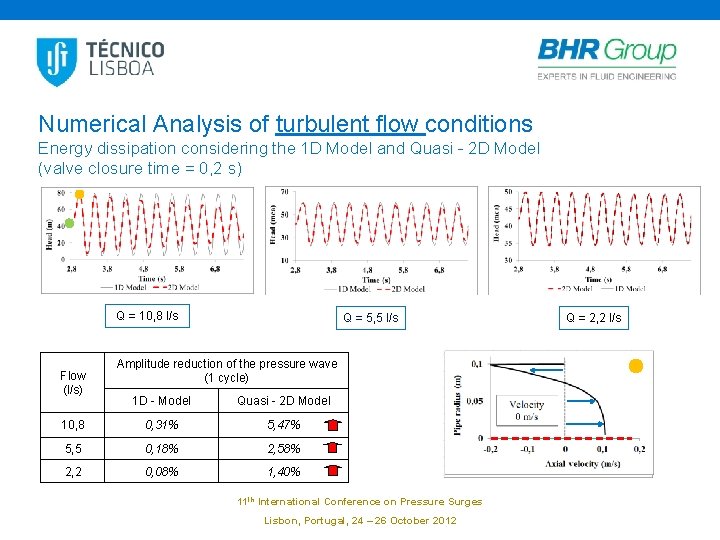
Numerical Analysis of turbulent flow conditions Energy dissipation considering the 1 D Model and Quasi - 2 D Model (valve closure time = 0, 2 s) Q = 10, 8 l/s Flow (l/s) Q = 5, 5 l/s Amplitude reduction of the pressure wave (1 cycle) 1 D - Model Quasi - 2 D Model 10, 8 0, 31% 5, 47% 5, 5 0, 18% 2, 58% 2, 2 0, 08% 1, 40% 11 th International Conference on Pressure Surges Lisbon, Portugal, 24 – 26 October 2012 Q = 2, 2 l/s
Numerical analysis of turbulent flow conditions Numerical versus experimental results 1 -D Model versus collected data 2 -D Model versus collected data ü The maximum pressure is reasonably described by both models. ü None of the numerical models describes minimum pressures and pressure wave phase and shape. 11 th International Conference on Pressure Surges Lisbon, Portugal, 24 – 26 October 2012
CONCLUSIONS AND FUTURE WORK 11 th International Conference on Pressure Surges Lisbon, Portugal, 24 – 26 October 2012
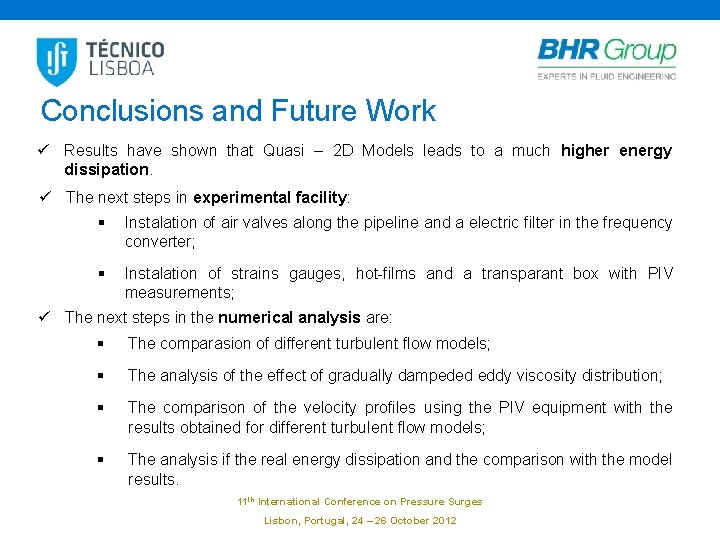
Conclusions and Future Work ü Results have shown that Quasi – 2 D Models leads to a much higher energy dissipation. ü The next steps in experimental facility: § Instalation of air valves along the pipeline and a electric filter in the frequency converter; § Instalation of strains gauges, hot-films and a transparant box with PIV measurements; ü The next steps in the numerical analysis are: § The comparasion of different turbulent flow models; § The analysis of the effect of gradually dampeded eddy viscosity distribution; § The comparison of the velocity profiles using the PIV equipment with the results obtained for different turbulent flow models; § The analysis if the real energy dissipation and the comparison with the model results. 11 th International Conference on Pressure Surges Lisbon, Portugal, 24 – 26 October 2012
Acknowledgments 11 th International Conference on Pressure Surges Lisbon, Portugal, 24 – 26 October 2012
Evaluation of flow resistance in unsteady pipe flow: numerical developments and first experimental results Pedro Leite, Dídia I. C. Covas, Helena M. Ramos Instituto Superior Técnico/Universidade Técnica de Lisboa jhj José Tentúgal Valente, Manuel Maria Pacheco Figueiredo Faculdade de Engenharia da Universidade do Porto 11 th International Conference on Pressure Surges Lisbon, Portugal, 24 – 26 October 2012