
Evaluation of EntryLevel Nurse Anesthesia Educational Programs Stephen
- Slides: 1
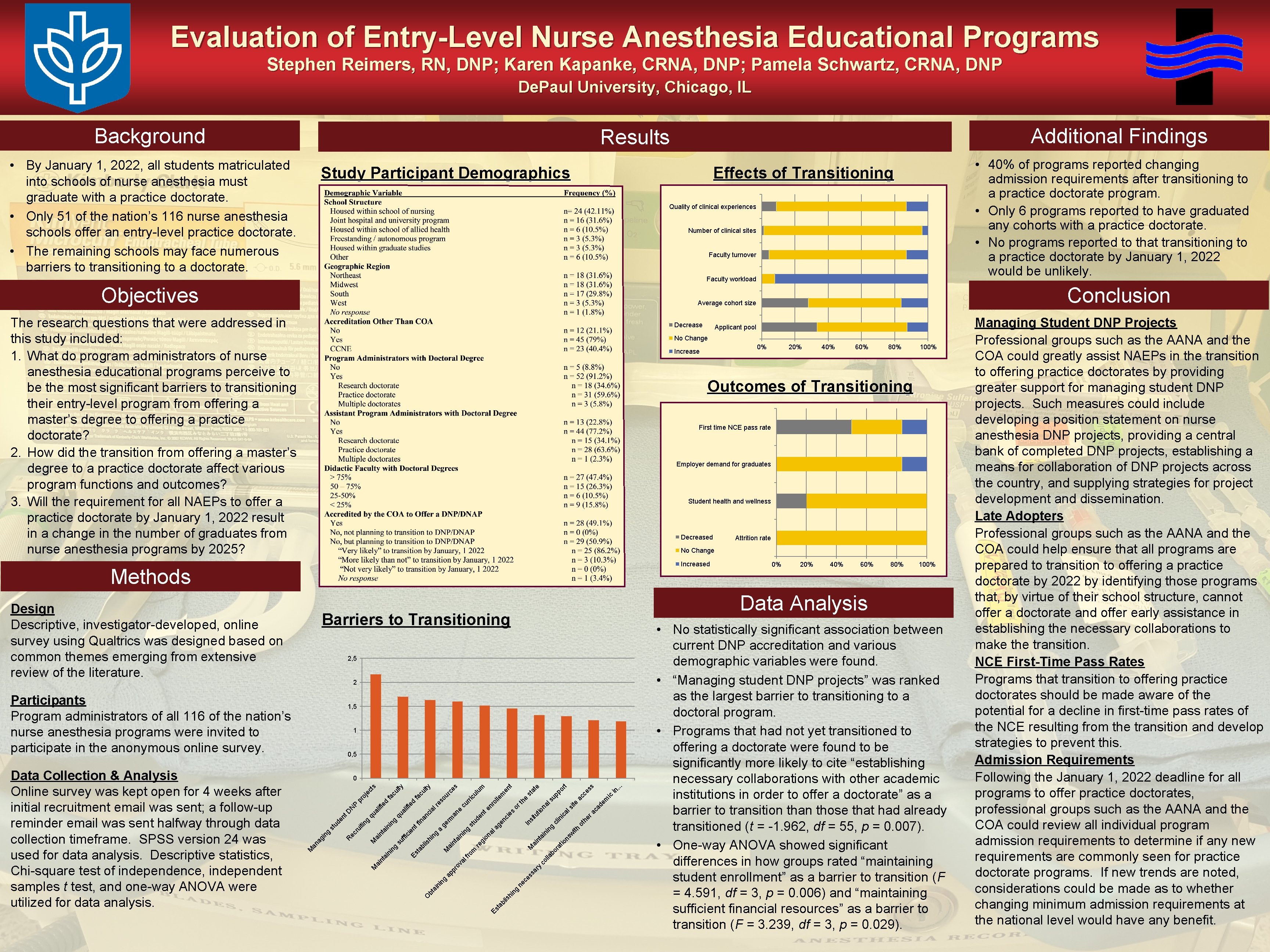
Evaluation of Entry-Level Nurse Anesthesia Educational Programs Stephen Reimers, RN, DNP; Karen Kapanke, CRNA, DNP; Pamela Schwartz, CRNA, DNP De. Paul University, Chicago, IL Background Additional Findings Results • By January 1, 2022, all students matriculated into schools of nurse anesthesia must graduate with a practice doctorate. • Only 51 of the nation’s 116 nurse anesthesia schools offer an entry-level practice doctorate. • The remaining schools may face numerous barriers to transitioning to a doctorate. • 40% of programs reported changing admission requirements after transitioning to a practice doctorate program. • Only 6 programs reported to have graduated any cohorts with a practice doctorate. • No programs reported to that transitioning to a practice doctorate by January 1, 2022 would be unlikely. Effects of Transitioning Study Participant Demographics Quality of clinical experiences Number of clinical sites Faculty turnover Faculty workload Objectives The research questions that were addressed in this study included: 1. What do program administrators of nurse anesthesia educational programs perceive to be the most significant barriers to transitioning their entry-level program from offering a master’s degree to offering a practice doctorate? 2. How did the transition from offering a master’s degree to a practice doctorate affect various program functions and outcomes? 3. Will the requirement for all NAEPs to offer a practice doctorate by January 1, 2022 result in a change in the number of graduates from nurse anesthesia programs by 2025? Decrease Applicant pool No Change 0% Increase 20% 40% 60% 80% 100% Outcomes of Transitioning First time NCE pass rate Employer demand for graduates Student health and wellness Decreased Attrition rate No Change Increased Methods Design Descriptive, investigator-developed, online survey using Qualtrics was designed based on common themes emerging from extensive review of the literature. 2, 5 2 1, 5 1 0, 5 in. . . es ic ad em ac ot ns w ith tio ra lla bo co y ar ng hi is bl ta Es he r in ic cl ng ni ai nt M ai ss ce ne in g in bt a O ac c te si al tio tu si In fro al ov ap pr M s t up na ls e th or es ci ge n la on a re gi m M ai po r e at st le m ol nr te ud en st ng ni ai nt hi is bl ta Es en t lu m cu rri cu e an ge rm ng a en ci ffi su g ai n ta in in ou rc es al r ci in an tf in g in ai nt a M es ty ul fa c ed ifi qu al al if qu ng ru iti ec R an a gi ng st ud en t. D N P ie d pr fa oj cu ec ts lty 0 M 0% 20% 40% 60% 80% 100% Data Analysis Barriers to Transitioning Participants Program administrators of all 116 of the nation’s nurse anesthesia programs were invited to participate in the anonymous online survey. Data Collection & Analysis Online survey was kept open for 4 weeks after initial recruitment email was sent; a follow-up reminder email was sent halfway through data collection timeframe. SPSS version 24 was used for data analysis. Descriptive statistics, Chi-square test of independence, independent samples t test, and one-way ANOVA were utilized for data analysis. Conclusion Average cohort size • No statistically significant association between current DNP accreditation and various demographic variables were found. • “Managing student DNP projects” was ranked as the largest barrier to transitioning to a doctoral program. • Programs that had not yet transitioned to offering a doctorate were found to be significantly more likely to cite “establishing necessary collaborations with other academic institutions in order to offer a doctorate” as a barrier to transition than those that had already transitioned (t = -1. 962, df = 55, p = 0. 007). • One-way ANOVA showed significant differences in how groups rated “maintaining student enrollment” as a barrier to transition (F = 4. 591, df = 3, p = 0. 006) and “maintaining sufficient financial resources” as a barrier to transition (F = 3. 239, df = 3, p = 0. 029). Managing Student DNP Projects Professional groups such as the AANA and the COA could greatly assist NAEPs in the transition to offering practice doctorates by providing greater support for managing student DNP projects. Such measures could include developing a position statement on nurse anesthesia DNP projects, providing a central bank of completed DNP projects, establishing a means for collaboration of DNP projects across the country, and supplying strategies for project development and dissemination. Late Adopters Professional groups such as the AANA and the COA could help ensure that all programs are prepared to transition to offering a practice doctorate by 2022 by identifying those programs that, by virtue of their school structure, cannot offer a doctorate and offer early assistance in establishing the necessary collaborations to make the transition. NCE First-Time Pass Rates Programs that transition to offering practice doctorates should be made aware of the potential for a decline in first-time pass rates of the NCE resulting from the transition and develop strategies to prevent this. Admission Requirements Following the January 1, 2022 deadline for all programs to offer practice doctorates, professional groups such as the AANA and the COA could review all individual program admission requirements to determine if any new requirements are commonly seen for practice doctorate programs. If new trends are noted, considerations could be made as to whether changing minimum admission requirements at the national level would have any benefit.