
Evaluation of Building Energy Performance Rating Methods ASHRAE
Evaluation of Building Energy Performance Rating Methods ASHRAE TRP-1286 Initial Results Jason Glazer, P. E. GARD Analytics January 2006
Project Overview • Today’s presentation – Overview of many rating methods – In depth evaluation of five methods • Work in progress – Gathered data for 29 test buildings – Test five methods with building data – Recommendations 2
Overview of Many Methods • Formal literature search • Internet search – – – – building benchmark building energy rating building energy metric Building Energy Measure OR Rank OR Gauge OR Grade Building Energy Criteria OR Classification OR Merit Building Energy Valuation OR Mark OR Yardstick Building Energy Target OR Score 3
Overview Results • 88 protocols initially uncovered – 47 commercial (focus) – 31 residential • Categorization applied – Use of, or reference to, ASHRAE products – Range of approach – Range of applicable building types – Number of users (subjective) 4
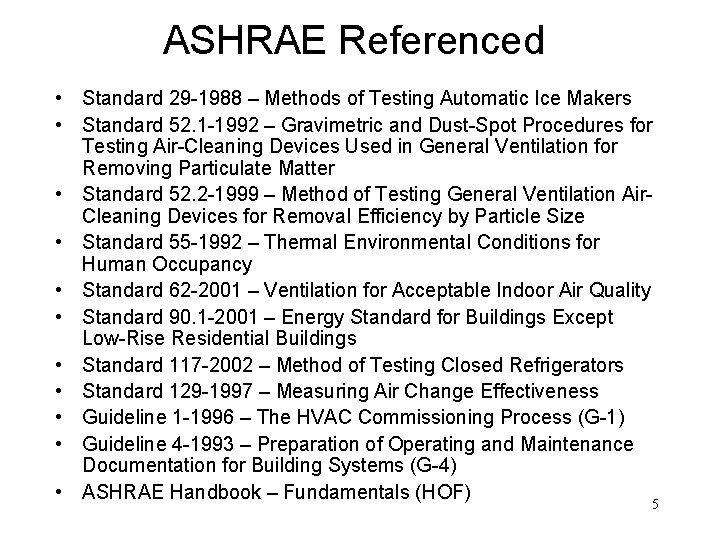
ASHRAE Referenced • Standard 29 -1988 – Methods of Testing Automatic Ice Makers • Standard 52. 1 -1992 – Gravimetric and Dust-Spot Procedures for Testing Air-Cleaning Devices Used in General Ventilation for Removing Particulate Matter • Standard 52. 2 -1999 – Method of Testing General Ventilation Air. Cleaning Devices for Removal Efficiency by Particle Size • Standard 55 -1992 – Thermal Environmental Conditions for Human Occupancy • Standard 62 -2001 – Ventilation for Acceptable Indoor Air Quality • Standard 90. 1 -2001 – Energy Standard for Buildings Except Low-Rise Residential Buildings • Standard 117 -2002 – Method of Testing Closed Refrigerators • Standard 129 -1997 – Measuring Air Change Effectiveness • Guideline 1 -1996 – The HVAC Commissioning Process (G-1) • Guideline 4 -1993 – Preparation of Operating and Maintenance Documentation for Building Systems (G-4) • ASHRAE Handbook – Fundamentals (HOF) 5

Use of ASHRAE Documents 6
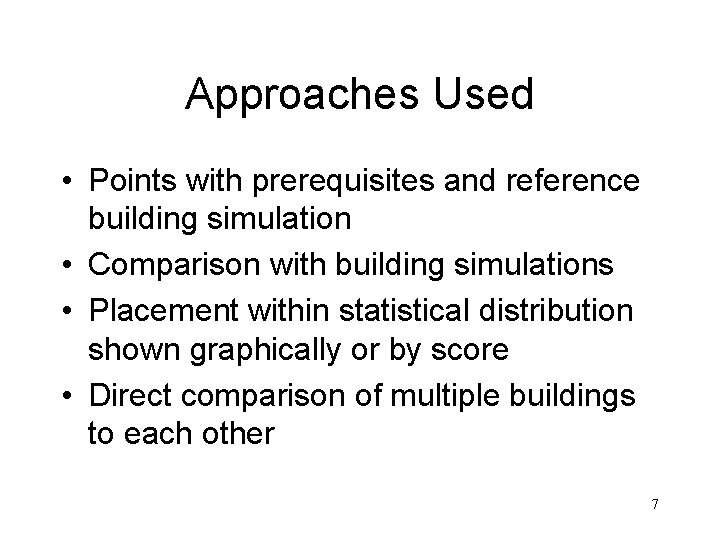
Approaches Used • Points with prerequisites and reference building simulation • Comparison with building simulations • Placement within statistical distribution shown graphically or by score • Direct comparison of multiple buildings to each other 7
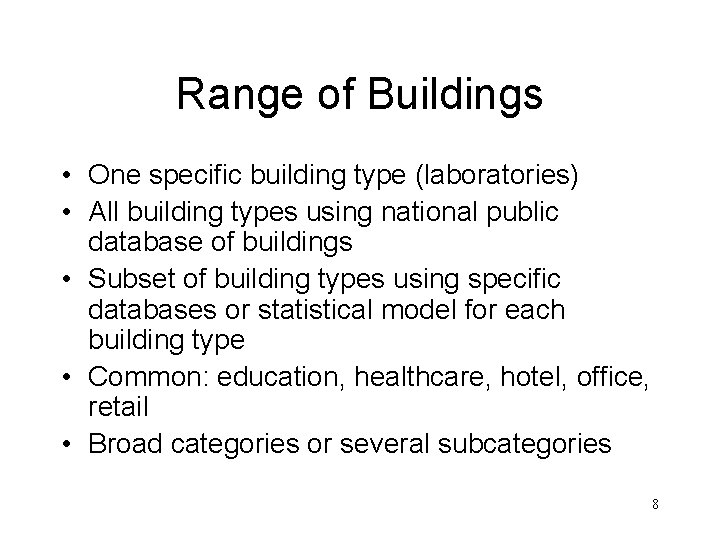
Range of Buildings • One specific building type (laboratories) • All building types using national public database of buildings • Subset of building types using specific databases or statistical model for each building type • Common: education, healthcare, hotel, office, retail • Broad categories or several subcategories 8
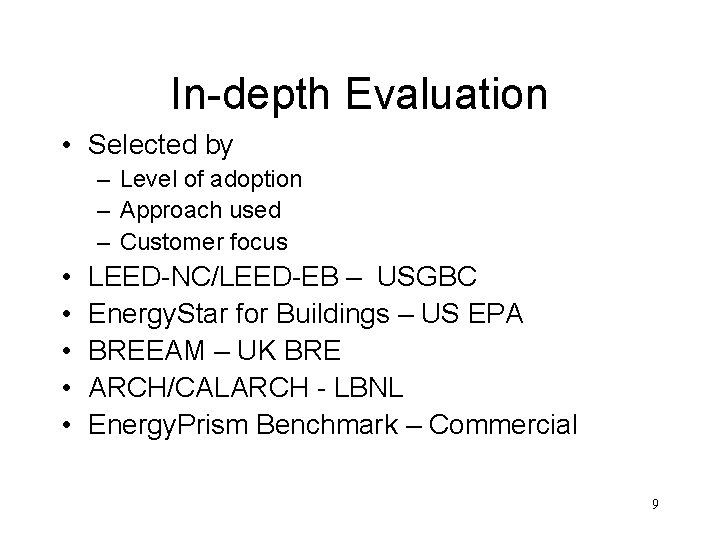
In-depth Evaluation • Selected by – Level of adoption – Approach used – Customer focus • • • LEED-NC/LEED-EB – USGBC Energy. Star for Buildings – US EPA BREEAM – UK BRE ARCH/CALARCH - LBNL Energy. Prism Benchmark – Commercial 9
Comparisons • • Scope of application Empirical basis Input requirements Output and transparency Part of certification process Effort and expense Influences design or retrofit 10
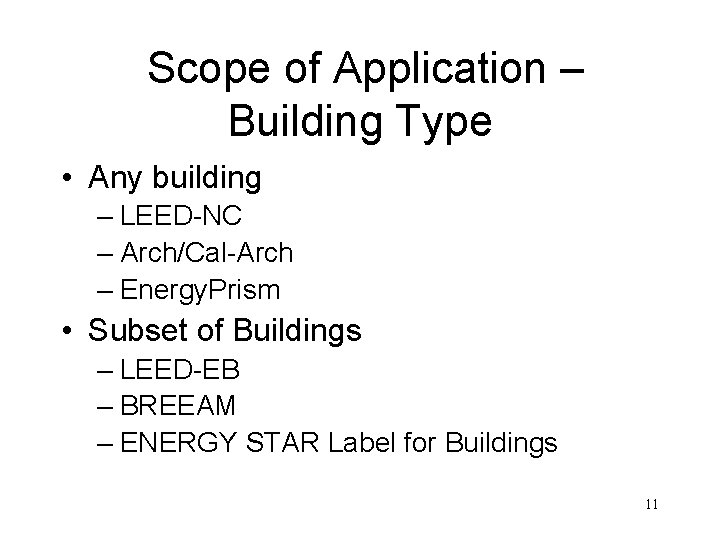
Scope of Application – Building Type • Any building – LEED-NC – Arch/Cal-Arch – Energy. Prism • Subset of Buildings – LEED-EB – BREEAM – ENERGY STAR Label for Buildings 11

Scope of Application Geography • U. S. – LEED, ENERGY STAR, Energy. Prism, Arch • California – Cal-Arch • Global – BREEAM 12
Scope of Application – Building Size • Some have specific building size range • Certification costs discourage small buildings 13
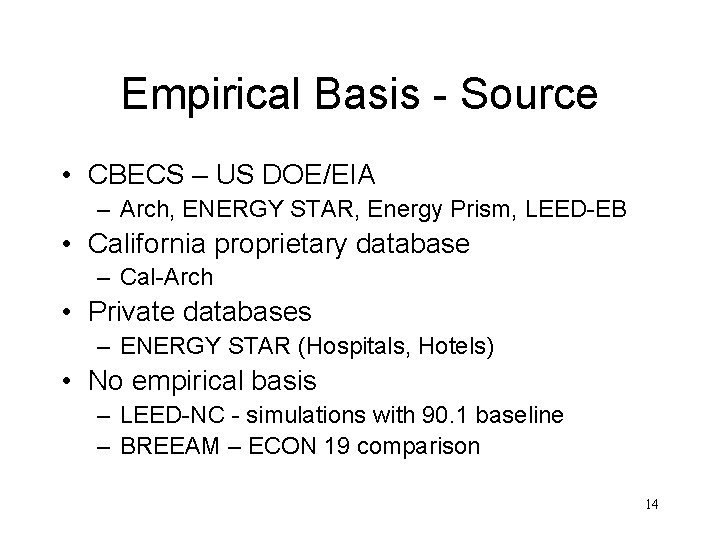
Empirical Basis - Source • CBECS – US DOE/EIA – Arch, ENERGY STAR, Energy Prism, LEED-EB • California proprietary database – Cal-Arch • Private databases – ENERGY STAR (Hospitals, Hotels) • No empirical basis – LEED-NC - simulations with 90. 1 baseline – BREEAM – ECON 19 comparison 14
Input Requirements • Building area and annual energy usage – Arch and Cal-Arch • Area by space type, monthly energy usage – ENERGY STAR Label for Buildings • Building area, annual energy use, end-use – Energy. Prism • Many inputs for each point sought – BREEAM, LEED 15
Output and Transparency – LEED and BREEAM • Several specific grade levels provide simple recognition by others – BREEAM: Pass, Good, Very Good, Excellent – LEED: Certified, Silver, Gold, Platinum • Points allow cafeteria style selection of measures • Lower resolution - not appropriate for multibuilding comparisons • More than energy: environmental 16
Output and Transparency – ENERGY STAR • Number between 0 to 100 with a specific threshold • Documentation aimed at analyst • Threshold of 75 provides user understanding if improvement is warranted 17
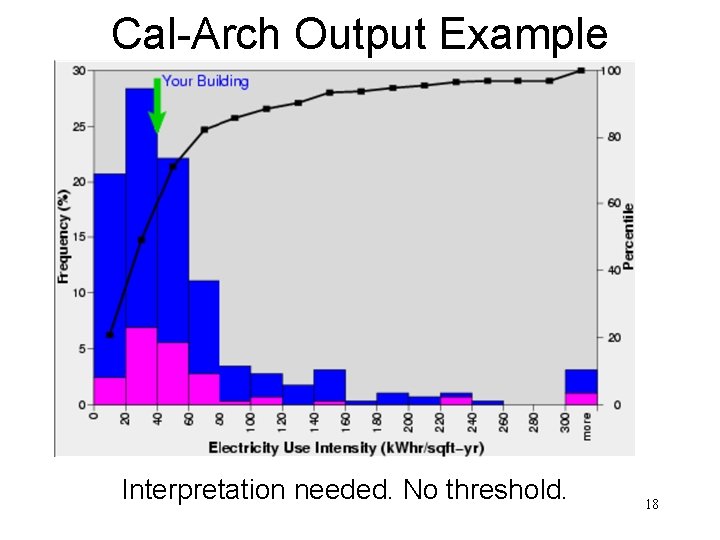
Cal-Arch Output Example Interpretation needed. No threshold. 18
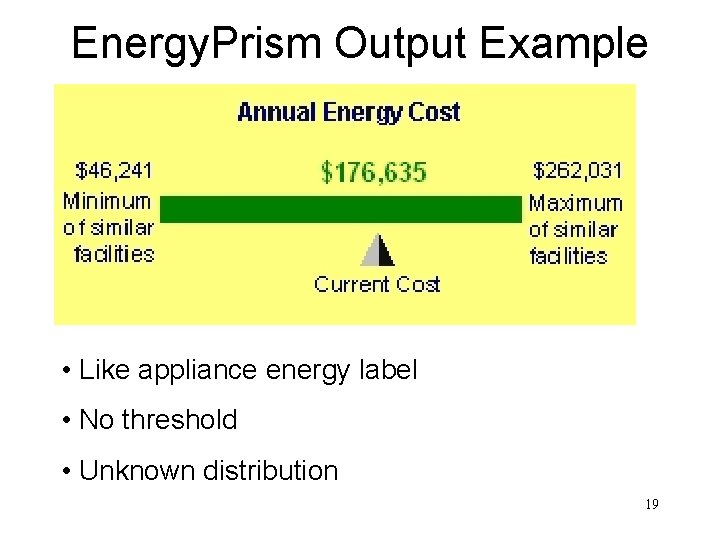
Energy. Prism Output Example • Like appliance energy label • No threshold • Unknown distribution 19
Part of Certification Process • ENERGY STAR, BREEAM, LEED – – – Recognition to building Third party gives legitimacy Widely recognized Adequate lighting, ventilation, comfort Utility or government incentives Leveraged by other organizations 20
Effort and Expense • No cost – an hour to self-assess – ENERGY STAR, Energy. Prism, Arch/Cal. Arch – 2623 ENERGY STAR certified (Jan 2006) • With cost – multi-month process – BREEAM, LEED – 359 LEED certified (Nov 2005) 21
Influences Design or Retrofit • Point systems for design – LEED-NC and BREEAM – Directly influence design – Incorporate with the design process • Consumption based protocols – – – ENERGY STAR, Energy. Prism, Arch/Cal-Arch Indirect influence on design May spur energy oriented retrofits Do not indicate why building performing poorly Added risk trying to meet threshold 22
Next Steps • Data from actual buildings – Office, K-12 schools, hospital, lodging • Test methods – Include test cases for major inputs • Prepare recommendations for future rating methods 23

Questions 24
- Slides: 24