
Evaluation of a School Wide Reading Program Wendy
- Slides: 26
Evaluation of a School Wide Reading Program Wendy S. Angleman Kathy J. Bass Kristina A. Finley 1
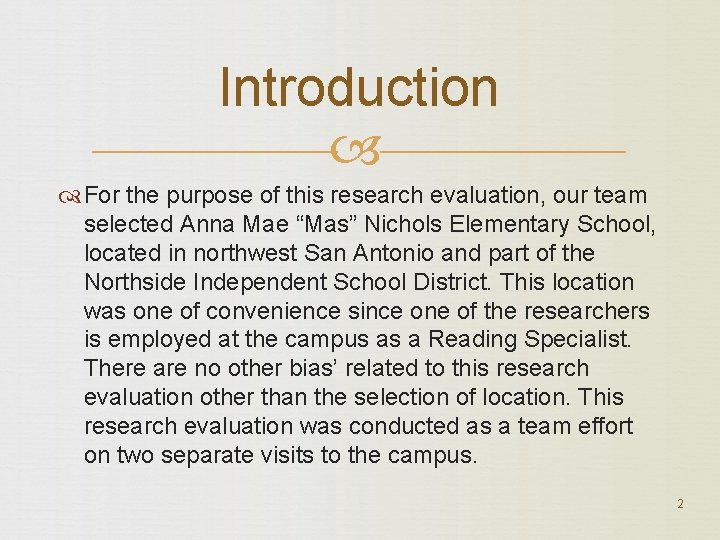
Introduction For the purpose of this research evaluation, our team selected Anna Mae “Mas” Nichols Elementary School, located in northwest San Antonio and part of the Northside Independent School District. This location was one of convenience since one of the researchers is employed at the campus as a Reading Specialist. There are no other bias’ related to this research evaluation other than the selection of location. This research evaluation was conducted as a team effort on two separate visits to the campus. 2
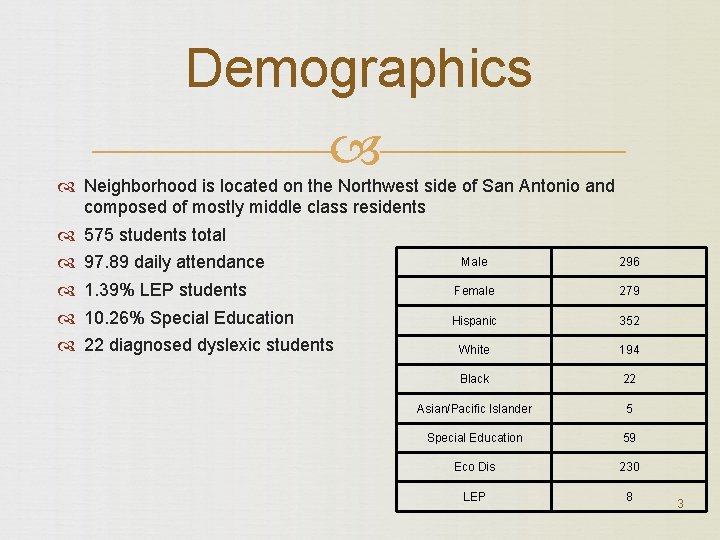
Demographics Neighborhood is located on the Northwest side of San Antonio and composed of mostly middle class residents 575 students total Male 296 97. 89 daily attendance Female 279 1. 39% LEP students 10. 26% Special Education Hispanic 352 22 diagnosed dyslexic students White 194 Black 22 Asian/Pacific Islander 5 Special Education 59 Eco Dis 230 LEP 8 3
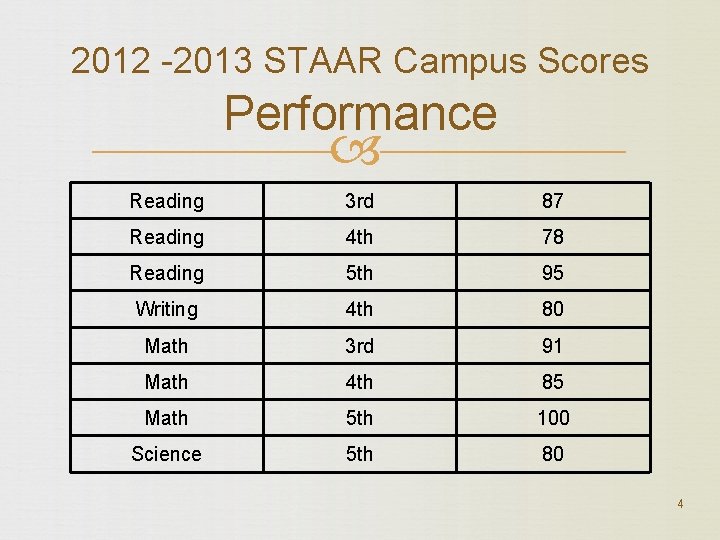
2012 -2013 STAAR Campus Scores Performance Reading 3 rd 87 Reading 4 th 78 Reading 5 th 95 Writing 4 th 80 Math 3 rd 91 Math 4 th 85 Math 5 th 100 Science 5 th 80 4
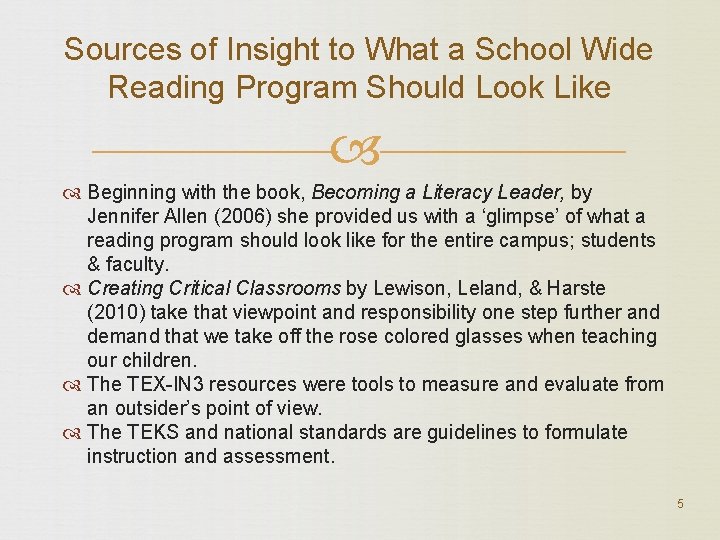
Sources of Insight to What a School Wide Reading Program Should Look Like Beginning with the book, Becoming a Literacy Leader, by Jennifer Allen (2006) she provided us with a ‘glimpse’ of what a reading program should look like for the entire campus; students & faculty. Creating Critical Classrooms by Lewison, Leland, & Harste (2010) take that viewpoint and responsibility one step further and demand that we take off the rose colored glasses when teaching our children. The TEX-IN 3 resources were tools to measure and evaluate from an outsider’s point of view. The TEKS and national standards are guidelines to formulate instruction and assessment. 5
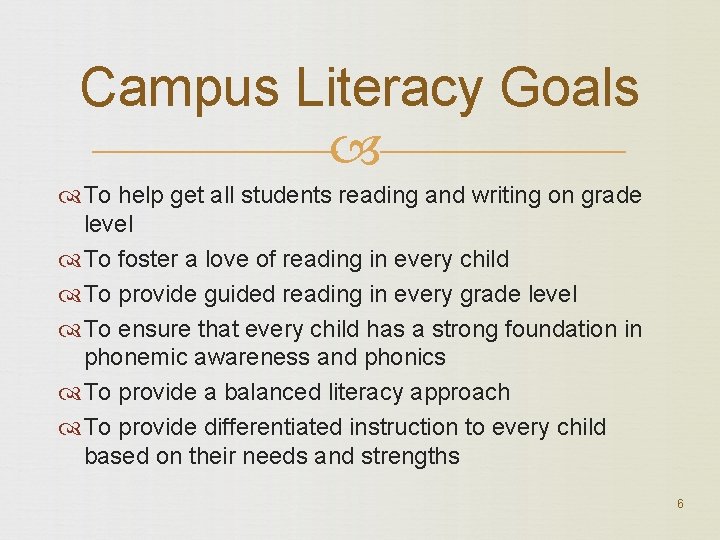
Campus Literacy Goals To help get all students reading and writing on grade level To foster a love of reading in every child To provide guided reading in every grade level To ensure that every child has a strong foundation in phonemic awareness and phonics To provide a balanced literacy approach To provide differentiated instruction to every child based on their needs and strengths 6
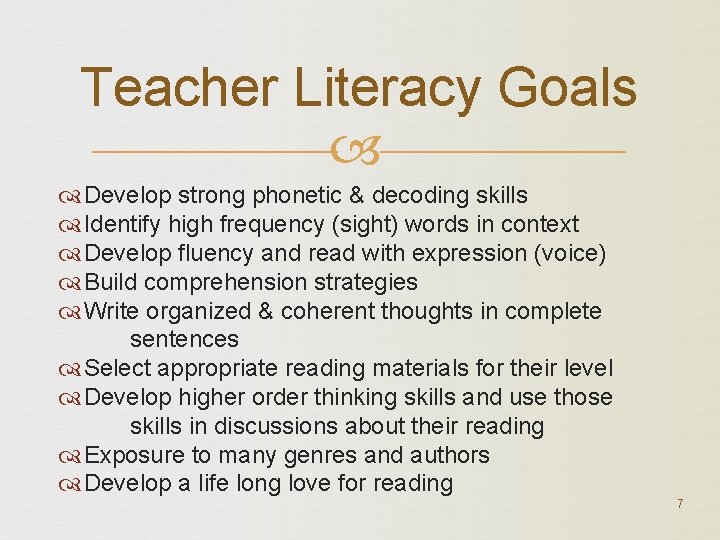
Teacher Literacy Goals Develop strong phonetic & decoding skills Identify high frequency (sight) words in context Develop fluency and read with expression (voice) Build comprehension strategies Write organized & coherent thoughts in complete sentences Select appropriate reading materials for their level Develop higher order thinking skills and use those skills in discussions about their reading Exposure to many genres and authors Develop a life long love for reading 7
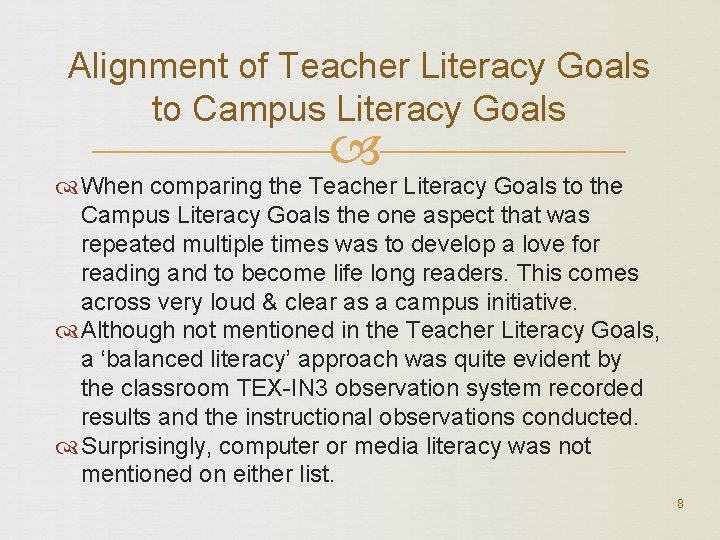
Alignment of Teacher Literacy Goals to Campus Literacy Goals When comparing the Teacher Literacy Goals to the Campus Literacy Goals the one aspect that was repeated multiple times was to develop a love for reading and to become life long readers. This comes across very loud & clear as a campus initiative. Although not mentioned in the Teacher Literacy Goals, a ‘balanced literacy’ approach was quite evident by the classroom TEX-IN 3 observation system recorded results and the instructional observations conducted. Surprisingly, computer or media literacy was not mentioned on either list. 8
Alignment of both Teacher Literacy Goals & Campus Literacy Goals with State & National Standards ALIGNMENT OF LITERACY GOALS – State Goals (Reading TEKS) emphasize: Fluency Vocabulary Development Comprehension of multiple genres and texts Media Literacy 9
Evaluation of Classroom Texts TEX-IN 3 Results In the 1 st grade classroom that we observed there was an overabundance of Extended Text Process Charts, Instructional Aid Charts, Limited Text Process Charts, Organizational/Management Charts, Social/Personal/Inspirational Text Displays, & Student/Teacher Published Work. All were ‘kid friendly’, colorful, and language level appropriate. It seemed almost as though there was no ‘bare’ wall space available and viewing the room could possibly be over stimulating to the viewer. 10
Evaluation of Classroom Texts TEX-IN 3 Results (con’t. ) In comparison, the 4 th grade classroom that we observed, there was more wall space visible with a ‘cleaner’ (more organized) appearance while still having Reading/Writing & Math Process charts. Some examples were Reading Strategies, ‘Things Good Readers Do’; Before, During, and After Reading; Reading Tool Chart, Author’s Craft, Expository Writing Web, Writing Great Hooks, Math Charts: Multiplication, Division, ‘Texas’, Math word wall, & organizational/management charts such as class rules, line-up, and fire evacuation. 11
Evaluation of Classroom Texts TEX-IN 3 Results (con’t. ) In regards to Games/Puzzles/& Manipulatives the 1 st grade classroom was again overabundant with these type of materials. This is age & developmentally appropriate being that children at this stage of development benefit from a ‘hands-on’ learning environment. In contrast, in the 4 th grade classroom there were math manipulatives and ‘Loteria’ – a science game but not near the number of manipulatives offered to students in the 1 st grade classroom. 12
Evaluation of Classroom Texts TEX-IN 3 Results (con’t. ) In the 1 st grade classroom the students had more than ample opportunity to write and express themselves both creatively and in multiple content areas. They had both a Science & Social Studies journal, a writer’s notebook, a ‘My Poetry’ notebook, a ‘Word Work’ notebook, & a Math notebook. In the 4 th grade classroom, the student’s had a Writer’s notebook, Math, Reading, Science, and Social Studies journals in which they took notes and did some lessons. Some assignments were individual work sheets that were collected for grading purposes. 13
Evaluation of Classroom Texts TEX-IN 3 Results (con’t. ) Textbooks for all content areas (Math, Science, Social Studies, Reading, and Language Arts) were available at both grade levels Leveled books were made available at both grade levels for independent reading times and easily accessible and clearly marked for student use. A lot of the tradebooks in both classrooms were teacher bought materials. There were teacher and student computers in both grade level classrooms with software available for instructional student purposes. 14
Evaluation of Classroom Texts TEX-IN 3 Results (con’t. ) The holistic rating for the first grade classroom was ‘Extremely Rich’ however, it could appear that it was over stimulating to the viewer and ‘too busy’ with too many student choices for academic endeavors. The holistic rating for the 4 th grade classroom was ‘Rich’ providing an emphasis on Reading, Writing, and Math activities (STAAR testable content areas) with less emphasis on Science & Social Studies content areas. 15
Interviews Teachers – first grade (1), fourth grade (1) Literacy activities, resources, goals, intervention programs Students – first grade (3), fourth grade (3) (1 each – high, medium, low) Literacy activities and preferences 16
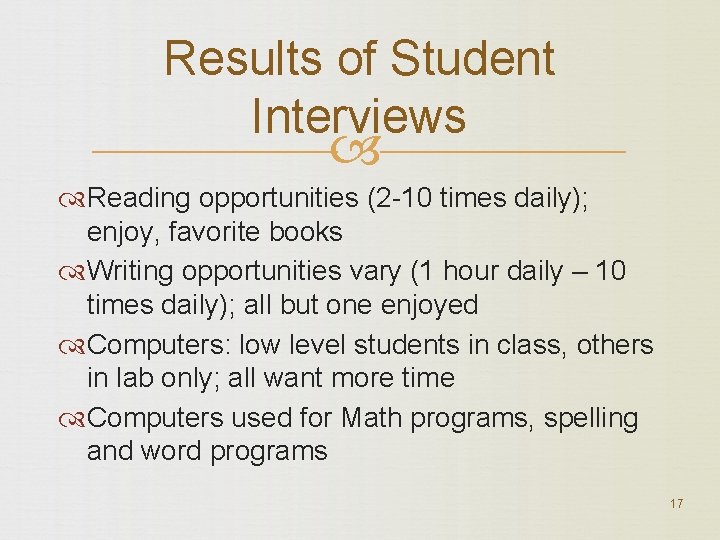
Results of Student Interviews Reading opportunities (2 -10 times daily); enjoy, favorite books Writing opportunities vary (1 hour daily – 10 times daily); all but one enjoyed Computers: low level students in class, others in lab only; all want more time Computers used for Math programs, spelling and word programs 17
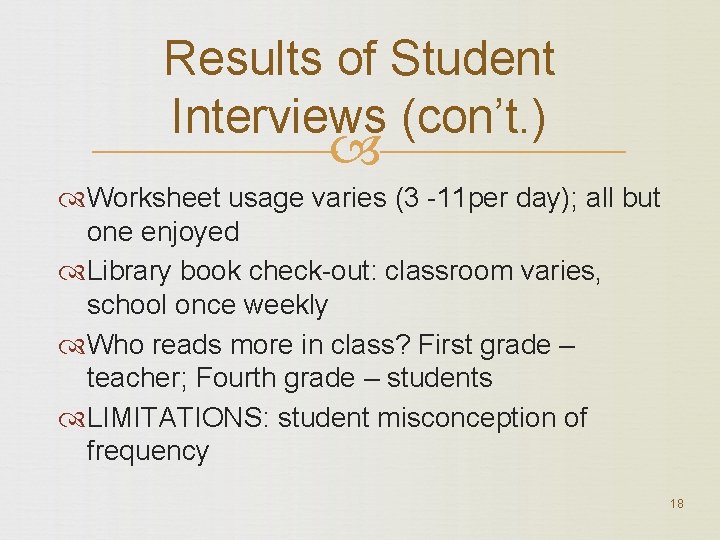
Results of Student Interviews (con’t. ) Worksheet usage varies (3 -11 per day); all but one enjoyed Library book check-out: classroom varies, school once weekly Who reads more in class? First grade – teacher; Fourth grade – students LIMITATIONS: student misconception of frequency 18
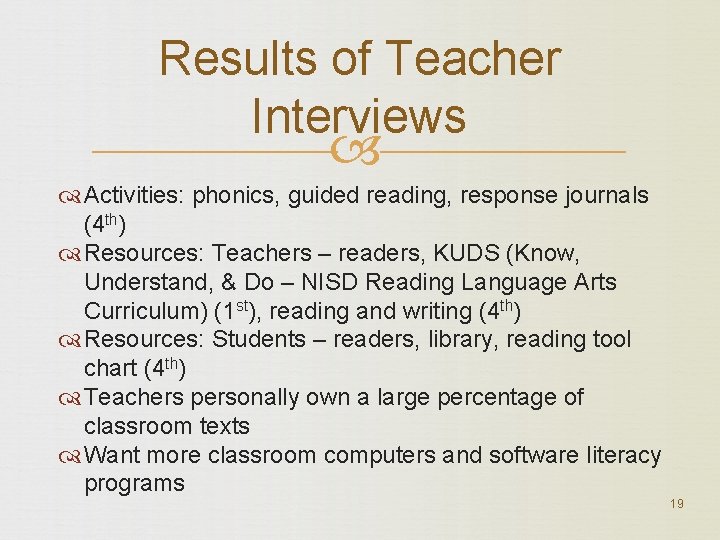
Results of Teacher Interviews Activities: phonics, guided reading, response journals (4 th) Resources: Teachers – readers, KUDS (Know, Understand, & Do – NISD Reading Language Arts Curriculum) (1 st), reading and writing (4 th) Resources: Students – readers, library, reading tool chart (4 th) Teachers personally own a large percentage of classroom texts Want more classroom computers and software literacy programs 19
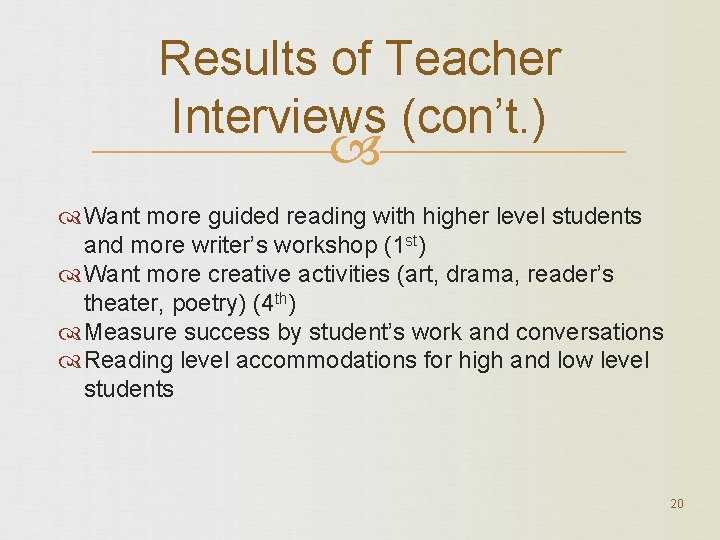
Results of Teacher Interviews (con’t. ) Want more guided reading with higher level students and more writer’s workshop (1 st) Want more creative activities (art, drama, reader’s theater, poetry) (4 th) Measure success by student’s work and conversations Reading level accommodations for high and low level students 20
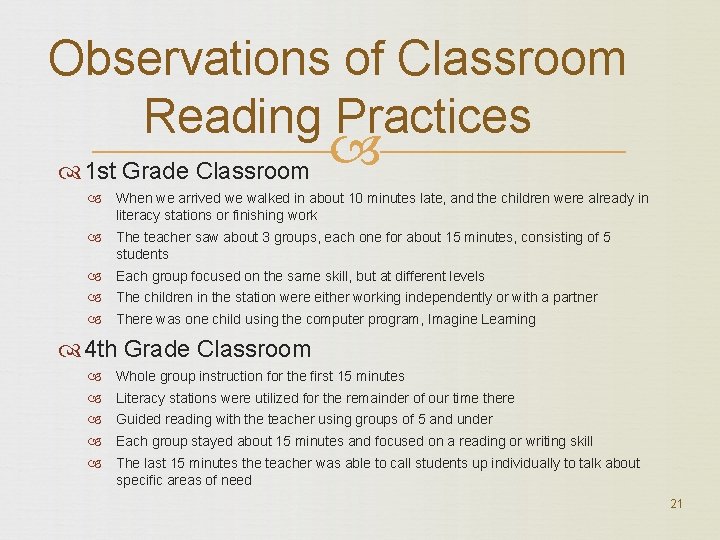
Observations of Classroom Reading Practices 1 st Grade Classroom When we arrived we walked in about 10 minutes late, and the children were already in literacy stations or finishing work The teacher saw about 3 groups, each one for about 15 minutes, consisting of 5 students Each group focused on the same skill, but at different levels The children in the station were either working independently or with a partner There was one child using the computer program, Imagine Learning 4 th Grade Classroom Whole group instruction for the first 15 minutes Literacy stations were utilized for the remainder of our time there Guided reading with the teacher using groups of 5 and under Each group stayed about 15 minutes and focused on a reading or writing skill The last 15 minutes the teacher was able to call students up individually to talk about specific areas of need 21
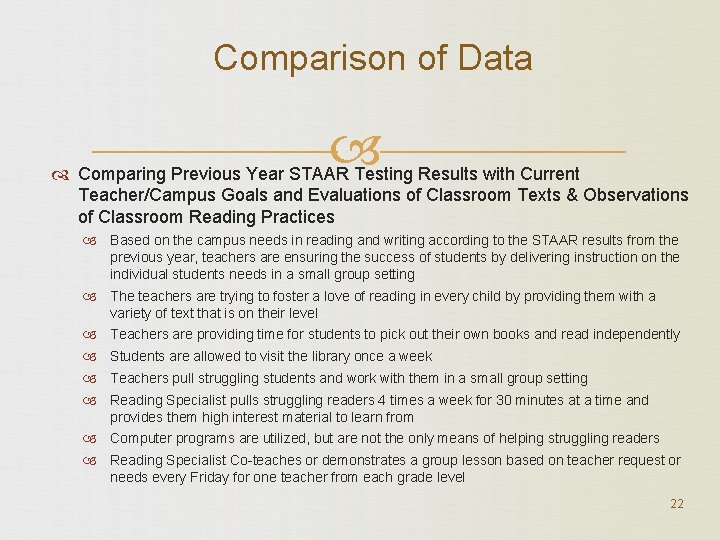
Comparison of Data Comparing Previous Year STAAR Testing Results with Current Teacher/Campus Goals and Evaluations of Classroom Texts & Observations of Classroom Reading Practices Based on the campus needs in reading and writing according to the STAAR results from the previous year, teachers are ensuring the success of students by delivering instruction on the individual students needs in a small group setting The teachers are trying to foster a love of reading in every child by providing them with a variety of text that is on their level Teachers are providing time for students to pick out their own books and read independently Students are allowed to visit the library once a week Teachers pull struggling students and work with them in a small group setting Reading Specialist pulls struggling readers 4 times a week for 30 minutes at a time and provides them high interest material to learn from Computer programs are utilized, but are not the only means of helping struggling readers Reading Specialist Co-teaches or demonstrates a group lesson based on teacher request or needs every Friday for one teacher from each grade level 22
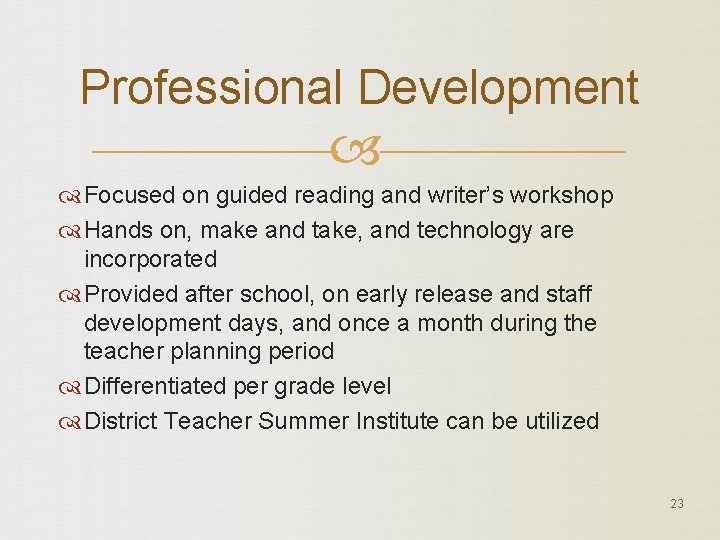
Professional Development Focused on guided reading and writer’s workshop Hands on, make and take, and technology are incorporated Provided after school, on early release and staff development days, and once a month during the teacher planning period Differentiated per grade level District Teacher Summer Institute can be utilized 23
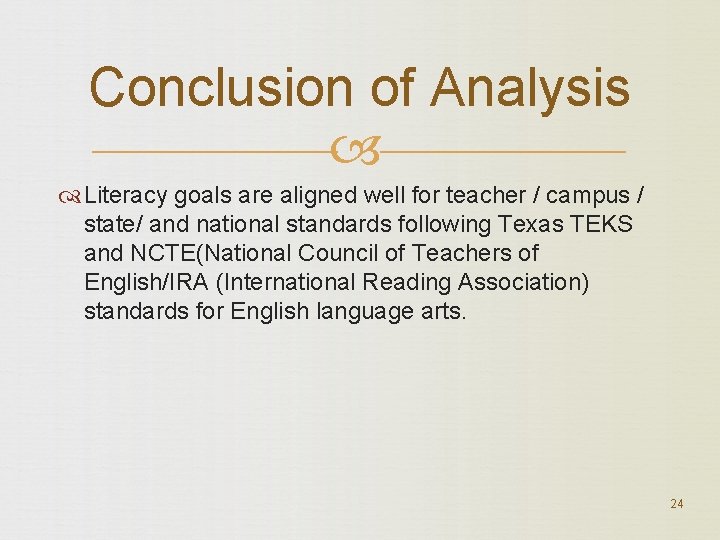
Conclusion of Analysis Literacy goals are aligned well for teacher / campus / state/ and national standards following Texas TEKS and NCTE(National Council of Teachers of English/IRA (International Reading Association) standards for English language arts. 24
Recommendations Professional Development: in-service teaching demonstrations of teacher’s best literacy lessons (i. e. , Response journals for science or math; Reader’s/writer’s workshop); District funding: study feasibility of more student accessible computers per classroom; literacy software; Resource stipend for teachers to fund classroom libraries (more personal choice for students fosters a love of reading; More opportunities for reading/writing connections and interdisciplinary writing. 25
References Allen, J. (2006). Becoming a literacy leader: Supporting Learning and Change. Portland, ME: Stenhouse Publishers. Fountas, I. C. & Pinnell, G. S. (1996). Guided reading: Good first teaching for all children. Portsmouth, NH: Heinemann. Hoffman, J. V. & Sailors, M. (n. d. ). Text Inventory, Text Interview and Texts In-Use Observation System (TEX-IN 3) (Modified) Observation Protocol. The University of Texas at Austin/The University of Texas at San Antonio. Hoffman, J. V. & Sailors, M. (n. d. ). Text Inventory, Text Interview and Texts In-Use Observation System (TEX-IN 3) User’s Guide. The University of Texas at Austin/The University of Texas at San Antonio. Lewison, M. , Leland, C. & Harste, J. (2010). Creating critical classrooms: K-8 reading and writing with an edge. New York, NY: Routledge National Council of Teachers of English. (2013). NCTE / IRA Standards for the English language arts. Retrieved from http: //www. ncte. org/standards/ncte-ira Northside Independent School District website. Retrieved from: http: //nisd. net/schools/scores/2012 -staar-grades-3 -5 Texas Education Agency. (2010). Texas administrative code (TAC), Title 19, Part 2, Chapter 110. Texas Essential Knowledge and Skills for English language arts and reading. Retrieved from http: //ritter. tea. state. tx. us/rules/tac/chapter 110/index. html 26