
Evaluation of a Novel Low Complexity Smart Antenna
- Slides: 1
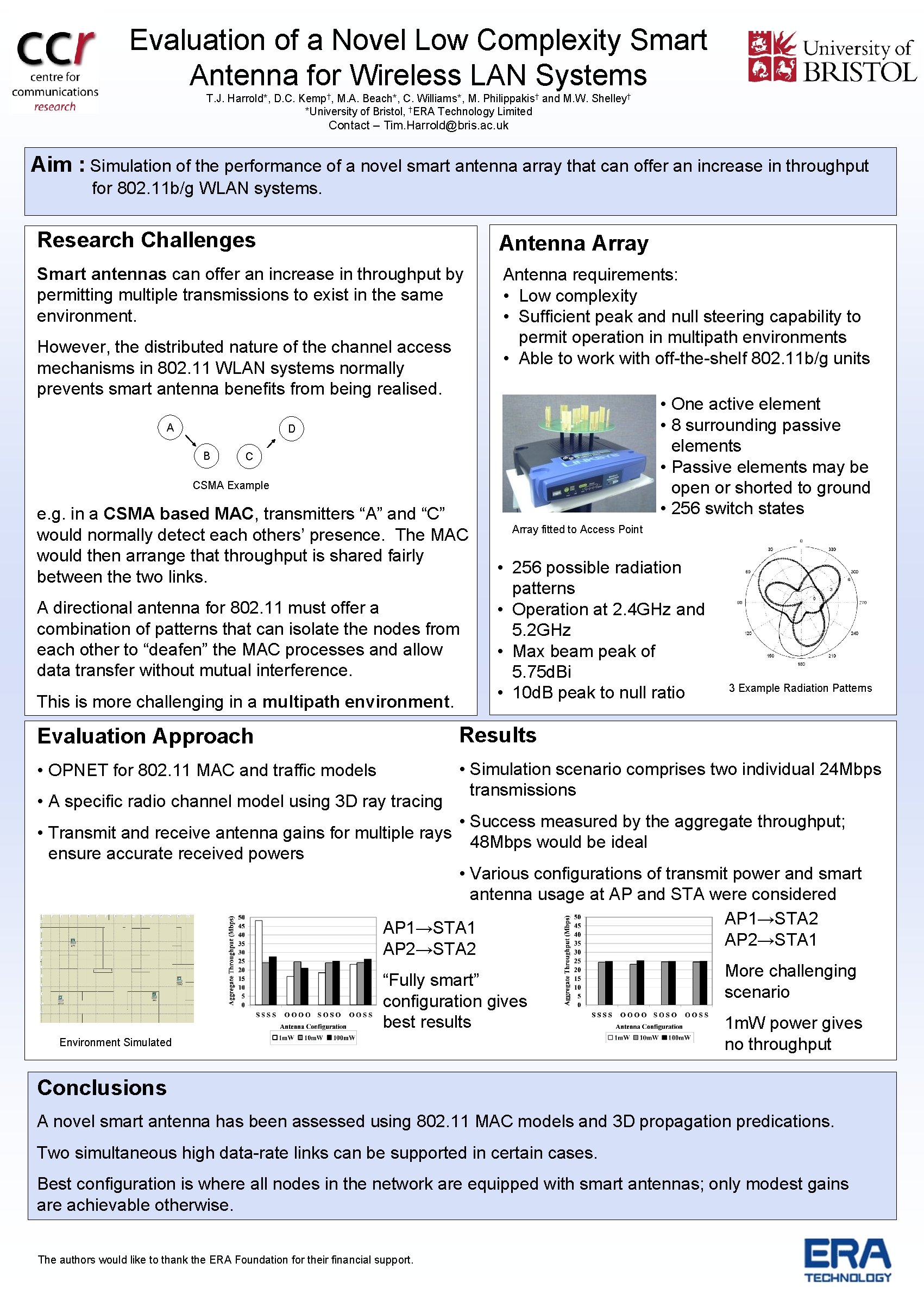
Evaluation of a Novel Low Complexity Smart Antenna for Wireless LAN Systems T. J. Harrold*, D. C. Kemp†, M. A. Beach*, C. Williams*, M. Philippakis† and M. W. Shelley† *University of Bristol, †ERA Technology Limited Contact – Tim. Harrold@bris. ac. uk Aim : Simulation of the performance of a novel smart antenna array that can offer an increase in throughput for 802. 11 b/g WLAN systems. Research Challenges Antenna Array Smart antennas can offer an increase in throughput by permitting multiple transmissions to exist in the same environment. Antenna requirements: • Low complexity • Sufficient peak and null steering capability to permit operation in multipath environments • Able to work with off-the-shelf 802. 11 b/g units However, the distributed nature of the channel access mechanisms in 802. 11 WLAN systems normally prevents smart antenna benefits from being realised. A • One active element • 8 surrounding passive elements • Passive elements may be open or shorted to ground • 256 switch states D B C CSMA Example e. g. in a CSMA based MAC, transmitters “A” and “C” would normally detect each others’ presence. The MAC would then arrange that throughput is shared fairly between the two links. A directional antenna for 802. 11 must offer a combination of patterns that can isolate the nodes from each other to “deafen” the MAC processes and allow data transfer without mutual interference. This is more challenging in a multipath environment. Array fitted to Access Point • 256 possible radiation patterns • Operation at 2. 4 GHz and 5. 2 GHz • Max beam peak of 5. 75 d. Bi • 10 d. B peak to null ratio 3 Example Radiation Patterns Evaluation Approach Results • OPNET for 802. 11 MAC and traffic models • Simulation scenario comprises two individual 24 Mbps transmissions • A specific radio channel model using 3 D ray tracing • Success measured by the aggregate throughput; • Transmit and receive antenna gains for multiple rays 48 Mbps would be ideal ensure accurate received powers • Various configurations of transmit power and smart antenna usage at AP and STA were considered AP 1→STA 2 AP 1→STA 1 AP 2→STA 2 More challenging “Fully smart” scenario configuration gives best results 1 m. W power gives Environment Simulated no throughput Conclusions A novel smart antenna has been assessed using 802. 11 MAC models and 3 D propagation predications. Two simultaneous high data-rate links can be supported in certain cases. Best configuration is where all nodes in the network are equipped with smart antennas; only modest gains are achievable otherwise. The authors would like to thank the ERA Foundation for their financial support.