
Evaluation Meaning Objectives Scope Principles Functions Methods of
Evaluation – Meaning – Objectives – Scope – Principles – Functions & – Methods of Project Evaluation. – Types (internal / external) of Evaluation. – A guideline for evaluating Projects.
Meaning of Evaluation has its origin in the Latin word “Valupure” which means the value of a particular thing, idea or action. Evaluation, Thus, helps us to understand the worth, quality, significance amount, – degree or condition of any intervention desired to tackle a social problem. Meaning of evaluation: – Evaluation means finding out the value of something. – Evaluation simply refers to the procedures of fact finding • Evaluation consists of assessments whether or not certain activities, treatment interventions are in conformity with generally accepted professional standards.
– Any information obtained by any means on either the conduct or the outcome of interventions, treatment or of social change projects is considered to be evaluation. Evaluation is designated to provide systematic, reliable and valid information on the conduct, impact and effectiveness of the projects. – Evaluation is essentially the study and review of past operating experience.
Purpose of Evaluation – From an accountability perspective: – The purpose of evaluation is to make the best possible use of funds by the program managers who are accountable for the worth of their programs. – Measuring accomplishment in order to avoid weaknesses and future mistakes. – -Observing the efficiency of the techniques and skills employed – -Scope for modification and improvement. – -Verifying whether the benefits reached the people for whom the program was meant. – Form a knowledge perspective: – The purpose of evaluation is to establish new knowledge about social problems and the effectiveness of policies and programs designed to alleviate them. – Understanding people’s participation & reasons for the same. – Evaluation helps to make plans for future work.
Principles of Evaluation The following are some of the principles, which should be kept in view in evaluation. 1. Evaluation is a continuous process (continuity). 2. Evaluation should involve minimum possible costs (inexpensive). 3. Evaluation should be done without prejudice to day work (minimum hindrance to day work). 4. Evaluation must be done on a co-operative basis in which the entire staff and the board members should participate (total participation). 5. As far as possible, the agency should itself evaluate its program but occasionally outside evaluation machinery should also be made use of (external evaluation). 6. Total overall examination of the agency will reveal strength and weaknesses. (agency / program totality). 7. The result of evaluation should be shared with workers of the agency (sharing).
Stages in Evaluation. 1. Program Planning Stage. Pre – investment evaluation or Formative evaluation or Ex – ante evaluation or Early / Formulation Pre project evaluation or Exploratory evaluation or Need assessment. 2. Program Monitoring Stage. Monitoring Evaluation or Ongoing / interim. Concurrent evaluation 3. Program completion Stage. Impact evaluation or Ex- post evaluation or (Summative / Terminal / Final) Final evaluation.

Types of Evaluation – Evaluation can be categorized under different headings – A) By timing (when to evaluate) 1)Formative Evaluation – Done during the program -Development stages – (Process Evaluation, ex-ante evaluation, project appraisals) 2)Summative Evaluation – Taken up when the program achieves a stable of operation or when it is terminated – (Outcome evaluation, ex post evaluation etc. )
B) By Agency. Who is evaluating? Internal Evaluation External Evaluation It is a progress / impact Unbiased, objective detailed Monitoring by the management it self assessment by an outsider (Ongoing / concurrent evaluation) C) By Stages On going Terminal Ex – post During the implementation At the end of After a time lag of a project or immediately from completion after the completion of a project
Methods of Evaluation: (Tools / techniques) • Over the years, a variety of the methodologies have been evolved by academicians, practitioners and professionals for evaluating any program / project. Some of the commonly used practices are given below. 1)First hand Information : • One of the simplest and easiest methods of evaluation by getting first hand information about the progress, performance, problem areas etc, . of a project from a host of staff, line officers, field personnel, other specialists and public who directly associated with the project. Direct observation & hearing about the performance and pitfalls further facilitate the chances of an effective evaluation. 2)Formal / Informal Periodic Reports.
a)Formal Reports: • Evaluation is also carried out through formal and informal reports. • Formal reports consists of Project Status Report Project Schedule chart Project financial status Report. • Project Status Report: • From this one can understand the current status, performance, schedule, cost and hold ups, deviations from the original schedule.
Project Schedule Chart: – This indicates the time schedule for implementation of the project. From this one can understand any delay, the cost of delay and the ultimate loss. Project Financial Status Report: – It is through financial report, one can have a look at a glance whether the project is being implemented within the realistic budget and time. b)Informal Reports: – Informal reports such as anonymous letters, press reports, complaints by beneficiaries & petitions sometimes reveal the true nature of the project even though these reports are biased and contains maligned information. 3)Graphic presentations:
Graphic presentations through display of Charts, Graphs, Pictures, Illustrations etc. in the project office is yet another instrument for a close evaluation. 4)Standing Evaluation Review Committees: Some of the organizations have setup standing committees, consisting of a host of experts and specialists who meet regularly at frequent intervals to discuss about problems and to suggest remedial measures. 5)Project Profiles: • Preparation of the project profiles by the investigating teams on the basis of standardized guidelines and models developed for the purpose, is also another method of evaluation
Views about evaluation – Evaluation primarily perceived from three perspectives. – 1)Evaluation as an analysis – determining the merits or deficiencies of a program, methods and process. – 2)Evaluation as an audit – systematic and continuous enquiry to measure the efficiency of means to reach their particular preconceived ends. – 3)In the agency context – Evaluation of administration means appraisal or judgement of the worth and effectiveness of all the processes (e. g. Planning, organizing, staffing etc. ) designed to ensure the agency to accomplish its objectives.
Areas of evaluation: – Evaluation may be split into various aspects, so that each area of the work of the agency, or of its particular project is evaluated. These may be, – 1. Purpose 2. Programs 3. Staff 4. Financial Administration 5. General. – Purpose: – The review the objectives of the agency / project and how far these are being fulfilled. – Programs: – Aspects like number of beneficiaries, nature of services rendered to them, their reaction to the services, effectiveness and adequacy of services etc. may be evaluated. – Staff: – The success of any welfare program / agency depends upon the type of the staff an agency employs. Their attitude, qualifications, recruitment policy, pay and other benefits and organizational environment. These are the areas which help to understand the effectiveness of the project / agency.
Financial Administration: – The flow of resources and its consumption is a crucial factor in any project / agency. Whether the project money is rightly consumed any over spending in some headings, appropriation and misappropriation. These are some of the indicators that reveal the reasons for the success or failures of any project. General: – Factors like public relations strategies employed by the project / agency, the constitution of the agency board or project advisory committee and their contribution future plans of the agency are important to understand the success or failures of any project.

Summary
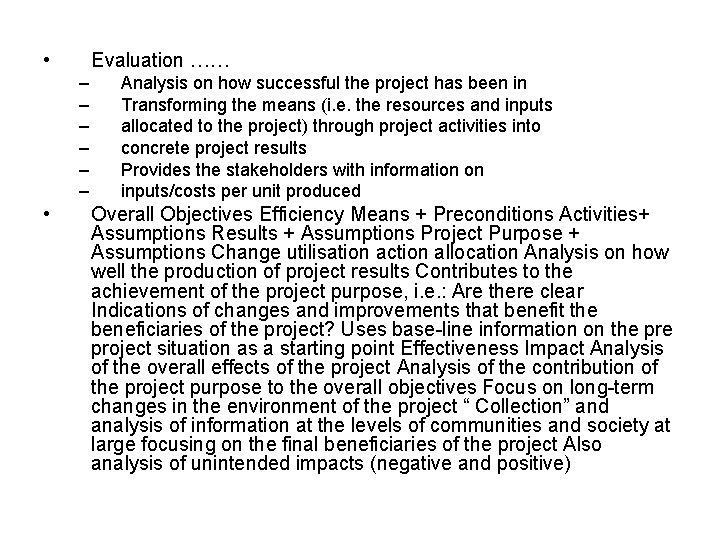
• Evaluation …… – – – • Analysis on how successful the project has been in Transforming the means (i. e. the resources and inputs allocated to the project) through project activities into concrete project results Provides the stakeholders with information on inputs/costs per unit produced Overall Objectives Efficiency Means + Preconditions Activities+ Assumptions Results + Assumptions Project Purpose + Assumptions Change utilisation action allocation Analysis on how well the production of project results Contributes to the achievement of the project purpose, i. e. : Are there clear Indications of changes and improvements that benefit the beneficiaries of the project? Uses base-line information on the project situation as a starting point Effectiveness Impact Analysis of the overall effects of the project Analysis of the contribution of the project purpose to the overall objectives Focus on long-term changes in the environment of the project “ Collection” and analysis of information at the levels of communities and society at large focusing on the final beneficiaries of the project Also analysis of unintended impacts (negative and positive)

Criteria for Evaluating Development Assistance – – – Relevance = The extent to which the aid intervention is suited to the priorities and policies of the target group, partner country and donor Possible questions: To what extent are the objectives of the program still valid? Are the activities and outputs of the program consistent with the overall goal and the attainment of its objectives? Are the activities and outputs of the program
– – – – consistent with the intended impacts and effects? Efficiency measures the outputs – qualitative and quantitative – in relation to the inputs. It is a term which signifies that the aid uses the Least costly resources in order to achieve the Desired results. This generally requires Comparing alternative approaches to achieving the same outputs, to see whether the most efficient process has been adopted Possible questions: Were the activities cost-efficient? Were objectives achieved on time? What were the major factors influencing the Achievement of the results?
• Effectiveness = A measure of the extent to which an aid intervention attains its objectives Possible questions: To what extent were the objectives achieved/are likely to be achieved? What were the major factors influencing the achievement or non-achievement of the objectives? Impact = The positive and negative changes produced by an intervention, directly or indirectly, intended or unintended. Possible questions: What has happened as a result of the programme or project? What real difference has the activity made to the beneficiaries? How many people have been affected? Sustainability = Sustainability is concerned with measuring whether the benefits of an activity are likely to continue after donor funding has been withdrawn. Possible questions: To what extent did the benefits of a programme or project continue after donor funding ceased? What were the major factors which influenced the achievement or nonachievement of sustainability
- Slides: 21