
Evaluation Controlled Experiments What is experimental design What
- Slides: 56
Evaluation - Controlled Experiments • • • What is experimental design? What is an experimental hypothesis? How do I plan an experiment? Why are statistics used? What are the important statistical methods? Slide deck by Saul Greenberg. Permission is granted to use this for non-commercial purposes as long as general credit to Saul Greenberg is clearly maintained. Warning: some material in this deck is used from other sources without permission. Credit to the original source is given if it is known.
Quantitative evaluation of systems Quantitative: – precise measurement, numerical values – bounds on how correct our statements are Methods – user performance data collection – controlled experiments
Collecting user performance data Data collected on system use (often lots of data) Exploratory: – hope something interesting shows up – but difficult to analyze Targeted – look for specific information, but may miss something • frequency of request for on-line assistance – what did people ask for help with? • frequency of use of different parts of the system – why are parts of system unused? • number of errors and where they occurred – why does an error occur repeatedly? • time it takes to complete some operation – what tasks take longer than expected?
Controlled experiments Traditional scientific method Reductionist – clear convincing result on specific issues In HCI: – insights into cognitive process, human performance limitations, . . . – allows system comparison, fine-tuning of details. . .
Controlled experiments Strives for lucid and testable hypothesis quantitative measurement measure of confidence in results obtained (statistics) replicability of experiment control of variables and conditions removal of experimenter bias
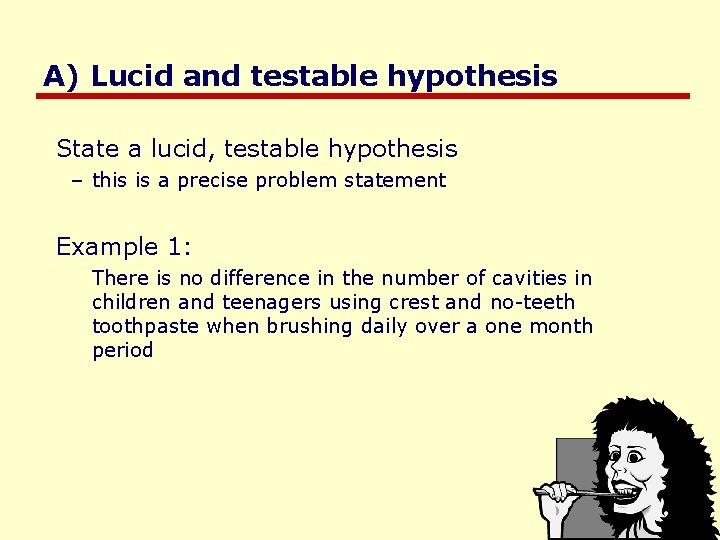
A) Lucid and testable hypothesis State a lucid, testable hypothesis – this is a precise problem statement Example 1: There is no difference in the number of cavities in children and teenagers using crest and no-teeth toothpaste when brushing daily over a one month period
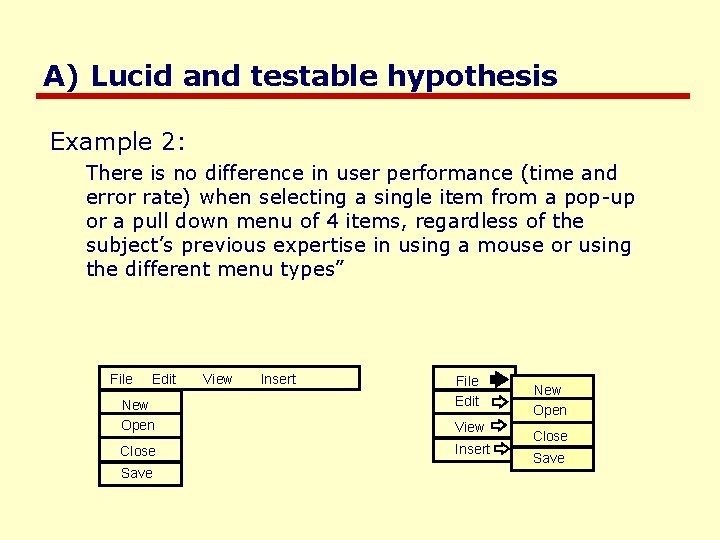
A) Lucid and testable hypothesis Example 2: There is no difference in user performance (time and error rate) when selecting a single item from a pop-up or a pull down menu of 4 items, regardless of the subject’s previous expertise in using a mouse or using the different menu types” File Edit View Insert File Edit New Open View Close Insert Save New Open Close Save
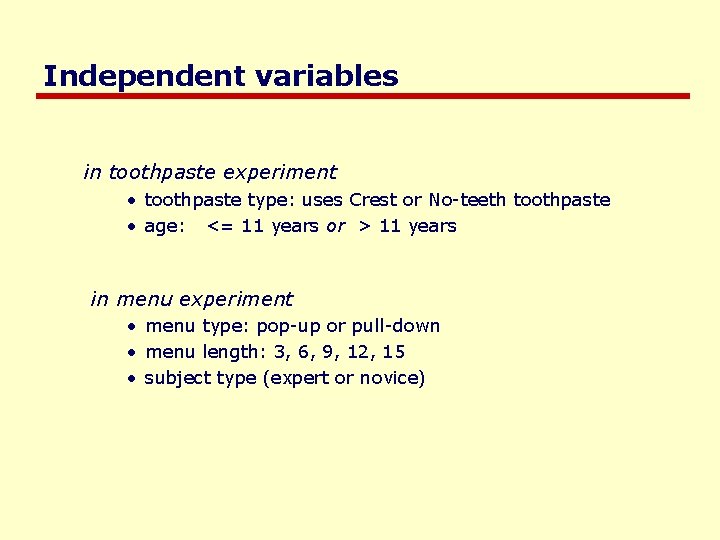
Independent variables b) Hypothesis includes the independent variables that are to be altered – the things you manipulate independent of a subject’s behaviour – determines a modification to the conditions the subjects undergo – may arise from subjects being classified into different groups
Independent variables in toothpaste experiment • toothpaste type: uses Crest or No-teeth toothpaste • age: <= 11 years or > 11 years in menu experiment • menu type: pop-up or pull-down • menu length: 3, 6, 9, 12, 15 • subject type (expert or novice)
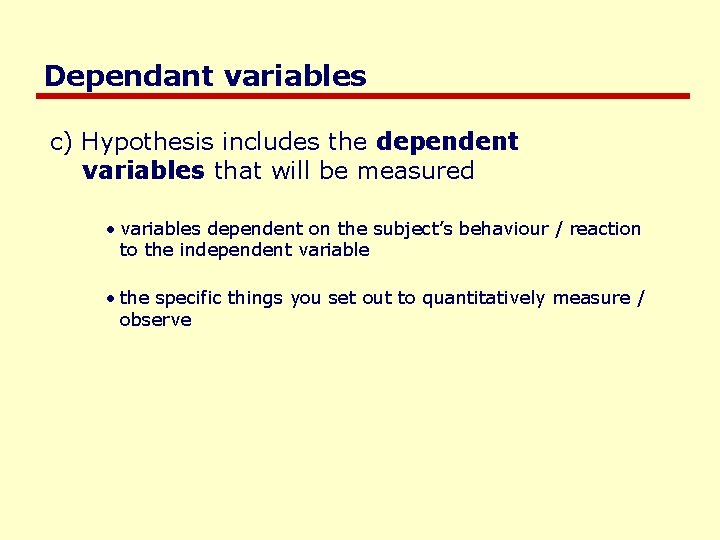
Dependant variables c) Hypothesis includes the dependent variables that will be measured • variables dependent on the subject’s behaviour / reaction to the independent variable • the specific things you set out to quantitatively measure / observe
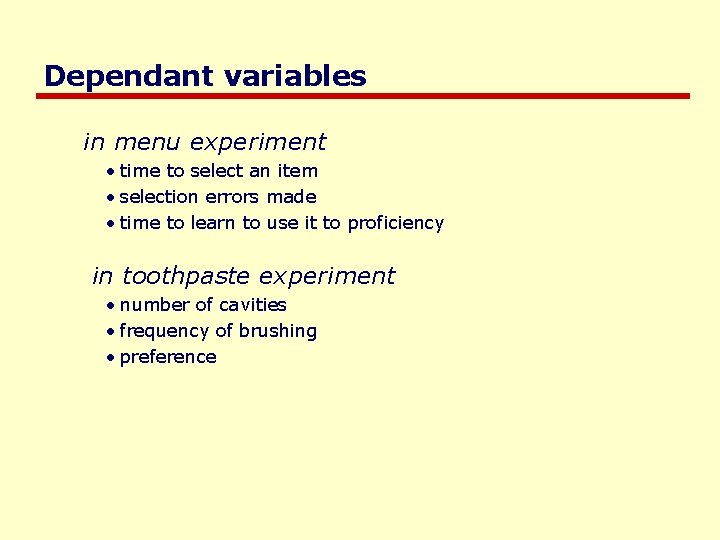
Dependant variables in menu experiment • time to select an item • selection errors made • time to learn to use it to proficiency in toothpaste experiment • number of cavities • frequency of brushing • preference
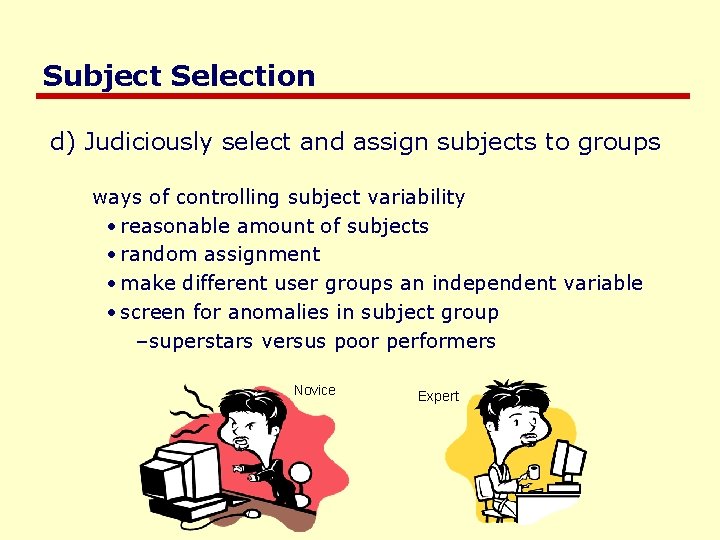
Subject Selection d) Judiciously select and assign subjects to groups ways of controlling subject variability • reasonable amount of subjects • random assignment • make different user groups an independent variable • screen for anomalies in subject group – superstars versus poor performers Novice Expert
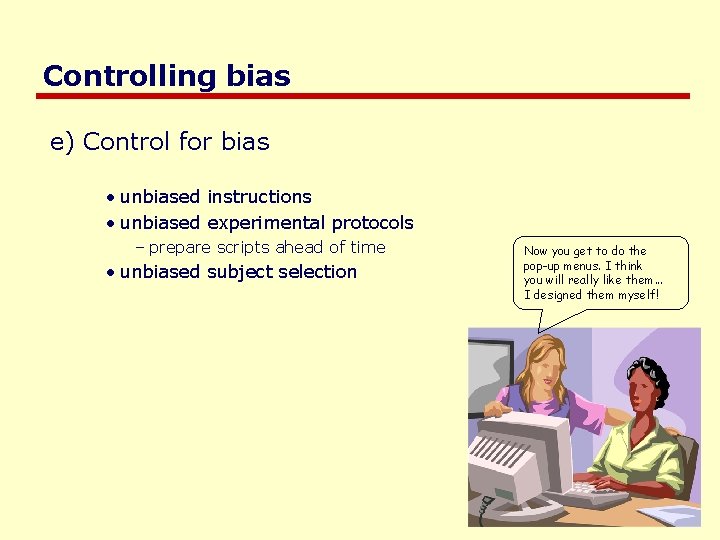
Controlling bias e) Control for bias • unbiased instructions • unbiased experimental protocols – prepare scripts ahead of time • unbiased subject selection Now you get to do the pop-up menus. I think you will really like them. . . I designed them myself!
Statistical analysis f) Apply statistical methods to data analysis – confidence limits: • the confidence that your conclusion is correct • “the hypothesis that computer experience makes no difference is rejected at the. 05 level” means: – a 95% chance that your statement is correct – a 5% chance you are wrong
Interpretation g) Interpret your results – – – what you believe the results really mean their implications to your research their implications to practitioners how generalizable they are limitations and critique
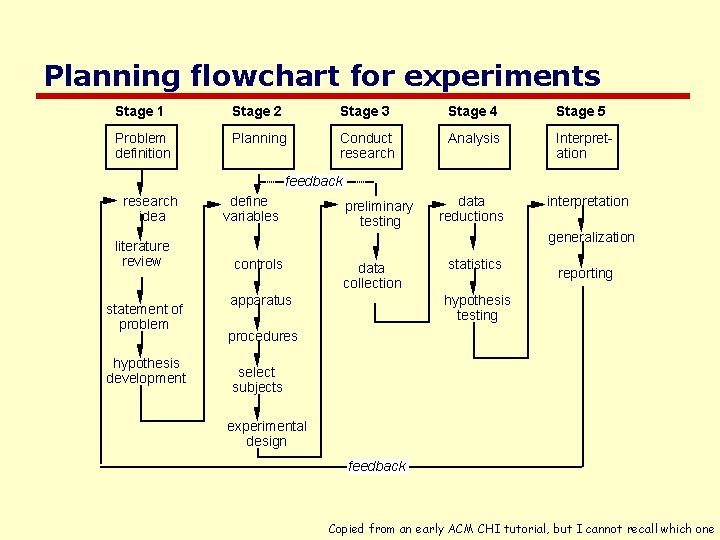
Planning flowchart for experiments Stage 1 Stage 2 Stage 3 Stage 4 Stage 5 Problem definition Planning Conduct research Analysis Interpretation data reductions interpretation feedback research idea literature review statement of problem hypothesis development define variables preliminary testing generalization controls data collection apparatus statistics reporting hypothesis testing procedures select subjects experimental design feedback Copied from an early ACM CHI tutorial, but I cannot recall which one
Statistical analysis Calculations that tell us – mathematical attributes about our data sets • mean, amount of variance, . . . – how data sets relate to each other • whether we are “sampling” from the same or different distributions – the probability that our claims are correct • “statistical significance”
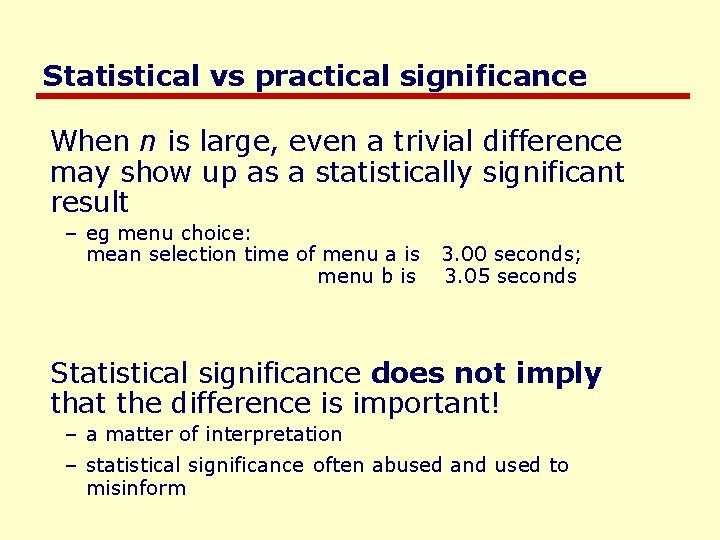
Statistical vs practical significance When n is large, even a trivial difference may show up as a statistically significant result – eg menu choice: mean selection time of menu a is menu b is 3. 00 seconds; 3. 05 seconds Statistical significance does not imply that the difference is important! – a matter of interpretation – statistical significance often abused and used to misinform
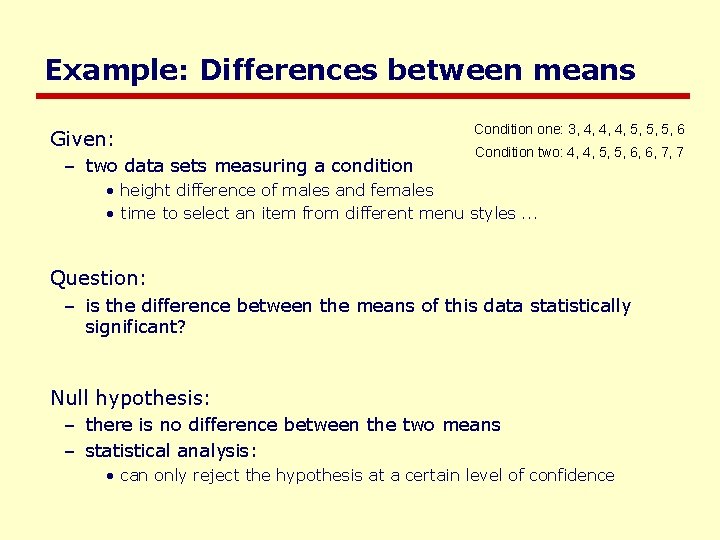
Example: Differences between means Given: – two data sets measuring a condition Condition one: 3, 4, 4, 4, 5, 5, 5, 6 Condition two: 4, 4, 5, 5, 6, 6, 7, 7 • height difference of males and females • time to select an item from different menu styles. . . Question: – is the difference between the means of this data statistically significant? Null hypothesis: – there is no difference between the two means – statistical analysis: • can only reject the hypothesis at a certain level of confidence
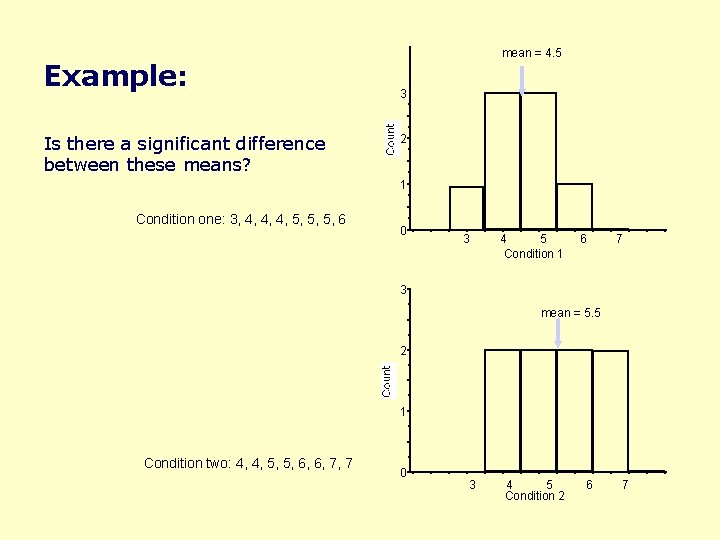
Example: Is there a significant difference between these means? mean = 4. 5 3 2 1 Condition one: 3, 4, 4, 4, 5, 5, 5, 6 0 3 4 5 Condition 1 6 7 3 mean = 5. 5 2 1 Condition two: 4, 4, 5, 5, 6, 6, 7, 7 0 3 4 5 Condition 2 6 7
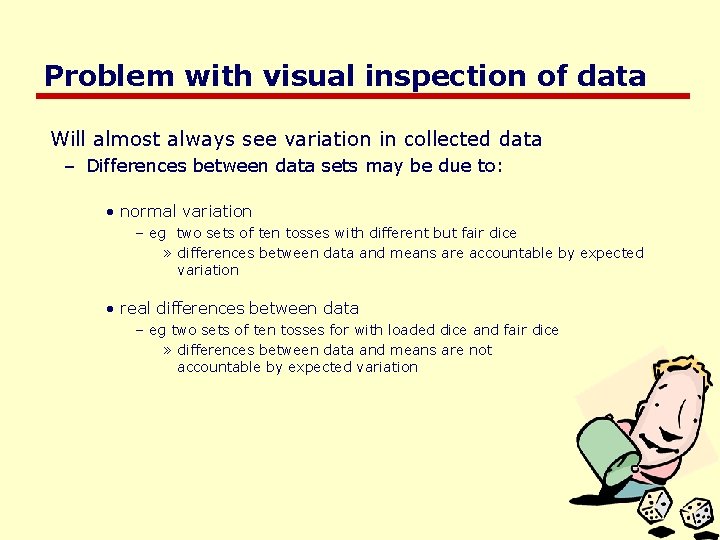
Problem with visual inspection of data Will almost always see variation in collected data – Differences between data sets may be due to: • normal variation – eg two sets of ten tosses with different but fair dice » differences between data and means are accountable by expected variation • real differences between data – eg two sets of ten tosses for with loaded dice and fair dice » differences between data and means are not accountable by expected variation
T-test A simple statistical test – allows one to say something about differences between means at a certain confidence level Null hypothesis of the T-test: – no difference exists between the means of two sets of collected data possible results: – I am 95% sure that null hypothesis is rejected • (there is probably a true difference between the means) – I cannot reject the null hypothesis • the means are likely the same
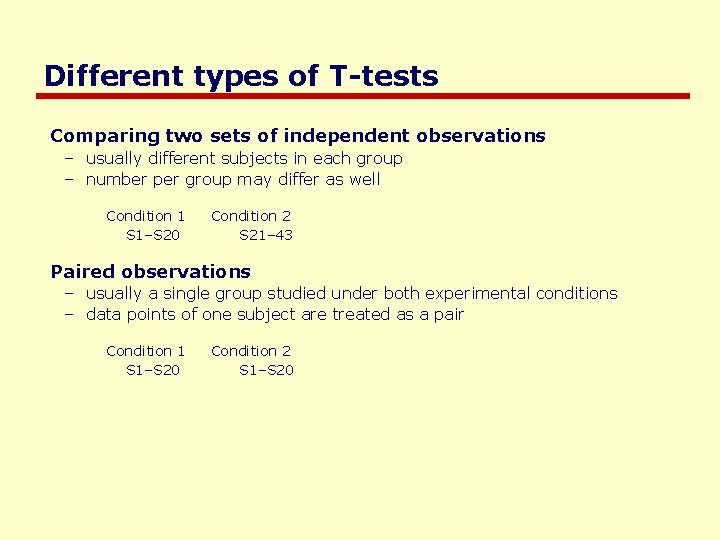
Different types of T-tests Comparing two sets of independent observations – usually different subjects in each group – number per group may differ as well Condition 1 S 1–S 20 Condition 2 S 21– 43 Paired observations – usually a single group studied under both experimental conditions – data points of one subject are treated as a pair Condition 1 S 1–S 20 Condition 2 S 1–S 20
Different types of T-tests Non-directional vs directional alternatives – non-directional (two-tailed) • no expectation that the direction of difference matters – directional (one-tailed) • Only interested if the mean of a given condition is greater than the other
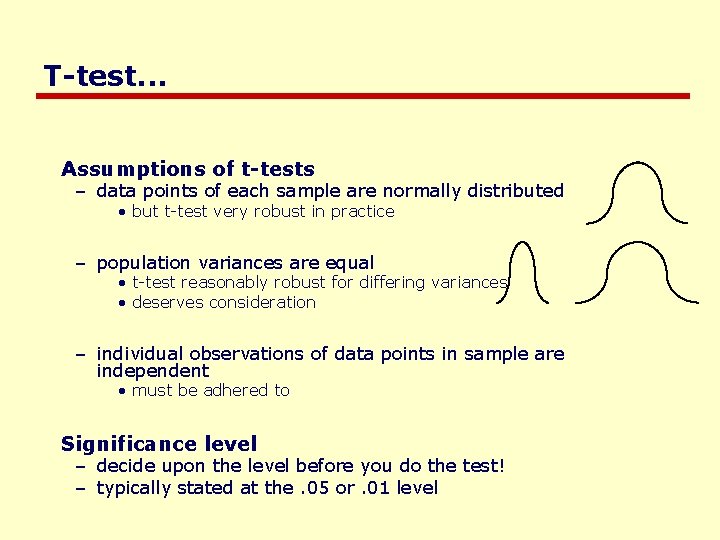
T-test. . . Assumptions of t-tests – data points of each sample are normally distributed • but t-test very robust in practice – population variances are equal • t-test reasonably robust for differing variances • deserves consideration – individual observations of data points in sample are independent • must be adhered to Significance level – decide upon the level before you do the test! – typically stated at the. 05 or. 01 level
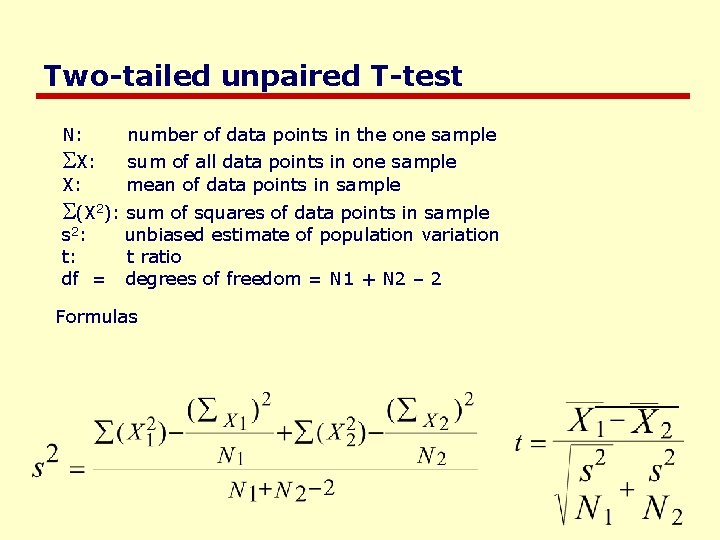
Two-tailed unpaired T-test N: number of data points in the one sample X: sum of all data points in one sample mean of data points in sample s 2: t: df = unbiased estimate of population variation t ratio degrees of freedom = N 1 + N 2 – 2 SX: S(X 2): sum of squares of data points in sample Formulas
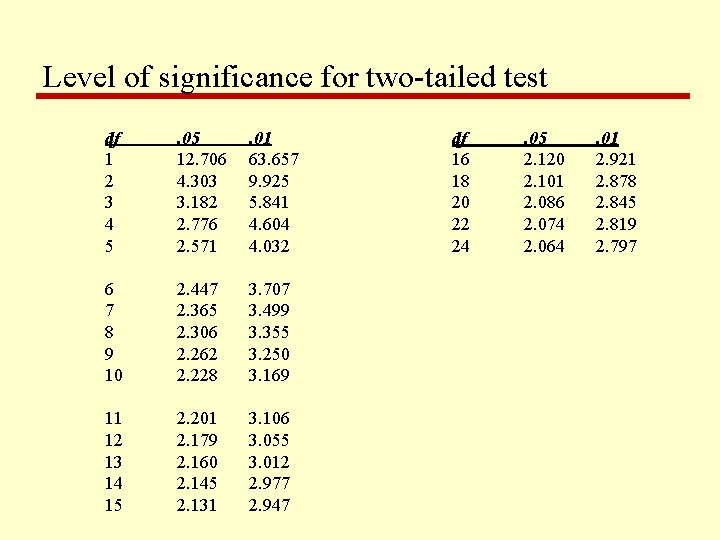
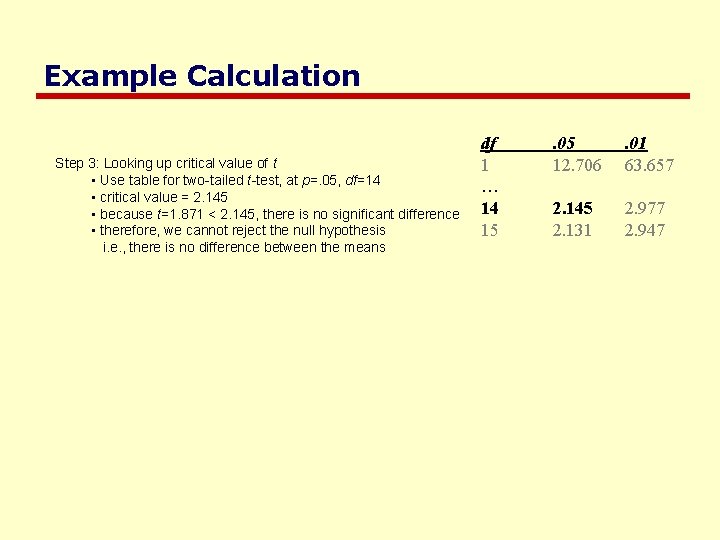
Level of significance for two-tailed test df 1 2 3 4 5 . 05 12. 706 4. 303 3. 182 2. 776 2. 571 . 01 63. 657 9. 925 5. 841 4. 604 4. 032 6 7 8 9 10 2. 447 2. 365 2. 306 2. 262 2. 228 3. 707 3. 499 3. 355 3. 250 3. 169 11 12 13 14 15 2. 201 2. 179 2. 160 2. 145 2. 131 3. 106 3. 055 3. 012 2. 977 2. 947 df 16 18 20 22 24 . 05 2. 120 2. 101 2. 086 2. 074 2. 064 . 01 2. 921 2. 878 2. 845 2. 819 2. 797
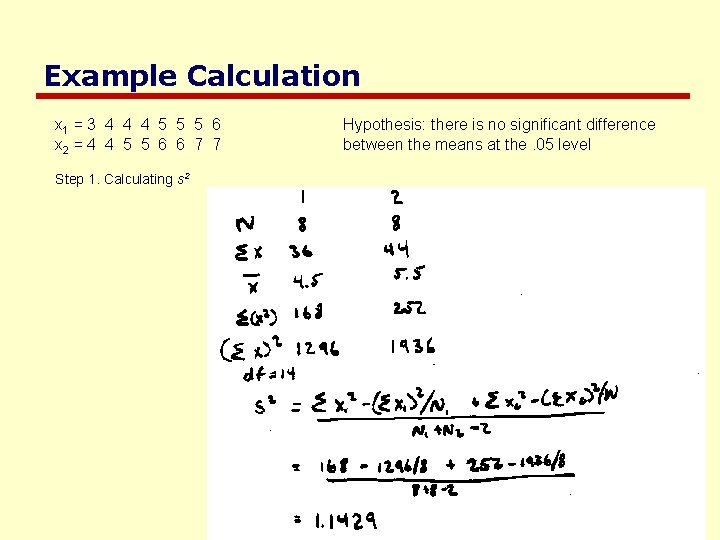
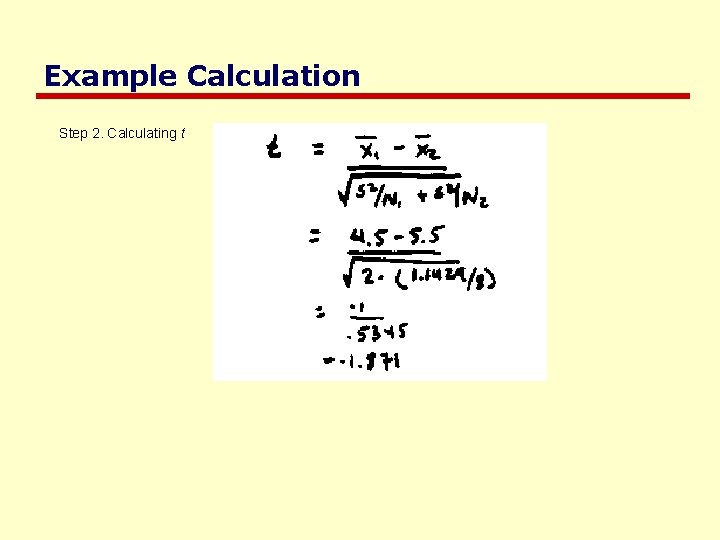
Example Calculation x 1 = 3 4 4 4 5 5 5 6 x 2 = 4 4 5 5 6 6 7 7 Step 1. Calculating s 2 Hypothesis: there is no significant difference between the means at the. 05 level
Example Calculation Step 2. Calculating t
Example Calculation Step 3: Looking up critical value of t • Use table for two-tailed t-test, at p=. 05, df=14 • critical value = 2. 145 • because t=1. 871 < 2. 145, there is no significant difference • therefore, we cannot reject the null hypothesis i. e. , there is no difference between the means df 1 … 14 15 . 05 12. 706 . 01 63. 657 2. 145 2. 131 2. 977 2. 947
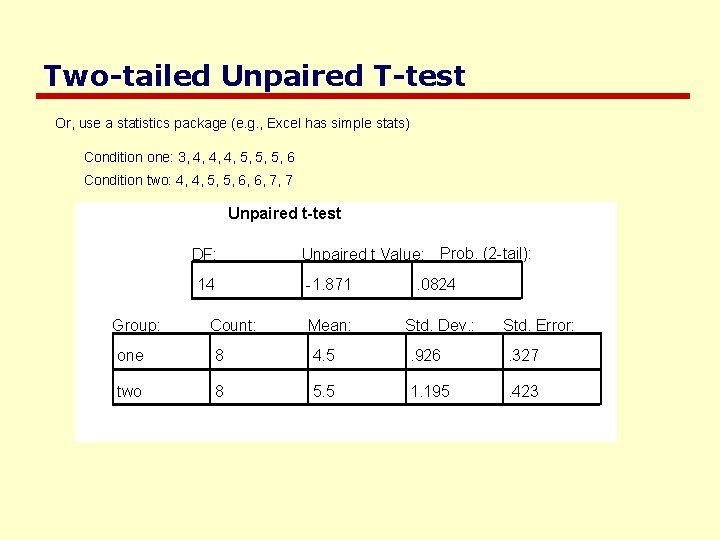
Two-tailed Unpaired T-test Or, use a statistics package (e. g. , Excel has simple stats) Condition one: 3, 4, 4, 4, 5, 5, 5, 6 Condition two: 4, 4, 5, 5, 6, 6, 7, 7 Unpaired t-test DF: 14 Group: Count: Unpaired t Value: Prob. (2 -tail): -1. 871 . 0824 Mean: Std. Dev. : Std. Error: one 8 4. 5 . 926 . 327 two 8 5. 5 1. 195 . 423
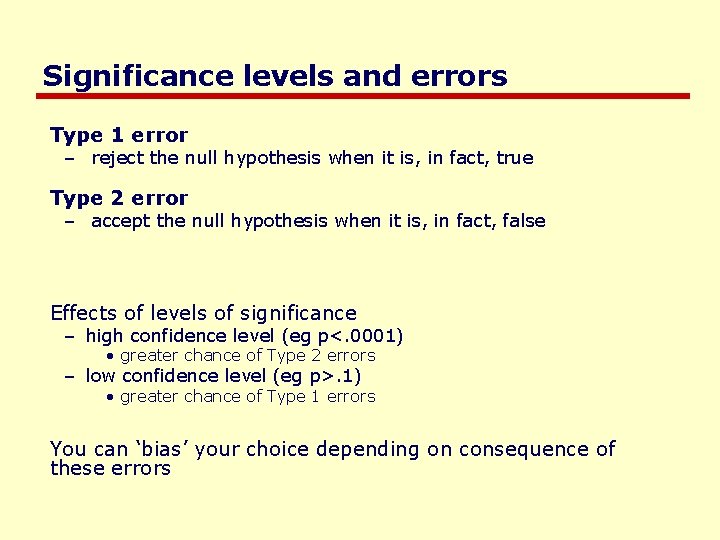
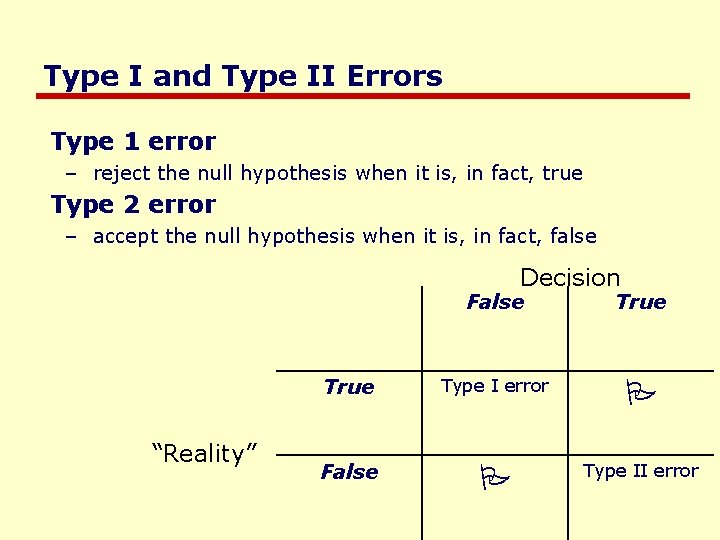
Significance levels and errors Type 1 error – reject the null hypothesis when it is, in fact, true Type 2 error – accept the null hypothesis when it is, in fact, false Effects of levels of significance – high confidence level (eg p<. 0001) • greater chance of Type 2 errors – low confidence level (eg p>. 1) • greater chance of Type 1 errors You can ‘bias’ your choice depending on consequence of these errors
Type I and Type II Errors Type 1 error – reject the null hypothesis when it is, in fact, true Type 2 error – accept the null hypothesis when it is, in fact, false Decision “Reality” False True Type I error False Type II error
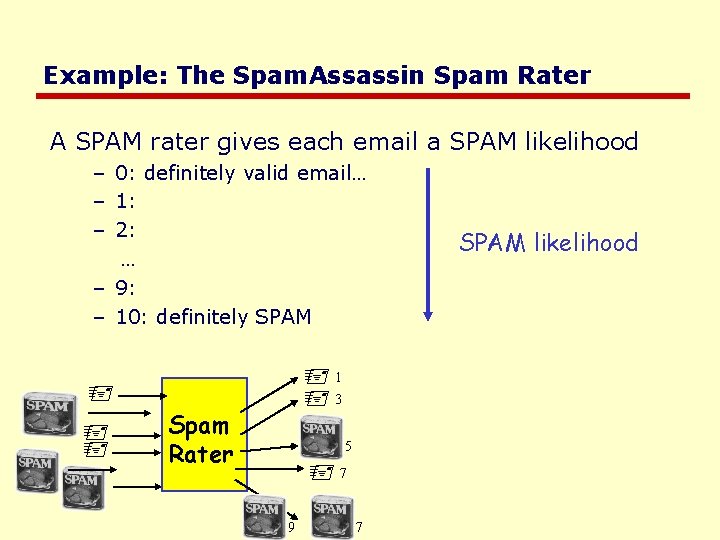
Example: The Spam. Assassin Spam Rater A SPAM rater gives each email a SPAM likelihood – 0: definitely valid email… – 1: – 2: … – 9: – 10: definitely SPAM 1 3 Spam Rater 5 7 9 7 SPAM likelihood
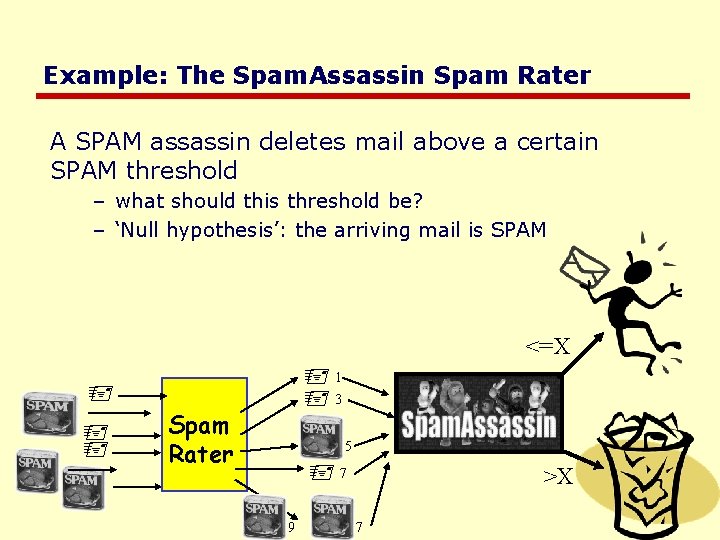
Example: The Spam. Assassin Spam Rater A SPAM assassin deletes mail above a certain SPAM threshold – what should this threshold be? – ‘Null hypothesis’: the arriving mail is SPAM <=X 1 3 Spam Rater 5 7 9 >X 7
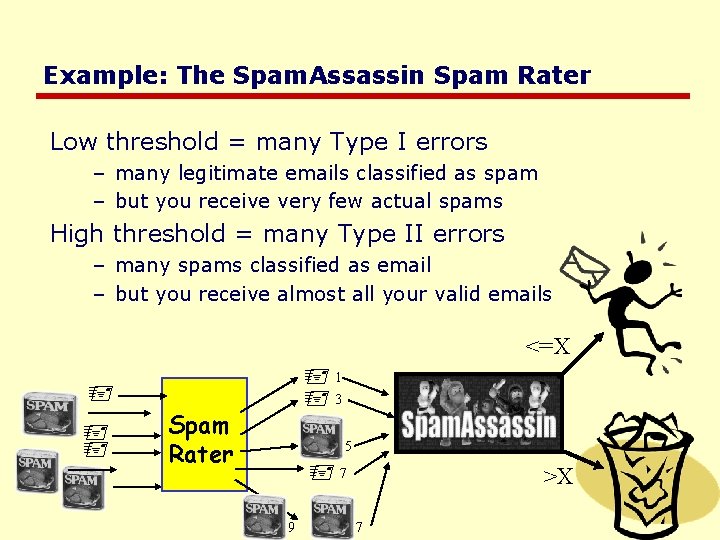
Example: The Spam. Assassin Spam Rater Low threshold = many Type I errors – many legitimate emails classified as spam – but you receive very few actual spams High threshold = many Type II errors – many spams classified as email – but you receive almost all your valid emails <=X 1 3 Spam Rater 5 7 9 >X 7
Which is Worse? Type I errors are considered worse because the null hypothesis is meant to reflect the incumbent theory. BUT you must use your judgement to assess actual risk of being wrong in the context of your study.
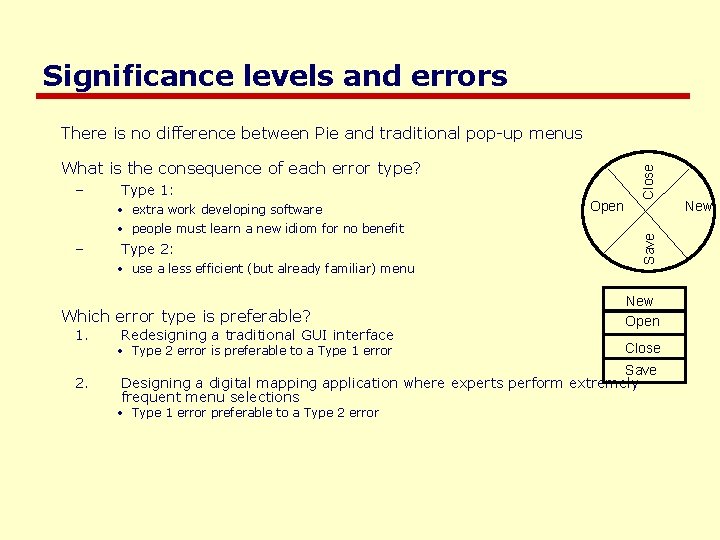
Significance levels and errors – Type 1: • extra work developing software • people must learn a new idiom for no benefit – Type 2: • use a less efficient (but already familiar) menu Which error type is preferable? 1. 2. Redesigning a traditional GUI interface • Type 2 error is preferable to a Type 1 error Open Save What is the consequence of each error type? Close There is no difference between Pie and traditional pop-up menus New Open Close Save Designing a digital mapping application where experts perform extremely frequent menu selections • Type 1 error preferable to a Type 2 error New
Scales of Measurements Four major scales of measurements – Nominal – Ordinal – Interval – Ratio
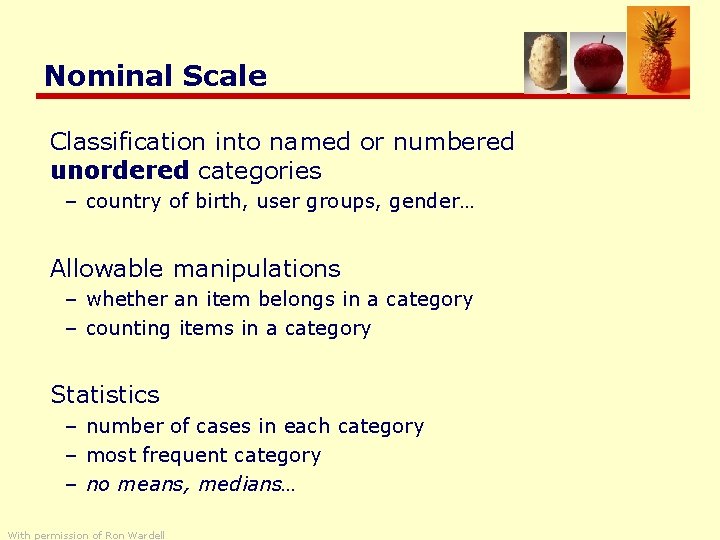
Nominal Scale Classification into named or numbered unordered categories – country of birth, user groups, gender… Allowable manipulations – whether an item belongs in a category – counting items in a category Statistics – number of cases in each category – most frequent category – no means, medians… With permission of Ron Wardell
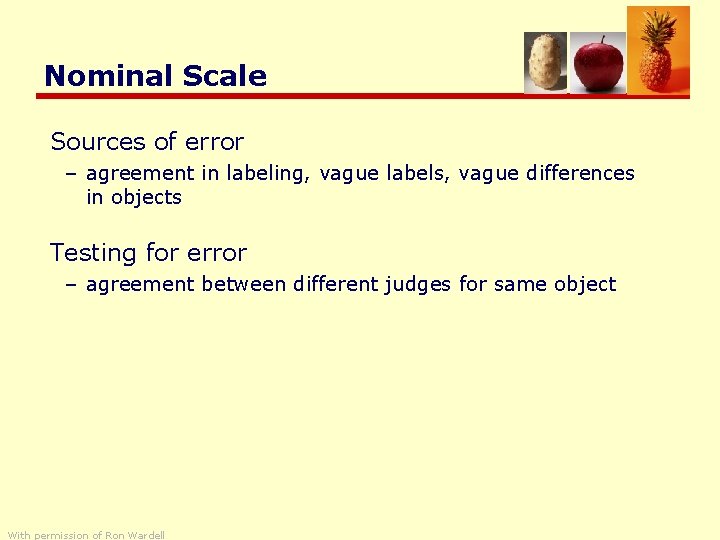
Nominal Scale Sources of error – agreement in labeling, vague labels, vague differences in objects Testing for error – agreement between different judges for same object With permission of Ron Wardell
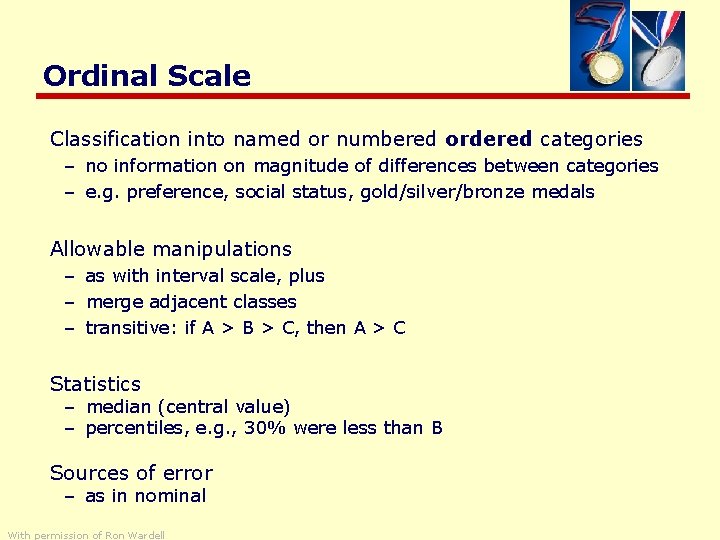
Ordinal Scale Classification into named or numbered ordered categories – no information on magnitude of differences between categories – e. g. preference, social status, gold/silver/bronze medals Allowable manipulations – as with interval scale, plus – merge adjacent classes – transitive: if A > B > C, then A > C Statistics – median (central value) – percentiles, e. g. , 30% were less than B Sources of error – as in nominal With permission of Ron Wardell
Interval Scale Classification into ordered categories with equal differences between categories – zero only by convention – e. g. temperature (C or F), time of day Allowable manipulations – add, subtract – cannot multiply as this needs an absolute zero Statistics – mean, standard deviation, range, variance Sources of error – instrument calibration, reproducibility and readability – human error, skill… With permission of Ron Wardell
Ratio Scale Interval scale with absolute, non-arbitrary zero – e. g. temperature (K), length, weight, time periods Allowable manipulations – multiply, divide With permission of Ron Wardell
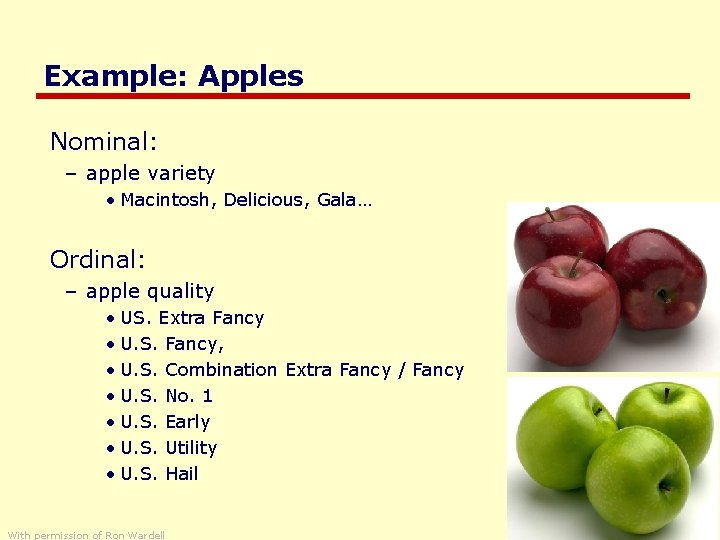
Example: Apples Nominal: – apple variety • Macintosh, Delicious, Gala… Ordinal: – apple quality • US. Extra Fancy • U. S. Fancy, • U. S. Combination Extra Fancy / Fancy • U. S. No. 1 • U. S. Early • U. S. Utility • U. S. Hail With permission of Ron Wardell
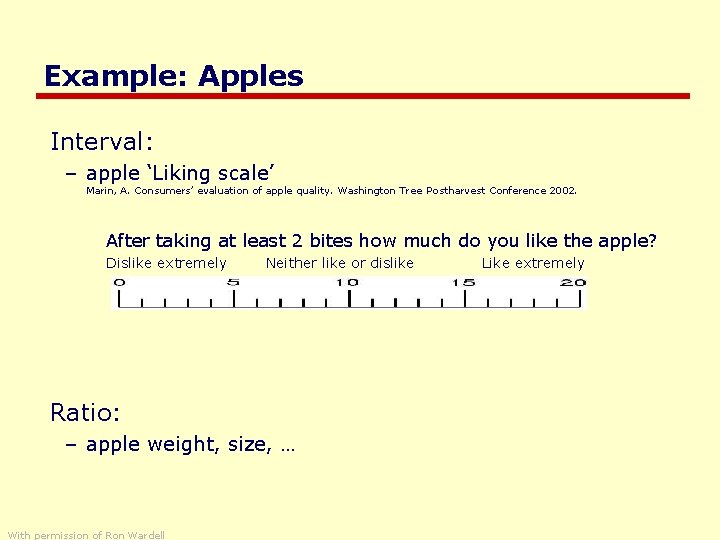
Example: Apples Interval: – apple ‘Liking scale’ Marin, A. Consumers’ evaluation of apple quality. Washington Tree Postharvest Conference 2002. After taking at least 2 bites how much do you like the apple? Dislike extremely Neither like or dislike Ratio: – apple weight, size, … With permission of Ron Wardell Like extremely
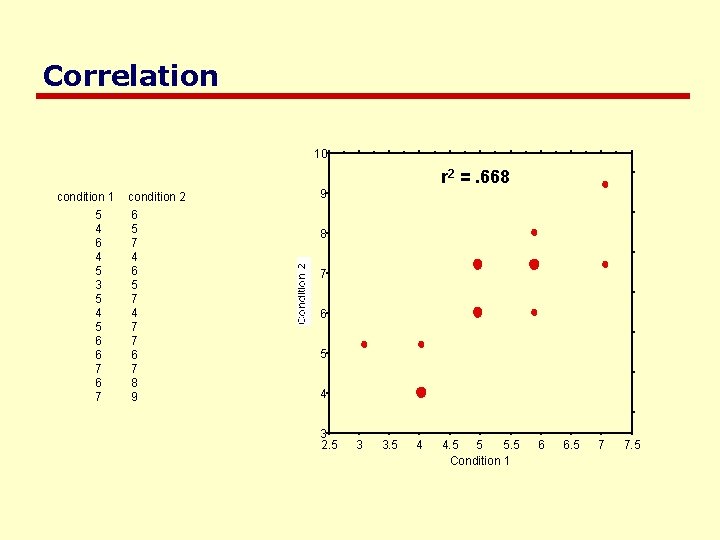
Correlation Measures the extent to which two concepts are related – eg years of university training vs computer ownership per capita How? – obtain the two sets of measurements – calculate correlation coefficient • +1: positively correlated • 0: no correlation (no relation) • – 1: negatively correlated
Correlation 10 condition 1 5 4 6 4 5 3 5 4 5 6 6 7 condition 2 6 5 7 4 7 7 6 7 8 9 r 2 =. 668 9 8 7 6 5 4 3 2. 5 3 3. 5 4 4. 5 5 5. 5 Condition 1 6 6. 5 7 7. 5
Correlation Dangers – attributing causality • a correlation does not imply cause and effect • cause may be due to a third “hidden” variable related to both other variables – drawing strong conclusion from small numbers • unreliable with small groups • be wary of accepting anything more than the direction of correlation unless you have at least 40 subjects
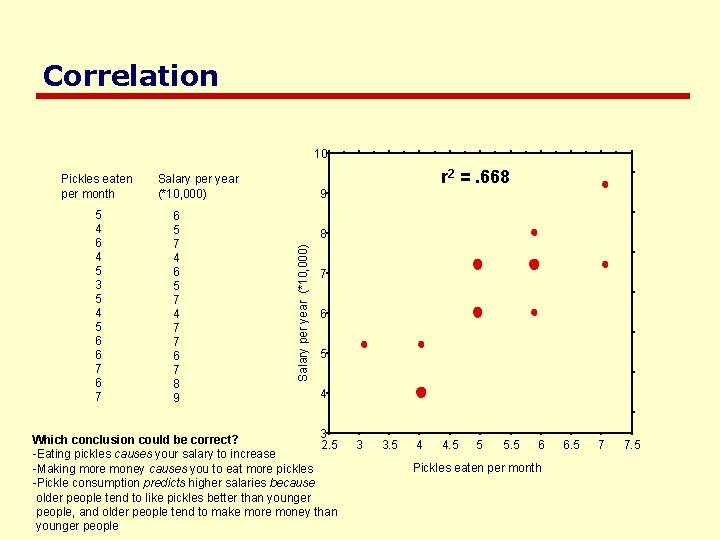
Correlation 10 5 4 6 4 5 3 5 4 5 6 6 7 Salary per year (*10, 000) 6 5 7 4 7 7 6 7 8 9 r 2 =. 668 9 8 Salary per year (*10, 000) Pickles eaten per month 7 6 5 4 3 Which conclusion could be correct? 2. 5 -Eating pickles causes your salary to increase -Making more money causes you to eat more pickles -Pickle consumption predicts higher salaries because older people tend to like pickles better than younger people, and older people tend to make more money than younger people 3 3. 5 4 4. 5 5 5. 5 6 Pickles eaten per month 6. 5 7 7. 5
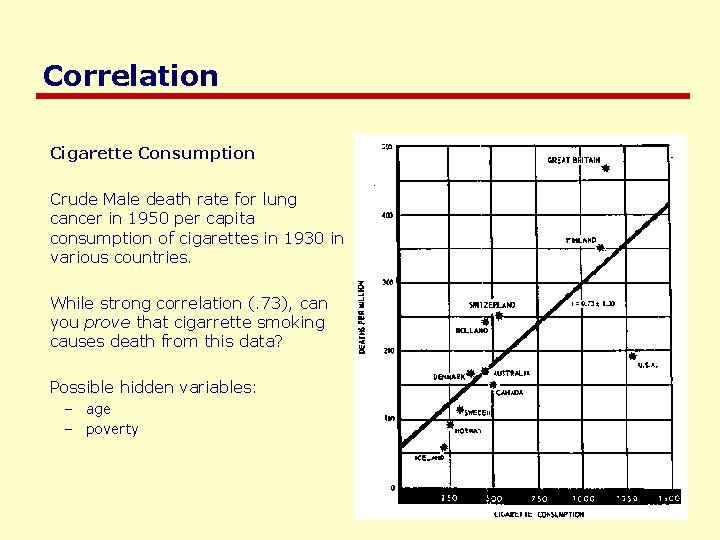
Correlation Cigarette Consumption Crude Male death rate for lung cancer in 1950 per capita consumption of cigarettes in 1930 in various countries. While strong correlation (. 73), can you prove that cigarrette smoking causes death from this data? Possible hidden variables: – age – poverty
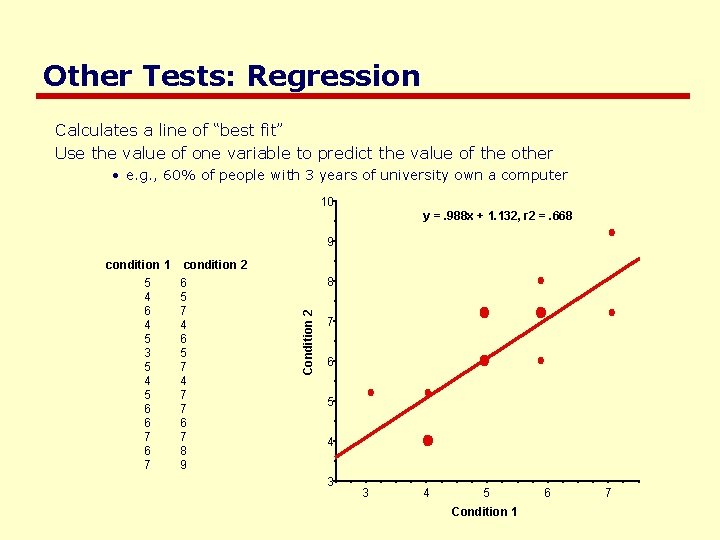
Other Tests: Regression Calculates a line of “best fit” Use the value of one variable to predict the value of the other • e. g. , 60% of people with 3 years of university own a computer 10 y =. 988 x + 1. 132, r 2 =. 668 9 condition 2 6 5 7 4 7 7 6 7 8 9 8 Condition 2 condition 1 5 4 6 4 5 3 5 4 5 6 6 7 7 6 5 4 3 3 4 5 Condition 1 6 7
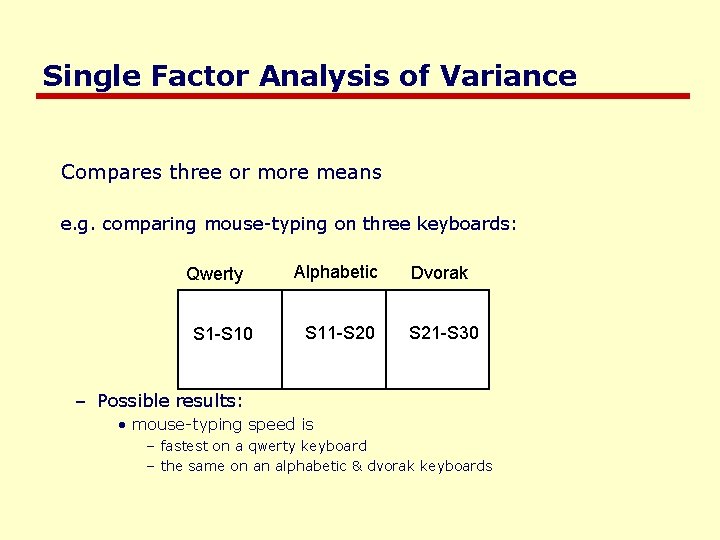
Single Factor Analysis of Variance Compares three or more means e. g. comparing mouse-typing on three keyboards: Qwerty S 1 -S 10 Alphabetic Dvorak S 11 -S 20 S 21 -S 30 – Possible results: • mouse-typing speed is – fastest on a qwerty keyboard – the same on an alphabetic & dvorak keyboards
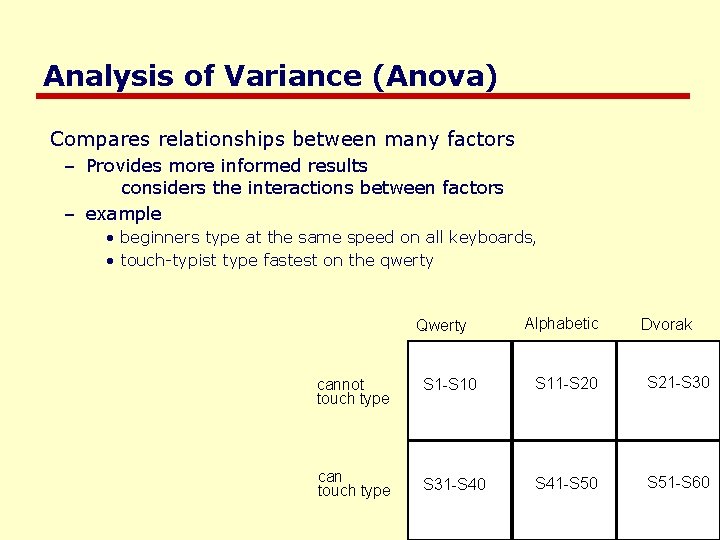
Analysis of Variance (Anova) Compares relationships between many factors – Provides more informed results considers the interactions between factors – example • beginners type at the same speed on all keyboards, • touch-typist type fastest on the qwerty Qwerty Alphabetic Dvorak cannot touch type S 1 -S 10 S 11 -S 20 S 21 -S 30 can touch type S 31 -S 40 S 41 -S 50 S 51 -S 60
You know Controlled experiments can provide clear convincing result on specific issues Creating testable hypotheses are critical to good experimental design Experimental design requires a great deal of planning
You know Statistics inform us about – mathematical attributes about our data sets – how data sets relate to each other – the probability that our claims are correct There are many statistical methods that can be applied to different experimental designs – – T-tests Correlation and regression Single factor Anova