
Evaluation Caitlin Pearson AS In what way does
- Slides: 5
Evaluation Caitlin Pearson AS
In what way does your media product use, develop, or challenge the forms conventions of real media products?
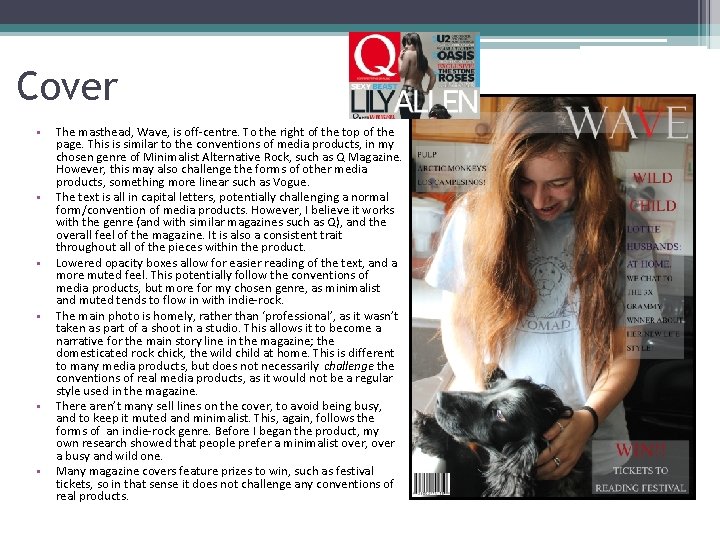
Cover • • • The masthead, Wave, is off-centre. To the right of the top of the page. This is similar to the conventions of media products, in my chosen genre of Minimalist Alternative Rock, such as Q Magazine. However, this may also challenge the forms of other media products, something more linear such as Vogue. The text is all in capital letters, potentially challenging a normal form/convention of media products. However, I believe it works with the genre (and with similar magazines such as Q), and the overall feel of the magazine. It is also a consistent trait throughout all of the pieces within the product. Lowered opacity boxes allow for easier reading of the text, and a more muted feel. This potentially follow the conventions of media products, but more for my chosen genre, as minimalist and muted tends to flow in with indie-rock. The main photo is homely, rather than ‘professional’, as it wasn’t taken as part of a shoot in a studio. This allows it to become a narrative for the main story line in the magazine; the domesticated rock chick, the wild child at home. This is different to many media products, but does not necessarily challenge the conventions of real media products, as it would not be a regular style used in the magazine. There aren’t many sell lines on the cover, to avoid being busy, and to keep it muted and minimalist. This, again, follows the forms of an indie-rock genre. Before I began the product, my own research showed that people prefer a minimalist over, over a busy and wild one. Many magazine covers feature prizes to win, such as festival tickets, so in that sense it does not challenge any conventions of real products.
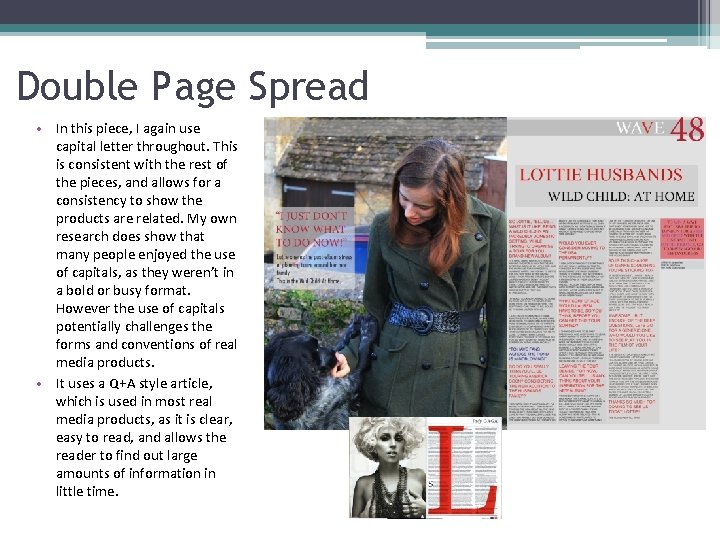
Double Page Spread • In this piece, I again use capital letter throughout. This is consistent with the rest of the pieces, and allows for a consistency to show the products are related. My own research does show that many people enjoyed the use of capitals, as they weren’t in a bold or busy format. However the use of capitals potentially challenges the forms and conventions of real media products. • It uses a Q+A style article, which is used in most real media products, as it is clear, easy to read, and allows the reader to find out large amounts of information in little time.
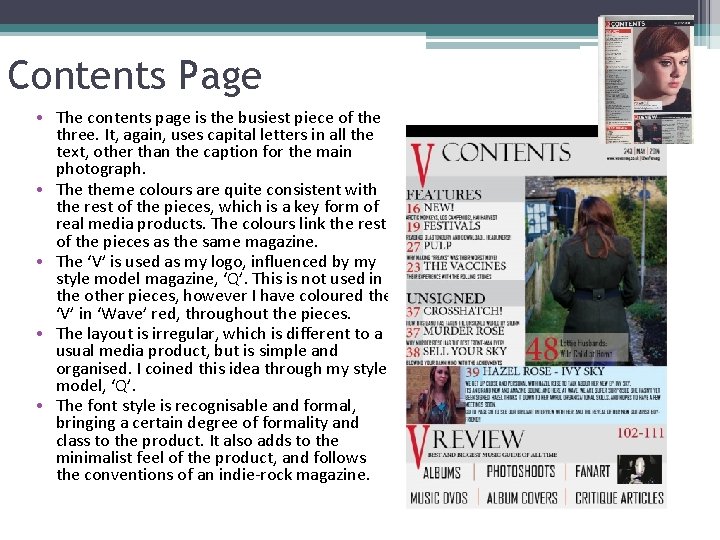
Contents Page • The contents page is the busiest piece of the three. It, again, uses capital letters in all the text, other than the caption for the main photograph. • The theme colours are quite consistent with the rest of the pieces, which is a key form of real media products. The colours link the rest of the pieces as the same magazine. • The ‘V’ is used as my logo, influenced by my style model magazine, ‘Q’. This is not used in the other pieces, however I have coloured the ‘V’ in ‘Wave’ red, throughout the pieces. • The layout is irregular, which is different to a usual media product, but is simple and organised. I coined this idea through my style model, ‘Q’. • The font style is recognisable and formal, bringing a certain degree of formality and class to the product. It also adds to the minimalist feel of the product, and follows the conventions of an indie-rock magazine.